Yeah, I pretty much dislike Memorial Day. Don’t get me wrong; the idea of honoring the men and women who died while serving the nation — that I respect. But that’s not really what Memorial Day is anymore. Now it’s mostly a day to say something nice about veterans, maybe see a parade, go shopping, then eat a hamburger. And you can usually skip right to the hamburger.
The thing is, a lot of folks don’t even understand Memorial Day. They get it confused with Veterans Day, which is a different beast altogether. The confusion is understandable, on account of they’re both about people in uniforms and big big big shopping discounts and picnics with hamburgers.

Allow me to ‘splain the differences. Memorial Day is the one where you say nice things about folks that actually died while in uniform. Veterans Day is the one where you offer ritual thanks for everybody who put on military harness — dead, living, somewhere in between (and if you think that’s just a figure of speech, go visit a VA hospital).
I like Veterans Day. That’s what we call it in the U.S., although most Western nations call it Armistice Day or Remembrance Day. I like it because it still retains some meaning. It’s still celebrated on the same day — the anniversary of the end of the First World War. The 11th day of the 11th month.
Memorial Day used to have meaning. It began as Decoration Day — a day when folks would decorate the graves of soldiers who died during the American Civil War. It was an organic holiday. It began spontaneously, on different days, in different years, in different parts of the nation. Folks just went to cemeteries where Civil War troops were buried and decorated the graves. You know, out of respect.
One of the earliest Decoration Day events took place in Charleston, South Carolina. Union prisoners of war had been interned at the Washington Race Course and Jockey Club. More than 250 of them died and were buried in a mass grave behind the grandstand. In April of 1865, a small group of freed slaves reburied the bodies in individual graves. They constructed a fence around the burial site, and put up an arched entryway with the inscription Martyrs of the Race Course. Then on the first day of May, some ten thousand former slaves and some white missionaries decorated the cemetery with flowers, and they held a picnic on the site.
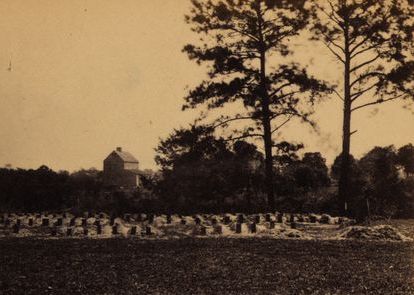
New graves of Union soldiers at the Washington Race Course
Now that is a serious show of respect. Over time, Decoration Day became Memorial Day and through some sort of osmotic agreement, it was celebrated throughout the nation on May 30th. At least it was until 1968, when everything changed. But I’ll come back to that in a bit. First let’s reduce this national holiday to the personal level.
In April of that same year, 1968, a young photographer named Art Greenspon shot this photograph in the jungle southwest of Hue. Alpha Company of the 101st Airborne had walked into an ambush. Several killed, more wounded. Bad weather prevented any medevac until the following day. So the troops sat awake all night, in the rain, with their wounded and dead, wondering if they’d get hit again. The next day, when the rain lifted enough for a medevac, Greenspon got this shot of a soldier directing the chopper. By that point it had rained so long and hard that when Greenspon tried to rewind the film in his camera, it stuck to the pressure plate.
Here’s some military esoterica for you: the first choppers take the wounded; the last choppers take the bodies. The bodies can wait; they’re not going to get any more dead. Greenspon flew out on a chopper filled with body bags. When he got back to his base, he discovered most of the shots weren’t usable. This one was.
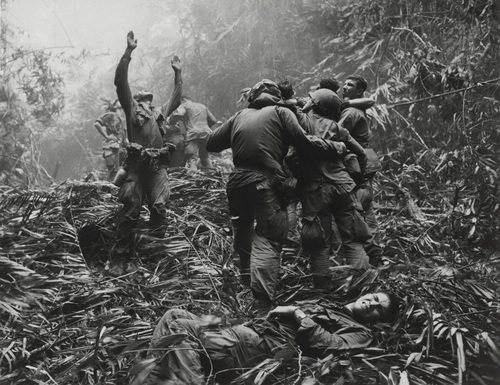
Art Greenspon was paid US$15 for that photograph. That’s all he’s ever been paid for it. A week later he and another photographer, Charles Eggleston, found themselves in a firefight outside of Saigon. Eggleston was hit by rifle fire and killed. One of the bullets passed through Eggleston’s hand, which slowed the round enough that when it hit Greenspon in the face, it didn’t kill him. Instead, the bullet lodged in his sinus cavity. In order to remove the bullet and minimize the facial scarring, the surgeons broke his cheekbone from inside his mouth.
Two months after that, during the darkest days of the war in Vietnam, Congress passed the Uniform Monday Holiday Act. The intent of the act was to change the date on which four holidays were traditionally celebrated in order to create three-day weekends. Great news for workers and a boon to commercial enterprises. The effect, however, was to trivialize those holidays. Now Presidents Day, Columbus Day, Labor Day, and Memorial Day are all about mattress sales and potato salad. We’re not really thinking about the men and women dying in jungles or deserts; we’re thinking about buying summer clothes.

Oh, we’ll still say nice things about the men and women who died in uniform. We’ll still have parades (that very few people attend), and politicians will still give speeches (that very few people will listen to), but mostly we’re just glad to have that extra day on the weekend, and a chance to save a buck on a mattress, and hey, it’s a good time of year for a picnic.
But Memorial Day isn’t — or shouldn’t be — about picnics. It’s about the people Art Greenspon flew with in that chopper; it’s about those bodies in the bags.
So yeah, I pretty much dislike Memorial Day. I don’t want to see the parade. I don’t want to buy a pair of cheap-ass flip-flops. I don’t want to hear any fucking politician thanking the troops for their sacrifice.
I want politicians to stop sacrificing them.
ADDENDUM: Last year on Memorial Day I wrote about my accidental visit to the local cemetery in the small town of Maxwell, Iowa. This year, while running around, I made an intentional detour to Maxwell. It looks exactly the same as it did last year (and probably for the last umpty-ump years) — flags lining the tiny town center, and all over the cemetery.
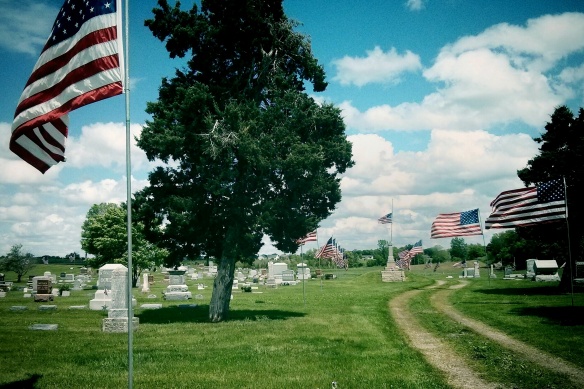
Maxwell, IA. Memorial Day, 2015
It doesn’t make up for the apathy and commercialism, but there’s something innocent and fundamentally decent about the way these small towns continue to honor their dead.