thisness and whatness and something more

I find I’m less and less interested in photographing stuff. By stuff, I mean things. Objects. Including people. Back in the late 1980s, William Eggleston declared, “I am at war with the obvious.” I’m not at war with it; I’m just no longer interested in it.

When you photograph things…and it doesn’t really matter what that thing is… you’re basically saying THIS is important. This thing, this object, this building, this person, this whatever. It’s an acknowledgment that THIS very specific, individual thing is worth your attention. Almost all photography is about THIS. I’ve spent most of my life photographing THIS. Look at THIS. This is how I see THIS.

There’s a term for that–the ‘thisness’ of things. Haecceity. Yeah, it looks like I just chucked a bunch of vowels and consonants into a jar and shook them up, but it’s an actual word (by the way, it’s pronounced hek-SEE-ity; I know you’re wondering about that). It refers to the unique, irreducible, often undefinable properties and aspects of a thing that distinguishes it from all other similar things. It’s what makes each identical twin an individual. It’s what makes your dog special. It’s what makes that elm tree distinct from all other elm trees. It’s the dings and dents and scars of life that makes this different from all of that. It’s the thisness of a thing.

If you’re interested in learning more about the concept of haecceity, do a search on John Duns Scotus, the 13th century Franciscan friar who put it together. I considered adding some of that in his post, but decided I’d rather pound a nail through my foot. My specific individual foot.

Much (maybe most) photography is an attempt to capture the haecceity of a thing. Every photograph of, say, a flower is an attempt to reveal the beauty of that specific individual flower. Every photograph of a water tower or a puppy or a pickup truck or a pair of old boots is an attempt to say THIS puppy or THIS boot is unique and special and is worthy of my attention. And let’s face it, most of those attempts fail.

Instead of capturing the haecceity of the thing, we more often capture the quiddity of the thing. Yes, quiddity is also a real word. It refers to the qualities and properties a thing shares with others of its kind. That photograph of the puppy or the boot is more likely to reveal a sense of puppyness or bootness. It’s the whatness of the thing…the thing that makes it a puppy or a boot.

That’s not a criticism. Depicting the essence of puppyness or bootness can be captivating. People familiar with that specific puppy or that particular boot may recognize it as an individual, but a lot of folks will look at your photograph of a puppy or an old boot and think, “Yeah, now THAT is what I call a boot, right there.” Which is another way of saying they appreciate its bootness.

I began this by saying I’m less and less interested in photographing stuff. These days I’m less interested in the thisness or the whatness of things. I still shoot those photos, of course. It’s most of what I shoot. But for the last few years I find myself trying to photograph something less tangible, and I’m not even sure I know how to describe it. I want to photograph…I don’t know, moods? States of mind? An ambiance maybe. A feeling.

I want to shoot photos that can express a sense of what it’s like to be there.

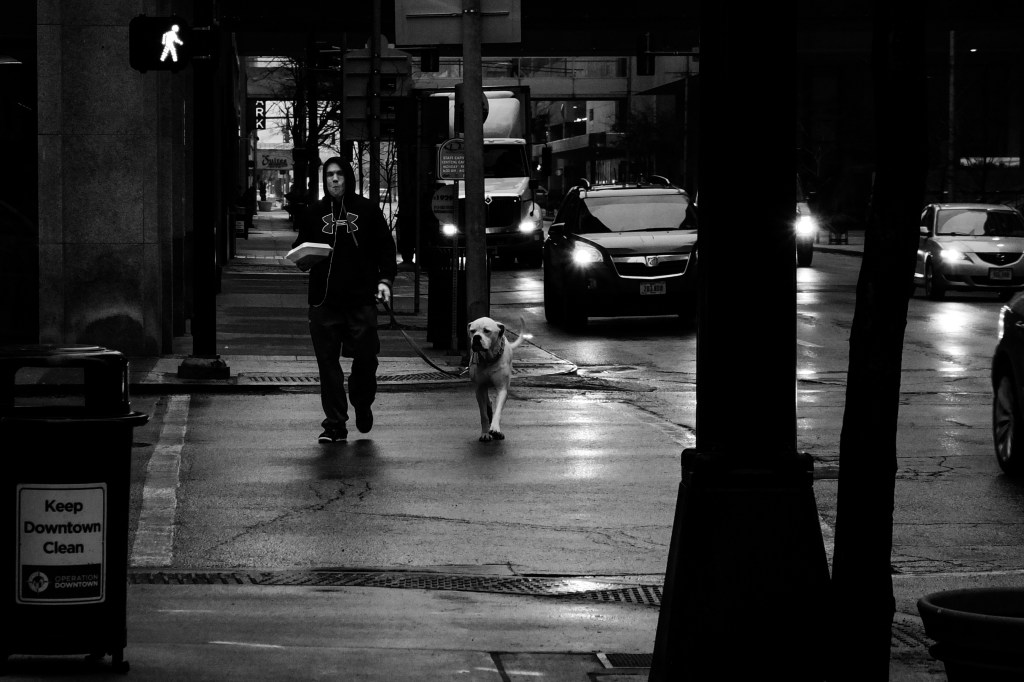
Yesterday on Bluesky I posted this photograph. It’s not about the haecceity of the dog (who was a wonderfully irreducible and highly individual dog named Luka) or his quiddity (although there was a lot of dogness going on with Luka) or the guy or the street or the city. It’s not about any THING.

I want it to be about being up early on a wet, chilly morning, bringing take-home breakfast back to your apartment while gainfully employed people pass by, isolated in their cars, trying to get to work on time. I want it to be about the dampness of the air and the noise and smell of traffic and the softer sound of a dog’s feet on cement. I want it to be about two beings who care for each other and are comfortable in their companionship, even though they’re of different species.

I want it to be about all of those things. But that’s a lot to cram into a photograph, and I don’t feel like I succeeded. It’s not quite there–not quite what I want it to be–but I like to think I’m getting closer.

cinematic epistemology

It’s pretty clear that the main actors in the war against Iran are operating under a system of cinematic epistemology. I’m talking about Comrade President Trump, the Secretary of What Used to be the Department of Defense, Pete Hegseth, and the entirety of Comrade Trump’s Cabinet of Nazgûl.

Cinematic epistemology is a term coined by Julian Sanchez. Basically, epistemology is the study of how we know what we know–how we achieve an understanding of how the world works. Cinematic epistemology is an understanding of the world grounded in movies. It’s naive, of course. Love in real life doesn’t work out the way it does in a rom-com. Criminal investigations aren’t done they way they’re depicted in television cop shows. Wars aren’t fought and won they way they are in action films.

But that’s exactly how Trump and Hegseth viewed their assault on Iran. Send in the Air Force, bomb the absolute shit out of a bunch of targets, let Hegseth make a few movie speeches accompanied by manly hand gestures, let Trump threaten our enemies and mock our allies, intimidate the nation into submission. Surely, once our allies saw our overwhelming military might, they’d wish they’d been a part of the war. Surely, once Iran saw they were up against a vastly superior military force, they’d quickly give in. TrumpCo knew it would take longer than a movie screening, but in their minds the outcome was pretty much guaranteed. Punch Iran in the face, take the fight out of them, roll credits.

It didn’t help that it largely did work like that in Venezuela. That quick, limited, precise military operation only solidified their cinematic world view. Trump, on Fox News, even said, “I watched it literally like I was watching a television show. If you would’ve seen the speed, the violence…it was an amazing thing.” But Iran isn’t Venezuela. Everybody knew Iran would hit back. Well, everybody but the folks encouraging Trump to attack Iran.

Iran, predictably, did hit back. They hit everybody in the region who’d who’d cooperated with the US. Trump and his people were surprised. “They weren’t supposed to go after all these other countries in the Middle East,” Trump said. “Nobody expected that. We were shocked.” He went on to say, “Nobody, nobody, no, no, no. No, the greatest experts—nobody thought they were going to hit.”

The actual experts, of course, knew Iran would hit back. Actual experts assumed Iran would close the Strait of Hormuz. The actual experts understood the international scope of a shooting war involving Iran. The actual experts realized a war in Iran could/would lead to a global energy crisis that could/would result in fuel and food shortages in the US and possibly a global recession.

The problem with actual experts is that the Trump administration got rid of them.

TrumpCo, of course, doesn’t know what to do now. Hegseth apparently wants to keep bombing, hoping somehow that just a few more bombs will make all the difference. Trump is bored with the movie; it’s lasting too long and he’s not enjoying the plot; he’d like to just leave the theater. He’s bored with the movie and furious that he bought a ticket to begin with. He’s pissed and desperate and is flailing about wildly.

My biggest fear right now is that Trump, out of spite or because he has a child’s self-control, will decide to set fire to the theater.