I live in Iowa, a farm state, but I don’t know dick about farms. Or farming or farm life or farm culture or farm technology. Crops—I can distinguish corn from soybeans. Livestock? I’m sort of familiar with basic farm animals—I’m okay with generic pigs and cows, but I couldn’t tell you about different breeds. I can identify some farm equipment, like a combine, though I don’t really understand what it does. I’m basically ignorant about almost everything farm-related.
That said, I’m sort of intrigued by farming in a sociological way. Periodically, I’ll make my way out into the countryside or I’ll visit a small town to shoot some photographs and maybe try to get a sense of what life is like for rural folks. In keeping with that, last week I went on a brief tour sponsored by the Iowa Barn Foundation, which is dedicated to preserving old barns. I expected to learn something about the history of barn architecture.
I did not expect romance.
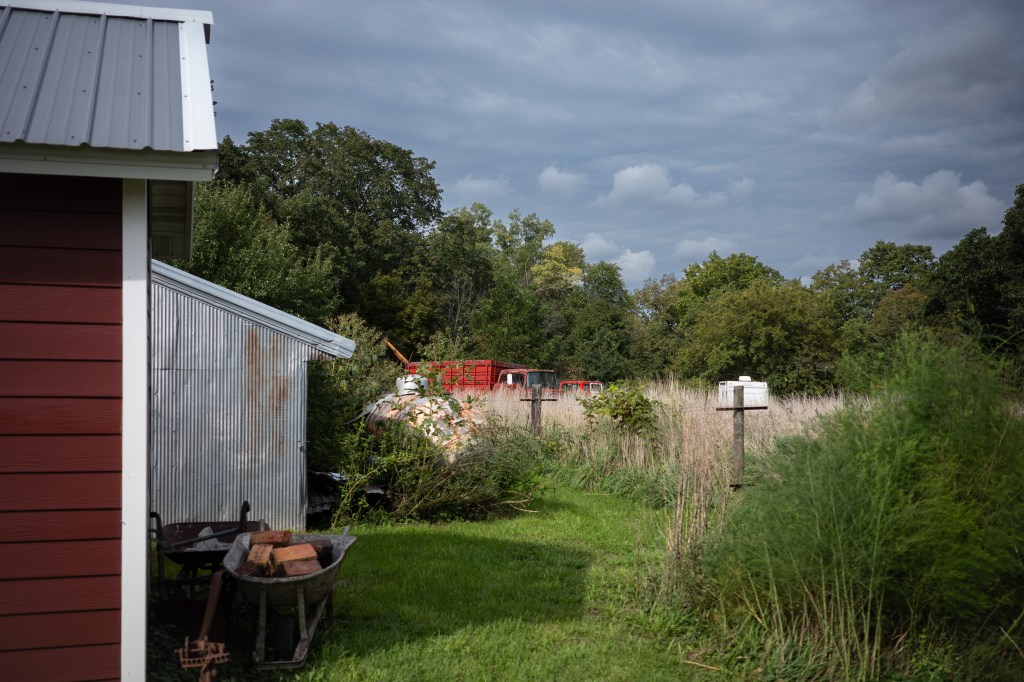
I’ll come back to the romance in a bit. First, the reason I wanted to take that tour and visit the Mitchell farm was to see their barn. Not the barn you see in the photograph below. Their other barn. The barn they bought in 2019, the barn a neighbor was about to demolish, the barn (built in 1915) they decided to jack up and move to their property. That’s right, the young couple you see in the photo bought a used barn for US$2000. Then they found some folks who’d put it on a massive trailer, and they had it hauled a couple of miles to their farm.
I was eager to see that barn. I figured any barn that could elicit that sort of response from folks must be one hell of a barn. But when we arrived at the Mitchell farm, I didn’t even notice the barn. In fact, I spent the entire morning on the farm and failed to shoot a single photograph of the exterior of that vagabond barn, that vaga-barn. Why? Because I was immediately distracted by…well, by everything else on the farm. Beginning with Matt and Libby Mitchell.
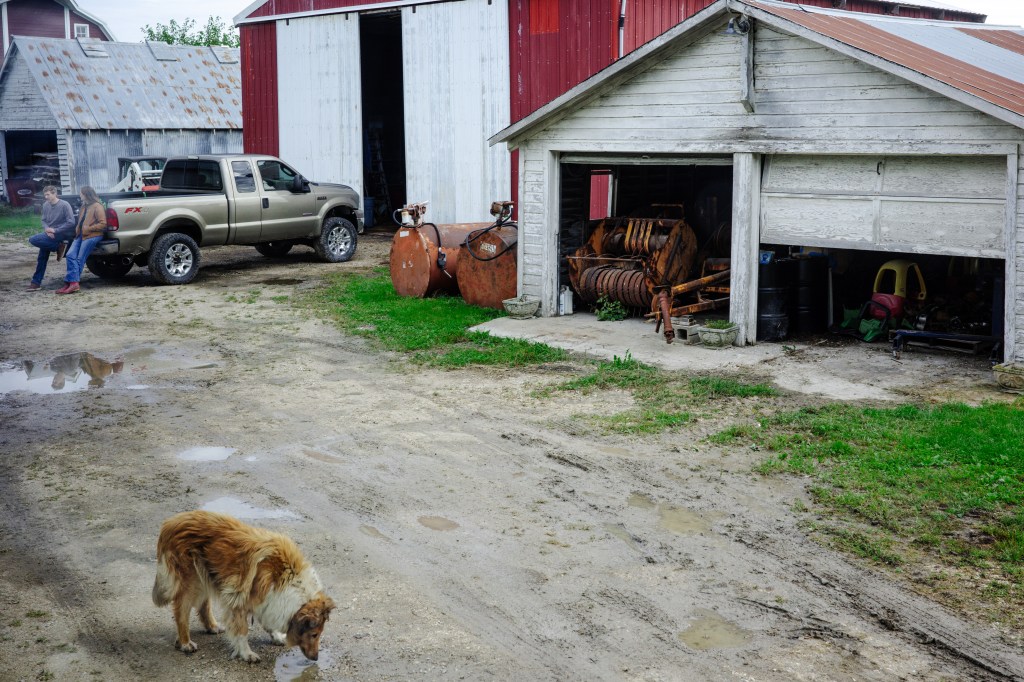
I noticed them even before I left the tour bus. They were sitting on the tailgate of a pickup, casually talking to each other. What struck me was how obviously comfortable they were with each other. Kicked back, patiently waiting for a bus to disgorge a small group of strangers who were there to nose around on their property. There was no sense of discomfort or unease or anxiety; there was, instead, a very palpable aura of quiet contentment. You could see that these two people liked and cared for each other, that they shared a casual, companionable intimacy. They were so obviously affectionate, so relaxed and comfortable, so contented. I wanted to photograph them…forget the barn.
Then, of course, there were all those tractors.
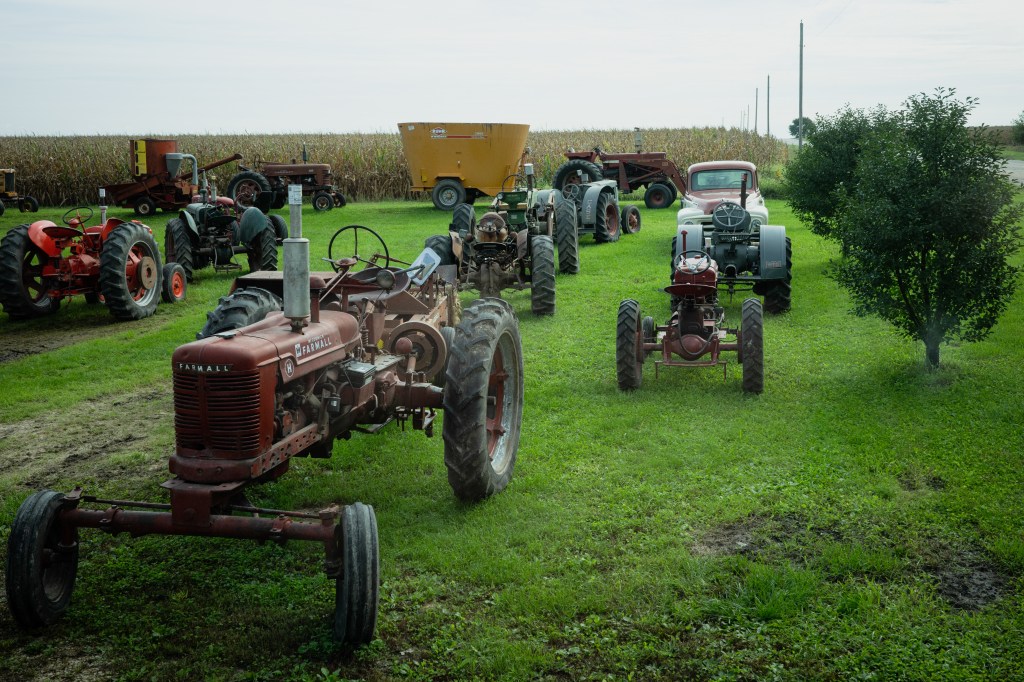
So many tractors. At one point I asked Matt how many he had. “Oh, about thirty-five or so.” Thirty-five or so. Like the actual number didn’t matter. What makes this even more weird is that the man doesn’t seem like a collector. At least not in the traditional sense. Not like people who collect coins or thimbles or comics. He doesn’t seem to be deliberately putting together a collection, he’s not out tractor-hunting. He just hears about old tractors nobody wants…and brings them home.
Those tractors? They’re all operational. They work. He hasn’t restored them; he apparently doesn’t care that they look like old tractors. He just wants them to work. To be working tractors. I don’t know, maybe he wants them to fulfill their tractor destiny or something, and tractors are supposed to work. That’s the purpose of their existence.
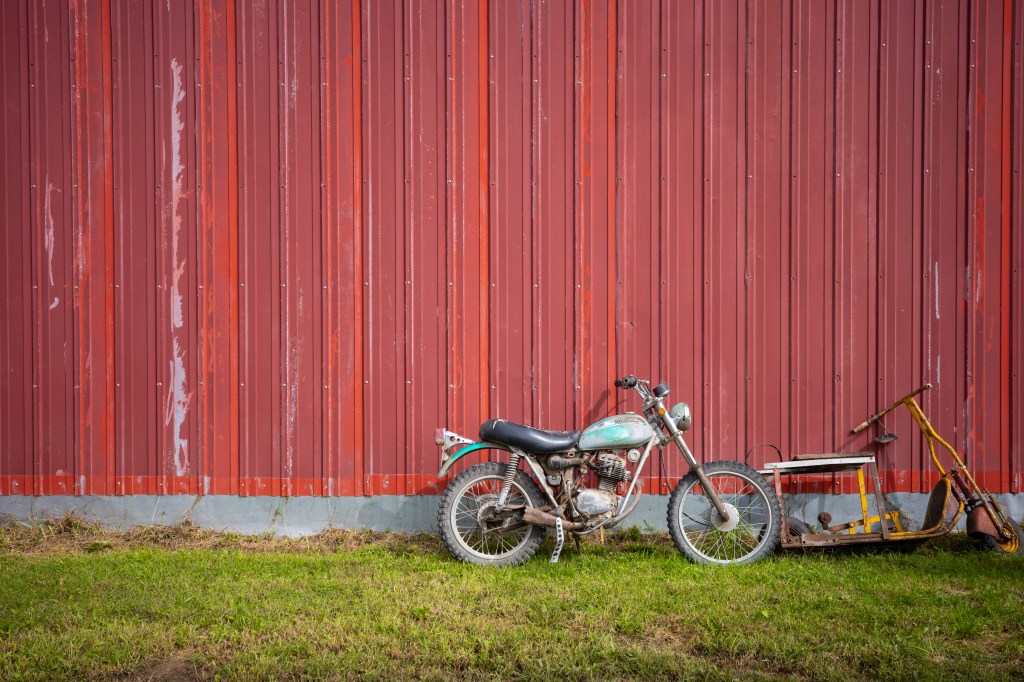
It was the same with almost everything on the farm. Matt Mitchell is something of an agri-tech otaku. He has a deep, obsessive passion for old farm equipment. He finds it, buys it, or barters for it, or just agrees to take it off somebody’s hands so they can get rid of it. Then he brings it home, gets it in working order, and…and that’s it. Then he’s happy.
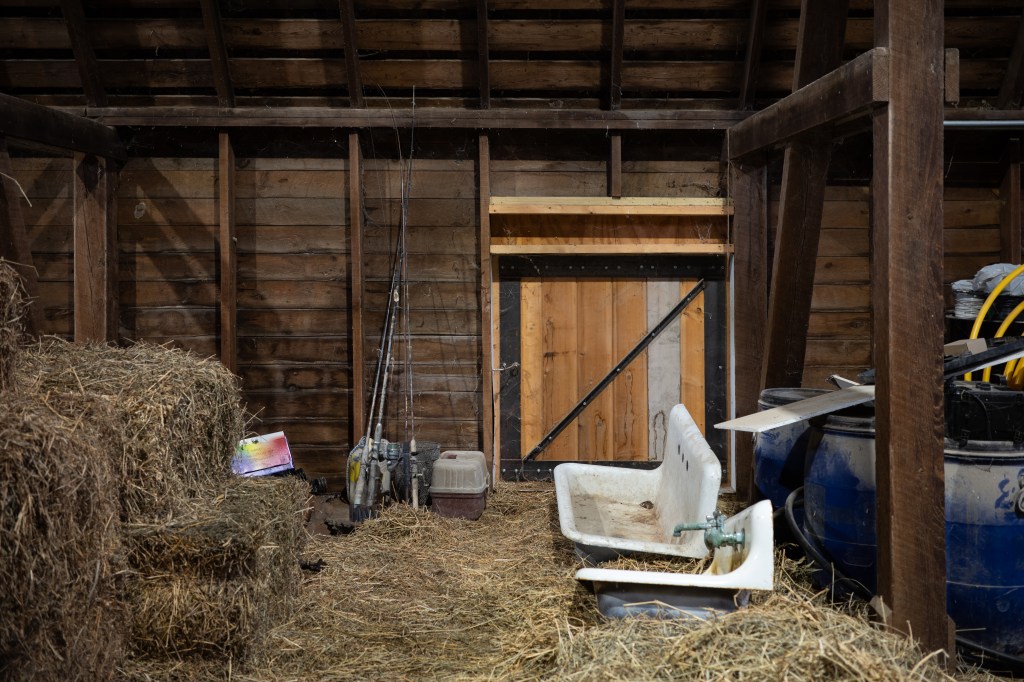
Scattered throughout the farm are projects—some finished, some in progress, some only a vague promise in the future. It’s a working farm, of course, so there’s a haymow in the vaga-barn’s hayloft (a brief tangent; I learned that a haymow is a pile of hay, loose or baled, stored in a hayloft). The vaga-barn is also a place to store future projects. An old Suzuki motorcycle, a pair of ceramic farm sinks, a rocking chair, an old desk—all of it dusty and distressed but potentially functional.
Potentially functional, that seems to be the key. Functional and practical. Not necessarily practical in the present day, but practical for its time. For example, the vaga-barn has an operational Louden Hay Carrier. “What in the hell is a Louden Hay Carrier?” you ask. It was a revolutionary pulley and track system developed by William Louden in 1867. It allowed farmers to easily transfer hay (either loose or in bales) into a hayloft, which made it possible to build bigger barns with larger lofts to store more hay. Here’s a video showing how it worked:
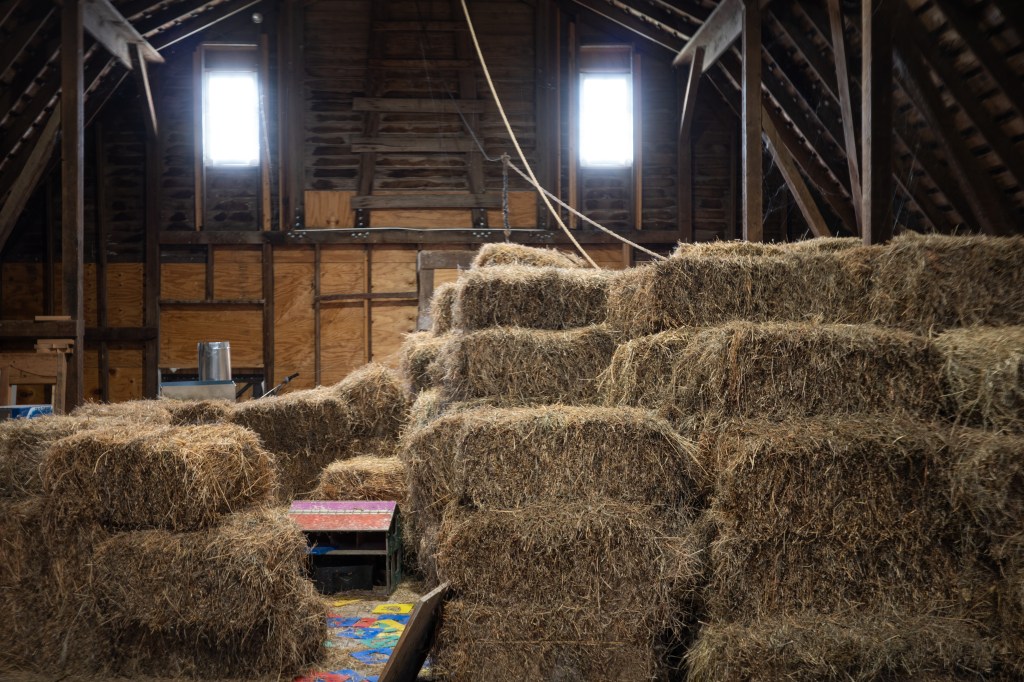
Unfortunately, I didn’t learn about the Louden Hay Carrier until after I’d spent time in the loft, so my photographs don’t show the tracking system. But in the photo below you can see the loft’s drop door and the ropes that accompany the system.
Following Matt and Libby Mitchell around their farm, listening to them talk about the things they’ve acquired, the projects they’ve completed (or started), I came to understand their interest isn’t grounded in nostalgia. Nostalgia is a sentimental longing for a golden past that’s very likely imaginary. This isn’t about a desire to capture the past.
This is romance. Not the sort of soppy, sentimental romance we see in movies (and, okay, I confess to enjoying rom-coms, but this isn’t that). This is romance in an older sense. I’m talking about an active, emotional connection with, and affection for, old technology. It’s passionate, to be sure, but not the burning, all-consuming sort of passion that torches everything and eventually extinguishes itself. This is a quiet, relaxed, enduring sort of passion. It escapes the boundaries of logic and convention, yes, but it never strays very far from reality. This is romance grounded in the appreciation of the beauty, purity, and out-dated practicality of agri-tech that can still work.
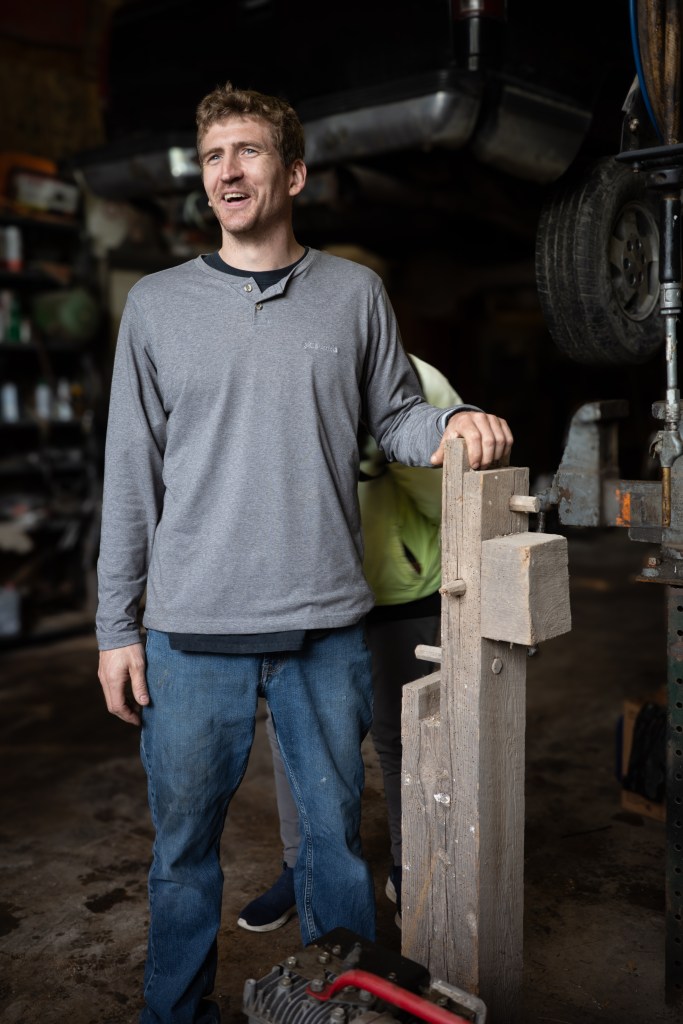
The Mitchells don’t need a thing to be shiny or pretty; it just has to have a history, it has to have had a life, it has to have mattered once to somebody, and it needs to have the potential to perform its function. If that potential is there, the Mitchells would like to see it fulfilled.
That’s romance, right there.


Damn I miss you!JSent from my iPhoneOn Sep 28, 2026,
LikeLiked by 1 person
Aw, Jody, I miss you too.
LikeLike
I’m like you when it come to farm and farming, having lived in the farmlands of Upper Monmouth County NJ (see a recent post of mine). The Mitchells’ farm look like the one that was just up the road from me, where I could take my kids to see the big pig named Hambone, to buy local veggies, and to marvel all all the cool looking farming accoutrements scattered around the land. Not shiny or pretty. Stuff with history. Stuff that had a life and mattered once to somebody (hey, that kinda describes me, too!)
LikeLiked by 1 person
I sometimes have roots envy. I’ve banged around the US for so many years, never acquiring very much because I knew I’d be moving on eventually. I learned not to get attached to stuff, because I’d probably have to leave it behind. So when I see folks who’ve got deep roots in a place, who’ve committed to those roots, who have a solid sense of belonging to a place–I sometimes wish I’d stuck around one place long enough to know what that feels like.
LikeLike
This is a really nice post Greg. And it’s encouraging that the Mitchells appear to be fairly young. At a time when many people their age are engaged in some soul sucking rat race somewhere, this gives me hope.
LikeLiked by 1 person
I was–still am–so impressed by their sense of belonging, by their commitment to the land and their community.
LikeLiked by 1 person