What do you do on a bright sunny October day when you don’t want to do the stuff you really ought to be doing? You decide to drive 30 miles into the countryside to photograph an abandoned (and reportedly haunted) 1860s Italianate house for Wikipedia.
Well, that’s what I decided to do anyway. But some days just don’t turn out the way you expect them to.
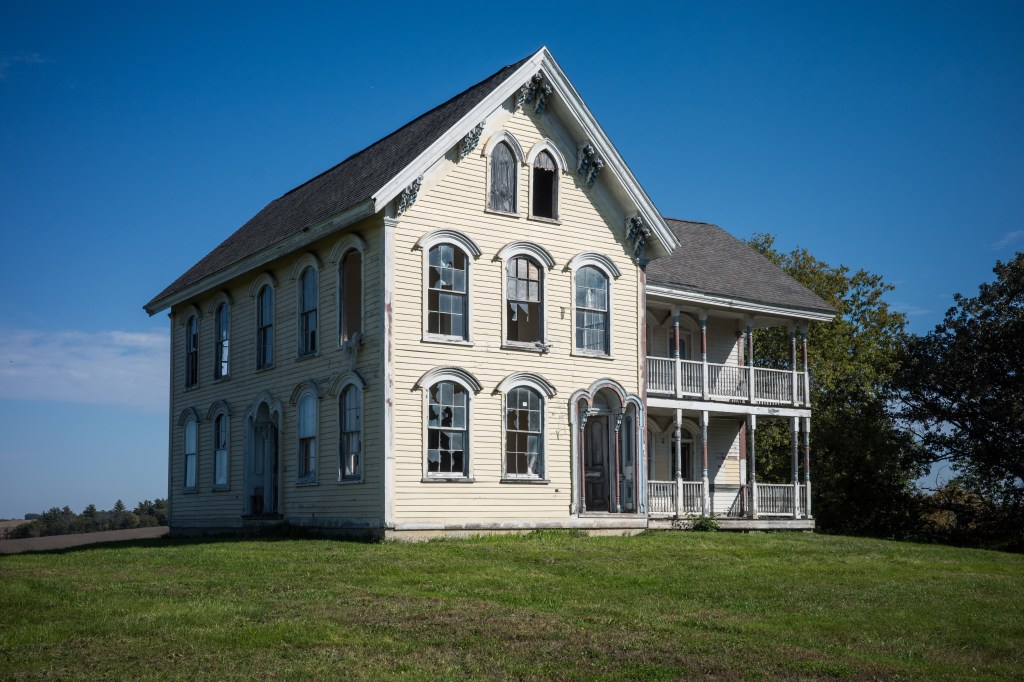
The house is listed on the National Register of Historic Places and has a Wikipedia page. Officially it’s called the J.G. and Regina Long house, but historically it was known as the Maple Grove Hill farm. Why? Because the house was set on a hill and Joseph Grayson (J.G.) Long planted a grove of maple trees which, in the mid 19th century, weren’t common in Iowa.
Three things on the Wikipedia page caught my attention. First:
According to local tradition, it was a stop on the Underground Railroad and features an underground tunnel connecting the house to a barn.
How cool is that? Very cool, is how cool. Who wouldn’t want to see a house with an underground tunnel (okay, ‘underground tunnel’ seems kind of redundant) to help escaped slaves? And then there was this:
a radio station in Iowa, has reported the house to be haunted by evil spirits due to its history.
Really, a house with a secret tunnel would have been enough. A house with a tunnel that was part of the Underground Railroad would have been enough. Dayenu, right? But on top of that we’ve got some evil spirits. It’s almost too much. According to the documentation to have the house listed on the National Registry,
A female wraith, projecting an image of haunting, albeit benign, sorrow, has appeared over the years to individuals in different rooms. The present owner, who has experienced the phenomenon, believes the figure to be Regina Hiskey Long, second wife of J. G. Long, because of its resemblance to a photograph of her.
So okay, maybe the spirits aren’t all that evil. Maybe Wikipedia got that part wrong. But even benign spirits are cool, right? And the third thing that caught my attention? There was no photograph of the house. We’re talking about a house that was part of an informal secret network to help slaves escape their bondage, a house haunted by a wraith (who may or may not have been evil, who knows?), and there was no photograph of it on the Wikipedia page? How was that possible? A house like that? It deserves a photo. The situation needed to be rectified. And I decided I was just the guy to do the rectifying.
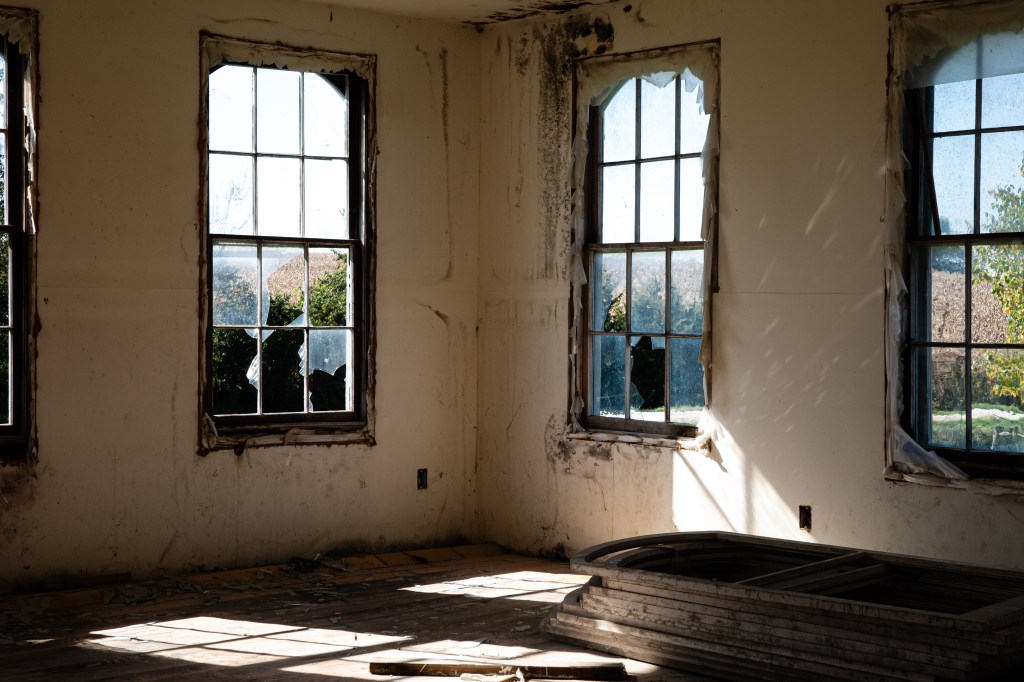
So there’s me yesterday, camera in hand, ready to do right by Wikipedia…and what did I find? No maple trees. No underground tunnel leading to a barn. No barn, in fact. And absolutely no ghosts. Not even the slightest tingling feeling of ghostitude. I can’t say I felt cheated, because the house was still exceedingly cool (for an abandoned farmhouse), but it wasn’t quite what I expected.
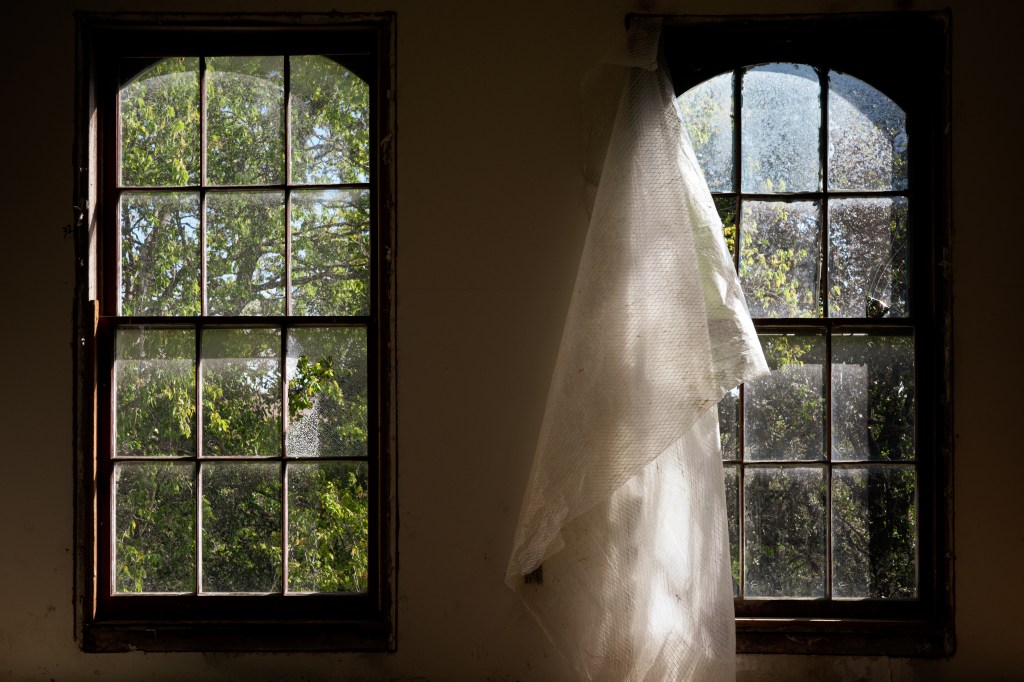
There was a very good reason for that. It turns out the house has been moved. Back in 2012 the property was sold and the new owner apparently decided he didn’t want to own a historic haunted house. So another person bought it and had it shifted a couple of miles to this new location. The tunnel, the barn, the maple trees, and the ghost were left behind.
But here’s the thing: houses aren’t just buildings; rooms aren’t just areas enclosed by a ceiling, floor and walls. Inhabited spaces can be metaphors for the people who inhabit them. A lived-in room can inform you; it can answer questions. Who lived here? Who worked here? What were their lives like? How did their lives shape this structure, these rooms?
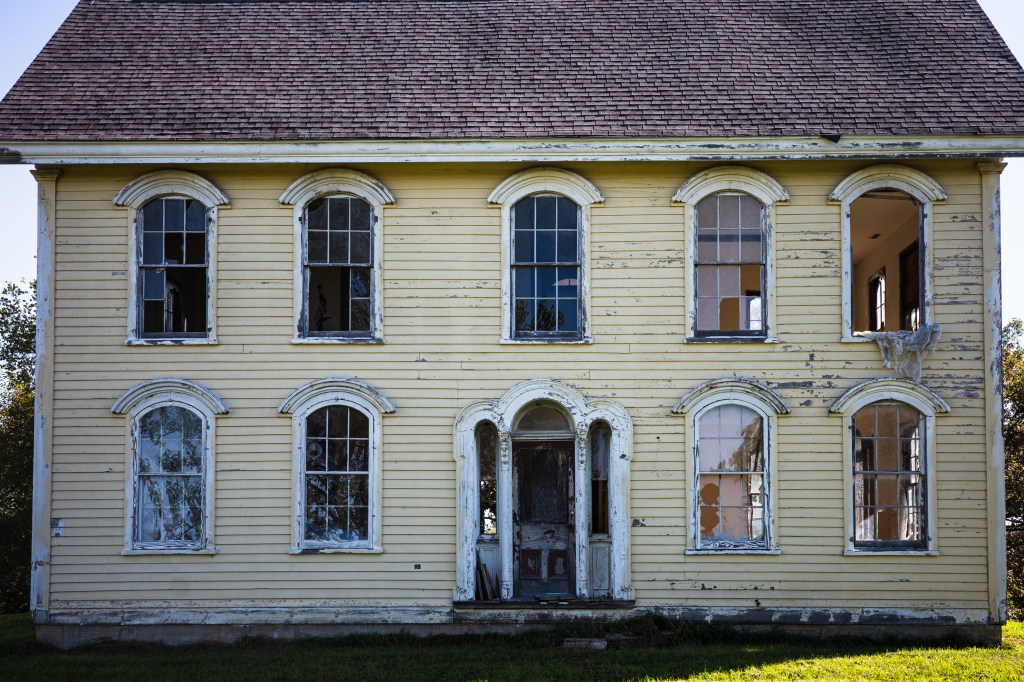
The J.G. and Regina Long house, even though it’s been moved and inhabited by many other people, can start to answer a lot of questions about who J.G. and Regina were. And the first question is this: how did they come to build a farmhouse in an Italianate style with Gothic arched windows in rural Iowa in the 1860s?
The U.S. Civil War had ended; ‘civilization’ was moving westward, driven by railroad expansion. The arrival of the Chicago & Rock Island railroad in Monroe, Iowa made it feasible for goods to be shipped from the east coast. Italianate style private homes had become popular on the east coast in the 1840s, largely because the development of cast-iron and press-metal technology made the production of decorative elements more affordable. Without the railroad, it’s highly unlikely an Italianate home could have been built in Iowa in the late 1860s.
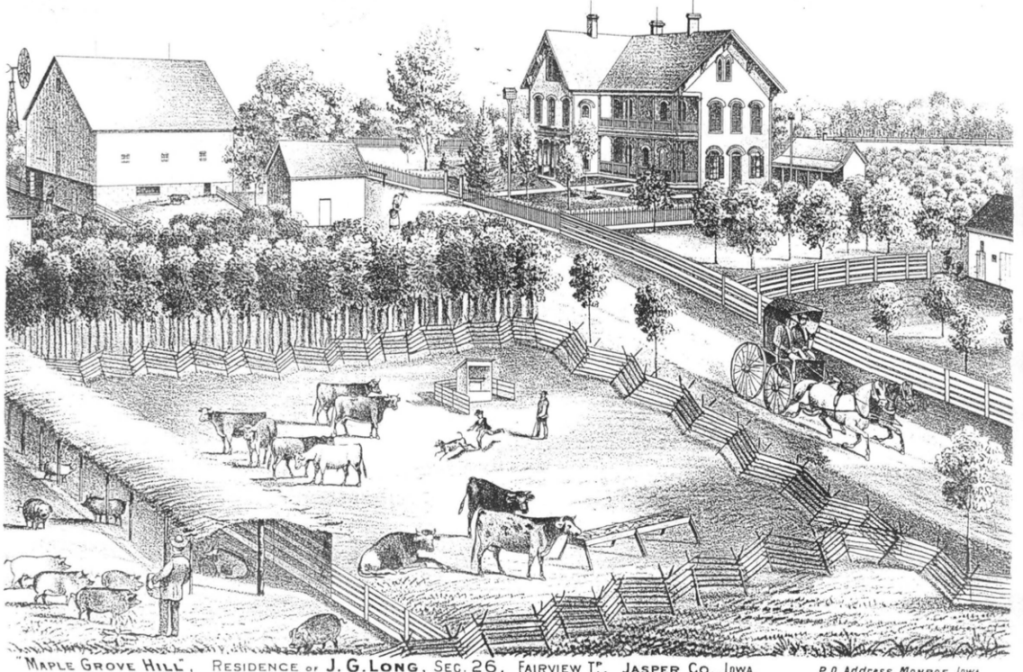
In the early 1860s, Joseph Grayson (J.G.) Long and his brother Jesse moved from to Iowa from Pennsylvania following the death of J.G.’s first wife. They’d been prosperous in Pennsylvania and farmland was cheap in Iowa. They both bought land, built similar Italianate houses, and became successful breeders of thorough-bred cattle. J.G. remarried (Regina Hiskey, a schoolteacher from Ohio) and had a family. Jesse became the president of a local bank. The future looked bright and promising for the Long brothers.
And yet, something was clearly wrong. In 1875, J.G.’s brother Jesse committed suicide by hanging. A few years later, J.G.’s son died from a self-inflicted gunshot. And according to the local newspaper, in 1899 J.G. himself “became insane, was adjudged a fit inmate for the asylum at Mt. Pleasant by the commissioners and has been taken thence.” He was institutionalized for a year; shortly after his release, he died in house he’d built. Jesse’s house was destroyed in a tornado.
Regina continued to live in the house her husband built; she died there in 1925. If ghosts actually exist, then I can see her as an “image of haunting, albeit benign, sorrow.”
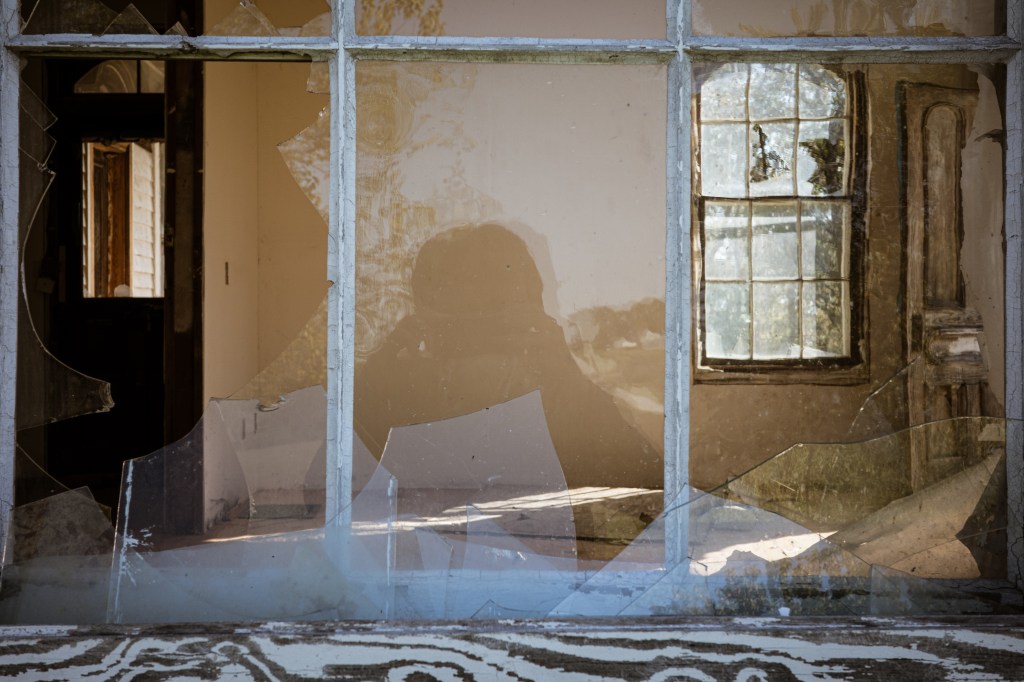
The house and property passed through various hands until 2012, when it was relocated. It’s now completely abandoned. Sadly, but not very surprising, the house has been vandalized. Inevitably, at some point in the future, the house will be gone—either intentionally demolished or a victim of severe weather. It’s a shame for many reasons. There’s something poignant and tragic about any abandoned house, but especially one that held such promise when it was built.
As the documentation for its inclusion on the National Register of Historical Places says:
The Long house dramatically expresses the optimism and economic vitality, which [the region] experienced during its early years when its location on a major overland route from the southeast to Des Moines seemed to insure its future growth.
Ambrose Bierce, in his Devil’s Dictionary, defined the future as a “period of time in which our affairs prosper, our friends are true and our happiness is assured.” Obviously, that sort of future is often an illusion. J.G. Long surely didn’t anticipate his future. And hey, my day yesterday didn’t turn out as I’d expected. But spending time in the J.G. Long house, learning about his life and the odd history of the house he built, has been worthwhile. I do find myself thinking about Regina, alone in that large house out in the countryside.
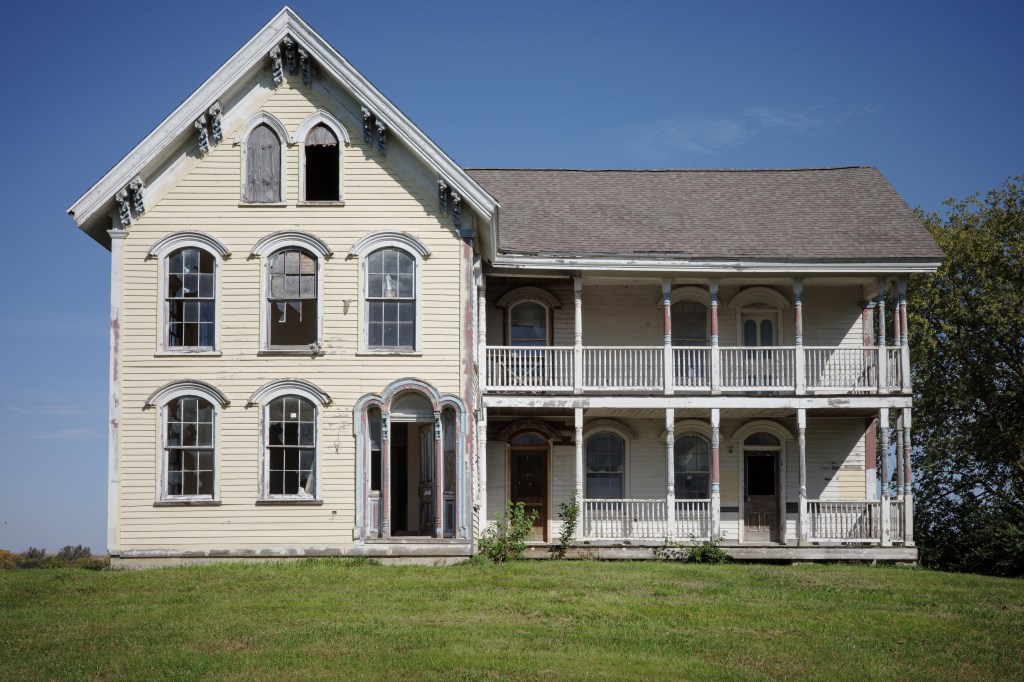
Any actual ghosts may not have moved with the house, but house itself is in the gradual process of becoming a ghost. I’m glad I was able to witness and explore a part of that process.

