just to explain why i took a photo

Last week while out noodling around I came across a tank. When I say ‘tank’ I mean a decommissioned military tank. An M60 battle tank, to be exact. It’s fairly common when the military starts scrapping old tanks, they offer them to small towns to use as memorials, or to ‘decorate’ public parks or town squares or wherever the hell a small town would like to park one. The US military stopped deploying M60s in 1997.

But this isn’t about the tank, really. It’s about how I photographed it. Which was like this:
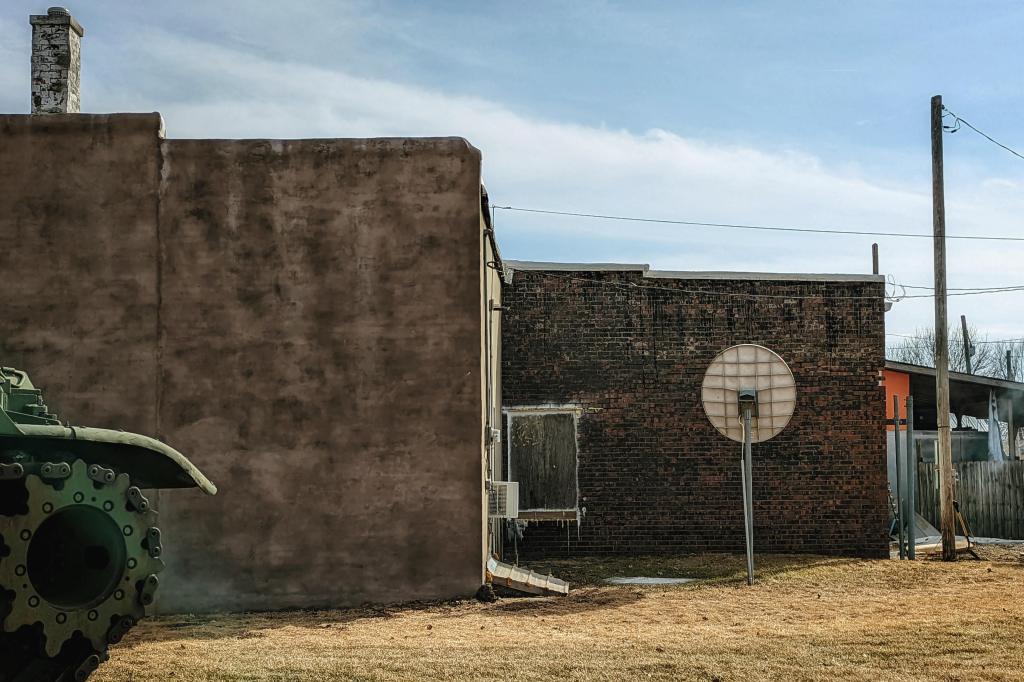
A friend asked me a couple of questions about the photo. First, what the hell is this a photograph of? Second, if it’s a photograph of a tank, why didn’t I include the whole tank? Those are valid questions. But they’re difficult to answer.

They’re difficult to answer for several reasons. The primary reason is that I’ve been shooting photos for so long that I rarely actually think about composition. I just kind of know what I want in the frame. Another reason it’s difficult to explain is because shooting a photo seems like it’s just a matter of releasing the shutter (or, with a cell phone, poking the whatsit that initiates the photo). But that moment is the result of a fairly complex process.

I wasn’t paying much attention to the process when I shot this, but I’ll try to recreate my thinking. Obviously, it began by getting out of the car to look at the tank because…well, there was a tank and I wanted to look at it. As I walked around it, I was attracted to that cascade of squarish shapes made by the building–so many different-sized squares of different textures. Then there was that white circle that sort of balanced the round rear tread wheel of the tank. And then there were those sweet vertical lines of the chimney and the light pole. And then I was drawn to that tiny splash of red, and that diagonal slant of the roof of the shed, and even the spade leaning against the light pole. All of those things appealed to me, both individually and as a collective.

I’d be lying if I said I noted all that stuff in that order, but when you’re lining up a shot it’s like your brain is ticking off boxes in a list. That works, that works, that doesn’t–so move a bit, that works. And then there’s some point when your synapses seem to agree that you’ve got all–or most–of the stuff you want in the frame, and you take the photo.

I’d probably have taken that photo even if the tank wasn’t there, because the light and the geometry appealed to me. But it was the tank that drew me to that spot and to me, that wee bit of tank is important to the composition. So, to me, it’s still a photo of the tank. The rest of the tank is implied.

Wait…I think I can explain this better. That same day, I took a photo of an old, rusted out Ford panel truck. Three photos, in fact, but only one photo mattered. Here’s the first photo.
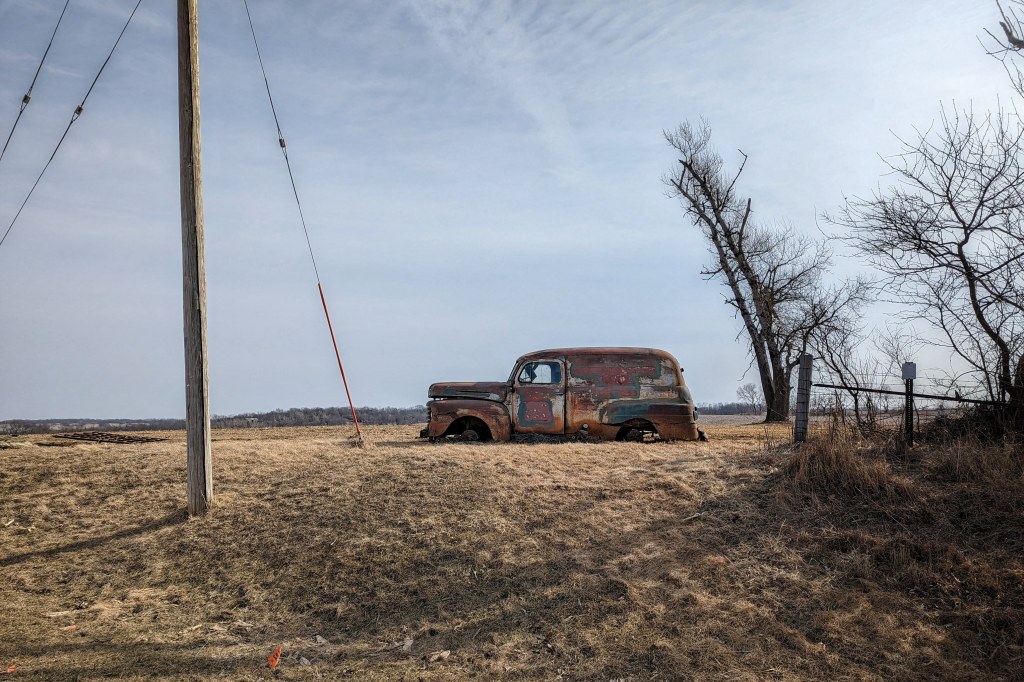
There’s nothing wrong with this as a photo. Again, I composed it intuitively, without a lot of thought. It’s got good lines. The curve of that tree is nice; it sorta kinda follows the shape of the truck. There’s a decent balance to the composition. It’s a perfectly adequate photo, a decent documentation of an old, rusted out Ford panel truck. Nothing wrong with it, but not terribly interesting.

So I got closer. Changed the perspective.
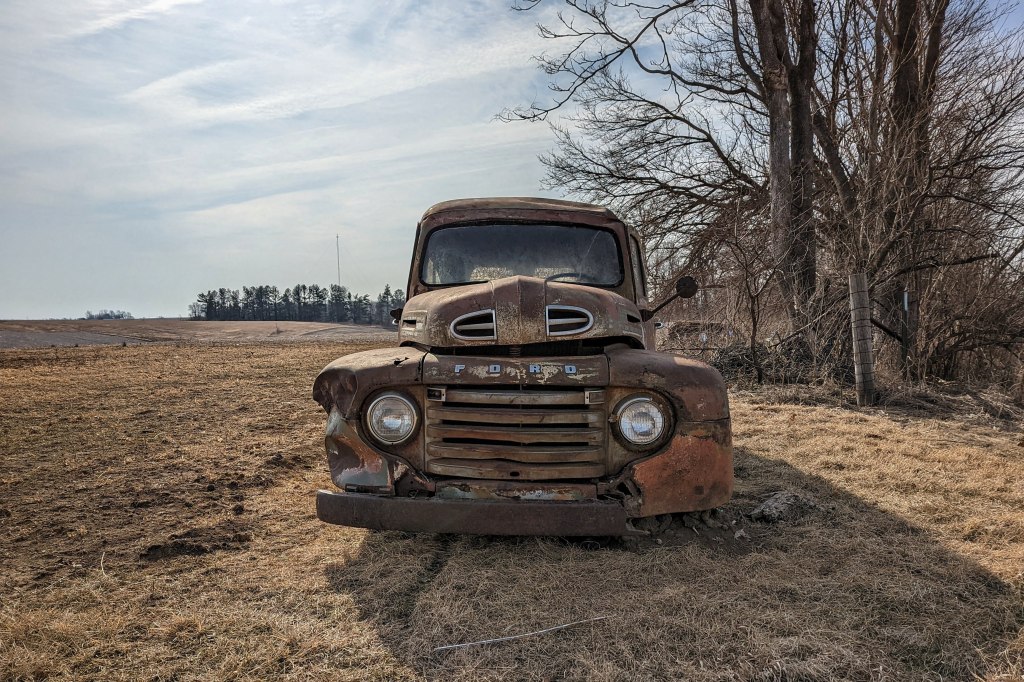
Again, there’s nothing wrong with this photo. Again, the composition was casual but deliberate. However, you’ve probably seen ten thousand photos almost exactly like this. A rusty wreck of a vehicle–an artifact of an outdated civilization cast aside in a living environment that will continue to grow while the artifact slowly degrades into nothingness. The best thing about this photo is that it places the panel truck in a larger landscape, which emphasizes how out of place it is. But basically, there’s nothing new to see in this photo.

So I got closer and changed the perspective again.
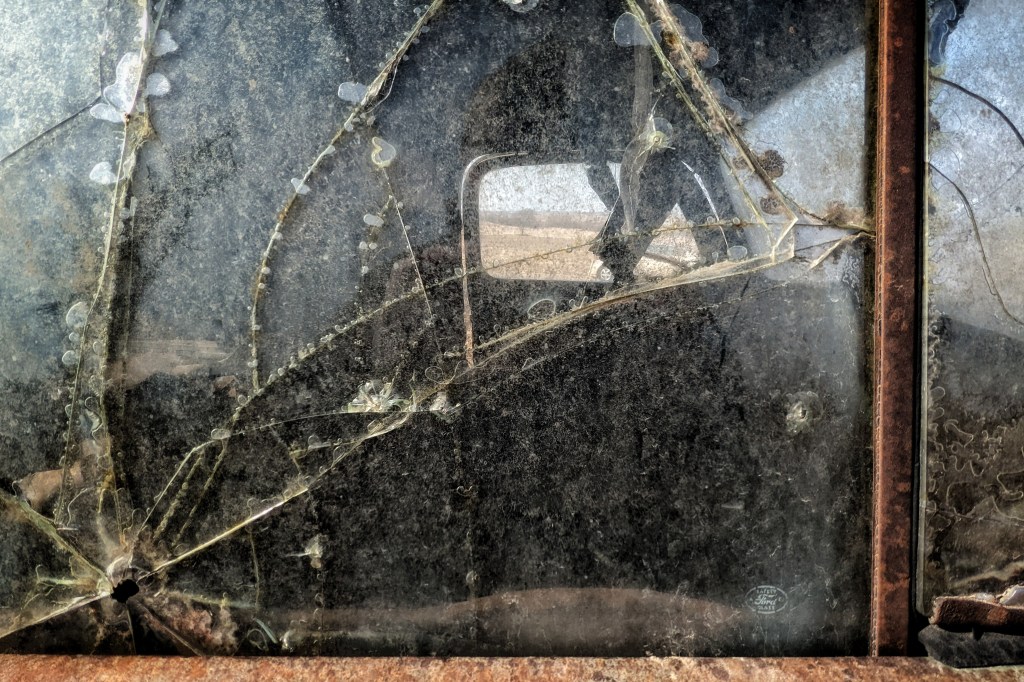
This is the photo that mattered. I took a bit more care with the composition. I knew I wanted the rust, I knew I wanted the suggestion of a large landscape through the windows, and I knew I wanted the lines of the shattered window and those bubbles formed by the thin layer of ice.

The actual old, rusted out Ford panel truck wasn’t really important; it’s the idea of the old, rusted out Ford panel truck that mattered. It’s a photo of an abandoned vehicle in the same way the first photo is a photo of a tank. The old, rusted out Ford panel truck is implied; you only need to see enough of it to hint at its existence.

The photo of the tank and the final photo of the panel truck are both photos of things that don’t belong there. Was I actually thinking of that when I took those photos? Nope. But after you’ve shot enough photos, a sort of algorithm develops in your brain. It’s like you know at the cellular level that everything in the frame matters, so you become very deliberate about what you keep in and what you keep out.

What you choose to include and exclude is grounded on why you’re shooting the photo. And that’s the thing. You may not be consciously aware that you’re shooting a photo of things that don’t belong where they are, but there’s some chunk of your brain that’s is actively registering that fact. If the tank or the panel truck were what mattered, you’d just photograph the tank and the panel truck. But you keep looking and moving and shifting around until your brain is at least semi-satisfied. Then you take the photo.

Okay, I’ve made the mistake of re-reading this (which I generally try to avoid in these blog posts). It sounds to me like I’m talking bullshit here (which is why I generally avoid re-reading these blog posts). But I’m still convinced that this is how I shoot photos. I can’t tell you how many times I’ve approached something that I wanted to photograph–that I felt was very photographable–and then walked away without taking a single shot because I couldn’t get what I wanted in the frame. There was something in the frame I didn’t want, or something I wanted but couldn’t include. My mind knew it, even if I wasn’t immediately aware of it.

The photographer Marc Riboud once said, “I photograph the way a musician hums.” That makes sense to me. Musicians, even when they’re just idly humming, know without thinking which notes work and which notes don’t. The wrong note ruins the composition.

And there it is.
let the journey unfold

I recently learned that Iohan Gueorguiev is dead. He died months ago–August of 2021. I had no idea.

You know how it is. There are things you wish you’d done. There are things you wish you could do. But there are also things you wish you’d wanted to do, even though you know you wouldn’t actually do them even if you had the opportunity.

I wish I would have wanted to do what Iohan did. I know, if given the chance to do what he did, I’d have turned it down. What he did was just too hard. I mean, it was absolutely wonderful and amazing and quixotic. I admire him for what he did and how he did it. But even though I’d have enjoyed doing some small parts of what Iohan did, I don’t have it in me to really want to do it.

What did Iohan Gueorguiev do?

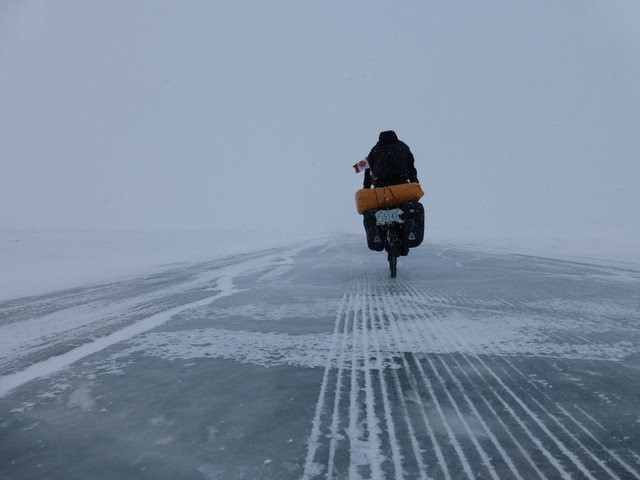
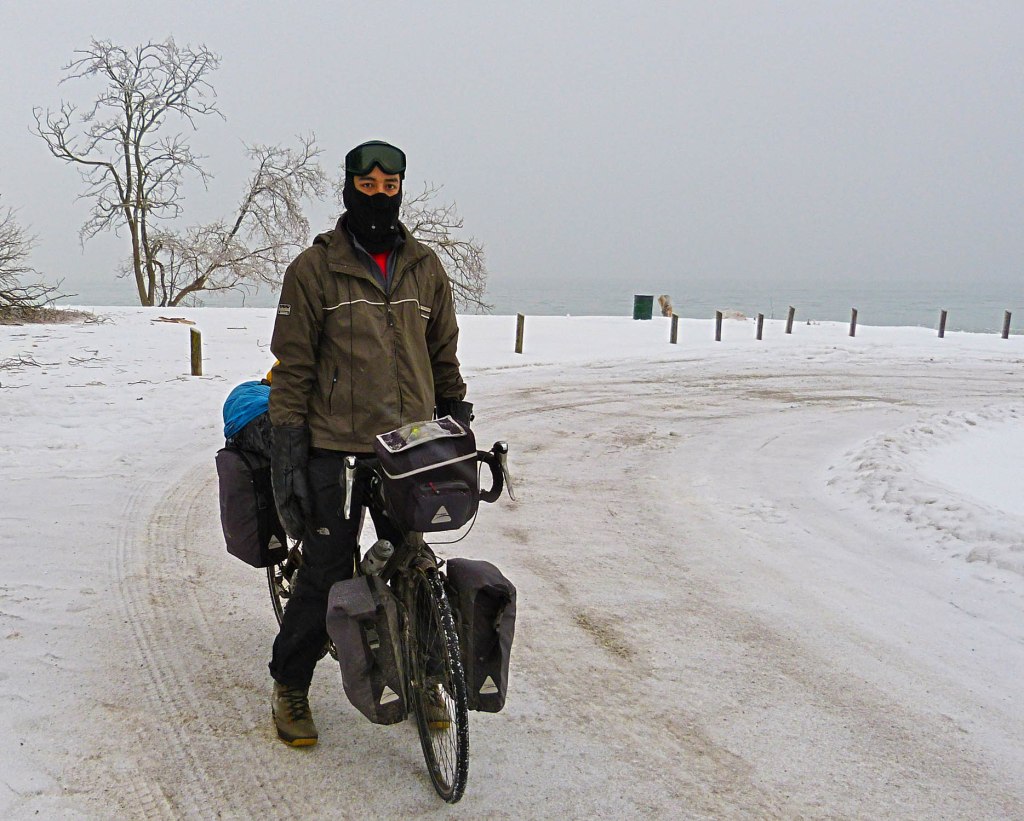
He rode a bicycle. He rode it a lot. He rode it very far. Incredibly far, in fact. Insanely far.

Iohan was born in Bulgaria in 1988. When he was 15 years old, his parents sent him to live with an uncle in Mississauga, Ontario. At some point he bought a bicycle–a touring bike–and went for a ride. To Vancouver. About 2700 miles.

That started his weird fascination and love for long-distance bike-camping. In 2014, he decided to ride his bike from the Arctic Sea in Alaska to the town of Ushuaia in Tierra del Fuego, the southernmost town in Argentina, generally called the ‘end of the world’. He thought it might take him a year. He was wrong. Wildly wrong.

It was, to be frank, an absurd and ridiculous idea. The distance from Prudhoe Bay, Alaska to Ushuaia is about 9500 miles as the crow flies. On a bicycle, it’s…well, who knows how far it would be? Farther than any rational person would consider riding.

Iohan’s touring bike–with its narrow road tires–was entirely inadequate for the project. Eventually he was able to acquire a fat tire bike that was significantly more suited for the trip, and over time he obtained a better camera (and a GoPro and some sort of drone), but his gear was always a secondary–or tertiary–consideration. The adventure was what mattered–the things he saw, the people he met. He maintained a blog describing the trek (which is how I learned about him) and he produced a number of YouTube videos.

“I want to see the world. Follow a map to its edges and keep going. Forgo the plans. Trust my instincts. Let curiosity be my guide. I want to change hemispheres. Sleep with unfamiliar stars. And let the journey unfold before me.”

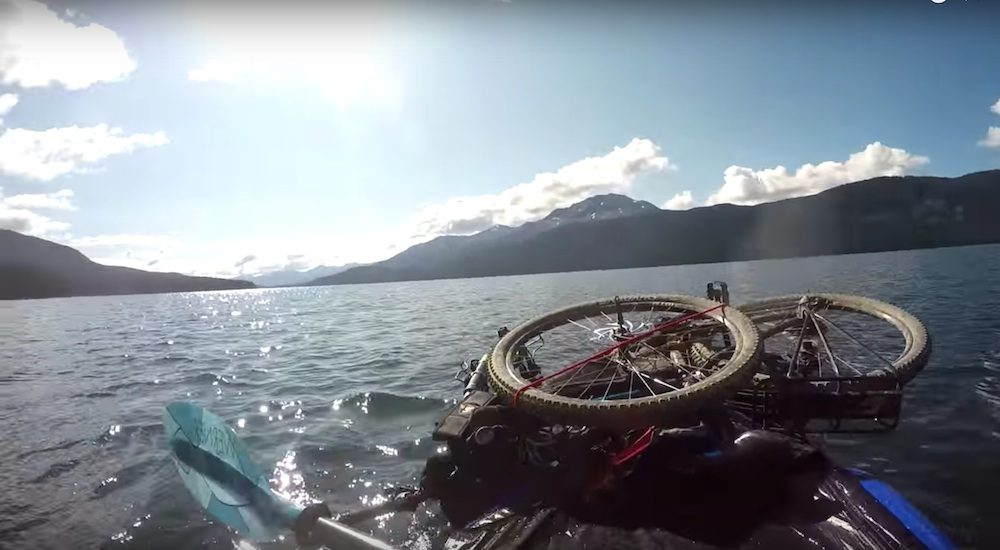
That’s mostly what he did–let the journey unfold. Iohan rarely took the easy route. He rode anywhere he could, anywhere he wanted: ice highways, lumber roads, hiking paths, wilderness trails. Hell, sometimes he didn’t take a route at all–he just set off in the general direction. On at least one occasion he broke down his bike to cross a lake using a collapsible kayak. He refused to let common sense dictate the trip.

He encountered every obstacle you could predict: bad weather, wildlife, gear failures, terrible terrain, mechanical issues. And yet he always seemed to find something positive about his situation. Cycling in a blizzard? He didn’t have to worry about his food supply spoiling. Traveling up a hazardous mountain trail so steep he has to carry his bike and all his supplies? The air is cool, he says, and fresh and invigorating.

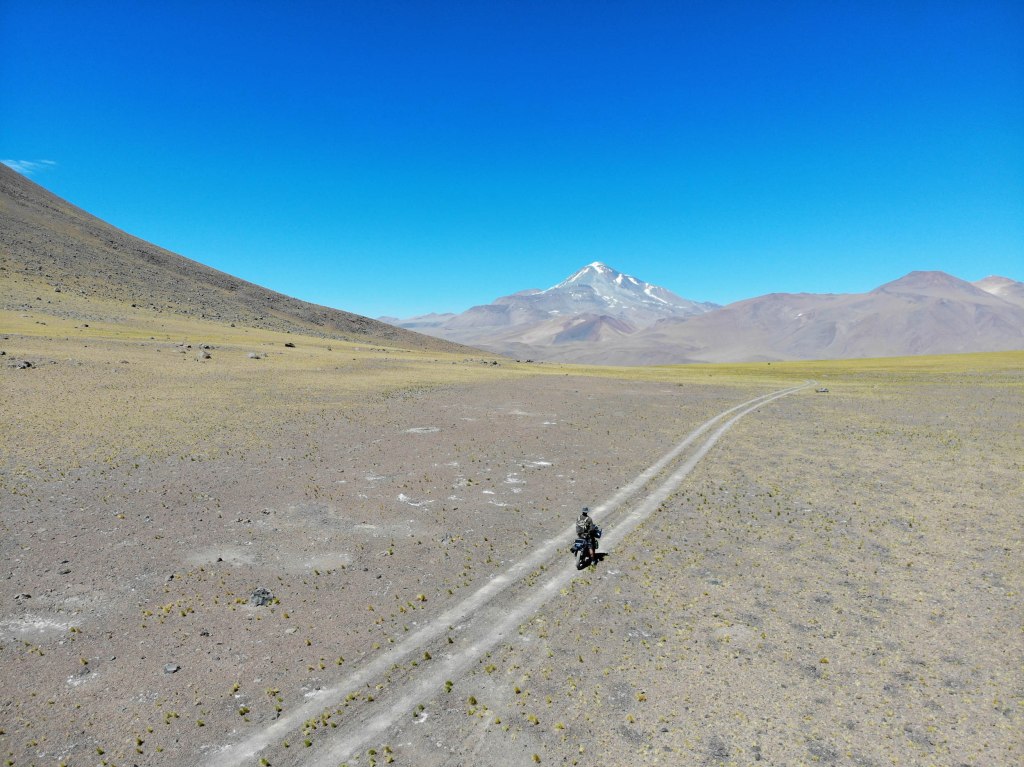
“Ruta de Los Seis Miles is a 1,310km, month-long, high altitude desert traverse across the Central Andean Dry Puna in Chile and Argentina. This route promises the most physically and mentally demanding high altitude touring in the Andes. Thankfully, it’s balanced with dream-like mountain scenery with salt fields, lava flows, flamingo-filled lakes, and some of the highest volcanos in the world, far away from the civilization.”

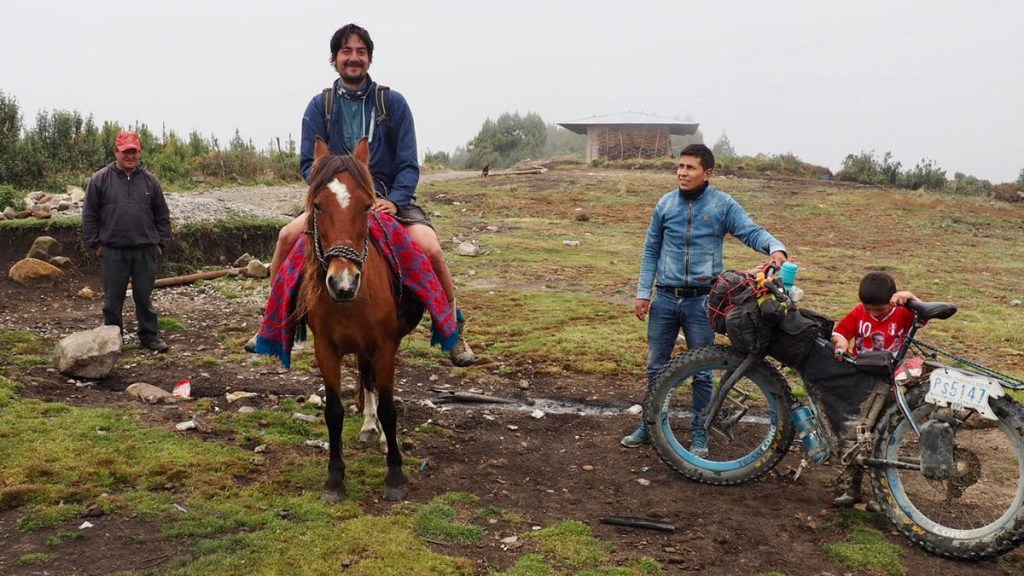
Everywhere he went, Iohan met good people. They’d offer him a safe place to sleep, a warm meal, maybe a bit of money, stories. He seemed to take as much joy from the people he met as he did from the sights he saw. He was certainly comfortable being alone–and there were times on the trip when he was terribly alone–but he clearly delighted in meeting new people in unusual circumstances.

“My motivation: the kindness of strangers and the beauty of the wild.”

Without a private fortune (which Iohan didn’t have) or some sort of corporate sponsorship (which he occasionally received), he was forced to interrupt his journey periodically and return to Canada and earn enough money to continue. Then he’d resume the adventure where he’d left off.

The trip he originally thought might take a year stretched out to more than six. Then Covid arrived; the pandemic disrupted everything. Iohan returned to Canada. He still took what he’d describe as ‘short trips’ in Canada. But the trips weren’t very rewarding; the pandemic made it impossible for him to meet new people. Depression set in; he developed insomnia, made worse by sleep apnea.

Last August, Iohan killed himself.

He still had about 1500 miles to go to reach Ushuaia.

Earlier I said I wish I would have wanted to do what Iohan did. I try to do what he did on a much much much more modest scale. I ride my bike. I talk to strangers. But if it’s too cold or too hot or too windy or too wet, I stay home. Still, there’s a part of me that wishes I had the sort of irrational will that could inspire me to actually undertake an adventure like his.

Iohan Gueorguiev went as far as he could. So much farther than common sense would carry you. He experienced so much more than the rest of us. It would be wrong to think he fell 1500 miles short of his destination. The distance Iohan Gueorguiev traveled can’t be measure in miles. He kept going until he couldn’t. Then he stopped.

EDITORIAL NOTE: You can still access Iohan Gueorguiev’s blog and his videos at BikeWanderer. It’s nice to watch the videos and think maybe he’s still on his way.

more like jesus

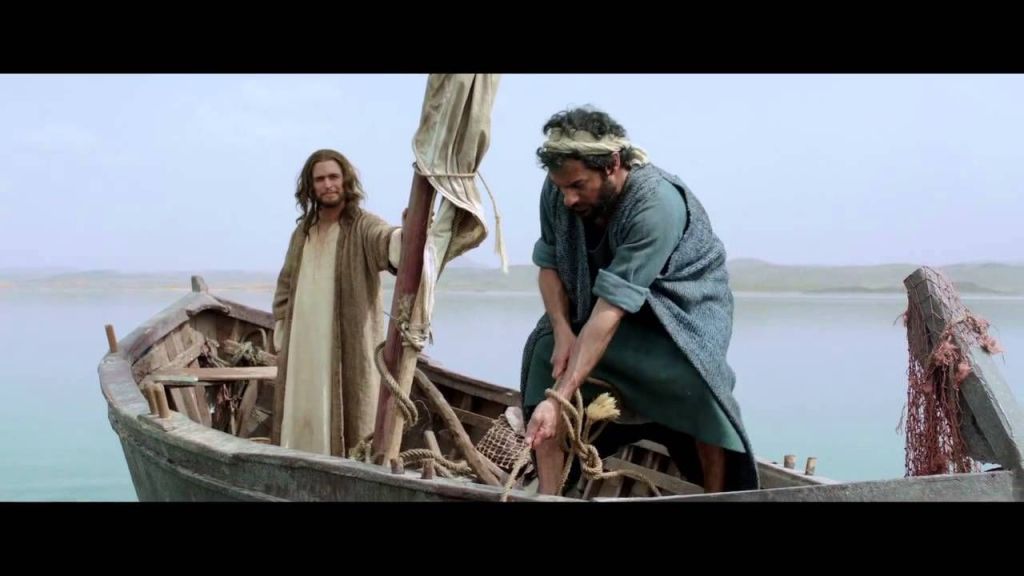
A couple of days ago, passing by a church, I saw a sign (I wish I’d stopped and photographed it) that said something like: Try to be more like Jesus. My first thought was “Dude, it’s January; I’m NOT wearing sandals.” Which, I admit, is somewhat disrespectful.

For some reason that be-more-like-Jesus concept stuck in my mind. I can see some benefits from it.

  • Spend time talking to strangers
  • Tell stories
  • Spend time chilling with sinners
  • Drink wine (in moderation, of course)
  • Ride donkeys
  • Remind folks to be kind and gentle.
  • Hang out in boats
  • Piss off hypocrites
  • Bake bread and share it

I seem to recall a lot of paintings showing Jesus playing with kids, and I don’t think that would work out so well these days. Besides, kids are noisy. So I think we could safely skip all that. Also, I’m not sure where Jesus stood on napping; I suspect he was a fan, but that might just be wishful thinking.

“Believe me, my young friend, there is nothing–absolutely nothing–half so much worth doing as simply messing about in boats.”

I’m not a Christian, but you can’t deny that the guy had some good ideas. Too bad so few Christians follow them. Seriously, the worst thing about Christianity is Christians.

EDITORIAL NOTE: The quotation in the photo is from the Gospel of The Wind in the Willows.

goals

The first thing I saw on social media this morning was…no, wait, that’s not true. It wasn’t actually the first thing I saw, or even among the first 20-30 things I saw, but it was the first thing that caught me by surprise. The first thing that made me go “wait…what?” It was a question in a forum for readers. Two questions, really.

What are your reading goals and targets for the New Year? Do they include different genres?

That pretty much stopped me dead. People have reading goals and targets? What does that even mean? And what’s the difference between a reading goal and a reading target? What does genre have to do with it?

The responses to those questions helped clarify them, but some of them still left me confused. Here are a few sample responses. “I plan to read 100 books this year, with at least 5 hard scifi, 5 fantasy, 5 YA, and 5 historical fiction.” “I intend to read the entire Richard Bolitho British Navy novels by Alexander Kent.” “I’m going to reread the novels that were my favorites as a teen.” “This years book list challenge is set; I’ve already finished 2 books today that I started yesterday.” ” In 2021 I read 88 books; this year I want to get 100.”

I can understand folks wanting to read favorite childhood novels. That makes sense to me. I do that occasionally. Just a few weeks ago I re-read The Prisoner of Zenda. I can also understand wanting to read a certain series of books–or at least start to read them. But what if you discover you don’t enjoy them? Or what if you enjoy the first couple, but them find the rest repetitive? If you’ve publicly committed to reading the entire series, do you keep reading…or do you stop?

And yeah, I understand the value of reading a variety of genres, They all have something to offer. But I do NOT understand the intention to read X number of books in a given time frame. I don’t understand that at all. What’s the point? What’s the purpose? Why does the number of books you read matter? It makes no sense to me.

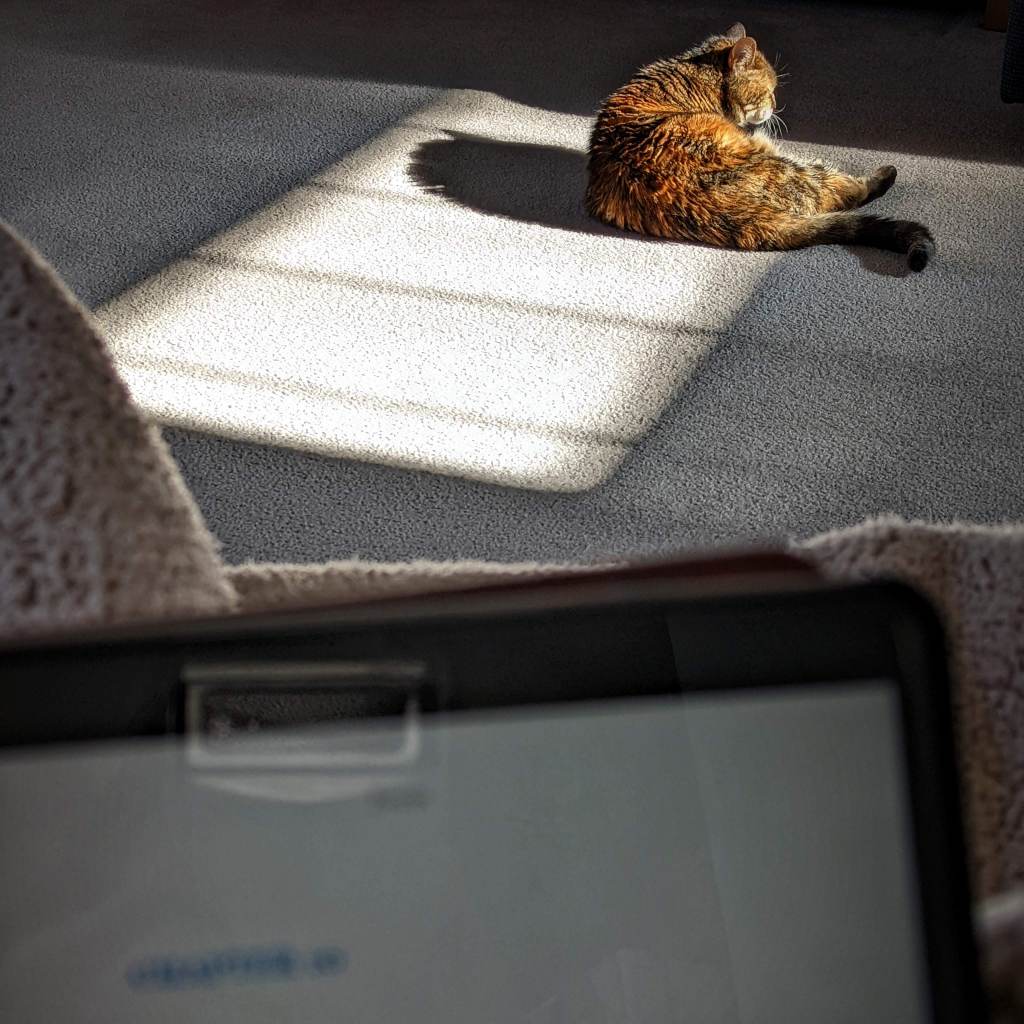
The cat naps; I read. Simple goal, simple plan.

I guess I’m just a disorganized, unstructured reader. I read a book, then when I’m done, I buy another book and read it. I DO have a Google Keep list of books called ‘Books I Might Want to Consider Reading‘ which, now I think of it, is a shamefully wishy-washy title for a list. It probably doesn’t really qualify as a list; it’s just notes on books folks have recommended or books I’ve heard about. Sometimes I’ll consult it before buying a new book, but I’m just as likely to rummage through the online bookstore and buy whatever strikes my fancy at that moment. I don’t have anything remotely like a plan for what I’m going to read next. It depends on…hell, I don’t even know what it depends on.

Every four or five years (or three years or six years) I decide to re-read one of Dorothy Dunnett’s historical novel series. Does that count as a plan? I’m still two novels away from finishing The Expanse series. Or maybe it’s three novels; I’m not sure how many novels are in the series. Eight? Nine? I’m sure I’ll buy and read those novels at some point–but I haven’t yet and I’m not sure when I will. Does that count as a plan? Maybe it’s a goal?

What is a plan, really? It’s just a roadmap pointing toward a goal. But if you don’t have a goal–and I don’t–then what use is a plan? Or maybe I DO have a goal. Just a very simple, easily attainable goal. To read another book when I’ve finished the one I’m reading now. My plan, then, would be to buy another book. Piece of cake.

#

I wrote this yesterday morning, then got distracted. I had a point to make, but I’ve forgotten what it was. I’m pretty sure it was clever, though.

Yesterday afternoon, I was sitting in a comfortable chair reading, a blanket on my lap, and the cat on the blanket. When the sun came through the transom, the cat got off my lap and laid in the sun. Every so often I looked up from my tablet and saw that the sunny spot and the cat had moved. It occurred to me that my reading goals and plans were similar to the cat’s napping goals and plans. Her goal is to nap in a sunny spot. When that sunny spot moves, she moves with it. My goal is to finish one book and start another.

The cat is content with her goal and plan; I’m content with mine. But I rather doubt my plan and goal will impress the other members of that reader forum.

new year bullshit

Okay, look, this whole New Year bidness? It’s bullshit. I mean, sure, we live in a culture that requires us to establish metrics for Time. But basically, I’m with Thomas Mann on this: Time has no divisions to mark its passage, there is never a thunderstorm or blare of trumpets to announce the beginning of a new month or year. The objective differences between December 31, 2021 and January 1, 2022 are trifling.

Even if we agree that there are valid reasons to demarcate one year from another, the only reason January 1–a date right in the middle of the fucking winter–is considered the first day of a new year is because Julius Caesar yanked the old 10 month Roman calendar and imposed a new, improved 12 month one. He added a couple of months, clever boy, one of which was January–named for Janus, the two-faced god of beginnings and endings, the god of gates and doorways, the god of transitions. Caesar made the imperial decision that the first day of the new month would be the first day of the new Roman year. I’m not saying he deserved to be stabbed to death for that, but c’mon, what an arrogant prick.

Generally, folks living in the Roman Empire at that time (which was seriously huge, by the way) felt a new year began at some point around the Vernal Equinox. Which totally makes sense. It’s around the end of March, winter is over, the land begins to come alive again, leaves grow on trees, plants bloom, days are longer, everything is new. So when Caesar imposed this new calendar on the empire, common folks mostly ignored it. They continued to celebrate a seasonal new year rather than a calendar-based one.

Then three hundred years or so later, Christianity came along and sort of fucked things up. When the Roman emperor Constantine decided that Christianity was the Official Religion of Rome (which is a whole nother story), all his generals and high ranking officials had to become Christian if they wanted to advance their careers. That meant supporting the nascent Church, and supporting the Church meant adapting pagan holy days to Christian holy days AND marking them on the Roman calendar.

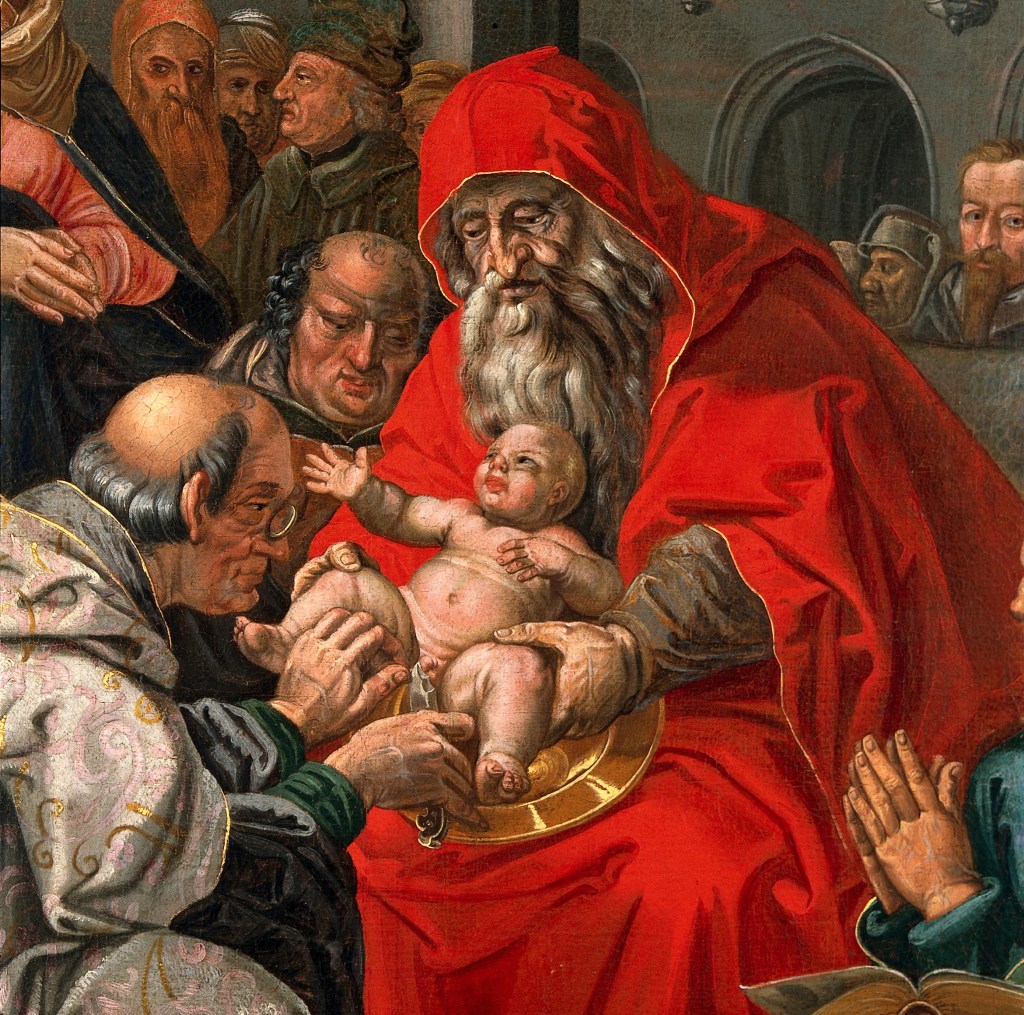
Still, hardly anybody celebrated January 1 as New Year’s Day. It was celebrated as the Feast of the Circumcision of Christ. You may be asking yourself how Romans decided that Jesus was circumcised on January 1, which is a reasonable thing to ask yourself. What happened was a Roman historian named Sextus Julius Africanus, after some serious consideration, decided Jesus was probably conceived around the Vernal Equinox. That’s why Christmas is mostly celebrated on December 25, nine months later. And according to Jewish law and tradition, eight days after a boy is born his parents hold a bris. What’s a bris? It’s a ceremony in which a mohel comes to the family’s home, snips the foreskin off the boy’s penis, then everybody has a nice meal. Eight days after December 25 is January 1.

Now, there’s a whole weird, uncomfortable history dealing with early Christianity and circumcision which isn’t worth going into (so much of history has been shaped by the relationship men have with their dicks). There’s a whole sub-genre of art devoted to Jesus getting snipped. The important thing, though, is that over time the Christian discomfort over the celebration of Jesus being separated from his Holy Foreskin morphed the event into a celebration of the New Year.

This is why folks are putting on pointy party hats and blowing horns and getting high school drunk tonight. Because Yahweh decided Abraham should be circumcised and Julius Caesar wanted a better calendar and a Roman historian made a wild guess about when Mary was impregnated by the Holy Spirit and Constantine decided to become a Christian and early Christians became awkward and uncertain about circumcision so instead of celebrating a bit of foreskin-snipping they fell back onto celebrating Caesar’s arbitrary decision to start a new year in the middle of the fucking winter.

It’s all bullshit. The sun rises, the sun sets, the earth orbits the Sun, tilts on its axis, we have seasons. And basically, that’s it. Some folks just need an excuse for a party.

on digital books, a lime green glass, and d’Artagnan

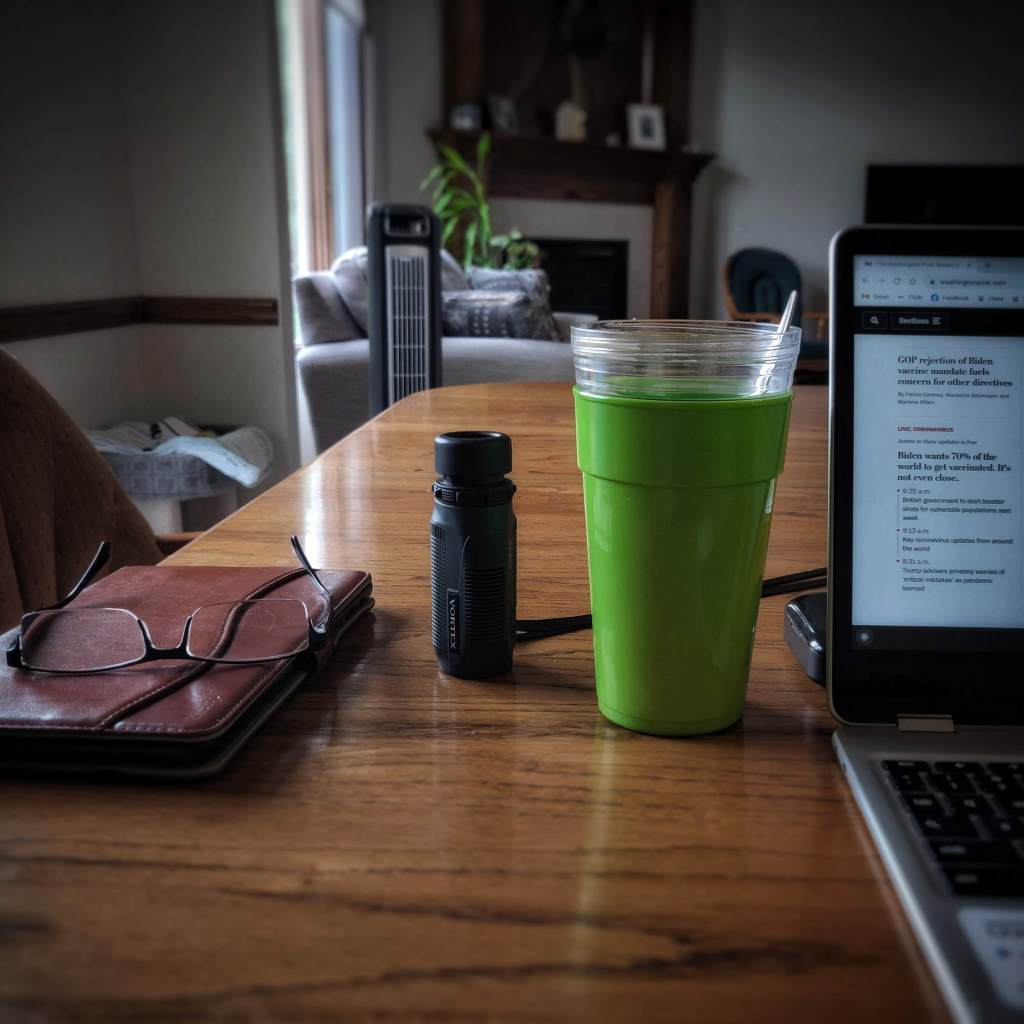
From some indeterminate point in May to an equally vague point in September, I drink cold brew coffee in the morning. I drink it from a lime green plastic glass — because something about that color appeals to me in a summer sort of way, and because I like the clicky sound made by the iced tea spoon when I stir it. In September — at the end of this week, in fact — I’ll shift back to hot coffee, which I drink in a brown metal insulated mug.

I could, of course, drink the coffee in any sort of container and it would taste as good, but I choose those two because they please me. They’re a part of my morning ritual. Greet the cat, check the perimeter (with the cat, of course), feed the cat, get my coffee, read the news. I live a fairly irregular and unscheduled life, so that morning ritual provides a sort of ground-level continuity — a semi-stable foundation to begin the day.

What does that have to do with digital books? Nothing, in a material way — but they’re related in a sort of philosophical way. Recently a friend mentioned they couldn’t bring themselves to buy an e-book reader, and asked me how I could bring myself to abandon physical books. This is my answer.

A lot of people have a relationship with books that’s similar to my relationship with my lime green plastic glass. The thing is, physical objects can develop a certain presence that stems from the object’s personal history with the user. We’ve all experienced this. Maybe you have a favorite shirt — something faded and worn and not suitable to wear in public, but imbued with memories and a weird sort of affection that makes it impossible to discard. Maybe you have a screwdriver or soup ladle inherited from a grandparent, or a some old work gloves loaned to you by a friend who moved away before you could return them, or an early Baywatch poster that’s sort of embarrassing now but still un-throw-awayable — something (some thing) that has a personal meaning to you and only you.

So, how could I abandon physical books? How could I give up that tactile experience of holding a book in my hand? How could I shift away from the sound and feel of turning a physical page? Didn’t I miss the particular smell of a book? How could I reduce a great novel to nothing more than a collection of digitized ones and zeros?

I get that notion. I totally do. There are absolutely some physical experiences that clearly lose something important when they’re de-objectified, when objects are turned into information. The ringing of a church-bell, for example; we can digitally reproduce that sound, but we can’t reproduce the experience, the physicality of a ringing bell, the way the sound waves impact our bodies.

But for me, the impact of a book — and especially of a novel — isn’t in the substance of the paper and the binding, it’s in the ideas generated by the story. It’s in the unique and intensely personal interpretation of what’s written. For me, it’s the writing that matters more than the way it’s presented; it doesn’t matter to me if the words are printed on a physical page or digitally reproduced on a screen.

Originally, I thought it would matter. In fact, I refused to buy an e-book reader because I was concerned it would degrade the experience of reading. But then, back in 2010, I was given a Nook, an e-reader developed by and for Barnes & Noble booksellers. It came with a couple of classic novels already loaded — both of which I’d read and re-read several times. Pride and Prejudice and The Three Musketeers. Because it was a gift, I felt obligated to at least try using the Nook. So I started to re-read the story of Charles de Batz de Castelmore d’Artagnan and his ridiculous quest to become a musketeer — and by the time I finished the third paragraph, I was caught up in the narrative.

Imagine to yourself a Don Quixote of eighteen; a Don Quixote without his corselet, without his coat of mail, without his cuisses; a Don Quixote clothed in a woolen doublet, the blue color of which had faded into a nameless shade between lees of wine and a heavenly azure; face long and brown; high cheek bones, a sign of sagacity; the maxillary muscles enormously developed, an infallible sign by which a Gascon may always be detected, even without his cap—and our young man wore a cap set off with a sort of feather; the eye open and intelligent; the nose hooked, but finely chiseled. Too big for a youth, too small for a grown man, an experienced eye might have taken him for a farmer’s son upon a journey had it not been for the long sword which, dangling from a leather baldric, hit against the calves of its owner as he walked, and against the rough side of his steed when he was on horseback.

That pair of sentences would make any modern editor have a seizure, but they set the tone for this particular novel. More importantly, they create an image in my mind of the character d’Artagnan. Reading it digitized — like it is here — creates the same image in my mind as reading it on a printed page. That mental image has nothing to do with the medium that created it, paper or digital. It’s unique to me; your mental image of young d’Artagnan is probably different, because…well, fuck. I have to go off on a tangent here. I’ve been trying to reduce the number of tangents in these blog posts, but damn it, here we go.

That’s d’Artagnan, right there.

I think we can all agree that with very few exceptions, books are better than the movies made from those books. One reason for that is because the characters in movies rarely resemble the characters we create in our mind when we read a novel. But on occasion, a character is so perfectly cast that we impose that actor’s face on the character in the novel. And the 1973 film adaptation directed by Richard Lester has permanently imprinted the face of Michael York on my personal interpretation of d’Artagnan. Now and for the rest of my life, when I read The Three Musketeers, I see Michael York.

Right, tangent over, and back to my point, which is as follows: some physical objects, though routine contact with people, develop an almost mystical connection to the person who possesses them. I have a relationship with my lime green glass, for example. My cold brew coffee would taste as good in a ceramic mug, but the glass means something to me. But my relationship with books, and particularly novels, is different. That relationship is grounded in the ideas created through the writing, not in the device that contains them.

When it comes to books, my interest is in the cold brew, not the lime green plastic glass.

slay the big bad, return to the prom

There were many days during the Trump Dark Nightmare Interval when I felt like we were living out an episode–hell, an entire season–of Buffy the Vampire Slayer. One of the many messages hard-wired into BtVS was that the Slayer was…wait. Okay, there may be some folks who aren’t familiar with this television show. I mean, BtVS ended in 2003, almost two decades ago, so I suppose I should recap the…no, never mind. You either know about BtVS or you don’t. If you don’t, then I advise you to correct that failure.

Anyway, one of the many things I liked about Buffy is the way the show ended. Instead of…okay, damn it, I guess I do need to explain a little bit about the show. Bear with me a moment. The premise of BtVS is that 1) there are vampires, 2) there is a vampire Slayer, and 3) the Slayer is always female. Got that? Lots of vampires, one female Slayer. Not just vampires, mind you; there are lots of other forces of…well, wait. Here’s the show’s intro:

Into every generation a slayer is born: one girl in all the world, a chosen one. She alone will wield the strength and skill to fight the vampires, demons, and the forces of darkness; to stop the spread of their evil and the swell of their number. She is the Slayer.

So, again, lots of vampires, one Slayer* (yes, there’s an asterisk to appease BtVS fans who know better, but y’all don’t need to fret about it–just accept one Slayer-many vampires). If you do the math, you’ll see the shelf life of a Slayer is generally pretty brief. But when one gets killed, another is ‘chosen’. Don’t ask about the selection process; it doesn’t matter. Just accept it. A Slayer dies, all her power and abilities get transferred to some other poor girl. And yes, they say ‘girl’ because the new Slayer is always a teenager. Again, don’t ask why; it just is what it is. What matters is that this girl/young woman is then stuck with the thankless job of killing vampires. There’s a large pool of ‘potential’ Slayers out in the world–girls and young women all over the globe who are unaware and unsuspecting, but standing in an apparently arbitrary queue to become the next Slayer.

Them’s the rules. Buffy had no choice; some Slayer died, and she got drafted into a career she didn’t really want–and tried to avoid. Who could blame her? One day she’s picking out what to wear to prom, then next she’s supposed to fight demons? And eventually be killed by them? Who’d sign up for that? Wait, here, watch this. It’s a scene in which Buffy learns about a prophesy that she’s going to die.

“I’m sixteen years old,” she says. “I don’t want to die.” Doesn’t matter that another Slayer will be born; she’s sixteen and she’s going to be killed (and don’t forget, there’s a HUGE difference between ‘dying’ and ‘being killed’) just because she won a lottery she hadn’t even bought a ticket for. “They say how he’s gonna kill me? Do you think it’ll hurt?” She just wanted to go the fucking prom like a normal person.

Okay, now back to the point I wanted to make at the beginning. We’re closing in on what we hope is the season finale of the Trump story arc. He’s been sidelined, but he’s still a threat. So are all the lesser marauding TrumpDemons out there in the community, spreading Covid and insurrection. I find myself thinking about the way BtVS ended. Until Buffy, every other television/movie superhero story in the world ended in pretty much the same way: the superhero finds a way to stop the Big Bad (whatever it happens to be) by being a superhero–by using superpowers in an heroic way.

But not Buffy. She stops the Big Bad largely by changing the rules–by ending that “one girl in all the world, a chosen one” business. Buffy stops the Big Bad by giving up the very thing that makes her special. She finds a way to make ALL the potential Slayers into actual Slayers. Teen-aged girls all over the world can now do what Buffy does.

And they need to. Because the Big Bad–in whatever form it takes–can be stopped, but it never dies. It always keeps coming back. Which, obviously, is why Slayers have to keep showing up and kicking its ass. Which is why Buffy’s prom keeps being interrupted.

Slay the Big Bad, return to the prom.

My point–my goofy, sappy, obvious point–is that even though the current Hellmouth has collapsed in on itself, there’s still a LOT of ugly shit in the world and the threat is still active. So it’s up to all of us, to each of us, to step up and be as strong and determined as teen-aged girls. So to speak.

We don’t have to stake anybody (and really, we shouldn’t, even if we want to); but we DO have to put in a little effort. Vote, of course. But also call your members of Congress. Donate (if you can afford it) to candidates who share your values. Attend a demonstration. Buy and wear a t-shirt proclaiming your views. Seriously, wear a t-shirt. Being public about your opinions is not only empowering for you, but also encourages other folks to be public. It’s a way of recognizing and supporting other vampire slayers.

It’s okay to be scared–even by little things, like making a phone call or wearing a t-shirt in public. Ask yourself, “What would Buffy do?” Then put on your t-shirt or prom dress and don’t let your fear make you silent. Go to the prom, dance and have fun, slay a monster or two while the band is on break, and return to the prom. Keep dancing. Make your voice heard.

Make your voice heard.

a slightly faster way of walking

I swear, every couple of weeks I come across another article about electric bikes and ‘cheating’. This one was on the Electrek website. Are electric bikes cheating? If you google ‘ebike cheating‘ you’ll get a cascade of results, and every single one debunks the idea that riding an ebike is cheating.

I’ve never quite understood the question. How can riding a bike–any sort of bike–be considered cheating? Cheating at what? Cheating against whom? That question led me to understand my personal approach to cycling is something of an aberration. The fact that the question persists–the fact that the question even exists and that it gets asked so often–is, in my opinion, evidence of a deep problem in the cycling culture of the United States.

I believe the problem evolved from the way cycling has been marketed. In the US, it’s almost always promoted as a ‘fun’ form of exercise. Exercise is basically a form of self-competition. Exercise isn’t supposed to be easy. Push yourself, work hard, work a little harder, sweat a bit more, feel the burn, ignore the pain, keep going, do better than you did the last time, meet or exceed your personal best. Exercise is a constant measuring of yourself now against yourself before. Are you getting better? Are you maintaining? Are you fading?

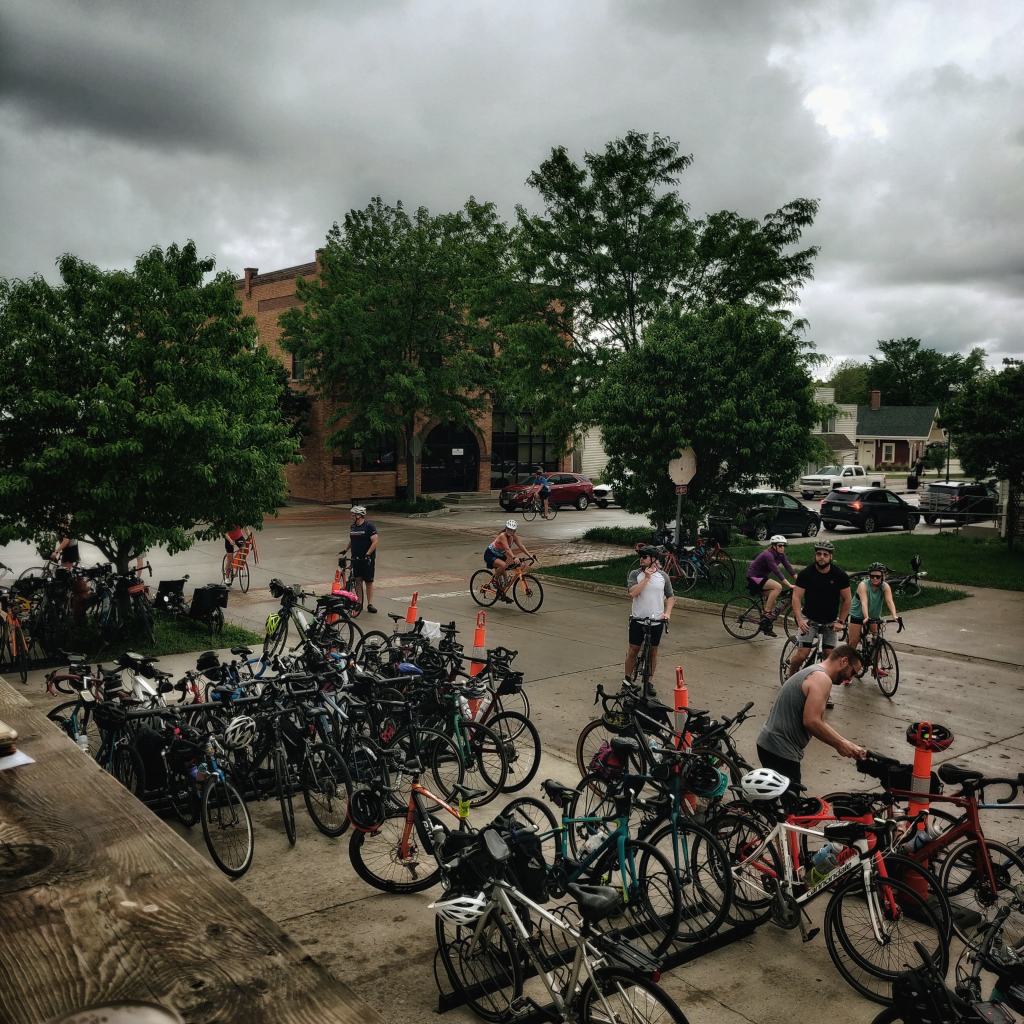
Row upon row of road bikes.

There’s nothing wrong with exercise, of course. It IS actually good for you. But there’s a lot more to cycling than a good workout, and that’s generally ignored when cycling is being marketed or advertised. In the US cycling is occasionally presented as an alternate form of transportation–as a way to commute to work or a way to run short errands. But it’s never marketed as a source of joy or delight or pleasure.

I’ve been cycling most of my life–never for physical fitness, sometimes as a mode of transportation, but always because it makes me happy, because it brings me joy and delight. I didn’t realize that approach to cycling was an aberration until recently. Part of that realization came about because of the ebike-cheating question. But it was driven home this year after joining a few organized bike rides.

Rows of road bikes outside a pub.

I’m basically a solitary cyclist. I like to ride at my own pace, take my own path, stop when I want, go faster or slower as my mood takes me. There’s just SO MUCH to see when you’re on a bike. You lose that independence when you ride in a group. But this year my charming sister (and her equally charming husband) have invited me along on a few organized bike rides–and because she’s my sister and because she’s charming, I’ve gone along.

I’ve thoroughly enjoyed the rides, in part because they always start at some bike pub and end at some bike pub, often with a couple of stops at bike pubs along the way. Bikes and beer have a long, happy history together. But because almost all of my professional training has taught me to pay attention to social behavior, I noticed this very obvious fact: aside from me on my ebike, almost everybody rode a road bike. There’d be an occasional mountain bike, a couple of fat tire bikes, maybe a recumbent bike, and one or two other ebikes–but the the vast majority of cyclists were on road bikes.

Why?

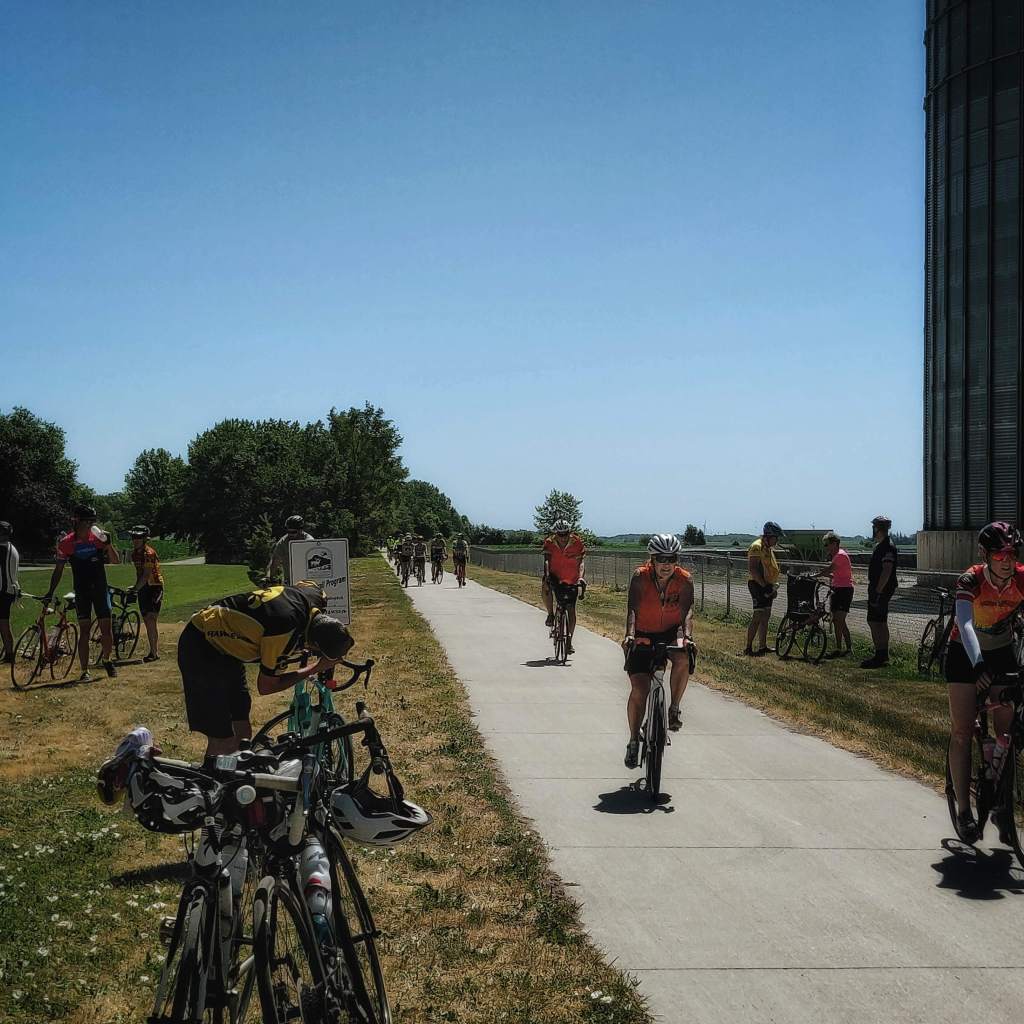
Dozens of road bikes.

A road bike is designed to be fast. Essentially, they’re designed for racing, even if racing isn’t the cyclist’s intent. Because of that, road bikes are the least versatile type of bike, the most finicky, the least forgiving, the most expensive, the least comfortable. But they’re fast. They’re built to be ridden almost exclusively on hard surfaces. They have thin, high pressure tires to minimize surface friction on the road, and that makes them faster. They lack any sort of suspension because the flex of suspension reduces the efficiency of the pedaling, and that makes them faster. The riding position is aerodynamic (which makes them faster), but it’s also unnatural and puts a lot of stress on joints and nerves.

Because road bikes are fast, and because their design makes them more vulnerable to road conditions, and because of the unnatural riding position, cyclists on road bikes need to focus their attention on the road in front of them. A lapse in attention can result in a crash. The result is folks on road bikes aren’t devoting much attention to the general environment they’re riding through. These cyclists are mostly focused on the road just a few yards in front of them.

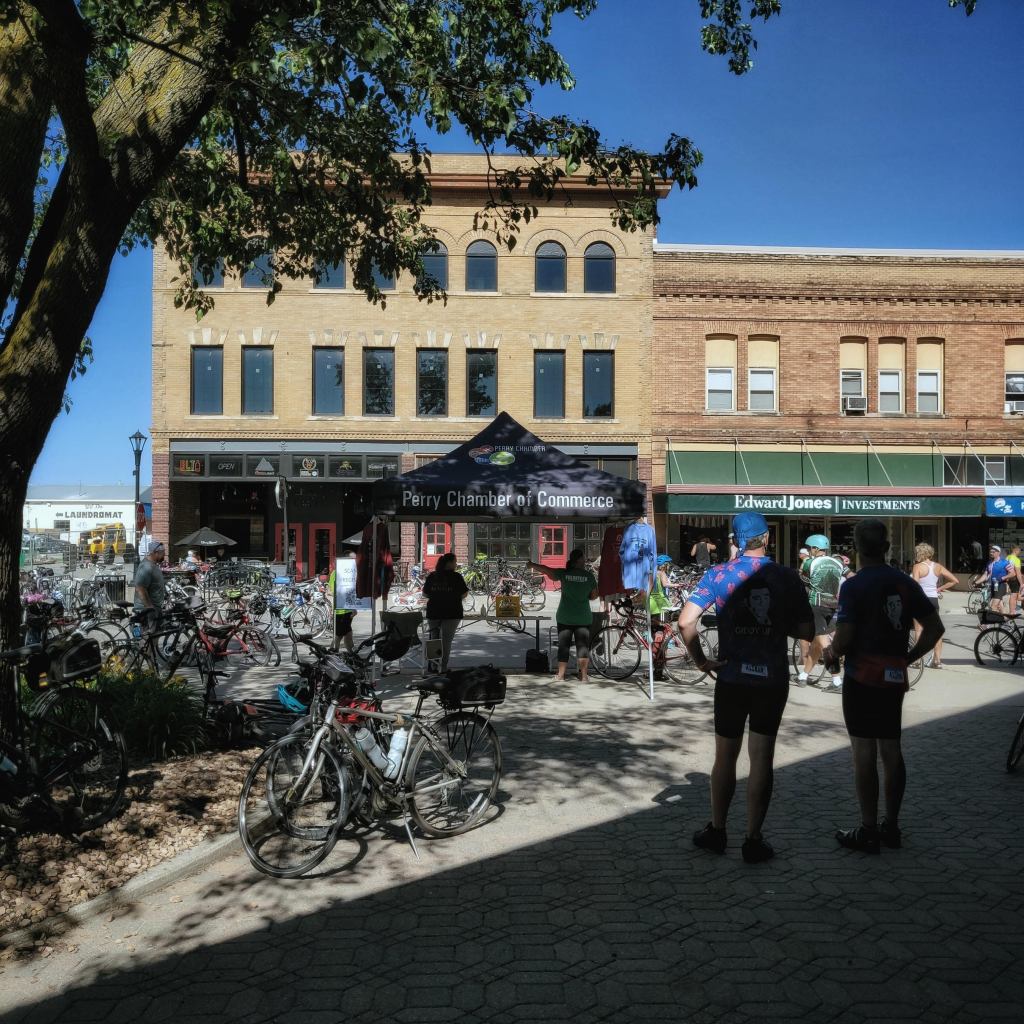
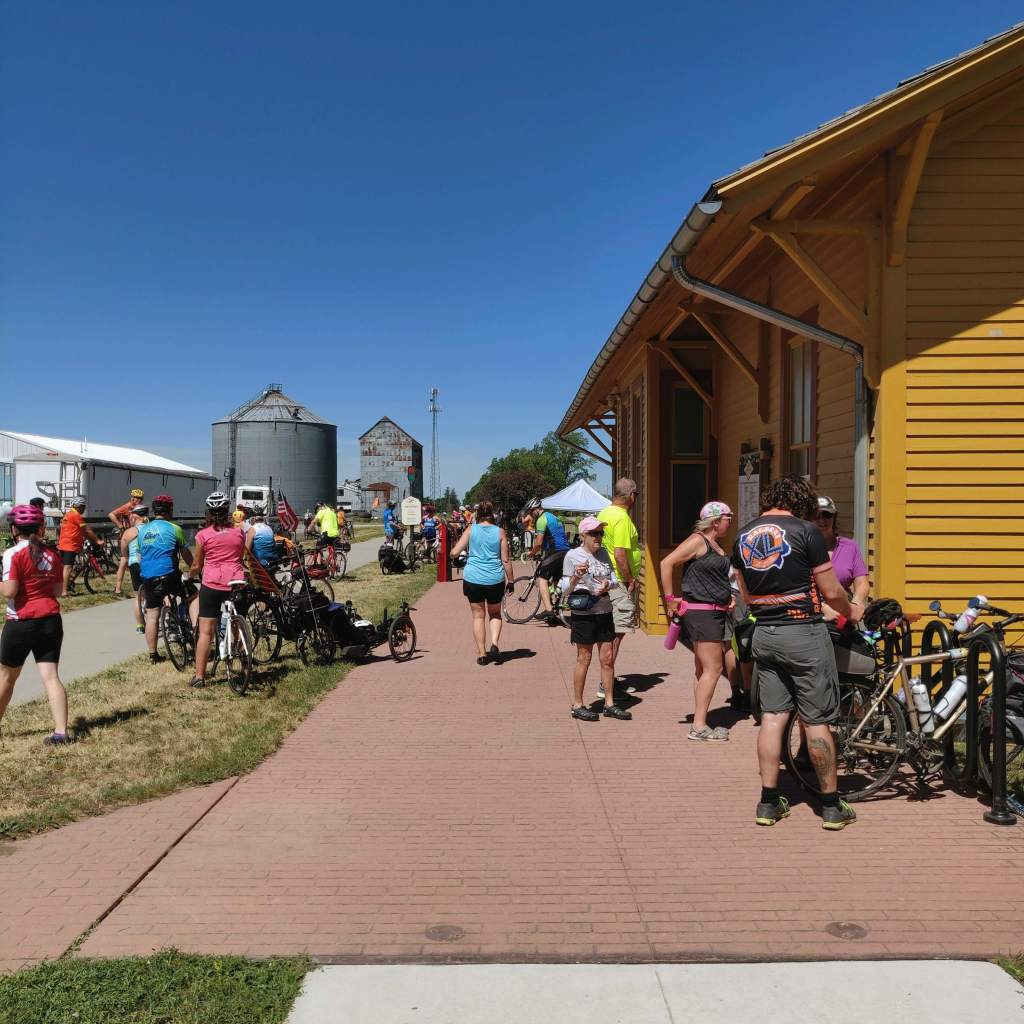
Road bikes outside a former train depot.

Why, I asked myself, were all these people riding road bikes? Because in the US, a road bike is the mark of a ‘serious’ cyclist. Because if you want a good workout–if your primary goal for cycling is exercise–you want a machine designed for competition, even if you’re only competing with yourself.

An electric bike can make cycling easier. This is where the ‘cheating’ notion comes in. Electric bikes can be fast–but with less physical effort. They can be fast with seatpost and tire suspension, which makes them more comfortable to ride. They can be fast with the rider in a more natural and comfortable riding position, with less neck and joint strain. They can be fast while allowing the rider to look around and enjoy the scenery.

And that’s ‘cheating’. Cyclists on electric bikes are cheating because they can go fast without having to suffer as much as regular bike riders. They’re cheating because they haven’t ‘earned’ the speed. They’re cheating ONLY IF you accept the notion that the primary purpose of a bike is sport or exercise or physical fitness. They’re cheating ONLY IF you buy into the way cycling is marketed.

Road bikes.

At the halfway point of a recent organized ride, while having a beer, I discovered that my sister and her husband simply didn’t see most of the cool stuff we rode by. A group of turkeys along the bike path, the dappled horses watching us ride by, a ring-necked pheasant that flew across the bike path about ten feet high directly in front of them, the turtle on a log in a pond, the fat groundhog. They didn’t see any of that, and it made me sort of sad.

Earlier I mentioned googling ‘ebike cheating’ and getting a flood of articles debunking the notion of cheating. Each of those articles base their ‘not cheating’ conclusion on the fact that ebike riders are still getting a good workout. They’ll tell you how ebikes still require physical effort–though the rider has more control over how much effort is expended. They’ll tell you ebike riders tend to ride more often than riders on regular bikes, and they tend to ride further–all of which increases the ebike rider’s fitness.

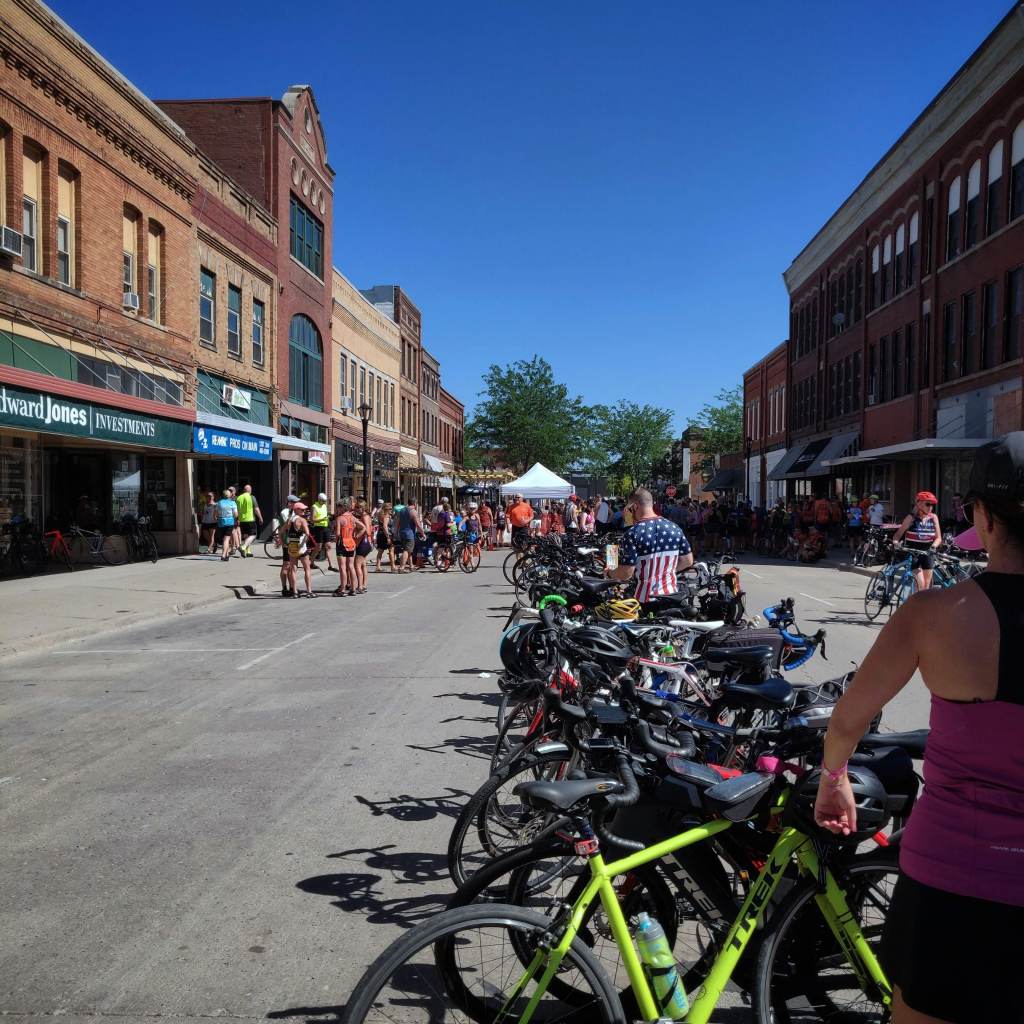
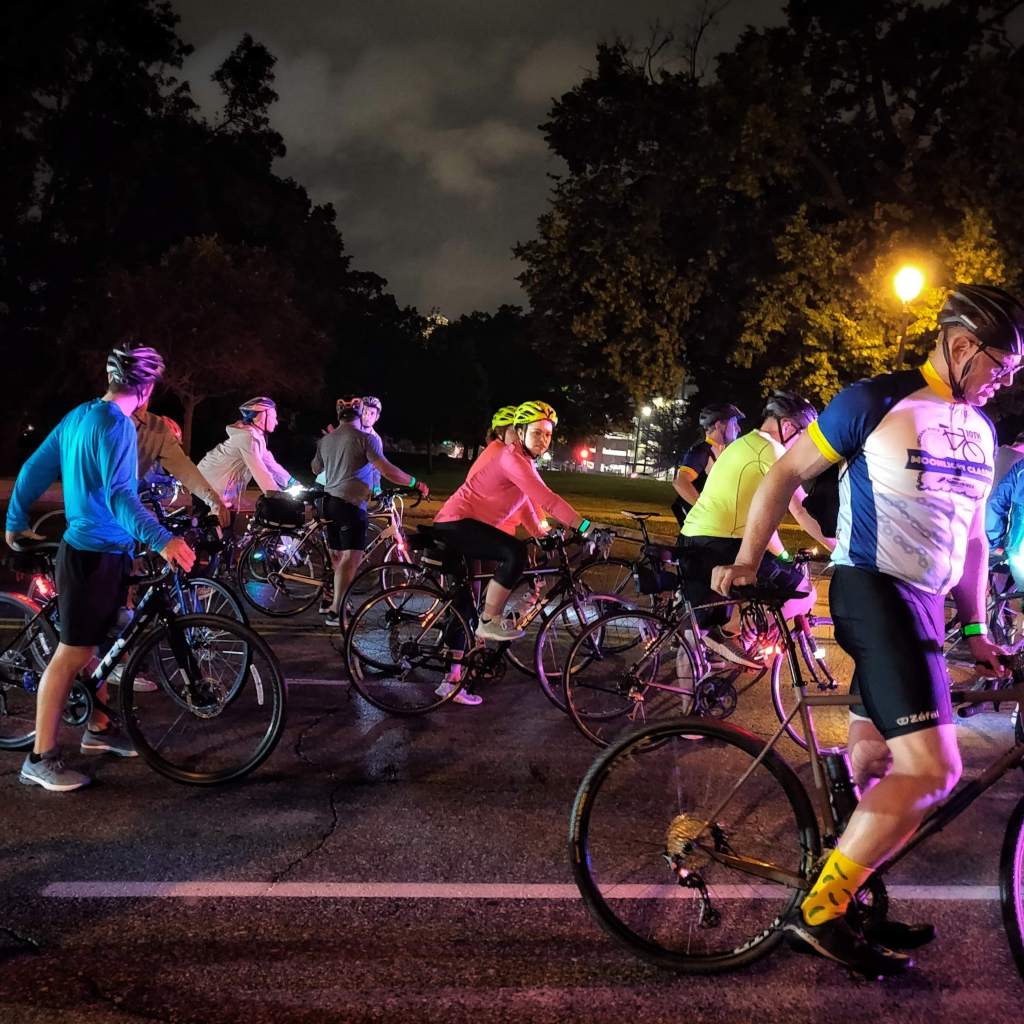
Road bikes on the Moonlight Classic.

Do you see the problem there? All of those articles accept the marketing premise–that the primary reason for cycling is fitness and exercise–as a given. None of them consider that there are other reasons for cycling. None of them consider that riding an ebike makes cycling more pleasurable, more joyous.

The problem is NOT road bikes. Road bikes are incredibly efficient machines. I’ve owned road bikes (though mine were all geared for touring rather than racing) and I’ve ridden them hundreds of miles. The problem (and I admit, this may only be a problem from my personal perspective) is that the marketing emphasis on physical fitness in cycling has turned it into a narrow form of self-competition that detaches riders from a richer experience. There’s nothing wrong with riding for exercise, but neither is there anything wrong with riding because it’s just fucking fun. I have never had as much simple joy and delight in riding a bike as I have this past year. Never.

For a lot of the riders in these organized cycling events, a beer at the end (or the halfway point) is seen as a reward–a sort of liquid recompense for the labor of cycling. I’m of the opinion that a beer is–or should be–just another pleasant facet of an already pleasant experience. It’s as integral to the experience as seeing a turtle on a log. You don’t have to have a beer or see a turtle on a log to enjoy a bike ride, but both enhance the ride in the same way.

I once read an article about the Dutch approach to cycling. It described cycling as a slightly faster way of walking. That fits perfectly with the way I ride. It’s just a pleasant way of getting around, quickly and easily, arriving at your destination (if you have one) without too much fuss, without being weary or sweaty (unless you want to be), and allowing you to enjoy and appreciate the world around you as you go.