find of the day

If you judged only by the number of morels plucked from the soil, then my first morel hunt of the season was an absolute bust. I saw one small grey morel, no larger than the first knuckle of my thumb. I found three times that many ticks on my clothes–so if this was a tick hunt, then it would have been slightly more successful.

However, if you just count it as a walk in the woods, it was an unqualified triumph. I went with my brother Roger Lee, who may be a tad too impatient to be a good mushroom hunter but has a nicely cavalier attitude about being in the woods. Some people hover around you when you’re in the woods–afraid to get too far away from you, afraid you’ll get lost or they’ll get lost. Roger Lee just wanders off with the casual assumption that somehow you’ll manage to meet up again somewhere. I like that.

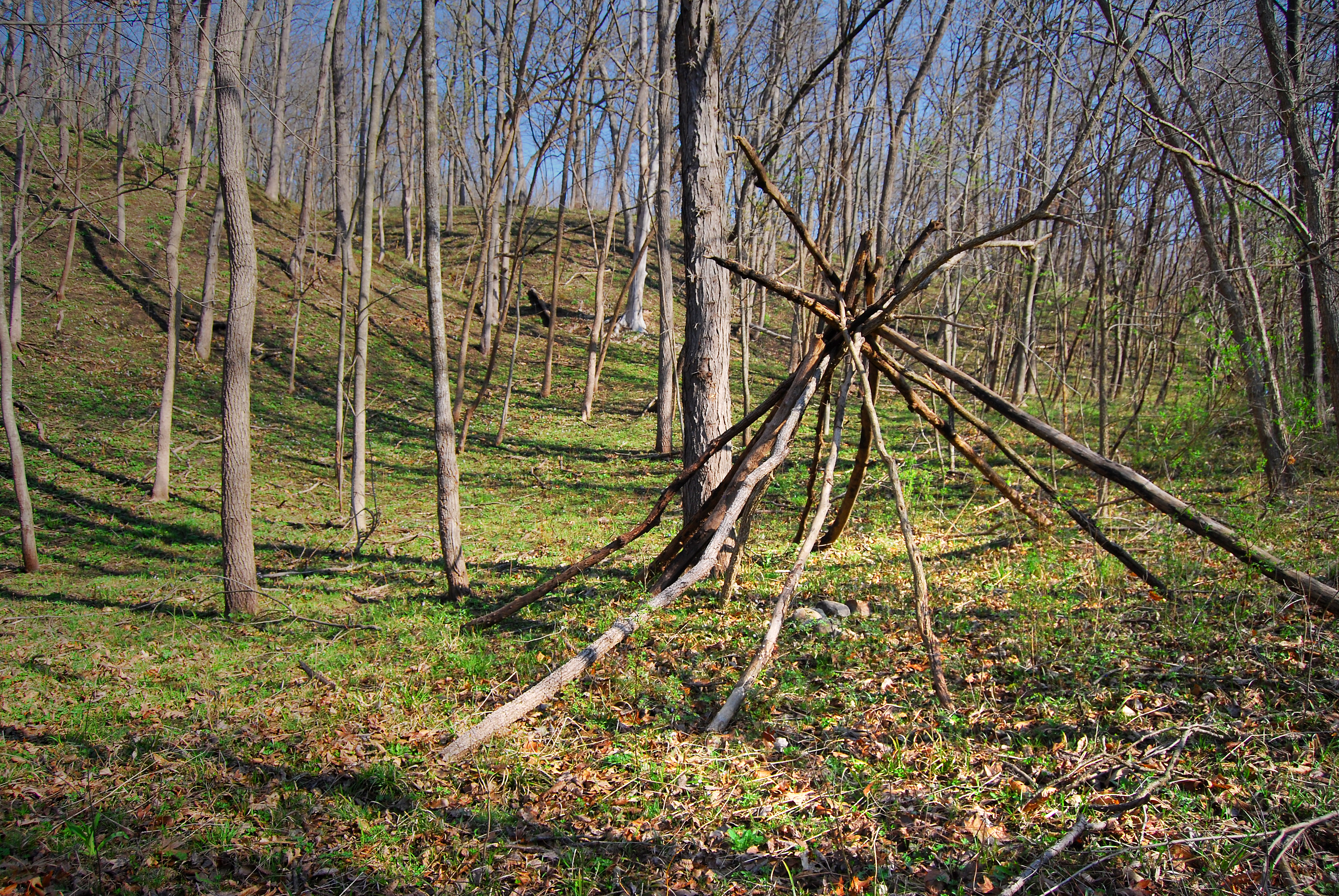
It was Roger Lee who made the Find of the Day. A tipi frame, almost camouflaged by being as bare as the trees around it. Centered below the frame was a small circle of rocks to serve as a fire-pit. Clearly somebody had camped there in the not-too-distant past; the need for a fire suggests last autumn or possibly even during the winter. The tipi was in a good spot–protected from the wind, a few yards away a small brook, isolated from view, far enough from the road to be inconvenient to find but close enough that fifteen minutes of steady walking would get you there.

But the tipi frame wasn’t the Find of the Day; that was just an interesting object. The woods are full of interesting objects–things that are thought-provoking but not particularly surprising. That’s one of the many reasons to walk in the woods.

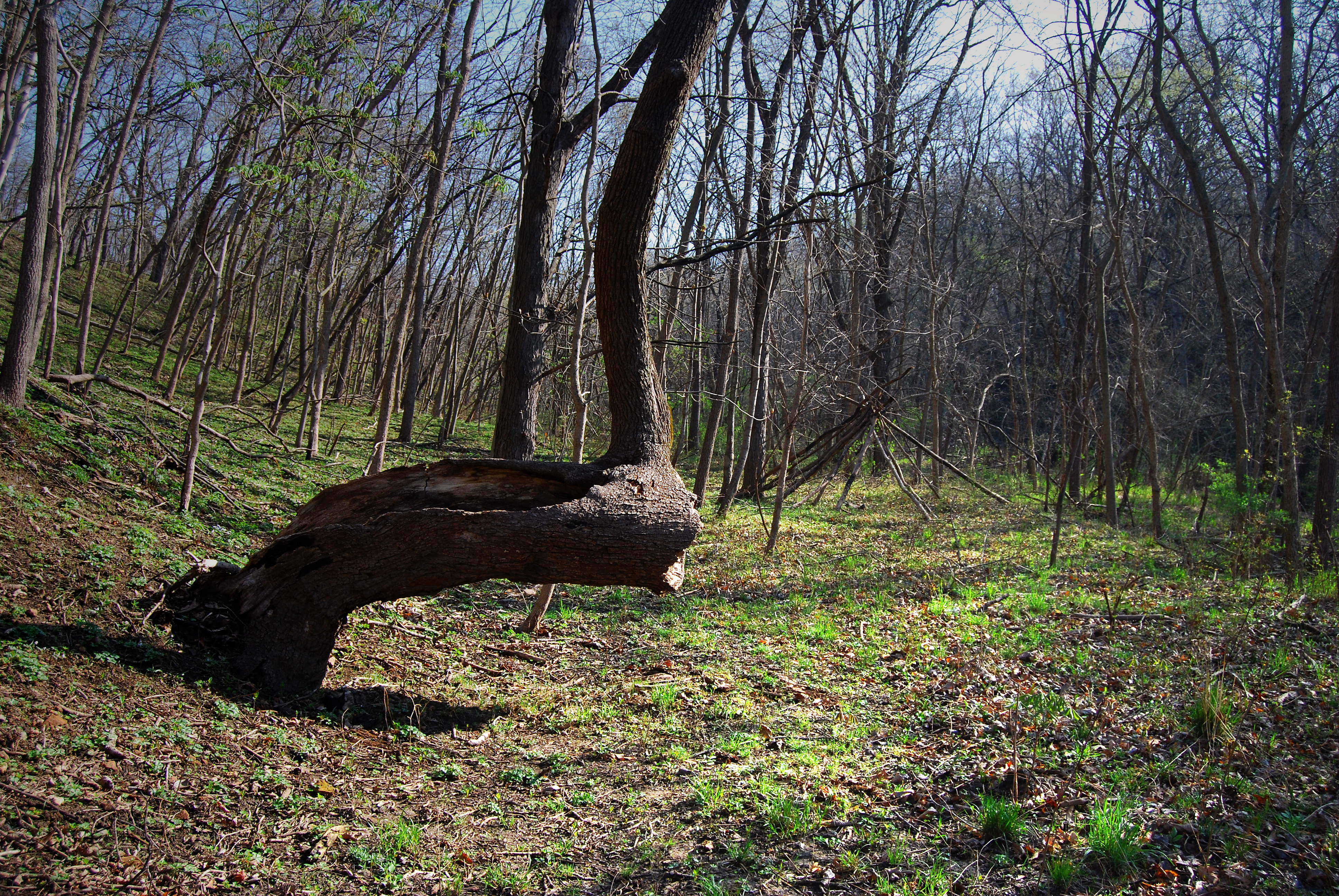
No, the Find of the Day was lurking a short distance away–maybe fifteen yards–hidden inside the hollow trunk of a dying tree.

The tree itself was an interesting object. It was bent and broken–maybe the result of an old lightning strike, maybe from some sort of rot, maybe ice damage, maybe an infestation of beetles–who can say? But it was bent and broken open, and the interior of the trunk was hollow.

The natural thing to do with a bent, broken, hollow tree trunk, of course, is to look inside. Which is exactly what Roger Lee did. You’d have done the same thing your ownself, you know it. What he saw inside, that was the Find of the Day.

I’ve written elsewhere about my fascination with a chunk of curbing wrapped in a length of red PVC wire. That object must have struck a chord with people, because since then I’ve received a number of emails from people describing similar found-objects, sometimes with cameraphone photos showing bits of concrete bundled in ribbon or stones tied up in wire like some sort of primitive holiday package. I find them all strangely fascinating.

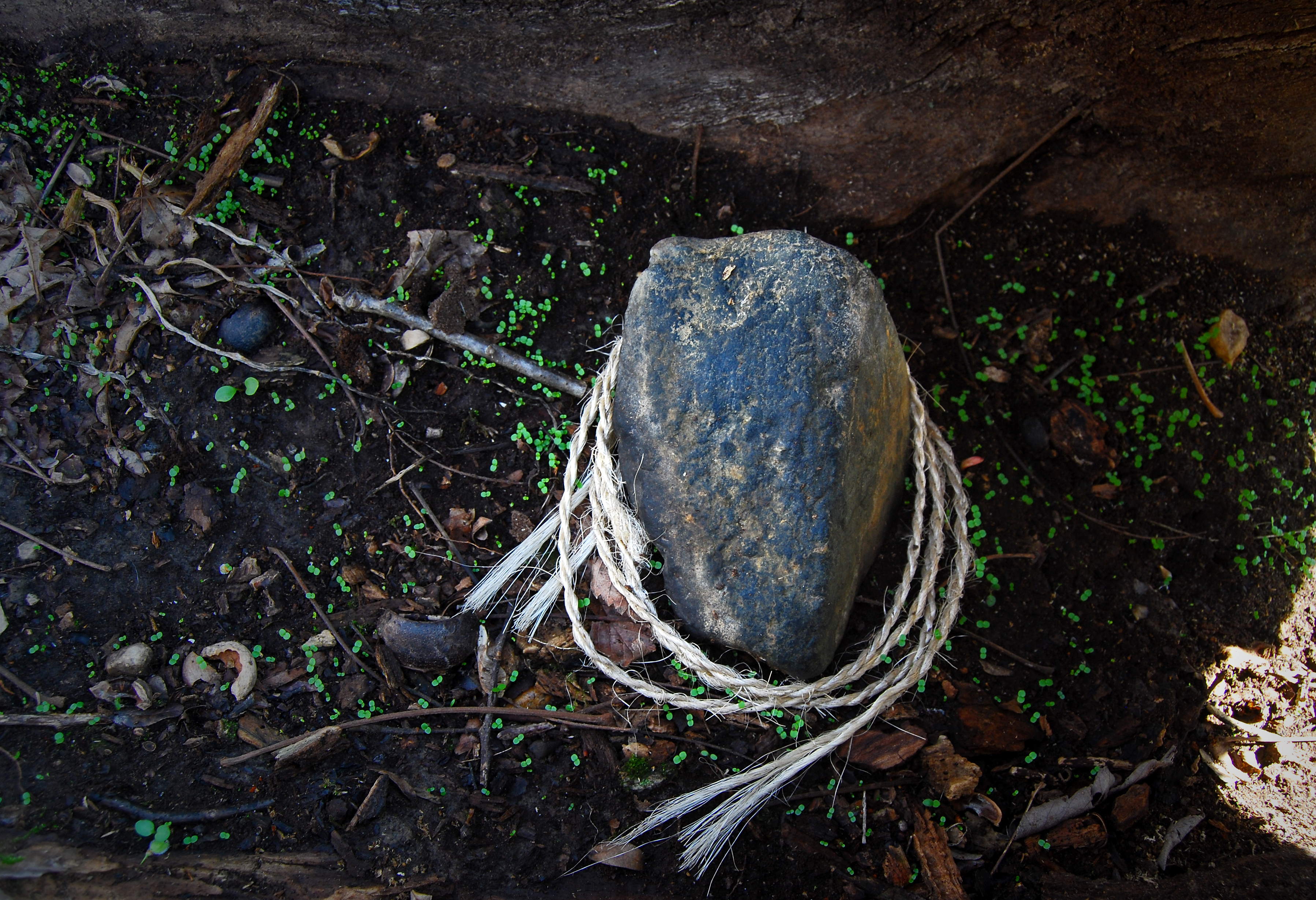
This is what was tucked away in the hollow of that bent tree:

I’ve no idea what this bluish stone is, although it appears to have been shaped at some point in the past. I’ve no idea why a length of twine is so tidily coiled around it, although the condition of the twine suggests it was done fairly recently. And I’ve no idea why it was stashed n the hollow of a dead tree trunk, although it clearly was stashed; it didn’t just wind up there by accident.

Somebody did this purposefully. Somebody deliberately placed the stone in the hollow of the tree, and just as deliberately encircled it with a length of twine. Most likely it was placed there by whoever was camping in the nearby tipi–but that’s just an assumption.

All I know is that this is strange and lovely and it moves me in some peculiar way. The Irish have a saying: Níl sa saol seo ach ceo is ní bheimíd beo ach seal beag gearr. It’s a misty old world and we’re only in it for a short, sharp while. It’s stuff like this that keeps it sharp.

go tell it on the mountain

I like to walk. If I have a destination—a specific place I actually intend to go—that’s okay. But I prefer to walk destination-free. Today I put aside the eighty thousand things I have to deal with and think about, and I walked.

It would be more accurate to say I went meandering—accurate on more than one level. The term meander comes from winding Turkish River called the Büyük Menderes, known for its twisting course. Homer mentions it in the Iliad. And today I walked aimlessly and slowly along a river. It’s the end of January and 64 degrees Fahrenheit, which is just bizarre. The ice was melting rapidly in the river.

I encountered a few people. Spoke to some of them. Didn’t speak to others. I’m not sure how I decided which ones to speak to and which ones to ignore. Some ignored me back, or ignored me preemptively. Others spoke and were happy and cheerful to be out in such weather. And one sang to himself, softly.

As I shot this photograph, a man of about my age came strolling by, singing to himself in a very small voice. It was an old Civil War era hymn—what used to be called a ‘Negro’ spiritual, a song of hope and the promise of redemption written and sung by a people you’d think would have little of either. “Go tell it on the mountain,” he sang. “Over the hills and everywhere.”

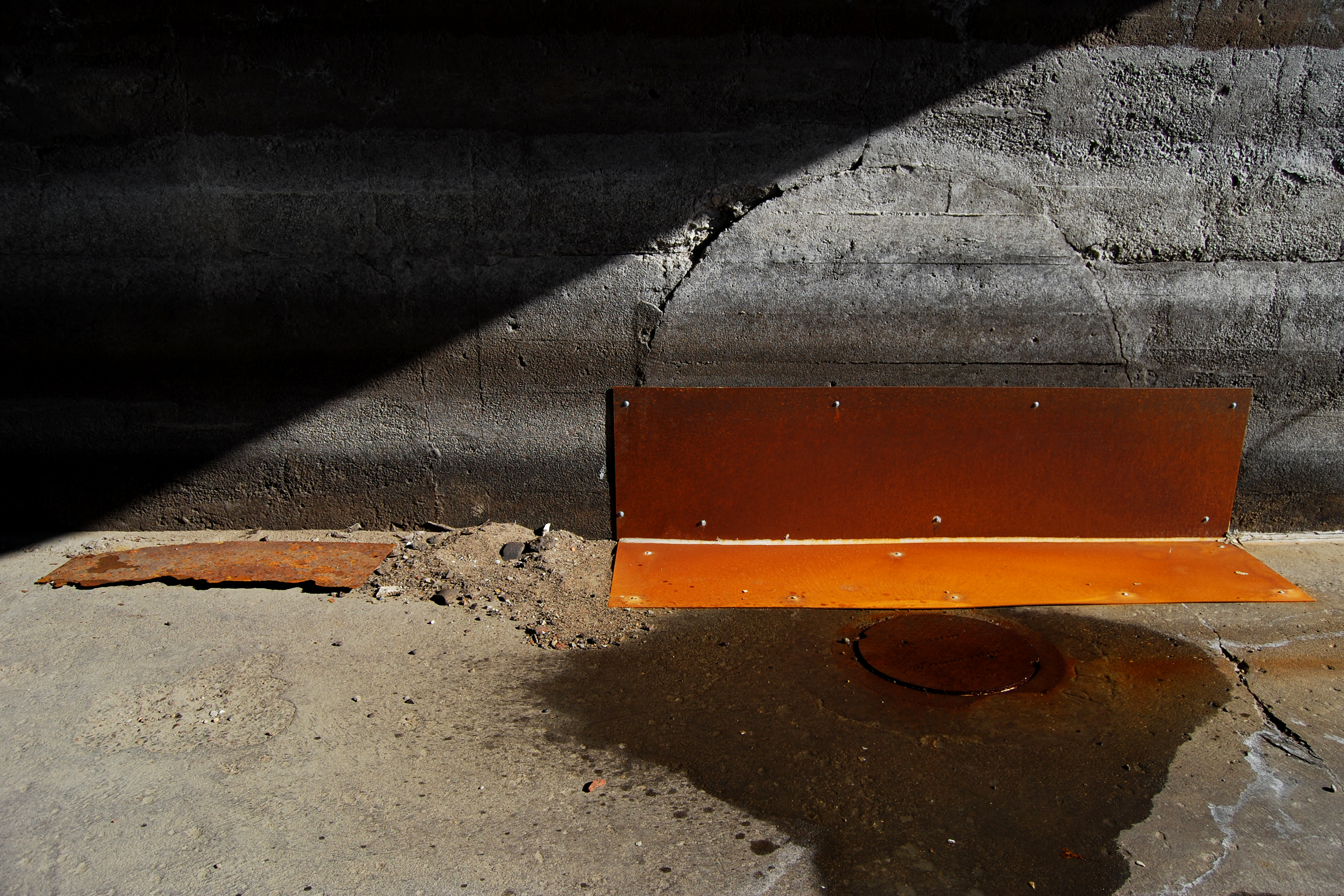
And it all cheered me up. An unseasonably lovely day. Walking along a river, walking in a way that takes its name from a river half a world away, a river celebrated in song and poetry for ten thousand years. Hearing a man singing another song, this one only a century old, but like the Iliad also about hope. Watching rust do its slow work, which for some reason I find oddly comforting. All of those things, they cheered me up.

There’s probably a lesson in there somewhere. A lesson or a moral. I have little truck with lessons or morals or spirituals, though I’m mightily taken with meandering. But whatever there lesson or moral there is, I’ll tell it on the mountain, and over the hills and everywhere.

hey bingo, it’s all good

I don’t know how it works for you (assuming ‘you’ are somebody who attempts Iron Photographer projects), but for me the IP process follows a few common patterns. Sometimes I know exactly what I want to do—and even if the final photograph has almost nothing to do with my original idea, the process is smooth and harmonious and I get that whole ‘A garden is a lovesome thing, God wot‘ feeling.

Sometimes I have absolutely no idea at all what to do (even though I help come up with the elements, along with the Blessed Jamelah—may her hair grow long), and I spend the two weeks of the project squatting toadlike and glaring at anything that might possibly relate to the three IP elements.

And sometimes I just say ‘fuck it’ and start jamming stuff together. Which is what I did here. The elements of Iron Photographer 143 are 1) something with a handle, 2) the colour orange (we add the irrelevant letter ‘u’ as a sop to our Canadian and British members), and 3) vignetting. I was shaving and I noticed the blue razor in the mirror and thought “Oh, something with a handle. Hey, bingo—Iron Photographer!” So I brought the razor with me from the bathroom. As I dressed I remembered I owned a seldom-worn orange t-shirt. Hey, bingo—two elements down.

But that would be a pretty dull photo, so I grab an old mirror off the dresser. Orange t-shirt as background, razor on the mirror and hey that’s still pretty damned dull. Wait, there’s an old Coca Cola bottle I’d set aside for the last IP project but didn’t use. Put it on the mirror and lawdy, it’s still dull.

Add some drama. Have the light reflect in the mirror, meter off the reflection. Nope, still dull. Get a sheet of black plastic, wrinkle it up for texture, put the t-shirt back down, fold it over a bit, add the mirror and the razor and the coke bottle, make sure the light is reflecting in the mirror and hey bingo—still needs something. Fuck fuck fuck.

Okay, maybe the bit of red plastic mesh I used in a much older IP project. Find that, knot it up. The red clashes horribly with the orange. I like that. Finally shoot a photo and—well, it’s better, but dull. Still dull. Still missing something.

Shift everything around. Shoot another dull photo. Shift it all around again. Shoot a couple more frames. The phone rings; I ignore it. Shift all the stuff around maybe three or four more times and shoot a couple more frames. Shifting it all around doesn’t help because it’s missing something. Shifting doesn’t add anything.

Study the mess I’ve made on the table for a bit, thinking about any of the bits that might please me. Decide what I like best is the curve of the mirror, and the curve of a fold in the t-shirt, and a curve in the knotted mesh and clearly what it needs is another curve. Grab a hanger from the closet. Slide it into the frame. No…slide it a bit farther into the frame. A bit farther. Too far. And there. Shoot two more frames. Process the one I like most, add a whole lot of vignetting (the third IP element) and…

Hey bingo, IP 143. Done.

Return the phone call I ignored earlier. First thing said: “What’ve you been up to?” And I realize I’ve just spent 90 minutes arranging and rearranging a jumble of random objects that are entirely unrelated to each other in any way. A razor, an old Coke bottle, a bit of mesh left over from some cherry tomatoes (that I didn’t eat, but bought purely because I wanted the mesh), a mirror, a t-shirt, a sheet of black plastic, and a coat hanger? So I confess to that over the telephone. After a long pause, “So, I’m thinking about going to Spain next summer.”

The phone calls ends after a brief chat. I look at the photo. It makes no sense. Nothing even remotely like sense. I consider deleting the photo. Then I figure, “What the hell. It’s Iron Photographer. The people who get it, will get it. The people who don’t will still discuss their travel plans with me. It’s all good.”

still talking

It was 34 degrees Fahrenheit when I gave into the fool notion to take a walk yesterday. I decided to visit the chunk of curbing. It’s been over a year since I first came across it—a small, displaced bit of asphalt curbing around which somebody had tied a length of red PVC wire fashioned into a sort of carrying handle. The bit of curbing had been toted a short distance from its original location—though I’ve no idea why anybody would do such a thing. It made absolutely no sense at all. That, of course, was its appeal.

After discovering it, I returned periodically to the site (an old, deteriorating parking lot that once surrounded a supermarket, but now surrounds the grassy field where the supermarket used to be) to look at and ponder the meaning of the chunk of curbing and the wire. It attracted attention from other folks as well. I never saw them, but the chunk of curbing was moved on at least one occasion.

Since I tend to over-think almost everything (apart from my behavior) I developed the conceit that I was engaged in a sort of ongoing conversation with the chunk of curbing. I looked forward to seeing it, which I realize sounds completely unhinged. But there it is. I’d developed a peculiar fondness for a bit of molded asphalt.

On my last visit—back in October—I noticed somebody had tried to move it again, and the red PVC wire had completely snapped. The chunk of curbing and the red PVC wire were no longer connected. I fully expected the next I visited the lot, the wind would have swept the PVC wire away. The conversation seemed to be over.

But I was wrong.

As you can see, the red PVC wire is still there. Totally divorced from the chunk of curbing, but it’s still there. I’ve no idea why; we’ve had serious wind storms—storms powerful enough to knock down trees. And yet there it is, splayed out slightly differently than before but in what appears to be the exact same spot. The original chunk of curbing, along with a companion chunk that appeared some months ago, seem to have moved again—which is entirely inexplicable and illogical. But against all expectations, the wire and the curbing are still there.

I find that reassuring. I guess the conversation isn’t over yet. I’ll visit again in a few weeks and see what I can see.

looking at puddles

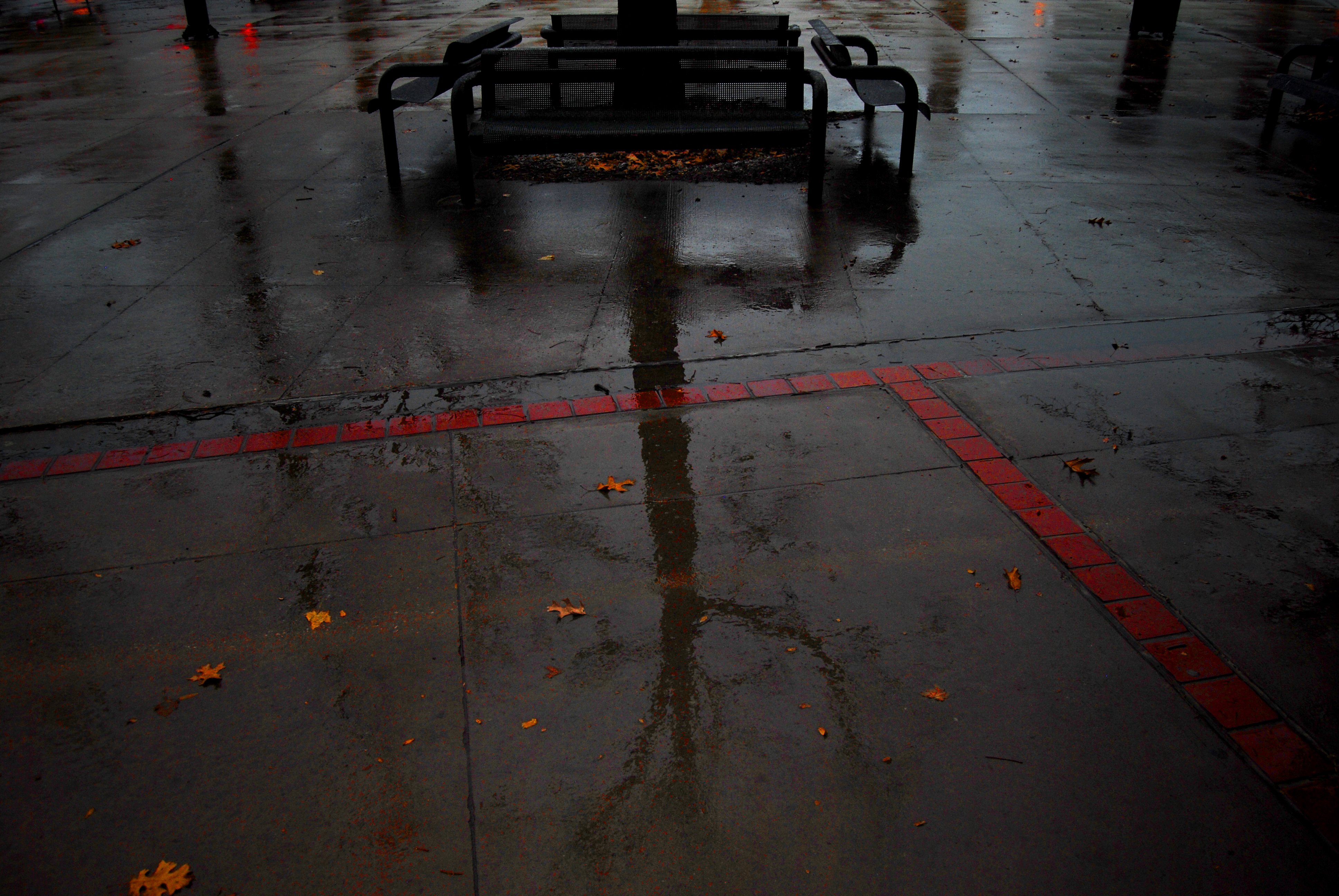
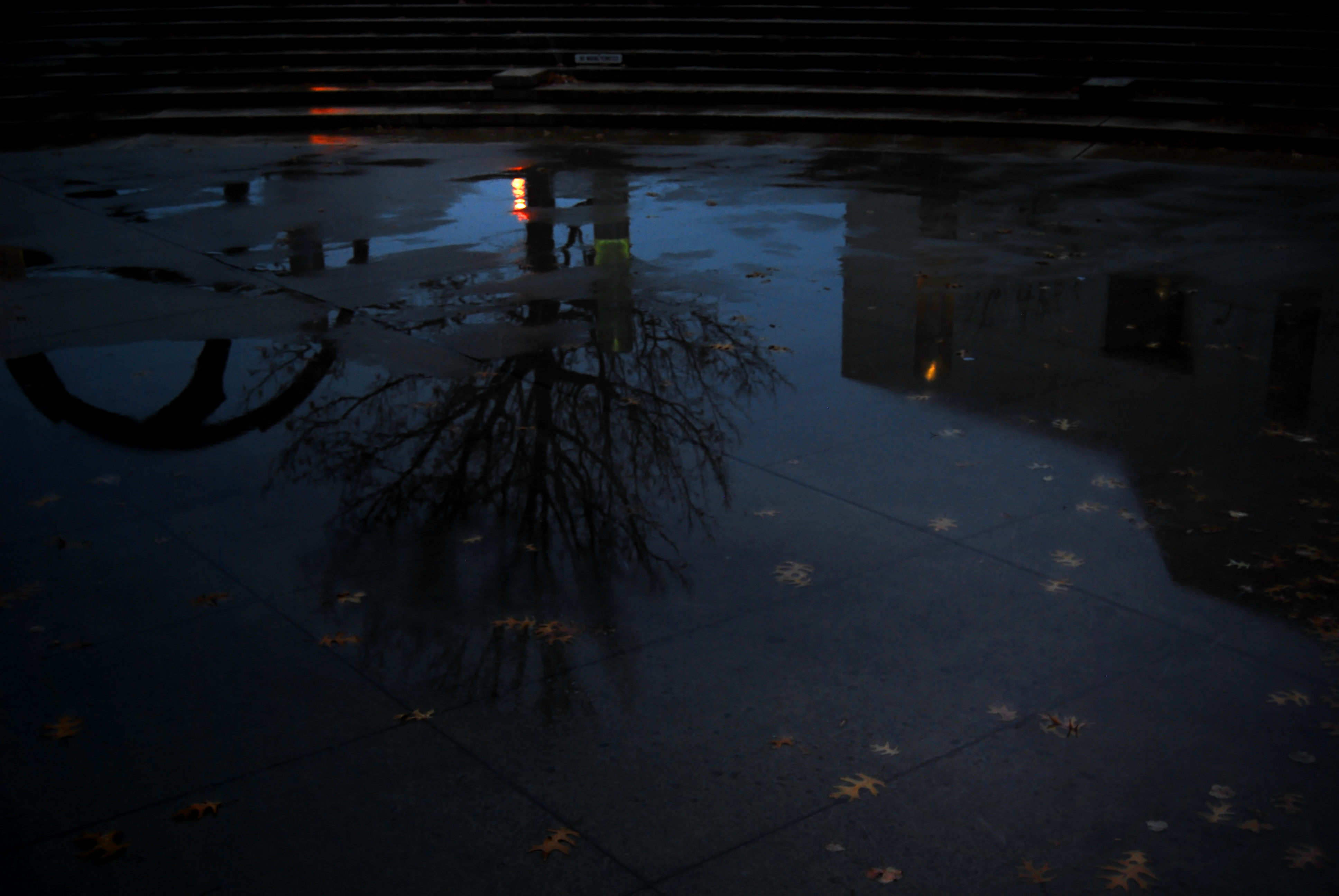
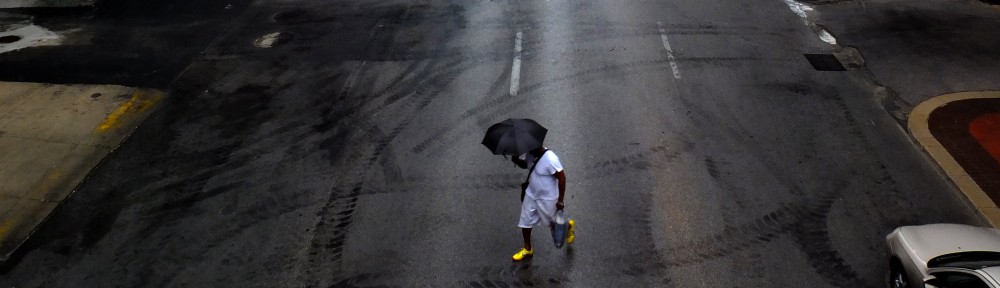
Yesterday was one of those cold, windy, wet, altogether miserable days. It snowed, and the snow turned to sleet, and the sleet turned to rain, and the wind blew hard enough in some of the narrow streets that at times the snow/sleet/rain was actually flew upwards.

So I went for a walk. Partly because it was Thursday and I belong to a group of folks who traditionally walk on Thursdays. But I’d have gone for a walk regardless of the day, because the snow/sleet/rain layered enough wetness on the streets and sidewalks to make them reflective. Even better, we’ve reached that time of year when it starts getting dark early—which is a thing I both love and hate.

It casts a gloomy pall over the world. Despite having watched every episode of Buffy the Vampire Slayer (most of them more than once), I’m not generally a fan of the dark and the foreboding and the brooding. But it’s a condition that makes for great visuals.

There’s a tipping point, of course—especially when it comes to puddles. Like most folks who’ve picked up a camera, I’m intrigued by puddles. But a puddle that’s too big lacks mystery. It just becomes a reflective surface. But a puddle that’s patchy, that’s barely there, that’s unpredictably disrupted by the contours of the surface—that’s the puddle for me. That’s a puddle with character.

That’s a puddle that will get me outside despite the snow/sleet/rain, and despite the wind and despite all rational thought.

Some day, when all my other projects are finished and I’m casting around for something to do, I’ll develop a taxonomy of puddles. A systematic classification of puddles based on the similarities and dissimilarities of their morphological features.

But no, of course I’ll never do that. I don’t really want to think systematically about puddles. I just want to look at them. I just want to walk around in the gloomy half-light of early evening, freezing my aging ass off in the snow/sleet/rain and look at puddles.

speaking in stones

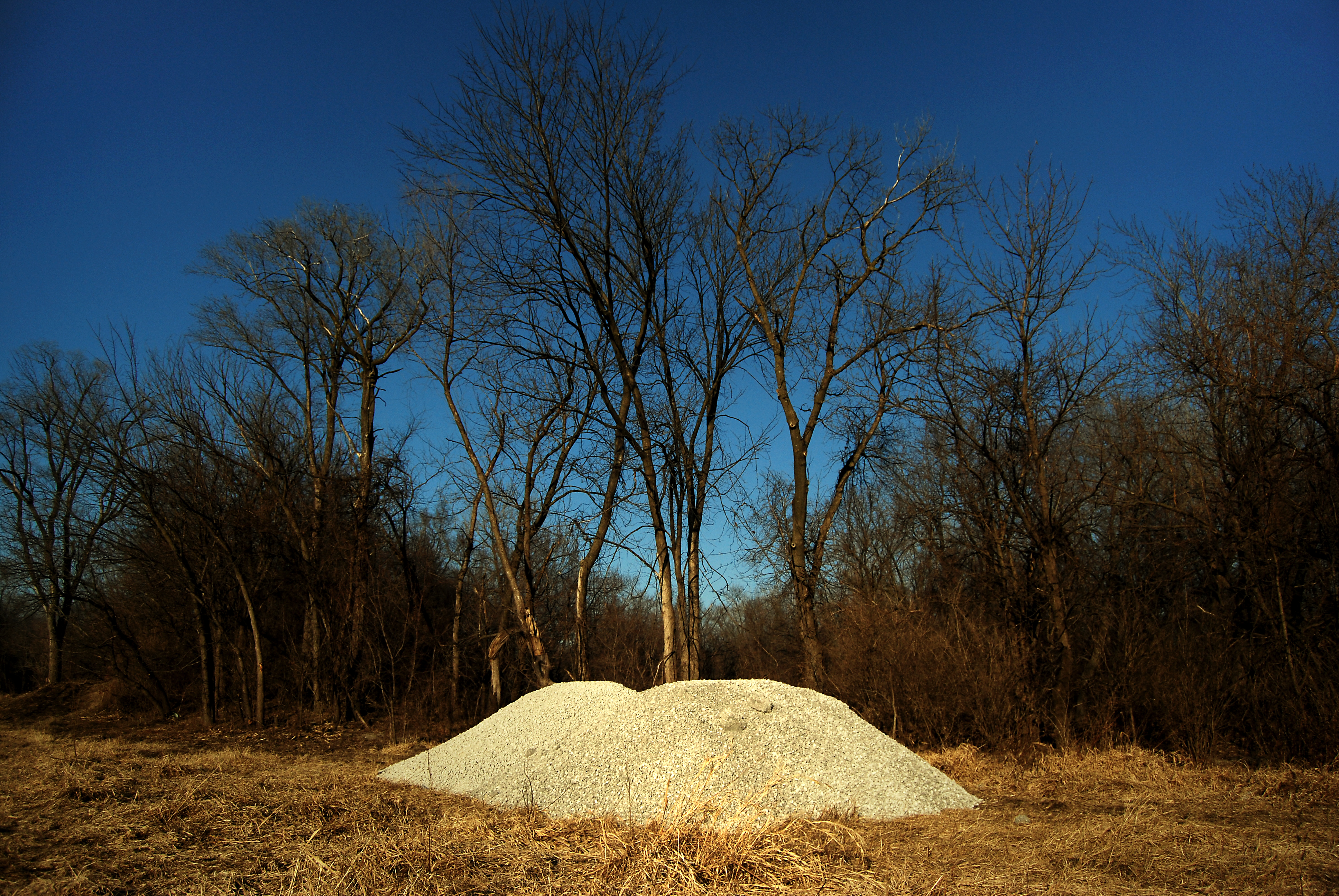
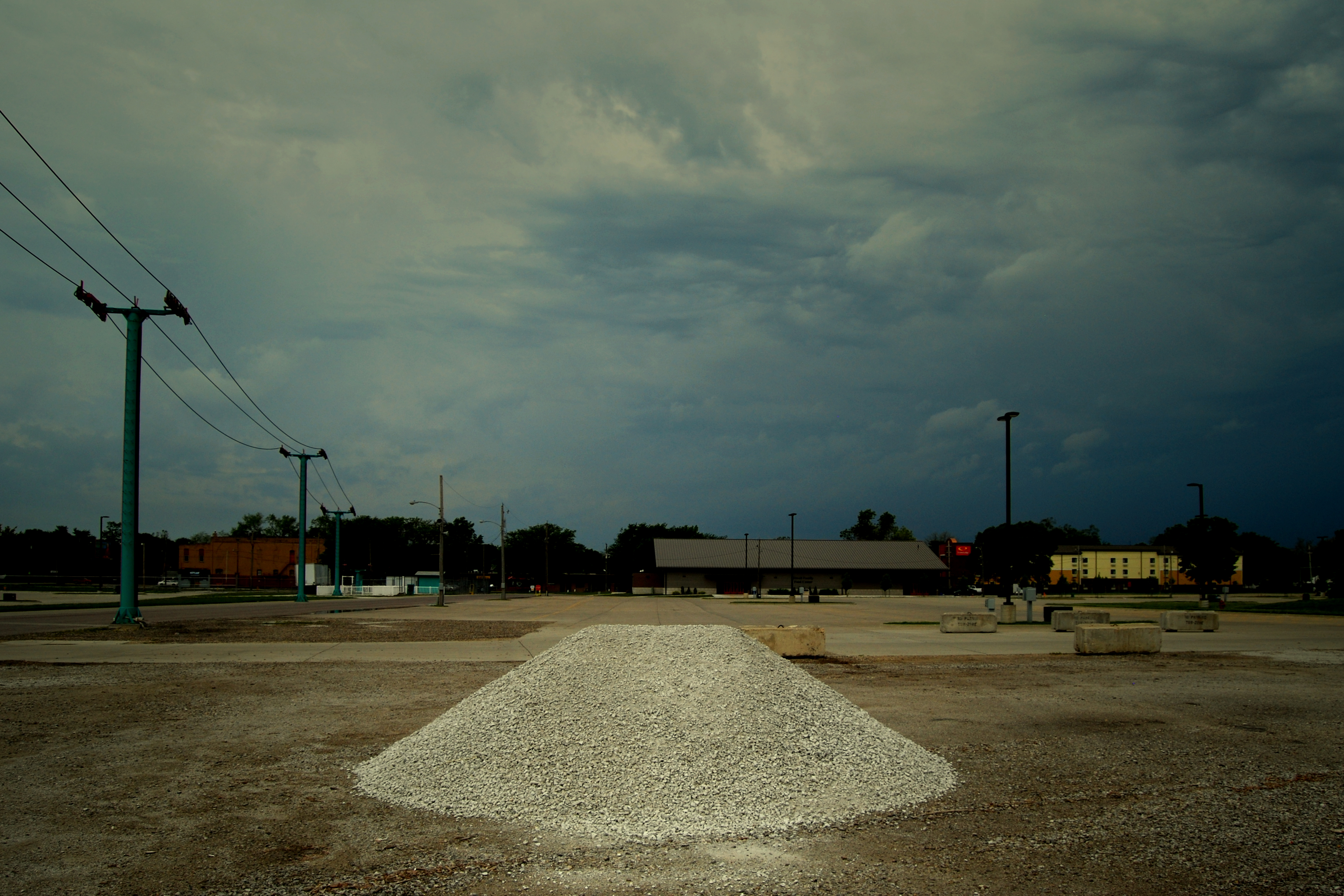
I am drawn to piles of stone.

Much of the appeal is that a pile of stones, no matter how disorganized or haphazard it appears to be, is clearly a product of human intervention. Outside an avalanche, a pile of stones doesn’t happen by accident. Somebody put them there. The exact placement of the stones may have been a matter of chance or convenience, but nonetheless they were put there—and put there deliberately.

People have been piling stone on stone for millenia. Literally. There are cairns and megalithic structures dating back to 9000 BC. Piling stones has always been a means of communication. At first, a pile of stones was a simple way to mark a trail—a device for telling others which way to go. Humans being human, the simple eventually became elaborate. Trail markers became boundary markers—a device for telling others where not to go. As the messages communicated by the piles of stones became more elaborate and sophisticated, so did the piles themselves. People began to pile stone for artistic and spiritual reasons.

And we got Newgrange in County Meath, And we got the pyramids at Giza. And we got the cathedral of Notre Dame in Paris. What is a tomb or a temple, after all, but a sophisticated pile of stones?

Obviously, the piles of stone I photograph haven’t any intentional meaning. They weren’t put there for any religious, artistic or social reason. They were just dumped there. Raw material at a construction site.

But the actual reason the stones are piled in any particulat place is, for me, entirely irrelevant. In my mind, I always choose to attach some sort of social significance to the stones.

Not seriously, of course, but inventing some meaning for the pile changes the way I see the stones. By giving the pile some arbitrary purpose, the stones cease to be mute construction material waiting to be used. Like those earliest piles of stone, they become articulate; they convey a message.

And they become beautiful.

Maybe this is one of the reasons I became so engaged by that chunk of curbing.

iron photographer

One of the things I love most about Utata—the peculiar collective of photographers I’m involved with—is a project we call Iron Photographer. We’ve been doing IP projects since April of 2006. Every two weeks Jamelah Earle and I come up with three elements—two compositional elements and an artistic element—which our members try to put together in an artful way.

The IP process begins when Jamelah and I chat about the elements over Instant Messaging. We purposely refuse to come up with a list of possible elements in advance; we want the elements to grow organically out of the conversation. Sometimes one (or both) of us isn’t in the mood to be creative, and the process is messy and awkward and a jangle of nerves, annoying as a paper cut. Other times the process is like the very best jazz, improvisational and intelligent and funny and entirely unpredictable. Sometimes it starts off one way and ends another, or goes through two or three iterations of each. But somehow, we always manage to come up with something.

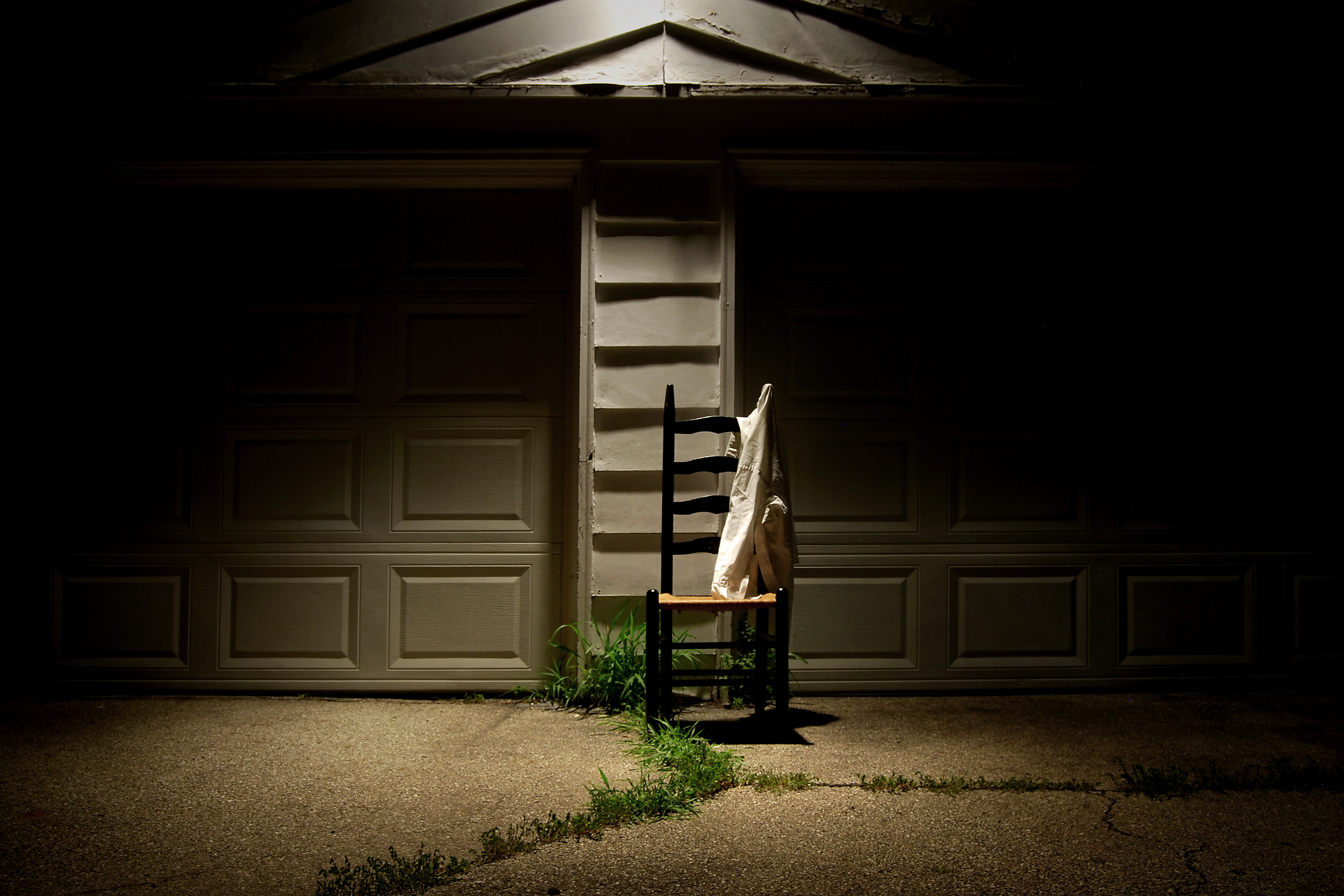
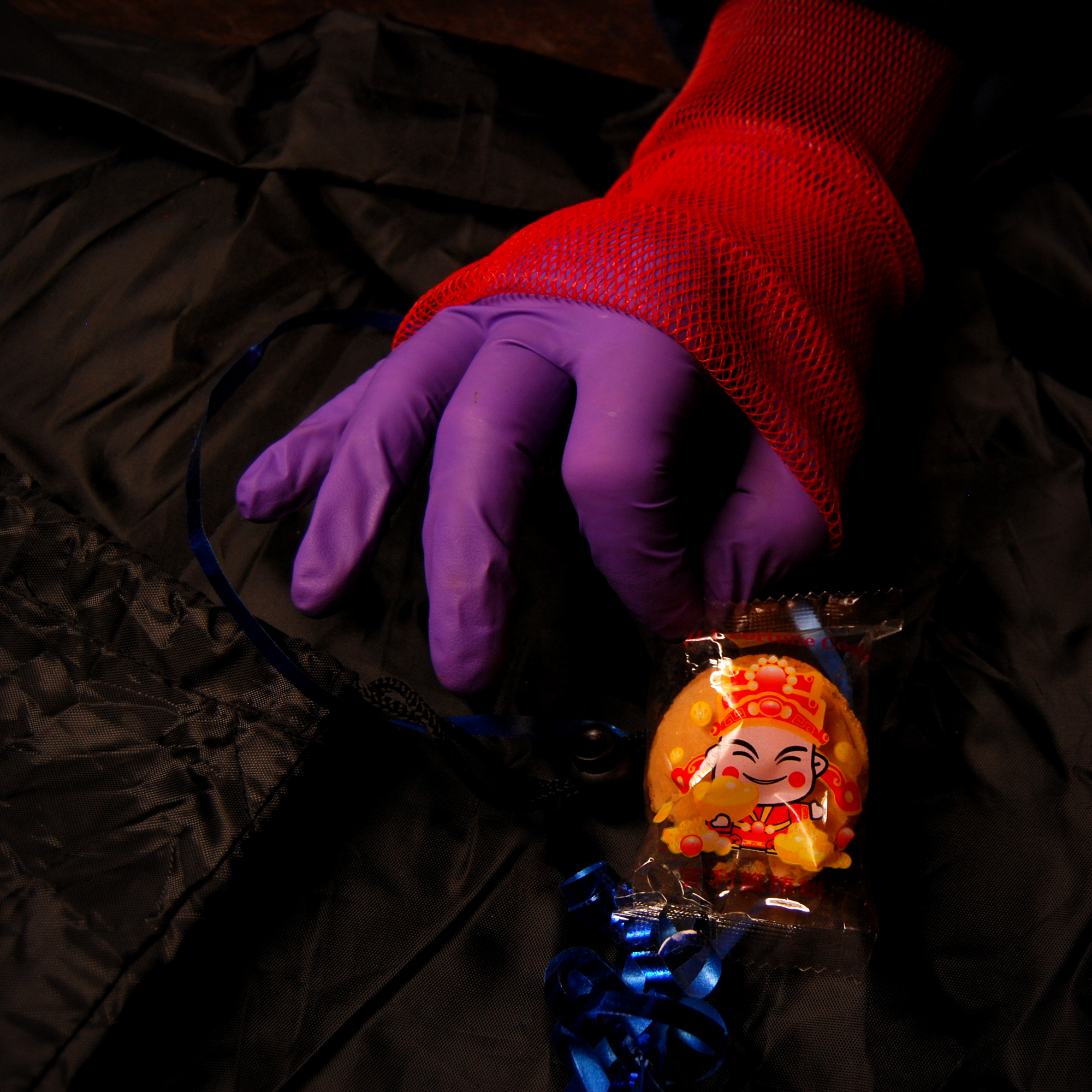
The elements can be…let’s call them idiosyncratic. Something with stripes, a food item, shot slightly out of focus (IP 47). Something white, a chair, shot in a gothic style (IP 102). A plastic bag, something red, shot in square format (IP 118).

What’s amazing to me is how often the members of Utata can take the most impossible and bizarre elements and find incredibly creative and artful ways to put them together. They do it so beautifully and with such consistency that they’ve forced me to become a better photographer in an attempt to keep up with them.

There’s nothing quite like a community of smart, funny, creative people to keep the creative juices percolating (if juices percolate—which under most circumstances, they don’t but in Utata percolating juices wouldn’t raise an eyebrow).

one conversation is nearly over

For almost a year I’ve been visiting an odd bit of curbing in a vacant lot where a supermarket was once located. There are two or three places where the curbing of the store’s parking lot had been broken up. It’s not clear if that destruction was accidental, intentional or organic. What was clear, though, was that somebody—for reasons entirely unclear—had tied a length of red PVC wire around a chunk of the broken curbing and carried it some sixty feet away.

And then set it down. I’ve been fascinated by it ever since. Why was it moved from its original position? Why that particular chunk of curbing? Why fashion a carrying handle from red PVC wire when it would be just as easy—easier, in fact—to carry it in your hands? And why leave it where it was left? It made absolutely no sense. I loved it.

Over time, the chunk of curbing was moved again—maybe twenty or thirty feet from its last position, and perhaps it would have been moved farther had the red PVC wire ‘handle’ not snapped. On a later visit I noticed the curbing had been overturned and another chunk of curbing had been carried and set down nearby.

It continued to make no sense, and I continued to be fascinated by it. But now the conversation is almost over. On my last visit, the curbing had been moved once again.

As you can see, the chunk of curbing has been moved and the red PVC wire left behind. In fact, both chunks of curbing have been shifted a few feet from their last positions.

I suspect kids are responsible for most of the recent moving, if only because young boys do things for reasons even they don’t understand—or no reason at all. It doesn’t matter, really who moved them, or even why. There’s something appealing about these migrating chunks of curbing. But the wind will probably blow away the red PVC wire eventually. And then the conversation will be over.

I’ll continue to visit the vacant lot, of course. There’s something about the slow reclamation process that I find weirdly comforting and attractive. There’s a sort of drama to it, though a very patient drama. It’s a different sort of conversation—less peculiar, more fundamental.

This abandoned lot is set on a fairly busy thoroughfare in a moderately poor neighborhood. Nearby is a car-wash, a small local Latino-operated auto repair shop, and an indie copying center that never seems to have any customers. The road noise is vicious—at least until you get near the back of the empty lot. Then it becomes muted, and it’s difficult to distinguish between the road noise and the sussuration of wind through the trees.

It’s not quite tranquil. But you can sense that tranquility used to exist here, and may some day return. That’s a conversation I’d like to join.