the women’s march — seven years ago

Seven years…seems like a lifetime. Donald Trump, with the aid of Vlad Putin, had been installed in the White House. Women decided to protest.

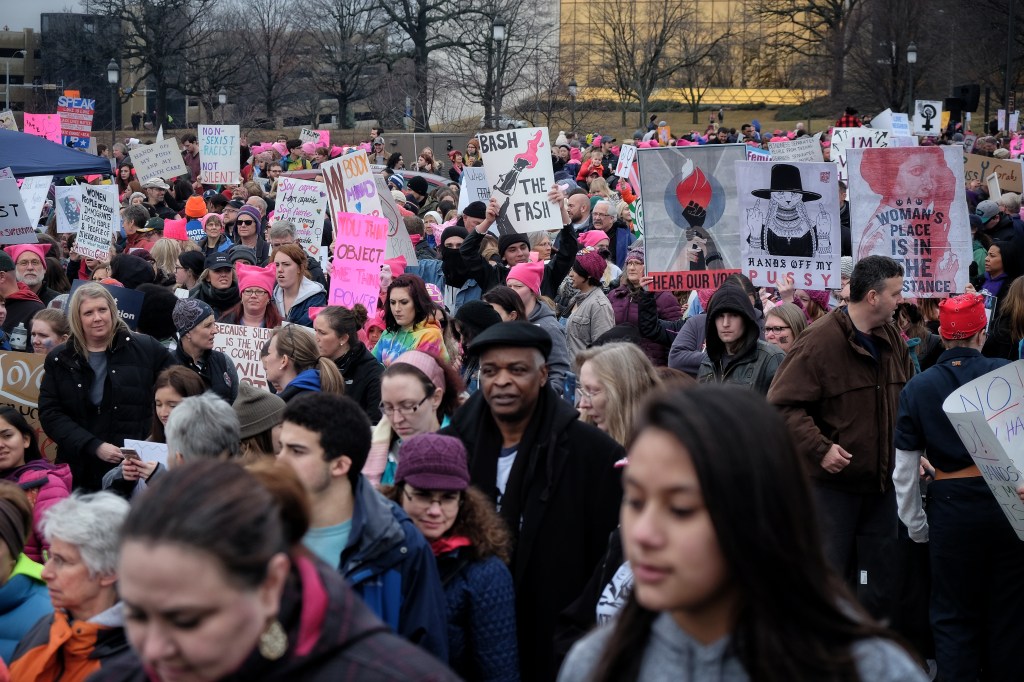
It was really that simple—which is to say it wasn’t simple at all. It was a spontaneous desire to protest, but it took incredible coordination by a group of volunteers. The original plan to march in Washington DC expanded to other major cities, then to more modest cities, then to small towns. In fact, there were satellite protest marches across the globe. There are no truly accurate numbers, but it’s estimated that in the US more than five million people marched that cold January day. That was a little over 1% of the US population. It was, in the end, the largest single-day protest in US history.

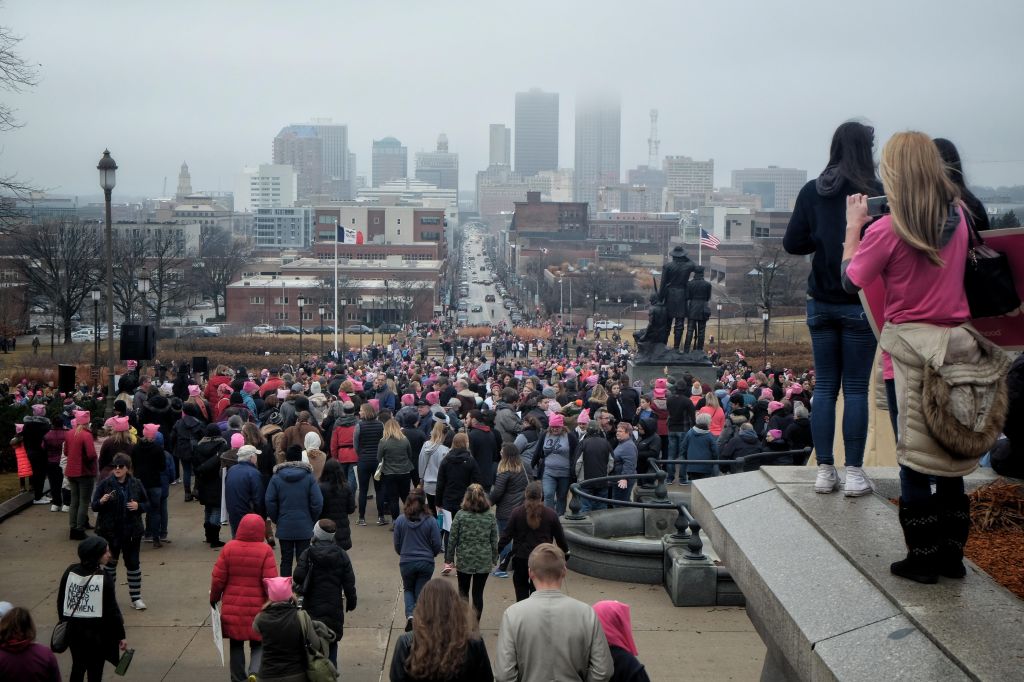
The crowd began to gather. We hoped to get 6000. We got 26,000.

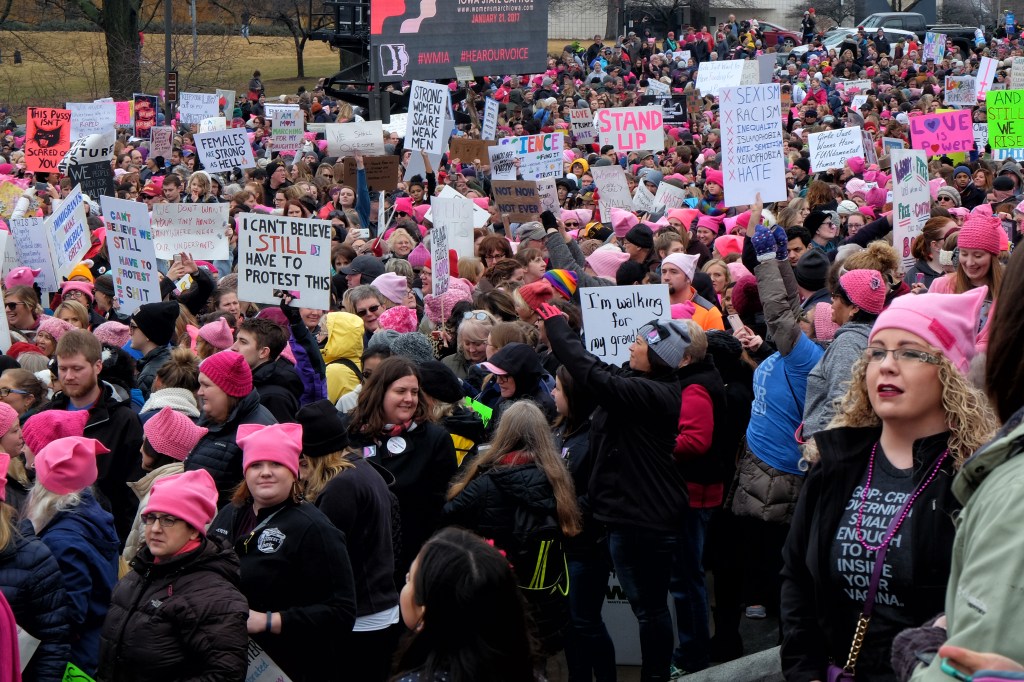
A couple of women in Los Angeles had an idea to create a hat that would not only help marchers stay warm, but would also be a visual statement of protest against a man who bragged women would allow him to “grab them by the pussy.” The pink pussy hat idea was flawed (it didn’t represent women of color or trans women) and was later abandoned as a form of protest, but on that day it provided a singularly powerful visual and emotional impact. It was, in a way, a sort of counter MAGA red baseball cap. The hats were also an example of the fundamental opposition to Trump; the vast majority of the pink pussy hats were made by hand by volunteers—often by personal friends of the marchers themselves.

Listening to music; waiting for the speeches to start.

I marched in Des Moines, Iowa. Originally, the organizers thought we’d have a couple of thousand marchers. Later, they hoped to have maybe 6,000. Then they thought it was possible for 10,000 to show up. According to the local newspaper the final estimate was approximately 26,000. (I wrote about the march and the pussy hats a couple days later.)

Oh Jeez

It was mostly women and girls, but a lot of men showed up as well. All ages. It was as racially diverse as Iowa gets (which, let’s admit it, isn’t terribly diverse). Abled and disabled. We gathered at the Iowa state capitol building. There was music, there was food and hot coffee, there were speeches, there were spontaneous chants, there was singing, and then we…well, marched. I use the term ‘march’ rather loosely. We basically hiked around the capitol grounds. Because this is Iowa, the march itself was far more polite than the signage and the chants; we didn’t block the streets, we didn’t get into any punch-ups with the very few counter-demonstrators, and we didn’t leave a mess for other folks to clean up.

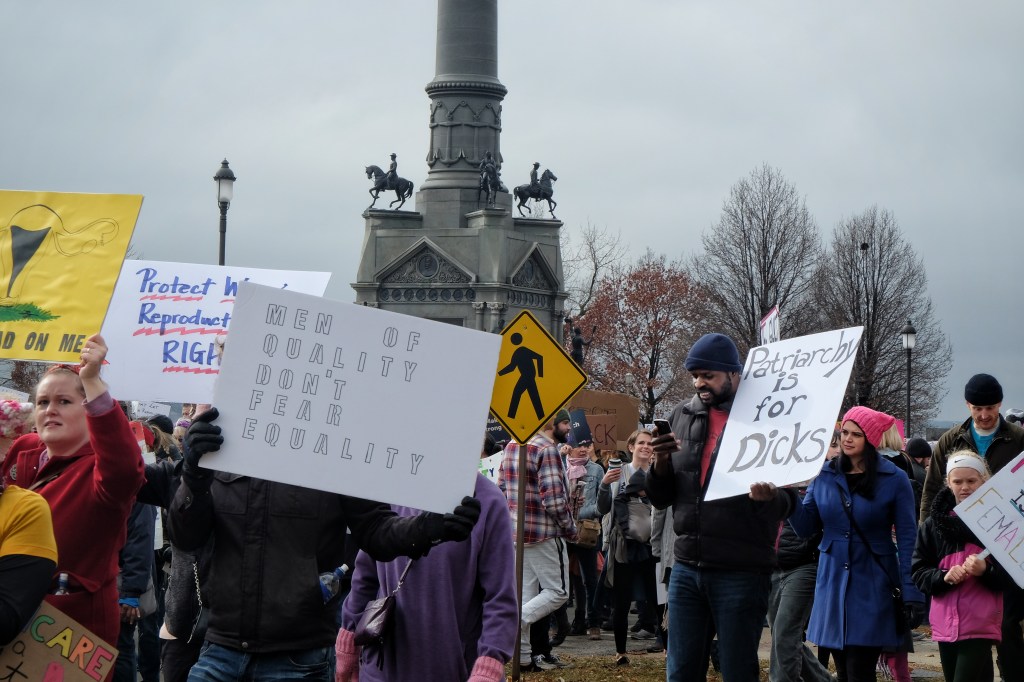
Patriarchy is for dicks.

I suppose the march officially ended when we’d returned to our original location, but few people left at that point. It may have been anger and concern that sparked the march and brought us all together, but once we’d gathered there was a pervasive sense of togetherness that everybody seemed reluctant to dismiss. There was a sense of hope, a feeling that if we all acted together—if we all worked for each other—we could mitigate the harm we fully expected to come from a Trump administration.

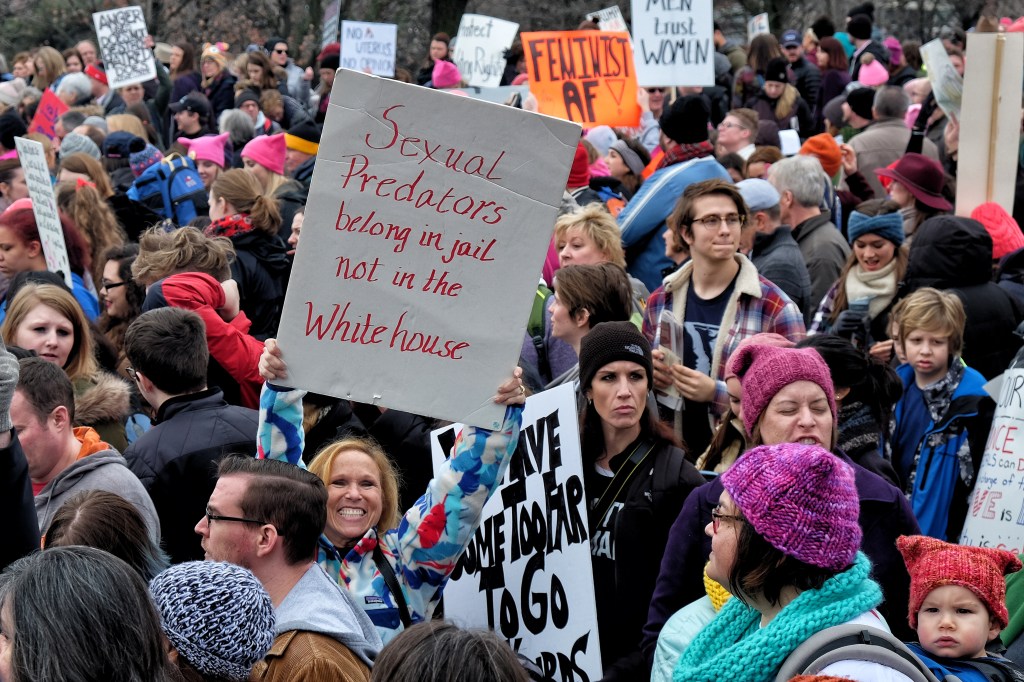
Not in the White House

We were so innocent. Trump was—and still is—worse than we could imagine. He’s done more damage than we thought possible. He had—and still has—more support for his authoritarian, anti-democratic, racist, misogynistic, vindictive agenda than we could conceive. I don’t think any of us had any idea of just how ugly, how hateful, how mean-spirited Trump’s supporters would be. We certainly didn’t anticipate how persistently and aggressively they’d attack long-held civil rights and liberties. We were so terribly innocent.

We’ve put away those hats, but we’ve kept the righteous anger.

It’s been seven years since the March. And we’re tired. Physically tired, emotionally tired, spiritually tired. We’ve put away our pussy hats (I still have mine—made for me by a friend, Kim Denise—stashed in a drawer), and rightly so because they weren’t inclusive. Our confidence in the benefits of protest has eroded; our confidence in our system of governance has been abraded by constant aggressive assaults by right-wing hate.

Bash the Fash

It’s fucking hard to be optimistic. The March itself, which was a buoyant expression of righteous anger and determination, has become a prolonged grind. It feels like the coming election will determine whether it’s possible for the US to recover from Trumpism.

Believe it.

So it doesn’t matter that we’re tired. We know what we need to do. We don’t need to gather together in person and march again, we don’t need pussy hats, we don’t need clever signs or chants. What we need is pretty simple. We need to gather together in spirit and tell Trump and all his enablers and supporters to go fuck themselves.

Just like the March itself, it’s that simple. Which is to say it’s not simple at all. But it’s necessary.

just another nightmare

I used to have recurring nightmares. Well, I still have recurring nightmares, but they’re not recurring as often. For a few years, I’d have 2-3 nightmares a week. Like most folks, I occasionally have your basic bog standard bad dream (somebody chasing me, shit like that), but they’re qualitatively different from the recurring nightmares. I can shrug those off. I’m talking about the sort of nightmares that wake you up and sometimes leave you too jittery to go back to sleep. Or too afraid to try to go back to sleep for fear the nightmare will return, and you’re just too fucking fragile to deal with that again.

Now I have a nightmare maybe every month. Maybe every six weeks. Okay, wait…a tangent. Sort of. When I say I have recurring nightmares, I mean I have four basic nightmare scenarios that repeat themselves; the scenarios are based on actual incidents. I’m not going to discuss the scenarios or the incidents that sparked them because that would take too long. And besides, the incidents don’t really matter; what matters is the nightmares.

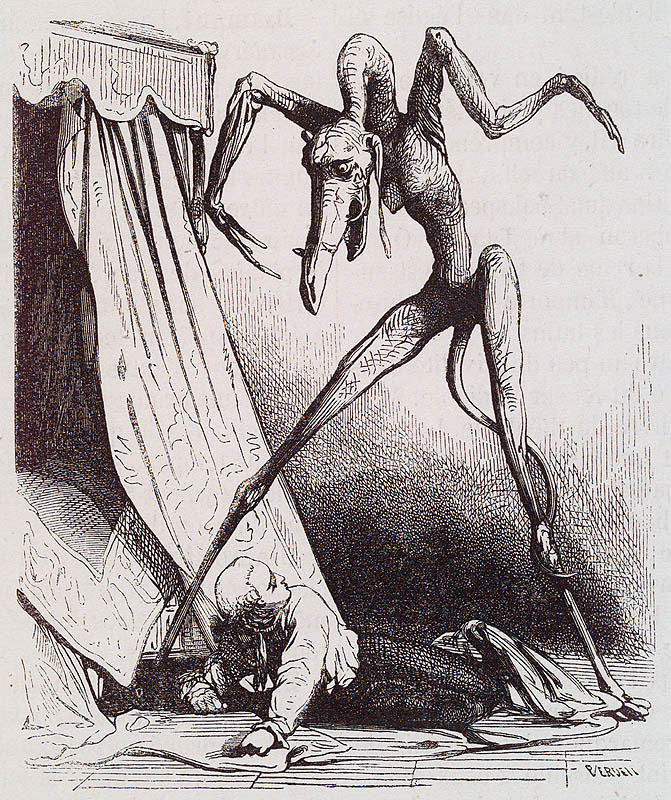
This is NOT my nightmare, but you get the point.

I’m writing about this because last night (well, early this morning) it happened again. I had a nightmare that woke me up. Here’s the weird thing: when I had them more often, I learned to cope with them. I was so familiar with them, I was often able to defuse them WHILE DREAMING. “Oh, right…light shining under a closed door, I know that one. Just open the door, see the horrible thing, and get on with it.”

I knew what to do when I had those nightmares. If I was too spooked to go back to bed, I knew how to distract myself so I could relax. Read for a while, maybe listen to some music, drink some cold water, eat a spoonful of peanut butter. Something mundane and ordinary to mute the effect of the nightmare.

But now that the recurring nightmares are less frequent, I find I’m sometimes more discombobulated by them. The nightmare that woke me up this morning had one of the usual recurring tropes (the sound of an empty Coke can being twisted back and forth in order to break it into two jagged-edge pieces suitable for hacking at arms and necks). Just at the point where the blood starts, I woke up; the last thing I remember was hearing a voice saying, “That’s not going to be covered by the manufacturer’s guarantee.” Which totally took the edge of the horror, so when I woke up I wasn’t so much terrified as weirdly but uncomfortably amused.

And yet, I was still too anxious to go back to sleep. None of my distraction techniques worked, mainly (I think) because my mind kept repeating that ridiculous phrase, which kept the nightmare alive in my head. Sort of alive.

So here’s me, three hours later, having had my morning coffee and read the news and banged out the Wordle (got it in four, as usual), and still nattering on about the nightmare. But now I think I can go back to bed and get another hour of sleep.

Thanks for listening.

the privilege of the sword

I don’t know if this is a thing or not, but during the holiday season (which, for those not in the US, is the period between our Thanksgiving and the New Year) I tend to re-read favorite novels. It’s probably got something to do with comfort and quiet and nesting. I don’t know, but there it is and I’m not going to think about it too much.

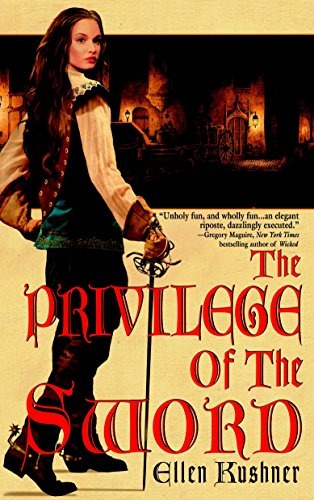
This year I’ve decided to re-read Ellen Kushner’s The Privilege of the Sword. It’s probably been a decade since I read it, but it’s a novel that resonated with me. I’d read her earlier novel, Swordspoint, a few months before. The Privilege of the Sword (okay, I’m just going to refer to as PotS from now on) isn’t exactly a sequel to the earlier novel, but it’s definitely sequelish. It includes many of the same characters and takes place in the same “fantasy” world.

You’ll note I’ve put “fantasy” in quotation marks. Both novels are often listed as fantasy novels, which is a genre I tend to associate with some sort of magic (and, too often, elves and dragons). I’m fundamentally skeptical about the use of magic (and elves and dragons) in a story, but I accept that they’re inextricably bound up in the fantasy genre. I accept them in the same way that I accept the frequency of murder victims in cozy mysteries. I tend to wince a little when it happens, then get on with the story.

As I started reading Swordspoint, the first novel, I kept waiting for somebody to do something magical. It was sort of like having a new car; you know it’s going to get dinged at some point, so you’re sort of tense every time you leave it in a parking lot. But once somebody opens their car door and dings your fender, you relax a bit. The damage is done. My point is I couldn’t quite relax and enjoy Swordspoint for the first few chapters, because I was waiting for somebody to wave a wand or cast a spell or something. Eventually I realized it wasn’t going to happen. It was a tremendous relief.

There’s no magic in either of these novels (at least not as an element of the story; the magic is in the quality of the writing). These novels are fantasies in the same way one of my childhood favorite books, The Prisoner of Zenda, was a fantasy. They’re set in an imaginary but internally consistent story world, one in which politics and political intrigue play as much a role as the swordplay. The ‘fantasy’ element is the way the story world–its culture, its social norms, its customs and traditions, its concept of status–is maintained and made real.

So why have I decided to read PotS instead of Swordspoint? Because I recall PotS as a more human story. I recall it being funnier, sadder, more simple but more surprising, more elegant, more intelligent, and more (for me, at any rate) emotional. My recollection may be faulty, but I’m relying on it anyway. There’s an excellent chance I’ll reread Swordspoint as well.

The basic plot of PotS (as I recall) is as follows: a young, rather flighty young woman is called to attend her uncle — the mad and deliciously depraved Duke of Tremontaine — who has decided, for obscure reasons and against all tradition, to train her as a swordsman. In both novels, disputes are sometimes/often decided by setting hired swordsmen against each other. The young woman (I think she’s in her teens?) is initially more interested in attending balls and attracting a potential husband, but tolerates her uncle’s peculiarities for her family’s sake. Eventually, she learns to appreciate swordplay both as a skill and for the freedom it provides her. Her new talent and attitude also allows her to help others who aren’t able to help themselves. There are, as I recall, at least a couple of subplots which are woven seamlessly into the narrative.

Some of that may be incorrect, but that’s how I remember it. What I remember most is that delicious feeling of being completely engaged with the story world and the characters who inhabit it.

I’ll start re-reading PotS this evening or tomorrow, depending on when I finish the novel I’m now reading (the most recent Murderbot novel) and how busy I am. I’ll take my time reading it — maybe read 2-3 chapters a day. I may report back here every few chapters.

I confess, I’m a tad hesitant to start re-reading it for fear it won’t quite hold up to my memory and my expectations. It’s always a risk to return to your favorites, isn’t it.

farewell to flickr

I joined Flickr in December of 2004. For a long time, Flickr–more particularly, a Flickr community called Utata–was a significant part of my daily life. I’ve mentioned this group several times on the blog (just counted–29 posts mentioning Utata) because it was massively influential in my digital life. I made a lot of friends because of Utata. I participated in a lot of photographic projects (both personal projects and group projects). I wrote a large number of essays about photographers (the Sunday Salons) for Utata. I spent hours every week monitoring, promoting, and supporting Utata community discussions. It was a lot of work and I loved it.

The last photograph I posted on Flickr — 01/31/2023

But over time, it became a grind. Part of the problem was classic burnout; I was doing too much, taking on too many tasks, agreeing to too many requests. That was compounded by changes in the way Flickr ran itself — changes in ownership, changes in policies. Those changes had a massive detrimental effect on the way communities operated. Over the last 18 months, I gradually slipped completely out of the orbit around Flickr and Utata. Eventually, I stopped using Flickr altogether. I no longer even thought about it.

Until a few days ago, when I noticed I was still paying for a Pro Flickr membership. It wasn’t a lot of money — less than US$9 a month — but I asked myself why I was spending a hundred dollars a year on something I don’t use. I opened Flickr and saw that I haven’t posted a photograph there since January. I was never a prolific poster; I rarely posted more than one photograph a day. As I became less interested in Utata, I posted fewer and fewer photos.

The true purpose of a fence is to create the desire to climb over it — 08/08/2006 (51,534 views)

Out of curiosity, I checked my Flickr stats. I’d only posted a total of 2412 photographs in my 19 years on Flickr. That’s an average of about 125 photos per year. Only 51 photos were post in all of 2022 — one a week. My most viewed photo was taken in 2006 — a black-and-white image of a converted barn, with an unforgivably long title.

I even went back to check my first photograph on Flickr, which turned out to be a selfie. December 17, 2004. Shot with my very first digital camera: a 4 megapixel Olympus C-770 UltraZoom. I no longer have that jacket; I managed to walk off and leave it behind somewhere. Which is sort of what I’ve done with Flickr and Utata.

Jean Jacket — 12/17/2004

Nineteen years is a long time in a relationship. But this morning I canceled my Flickr Pro membership. Not my membership–just my paid membership. It’s more of a symbolic gesture than anything else. It’s me saving nine bucks a month. Maybe I’ll use that money to buy another jean jacket.

I sort of expected canceling my Pro membership would make me feel something. It seems like it ought to mean something, like leaving this behind should carry more weight. But it doesn’t. I guess that’s evidence that I’ve made the right decision.

I’ll continue to shoot photographs, of course. After all, I’ve just recently re-discovered the joy of shooting my 12-year-old Fujifilm X10 (which, by the way, would fit perfectly in the pocket of that jean jacket I no longer have). I can’t imagine NOT shooting photos. Or thinking about photography. Even when I don’t have a camera with me, I shoot photos in my mind. The fact is, absolutely nothing will change, except nine dollars will no longer be automatically deducted from my checking account. The ONLY actual thing that will come out canceling my Flickr subscription is this announcement.

That probably ought to be sad. But it’s not. It’s just something I did this morning after coffee.

six minutes

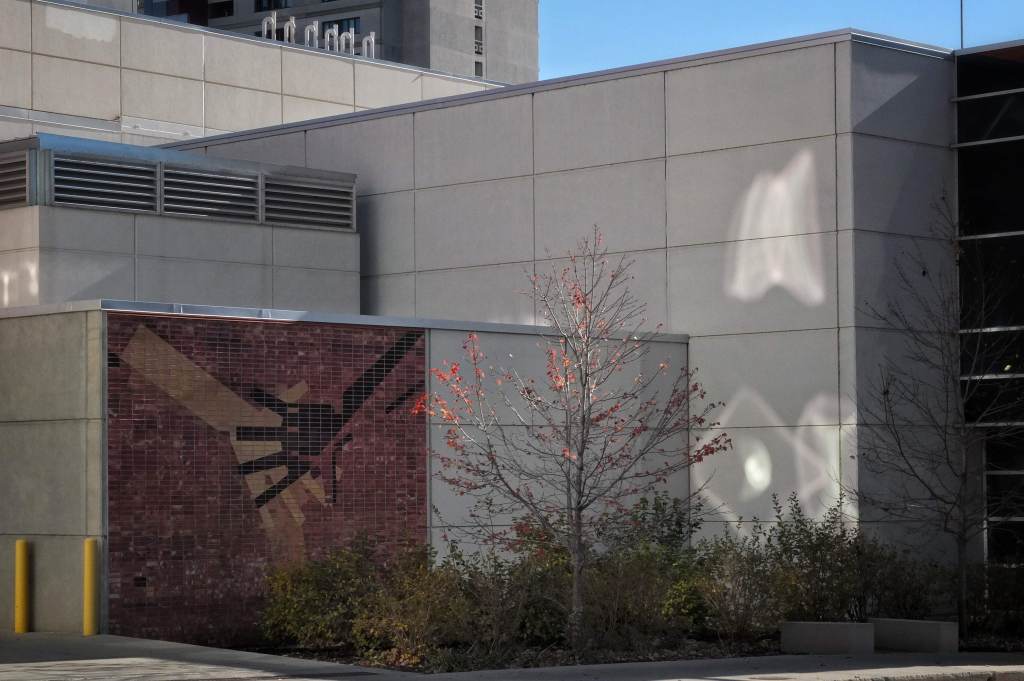
So I’m walking down the street last Saturday, right? And I see these weirdly-shaped areas of light on the side of a building–light reflected off another nearby building. The light is also illuminating just the top of a tree that’s almost completely devoid of its Autumn leaves. The nearly-bare tree is beside a tile mural of two hands–one black, one white–touching each other. The fingers on the hands sort of mirror the limbs of the tree. Everything there is odd and lovely and since I’ve got my little 12-year-old, 12 megapixel Fujifilm X10 in a pocket, I stop and shoot the photo.

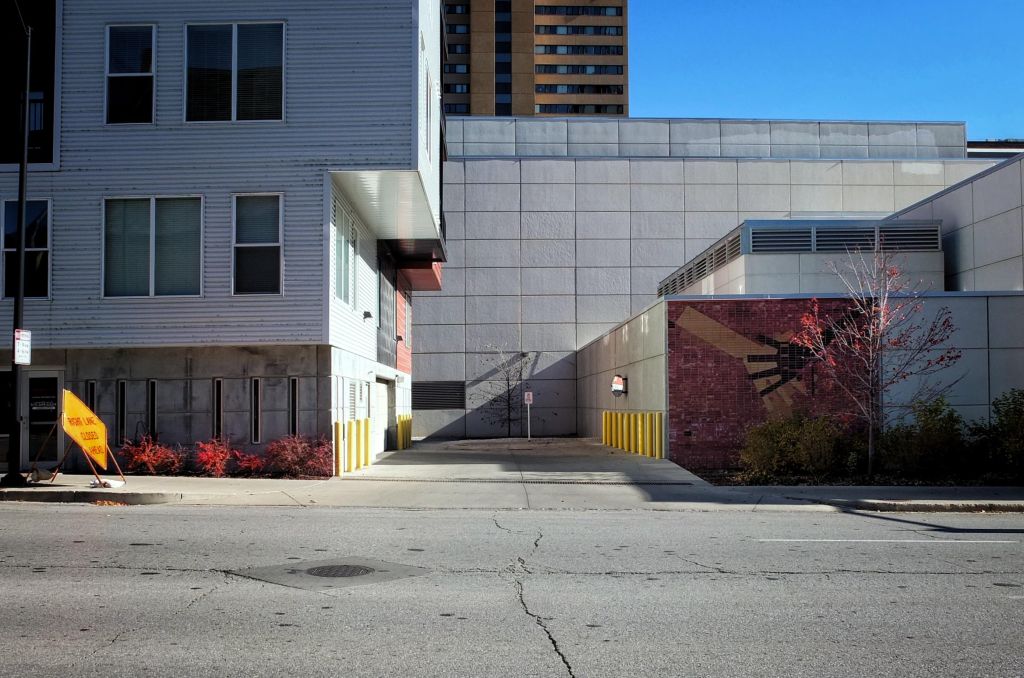
And I’m happy with it. So I keep walking and I notice the mural is directly next to a cul-de-sac that’s the entrance to an underground parking garage for an apartment building (the building that’s creating the weird reflections in the first photo). There are a LOT of lovely yellow bollards (I have a thing for bollards) in the cul-de-sac that are sort of balanced by a yellow ‘Lane closed’ sign. Even better, there are some reddish shrubs that sort of balance the red of the illuminated tree. Better still, there’s a delicious acute right angle of shadow right in the middle–and in the middle of the shadow, another tree. And I’m immediately smitten by all the colors and the lines of the various buildings. So I stop and shoot the photo.

I want to get closer to those bollards, so I cross the street, where I discover that there are sections of the apartment complex that couldn’t be seen from a distance. Lovely red and black color blocks, with windows that cast still more reflections on the wall opposite. A circular convex mirror reflects those red and black colors. I notice that the wall at the back of the cul-de-sac, which appeared white from a distance, is actually a very pale shade of blue, that’s enhanced by the slight shift in the angle of the light. The angle of shadow is somewhat less acute. There’s a strange curving line of electrical tubing for a lamp, and some crazy shadows. Those yellow bollards, also catching some reflected light, seem almost decadent. And so many glorious straight lines at interesting angles to each other. Finally, right in the center, a tree which sneers at straight lines. So I took another photo.

Six minutes. According to the EXIF data, that’s how long I spent at that scene. It seemed a lot longer. Six minutes and three shots. Six minutes, drunk on light and shadow and line and shape. Six captivating minutes.

This isn’t unique. Every photographer has had a similar six minutes. They’ve probably had several similar six minute experiences. It’s those six minutes that keep us toting cameras and making a nuisance of ourselves. Six minutes of ineffable delight.

a year

It’s been a year now. A year without the cat. I don’t check the perimeter anymore.

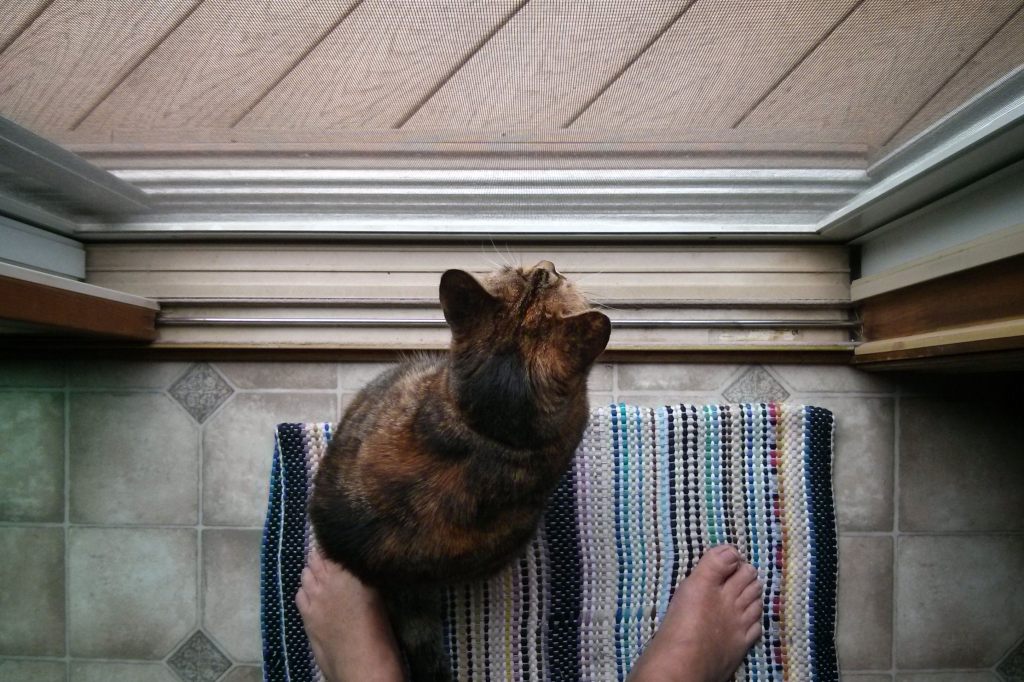
Checking the perimeter. I should explain that. The cat was already living here when I moved in. Every morning, I’d get up, start the coffee, then I’d go stand by the sliding glass door that led out to the deck and the back yard to see what the weather was like. At some point, the cat decided to join me. And that became our morning routine.

August 31. 2014

Almost every morning for years. Once or twice a month the cat would decide to sleep in, but usually she’d hear me getting up and would meet me on my way to the kitchen. I’d start the coffee, then we’d stand at the door and look out. Nothing special, really. It was just a thing we did.

December 4, 2016

The cat would usually lean up against me when we did this. Sometimes she’d sit on my foot, which couldn’t have been comfortable for her. We’d look outside for a minute or so, then the cat would either suggest I feed her or she’d quietly slide off to some other part of the house.

January 2, 2018

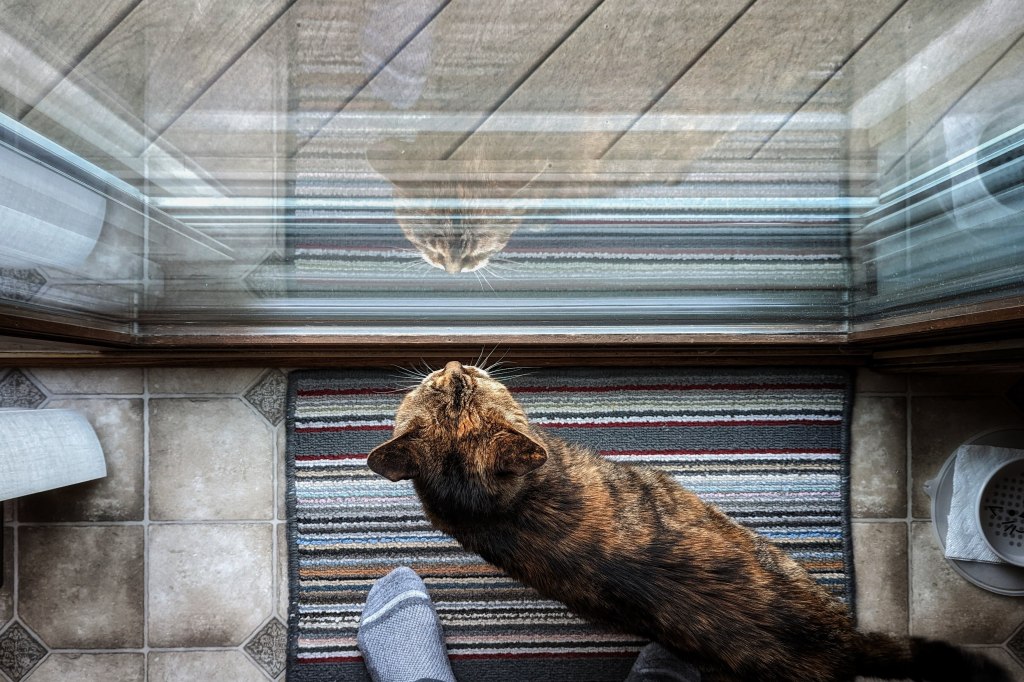
Almost every day, we did this. Some mornings, if I had my phone with me, I’d take a photo of the cat beside me. I don’t know why; it was always the same basic photograph; my feet, the cat, the door. Some photos were in color, some black-and-white, some square, some with the standard 3:2 format. It would depend entirely on which app I opened on my phone (yeah, I’m the sort of guy that has a dedicated b&w app on my phone). Usually I deleted the photos shortly after I took them. Usually. Not always.

Periodically, I’d post a photo on Facebook or Instagram of the two of us at that door and caption it ‘The perimeter is secure.” My friends found it amusing. So did I. It became a thing, checking the perimeter. It turned into an accidental photo project.

The photo below is the last photo I shot of us checking the perimeter. I don’t think I posted it. A couple of weeks later, she was gone.

October 25, 2022

You do something together every morning for years and then one day it’s just you. It leaves you off-balance. For a week or two after the cat died I’d step over to the sliding door after starting the coffee and I’d check the…and I’d look outside. It wasn’t checking the perimeter anymore. It felt wrong. It felt wrong, and it just hurt too fucking much. So I stopped.

It’s been a year now. If I want to know the weather, I look out the window. Some mornings I still expect to see her waiting for me. Every so often I still get weepy, thinking about her. It still hurts. I hope it will always hurt.

It’s been a year. I miss her so much.

a candy corn centrist

Every year around this time I feel the need to eat candy corn. And every year, after I eat a few pieces, I find myself wondering why. Because of that, I find it impossible to take sides in the ‘candy corn’ debate. I feel about candy corn the same way I feel about some of the more esoteric sexual practices: if you enjoy it, have at it. If you don’t, you still have lots of options.

But for fuck’s sake, people, don’t try to stop others from enjoying their candy corn, and don’t shame them for liking it. And candy corn aficionados, don’t try to force your candy corn on anybody who doesn’t want any. This is NOT complicated.

Candy corn has a long history in the US. It’s been around since the late 1880s. As far as I can tell, the company that’s been continuously making candy corn the longest is Jelly Belly, which was originally called the Goelitz Confectionery Company (and I have to say, I think the name change was an unfortunate decision; some poor bastard is now forced to introduce himself as the CEO of Jelly Belly, and you know all the other CEOs are laughing).

The Goelitz brothers began producing candy corn in 1898. Unlike the white, orange, and yellow candy we’re mostly familiar with, Goelitz candy corn (also apparently referred to as ‘chicken feed’) was white, brown and yellow. I’m sure there was some rational corporate explanation for the change in the color scheme, but I’m going to assume it was because orange is simply a more jolly color.

The commercial manufacture of candy corn was NOT the most unfortunate event of 1898. Henry Lindfield became the world’s first fatality from an automobile accident on a public road (his car rolled down a hill in Purley, England and struck a tree–which is less embarrassing than having to introduce yourself as the CEO of Jelly Belly). And the USS Maine exploded in Havana harbor, sparking the Spanish-American War (which, although it was fought primarily in the Caribbean, resulted in the US owning Guam and the Philippines; the US also annexed the Hawaiian islands that year, which was unrelated, but you have to wonder about the sudden desire of the US government to own islands located way the fuck away from the mainland). And Caleb Bradham invented Pepsi-Cola (so named because it was intended to relieve dyspepsia, whatever that is).

I seem to have lost track of my point, which is that despite the attempts to vilify it, there is absolutely nothing wrong with eating and appreciating candy corn. Even ordinary decent citizens (such as myself) have been known to enjoy it (or at least wanting to enjoy it, even if afterwards it turns out we do not). Nobody needs to justify their taste for candy corn.

Licorice, on the other hand, is an offense to the gods.

done and dusted

A few days ago I mentioned I was actually busy, that I’d found myself in “one of those rare instances when I’m working under a deadline.” Some folks wondered about that deadline business. Allow me to splain.

Twelve days ago (on Tuesday the 3rd) I noticed a post on Bluesky (which, by the way, is by far the most engaging and positive (and frequently very weird) social media platform I’ve ever encountered) stating that Uncanny Magazine had opened submissions for short fiction. Uncanny has been publishing science fiction and fantasy fiction for about a decade. The magazine itself and the fiction it’s published have won numerous awards. Uncanny has published short fiction and novellas by a LOT of the big hats in the SFF biz.

I don’t write science fiction or fantasy. I write detective/crime stuff. I’ve always read SFF, and I’ve occasionally banged out some ideas for SFF novels, but I’ve never followed through. So when I saw the post about open submissions, I said to myself, “Greg, old sock, why not give it a shot?”

The obvious response was, “I’ll tell you why not. First, you’ve never written SFF in your entire semi-wicked life. Second, you’ve got less than two weeks to come up with an idea and write a short story, which is another thing you’ve never done. Third, there are a million other things you actually WANT to do instead of sitting alone in a quiet room making shit up. It’s October, for fuck’s sake, and you’ll want to ride your bike and see people and go on long drives to look at autumn foliage. Fourth and finally, let me repeat that you’ll only have two weeks to write a story in a genre you’ve never written and it’s the best two weeks of autumn, you massive idiot.”

So I decided to write a story and submit it.

Which is exactly what I did.

Finished it last night, formatted it this morning, just submitted it moments ago. About 9500 words in eleven days. It doesn’t sound like a lot. Less than a thousand words a day. But that includes coming up with the idea, envisioning the story world, populating it with believable (I hope) characters, ensuring the plot holds together, arranging the scenes, and putting all those words in a row. I’ve never written an entire short story, nose to tail, in such a short period of time.

I have absolutely no idea if it’s any good. I mean, I was satisfied enough with the story that I submitted it, but Jesus suffering fuck, 12 days? And, of course, the fact that I’m satisfied with it doesn’t mean a damned thing. The folks who’ll send you the contract and cut the check, they’ve got to be satisfied…and who knows what they’ll do?

But THIS is the part of the writing gig I’m really very good at: letting go. Most writers I know tend to fret about the stories they’ve submitted. Me, once I submit a story for publication, I basically forget it…until I get an acceptance or a rejection. Out of sight, out of mind. Done and dusted.

Which may be good for my mental health, but is a terrible business practice. Because if a story gets rejected by one publisher, you may want to submit it to another. This actually almost happened to me last year. I’d submitted a story to Alfred Hitchcock’s magazine and immediately forgot about it. Well, I forgot about it until I was ready to submit another story to different magazine. Then I remembered, “Hey, dude, it’s been maybe 3-4 months and you haven’t heard about the other story; that ain’t right.” So I sent an email saying ‘Don’t want to make a fuss, but if you’re not going to accept the story, let me know so I can sell it elsewhere.’ The magazine responded with a contract. That story eventually won an Edgar award. Go figure publishers.

Anyway, the story is written. It’s been submitted. And I feel liberated. Now, if you’ll excuse me, I’ll go for a bike ride.