walking and washing the dishes

Much of what I do for a living requires (or allows) me to sit in a little room and think about stuff, then write something about the stuff I’ve thought about. Some of the stuff I think about is real stuff that’s actually happening in the real world; some of it is just shit I’m making up, and some of it is shit other folks have made up but aren’t entirely happy with. But I think and I write, and yeah, it’s a pretty weird gig.

The nice thing — one of the nice things — about the gig is that it’s not governed by space. I may be physically sitting in that little room, but my mind and imagination are pretty much unfettered. All those clichés you’ve heard about your thoughts only being limited by the stretch of your imagination — corny, but true. It’s a pretty sweet gig for my mind. My body, though, resents the little room. My body wants to get up and move around.

So almost every day I indulge my body’s wishes. I go for a walk or a bike ride. I ride the bike for the fun in it. Sometimes I’ll run errands on my bike, and yeah, that’s good for my body and for the environment and all — but mostly it’s just fun.
But here’s the thing about a bike: you have to pay attention. Cars and trucks will run into you, pedestrians will step directly in your way (even if you call out ‘On your left’ as you approach), dogs will chase you (so will geese, by the way — and that’s a lot more alarming than it sounds), the streets have potholes, the bike trails sometimes have walnuts or other detritus scattered around. When I’m cycling, I have to keep a big chunk of my mind constantly engaged with the world around me. I enjoy that, partly because it makes it impossible to think about whatever I’d been thinking about in that little room.

Walking, though — totally different. Walking doesn’t require the same level of situational awareness that cycling does. Sure, you have to pay enough attention to avoid stepping in dog shit or tripping over a curb, but basically walking doesn’t require much in the way of immediate vigilance.
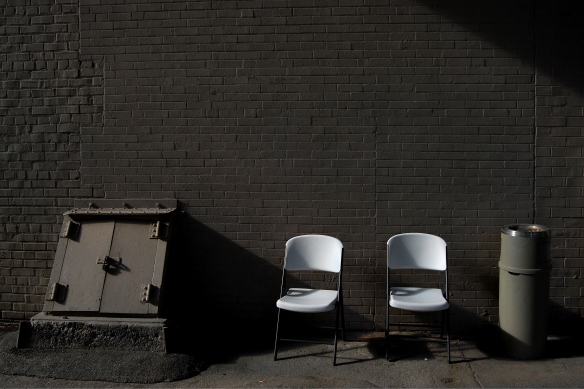
tobacco row

So I walk a lot, and I walk all over. Suburban neighborhoods, bike paths, city streets, alleys, hiking trails, country roads, the city skywalk. I walk year around, regardless of the season (though rarely in the rain). Sometimes I tote a camera. Most often, I don’t — though with a smartphone you always have a camera with you. Sometimes I take photos of stuff I see when I’m walking. All the photos you see here were shot while I was taking a walk.

I do three types of walking. Some of it is just utilitarian — a way to get somewhere and do something. You know, drop off a package at the local FedEx office, buy a clove of garlic, that sort of thing. Ordinary chores and tasks that are located nearby and aren’t particularly time-dependent.
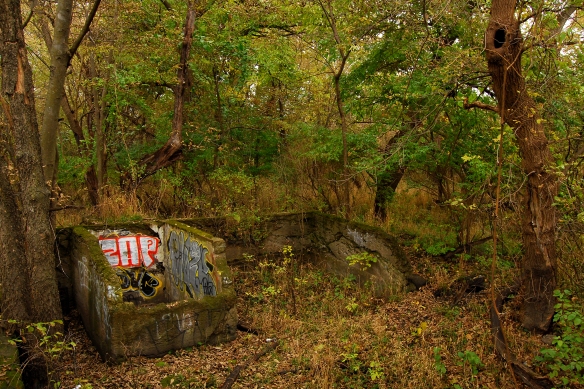
somebody lived here once

Most often, though, I walk and think — usually about something I’m writing. Or want to write. Or have been paid to write. That type of walking is essentially an extension of sitting and thinking in that little room, only without the sitting or the little room. Without the four walls and the computer screen in front of me, I’m generally more relaxed and flexible in my thinking. When I’m walking, I’m not distracted by the words on the screen. Instead, I’m thinking about what those words need to do.

I also walk as a form of meditation. A million years ago I briefly belonged to one of those strict, formal Zen communities where meditation practice was regimented. It was a group activity, with a starting time and a stopping time. You enter the zendo, make gassho to your zafu (which is basically bowing to the cushion you sit on), sit in orderly lines, wait for somebody to tap a brass bowl, which gives out a lovely tone that’s the signal to get to meditating. You sit very still, focus on your breathing, release all distracting thoughts. While you’re meditating some guy walks quietly around, watching to make sure you’re actually meditating and not thinking about what you’re going to make for supper or whether you should adopt a cat. If he thinks you’ve allowed yourself to become distracted, he whacks you with a little stick.

three guys in red

It works for some folks. It didn’t work for me. After a few months of that, I stopped going. I didn’t abandon Buddhism, but I abandoned meditation. Years later I stumbled across an article that mentioned a monk named Thich Nhat Hanh and walking meditation. No rows of cushions, no regimented starting or stopping time, and no guy behind me with a fucking stick — sounded good to me. So I did some reading, talked to some people, gave it a try.

It’s still about breathing. But walking meditation creates rhythm between your breathing and your steps. The heart of the idea, according to Thich Nhat Hanh, is to ‘arrive’ with every step — which sounds awfully buddha-buddha, but is really pretty simple. It just means being aware of every step, connecting with every step. My walking meditation is slower than my usual walking pace. I breathe in for three steps, out for four steps. It’s that simple.
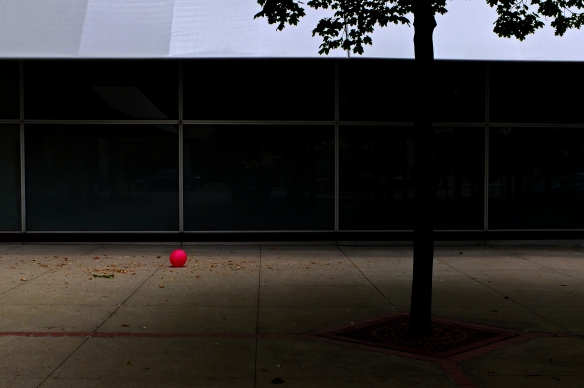
red balloon

And it’s easy to transition from my utility walking or work-walking into walking meditation. When I decide to meditate, I usually start by thinking of a simple Buddhist poem.

Washing the dishes
Is bathing the Buddha

And that triggers the meditation. I breathe in with the first line, and breathe out with the second. After a bit, the words becoming nothing but sounds and lose their meaning, and then it’s all about the rhythm. Everything else slides away. Easy peasy, lemon breezy.

I meditate until — well, until I stop meditating. It might a couple of minutes — it might be twenty. Doesn’t really matter. The meditation shifts back to plain walking, but I feel more refreshed and creative.
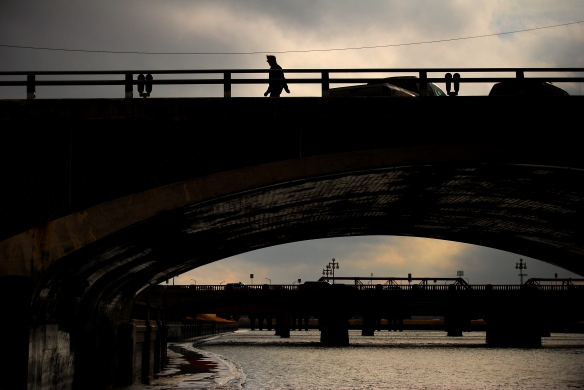
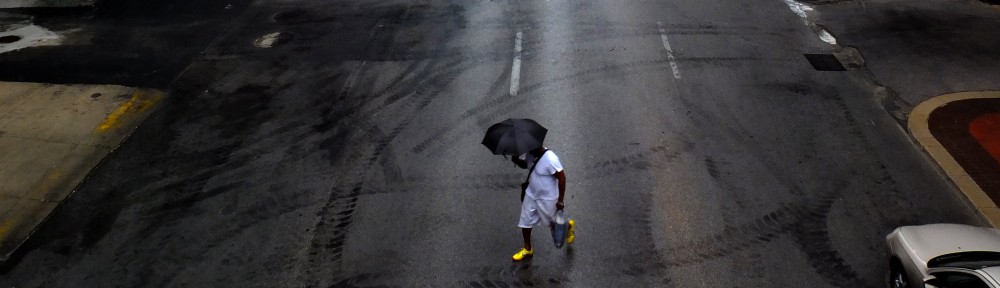
guy onna bridge

I had a point when I began writing this. I’ve completely forgotten what it was. Something about walking, probably. Or maybe something about writing. I’m pretty sure it wasn’t about meditation. It could have been about how sitting too long in a little room thinking about stuff can turn your mind into guava jelly.

Clearly, I’ve been sitting in this little room too long.
intercession, and all that

Today, apparently, is the National Day of Prayer. I wasn’t aware of that. I was completely and utterly ignorant that the United States has a National Day of Prayer. I’m not at all sure why we need a National Day of Prayer, but we have one and it’s today.

I learned today is the National Day of Prayer when a friend asked me, saying “Hey, Greg, did you know today is the National Day of Prayer?” He then urged me to go to the National Day of Prayer website and “leave a snarky comment”. When I asked why I’d want to do that, he said “You’re good at snarky comments.” Which didn’t really answer the question (does that count as a snarky comment?).

I did go to the website, on account of I’m curious about stuff like this. And I discovered the mission of the National Day of Prayer, which is

[T]o communicate with every individual the need for personal repentance and prayer, to create appropriate materials, and to mobilize the Christian community to intercede for America’s leaders and its families.

Well. Okay, then. Good on the Christians, I guess. Very thoughtful of them to pray on behalf of America’s leaders (seriously, it IS thoughtful, though I’d be interested to hear some of those prayers involving President Obama). The website also states:

The National Day of Prayer belongs to all Americans. It is a day that transcends differences, bringing together citizens from all backgrounds.

All Americans. Transcends differences. All backgrounds. Unless, it seems, you’re not Christian. That difference, not quite transcended. (Is that snarky? I guess it’s kind of snarky.) Still, thoughtful and all that. The website also includes the official prayer for the National Day of Prayer. Which is pretty old school, with bits about being humbled and broken, and cries for mercy, and a reference to ‘you are our only hope’ (and I’m sorry, I cannot hear that phrase without mentally adding ‘Obi-wan’ and c’mon, you did the same thing, fess up).

There’s a National Day of Prayer video, because you can’t have any sort of national day without a video.

It’s a racially diverse video. There’s young white woman whose boyfriend tells her he just wants to be friends, there’s a hard-working white laborer whose boss tells him he has to work late, there’s a middle-class white woman whose middle-class white husband doesn’t believe in the Bible, and there’s a black kid in sneakers who lives in a neighborhood where other black kids gamble on the sidewalk. The National Day of Prayer apparently allowed the black kid to walk right through a group of thugs shooting dice, caused the middle-class white husband to join his wife reading the Bible, informed the hard-working white guy that he should work even harder, and…well, the young white woman still doesn’t have a boyfriend, but at least she’s white and has a nice sofa on which to cry. So there’s that.

I noodled around for a bit on the National Day of Prayer website, but I didn’t leave a snarky comment. Not because there’s no snark-worthy material there, but because why should I go out of my way to offend Christians? That just seems silly and spiteful. Yes, there are Christians who, despite the fact that we have an actual National Day of Prayer (not to mention national Christian holidays), continue to believe Christians are somehow being suppressed and victimized. And yes, there are a lot of Christians who are astonishing hypocrites.

But so what? Most of the people I know are Christian in some sense, and most of them are good people. I can’t blame them because they share some religious beliefs with people who are total assholes.

But you know what would be cool? If we, as a nation, had a National Day of Not Being a Dick. That would be cool. Or a National Day of Maybe We Should Trust Women to Make Their Own Reproductive Decisions. I’d also like to see a National Day of Get Off Your Ass and Take a Walk or Ride a Bike. Or how about a National Day to Eat Vegan? I’m not a vegan, or even a vegetarian, but I think it would be worthwhile for people to consider the moral consequences of their food choices. I can think of a LOT of national days that seem more relevant and important than a National Day of Prayer specifically for Christians.

If I prayed — if I believed in Something or Someone to pray to — I’d pray for something like that. Even if there wasn’t a national day for it.


so sad so cool

The truck, that was the first thing I noticed — just off the road, on the other side of a deep, grassy ditch. At some point in time it had been a serious truck. Not a gentleman farmer’s pick-up that could also be used to run errands, but a full-sized working truck built to haul serious payloads. Now it was basically a ruin; sitting lop-sided in the dead grass. It had been sitting there so long it had actually settled into the soil.

truck2

Beyond the truck was a house. A small farmstead, really — the house, a collapsed barn, a few small outbuildings, some sheds, a scattering of grain bins, rusted farm equipment. There was surprisingly little vandalism, aside from a few shattered windows and maybe the front door, which had been torn from its hinges. Most of the damage appeared to be the result of weather and long neglect. The property was clearly abandoned, and had been for some time.

It’s a curious term, abandon. It connotes a complete giving up, an absolute and total acknowledgment that there will be no return, a total surrender. Perhaps whoever lived there had originally intended to return — but at some point there had to be a moment of recognition that it would never happen. There’s something profoundly sad about that.

abandoned farmhouse2

Here’s an odd thing: I couldn’t bring myself to enter the house. I mounted the stairs and stood in the doorway, but I was reluctant to go inside. Not because it wasn’t safe (the house itself seemed pretty stable), and not because it would be trespassing (legally, I was already trespassing). I was unwilling to go inside because it felt wrong. It felt like a violation, somehow. What makes it odd is that at one point in my life I had a job that involved routinely trespassing and violating the privacy of other folks. But back then I was getting paid; to trespass in the house for no reason other than my own amusement seemed like some sort of transgression.

However, I didn’t feel that way about the other buildings on the property. I noodled around in them without any compunction at all. This one, for example.

music room2

It was just a few yards away from the main house. The roof had caved in a long time ago, and the debris made it almost impossible to walk around. It didn’t help that there were obvious nails and shards of broken glass lying about (combined with the fact that I was wearing sneakers). Still, it was easy to tell the building had most recently been used as a sort of office or studio.

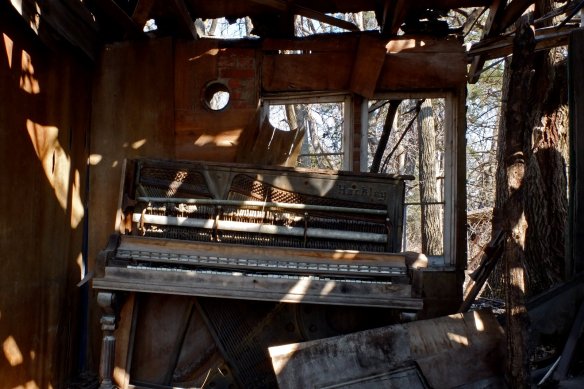
The bones of an old Hackley upright piano occupied the main room.

piano also2

In 1863, at the height of the American Civil War, Milo J. Chase began building pianos in Grand Rapids, Michigan. A few years later, his company was reorganized as Chase-Hackley Pianos. The company had a good reputation as builders of durable, medium quality instruments. The pianos could be bought directly from the manufacturers, which allowed buyers to avoid sales and additional shipping charges. This made Chase and Hackley pianos popular with rural and farm families — at least until they went out of business in 1930, victims of the Great Depression.

It’s easy to imagine farm kids sitting in front of this old Hackley, struggling away at some painful version of Clair de Lune.

tractor again2

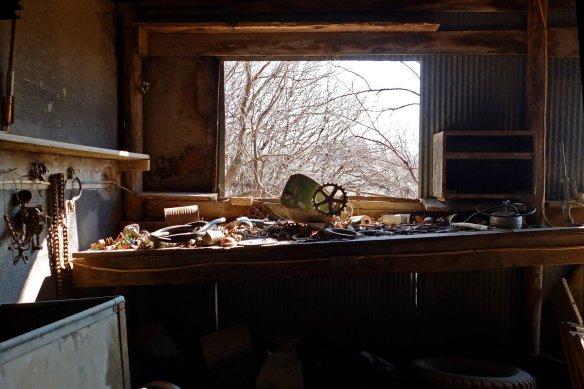
Behind the house were a variety of small, slowly collapsing sheds and workshops, as well as well as some farm equipment — all of which suggest that at one time this was a rather successful farming operation. There was a woodworking shed, a machine and tool shed, and a couple of storage buildings — all of which were in some stage of dilapidation. Only a few had working doors; none had functioning windows.

As with the house, most of the damage was a result of time and weather — and in some cases, animals. One bench was littered with raccoon shit, there were what appeared to be small mammal nests under some of the workbenches, and paw prints in the dust.

shed again2

The barn was the most severely damaged structure on the farmstead. The roof and one wall had completely collapsed, two of the other walls were pretty unstable, and the fourth wall seemed to be supported primarily by stacked bales of old hay. I wouldn’t have gone inside at all, except that I could see some bones — and bones make me stupid.

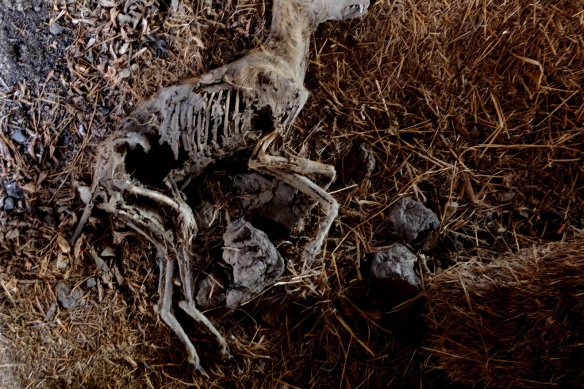
So I crouched down and groucho-walked inside to look at them. It was dark, of course, and what I first thought was an old sack turned out to be the semi-mummified remains of a dog. It appeared to have died of exposure or natural causes rather than violence, and was eviscerated by other creatures after death. The roof was too low at that point to allow me to examine the dog closely. I couldn’t even photograph it properly; I had to hold the camera out at arm’s length and shoot blindly. This is the only shot that was in focus — which is probably just as well.

family dog2

I didn’t stay at the farmstead very long. Places to go, people to meet, and all that. But the entire time I was there, I was very aware of my own internal dissonance. I’m not a terribly self-reflective person under most circumstances. I don’t spend much (or any) time thinking about what I feel, or wondering why I do stuff. Yet I was conscious of being torn between feeling This is so sad and thinking This is so cool.

Because it was so sad and it was so cool, and it still is. I’ll almost certainly go back at some point when I have more time to explore. Maybe I’ll even overcome my conscience and actually go inside the house.

in which i enrich my life in small ways

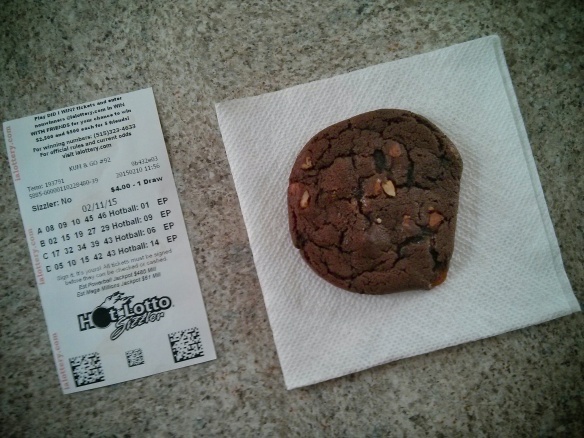
There’s a Stop&Rob convenience store about a mile from where I live. I slide in there once or twice a week during my daily walk/bike ride, mainly because they sell these amazingly good freshly-baked chocolate turtle cookies. Or maybe they’re chocolate tortoise cookies. I can never remember, though I know the difference when it comes to the non-baked goods turtles and tortoises. Regardless, they’re spectacularly good and are a nice reward for having taken a walk or a bike ride (by the way, the cookies are NOT made from actual turtles or tortoises, and as far as I can tell have absolutely nothing to do with the Chellonii (which, I’m told, is the proper term, even though I normally just call them Chellonians)).

This afternoon, as I was heading home from my walk, I stopped in for my cookiie. The woman in front of me at the register was all a-fluster. She’d tried to buy some lottery tickets, but had either asked for the wrong species of lottery or the clerk had made an error and printed out the wrong lottery tickets. Either way, she was rejecting the tickets and demanding the clerk give her the tickets she actually meant to purchase.

Things I bought today that will NOT be laundered

Things I bought today that will NOT be laundered

I occasionally buy a lottery ticket along with my cookie. It’s stupid, I know, but it’s not even close to the stupidest thing I do routinely in my daily life. Maybe every couple of months, based on nothing in particular, I’ll buy a ticket. It usually ends up in a shirt or pants pocket, where I only remember it when I’m about to do my laundry. Or, just as often, after I’ve done my laundry.

Lottery tickets, if you weren’t aware, aren’t designed to go through a laundry cycle. It turns them into a strangely compact and totally illegible wad of paper. Now, by my math (and my math, admittedly, is singularly pathetic math, but I’m pretty confident in this), a lottery ticket that’s utterly illegible only slightly reduces your odds of winning — so it’s no great loss if the ticket is laundered. Consider this a public service announcement.

At any rate, the woman had rejected her tickets and the clerk (a young woman with a tattoo on her forearm that appeared to depict a seahorse being ridden by Batman, though I never really got a very good look at it and it seems really unlikely that she’d have a tattoo of Batman riding a seahorse, so I’m probably wrong about this) was clearly baffled as to what she should do. So I offered to buy them.

The idea of buying rejected lottery tickets has a bizarre but powerful appeal. Well, it does to me. I have no idea what bizarre but powerful thing appeals to you (and knowing some of you, it really doesn’t bear thinking about). A rejected lottery ticket has no statistically better chance of winning, but it has a sort of poetic aura of despair and futility that is well worth four American dollars. It’s entirely possible that from now on I will only buy rejected lottery tickets.

So I’m back now from my walk, I’m in the process of eating the cookie, and I’ve set the lottery ticket aside to prevent it from being laundered. I’m feeling stupidly pleased with myself.

UPDATE: Four separate entries consisting of seventeen unique numbers, and not one single number of those seventeen matched any of the winning numbers. In effect, my ticket said “You lose four bucks.”

Still worth it, though.

oblique nouveau-neo-new topographics

Twice in the last couple of weeks I’ve been asked about my ‘photographic style.’ The first time I basically said “Dunno, never thought about it.” I mean, who thinks about stuff like that? The second time I said “New Topo, laid on its side, and turned 45 degrees to the left.” I said it as a joke, but after I said it, I sorta kinda became the type of person who thinks about stuff like that. And hey, it turned out to be sorta kinda true.

Back in 1975 a guy named William Jenkins curated an exhibition of a new school of landscape photography: the New Topographics movement. Landscape photography to that point in time had generally followed the path of landscape painting, which for the most part consisted of romantic depictions of ‘undisturbed’ nature. We either had the Ansel Adams approach (epic vistas photographed on a grand scale in black and white) or the Eliot Porter approach (intimate color images of a few trees or a handful of leaves scattered on a pond). Nothing wrong with either approach, but that was basically it.

Traditional New Topo approach

Traditional New Topo approach

Then along came Jenkins and his New Topo crew. His exhibition consisted of 168 black-and-white prints of warehouses, industrial sites, suburban tract housing, filling stations. The idea behind the exhibition was to present the modern landscape as it actually existed rather than in an idealized way. Most art photographers used the camera as a device for self-expression. The New Topographics photographers reduced the camera to its most basic function.

The camera, after all, is a tool that records everything in front of the lens. Every goddamned thing, not just the pretty stuff or the majestic stuff. And it records it all with the same precision. It records with a detached, unemotional, deadpan eye. That’s all a camera does. With that idea in mind, New Topo photographers deliberately attempted to remove any notion of ‘artistry’ from the act of photography. Their intent was to depict the objects in front of the lens in a way that merely mapped their surface. In other words, to reduce the subject of the photograph to an essentially topographic state.

Neo-New Topo

Neo-New Topo

The exhibition garnered a lot of attention. Not all of it was positive. Hell, relatively little of it was positive. Most folks thought the photographs were bland, uninteresting, boring, even ugly. And hey, those folks were right. I tend to agree. In my opinion, a lot of those photos really were butt-ugly. But they were interesting.

People who thought about photography as an art — not just viewed it, but consciously and deliberately thought about what photography was and could be — those folks found the exhibition fascinating. Why? In part because they realized the emotionally detached camera opened up a visual world in which people could see the stuff that had previously been filtered out. The ugly stuff. The old tires, the broken sidewalks, the trash cans, the old telephone wires, the litter. All the crap photographers normally worked hard to exclude from their photographs.

Nouveau-Neo-New Topo

Nouveau-Neo-New Topo

But there was a problem. Humankind has spent something like twelve thousand years unconsciously building the foundation of aesthetics. It’s really difficult to just toss all that aside. It’s hard NOT to look for beauty, hard NOT to try to include that beauty in a photograph. That’s a lot of human nature to overcome.

So a sort of Neo-New Topographics style emerged fairly quickly (and yeah, I just made that name up). It’s a style in which photographers still photographed the same anonymous human-shaped landscapes, and continued to objectively map the surfaces of whatever is in front of the lens — but with the recognition that even industrial sites and warehouses can be beautiful. And after that, a Nouveau-Neo-New Topo approach, in which photographers actively sought out what beauty can be found through surface mapping.

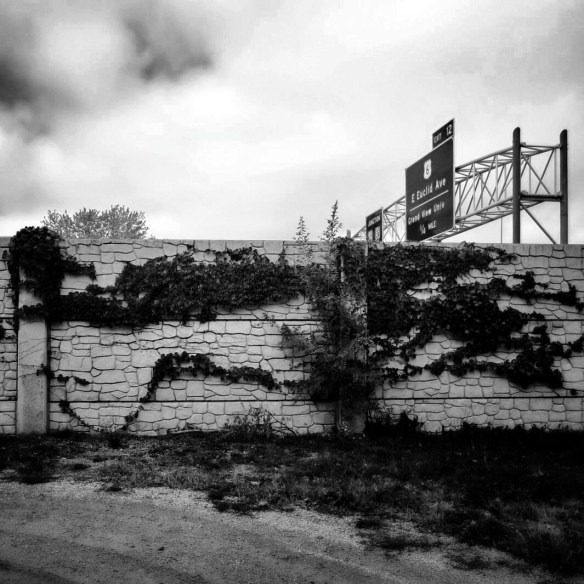
Oblique Nouveau-Neo-New Topo

Oblique Nouveau-Neo-New Topo

That idea has become a big chunk of my photographic patch. Over the last few years I’ve been working in a sort of Oblique Nouveau-Neo-New Topo style. Surface mapping at a slant. New Topo, laid on its side, and turned 45 degrees. Because I prefer my surface to have depth. I like a surface that extends itself. A surface that sort of falls away.

ONNNT (which is also the sound a Canada Goose makes when landing in icy water)

ONNNT (which is also the sound a Canada Goose makes when landing in icy water)

I can’t really say that’s my ‘style’ since I shoot all sorts of crap. But when I’m deliberately looking and seeing photographically, that’s pretty much my default approach. Find an interesting surface — then either photograph it straight or find an angle that allows the eye to shift off into the distance. Oblique Nouveau-Neo-New Topo. Takes longer to say than to shoot.

But hey, at least now I have a response the next time somebody asks me about my photographic style. ONNNT.

The photo that sparked the question the second time.

The photo that sparked the question the second time.

i received a note from a friend

Ten days ago, as I was packing to go house-sit for my brother, I received a note from a friend.

That sounds so simple, so mundane. I received a note from a friend. But it wasn’t just a note. It was a hand-written note. Hand-written in ink. Written in ink with a lovely, idiosyncratic fist. Written in ink on fine paper — paper thoughtfully chosen, with a graphic that holds a personal meaning to me. Written in ink and posted in an envelope with a delightful and eccentric selection of postage stamps

Hand-written in ink. Think about that. When putting ink to paper, the writer has only one chance. There’s no possibility to correct a mistake in ink, so the writing must be exact. But perfect exactitude in writing usually feels mechanical — pretty, perhaps, but without any true sense of personality. So in order to write fluidly and expressively in ink, the writer must be relaxed but deliberate.

There’s a concept in Buddhism called mushin, which is generally translated as ‘no mind.’ Basically, that means emptying the mind of crap-baggage like ego and expectation and fear. The idea is that letting go of any concern about the end product allows you to be focused on what you’re doing with a level of intensity that wouldn’t be possible to achieve if you were consciously thinking about it. Mushin in writing is to write unencumbered by expectations, free of the burden of perfection, embracing imperfection, accepting the perfect beauty of the imperfect.

note and pear

I received a note from a friend. But he’s not a traditional friend. I’ve never met Fernando. I’d very much like to — but if I never do meet him, that’s perfectly okay. The internet, after all, has completely redefined the concept of friendship. It’s no longer limited by physical proximity; instead it’s grounded in shared interests. I ‘get’ Fernando. I may not always understand him, but I ‘get’ him. So yes, even though I’ve never met him, he’s definitely a friend. A friend made possible only through of the existence of the internet.

So ten days ago I received a note from a friend while I was packing to go house-sit. I read the note. Read it again. Knew I wanted to write about it, and set it on a table so I’d remember to take it with me. It was still there on the table when I got back home last night.

Here are the last two lines of the note:

There are just too few people one crosses paths in life that one can stop and make an effort to appreciate. (Their [something] is to be punished by trying to figure out my handwriting).

Fernando’s handwriting is…let’s say it’s free of the burden of perfection. And that makes it absolutely perfect.

okay, yeah, that’s pretty weird

Let’s just acknowledge that everybody’s life is weird. They’re all weird in different ways, sure — but the weirdness is there. It’s built into the system; you can’t get around it. Most of the time we don’t even notice the weirdness of our own lives. It’s so much easier to see the weirdness of other folks.

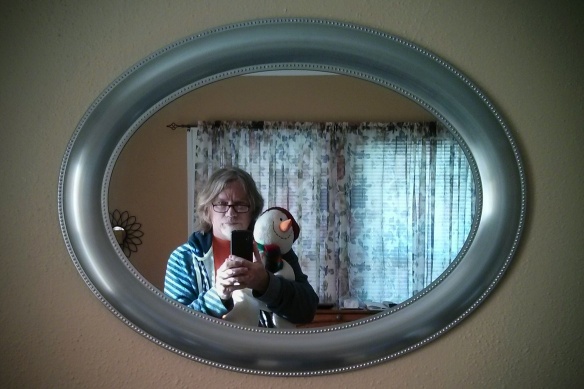
Today, though, some of the weirdness of my life bled through. First off, it’s my birthday. That’s not a big deal and there’s nothing weird about it. Everybody has a birthday. The only thing weird about mine is that I happen to be house-sitting for my brother (who is larking about on the beaches of Puerto Vallarta), so I’m sitting here alone in a strange house that’s decorated with about a thousand snowmen. Not actual snowmen (nor those creepy-cool snowmen from Doctor Who), just holiday decoration snowmen.

me in the mirror

It’s also a little weird to get a lot of birthday greetings. The greetings themselves aren’t particularly weird (well, some of them are a tad weird), but as I read through them all I’m reminded that I have a pretty odd range of friends and acquaintances. Lots of writers, lots of artists, lots of librarians, some lawyers, some regular working folks, a few gun nuts, a few scientists and mathematicians, a former nun, lots of tech-related people, some folks who work as advocates for mostly lefty causes. There are more women than men, more liberals than conservatives, more straight folks than gay, more folks from the US than any other place, but all in all it’s a pretty eclectic group.

Most folks just say ‘Happy birthday’ and leave it at that, which is nice and simple and direct. I’m a big fan of simple. One person wants me to use the occasion of my birthday to ‘reflect on your life and this past year, and consider what it’s all meant.’ This person hopes I ‘gain a deeper understanding of what it means to be you’ and wants me to ‘examine what you’re feeling today and why you’re feeling it’. It’s very sincere and earnest and I appreciate this person’s concern — but at the same time I’m thinking ‘Don’t you fucking know me at all?’

Seriously, I can’t remember the last time I felt the need to try to understand what I’m feeling. I figure if I’m feeling it, that’s good enough. And a deeper understanding of what it means to be me? I don’t even know what that means. Don’t get me wrong; it’s sweet that somebody is concerned about my spiritual growth. If that’s what the concern is. But lawdy, I’ve been me my entire life — there’s not much new to learn, and frankly that makes thinking about myself as a person pretty dull. It’s more fun to think about other folks. I’m used to my own patch of weird; I’m a lot more interested in the weirdness of others.

That said, my patch of weird expanded a little today. I discovered that a few days ago I was featured on a website called Nail Art Design. I swear, I am NOT making this up. There’s actually a website about nail art, and there’s actually a photo of me wearing red nail polish and holding a snow shovel.

Let me just repeat that. There’s a photograph of me wearing red nail polish and holding a snow shovel on Nail Art Design.

Even I have to admit that’s a little weird.

completely unexpected

So I’m at the supermarket on a Thursday afternoon, right? All the decent hard-working people are at their offices, or doing their jobs. It’s mostly old folks and young mothers pushing around carts. It’s the best time for shopping, because I can take my time and look at all the products, and not feel like I’m disrupting the shopping experience of the other people in the market.

I’m always delighted by how ridiculously large the market is, and how many variations there are of the same product. The cereal aisle, for example. There must be half a dozen different types of cinnamon-flavored cereal. Maybe twice that many chocolate-flavored cereals. And really, how different can they be? A dozen or so different types of macaroni and cheese in a box. The absurdity of it — and I’m torn between delight and horror. Is there really a need for twenty-five feet of shelves displaying so many mass-produced pickle variations?

And then there’s the astonishing cookie aisle. The Great Wall of Cookies. There was a period of a year or so when I was moderately young when my breakfast consisted of two Oreos and a glass of milk. But I couldn’t tell you the last time I’d bought a mass-produced sandwich cookie.

Until I saw these:

IMG_20141107_121355_1

Watermelon Oreos. Watermelon. I don’t even remember picking them up. It was like my hand went all Dr. Strangelove on me and just snatched a package off the shelf and deposited it in the cart. Watermelon Oreos. No way I could pass them up.

The entire concept of an Oreo that tastes like watermelon — it’s a sort of genius. It’s like somebody sat down in the Oreo Factory and asked “What possible flavor can we come up with that will alarm the senses enough to draw attention but not so much that potential customers will vomit in the aisles?” Just think of all the possibilities they had to reject in order to come up with Watermelon Oreos. Tuna Oreos, Okra Oreos, Lima Bean Oreos. Liver and Onion Oreos. Fried Clam Oreos.

So yeah, I bought them. It was the happiest purchase I’ve made in a long time. Seeing the package in my cart was completely smile-making. I walked around the market beaming at everybody. Like post-Ghost-of-Christmas-Yet-to-Come Ebenezer Scrooge on Christmas morning. I bought them with something akin to joy.

And I ate one when I got home. I didn’t expect it would actually taste like watermelon. In fact, I hoped it wouldn’t. Because c’mon, watermelon and Oreo? It’s an anomaly in the constellation of flavors. And, of course, it didn’t taste remotely like watermelon. First off, the cookie smelled like a floral dish-washing soap — something with a label like Lilac Breeze. It tasted like sugar filtered through fresh anti-freeze. It was really quite a remarkable flavor. I ate half a second cookie just to be sure I wasn’t hallucinating.

The cat was curious, so I offered her a small piece (the cat, I should say, doesn’t eat human food — never has — and I didn’t expect her to actually eat this, but I was as curious as she was and wondered how she’d respond).

20141107134002_1

She sniffed at it for a brief moment, then attempted to cover it up. It could have been worse. Mind you, this is an animal that spends a significant portion of every day splayed out like a Martha Graham dancer, and carefully grooming her butt.

I don’t recall what the cookies cost. Two or three bucks, I suppose. Worth every penny. Not as a cookie, but as an experience. I’d have happily spent that much just for the joy of knowing that something as unlikely as Watermelon Oreos exist. I mean, you can get a cookie any old day. But you only discover Watermelon Oreos once in a lifetime.