uncomfortable confessional crap

You know, you get so used to your life that sometimes you fail to recognize how odd it is. Or how odd it seems to other people.

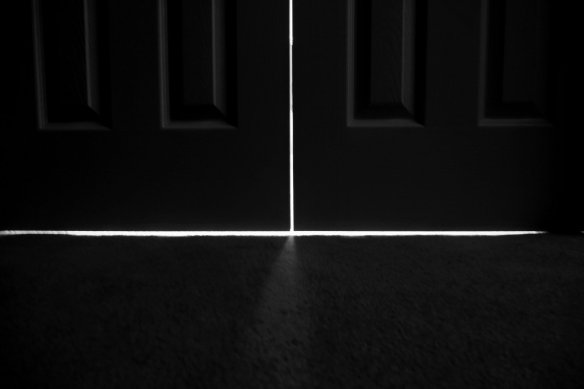
I was reminded of this recently. It was a pretty ordinary situation; I was with a friend in a dimly-lit hallway and there was a bit of light peeking out from beneath a closed door. I must have hesitated a bit before opening the door. Well, no, I know I hesitated a moment. I always do.

“What was that about?” my friend asked.

“What was what about?”

“That pause before you opened the door.”

pause a moment

I don’t talk about myself very often. I don’t really spend much time thinking about myself. I’m not very self-reflective. I’ve lived with myself my entire life, so there’s nothing really new there for me to learn. I’m aware that other people don’t hesitate before opening a door that has a light shining underneath it — but it doesn’t occur to me that it’s odd that I do it.

But when somebody else notices it, you sort of have to explain. And how do you do that? How do you tell somebody that when you approach a door in a dimly-lit hallway — a door with a light shining underneath it — that you hesitate because you always remember opening a similar door with a similar light and finding a dead guy hanging from a pipe? How do you do that without sounding all dramatic?

Because it’s really not dramatic. There’s just a moment — and seriously, it’s just a very brief moment — when you have to suppress an old spark of fear. I know I’m not going to open that door and see a dead guy hanging from a pipe. But my brain always says “Okay, prepare yourself for something horrible, then open the door.” And I open it and everything is okay.

I was a medic in the military. For most of my military career I was assigned to a large medical center, in a unit called Special Functions. I was part of a team that responded primarily to respiratory and cardiac emergencies. Most of what we did took place within the medical center; cardiac arrests, respiratory arrests, that sort of thing. But sometimes we’d be sent out on ambulance runs.

I don’t recall what sparked this particular run; somebody must have assumed there was a living person in some sort of respiratory distress. But there wasn’t. We responded to a hotel where somebody from the base worked part-time on a maintenance crew. The hotel staff directed us to the basement. Some sort of heating and air-conditioning facility.

So…dimly-lit hallway, light shining out from under the door.

The guy had been dead for a few days. All the bodily fluids had drained to his extremities, so his arms and legs were bloated and dark purple. His neck had stretched about a foot, so his feet were almost touching the floor. We were afraid that if we cut him down, the impact would cause his bloated feet to explode, so another medic and I had to support him while a third cut the — I don’t recall if it was a rope or a belt or a cord. Whatever he’d hung himself with. And, of course, there was the stink of putrefaction.

The whole event was pretty ghastly, but really it was just one of a number of ghastly things I’ve seen or done. I won’t say you get used to ghastly stuff, but you do become sort of inured to it. There have been other experiences that gave me nightmares for years, but that wasn’t one of them.

And yet I still flash on the image when I’m in a dimly-lit hallway and I see light under a doorway. To me, it’s not a big deal. Explaining it to somebody, though, is sort of embarrassing. Not because of what happened, but because of the way they look at you.

My friend said “You should talk about that stuff. You should write about it. Maybe you’ll get over it. Put it behind you.” So I said I would, because that was the easiest thing to say.

But here’s the thing: why would I want to put it behind me? Ugly things happen. They happen to everybody. I don’t want to forget them. I don’t mind that the memory of ugly things sometimes cause some minor disruption in my life. Ugly things are supposed to cause some disruption.

I know now what I should have said to my friend: “I still open the door. I always open the door. I’ll keep opening the door.” Because as long as you can open the door, that’s really all that matters.

my morning, interrupted

So I’m sitting here, right? It’s 9:30 on a Saturday morning, I’m drinking a cup of cold brew, looking out the window at drizzly-cloudy day, getting ready to read my students’ work. And the doorbell rings.

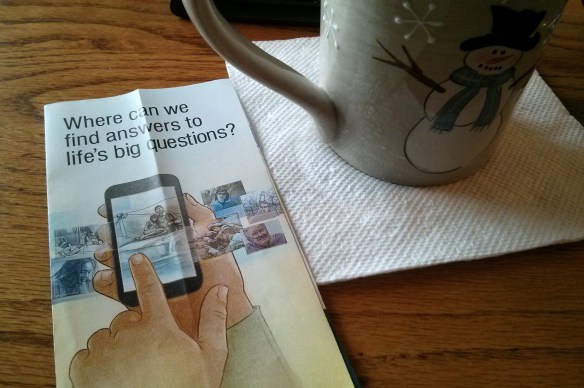
Guy in a suit. Young guy, white, earnest glasses, unsmiling. Right, Jehovah’s Witness. I open the door, he mutters something, hands me a pamphlet, and turns away. I didn’t even get a chance to say ‘Good morning.’ Not much of a witness — but hey, it’s 9:30 on a Saturday morning and it’s drizzly-cloudy. Who can blame him for wanting to finish his chores and go find a dry place where he can get a cup of…do Jehovah’s Witnesses drink coffee?

JW

Where can we find answers to life’s big questions? The pamphlet seems to suggest we can find them on our smartphone. Android phone, by the looks of it. Sorry, Siri. But what ARE life’s big questions? They’re listed on the back. Which of these big questions concerns you most? They’re not the questions I would have asked. Which is maybe one of the many reasons I’m not a Jehovah’s Witness.

What is the meaning of life?

Is God to blame for our suffering?

What happens when you die?

I’m a tad disturbed by the way the last two questions are phrased. Is God to blame for OUR suffering, and what happens when YOU die. Our suffering, your death. They don’t want to come right out and say ‘Dude, we know what’s going to happen when WE die, but you? Different story, bud.’

I don’t know…all I wanted was a cup of cold brew coffee, a few minutes to scan the news, then get my homework out of the way. Now I’m faced with these three questions. Fucking doorbell. Never should have answered the door. Never get out of the boat (no idea why Apocalypse Now popped into my brain).

Okay…meaning of life. I don’t know. Not very concerned about it. Eat well, get to know some interesting people, be curious, help other folks when you can. That ought to do it.

Is God to blame for our suffering? I don’t know. I don’t believe in god. But sure, why not? If you’re going to go to all the fuss and bother of believing in god, you might as well give him something to do. Shoulder the blame–that ought to keep him busy. And everybody who claims to speak for god, let’s hand them a share of the blame too. And let’s give a portion to all those young guys who ring doorbells at 9:30 on a Saturday morning — they sure as hell added to my suffering.

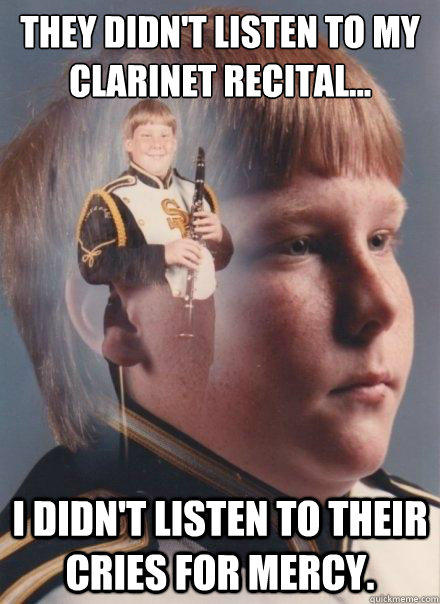
Right, what’s next? Oh…what happens when you die? I don’t know. Does it matter? I mean, regardless of what happens you’re still going to do it. It’s not like it’s optional. I totally get the idea that a lot of folks believe that if you live your life a certain way, then after you’re dead you get to join god’s special club. Like if you practice the clarinet, maybe you’ll get to play with the marching band. Or maybe you’ll just piss away a lot of time playing the clarinet. I don’t know. Can’t get very concerned about it.

By the way, I did a Google image search of ‘god clarinet’ to find a visual to include in this post. So okay, I don’t know the meaning of life and I don’t know what happens when you die, but I think this has to figure into it somehow:

clarinet cries for mercy

Seriously, you ought to do that image search. Brilliant. And that earnest young man who rang my doorbell this morning? If not for him, I’d have never seen this. Maybe there really is a god and this is his plan.

Her plan.

One of those. Praise Jeebus.

memorial day, maxwell

I only know a few veterans who give much attention to Memorial Day. I generally don’t. Don’t get me wrong — the concept of Memorial Day is beautiful. Honoring the men and women who’ve died while serving in the military is a worthy idea. But let’s face it, there’s not a lot of actual honoring going on these days. In practice, Memorial Day has become a cheap-ass way for people to ‘support the troops’ without actually having to do anything. It’s a form of emotional absolution; people wave the flag a couple times a year and say ‘Thanks for your service’ to a few folks in uniform, then they’ve done their duty and can go about their lives.

It’s not their fault. Most folks simply don’t have any skin in the game. Since we have a volunteer military, relatively few people have family serving in the armed forces. In fact, I’d suggest most people don’t even know anybody currently serving in uniform. We now have a military force comprised almost entirely of strangers. So it’s understandable that we don’t really care too much about what happens to them.

It saddens me. It annoys me. But it no longer angers me. I totally understand and I can’t really blame anybody for only paying lip service to the troops.

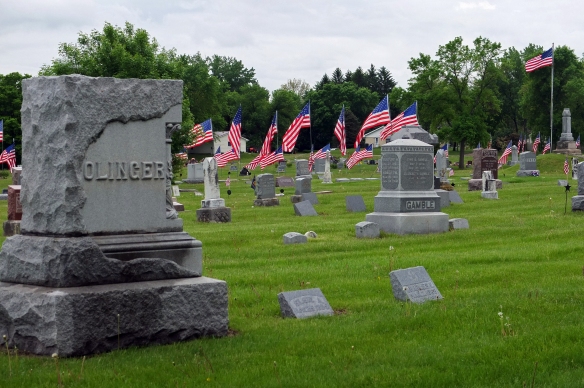
cemetery, maxwell

So in order to avoid becoming annoyed with people, I prefer to spend Memorial Day doing something non-Memorial Dayish. But yesterday, on the way from one place to another, I happened to drive through the small town of Maxwell, Iowa. And I mean small town. Population of 920, according to the last census. That’s 920 people total, living in 349 households, and belonging to 242 families.

The main road through Maxwell passes by a cemetery. And there were flags. So I made a U-turn and stopped.

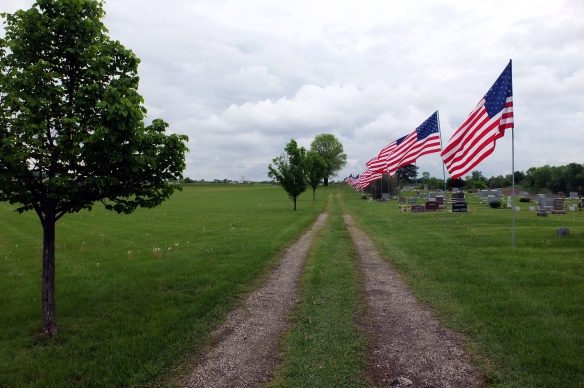
I didn’t even attempt to count them. Let’s just say there were a lot of flags. Not tiny flags, like the ones they hand out at parades or most often seen in cemeteries. These were full-sized flags.

And I was moved, almost to tears. Not because of the flags themselves; the U.S. flag may be a marvel of graphic design, but it’s increasingly being used primarily as a prop. No, I was moved by the effort.

These 920 people went to a great deal of bother to put up those flags. They likely spent a sizable chunk of the town’s tiny budget to buy them. This had to involve a very real sacrifice of time and money on the part of the citizens of Maxwell. A town that small, you know most of the people living there are farmers or have farm-related jobs. I don’t know anything about farming, but it seems like this is a busy time of year for folks who do farm stuff.

memorial day, maxwell

But they somehow found the time — no, they made the time — to put up all those flags. Why? Because they thought Memorial Day was worth it. Because they thought we were worth it, all of us who’ve spent time in military harness. Because they think the troops are still worth it.

For the first time in years, Memorial Day meant something to me. It meant something to me because it meant something to the 920 people of Maxwell, Iowa.

things on a table — knuckles dobrovic

Back in January I wrote about my reluctant conversion to Instagram. I was one of those people who mocked and jeered the app. I was one of those folks who used a camera to shoot photos — not a telephone with integrated camera-like technology. I considered Instagram to be a platform for cheesy photographers to display cheesy snapshots of their feet, or drunken snapshots of their drunken friends at parties, or sappy snapshots of sappy sunsets.

And hey, there really is a LOT of that stuff to be found in Instagram. But when I started to noodle around looking at photos on Instagram, I discovered there was also a surprising amount of really good work. It was because of that work (along with the purchase of a phone with a moderately decent camera) that I decided to dip my toe into the Instagram stream.

22 July, 2013

22 July, 2013

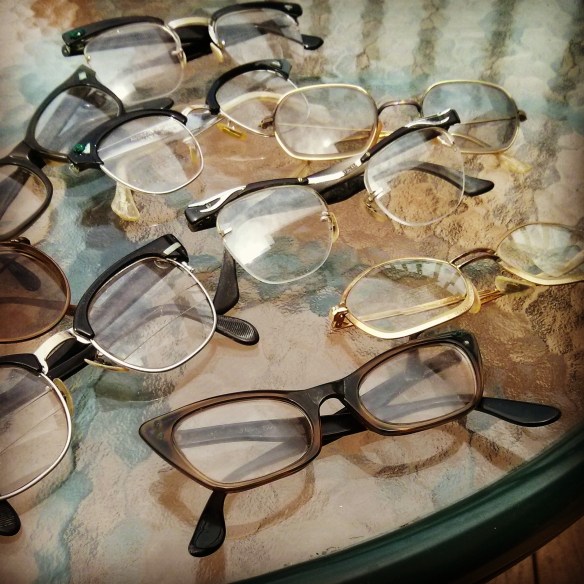
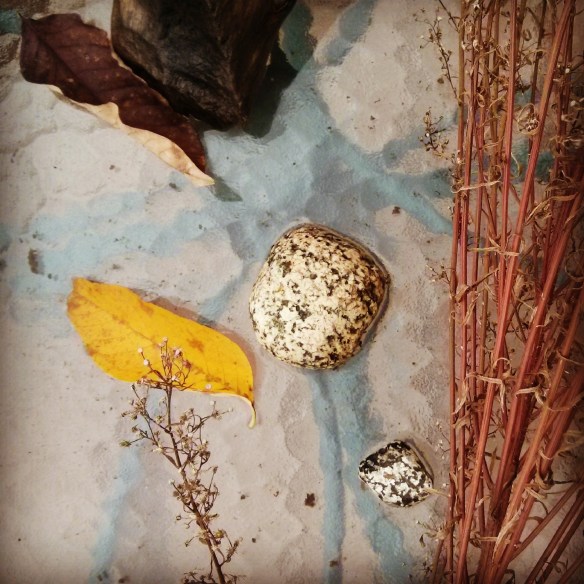
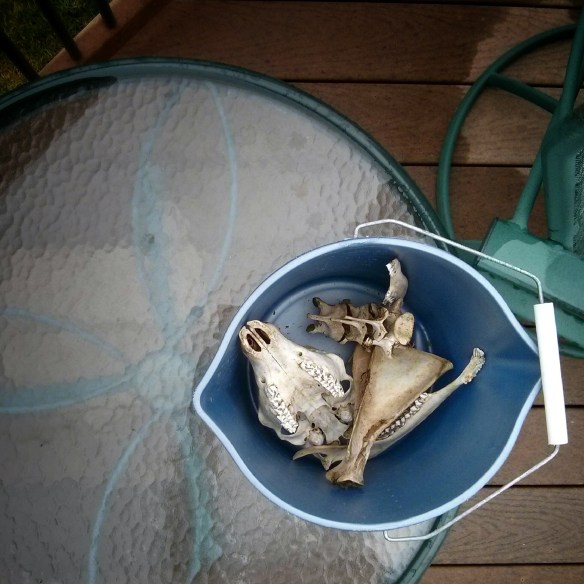
So in July of last year, I created an Instagram account. I was shy about it. I didn’t want something that could be publicly associated with me, so I used an alias for my account: Knuckles Dobrovic. I conceived a really simple (and let’s face it, really contrived) idea for some Instagram-ish photos: I would put something on a glass patio table, and I’d photograph it.

It was intended to be a lighthearted experiment. I was just going to noodle around and see what the cellphone camera could do, and get some idea of how Instagram worked. I wanted it to be something I could delete without hesitation or regret if/when it became too embarrassing or too dull.

August 3, 2013

August 3, 2013

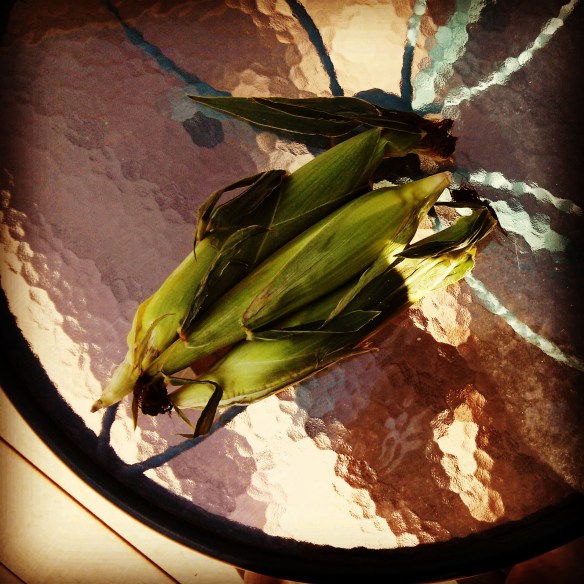
What I’d actually done, of course, was unconsciously sabotage the experiment. I didn’t want to like Instagram. And in the earliest photographs, that really showed. I just put any damned thing near to hand on the table — some ears of corn, a baseball, a beer bottle,  a random collection of old eyeglasses — and photographed it without much care or concern about the final image.

Sure, there was some minimal attempt at composition, but it remained basically a fairly lackadaisical exercise.

September 19, 2013

September 19, 2013

At some point, however, the experiment took hold of me. I found myself being more thoughtful and deliberate about the photos. I began to look around to find things that would be more photogenic on the table. I began to compose the shots more carefully. When I was out and about, I began collecting things specifically for the table. I talked about the project to friends and family. I actually began to care about the photographs.

November 4, 2013

November 4, 2013

Things on a Table became an actual project. Almost every day, I put something on the table and photographed it. I began to vary the time of day I shot the photo so I could use different light and catch different shadows. I photographed things on the table in all sorts of weather. I’d shift the table to different spots on the deck to get different patterns of line, light and shadow.

I even considered taking the table to different locations — out into the country, onto the sidewalk, into the city. That idea got tossed fairly quickly, mainly because it would have been a massive pain in the ass. But the important thing was that I’d begun to set specific parameters for limits on the project.

November 22, 2013

November 22, 2013

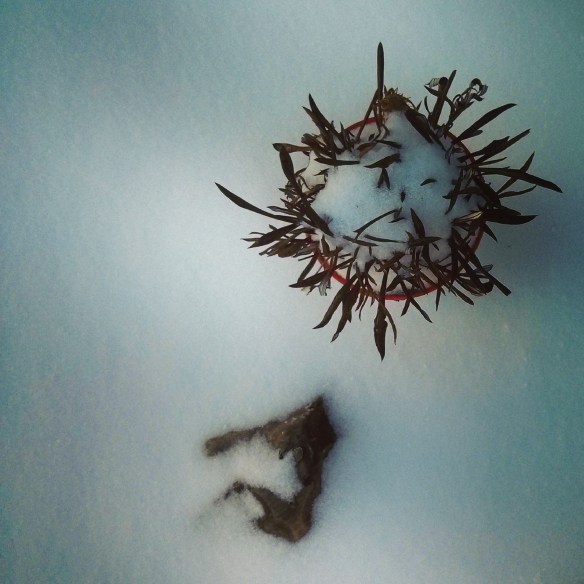
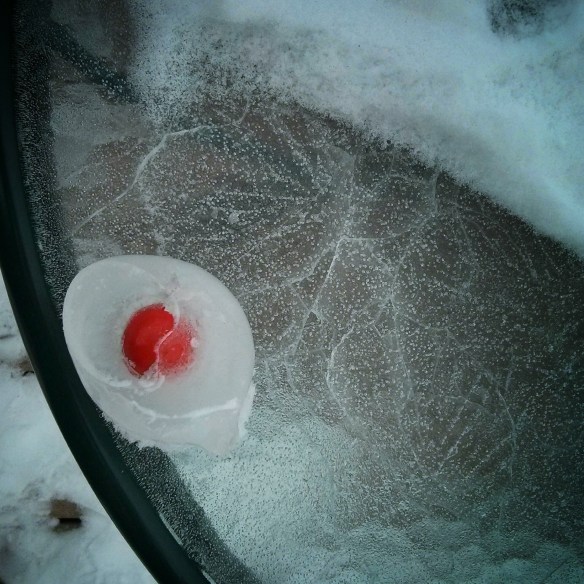
Winter came and snow covered the table, and I still put a thing on it and took a photo. I even began to create ice-things for the table. I’d find a thing, put it in a container, fill the container with water, set it outside and photograph the frozen result. I’d stuff things inside balloons, then fill the balloons with water and let them freeze. I’d shoot the photo, then leave the frozen things on the table and let the snow cover them. Over time the heat of the sun or the force of the wind would gradually reveal them, and I’d photograph them again.

January 9, 2014

January 9, 2014

To my surprise, friends and family members began gathering assorted bits and bobs of stuff they thought might appeal to me or look good on the table. An odd rock, plastic bubble wrap from a toner cartridge, an interesting weed, a hubcap found along the road. Eventually, people I know only through social media began to mail me things to put on the table.

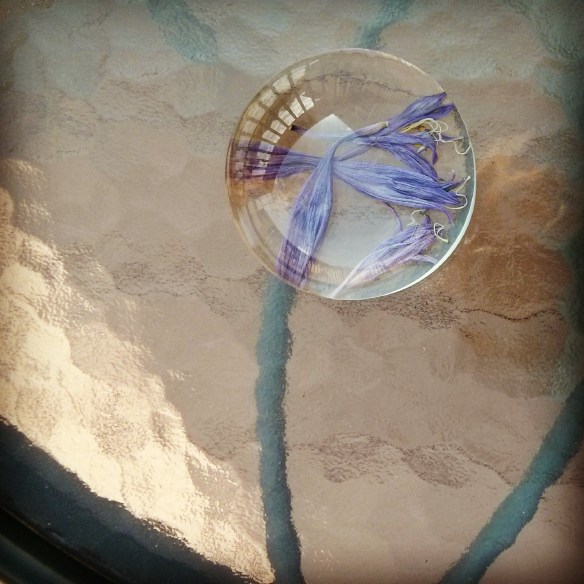
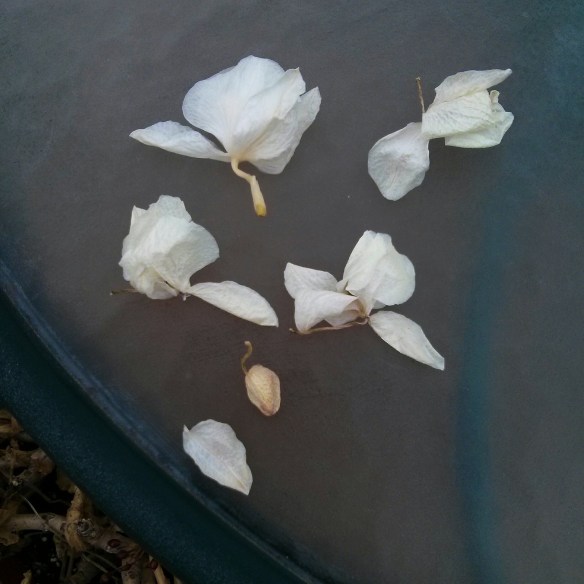
I began to re-use some of the things — a piece of driftwood, a half a brick, some dead flower blossoms, an ornamental magnifier — partly because I like their shape or texture, and partly because the idea of continuity of things appealed to me.

March 15, 2014

March 15, 2014

Like any project, this one occasionally feels like a chore. I’ve considered abandoning it two or three times. But each time I’d spot something that might be interesting on the table, and I’d find myself out on the deck trying to find an angle that worked.

At this point I figure I’ll finish out the year. I’ll continue to photograph things on the table into July. Then I’ll probably come up with some other sort of project, simply because I’ve grown fond of the name Knuckles Dobrovic.

April 29, 2014

April 29, 2014

I realize that’s a stupid reason. I don’t care. I’ve no objection to doing things for stupid reasons. I mean, I’m the guy who came up with the name Knuckles Dobrovic just to photograph random things on a table. Stupid is where I live.

May 23, 2014

May 23, 2014

impermanence

So there’s me, on the first day of Spring, noodling around the Riverwalk just as if I didn’t have anything else to do. And man, it felt like Spring. Bright and sunny, almost warm, fresh breeze. Bicyclists were out, and young mothers with strollers, and over the lunch hour all the employed people abandoned their offices and escaped the skywalk and hit the sidewalks with all the energy of spawning salmon.

So yeah, even though I had work that needed to be done, I was out walking. And here’s a true thing: you cannot walk along the Riverwalk without stopping occasionally and peeking over the balustrade to watch the river flow by. While I was doing that, I saw a milky white film of some sort, splashed out on the river. Who knows what it was — soap scum maybe, or chemical waste, or something organic roiled up by the snow melt rushing over the dam upstream. Whatever it was, my immediate reaction was disappointment and a mild distaste at the sight of it.

But then it sort of drew me in. It was almost hypnotic, the way the motion of the river shaped and reshaped the stuff, the way the color shifted with each tiny wave.

I must have watched this happen for a quarter of an hour. I can’t say it was pretty, but there was something compelling about it — something unexpectedly absorbing. The river, I knew, would shrug this stuff off, whatever it was. Even in the short time I was there, I could see the stuff gradually being disrupted by the current — broken up, disorganized, reorganized, and all while being forced inevitably downstream. There wasn’t a single moment when the stuff held a coherent shape.

I realized the only constant in this event was me. I was standing still. I wasn’t moving. I was the only fixed point in an otherwise unfixed occurrence.

So I left.

nobody pays much attention

In the United States, November 11 is called Veterans Day. In other parts of the world it’s called Remembrance Day or Armistice Day. The latter is appropriate since it celebrates the anniversary of the day hostilities formally ceased in the First World War. The 11th hour of the 11th day of the 11th month in 1918.

Ninety-five years. And what have we learned? Aside from more efficient and more impersonal methods for killing, not a hell of a lot. We’re still fighting wars, we’re still fighting them for the same stupid reasons, and at the behest of the same powerful business and political interests. Young men and women are still killing and dying in foreign lands. And nobody is paying much attention.

U.S. Army Pfc. Michael W. Daley Jr. (right) and Pfc. Travis B. Woolwine, both Soldiers with 1st Battalion, 506th Infantry Regiment, 4th Brigade Combat Team, 101st Airborne Division (Air Assault), scan their surroundings while on patrol in Paktya Province, Afghanistan / Photo by Sgt. Justin Moeller

U.S. Army Pfc. Michael W. Daley Jr. (right) and Pfc. Travis B. Woolwine, with 1st Battalion, 506th Infantry Regiment, 4th Brigade Combat Team, 101st Airborne Division (Air Assault), scan their surroundings while on patrol in Paktya Province, Afghanistan / Photo by Sgt. Justin Moeller

As of this date, 402 troops have died fighting in Afghanistan this year. Most of those (310) were US troops, but soldiers and marines from the UK, from Poland, from Georgia (the former Soviet state), from Romania and Slovakia and Italy and Germany and Australia have also been killed.

In the last few days 42-year-old Warrant Officer Ian Fisher of Barking, Essex in England was killed in an IED attack in Lashkar Gah in Helmund Province. Army Sergeant 1st Class Forrest Robertson, 35 years old, of Westmoreland, Kansas was killed by small arms fire in Pul-i-Alam in Kogar Province — also known as Bab al-Jihad, the Gates of Jihad, because of the savage fighting between Soviet troops and mujahideen during the Soviet-Afghan war. Army Specialist Angel Lopez, 27, from Parma, Ohio was killed by small arms fire in a Green on Blue attack in Zabul Province. Twelve deaths in the first nine days this month. The youngest was 19 years old. Nineteen years old — Jeremiah Collins of Milwaukee wasn’t even old enough to buy a beer. Dead, 7000 miles from home, in service to his country.

US Army Spc. Kevin Jackson, 4th Squadron, 9th Cavalry Regiment, 2nd Armored Brigade Combat Team, 1st Cavalry Division, pulls security during a reconnaissance mission in a village south of Forward Operating Base Fenty, Nangarhar province, Afghanistan, Sept. 8, 2013 / Photo by Sgt. Margaret Taylor

US Army Spc. Kevin Jackson, 4th Squadron, 9th Cavalry Regiment, 2nd Armored Brigade Combat Team, 1st Cavalry Division, pulls security during a reconnaissance mission in a village south of Forward Operating Base Fenty, Nangarhar province, Afghanistan, Sept. 8, 2013 / Photo by Sgt. Margaret Taylor

All of those troop who’ve died have families and friends, they have fathers and mothers, brothers and sisters, they have wives and husbands and children. Outside of their families and friends, hardly anybody will notice those deaths. Because nobody, really, is paying much attention.

I mentioned this earlier in the year. At that point there were about 70,000 US troops serving in Afghanistan; today there are about 60,000. Combat operations by US troops are slated to end in late 2014 — but even then the US will likely leave between 15,000 and 30,000 troops in the region. And be sure of this: some of them will be fighting and dying.

Cpl. Zachery K. Arrowood with 1st Battalion, 9th Marine Regiment, provides security during a patrol in Helmand province, Afghanistan, Oct. 12, 2013. The patrol was conducted to disrupt enemy activity in the area / Photo by Lance Cpl. Zachery B. Martin

Cpl. Zachery K. Arrowood with 1st Battalion, 9th Marine Regiment, provides security during a patrol in Helmand province, Afghanistan, Oct. 12, 2013. The patrol was conducted to disrupt enemy activity in the area / Photo by Lance Cpl. Zachery B. Martin

There’s still only one media outlet that routinely pays attention to the troops serving in combat zones — the liberal muckraking magazine Mother Jones. They still publish their brilliant photo series We’re Still at War: Photo of the Day. I don’t know how many people bother to look at the photos. Not enough. Not nearly enough.

Why? Because the war is primarily being fought by strangers — by people we don’t know and don’t care about. Historically, wars have always been fought primarily by the poor and working class. Officers, of course, usually come from the middle classes, but most of the killing and dying has been done by the underclasses. The demands of twelve years of war — the longest war in US history — have exacerbated that problem. The gap between the people who initiate the wars and the people who actually fight them is greater now than ever before. And the mass in the middle — which includes most of the American public — are estranged from both groups. And so when a soldier gets killed in some dusty desert, very few people are affected, and nobody pays much attention.

Marines and Georgian Soldiers with 33rd Georgian Battalion exit an MV-22 Osprey aircraft during an operation in Helmand province, Afghanistan, Sept. 23, 2013. Marine Medium Tiltrotor Squadron 165 provided the service members with aerial support during the operation / Photo by Cpl. Ashley E. Santy

Marines and Georgian Soldiers with 33rd Georgian Battalion exit an MV-22 Osprey aircraft during an operation in Helmand province, Afghanistan, Sept. 23, 2013. Marine Medium Tiltrotor Squadron 165 provided the service members with aerial support during the operation / Photo by Cpl. Ashley E. Santy

On Monday — Veterans Day — I’ll meet with my brother and my cousin, both of whom served in the Marines, and we’ll attend a breakfast given by a local grocery store chain (Hy-Vee), just as we’ve done for the last few years. There’ll be a lot of old veterans there — a handful from World War II, a few from Korea, some from Viet Nam and Iraq and Afghanistan. The food will be mediocre — but better than what we’d have gotten in the mess hall back when we were in uniform.

Nobody will be there just for the food. We’ll all be there because we’re veterans, and on this one day some folks will pay attention. Most of the veterans sitting down to breakfast will have scars, physical or emotional. Some will be missing limbs. And every one of us will, at some point, remember somebody who was wounded or killed.

Marines with 3rd Battalion, 7th Marine Regiment, patrol near Forward Operating Base Musa Qala, Helmand province, Afghanistan, Oct. 19, 2013. The Marines of 3/7 patrolled to reduce enemy activity in the area / Photo by Lance Cpl. James Mast

Marines with 3rd Battalion, 7th Marine Regiment, patrol near Forward Operating Base Musa Qala, Helmand province, Afghanistan, Oct. 19, 2013. The Marines of 3/7 patrolled to reduce enemy activity in the area / Photo by Lance Cpl. James Mast

As we enter and leave the breakfast venue, the volunteers from the grocery store will thank us for our service. And they’ll be sincere, because they’re working people. Some of them will be veterans themselves, or have family members who have served or are still serving. During the day a lot of politicians will also give public thanks for our service. Some of them will be sincere and some of them will mean it. Damned few of them, though, will actually understand what service to the country means. It means sacrifice. When most politicians speak about sacrifice, they’re talking about other people.

On Tuesday the 12th, the world will forget us for another year. Troops in Afghanistan will continue to go out on patrol. Some of them will get wounded. Some will get killed. And nobody will pay much attention.

Editorial note: The photos above were shot by members of the military, and published in Mother Jones magazine.

happy birthday molly

Today is the birthday of the late, great Molly Ivins. ‘Late’ on account of she’s been dead since 2007, which is far too long. ‘Great’ on account of she was the smartest and wittiest and sharpest political writer since the invention of political writering.

molly ivins1

Laughing Molly Ivins

I don’t recall the first time I came across Molly’s writing, but I’d been a fan for quite a long time before I ever saw her speak. I only saw her speak the one time. I was a grad student at the American University back in 1990 or 91, and I heard she was going to be interviewed at some local event. So I put on a sport coat and a tie and took myself to some grand Washingtonian venue and joined the other couple hundred folks who’d come to hear Molly speak.

I don’t know what I was expecting, but it wasn’t the tall (in her cowboy boots she had to be over six feet tall), awkward-looking woman with the unfortunate haircut (it looked like she’d cut her own hair…with pinking sheers) who walked onto the stage. Then she sort of dropped herself into a wing-backed chair and grinned — and there was so much joy and delight and orneriness in that grin that I completely fell in love with her. She grinned like a pirate.

I couldn’t tell you what she talked about. I just don’t recall. What I do recall is that she was charming and clever and thoughtful and uproariously funny. I don’t know if she was exaggerating her drawl or if she was moderating it, but there was no doubt Molly Ivins was from Texas. And laugh…lawdy, that woman could bring a laugh. Nothing demure about it; she laughed all the way down to her boots.

Young Molly Ivins

Young Molly Ivins

It was the breast cancer that killed her. One more reason to hate cancer and donate money to kick its ass.

“Having breast cancer is massive amounts of no fun. First they mutilate you; then they poison you; then they burn you. I have been on blind dates better than that.”

That was Molly Ivins. She’d bring you the Truth in all its ugliness. And she’d make you laugh about it. She didn’t make light of it, she didn’t want you to ignore the ugliness; she wanted you to feel the sting of the ugly. But she didn’t want you to forget to laugh. She didn’t want you to forget that having fun isn’t just how we tolerate the ugly. It’s how we defeat it.

A few of my favorite lines from our Molly:

[W]e’ve bounced back from this same mistake before—the mistake of thinking that we can make ourselves safer if we just make ourselves less free. We get so scared of something—scared of communism or crime or drugs or illegal aliens—that we think we can make ourselves safer by sacrificing freedom.  Never works.  It’s still true: the only thing to fear is fear itself.

I don’t have an agenda, I don’t have a program. I’m not a communist or a socialist. I guess I’m a left-libertarian and a populist, and I believe in the Bill of Rights the way some folks believe in the Bible.

A populist is someone who is for the people and against the powerful, and so a populist is generally the same as a liberal—except we tend to have more fun.

In Texas, we do not hold high expectations for the [Governor’s] office; it’s mostly been occupied by crooks, dorks and the comatose.

I dearly love the state of Texas, but I consider that a harmless perversion on my part, and discuss it only with consenting adults.

I have been attacked by Rush Limbaugh on the air, an experience somewhat akin to being gummed by a newt. It doesn’t actually hurt, but it leaves you with slimy stuff on your ankle.

So keep fightin’ for freedom and justice, beloveds, but don’t you forget to have fun doin’ it. Lord, let your laughter ring forth. Be outrageous, ridicule the fraidy-cats, rejoice in all the oddities that freedom can produce. And when you get through kickin’ ass and celebratin’ the sheer joy of a good fight, be sure to tell those who come after how much fun it was.

Aw lawdy, that was a woman. They say the good die young. I don’t know about that. What I do know is this: the great die too soon.

The late, great Molly Ivins

The late, great, beautiful Molly Ivins

Happy birthday, Molly Ivins. We miss you.

coffee, guns, & sensitivity

“Starbucks? You get coffee at Starbucks?” I get asked that question periodically. Sometimes by people who dislike the cost or taste of Starbucks coffee, sometimes by folks who dislike the way Starbucks treats its employees, sometimes by people who dislike the music at Starbucks, or the customers who frequent Starbucks, or the name Starbucks. And lately I’ve been asked that question by folks who are appalled by the refusal of Starbucks to ban firearms from their coffee shops.

starbucks and guns

That’s right, Starbucks allows its overly-caffeinated customers to be armed. Not every Starbucks; only those Starbucks in states that have ‘open carry’ laws**. According to Zack Hutson, a spokesman for Starbucks,

“We comply with local laws and statutes in the communities we serve, abiding by laws that permit open carry. Where these laws don’t exist, openly carrying weapons in our stores is prohibited.”

So if your state or city allows folks to openly tote a firearm, then Starbucks says you’re welcome to take that firearm into their coffee shops. They don’t advertise this, but there it is.

Gun safety advocates think this stance is massively stupid. Gun rights advocates are basically divided into three camps. There are those who think anybody who’d enter a Starbucks is a communist who’s only about five minutes away from gay-marrying a sheep. There are those who dislike Starbucks because they’re only ‘gun-neutral’ instead of ‘pro-gun.’ And there are those folks who think Starbucks deserves a round of applause for their bold hey-we-didn’t-write-the-law stance on firearms.

The latter group organized Starbucks Appreciation Day. Which was last Friday, in case you didn’t notice (and you probably didn’t). Starbucks Appreciation Day was sort of like Chick-fil-A Appreciation Day, only that was for hating gay folks and this was for loving firearms. Given that there’s some serious overlap among the gun-loving and gay-hating subsets, it’s not surprising that Starbucks Appreciation Day received some blowback (hah, blowback…see what I did there?) from the triple-shot testosterone black coffee crowd.

The CEO OF fAGbucks told the rest of us that if we dont support ass munchers getting married, we should not buy fagbucks, so I now go to the Coffee Bean

I’m aware of [Starbucks] recent backing of homosexual “partnerships”. My point was that they have not changed their open-carry policy and that behavior deserves acknowledgement. As long as the homosexuals don’t “invade my space”, I’ll let them suffer the consequences of their lifestyle.

Yeah. Fagbucks. One argument for getting coffee at Starbucks is you’re not likely to meet the guy who refers to it as ‘Fagbucks.’

In any event, I was pleased by Starbucks Appreciation Day. Not because I support the notion of openly carrying firearms — I definitely do not. I like Starbucks Appreciation Day because 1) it brings attention to Starbucks’ policy (which, in my opinion, really needs to change), and 2) I’m a very firm believer in the First Amendment of the U.S. Constitution, which guarantees “the right of the people peaceably to assemble.” So it makes me perversely proud to see people with whom I actively disagree making a public stand and exercising their constitutional rights. I’m more willing to support people who openly stand up for causes I dislike than I am to support a corporation that quietly refuses to adopt a policy that’s in the best interest of its customers. 

starbucks and guns3

Here’s the thing about freedom of speech and freedom of assembly: if it’s to have any meaning at all, it can’t be limited for reasons of sensitivity. These rights cannot be restricted simply because they might upset somebody.

It would, for example, be incredibly insensitive and deliberately offensive for gun rights advocates to hold Starbucks Appreciation Day at a Starbucks in Newtown, where more than two dozen children and teachers were murdered eight months ago. Only a group of world class jackasses would schedule a pro-gun rally in Newtown.

And so, of course, that’s exactly what the Connecticut Citizens Defense League decided to do. Not surprisingly, gun safety advocates objected. Equally unsurprising, pro-gun folks mocked them.

Interesting comments by the “victim class” from Newtown.

They need to suck it up. We don’t all stop driving our cars when there is a big car crash. We don’t ban flights over a town where a plane crashed. to heck with all that. If we want to be sensitive of the kids fears then let them stay home from public school for a year. My rights are not negotiable on someone elses fears.

As if we should be ashamed at insisting on rights in such an insensitive way. Screw that! Sensitivity is why they band open carry and concealed carry in most states ages ago. It took us DECADES of tragedies before people started insisting on overturning those laws. We will NOT crawl back in our holes because someone whines and cries.

I guess civil rights stop after a killing.

Seriously, these guys were actually offended–offended–by the notion that they should be sensitive to the pain and suffering of parents whose six-year-old children were recently murdered. In fact, they seemed to see this as some sort of challenge. “You don’t want me to bring a gun to your Starbucks in Newtown? Fuck you in the neck, you whining babies. I’m going to drive an extra ninety minutes just so I can bring a gun to Newtown. In fact, fuck you so much I’m bringing TWO guns now. Sensitivity is for pussies. Suck my puny white dick.”

The whole Starbucks Appreciation Day idea put the corporation in an uncomfortable public relations situation (which, let’s face it, is exactly where they belong for having such a passive policy). They had to choose between 1) maintaining their policies and showing themselves to be heartless corporate fuckwads or 2) being decent members of the community. They tried to choose both.

Starbucks issued a statement on the decision of pro-gun advocates to hold Appreciation Day:

These events are not endorsed by Starbucks. That said, our stores are gathering places for the communities we serve and we respect the diverse views of our customers.  We recognize that there is significant and genuine passion surrounding open carry weapon laws. Our long-standing approach to this topic remains unchanged.

Oh Starbucks, you had me at ‘that said.’ Except, of course, this is NOT an issue of ‘diverse views’ as the Starbucks statement suggests. It’s an issue of health and safety. While it’s true that occasionally somebody carrying a concealed weapon will prevent a crime from taking place, it’s a lot more likely somebody carrying a weapon will fire it in anger (and I don’t know about you, but every time I’m behind somebody who orders a “Venti iced skinny hazelnut macchiato, sugar-free syrup, extra shot, light ice, no whip” I want to kneecap them). It’s even more likely somebody will discharge their weapon accidentally (and if we’re lucky, they’ll only wound themselves).

starbucks and guns2

In the end, Starbucks is a corporation and the only thing corporations really care about is maximizing profit. Starbucks isn’t about coffee; it’s about selling coffee. At least whoever owns the Newtown Starbucks franchise had the decency to close the coffee shop five hours early, so there was no Starbucks Loves Guns event there.

Oh, and if Starbucks is so wicked, why do I buy their coffee on occasion? Simple. There’s a Starbucks about seventy paces from the entrance to the main branch of the public library. I can stop there, buy a big white chocolate mocha, take it into the library with me, and sip on it for an hour or two while I work.

I’m apparently willing to periodically sacrifice my principles in the interest of convenience.

** There are only seven states and the District of Columbia (in red) that prohibit the open carrying of handguns (California permits citizens to openly carry rifles and shotguns in rural areas). Fourteen states (in green) require some form of permit to openly carry a handgun in public. Seventeen states (in gold) allow open carry of handguns, though there are general restrictions (for example, it may be prohibited to openly carry a handgun into a church or an establishment that serves alcohol). The remaining twelve states allow full open carry (though individual businesses and establishments can forbid weapons on the premises).

open carry map