last breath

Somewhere in a filing cabinet stashed (at great inconvenience to everybody involved) in Ohio or Virginia or possibly New York are a few three-ring binders containing Kodachrome transparencies of various old crime scenes. They’re images I shot as a criminal defense investigator–all from cases that never went to trial. Had the cases gone to trial, the images would be filed away somewhere else as evidence. Since the cases were either dismissed or resolved by a plea agreement, the transparencies remained in my possession.

They are, for the most part, the most dull images imaginable. A lot of them are nothing more than establishing shots–photographs taken to establish the features of a location. If, say, a murder took place in a house, you’d begin (or end) your crime scene photography by shooting pictures of the exterior, taking care to include things like street signs and traffic signals and light poles. Evidentiary photographs are about registering clear information that might be helpful to an attorney or to a jury. A conviction or an acquittal might depend on something as mundane as the distance between a front stoop and the nearest light pole.

But also tucked away inside those three-ring binders are images that have no evidentiary value at all. These are photographs I shot simply because they appealed to the eye. There is, for example, a photograph of a blood spatter pattern that splashed across a church calendar hung on a kitchen wall. The calendar has a painting depicting the face of Jesus on the cross. It’s pretty horrible (both the painting itself and the photo showing the blood on the painting), but it’s also visually arresting.

There’s also an abstract image that shows a glass sample container from an old Breathalyzer test. Years ago when suspects were administered a Breathalyzer test to determine their blood alcohol, the samples were kept in glass vials that looked rather like test tubes. Two samples were taken–one of which was sent to the crime lab, the other was set aside for independent testing by the defense. In this case, the accused was charged with vehicular homicide. While awaiting trial, he hung himself in his jail cell. Several months later I discovered the tube while I was cleaning out my evidence locker. It occurred to me that it contained the breath of a dead man. So I photographed it.

There are probably no more than fifteen or twenty such Kodachromes. Except for a few defense lawyers, nobody has ever seen them. I’m not entirely comfortable with them. I’m rather glad they’re unavailable to me now. If I had them, I’m not sure if I’d scan them and make them available for people to see.

I rather think I might, though I’d feel bad about it. I hope I’d feel bad about it.
we walk on thursday

I belong to a group called Utata. The group is an odd collective; we have photographers and writers, we have stay-at-home moms and software designers, we have scientists and security guards—and you can’t always tell which is which. Mostly what we do is talk a lot and participate in photography projects.

Our longest-running project is also our most simple. We walk on Thursdays. As of yesterday, we’ve been doing this every Thursday for 281 weeks. That’s nearly five and a half years. Five and a half years.

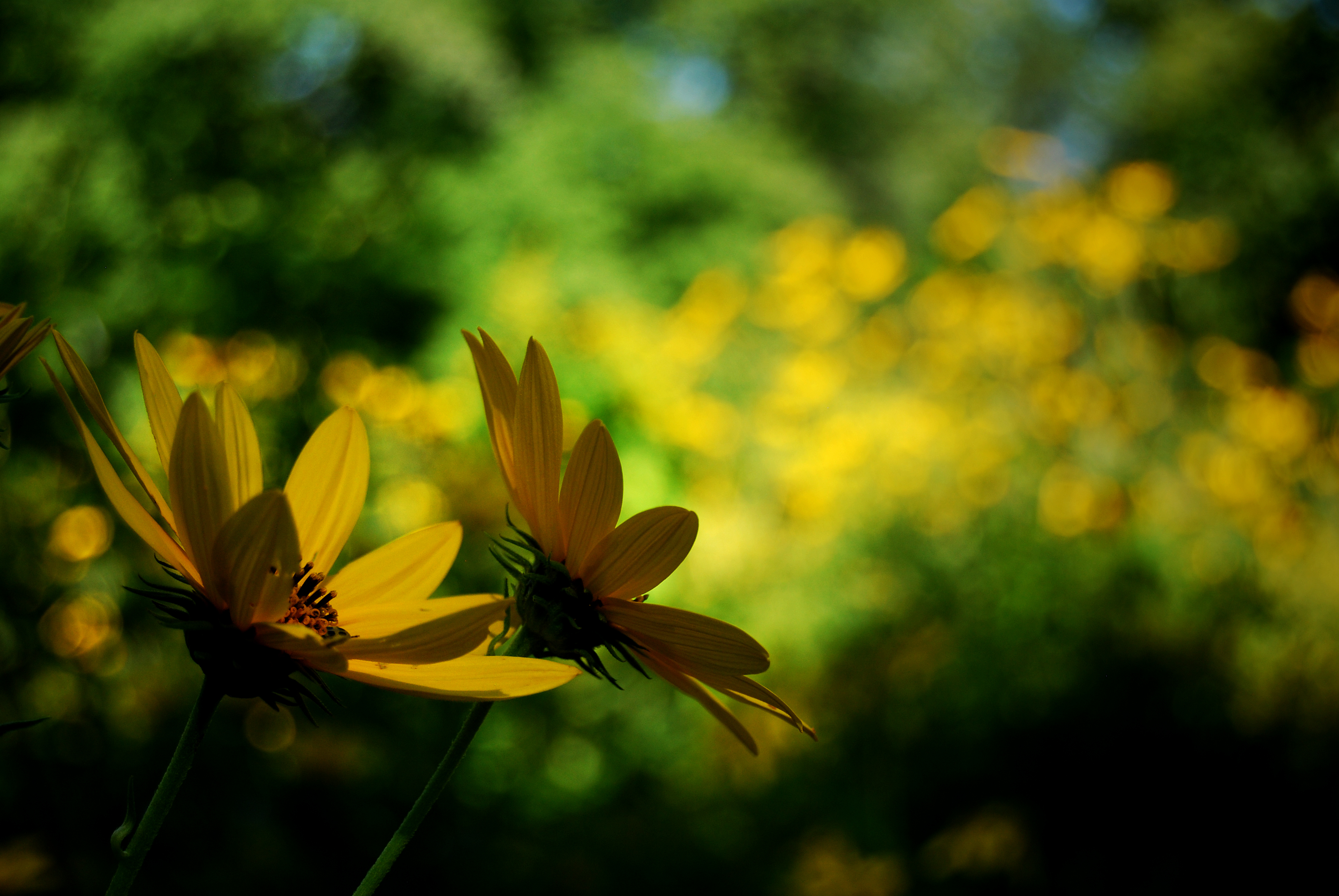
Not everybody in the group walks on Thursdays. We have around 20,000 members, after all. But every Thursday, somebody is walking somewhere and taking photographs. This week we had somebody walking a picket line in Canada, somebody walking down a street in Kaiserslautern, Germany and along a field in Tungelsta, Sweden, somebody walking along a beach in Florida and a harbor in Ireland. And me, I went walking along a wooded creek and took the world’s most common photograph: flowers.

It’s such a simple thing, and yet it’s completely wonderful—and I mean wonderful in the old sense of the term. It leaves me full of wonder. There’s no logical reason for people all over the world to do this—and yet they’ve continued to do it for half a decade. We have continued to do it for half a decade.

I really feel fortunate to be a part of such a group.

alert to possibilities

Ever since I wrote this I’ve been thinking about why I enjoy shooting photographs of traffic signals. I’d never really given it much thought before.

I first photographed traffic signals in 2009, as part of the Utata Storytellers project. The project ended, but I continued to wander around and shoot the signals. I wasn’t trying to make a point or suggest something meaningful—I just wanted to create a certain mood. The traffic signals were just the compositional device that tied the various photographs together.

But having finally turned my mind to the idea, I think I’ve figured out why I’m drawn to traffic signals. First, they’re all essentially the same—one stoplight looks pretty much like another, one Walk/Don’t Walk signal is identical to all the others. But the backgrounds change. What I like is the continuity of the subject matter and the variety of the surroundings. I enjoy finding the best angle from which to photograph the signal, finding the right light, finding the right moment. There are some traffic signals I want to photograph, but not until the shadows are right. There are some that will, I believe, only become an interesting composition if there’s a person in the frame. I’ll sometimes wait ten, fifteen, thirty minutes hoping for just the right person to walk into the frame—and then I need to catch them at just the right point and, it’s to be hoped, in a posture that complements the traffic signal.

I enjoy this because sometimes it’s incredibly easy and sometimes it’s incredibly difficult. I enjoy this because there are traffic signals wherever I go. I enjoy this because even though the photographs are about traffic signals, they’re not really about traffic signals at all. They’re about being alert to possibilities.

a small drama

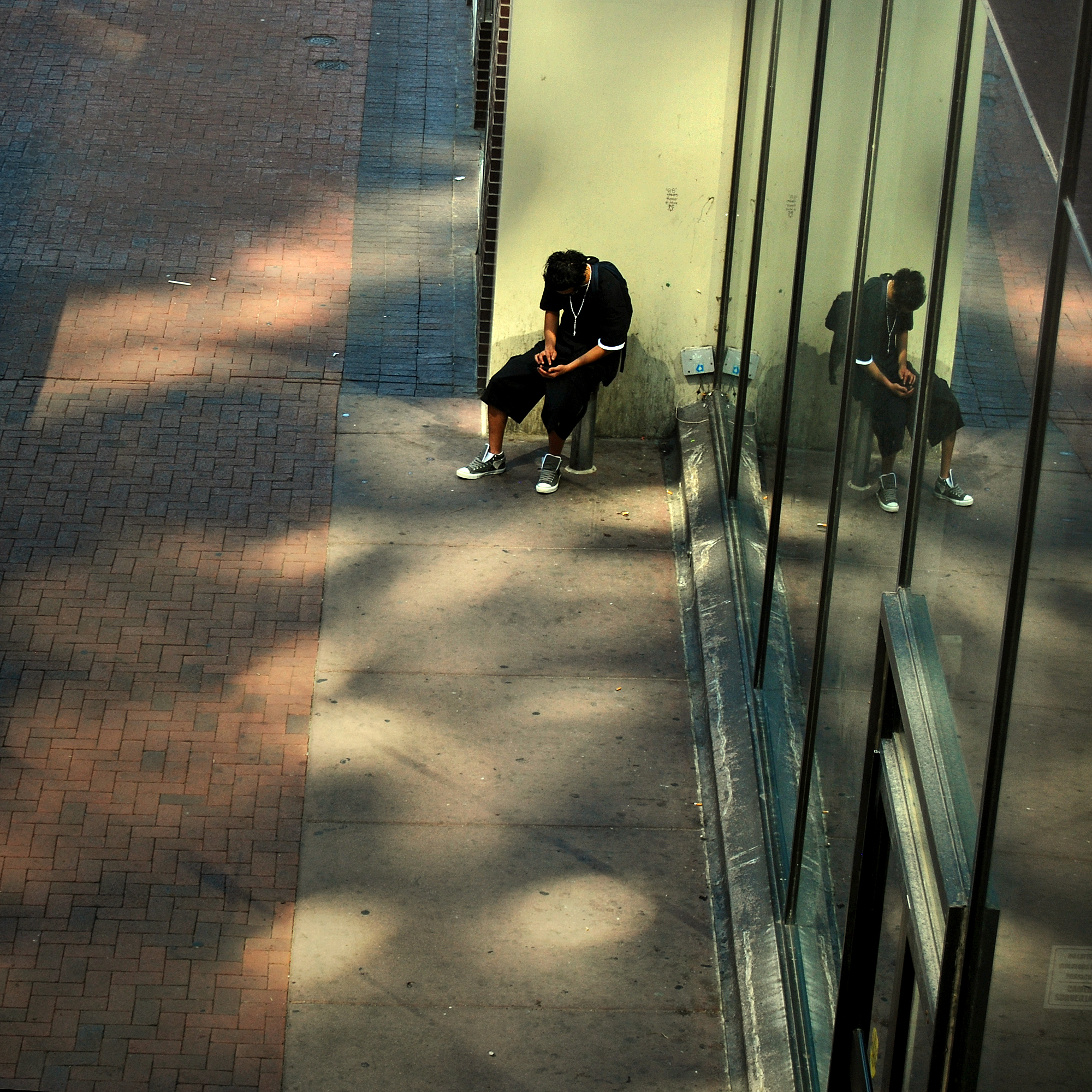
I was in the skywalk when I spotted this kid strolling down the sidewalk and texting. I probably wouldn’t have paid him any attention at all if he hadn’t come to a sudden John Belushi-style halt. He sort of bounced up and down on his toes for a moment, then rushed over to the standpipe, sat himself down, and began texting furiously.

I started to take his photograph, then hesitated. There was something about his posture that led me to think he wasn’t getting pleasant news. I watched for a bit, feeling sorry for the kid and feeling a little guilty for spying on him in his misery. At least I assumed he was in misery; for all I know he could have been involved in some furious last-minute Ebay bidding on an autographed Lady Gaga poster.

So I stood there for a moment. It occurred to me that I’d have had no hesitation shooting his photo if he’d appeared  happy–so why shouldn’t I take the shot just because he seemed distressed? Why should his mood be the deciding factor on whether or not I take a photograph? Why should that matter?

But it did. All the same, I shot the photograph. I felt like a voyeur, and in the end I only shot the one frame–but I took the shot. Afterwards, I found an exit from the skywalk and strolled over to the drugstore, though I’m not sure what my purpose was. I guess I thought maybe I’d see or hear something that would give me some hint as to the kid’s mood. But by the time I got there, he was gone.

I wish now I’d taken my time and shot three or four frames. If you’re going to do a thing, whether it’s morally questionable or not, you may as well do it properly.

passing through

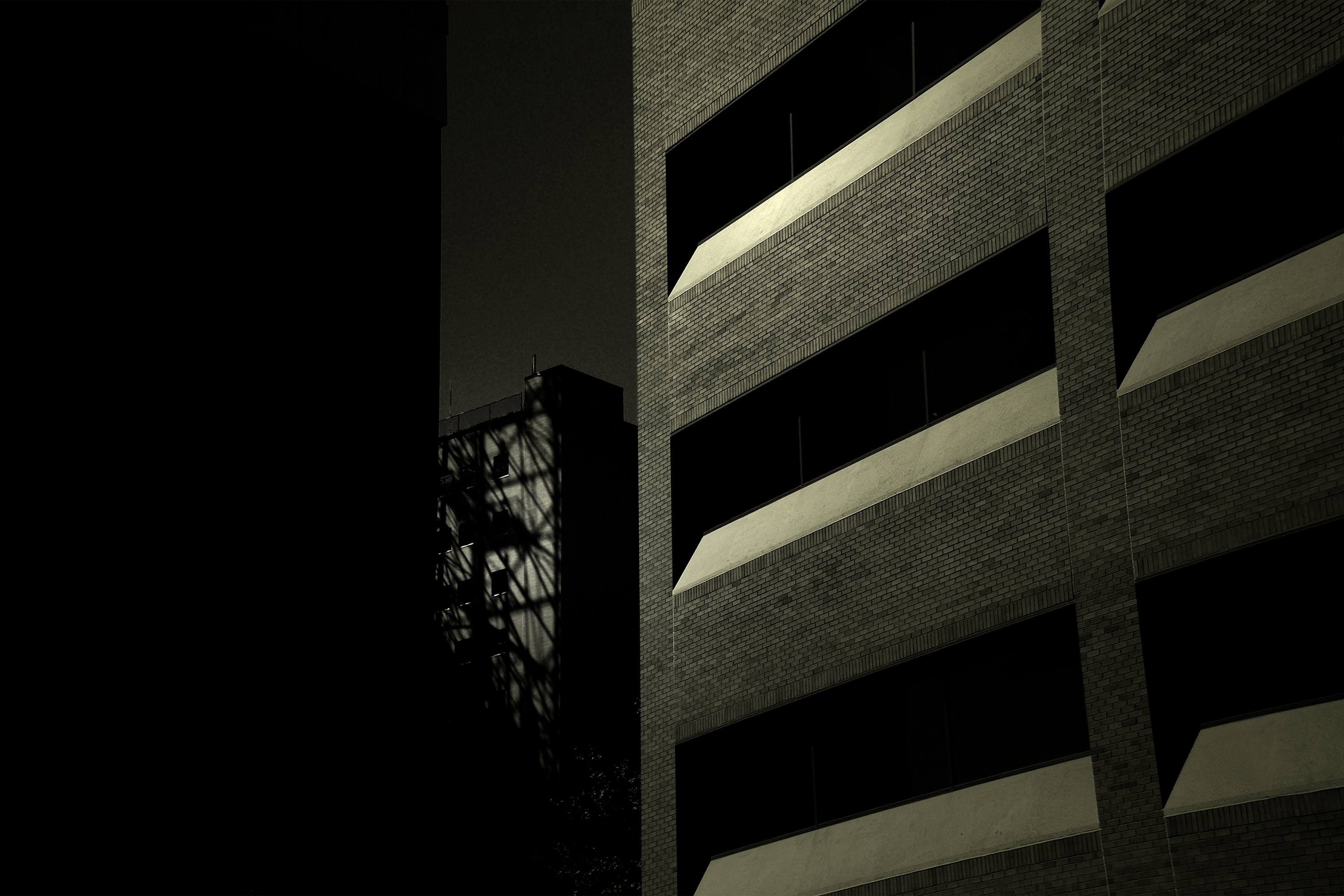
I like to think that at heart I’m really a black-and-white sort of guy. Not in my worldview, but in photography. B&W is all about form and shape, without any of that distracting color. B&W is visceral. You see the shot and it passes directly from your eyes through your balls and straight to the finger on the shutter. B&W is Tom Waits.

I like to think that at heart I’m a black-and-white sort of guy…but I’m not. Oh, I can get close to it now and then—I can visit the territory, but I don’t belong there and I’ll never be a resident. I do enjoy passing through, though.

following through rock

I  used to dislike giving titles to photographs. Then, for reasons I’ve never bothered to try to understand, I began to enjoy giving titles to photographs. Sometimes the title means something; sometimes it’s just a word or phrase that makes an otter slide into my head and I slap it on the photo.

I did that this morning. I was getting ready to post a faux Polaroid in my traffic signal series and I needed a title. I called it Lodestone. No idea why. I wasn’t entirely certain I knew what a lodestone was—a primitive magnet of some sort used as a compass?

It turns out a lodestone is a naturally occurring magnetized mineral called (are you ready for this?) magnetite. But what’s really interesting is that lode is the original spelling of load, and in Middle English it meant a path or a course. Somewhere around the 16th century, miners began to speak of following a vein of ore through the rock—following the lode. They would then carry the lode (load) out, and eventually folks began to differentiate between lode and load.

Because magnetized stone would, if suspended, always point North, a lodestone was a stone that showed one the way.

I still don’t have any idea what that has to do with the photograph. But I learned something new. So there’s that.

burying the brother

I’ll be leaving in a couple of hours to go bury the brother. It’s a weird, dissociative feeling—like when you wake up inexplicably in the middle of the night and you get out of bed and go get a drink of water and nothing in your house looks quite right—as if everything in the house has been removed and replaced with nearly perfect replicas. That’s sort of how I feel. Just a wee bit distant from myself and everything in the material world.

Soon I’ll be surrounded by grieving and sympathetic people, who will say shit like “He’s in heaven now” or “He’s probably looking down on us now and smiling” and I’ll be nice about it and maybe nod in agreement. Almost everybody there will be some brand of Christian and they’re going to talk a lot about God. “We don’t understand God’s plan,” and “He works in mysterious ways.” If they find comfort in that notion, who am I to disagree? But I don’t believe it.

This is what I believe. My brother lived a moderately good life—and that was about the only thing he ever did in moderation. He was a firefighter and he was given to all the sins and graces of firefighters. He sometimes drank too much, he took too many risks, he never quite grew up, and he gave the best parts of himself to the job—sometimes to the detriment of his wives and children. But he also saved some lives and he mitigated some disasters and he spent most of his life putting himself at risk to help strangers. He could have been a better person, but—and this, I think, is what matters—he was the best person he could be.

I’m going to miss him. I miss him already.