my 188th thursday walk

Every couple of weeks I’ll head downtown, run a few errands, grab a venti white mocha (and a glazed donut) from the Starbucks directly next to the main branch of the public library, then spend a couple of hours noodling around in the stacks. I know a lot of folks consider Starbucks to be the Devil — and they may be right — but its right there, just steps from the library. Besides, I’ve never been known to shun the Devil.

In any event, the library is a good place to begin a Thursday Walk. The Utata group has been walking on Thursdays since April 20, 2006. I don’t always participate in the project, but I try not to let more than a couple of weeks go by without joining in. Last Thursday was the 361st consecutive Utata Thursday Walk. Isn’t that amazing? It was my 188th; I’ve done just over half of the Thursday Walks.

The date is in danger of not being saved

The date is in danger of not being saved

I began by heading back to the Save the Date scene, which was hidden away behind construction equipment on my last visit. It’s still behind a bright orange warning fence, but at least I can see the spot where the message is located. I talked to some of the construction guys — they said the building has been bought by an architectural firm, which will use the ground floor as offices and turn the upper floor into loft-style apartments.

In a way that pleases me. I love to see these old industrial buildings restored and put into use. But it pretty much ruins any hope of learning what I was saving the date for. And in related bad news — I was able to see that my chalked question had been washed off (I presume by rain or snow or ice or some other meteorological eraser).
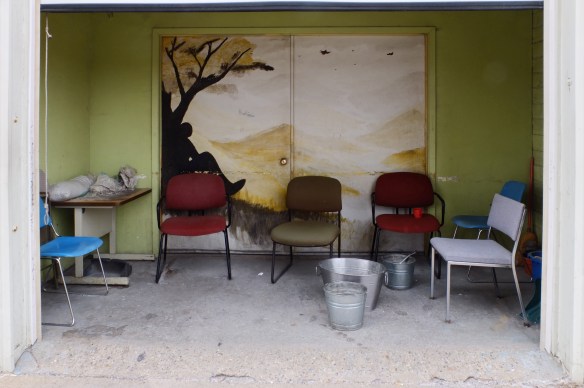
Smoker's haven

Smoker’s haven

Around the corner there’s a converted garage entrance that’s been turned into a place where smokers can gather and escape the worst of the weather. It’s a weird little place. They open the garage door in the morning and close it at the end of the working day. They’ve made an effort to make it comfortable, and it’s kept surprisingly neat.

I walk by this spot periodically, and occasionally I’ll stop and say hi to the smokers. They’re a camera-shy group. So far none of them has been willing to be photographed. It’s a guy thing. But I’ll keep trying. Maybe some day one of them will relent.
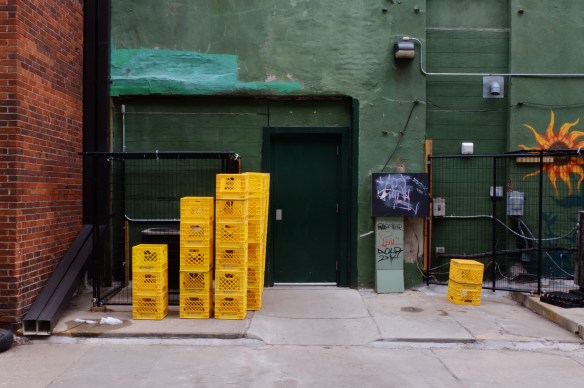
Stacks of yellow crates

Stacks of yellow crates

There’s an alley that runs behind a few bars, a coffee shop, and a somewhat seedy hotel. It’s a nice alley (as alleys go) and there’s usually something there worth photographing. But I rarely shoot anything there because it’s always clogged with cars or delivery vehicles. People seem willing to park anywhere, without any regard at all for photography.

I always glance down the alley as I pass, hoping that one day it’ll be free of parked vehicles. Last week it wasn’t exactly clear, but there was a space between vehicles where I could see some stacks of seriously yellow crates. Even as I walked toward the crates, I could see a transit van entering the other end of the alleyway. So I hustled and managed to shoot one frame just as the van pulled up. I shot a second frame before he honked his horn, and one final frame after the honk, then waved him into the spot.
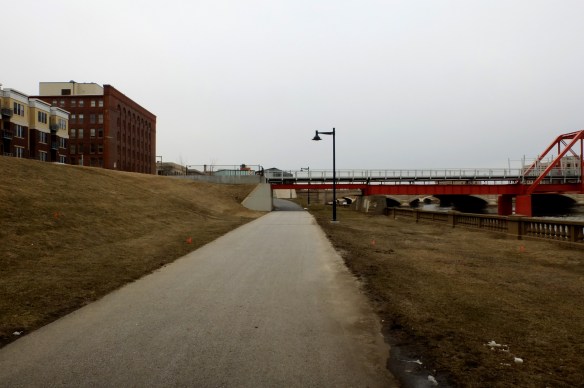
Riverside bike path

Riverside bike path

I was heading east toward the river. If the weather is nice, I usually head toward the river. In fact, if the weather is less-than-nice, I often head for the river. Oh hell, I’ll head toward the river even if it’s pissing down rain. I’ll head to the river if a hail of scorpions is falling from the sky. I like the river.

Nobody would call the weather nice — it was cloudy and pretty cold — but it wasn’t raining or snowing, and the sky was scorpion-free. So…river.

Under the Court Street bridge

Under the Court Street bridge

There’s a bike path along the river and a fairly new pedestrian walkway, though much of the time the two are merged. There’s also an old river-level walkway down below the balustrade. On windy days the river often laps up over that walkway. Sometimes you’ll find fish — usually small ones — that have leaped out of the water and onto walkway. You’ll also find the occasional old grommet where boats and barges used to tie up back in the day when they were allowed in this stretch of the river.
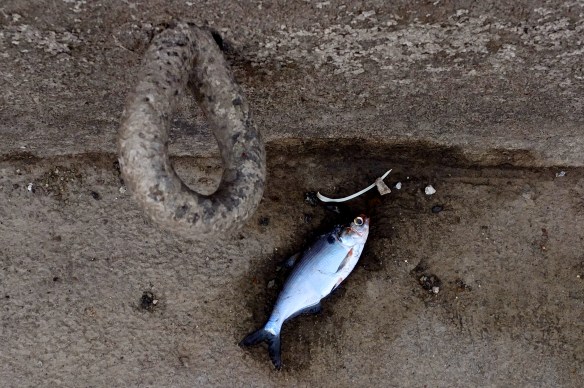
Dead fish and grommet

Dead fish and grommet

One of the things I like about the riverwalk is that it’s out-of-the-way. There’s absolutely no reason to go there unless you want to be there. I mean, it’s not on the way to anyplace else, and there’s no purpose in walking the river level other than to be walking the river level. You rarely meet people there — but when you do, the people tend to be interesting. Or scary. And sometimes both.

On that day, there was nobody on the river level except me and a few dead fish.
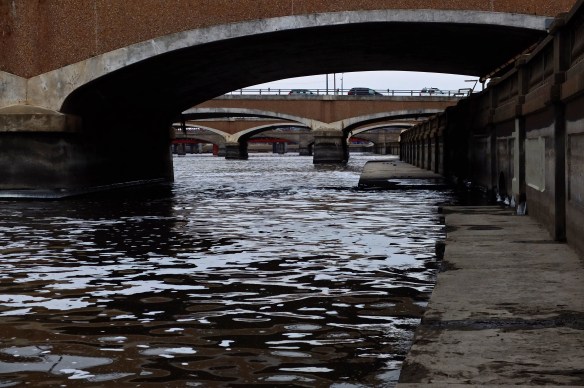
At river level

At river level

Most days I’ll only walk a short stretch of the river. Just far enough to generate some river-calm. You know, that feeling that comes with spending time along a slow-moving body of water. I find it soothing to know the water sliding by me began in Lake Shetek in Minnesota, and 525 miles later it’ll join the Mississippi River on its way to the Gulf of Mexico. I like knowing the river is following a course carved out by glacial melt some 13,000 years ago.

It makes me feel small and impermanent. I’m aware some folks are uncomfortable with that feeling, but I find it weirdly comforting. It reminds me that whatever crap is going on in my life — and right now my life is pretty crap-free — isn’t all that important or momentous. That’s a nice thing to remember.

Pedestrian bridge over the Center Street dam

Pedestrian bridge over the Center Street dam

I continued all the way to the end of the riverwalk, just below the Center Street dam. From there I could see the crazy-ass pagoda constructed by the Chinese Cultural Center, and the crazy-ass John Anderson White paddle-wheel riverboat, and even the crazy-ass dome of the Botanical Center. Each of those things is maybe a wee bit weird, but seeing them all in one place always makes me feel like I’m hallucinating. I like that.

Center Street dam

Center Street dam

That dam, by the way, is fifteen feet tall. The water rushing over it makes a hell of a noise. It gives you a real sense of the astonishing power of the river. Even though it’s a fairly slow moving river, it’s a lot of water and it just doesn’t stop. Eleven people have died in the boil below that dam — mostly stupid boaters who got too close despite all the warning signs and the rescue cables.

I’d have kept walking, over the pedestrian bridge, down the riverwalk on the east side of the river, and back again over the lower pedestrian bridge. But by then it was nearly five o’clock and I had to meet a friend, and even though it was only a three and a half mile walk, I was feeling the cold in my knees.

But it was a good walk. They all are. Man, I love Utata for giving me an incentive every week to get out, put a camera in my hand, and walk someplace. And there’s something really special about knowing that other folks all over the globe are out doing the exact same thing for exact same reason. This is going to sound really corny, but I don’t care. These Thursday Walks are like being part of a river. And I’ll leave it at that.


troublemakers are my heroes

I’ve been noodling around with computers for about a million years. Seriously, a million years in tech terms. I bought my first computer in the autumn of 1982. It looked like this:

kayproIt was a Kaypro II. State of the art, motherfucker — portable (only 26 pounds), with a 9-inch monitor (the Osborne only had a puny ass 5-inch monitor), a CP/M operating system, and two (yes 2)  internal disk drives that could handle those sweet 5 1/4 inch floppy disk each of which was capable of holding 195k of data. Arthur C. Clarke had a Kaypro II. It cost me about US$1500. A few months later I bought a Hayes 300 baud modem; I could put the telephone receiver into a coupler and magically connect with a Bulletin Board System in Boston.

That’s what we had. BBS’s. There was no Internet, no World Wide Web, no information superhighway, no cyberspace — just a green phosphorus monitor linked by telephone to a bulletin board.

Back then I was a geek. I took computers apart, fixed them, replaced and upgraded motherboards and disk drives. But along the way I lost interest in the tech and became more intrigued by the culture and the utility of computers.

Now when I need to do something technical — like, say, hook up my laptop to an external monitor — I have to ask somebody how it’s done. Or find a YouTube video to explain it to me. And when I’ve needed that information, this is who I generally turned to:

adria richardsAdria Richards. Smart, funny, relaxed, smart, easy-going, knowledgeable, and smart. She’s all over the tech world. If you haven’t heard of her, it’s because you haven’t paid attention.

Richards recently attended a Python development conference called PyCon (okay, here’s where I have to admit I don’t have a fucking clue what Python is). In one of the sessions, a couple of guys behind her began making jokes about ‘forking’ and ‘big dongles.’ You know, the sort of humor common among fourteen year old boys.

I’m a guy. I was once a fourteen year old boy. I still am, sometimes. I know I’ve made similar jokes in my life — because all guys are capable of being idjits. But somewhere in the growing up process I learned not to make jokes around strangers who might be uncomfortable with them. It’s just good manners, right?

This is what Richards says about the incident in her blog:

I was going to let it go. It had been a long week. A long month. I’d been on the road since mid February attending and speaking at conferences.  PyCon was my 5th and final conference before heading home.

I know it’s important to pick my battles.

And that’s usually what happens, isn’t it. Men say something offensive, women stay quiet about it. They stay quiet because making a fuss will get them labeled as humorless lesbians who hate men. If women say something, they’ll make men feel uncomfortable that they said something that made the woman feel uncomfortable. And the women will then be punished for making the men feel uncomfortable. You know this is true.

So women usually let it go. But this time was different. Richards didn’t let it go. This is what happened:

I saw a photo on main stage of a little girl who had been in the Young Coders workshop.

I realized I had to do something or she would never have the chance to learn and love programming because the ass clowns behind me would make it impossible for her to do so.

Okay, that’s overly dramatic. Those two guys wouldn’t make it impossible for the girl in the photo to learn and love programming. But guys just like the guys behind Richards would certainly make girls just like the girl in the photo feel they didn’t belong in the techno-boy’s club.

So Richards sent a tweet describing the situation and asking the PyCon staff to resolve it. And hey, they did. They escorted the two guys out of the session (and, presumably, told them to grow the fuck up). Richards had stood up for herself and women in tech, the guys had been properly put in their place, and the green grass grows all around, all around.

That should have been the end of it. But it wasn’t (otherwise I wouldn’t be writing about it). In her tweet Richards had also included a photo of the guys who were making the jokes. As a result, one of the guys was fired from his job. His company issued a statement, including the following:

[A]s a company that is dedicated to gender equality and values honorable behavior, we conducted a thorough investigation. The result of this investigation led to the unfortunate outcome of having to let this employee go.

That seems an over-reaction. I suspect it would have been more appropriate for the CEO of the company to sit the guy down and tell him not to be such a dick in the future. But here’s something to remember: it was the company that fired him — not Adria Richards.

When word of the firing began to spread, Richards became the villain of the story. Her blog was hit with a Denial of Service attack. She received rape and death threats on Twitter (those tweets have been deleted by Twitter). The company she worked for, SendGrid, also became the target of DoS attacks, shutting it down.

So SendGrid fired Adria Richards. They released a statement:

SendGrid supports the right to report inappropriate behavior, whenever and wherever it occurs. What we do not support was how she reported the conduct. Her decision to tweet the comments and photographs of the people who made the comments crossed the line. Publicly shaming the offenders—and bystanders—was not the appropriate way to handle the situation.

After Richards was fired, the DoS attack stopped and people could access the SendGrid site again.

There is, of course, a huge furor in the tech world over this. I won’t bother repeating all the arguments and counter-arguments; they’re easy to find, if your interested (and they’re all represented in the comments on Richards’ blog post). I’ll just say this.

Adria Richards over-reacted. And yay for her for doing it. The only way to change culture is for some people to push back and push back hard. They’ll get punished for it, they’ll be called names, they’ll be labeled as troublemakers. But it’s the troublemakers who initiate change. The only way to overcome systemic discrimination and bigotry is to make a huge fuss.

The civil rights marchers and freedom riders of the 1960s were troublemakers. The first wave of feminists were troublemakers. If troublemaking gay men and lesbians hadn’t pushed hard against the boundaries of hetero-culture, same-sex marriage wouldn’t be a reality in some states (and eventually throughout the U.S.).

Adria Richards got fed up and acted. Did she act wisely? Maybe not. I don’t care. She acted and she caused trouble (even if she didn’t mean to). She shook the foundation of tech culture by telling the guys it’s way way way past time to stop being 14 year old boys.

After this, any guy who publicly makes those sort of jokes at a professional conference will be doing it knowingly and deliberately just to be offensive. And that, folks, is how mainstream bigotry gets driven to the fringes.

no defense

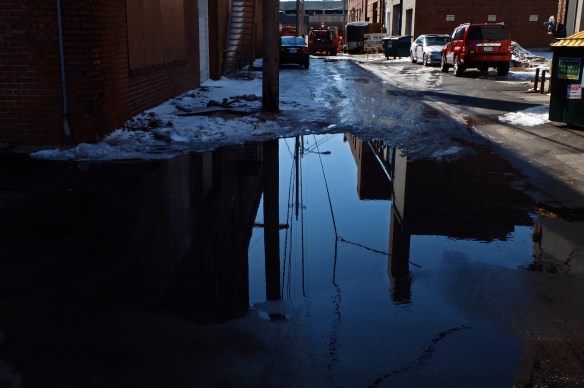
Freeze and melt — that’s been the pattern for the last week or so. Snow, melt, freeze, melt. It’s not so bad on the main streets and sidewalks, which are cleared and have enough car and foot traffic to keep things tidy. But it plays merry hell in the alleys.

A couple days ago I decided to wander back to Save the Date Alley to see if I’d gotten a response to my question. It was pretty treacherous footing. In the sunnier parts of the alleyway the ice and snow had partially melted, leaving a layer of water over the ice. There were occasional patches of snow, which gave a bit of traction, and even a few places with clear concrete — but for the most part, walking in the alley took a lot of care.

treacherous footingIt was slick enough that I considered giving up the idea and returning another day. Why risk breaking a bone just to satisfy my idle curiosity? But I could see some sort of construction was taking place down the alley — and it looked suspiciously near the spot where the Save the Date invitation (if it was an invitation) had been left.

I apparently have absolutely no defenses against curiosity, even idle curiosity. I wanted to know what was going on. So I slowly soldiered on.

Until I got distracted by a fire escape.

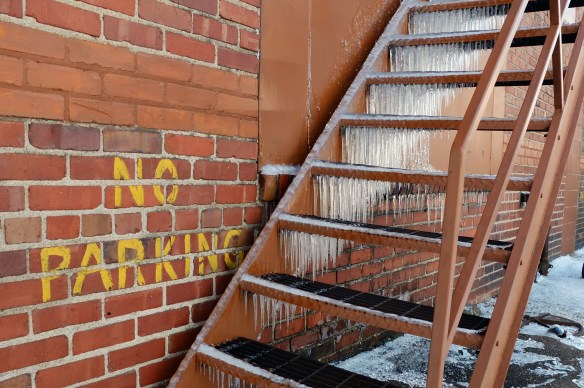
no parkingWell, not so much the fire escape itself, which isn’t all that interesting, but by the hundreds of icicles that formed beneath it. I think most folks are fascinated by icicles and how they form. And I suspect most folks feel a powerful impulse to touch them. Or knock them down. Or, of course, photograph them.

ice

The fire escape was in a shaded part of the alley. I’d been walking on the bright, sunny side. So I had to cross the alley, which doesn’t sound like much of a feat, but lawdy I’m telling you it was incredibly fucking difficult. It took me maybe three or four minutes to slowly slide across maybe ten feet of icy alley. And then, of course, the light sucked.

But I shot a few photos anyway, and even though they don’t give any real sense of how magnificent the icicles were, I’ve decided to include them here. I mean, if I can risk my aging bones to satisfy my curiosity, you can damned well spare a moment to glance at a couple of uninteresting photographs.

The child in me (and yeah, that’s an awfully big part of me) wanted to knock the icicles loose, just to hear the sound. Or at least I wanted to take off my gloves and maybe pull one loose. But the adult in me insisted the responsible thing to do was leave them untouched so the next idiot to slip-slide down the alley could enjoy them too.

stairciclesSo that’s what I did. I made the adult decision, then another three minutes sliding back to the less hazardous side of the alley (there is, I suppose, some irony to be found in the fact that I’m proud to have made an adult decision while in the midst of an entirely juvenile enterprise). And I was back on my way.

Here’s a true thing about alleys: they can be sort of generic. The alley entrance to a radiator repair shop isn’t very different from the alley entrance to an electronics store or a pet shop. So from a distance, it’s not always easy to tell one section of alleyway from another. But as I got closer, it became apparent that the construction was taking place very near the location where Save the Date and my question were to be found.

In fact, it was the very building.

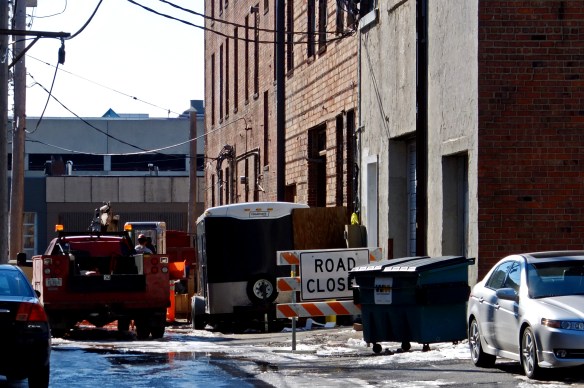
road closedI got as close as I could. I was able see workmen working, but I couldn’t tell what they were working on. I couldn’t see if they were working on the building or on the alley itself or on something altogether different. I tried shouting to get somebody’s attention, but there was a generator banging away loudly and a small diesel-powered Bobcat idling. Nobody heard me. Of else they just ignored me. Either way, I learned nothing.

I made my way back out to the street and approached the construction site from the other end of the alley. No joy there either.

So there we are. Save the Date suspense and drama. I’ll wait another week or so and return to the alley to see if Save the Date and my question are still there. If so, then I’ll keep going back to see if I get an answer. If not…well, I’ll probably keep going back anyway.

Seriously, I have no defenses against curiosity.

cowardice

First, a confession. I’d originally planned to write about my ambivalence regarding the ‘assault-style weapons’ ban. I don’t believe banning those weapons would have any real effect — certainly not on crime in general, and probably not on mass killings.

I may be ambivalent about the proposed legislation, but I’m NOT ambivalent about the way it’s been dropped by Harry Reid, the Senate Majority Leader. If the legislation had been given a vote and failed, I wouldn’t be upset. If it had succeeded, I wouldn’t be upset. But to refuse to even offer it up for a vote? That upsets me.

Harry Reid, Senate Majority Leader & Coward

Harry Reid – Senate Majority Leader, Coward

Here, according to Politico.com, is the reason:

Reid’s decision highlights the tightrope walked by the majority leader in governing the gun control issue. Trapped between the White House and rank-and-file Democrats who support broad gun control legislation following the shootings last December in Newtown, Conn., Reid must also be mindful of red-state Democrats up for reelection in 2014 who favor gun rights.

Why? Why must he be mindful of red-state Democrats up for re-election? Shouldn’t he be mindful of the citizenry they’re supposed to represent? The most recent ABC News–Washington Post poll found 57% of the nation supports the proposed ban. The University of Connecticut–Hartford Courant poll had the very same result. Quinnipiac found 54% supported the ban, and Pew found 56%. Hell, even a recent poll in Texas (which revealed 39% of those polled want to see President Obama impeached) showed 49% support for an assault-style weapons ban.

I’m not suggesting the majority is always correct. Clearly, they’re not. Nor do I believe legislators should always do what the majority of their constituents want. Legislators should vote their own conscience, even if it goes against the will of their constituents. But I am suggesting they should vote on the issues their constituents think are important.

They want a vote on the proposed weapons ban.

Bushmaster .223

Bushmaster .223

Refusing to bring the proposed legislation to the Senate floor for a vote is, in my opinion, an act of cowardice. It’s not about representing the citizenry; it’s about political expediency. It’s about wanting to stay in office. It’s about putting their personal considerations before those of the people they’re supposed to represent.

#

So, why am I ambivalent about the legislation itself? I wrote something about the topic back in December, so forgive me if I partly repeat myself. Basically, I don’t see any evidence that banning the 157 assault-style weapons listed in the law will have an impact on mass killing.

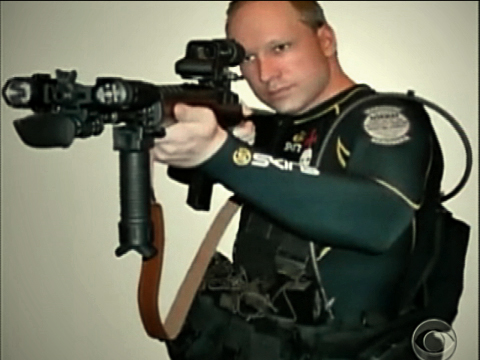
Since the first assault-style weapons ban was put into place in 1994, there have been 44 mass killings (see the note below). Relatively few of those involved assault-style weapons. I don’t think there’s much doubt that, given a choice, mass killers would prefer to use assault-style weapons — but the sad fact is, folks who are intent on committing mass murder will use whatever weapons they can get their hands on. Mass killers don’t choose assault-style weapons because they’re better at killing people — they’re not. They choose those weapons because they fit in with the Mass Killer Aesthetic. They look scary.

Anders Behring Breivik, poster boy for the Mass Murder Aesthetic

Anders Behring Breivik, poster boy for the Mass Murder Aesthetic

That’s the same reason mass killers (and especially the younger ones) tend to dress in similar ways — camouflage or all-black tactical outfits. These guys plan these crimes in advance, including how they’re going to dress. They make deliberate fashion-based decisions. They know how mass killers are supposed to look. Popular culture has taught us the elements of Mass Killer Fashion. Assault-style weapons are the weapons of choice because they complete the look. But in the end, the most common weapons used by mass killers since 1994 has been the semi-automatic pistol with a high capacity magazine.

You want to pass a law that will have a real and measurable effect on mass killings? Pass the universal background check. Pass the ban on magazines holding more than ten rounds. And give the BATF enough funding and personnel to do its job. That will make a difference.

In any event, when the public wants these measures enacted, the refusal to bring them to the floor of Congress for a vote is an act of political cowardice. Harry Reid should be ashamed of himself. He should have to explain to the families of the victims of the Newtown School murders why he’s failing to put the legislation to a vote.

But I’m willing to bet he doesn’t have the balls to do that either.

Nathan Van Wilkins - not a mass killer

Nathan Van Wilkins – not a mass killer

Editorial note: How do we define a mass killing? It’s generally defined as one in which at least four people unknown to the shooter were killed. This, of course, excludes all those mass killings in which family members or ‘loved ones’ were among those killed. It also excludes failed attempts at mass murder. For example, in January of this year Nathan Van Wilkins opened fire in downtown Tuscaloosa, Alabama with an AK-47 variant; 17 people were injured, but nobody died, so this incident is only a mass shooting, not a mass killing.

please keep out

So I’m getting ready to shoot a photo and this guy comes up to me — he’s maybe in his mid-to-late 20s, wearing skinny-jeans, a zippered hoodie, and one of those floppy-eared Tibetan-looking knit hats — he comes up and he says, “What is that, a little Leica?”

I tell him it’s a Fuji X10.

He says, “Fuji. Is that, like, Japanese?”

I say yes, it’s a Japanese company.

He says, “The Germans, they make great cameras.”

I take the shot, then agree with him.

He says, “You shouldn’t be shooting into the sun like that.”

I tell him I think it’ll be okay.

He says, “It’ll be over-exposed. Or under-exposed. I forget which. Over-exposed.”

I tell him I’m using spot metering, and take another shot.

He says, “Oh” then tells me he’s been thinking seriously about buying a Leica. “But they cost so much.”

I agree that they’re expensive cameras.

He says, “Spot metering,” then asks if he can see the photo.

please keep out

It’s not a great photo, but I knew that when I was shooting it. I just liked the shadows. And sometimes you just want to see what a camera can do. Anyway, I show him the preview on the LCD.

He nods and repeats himself. “Well. Spot metering. And you shot that right into the glare of the…uh…thing there. And that’s a Fuji?”

I tell him I think they have spot metering on Leicas too.

He nods happily and says, “Cool.”

NOTE: Here’s a thing I’ve observed since I started using the little X10: most often people don’t even notice the camera. But when they DO notice it, they sometimes ask me about it. Nobody ever asked about the Nikon DSLR, which is also a very fine camera. I think that ‘retro’ look confuses and interests people.

happy anniversary, clarence earl gideon

Let’s say all police officers and all criminal prosecutors are sincere and honest. We know that’s not true, but bear with me a while. Let’s also say the police only arrest people they’re convinced are guilty, and that prosecutors only bring cases against defendants they truly believe committed the crime with which they’re charged. That’s probably closer to being true, but it’s still got a healthy bit of fantasy in it.

Let’s also acknowledge that even the most sincere and honest police and prosecutors occasionally make mistakes. For the sake of argument, let’s be generous and say the police and prosecutors are correct 98% of the time.

That necessarily means that even the most honest and sincere police and prosecutors are wrong 2% of the time. That doesn’t sound too bad, does it.

Greg Bright - wongly convicted of murder; served 27 years

Greg Bright – wrongfully convicted of murder; served 27 years

In 2010, according to the Bureau of Justice Statistics, there were 1,484,530 arrests for violent crimes. We’re talking murder, manslaughter, rape, armed robbery, aggravated and simple assault. If the police arrested the right person 98% of the time, it means they mistakenly arrested around 30,000 innocent people in 2010. That’s eighty people every single day on the calendar, arrested for violent crimes they didn’t commit.

And those are just the arrests for violent crimes. Add in property crimes, drug offenses, and social order crimes like prostitution, liquor violations, indecency and the like, and you end up with 13,122,110 arrests in 2010. Applying the same 98% rule, it means more than a quarter of a million innocent people were arrested in the U.S. in 2010.

The reality, of course, is uglier. Much uglier. Nobody believes the police arrest the right person 98% of the time. Nobody believes that every police officer and prosecutor is sincere and honest. Those are fantasies.

Michael Morton - wrongfully convicted; served 25 years

Michael Morton – wrongfully convicted of murder; served 25 years

Now think about those poor bastards who are arrested and prosecuted for crimes they didn’t commit. When a person is being prosecuted for a crime, it’s listed on court dockets in this way: The State of Wherever versus Defendant Whozis. That actually means what it says. For example, if you’re going to trial in Wyoming (the least populated state in the Union), all the resources of the State can be arrayed against you. All those uniformed Wyoming police, all those detectives, all those lawyers and those forensic experts and those evidence technicians and those lab geeks — every one of them could be used in an effort to convict you.

What do you, the defendant, have? A defense attorney. Maybe an investigator, if you’re lucky. If you’ve got money, you can hire a team of defense lawyers and investigators, but you’ll never have anything like the resources available to the prosecutor. Still, if you’ve got money you’re in significantly better shape than somebody who’s poor. If you’re poor and accused of a crime, brother you’re in serious trouble. And it’s getting worse.

Darryl Burton - wrongfully convicted of murder; served 23 years

Darryl Burton – wrongfully convicted of murder; served 24 years

This is where our boy Clarence Earl Gideon comes into it. He was born in 1910, in Mark Twain’s old hometown of Hannibal, Missouri. Gideon was basically Huck Finn without the charm. He quit school in the 8th grade and ran away from home. He was a petty thief for much of his life. He did time in Missouri, Kansas, and Texas — mostly for minor larcenies. He moved to Florida in the late 1950s. In 1961 the owner of the Bay Harbor Pool Room noticed that five dollars in change and a couple of bottles of beer were missing from his fine billiards establishment. A witness said he saw Gideon leave the pool hall with a bottle of wine and bulging pockets.

Gideon, with his history of theft, was arrested and prosecuted. Since he had no money for a lawyer, he had to defend himself in court. He asked the judge if he could have a lawyer to help him. The judge said no. Gideon was convicted, of course, and sentenced to five years in prison. He was 50 years old at the time.

Clarence Earl Gideon

Clarence Earl Gideon

While in prison, Gideon began reading about the legal system. Among the things he read was the Bill of Rights — specifically the 6th Amendment, which includes this:

…the accused shall enjoy the right to…the assistance of counsel for his defense.

Gideon wrote the FBI, essentially saying “Dude, I didn’t get any of that assistance of counsel stuff.” The FBI wrote back saying, “Well, that’s a shame. Sorry.” Gideon wrote the Supreme Court of Florida. “Dude, that assistance of counsel business? I didn’t get any of that.” The Supreme Court of Florida wrote back. “No, really? It sucks to be you.” Finally Gideon wrote to the Supreme Court of the United States. “Seriously guys, no assistance of counsel. WTF?” The Supreme Court wrote back. “Yo, Clarence, tell us all about it.”

Think of how remarkable that is. An uneducated prison inmate sent a hand-written (in pencil, no less) request to the highest court in the land, asking for justice — and they listened. More importantly, they acted.

Alan Northrop - wrongfully convicted of rape; served 17 years

Alan Northrop – wrongfully convicted of rape; served 17 years

Today is the 50th anniversary of the Supreme Court’s unanimous verdict in the case of Gideon v. Wainwright (Louie Wainwright was the director of the Florida Division of Corrections). That ruling changed the way criminal law was practiced in the United States. Gideon said you had the right to an attorney, Miranda said the police had to tell you about that right. Every time you watch a cop show on television and hear “You have the right to an attorney; if you can’t afford one, one will be appointed for you,” you can thank Clarence Earl Gideon.

In principle, the Gideon decision guaranteed that every person accused of a crime had the right to be represented by competent counsel. Justice Hugo Black wrote:

Reason and reflection require us to recognize that, in our adversary system of criminal justice, any person haled into court, who is too poor to hire a lawyer, cannot be assured a fair trial unless counsel is provided to him.

What Justice Black failed to consider is that ‘reason and reflection’ generally get kicked in the ditch by politics. In theory, the law may require poor folks be given a competent attorney. Of course, in theory the police and prosecutors always arrest and prosecute the guilty party. Theory, like ‘reason and reflection,’ tends to end up bloody and confused in the ditch.

George Allen, Jr. - wrongfully convicted of rape/murder; served 30 years

George Allen, Jr. – wrongfully convicted of rape/murder; served 30 years

A half century after Gideon, the entire indigent defense system is pretty much fucked up and getting worse. The system has never been adequately funded (paying lawyers to represent poor folks has never been a very high priority), but in this era of drastic cuts in state budgets, indigent defense funding it getting it in the neck.

Remember, some of these people are innocent. Greg Bright, the man in the first photograph, was convicted of murder based on the testimony of one eyewitness who claimed to have seen the crime from her apartment window. If the defense had had the resources to hire an investigator, they’d have found the witness had been diagnosed as schizophrenic, had a history of visual and auditory hallucinations, was a heroin addict, and lived in an apartment that didn’t overlook the crime scene. One day of competent investigating would have saved Greg Bright 27 years of prison.

Here’s the really scary part: Bright was convicted at a time when indigent defense had better funding than it has now. The reality is that if you’re poor and you get arrested and charged with a crime, you’re not very much better off today than Clarence Earl Gideon was fifty years ago.

brutal bastard

You get that one moment. That’s it. You either get the shot or you don’t. And let’s face it, most often, you don’t. And in some types of photography, there’s no second chance. I love that. I hate that.

Yesterday was a cold, bright, sunny day. A good day for a guy with a fine little street camera to take a walk through the city. As I was walking along I saw this dark gash of an alleyway running between a building and a parking garage. I have a thing for alleys, so I decided to wander down it. But it was on the other side of the street; I had to wait for traffic to clear before I could jaywalk to the alley.

As I stood there I saw an obscure shape moving in the alley. A guy. A guy with a red hat. And I knew there might be a photograph to be made.

This is what I love: sometimes you can anticipate that moment. You can see the shot developing. You can visualize all the elements potentially moving into place. Potentially, that’s the key. It’s all about the potential, because any number of things can happen to totally fuck up the situation. A cloud might obscure the light. A car might pass in front of you at the critical moment. A passerby could throw off the balance of the composition.

I saw the guy with the red hat. A moment earlier I’d noticed a doorway with a red logo at about head level. I figured there was a good chance the guy was going to walk out of the dark alley and into the light. So I hurried to my right so I could include both the red hat and the red logo — and the moment I began moving I also began to kick myself in the ass. I was thinking “Idiot, you should have closed in on the alley and caught the guy stepping into the sunlight.” But it was too late to change my mind. I’d committed myself to a wide shot.

Sometimes the shot never comes together. You know that going in, of course. Sometimes all those elements you saw moving together simply move away from each other. The guy could turn around and go back down the alley. He could step out of the alley, but remove his red hat. Somebody could could open the door with red logo. So many things could go wrong.

But they didn’t. Things not only didn’t go wrong, they actually got better The guy stepped out of the alley and into the sunlight, just like I’d hoped he would. His red hat was almost perfectly in line with the red logo on the door, just as I’d hope it would. And then a little black and white dog followed him out.

So I took the shot.

a guy and his dogIt was the shot I wanted. It was almost exactly as I’d envisioned it. But it doesn’t really work. Not at this scale.

The guy gets lost, the red hat gets lost, the red logo gets lost, even the little dog gets lost. I think the photo might work if it was printed very, very large — but dammit, it doesn’t work at this scale. It just doesn’t.

Even when all the elements do come together — even when it all coheres perfectly and organically, as if it was predestined — even when you get the shot you want, it might not actually be the shot you want.

It gets worse. I got the shot I wanted. I knew it as soon as I released the shutter. I’d no idea it wouldn’t turn out, of course, but at that moment I knew I’d got the shot. I felt satisfied and full of myself. For maybe half a second. Even as I was lowering the camera, I saw the guy hold something out in his hand. The little dog leaped up to get it. And I missed it.

Photography is a brutal bastard. And I must be masochistic, because I’m okay with that.


fed up

This evening a small town in Maine will vote on an ordinance requiring “all households to have firearms and ammunitions to protect the citizens.”

We’re talking about Byron, Maine. Population about 140. You may be asking yourself why such a small town in rural Maine needs an ordinance requiring their citizens to own a firearm. Simple. According to Head Selectman Anne Simmons-Edmunds.

“We’re fed up.”

What are they fed up about? They’re fed up about the government telling them what to do. You may be asking yourself “Isn’t the Head Selectman a member of the government, and isn’t this ordinance an example of the government telling them what to do?”

Anne Simmons-Edwards (center) with other Byron Selectmen

Anne Simmons-Edwards (center) with other Byron Selectmen

Silly rabbit. It’s the Federal government they’re worried about. You know…Uncle Sugar. The Big Tuna in Washington, D.C. That government. The one with the negro who’s secretly planning to take all the guns away from the 140 good people living in Byron, Maine.

We’re trying to prevent someone from coming into our town and trying to restrict our rights. It’s time to tell the government, ‘Enough’s enough. Quit micromanaging us.’

No wonder they’re fed up. Micromanaging is a matter best left to the individual state. Everybody knows that.

Of course, in 2011 the Maine legislature passed a law barring municipalities from adopting firearm regulations. So legally, any ordinance requiring the 140 good people of Byron to own a gun wouldn’t have any legal standing.

So maybe micromanaging is a matter best left to local governments. Sure, that’s got to be it. The State or Federal government can’t just force people to do something they don’t want to do. That’s the job of the local government. Besides, who could possibly object to owning a gun?

Bruce Simmons & his ,40 caliber friend

Bruce Simmons & his ,40 caliber friend

To be fair to Ms. Simmons-Edmunds (who is not only Byron’s Head Selectman, but also serves as a police officer in semi-nearby Dixville and as an animal control officer for both Dixville and Mexico — the small town in Maine, not the independent nation found somewhere south of Texas) and the other Byron Selectmen, the local ordinance wasn’t entirely their idea. It was proposed by former Byron Selectman Bruce Simmons (why yes, he is Ms. Simmons-Edmunds’ father). His reasoning?

“The president, in January of last year, passed an executive order giving Homeland Security the right to go into your house, grab you without a warrant and take you away. And no one will ever see you again.”

There you go. Nobody wants to be taken away and never seen again. Sadly, Simmons couldn’t identify that executive order, but he’s pretty certain it exists. Therefore it’s critically important for the good people of Byron to be required to have firearms AND ammunition in their homes in order to defend themselves from being taken away and never seen again.

Sure, you scoff. But it’s a real danger. The good people of Byron are at risk of being taken away and never seen again because they own guns, and the negro in the White House wants to take away their guns. So of course, they need to mandate owning a gun in order to keep the government from taking away their…no, wait. Okay, they need to have guns because if they didn’t have guns, then Homeland Security would…no, wait. If they didn’t have guns, then Homeland Security wouldn’t…no, that can’t be right either.

I don’t know. Shut up. It doesn’t matter. What matters is the 140 good people of Byron, Maine are fed up. And what do you need more than anything else when you’re fed up? Guns and ammunition.

Who can argue with that?