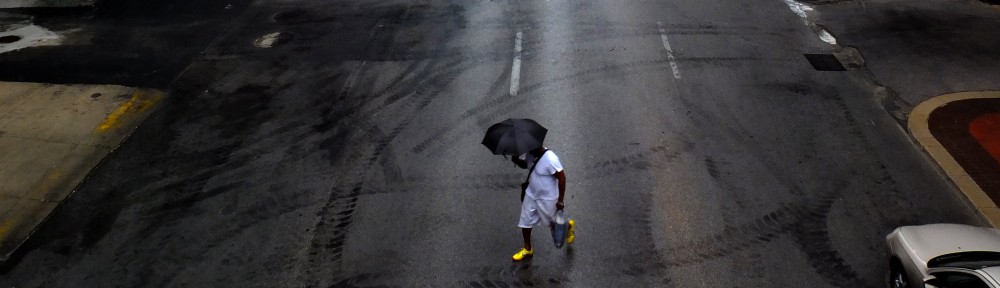
pioneer cemeteries

A week ago I posted the following photograph of a dirt road leading back into field that held a pioneer cemetery. It sparked a number of folks to ask a perfectly reasonable question: Dude, what the hell is a pioneer cemetery? I asked the same question the first time I came across a pioneer cemetery. I’m here to give y’all the answer.
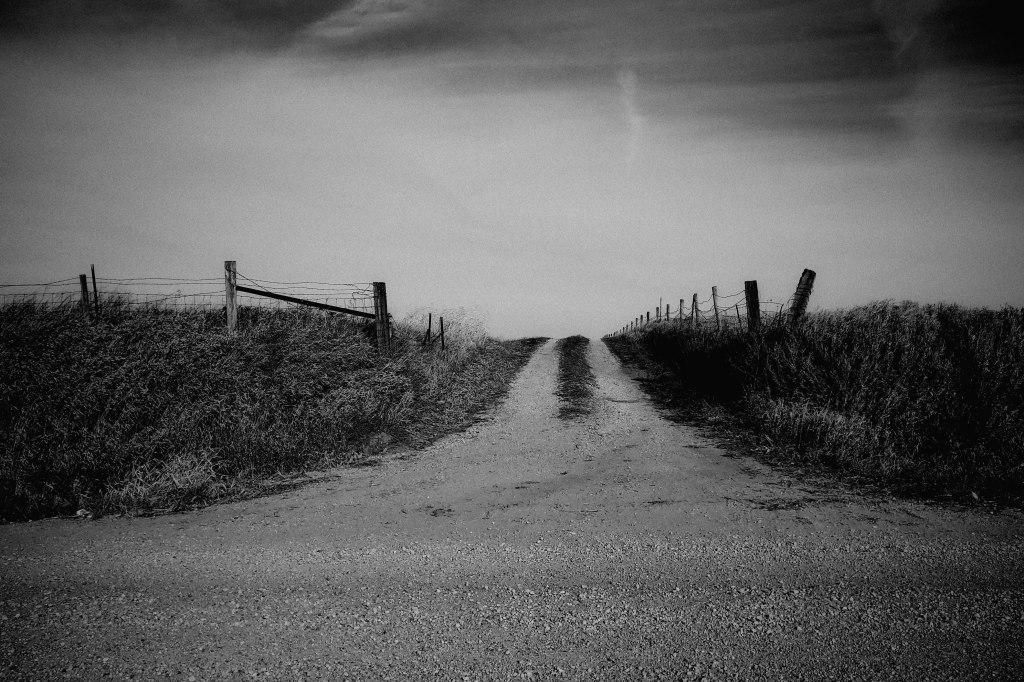
Road to Sams pioneer cemetery

Let me amend that. I’m here to give a couple of answers. I mean the obvious answer is simple: a pioneer cemetery is a plot of ground where pioneers are buried. But that leads inevitably to the question: Dude, what the hell is a pioneer?

Let’s start there. The term ‘pioneer’ comes from the French pionnier, which originally referred to a type of specialized foot soldier — troops who were furnished with digging and cutting equipment and sent into new territories to prepare the way for an army. The root term is much older, medieval Latin, pedonem, which meant ‘foot soldier’. That’s also the root for the term ‘pawn’. In chess, pawns always move first; they’re essential, but disposable. The same applies to pioneers; they go first, they’re essential, but disposable.
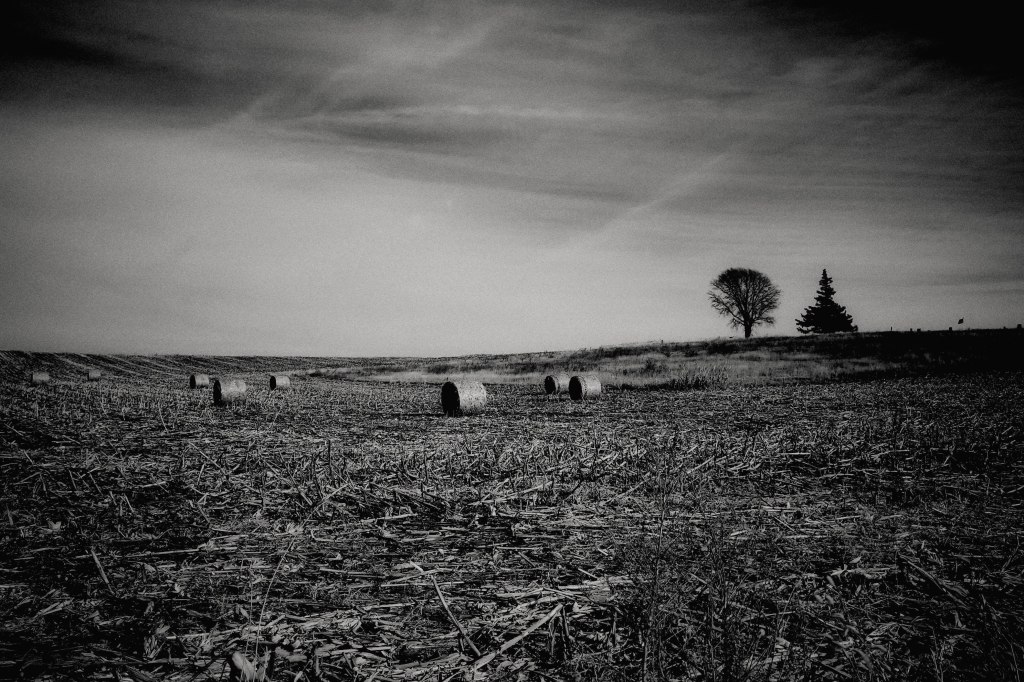
Sams pioneer cemetery is located on the rise by the trees.

In the US, the term ‘pioneer’ has a vaguely heroic connotation. I suppose that’s warranted because it takes a sort of courage — or maybe desperation — to take your family into unknown territory. And that’s what the early US pioneers were. They weren’t soldiers; they were mostly families of immigrants and first generation Americans. At the time, they were called settlers, or homesteaders, or sodbusters. They were families who loaded up wagons with their few possessions and pushed into largely unmapped territories, fording rivers and streams, in the hope they could find land they could farm. When they came to land they felt was promising, they stopped. They chopped down trees and built cabins out of the logs. They cleared trees and stones from the land by hand or with the help of livestock and created fields for crops. They planted and harvested, and they died and were buried.
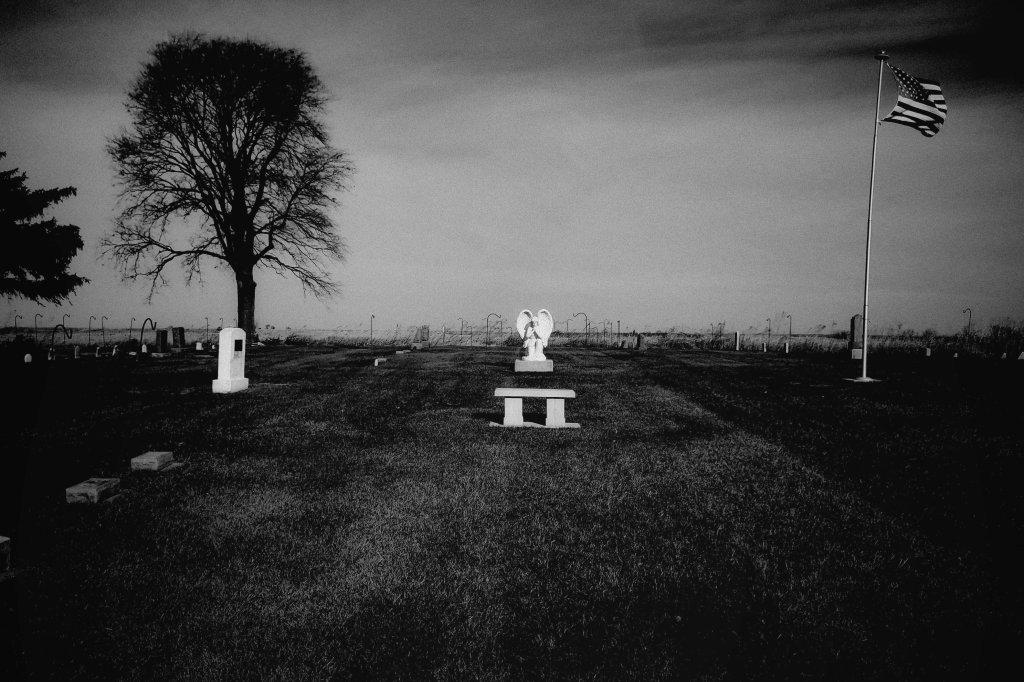
Sams pioneer cemetery.

Pioneer cemeteries are plots of land, often on family property, that these small, loosely formed farming communities agreed was sufficient to bury their dead. They’re the graves of the thousands of unremembered, ordinary people who turned wilderness into settlements.

We have to acknowledge the pluckiness of these pioneers, but we also need to be aware there was a very deep ugliness in what they were doing. In the US, pioneers were the leading edge of the concept of Manifest Destiny. The idea was promoted initially by John O’Sullivan, the son of an Irish immigrant. He wrote it was the new nation’s “manifest destiny to overspread the continent allotted by Providence for the free development of our yearly multiplying millions.” In essence, manifest destiny was a nice way of saying the expansion of white Europeans and their culture across the continent, displacing or killing the native tribes who’d actually lived there for centuries, was not only inevitable, it was also justified by god.
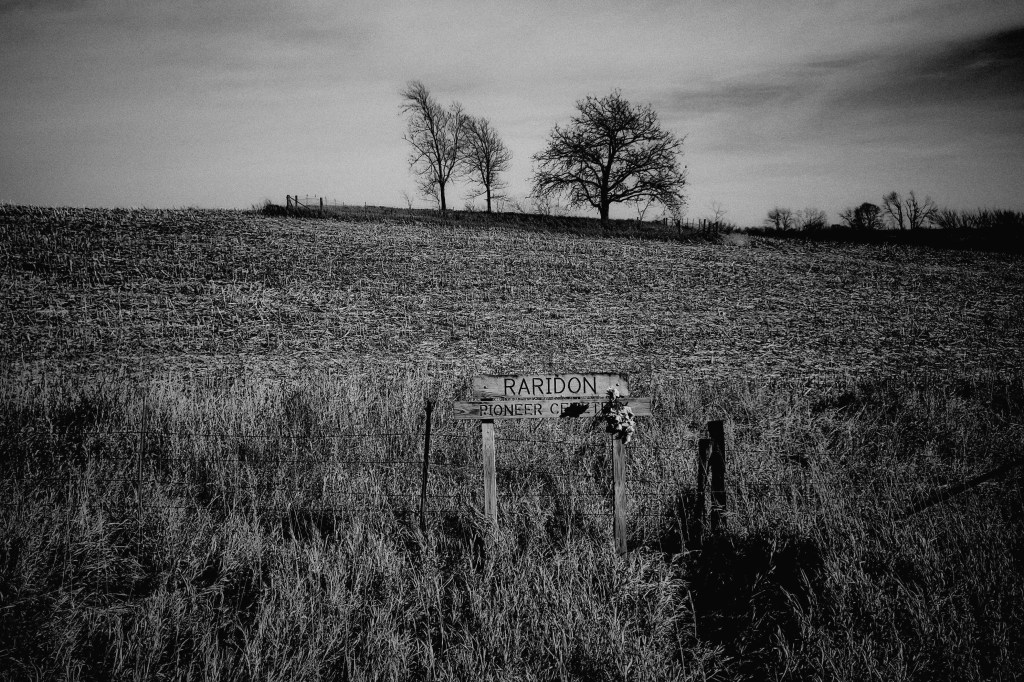
Raridon pioneer cemetery in the middle of a field.

There you have it. The pioneers were intrepid settlers struggling to create a life for themselves. And they were also sanctimonious invaders who were comfortable with the idea of pushing the indigenous people off their land, stealing it for themselves, and killing those natives who resisted.

That’s who the pioneers were — settlers who were almost as expendable as the natives they dislodged and supplanted. But not everybody buried in a pioneer cemetery was an actual pioneer. The pioneers created the conditions for permanent settlements; permanent settlements inevitably bring disputes; disputes require some forum for resolution. That means a bureaucracy, and bureaucracies demand definitions.
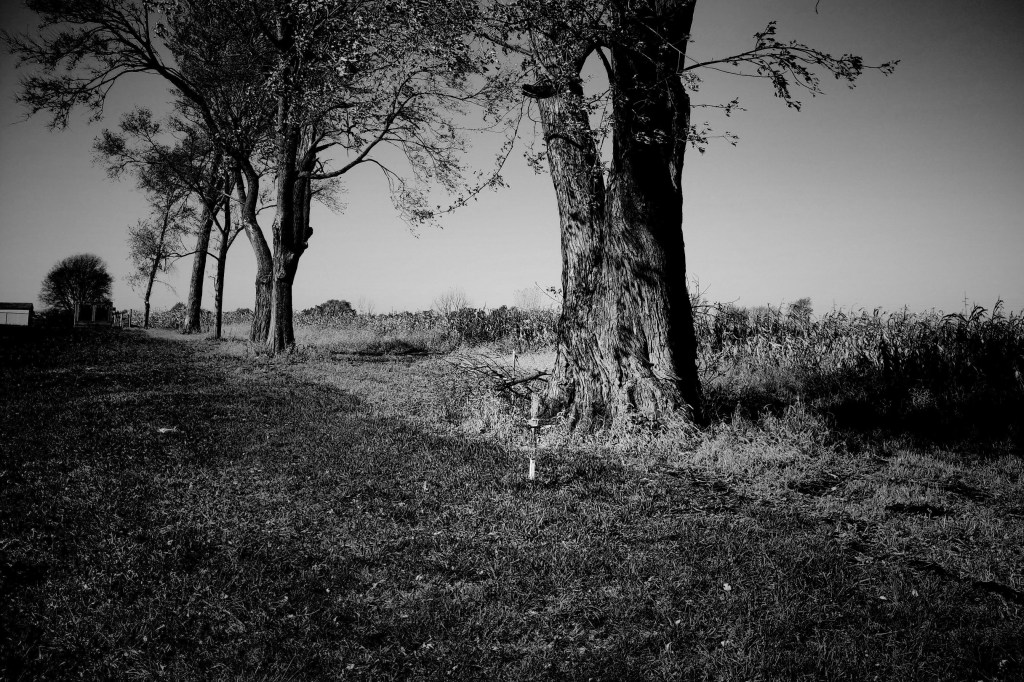
The Enterprise pioneer cemetery has only a single marked grave, a simple cross by a tree.

Which brings us back to the original question: Dude, what the hell is a pioneer cemetery? The bureaucratic answer depends on where you live; different states have different legal definitions of ‘pioneer cemetery’. In Iowa, where I live, the law defines it as a cemetery in which there have been no more than twelve burials in the preceding half century. In neighboring Nebraska, a pioneer cemetery is defined as an abandoned or neglected cemetery that was founded or situated on land “given, granted, donated, sold, or deeded to the founders of the cemetery prior to January 1, 1900.”

There is, I think, something weirdly admirable about a bureaucracy making a deliberate decision to recognize and honor the ordinary people who lived and died in small farming communities dating from the late 1700s. The bureaucracies may not care about the individual pioneer cemeteries, but they care about the notion that there are people buried and memorialized in remote, semi-forgotten patches of land.
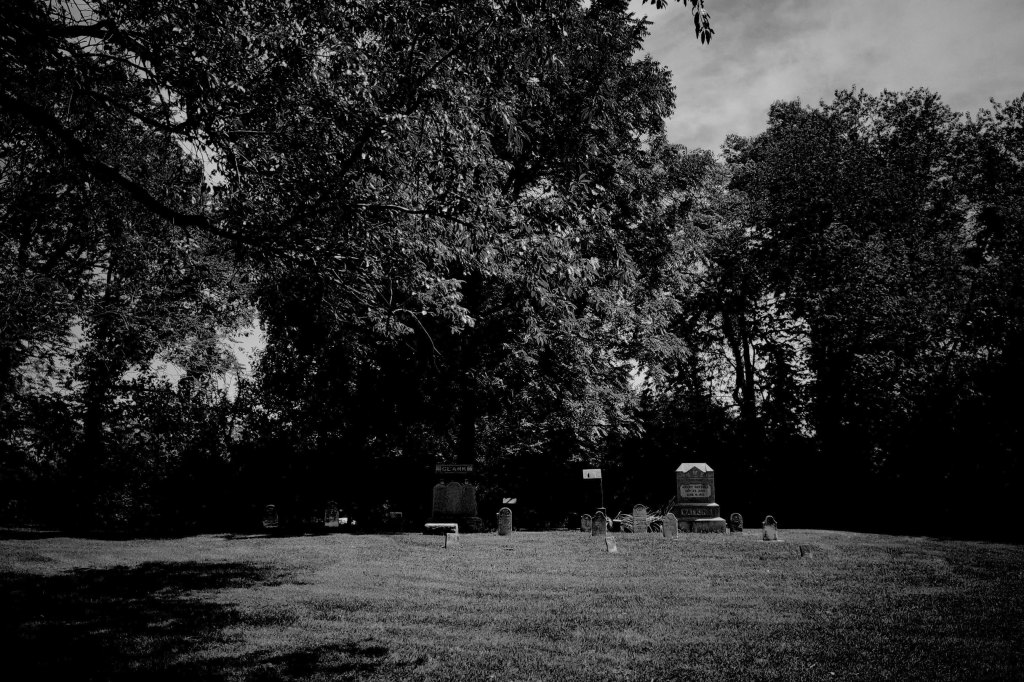
This pioneer cemetery could only be reached by steep path through overgrown brush under a canopy of old trees. Yet it was beautifully cared for by a local Boy Scout troop.

Most of the pioneer cemeteries I’ve visited are lonely places on patches of farmland or meadowland. They’re generally located on a low hill, most often with a small grove of trees. Some are only accessible by overgrown paths, or by vehicles with high ground clearance. A few pioneer cemeteries are well-tended; most aren’t. Many are overgrown with grass and weeds. Most have gravestones that are damaged, weathered, unreadable.

But all of them are full of stories. There are graves of soldiers — Civil War veterans, veterans of the world wars. You can tell by the dates which ones died in uniform. There are graves of wives who outlived their husbands, graves of mothers who died in childbirth, graves of the children they bore. There are lots of graves of infants, often with the number of months or weeks they lived.
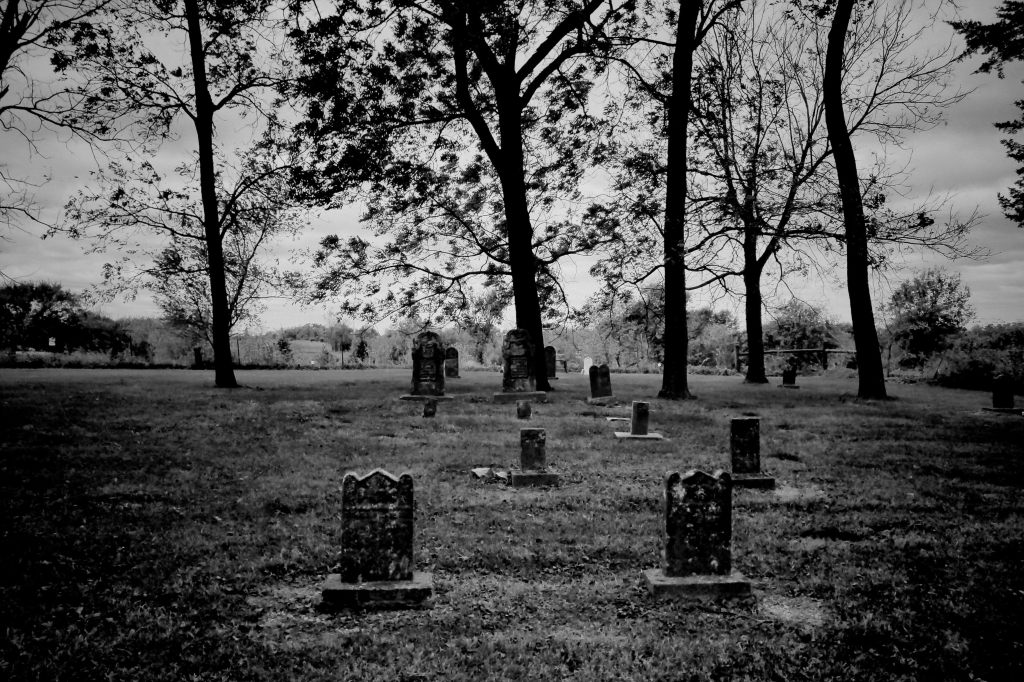
Trester pioneer cemetery

All cemeteries and graveyards tend to be quiet. Pioneer cemeteries are more than quiet. They’re silent. And yet they’re full of stories. Untold stories. Forgotten stories. The first person buried in what would eventually become the Slaughter pioneer cemetery was eight-year-old Hester Slaughter, who died of ‘the fever’ in the summer of 1846. She was buried in a corner of the family farm. There was no lumber mill in the region, so there was no sawn lumber to make a casket. Instead, the family split the trunk of a tree that had been chopped down to clear the land; they hollowed it out, placed poor Hester inside, closed it back up, and buried her. A total of 69 people would be buried in that small plot of land, including three Civil War veterans and a veteran of the War of 1812.

Among them is Bluford Sumpter, who served in the 39th Iowa Regiment in the Grand Army of the Republic during the Civil War. We don’t know the details of his story, but we know the 39th was active from November 24, 1862, to August 2, 1865. We know they were involved in a great number of battles and skirmishes. We know the 39th helped chase Confederate General Nathan Bedford Forrest (who would survive the war and help found the Ku Klux Klan) into Tennessee and suffered many casualties. We know they eventually deployed with Union General William Tecumseh Sherman in his brutal and savage march across the South that essentially ended the war. We assume Bluford Sumpter survived the war (since it was uncommon then to ship bodies home for burial), but there are no dates on his tombstone, so we don’t know when he died. We only know he was eventually buried in the Slaughter cemetery in Jasper County, Iowa.
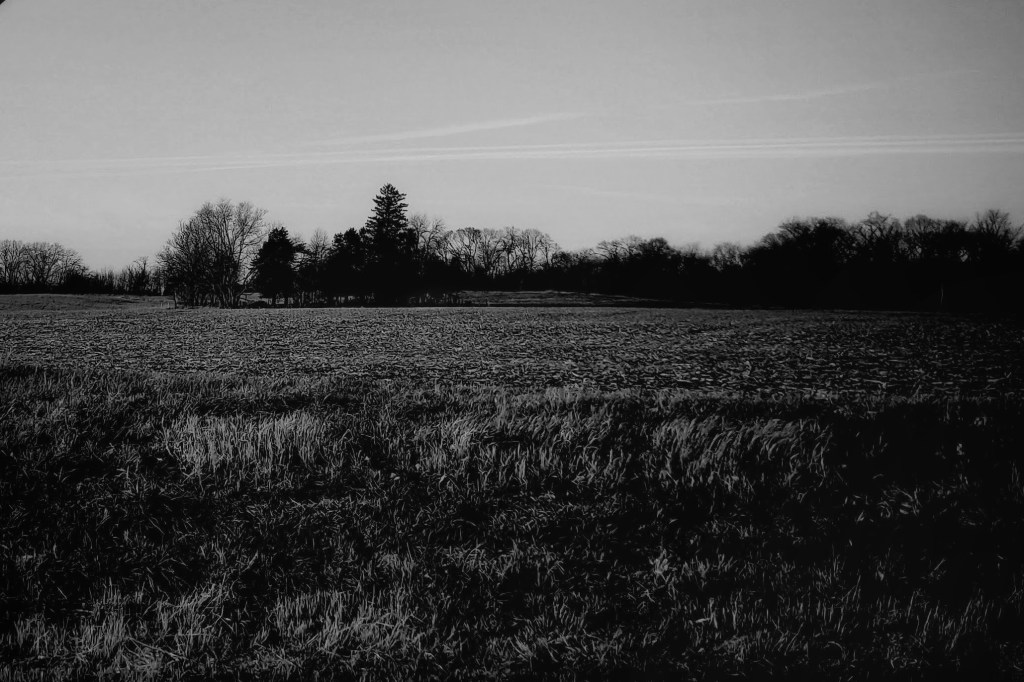
Slaughter pioneer cemetery in the grove of trees in the middle of a field.

Also buried nearby is William Wimpigler, who has his own story. Wimpigler served in the Iowa 48th Battalion during the Civil War, He was one of the Hundred Days Men — a troop of volunteers raised in Midwest during the final days of the war; they agreed to serve one hundred days in order to free experienced troops for combat service. The 48th spent its hundred days at the Rock Island Barracks in Illinois, coincidentally guarding Confederate prisoners taken during Sherman’s campaign.

Both of those Civil War veterans are buried near eight-year-old Hester Slaughter in her hollowed out log coffin on what was once an unused parcel of her family’s farm. Every grave has a story. But we only know about those stories exist because the graves exist, and we only know those graves exist because some unnamed person in a bureaucracy decided it was worthwhile to officially recognize and record the existence of pioneer cemeteries.

That unknown bureaucrat has a story too. We all do. Few of them get told, but all of them are worth telling.


reading the comments

A friend sent me a message this morning:

Read something about Trump and the Sup.Ct last night and made the mistake of reading the comments and couldn’t get to sleep for longest time. People are so hateful. Didnt you write something recently about not reading the comments.

My first thought was How am I supposed to remember stuff I might have written? I mean, I write a lot of crap every day. Sometimes several times a day. Much of what I write on social media is off the cuff and barely thought out. On the other hand, I’m one of those putzes who almost always reads the comments. So yeah, I probably did. It sounds like something I’d write.

My second thought was Dude, there’s a search function on the blog, why don’t you use it? And then I thought Why don’t I use it? So I used it. And hey, whaddayaknow? Turns out I wrote two things about the comments. Neither of them was recent, but still.

The most recent was in April of 2017. I’d written a thing about the Fearless Girl sculpture on Wall Street. It was the only thing I’ve ever written that actually went viral. It got a shit ton of comments, so I wrote about the comments. Not exactly about the comments, but about the fact that ordinary people were arguing and debating works of art. Which I think is really a pretty cool thing for ordinary people to do.

The living embodiment of the Comments section.

The other thing I wrote was almost exactly four years ago — October of 2016. And it was weirdly appropriate. It was about the reasons people give for NOT reading the comments. And it was also about Comrade Trump and his supporters. Here’s the last line of the post:

Donald J. Trump, his campaign, and his supporters are the living embodiment of the comments.

That’s a pretty good line. Still true.

the difference between grief and mourning

Justice Ruth Bader Ginsburg is dead.

The grim and sorrowful constellation of thoughts and emotions we’re experiencing right now, that’s grief. The word comes from the Old French term grever meaning “afflict, burden, oppress,” which is from the Latin gravare, which meant “to make heavy.” Grief is heavy; it weighs us down.

The outward expression of grief, that’s mourning. Mourning has a more complex origin. It comes from a Proto-Indo-European root which, because of linguistic convention, is usually written as *(s)mer. It refers to the act of remembrance, reflection, recollection. Mourning is how we use our memories and understanding of the dead to gradually reduce the awful weight of our grief.

Grief is what we feel; mourning is what we do.

Justice Ruth Bader Ginsburg is dead, and there’s absolutely nothing we can do about that. Our grief is both personal and communal. We grieve for what she means to us personally, we grieve for her family and friends, we grieve for what her death might mean for the concept of equal justice under law in the United States. It’s good that we grieve; it’s right that we grieve.

But our grief is less important than how we mourn her — how we collectively express our grief and how you as an individual will express your grief. Is making RBG your Facebook icon enough to lighten your grief? Will wearing your Notorious RBG t-shirt alleviate your grief? What about voting, will that help? What about getting others to vote? Volunteering to drive others to the polls? Donating money or labor to a candidate? What about calling both of your senators on Monday, and asking them NOT to vote on a successor to RGB’s seat until after the election/inauguration? Will that do it?

Here’s a True Thing: your grief is your grief. Nobody gets to tell you how to express it. Nobody gets to tell you the proper way for you to mourn. Nobody gets to tell you how much you have to mourn or what that mourning should include. Nobody gets to tell you what RBG would want from you. Mourn her in your own way.

But mourn her. Right now, it’s enough to grieve. Right now, it’s okay to give into your grief. Let yourself fully experience your grief. Then start actively mourning.

Obscure and Semi-inappropriate Addendum: That Proto-Indo-European root *(s)mer is also the source of the name of Mimir, the Norse god who guarded the Mímisbrunnr, the Well of Wisdom. Mimir, not surprisingly, was known for his judgment, his sagacity, his knowledge. None of that, unfortunately, prevented him being beheaded in the battle between the Æsir and the Vanir (don’t ask; we’re talking Norse mythology, so it’s complicated). After the battle, Odin found Mimir’s body and collected his head (as gods do). He did some sort of god-thing to Mimir’s head so he could tote it around with him and continue to get Mimir’s advice.

Metaphorically, we can do the same with RBG. We can carry our memory of her around with us. We can ask ourselves ‘What would RBG do?’ and then try to do it. That’s proper mourning, right there.

knuckles dobrovic is slightly dislocated

The whole Knuckles Dobrovic thing began in 2013 when I reluctantly and grudgingly realized there was some artistic value to Instagram. I created the Knuckles alias as a way of investigating Instagram without having my name associated with it. I thought it made sense back then, but sounds really silly now. So I started putting a thing on a glass-topped table on the deck and photographing it. It became a project. Things on a Table. I did that for about a year.

Eventually I started an Instagram account using my real name, but I’d grown absurdly attached to the name Knuckles Dobrovic. I decided I’d keep that account and us it strictly for photo projects. Because I tend to over-analyze things, I came up with some basic parameters for all future Knuckles projects: 1) it’s got to be simple (which means I won’t have to do a lot of planning or a lot of post-processing), 2) it’s got to be organic to my life (which means it’s something I can photograph during the course of an ordinary day — whatever that is), 3) it’s got to have at least one intellectual component (which is more accurately described as a pretentious bullshit element), and finally, 4) it’s got to be able to keep my interest over time.

After ‘Things on a Table’ I turned to Double Exposures of My Feet on the Earth and then to the Hundred Appropriated Google Street View gig. When that was finished, I felt no hurry to find another project. Some idea would eventually roll up in a ball and get my attention. That’s how these things work, mostly.

Yeah, no, not this.

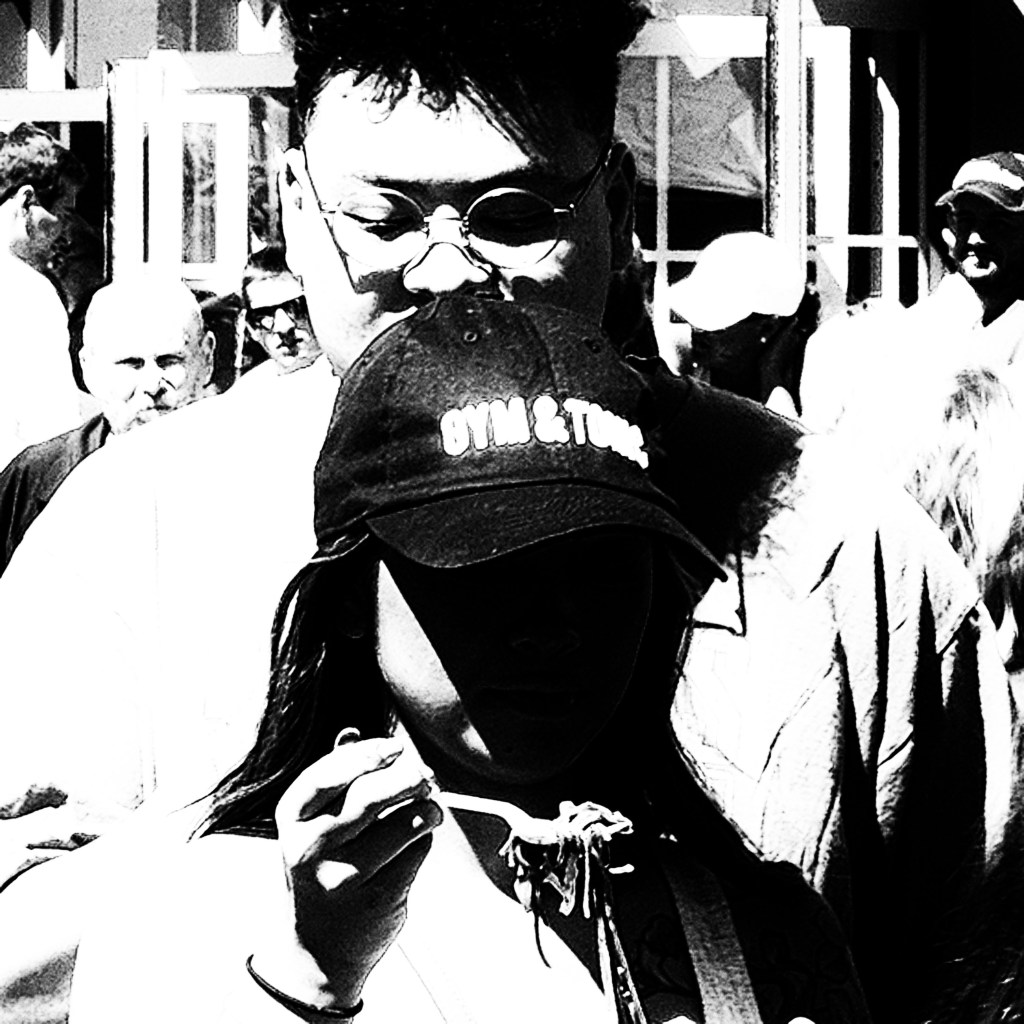
Then, of course, Covid-19 showed up and parked its fat ass in the center of our society. At some point I decided the next Knuckles gig should reflect the strange new Covid reality. I tried a 16:9 moody landscape concept. Broad landscapes as a way of dealing with an increasingly closed in life. But no. Besides, it felt too similar to the Google gig. I also tried reworking a lot of old unseen street portraits in a high contrast are-bure-bokeh-ish style. The idea was to remember life without masks, but do it with a harsh, garish, blurry aesthetic that was sort of alienating. But, again, no. I really like that style, but no. Not now. Maybe someday I’ll come back to that.

Yeah, no, not this either.

But I kept noodling around semi-randomly. Taking new photos and playing with them, looking at old photos (which is something I almost never do) and smooshing them around a bit. Then one restless night I took an old photo of some lawn chairs in a suburban yard, diddled with the color a wee bit, digitally sliced it in thirds, then re-arranged the pieces.

Okay, this might work.

I liked it. It was a mundane, familiar scene but it felt a wee bit out-of-sync. It felt somewhat disjointed and almost (but not quite) unbalanced. Which is sort of how the world seems right now. So I tried with another photo. A bar that wouldn’t be seeing any customers this year.

Yeah, okay, this is starting to work.

The bar was still exactly as it was before the pandemic, but now it was just a tad off-color and slightly dislocated. Which seemed like an obvious title for the gig. It seemed like the approach would be elastic enough to use for almost any sort of photographic style. Landscapes, interior shots, still lifes, street photos.

Okay, that’s it. It’s a project.

It wasn’t until I took a rather busy photo of last year’s Planned Parenthood book sale, chopped it up, and re-organized it that I became confident the gig would probably work. I’ll almost certainly continue to use some old photos in the gig, but I expect I’ll be shooting a lot of new stuff with half an eye on the Slightly Dislocated idea (but only half an eye; I don’t want to be searching for material). I expect I’ll be stopping my bike sporadically to shoot something like this:

Slightly Dislocated — goal

This project may, of course, turn out to be awful. It may become predictable or repetitive, it could turn out to be dull–for the viewer or for me. Hell, as unlikely as it seems, the pandemic might come to a quick end (yeah, that’s not going to happen) and the entire concept of Slightly Dislocated may become out of date. I’ve no idea how long I’ll keep this up, but for now I’m having fun with it.

wake up, america

This question was actually asked and answered at Comrade Trump’s Covid news briefing last week.

Question: Mr. President, at the crux of the theory is this belief that you are secretly saving the world from this satanic cult of pedophiles and cannibals. Does that sound like something you are behind or a believer in?
Trump: Well, I haven’t — I haven’t heard that. But is that supposed to be a bad thing or a good thing? I mean, you know, if I can help save the world from problems, I’m willing to do it.

The question was about Q-Anon, of course. Everybody is talking about Q, curious about Q, focused on Q. Think about it, though. Is it actually believable that Trump is secretly working with law enforcement to stop Hollywood celebrities and Democrats from stealing European children from Episcopalian churches for perverse sexual rituals and Satanic cannibalistic feasts?

No. No, the Truth is the Q-Anon conspiracy theory is just a silly distraction devised by alien agents embedded in the Dip State to keep you from looking at real conspiracies.

Zoo-Anon — Have you ever noticed how many seemingly innocent buildings in zoos have locked doors? Locked, with prominent Keep Out signs. Some are even reinforced with padlocks. What are they hiding? What’s going on behind those closed doors? What…or who…are they keeping hidden away from public scrutiny? Could there be secret rooms lined with stacks of cages holding European children stolen from Episcopalian churches? Are those children being sold to Hollywood celebrities? Or Democrats? For perverse sexual rituals and Satanic cannibalistic feasts? It’s no coincidence zoos are stocked with tranquilizer dart guns. Wake up, America.

Hue-Anon — Why are there so many multi-colored flags out there? You’ve seen them. Some are variations on the Stars and Stripes, but with curious and unorthodox colors. Some are passed off as Pride flags or flags of supposed ‘sports’ teams, or even national flags of countries with ridiculously improbable names (like Ruritania or Peru). Isn’t it more likely that many of those ‘flags’ are actually coded messages? Messages hidden in plain sight, recognizable to agents of the Dip State traveling incognito, transporting European children stolen from Episcopalian churches to be delivered to Hollywood celebrities and Democrats for perverse sexual rituals and Satanic cannibalistic feasts. Keep your eyes open, don’t accept any flag except Old Gory. Wake up, America.

Roux-Anon — Have you noticed how many so-called ‘chefs’ are foreigners? Not just foreigners, but supposedly French? Why? Are we to believe France–a nation whose relationship with armpit hair is questionable–produces the world’s best cooks? Have you ever actually met a real French cook? Probably not. And yet the myth persists and the myth is grounded in the preparation of a thickening agent used in cooking. It’s called a ‘roux’ but it’s literally nothing more than flour mixed with some form of rendered fat, perhaps. Why did they have to make up a French-sounding world for that? More importantly, where does that fat come from? Could it be the baby fat of European children stolen from Episcopalian churches for the perverse pleasure of Hollywood celebrities and Democrats for perverse sexual rituals and Satanic cannibalistic feasts? Why do you think ‘French cuisine’ is so expensive? Learn to think for yourselves. Wake up, America.

J. Crew-Anon — This clothing retailer recently announced it would apply for bankruptcy protection. Why? They claim it’s because of the Covid-19 pandemic. But the president assures us that children are virtually immune from Covid. Isn’t it more likely that European children stolen from Episcopalian churches are sold to J. Crew as slave labor after they’ve grown too old for the perverse pleasure of Hollywood celebrities and Democrats for perverse sexual rituals and Satanic feasts? Isn’t it more likely the company is closing its doors for fear that President Trump and Attorney General Barr are on the verge of arresting the executives of J. Crew and holding them in a Manhattan jail until they are murdered by ninja assassins hired by Hollywood celebrities and Democrats? Follow the logic. Wake up, America.

Gnu-Anon — A pony is an odd-toed ungulate. A gnu is an even-toed ungulate. Why is this important? Hollywood celebrities and Democrats are fiendishly clever. They needed an easily identifiable symbol that can be worn in public–a symbol which would allow them to recognize others of their sexually perverse Satanic cannibalistic ilk (yes, they are an ilk). Ordinary decent people might wear a polo shirt with the traditional emblem of a polo pony on the front. If you look closely at the next Hollywood celebrity fund-raiser for a Democrat, you’ll notice some of those polo shirts actually feature a galloping gnu. If you pay attention, you’ll hear them exchange a ritual greeting. “Hey buddy, how’s it going?” What this really means is, “Hello fellow conspirator, have you any European children stolen from Episcopalian churches available for perverse sexual rituals and Satanic cannibalistic feasts?” This is happening right in front of your eyes. Wake up, America.

Jew-Anon — This is a false flag conspiracy theory. (Not in the Hue-Anon sense, but in the sense that it doesn’t make any sense, if that makes sense.) Does anybody really believe Jews would engage in a conspiracy of any sort? I mean, they’ve never even been able to put together a professional football team. Don’t be stupid.

The Truth is out there. All you have to do is look for it. Wake up, America. Wake up.

mawkish memorial day metaphor

Did my bit yesterday. You know…the ritual of tending the graves for Memorial Day. It’s supposed to be a holiday created by a grateful nation to honor the men and women who died while in military service. Some folks are grateful enough to visit cemeteries, large and small in every corner of the nation, to plant a flag on the grave of every veteran. It’s a pretty idea, isn’t it.

But let’s face it, the nation really isn’t all that grateful, and it’s been years since the holiday was about dead veterans. Modern Memorial Day is more a celebration of consumerism than anything else — like most American holidays. But it’s also expanded beyond its original purpose. There’s still a lot of tending to graves, but it’s no longer limited to veterans.

I’m fine with that. It’s nice to have a day set aside for remembering the dead, whoever they are, however they died. That’s especially true now, when the butcher’s bill for Covid-19 will almost certainly top 100,000 in the next week. Maybe next year somebody will plant a flag on the grave of every Covid-19 victim. I think we, as a nation, will need to find some way to express both our horror and our collective grief at the loss of so many lives. Right now it seems we’re either in shock or denial of the enormity of what’s happening. The fact that it’s still happening — that the pandemic is ongoing — makes it difficult to process. Some events are too catastrophic to comprehend until after they’ve finished, until we know how they end.

Yesterday I visited half a dozen different cemeteries — some in the city, some in the burbs, some in the middle of farmland. Some were nicer than others, some better tended, some busy with other Memorial Day caretakers, some weren’t. I helped tend to graves of family and friends, even those of a few strangers, only about half of whom were veterans.

As usual, I shot a few photographs. I generally delete most of the photos I shoot, especially on Memorial Day.  How many photos do you need of gravestones and flags?

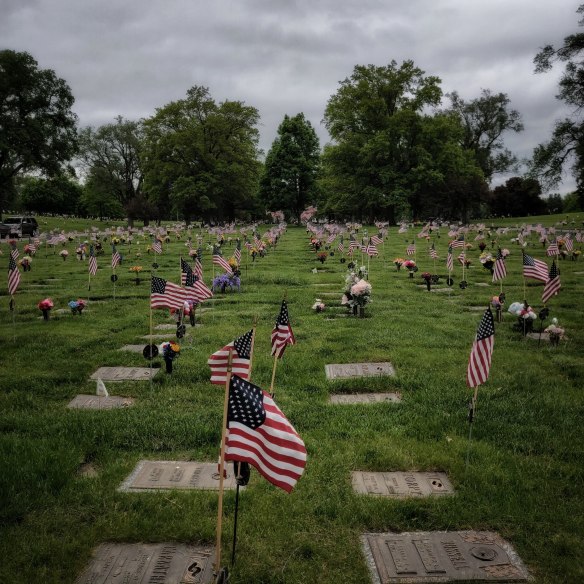
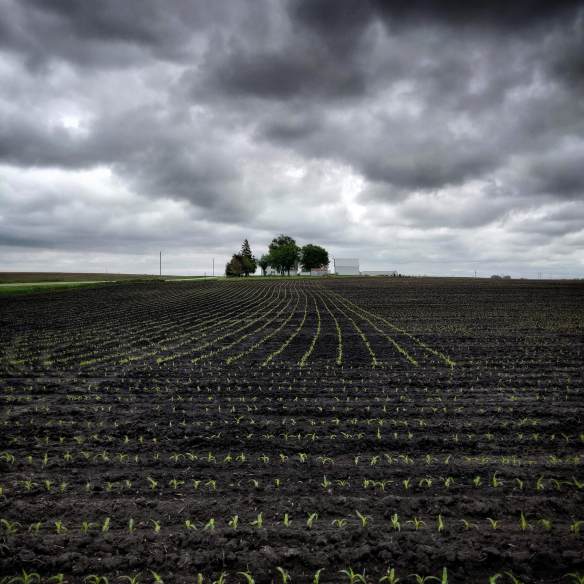
This morning I looked at the photos I shot yesterday. I deleted all but a few. Two of them struck me. One, shot in an urban cemetery, was of the rows and rows of flags — a reminder that there was a time when it was common for American men to do a few years of military service, that it was seen as an honorable thing to do. The other photo was of the farmland just outside a rural cemetery, rows and rows of seedlings growing.

Rows of flags, rows of crops. There are metaphors in those two photos. They’re mostly trite, mawkish metaphors, almost embarrassingly sincere, but they’re also honest. Which is more than I can say for a lot of what we see on Memorial Day. 

targeted murder hornets

Okay, so, I have a plan. It’s still in the very early stages of development, so maybe it’s not actually a ‘plan’. At least not in the sense of a thought-out arrangement or method for doing something. I can’t really say I’ve thought this out terribly well. In fact, it would be more accurate to call it a ‘plot’ rather than a plan, since it’s more of a sequence of intended events rather than an actual arrangeme…well, okay even ‘plot’ is probably inaccurate. Let’s call it a thought experiment. Or wishful thinking.

Okay, so I’ve been doing some wishful thinking about those tuna-brained plonkers parading outside the offices and homes of state government officials who have implemented stay-at-home orders in an effort to reduce the Covid-19 butcher’s bill. I should say that I support anybody’s right to protest. Anybody’s, even if I disagree with the protest, and even if I think the protest is stupid beyond belief.

Yeah, THIS is a guy I’d trust with a firearm. He looks nice.

But damn. Look I know I should feel compassion for folks who are so frightened or timid they feel they need to carry at least one firearm (and preferably more, plus some extra ammo and probably some sort of tactical knife) to go to the market or to exercise their civil liberties. It must be miserable to be that scared all the time. But the sad truth is I’m finding it increasingly difficult to be compassionate for people who have to carry a firearm everywhere they go in public in order to feel safe while insisting that others who are scared of a virus should just stay home.

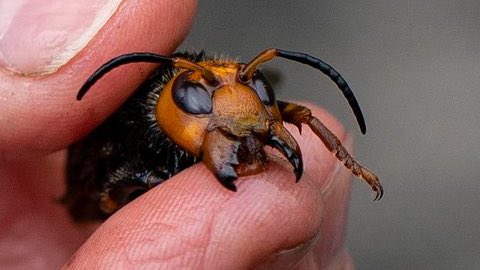
Anyway, I have a plan some wishful thinking about these dolts. It involves murder hornets. Have you heard about the murder hornets? Vespa Mandarina, or something like that. Big fucking Asian wasps that have found their way to the US, probably from Wuhan China (I mean, why not?). Two inches long, with mandibles like scimitars and a stinger long enough to penetrate a bee-keeper’s suit. Also? They can sting you multiple times. Multiple. Flies at 20 miles per hour, so good luck outrunning one of those angry bastards. I mean, Usain Bolt, who is like the fastest man on the damned planet, was clocked at 28 mph, and that was only for a hundred meters. Of course, if he had a murder hornet behind him, he might do better. But the rest of us are fucked. I mean, just look at them.

Their sting has been described as like being impaled with red hot thumbtacks.

Here’s a thing about hornets (well, some hornets, not all of them, but maybe including murder hornets, I don’t know, but we’re still in the wishful thought experiment stage, so don’t discourage me): when angry or attacked, they release an alarm pheromone (your basic 2-methyl-3-butene-2-ol) that incites other nearby hornets to attack. This alarm pheromone is semi-key to my plan wishful thought experiment.

Okay, here it is: we (and by ‘we’ I mean somebody else other than me) capture and breed hundreds or thousands of murder hornets, genetically modifying the brutes so they’re attracted to the smell of Hoppe’s gun oil. How hard could that be?

Hey tunahead, say hello to my little friend.

Anyway, that’s the plan wishful thought experiment. Breed them, train them, turn them loose at these protests. Then stand back. The hornets are drawn to the firearms, the tunaheads panic and swat at them (or just panic and run, the plan work…dammit, the wishful thought experiment works either way), hilarity ensues.

There are still a few wrinkles to work out, I admit. I wonder if Kickstarter would accept something like this.

still standing

I do like an early morning thunderstorm. It’s nine o’clock in the morning and it’s so dark I have the kitchen light on while I drink my morning coffee and read the news. The rain is falling with a sort of steady insistence, like it’s telling us we can stay inside and act like nothing is happening, but it is not going to stop. The cat is looking resentfully out the window at the rain, unfazed by the sporadic thunder. It’s a pretty solid thunderstorm in terms of rain and thunder, but it’s skimping on the lightning. Maybe it’s storing it up and will give us a show later.

The news tells me that on Friday the Bureau of Alcohol Tobacco Firearms and Explosives issued guidelines to allow federally licensed firearm dealers to provide drive-up or walk-up gun sales during this period of isolation. Why? To reduce the health risks posed by the coronavirus. The BATF has a dead solid lock on graveyard humor.

On Facebook one of my Christian senator is wishing me a happy Easter and assuring me ‘He has risen’. I hope she’s not referring to that dark, malignant force haunting the White House, ghoulishly presiding over the drown-in-the-fluid-that-fills-your-own-lungs pandemic. Speaking of which, the butcher’s bill in the U.S. will exceed 21,000 deaths at some point today.

This morning the Twitterverse is, as usual, like Jabberwocky written by the illegitimate child of Oscar Wilde and Charlie Manson (just go with me on this; I don’t need a lesson in biology). It’s clever and hateful and funny and malicious and witty and snarky and so incredibly stupid and full of fascinating information and confusing as hell. Twitter is probably like a lot of family gatherings.

~ ~ ~

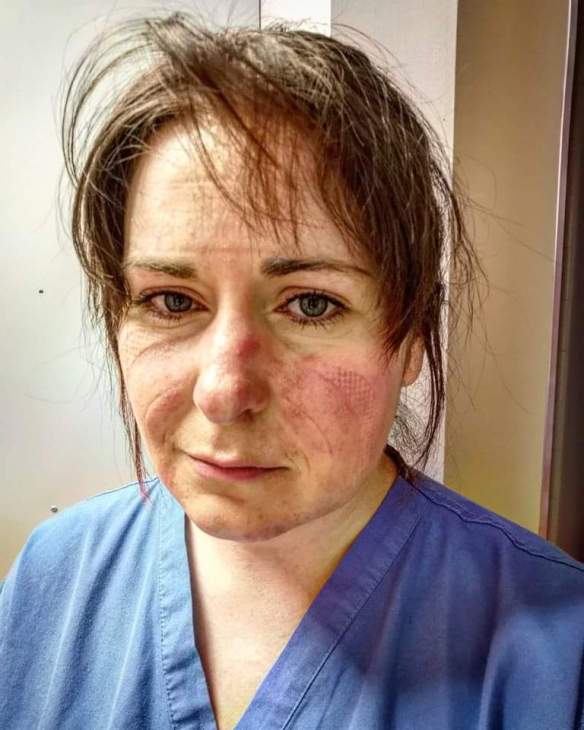
I’ve forgotten what point I’d intended to make when I started writing this morning. I got distracted by this photograph. I saw it on Twitter. If Twitter can be believed — and I want to believe this is true — this is a photograph of an ICU nurse who has worked 65 hours in the last week. I’ve been looking at and thinking about this photo for about an hour.

I don’t know this woman’s name, or where she works, or who shot the photo. I don’t really know anything at all about her. But I recognize her. I recognize that look. I know she’s on the ragged edge of exhaustion, discouraged, worn down by grief and duty. I don’t know who she is, and I know she can’t save us. But I also know she’ll try. And I know that after a few hours of sleep, she’ll be back at it. So will all of her colleagues.

Today I’ll stay inside, dry and warm. I’ll read my book, I’ll cook some food, I’ll do a little housework, I’ll do a bit of writing, I’ll feed and pet the cat, I’ll continue to check in on social media. At some point tonight I’ll watch an episode of Breaking Bad and maybe an episode of some other show. I’ll fill up every hour of the day, but I’ll never be busy and I’ll never be uncomfortable and I’ll never have to make a decision more difficult than what to cook for supper.

But I know I’ll return, over and over, to this photograph. It’s that powerful; it’s that compelling. Right there — everything that can be said about the power of photography is right there. Everything that’s good and noble about humankind, right there. Everything that can be said about sacrifice and dignity and dedication and love and compassion, right there. Everything that is heart-crushing, that is hopeful, that is beautiful, that is desperately sad and deeply caring and incredibly tough and still tender, it’s all right there.

I hope my Christian senator sees this photograph. I’m glad she finds some comfort and strength in her belief that ‘He has risen’. Me, I’m drawing my strength and comfort from knowing that this woman, whoever she is and wherever she is, is still standing.