Okay, first — free wi-fi. Who doesn’t love free wi-fi? It’s free, it’s wireless, and it’s…I don’t know. Something that begins with fi. Fizzy, maybe. Doesn’t matter. It’s free and you can connect to the Intertubes, and that’s what counts.
Second, there’s a coffee shop that also serves an Italian soda, which is a lot like an egg cream. It’s not an egg cream; I’m confident they don’t use U-bet Chocolate Flavor Syrup, which is absolutely essential in the making of an egg cream. But considering this is the Midwest, it’s close enough. The basics are there: seltzer, milk or cream, flavored syrup in a chilled glass. It’s light and cool and refreshing, which is what you want in the summer. They serve coffee as well, of course.
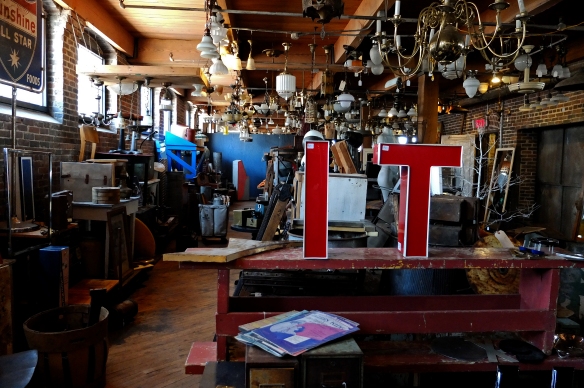
I declare, every square inch of ceiling space is covered with light fixtures
Finally, there are three floors filled with stuff salvaged from hither and yon. Not just hither, mind you, and not just yon — hither AND yon. Chicago, St. Louis, New York, London — you get the idea. Hither. Yon.
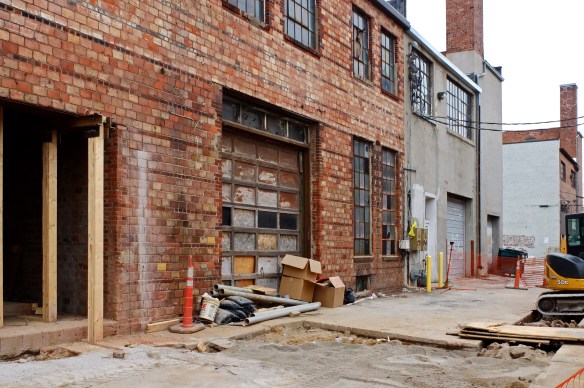
So, to recap: free wi-fi, Italian soda (almost an egg cream) and coffee, architectural salvage. All in the same old warehouse building. It’s called West End Salvage and Coffee Shop. It’s located directly beside the 9th Street viaduct and three blocks from the County Jail. I love this place.
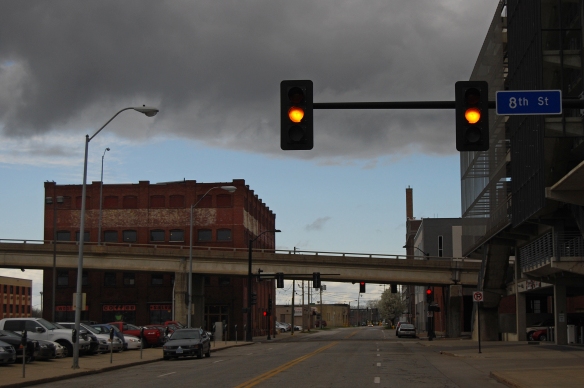
West End Salvage & Coffee — that’s it on the left
They don’t mind if folks just wander around and look at stuff. Hell, they encourage folks to just wander around and look at stuff. “Hey folks,” they say, “go wander around. Look at stuff.” And that’s exactly what folks do. The place is sort of a combination of a maze and a warren, so you often hear the voices of folks you can’t see, saying things like “Ooh, look at that” or “What the hell is that thing?” or “I want that — I don’t know what it is or what it does, but I want it.”
I’ve said each of those things myself.
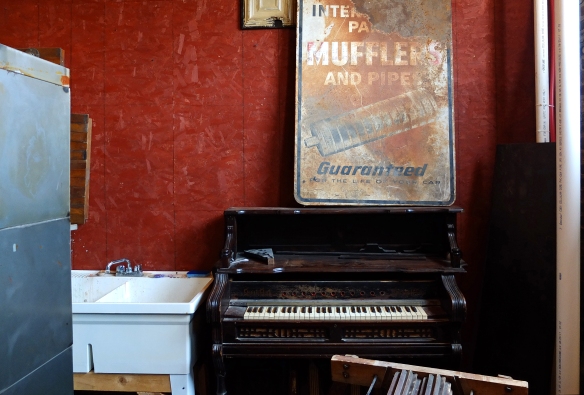
I could totally justify buying any of these things
It’s the sort of building where you step around a massive wooden cupboard and find a stereopticon sitting on a beat-up old printer’s cabinet. Or an un-restored organ standing beside a plastic double-sink, near a crate containing a collection of large metal gears. If you’re ever in need of a tin box, this place has several dozens in sizes ranging from tiny enough to fit a pair of earrings to enormous enough to bury a rhinoceros. And chairs, lawdy these people have chairs. And mirrors. All over the fucking place, chairs and mirrors. And tables. And and and.
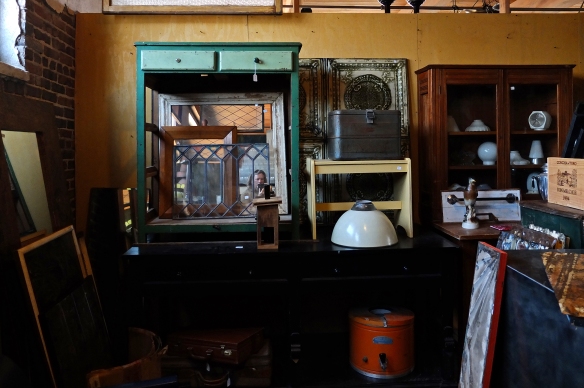
Yeah, that’s me under the table in the mirror that’s behind the leaded glass window
All those mirrors can be startling. You’re always catching reflections out of the corner of your eye. Your own reflection, the reflections of other people. And since the mirrors are often semi-hidden behind other stuff, those reflections can be a tad startling. You’re not always expecting to see a face peep out from under a table, or from behind a sign written in the Tibetan alphabet explaining something about goat husbandry.
There are lots of signs here. Hanging on the wall, leaning against an old sofa, standing on tables. Signs for products, instructional signs, place-name signs. Even an old sign written in bad English explaining the rules for prostitutes wanting to do business with the U.S. 8th Army stationed in Korea.
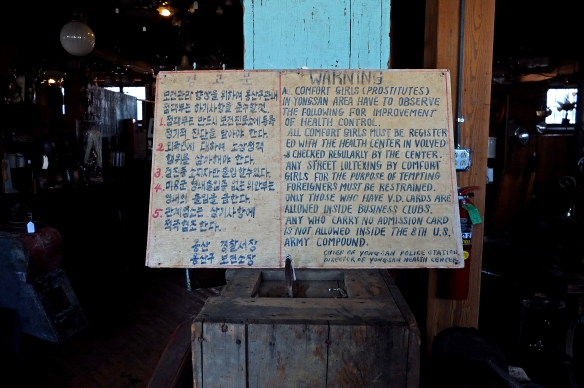
I have no idea what street loltexing involves, but apparently it must be restrained
Some of the stuff you see has been refurbished or repurposed. Some of it’s in the process of being refurbished or repurposed (it’s not uncommon to hear the sound of power tools whining). But most of the stuff is just casually strewn about by folks with an intuitive sense of color and aesthetics. You really get the sense that somebody made a deliberate decision to arrange that blue male torso between that pair of old floodlights.
You see that same sense of unhurried thoughtfulness in design almost everywhere in the building. Almost everywhere.
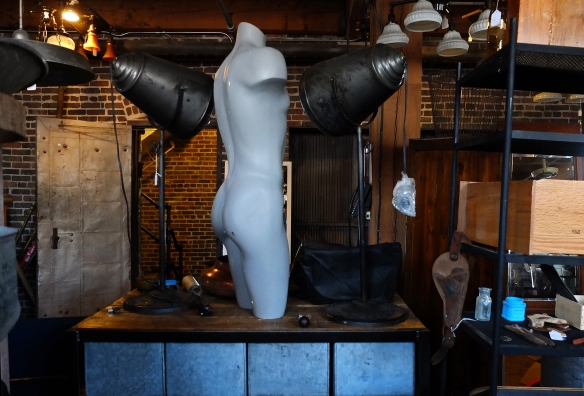
Just behind the torso’s butt you can see the stairs leading up to more stuff and down to the coffee shop
Oh, there are areas where stuff is just gathered higgledy-piggledy, but there are enough instances where the arrangement is so aesthetically pleasing that it can’t be accidental.
At some point you stop saying to yourself “That would be a great photo prop.” At some point you stop asking yourself “If I owned that, where would I put it?” At some point you realize you just want to move into the building.
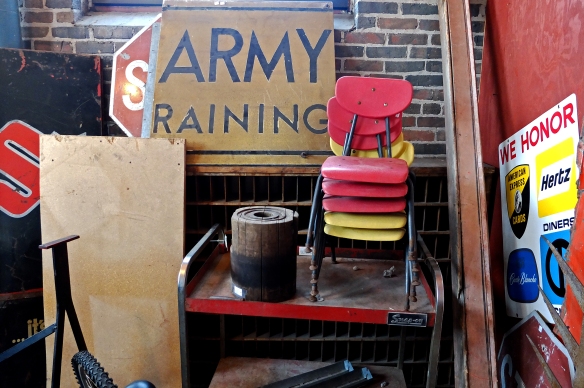
Okay, so it’s not all arranged with an eye toward aesthetics
I’m told that the West End Salvage & Coffee folks have a make-over show on the Home and Garden Television cable channel. You know the type of show I’m talking about. Some folks are bored with their normal old living room and want to turn it into something that’s more representative of who they are as individuals — so they hire somebody to design and furnish a room for them. One of those shows.
I haven’t seen it (though I’m a big fan of HGTV). I haven’t bothered to watch it on account of who cares? I mean, there are dozens of those shows, and West End Salvage is much too cool to be wasted on that stuff. They ought to be doing shows on the stuff they salvage — where it came from, who made it, why the salvage job has become necessary, what the salvaged thing does, and what eventually happens to it.
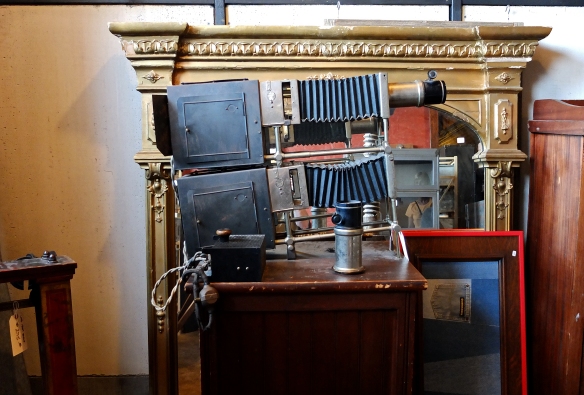
You guys, it’s a stereopticon, just sitting right there
I don’t know about you, but I’d definitely watch a show that told me the general history of stereopticons, and where this one was made, and by whom, and who originally bought it, and who’d buy it now, and what they intended to do with it. That would be SO much more interesting to watch than seeing some folks have their dining room re-done.
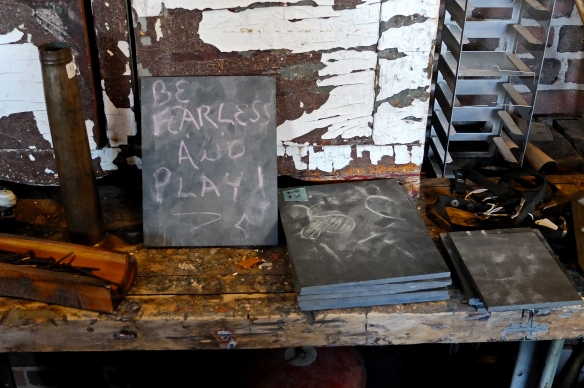
And hey, maybe have a go at some street loltexing
On the other hand, if they did a really cool show then maybe West End Salvage and Coffee would be overrun by tourists. So maybe it’s for the best. Because, c’mon — free wi-fi, something sorta kinda close to an egg cream from the coffee shop, and floors of architectural salvage? Who wants to fuck that up by having hordes of fat-walleted HGTV fanboys and girls cluttering up the place? Not me.