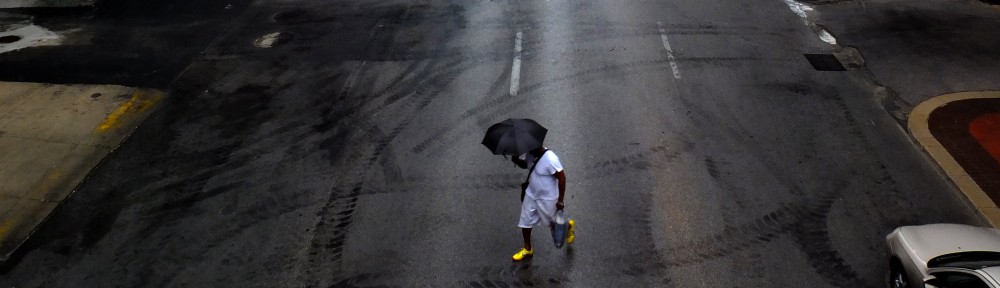
it ain’t just the zombies

I’ve avoided writing about The Walking Dead because, as improbable it sounds, there are people who don’t share my perfectly normal interest in zombies. But almost everybody I know is interested in art and photography. The cinematography of TWD is always compelling — but sadly most zombie fans don’t recognize the artistry involved in constructing those shots. That artistry was apparent in the most recent episode.

A word of warning: this WILL CONTAIN SPOILERS.
wd1

In order to really appreciate the photography, it’s necessary to give a bit of background information. Here’s what you need to know: 1) a zombie apocalypse has taken place; only a few survivors exist, 2) everybody is infected with the zombie virus, though it’s dormant in the living, 3) a zombie bite is always fatal, 4) everybody who dies — including those who die of natural causes — becomes a zombie,  5) the only way to ‘kill’ a zombie is to destroy its brain.

A group of survivors has taken residence in an old prison, where they can live in relative safety inside its walls. However, some sort of lethal flu-like syndrome has infected many of the survivors — and when they die…you get the picture. The most recent episode is called Isolation. On the most obvious level, it refers to the fact that the survivors are attempting to isolate their members who’ve contracted the ‘flu.’
wd2

On a deeper level, though, the episode is about human isolation. The geographic isolation of the small group of humans in a world of hungry zombies. Their physical isolation inside the walls of the prison (which, after all, is designed to isolate convicts from the citizenry, and from each other). The medical isolation of the sick from the healthy. The psychological isolation of the survivors from each other. And the terrible emotional isolation of the individual survivors from their own feelings.

And all of that is depicted on the screen — through the writing and the acting, of course, but also through the camera work.
wd4

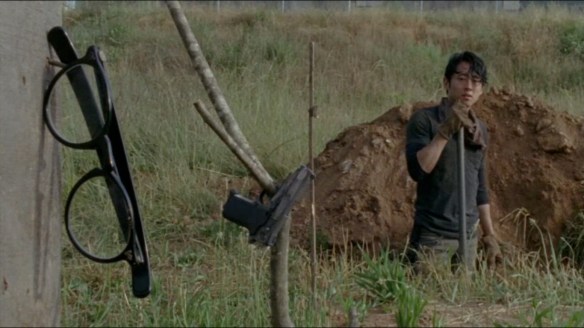
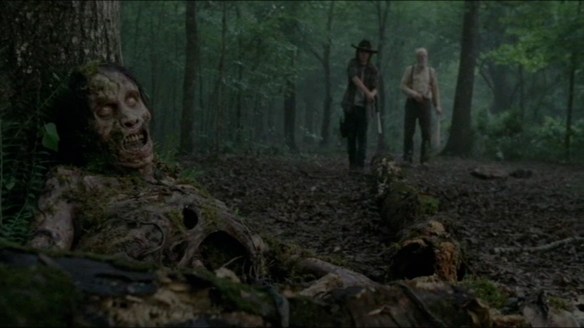
Notice how often the cinematographer uses the entire frame — not just from side to side, but from front to back. He deliberately stacks subjects on various planes within the frame. In the foreground of the first shot above we see a pair of eyeglasses attached to a simple grave-marker. Viewers will recognize the glasses as belonging to a young boy, the first victim of the mysterious flu. In the previous episode the boy died, became zombiefied, and had to be killed. In the middle-ground, a pistol — a killing tool, necessity in TWD world. In the background is Glenn, who is clearly exhausted — he’s exhausted both physically and emotionally, exhausted in almost every possible way (the boy with the eyeglasses was attacking Glenn at the time he was killed).

Everything in that shot — Glenn, the dead boy, the handgun — is linked thematically. Every element is isolated from the others. And yet every element is also inextricably linked to the others. The photography supports and enhances those themes.
wd7

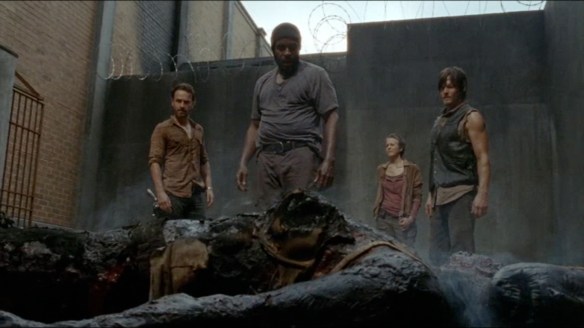
The same is true of the second shot. In the foreground, two bodies belonging to people who’d displayed symptoms of the illness. They’d been isolated; but somebody entered the isolation area, killed them, dragged their bodies outside, and set fire to them (much of the episode revolves around discovering who murdered these two). In the front middle-ground is the lover of one of the victims — a man obviously in shock. In the rear middle-ground are Rick and Daryl, leaders of the group of survivors. And in the background is Carol, the only one not looking directly at the bodies. At the end of the episode, Carol is revealed as the murderer.

Again, everyone and everything in the frame is thematically linked to everything else. And again, they’re all isolated from each other.
wd9

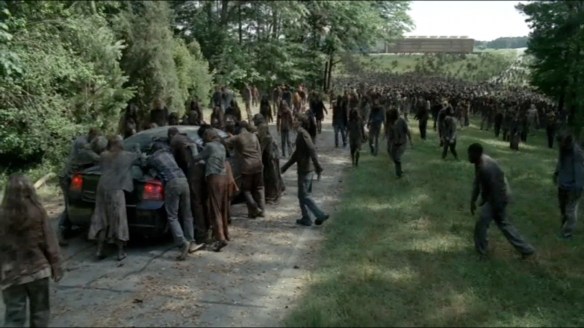
The director and cinematographer also use the frame to instill a sense of confinement. Everything seems to be crowding in on the characters. Even in the scenes that take place outdoors, the characters are somehow confined. In the woods they’re hemmed in by the trees, and by lurking zombies. On the open road — that most American venue — they find themselves quickly enclosed by a herd of zombies, trapped in the vehicle that’s supposed to grant them freedom of movement.

This happens in scene after scene in the episode. The frame is filled in every direction, thematically tight, and psychologically crowded. All those cascading claustrophobic moments create an aura of dread and despair in the viewer. It’s subtle, but very effective.
wd11

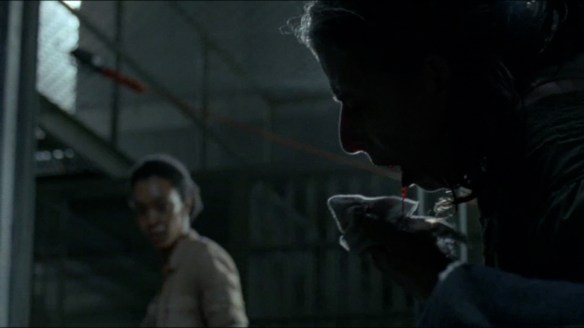
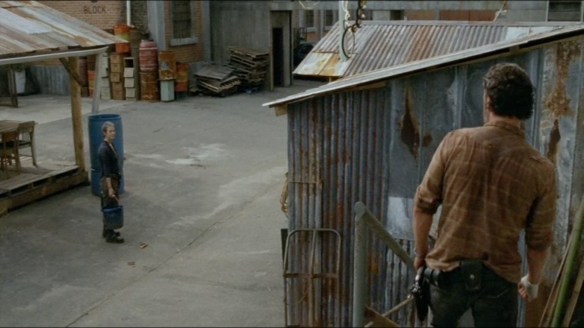
In the final sequence of the episode Rick is reluctantly preparing himself to ask Carol if she’s the person who killed and burned the two flu-sufferers. They’re filmed far apart; he’s high above her, in a rather judgmental position. She’s small and far below, waiting. He gradually comes down to her level — physically, emotionally, ethically — and asks the question he doesn’t want to ask.

The tension is palpable. She answers simply — yes. And walks away, the distance between them growing. And yet they’re both still linked, both still confined, both even more isolated.

I began watching The Walking Dead for the zombies. I still like it for that reason. Zombies are just flat out cool. But I appreciate TWD for the quality of the acting, the occasionally brilliant writing, and for the consistently amazing camera work.

The Room

I like games. I love games. I love ‘play’ as a concept, and as an activity that’s absolutely fundamental and necessarily integral to a meaningful life. There’s been an element of ‘play’ in everything I’ve ever done for as long as I can remember. I’ve never held a job that didn’t allow me to include ‘play’ in some manner. Even when the job was deadly serious, there was always the potential for ‘play’ in it somewhere.

So I love games — but I’m not really a gamer. Not in the modern sense of the term. I don’t spend much time playing video games, primarily because so many of them are goal-directed. Achieve this, attain that, increase in level, gain points, compete against your friends, maximize your scoring potential, win.

Don’t get me wrong. I can be ridiculously competitive in some things, and I like winning. But for the most part, it’s not what drives me. What drives me is being immersed in the experience of the game, deeply engaged in playing it. The outcome is secondary. Or even tertiary.

I’m talking about all this because I got an email from a friend who knows how I feel about play and games. The subject line of the email: Here, look at this. And the text of the email:

I downloaded this on my phone. I fucking hate it. It’s all about observation and thinking and logic and intuition and solving puzzles and the music totally fucking creeps me out. It’s everything that makes me nuts in a game. It made me think of you. You’ll love it.

And it included a link to this teaser:

So I downloaded the game to my new phone. I think it cost me two bucks. It’s the only game app I’ve put on my phone. And my friend was right. I love it.

There’s a narrative behind it, but I really don’t care (which in itself is odd, because I’m usually all about the narrative). I’ve not finished the game yet, and I’m in no hurry to do that (well, I’m in an absolute hurry to finish only in the sense that I want to keep playing; but I’m in no hurry in that I want it to last). The experience is satisfying in the way solving any puzzle is always satisfying. But the game designers understand that solving the pleasure of solving the puzzles is enhanced by the visually rich environment and the sweet and peculiarly creepy music. It’s so good that I’m parceling the game out, which seems awfully Protestant of me — like it’s a reward for doing the things I’m actually required to do. There’s apparently something to all that ‘delayed gratification’ business.

I have no idea if I’m almost done with the game, or if I’ve just begun, or if I’m somewhere near the middle. If it ends after I’ve solved the next puzzle, I’ll be disappointed. Not by the game itself, but only because it’s over.

Now I have to make myself some lunch, log in a couple hours in reviewing my students’ homework, and then back to The Room.

the cat vomited

You wake up. You struggle against the gravitational pull of the bed and get to your feet. You head for the coffee pot, reminding yourself that yes your damaged knees ache right now, but the pain will diminish over the next hour or so as you move about. Before you reach the coffee pot you discover the cat vomited during the night.

It’s a small thing. A truly small thing, even for the cat — who is sitting lazy-eyed in the sun by the window, completely unconcerned. It’s a small thing, but it has to be dealt with. It has to be cleaned up, which you can do as soon as the coffee has been started.

In a bit you’re sitting in front of the computer, your knees hardly ache at all, there’s a cup of Kona to one side, the cat vomit has been cleaned, the sun is shining, and you see this:

earth and moon 900 billion miles

The Earth and the moon, from nearly nine billion miles away

Fifteen years, nine months, and six days ago the Cassini-Huygens satellite was hurled into space atop a Titan IV rocket. It’s mission was to study Saturn, and it’s been in orbit around that planet since 2004. But a few days ago, the satellite turned its cameras homeward.

That’s the Earth, that sparkly bit right there in the middle. The Earth and the moon, seen from 898,410,414 miles away.

When I say That’s the Earth what I mean is That’s you and me. That’s everybody we know, and everybody we’ve ever known, and everybody we’ve ever heard about or read about. Shakespeare lived on that little sparkly bit, and Dashiell Hammett. Woody Guthrie made music on that sparkly bit, and so did Mozart and Cole Porter. Pablo Picasso noodled around that sparkly bit for more than ninety years, splashing dabs of genius all over the place. Seventy-some years ago that sparkly bit was involved in a war that spanned three of its seven continents. At least five times in its life, that sparkly bit has been largely covered with ice.

Seen from a distance of nearly nine billion miles, an ice age seems like just a passing phase. World War II, just a small thing. Mozart, a blip. Picasso? Well, he had cats. And you can be sure those cats occasionally vomited, and likely Picasso had to clean it up.

the cat, from just over five feet away

the cat, from just over five feet away

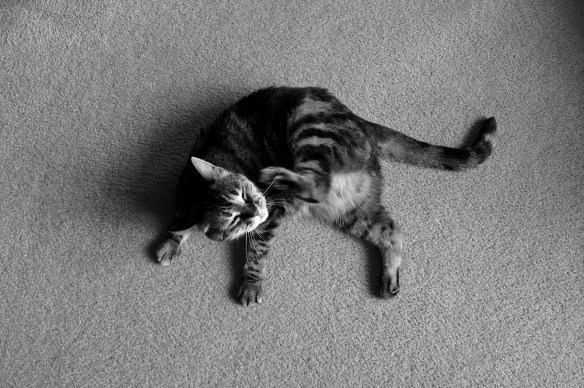
This is the cat that vomited. The photo was taken about the same time Cassini-Huygens took the photo of the Earth and the moon. This cat doesn’t care about Picasso, or world wars, or ice ages, or satellites hurled nearly nine billion miles into space. This cat doesn’t even care that she vomited, not really. She doesn’t have to clean it up.

Distance gives you perspective. Proximity gives you life. We can create marvelous technological feats, we can inflict horrific depredations on our planet — but the cat will still vomit and somebody has to clean it up.