a five dango city

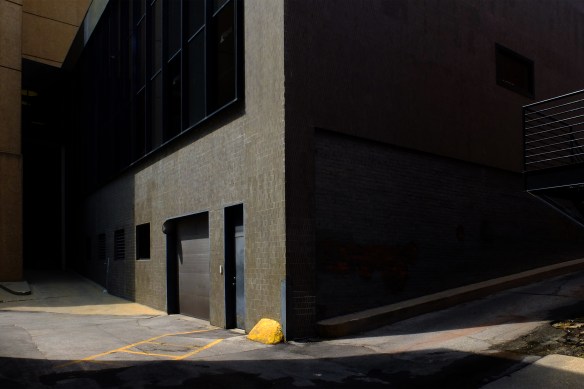
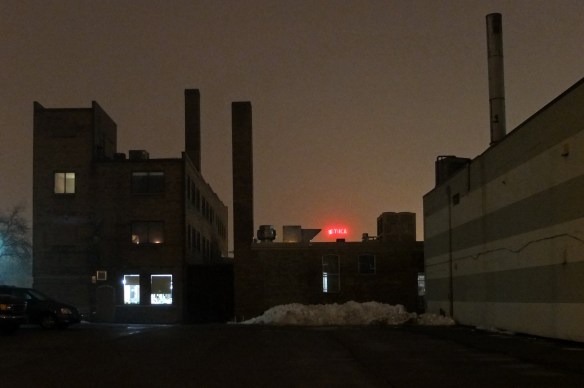
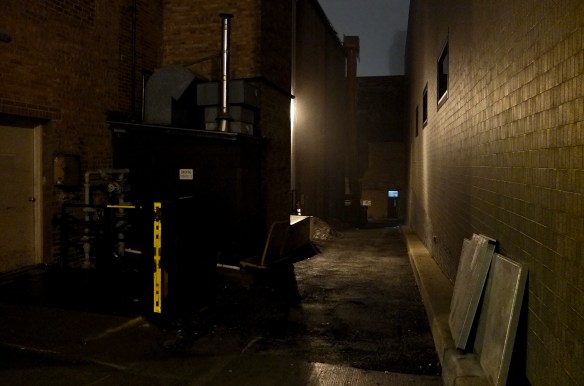
It was a cold, cloudy, wet, grey, miserable sort of afternoon and I was downtown with a couple of hours to piss away on nothing in particular. In other words, a perfect time to go larking about in alleys. Alleys are best photographed in rotten weather because there are fewer people working in them. I actually like the people who work in alleys, but they tend to be camera-shy. And suspicious. It’s just easier to do alley work in foul weather.

So I slipped the little X10 in my pocket and headed out to find a nice juicy alley. First, though, I thought I’d make a little detour to visit to the river.

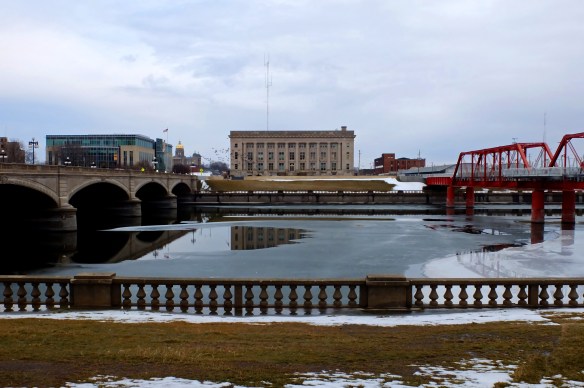
courthouse across the river

courthouse across the river

I’m of the opinion that you can never go very wrong making a detour to visit the river. Any river. That said, I have to admit there are certain aspects of a river that make you better appreciate a good alley. Like the absence of walls and buildings to block the wind. Let’s face it, rivers suck at wind-blocking.

On the other hand, the absence of all those walls and buildings gives rivers the great advantage of meteorological drama. With rivers you get all that accompanying sky. And you get it twice — once overhead and once in reflection.

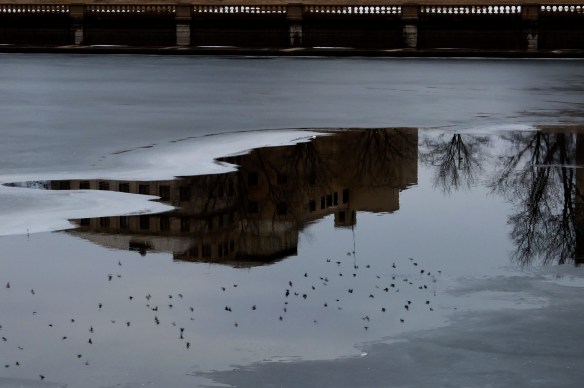
there are always pigeons along the river

there are always pigeons along the river

There really wasn’t anything particularly interesting going on at the river. There was the usual flock of pigeons morris-dancing around in the sky. Despite the cold and wet, there were a few intrepid bicyclists and runners tooling up and down the riverwalk and bike path. There were a couple of really bitchy Canada Geese fussing at each other.

It took me a while to figure out why it was so quiet. The construction that’s been taking place along the riverwalk for the last couple of years is largely finished. There were no generators coughing away, no backhoes, no bucket trucks or forklifts, no men with jackhammers. The riverwalk was…quiet.

riverwalk intersection

riverwalk intersection

For years the Des Moines city planners have been making a considerable effort to draw people back into the downtown area. It’s not just that developers have been building loft apartments and faux brownstones — the city has been adding a lot of public art and other quality of life amenities. There’s a new dog park, there’s a skating rink, there are bike trails and pedestrian bridges, there’s a botanical center and a science center and a historical building — all near the river.

Construction has just been completed on a small, two-level riverwalk pavilion. When it opens, it’ll include public restrooms (and trust me, that’s important in a city) and a small cafe or coffee shop.

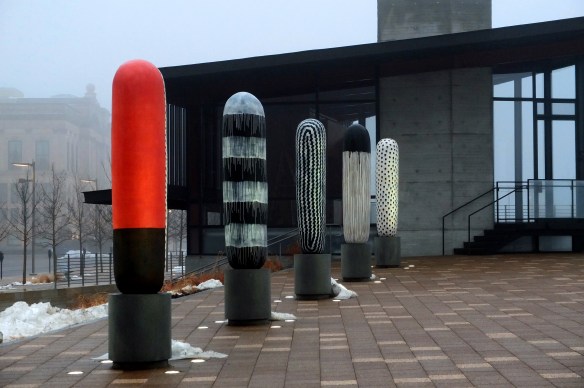
And in front of the pavilion: five dango.

the dangos of jun kaneko

the dango of jun kaneko

The dango are large ceramic sculptures by Japanese artist Jun Kaneko. A dango is a sort of Japanese steamed dumpling. These don’t look anything like dumplings, but I think there is something dumplingish about them. They’re not bland like dumplings, but they’re simple and strangely comforting. These are happy-making works of art.

There’s something very sweet and childlike about the dango. They were only installed a few weeks ago, but they seem to fit right in along the river. Seeing them, touching them, watching other folks look at them with a sort of bemused confusion — it makes me ridiculously happy.

Still, I hadn’t set out to look at the dango; I’d set out to wander idly through alleys. So I didn’t stay.

 the court avenue bridge

the court avenue bridge

But before I ventured forth alleyward, I decided to check out the other structure that’s been under construction along the riverwalk.

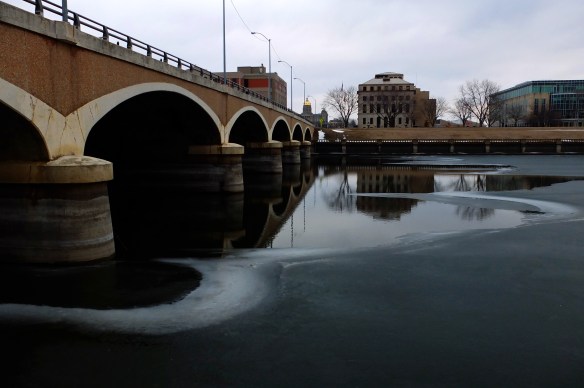
Rivers flood. All of them, they all flood. If you look at the large version of the photo below (or almost any photo of the riverwalk) you’ll see several lines of flood levels. What you can’t see are the tree-trunk-sized logs jammed up in the infrastructure beneath those bridges. When the Des Moines River has once-in-a-century floods (which we seem to have every five years or so now, thanks to climate change and the short-term planning of the old Army Corps of Engineers), it really floods. It’s not uncommon for those balustrades to be under water.

police department

police department

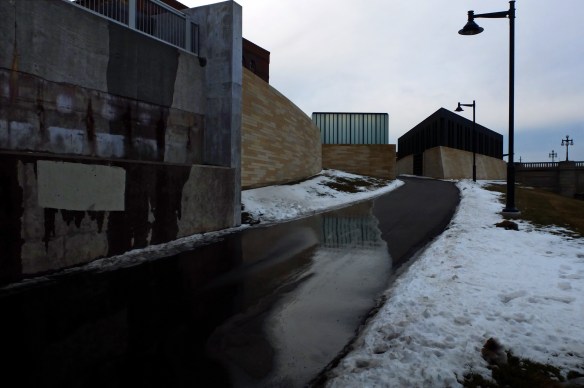
I’m mentioning that because the other structure that’s been under construction is a storm pump station. It’s designed to keep those pesky once-in-a-century flood waters under control. Both the pump station and the new pavilion have exceedingly cool flood doors that can be closed during high water. They look a lot like the doors you see protecting the island lairs of James Bond villains.

I spent an absurd amount of time looking at those doors. I don’t really want to see the river flood, but at the same time I can’t wait until the river floods.

and the snow melts slowly

flood pump station

I was just getting ready to head out and find a friendly alley when my cell phone chirped. I discovered I’d spent about two hours walking a grand total of about three and a half blocks. I had to hurry to meet my friend, so I took a shortcut through an alley.

I did manage to shoot a photo in the alley. But it was blurry.

Siren

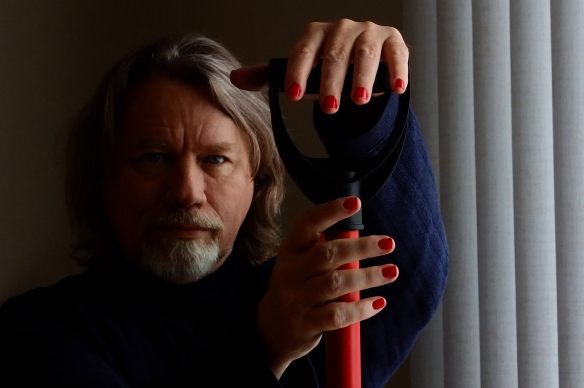
So. My fingernails. They’re red. Bright red. Incredibly fucking red. I have incredibly fucking red fingernails. I’m typing this with fingers that have incredibly fucking red nails. It’s really distracting.

Last night, during the fourth quarter of the Super Bowl, while it looked like San Francisco might actually make a comeback, I had my fingernails painted incredibly fucking red. The actual shade of red, according to the label on the bottle, is Siren. No, I’m not making that up. Siren. Also on the label is a warning:

Avoid Heat and Flame

For all I know, Heat and Flame may be other shades of red. And if they’re redder than Siren, you can bet your ass I’ll avoid them. But I assume the manufacturers of Siren are actually warning me NOT to put the bottle of fingernail polish in a fire. I hadn’t even considered putting the bottle in a fire — not until they told me NOT to. Now it seems like it might be an interesting experiment.

why yes, my fingernails ARE incredibly fucking red

why yes, my fingernails ARE incredibly fucking red

You may be wondering why I had my fingernails Sirenized. I got to confess, there were moments when I wonder that my ownself. I did it for an Iron Photographer photo. I have discussed the IP process before. I can’t even begin to tell you about the phenomenally stupid shit I’ve done for Iron Photographer photographs. I need to point out that Iron Photographer is about creating artful photographs, not about doing stupid shit. But it’s surprising how often the process involves some degree of stupid shit.

This time it involved Siren. And a shovel. Seriously, it always makes sense while you’re putting the photo together. It’s only when you look at it afterwards that you begin to ask yourself “What the HELL was I thinking?”

Now I have to figure out how to remove this incredibly fucking red nail polish before I can leave the house. Or answer the door (I have an order of Thin Mints scheduled to be delivered and I do NOT want to have Siren-red nails when I’m handing over some cash to the poor innocent Girl Scout. Or her mother).

the integrity of theft

Whenever somebody asks me about ‘my work’ I automatically assume they’re talking about writing, not photography (although it now occurs to me that I almost never discuss writing on this blog — which is probably something I’d think about if I was even remotely self-reflective). I don’t think of photography as ‘my work.’ I don’t even think about it in terms of ‘my photography.’ I think about it as ‘the photographs I shoot,’ which is a subtle but meaningful distinction. At least it’s meaningful to me.

Don’t get me wrong; I take photography seriously. I just don’t take myself seriously as a photographer. So it feels odd to me to write about the photographs I shoot. But a few days ago I mentioned I received an email in which I was asked the following questions:

I guess what I’m asking is how do you develop a personal photography project? Do you just pick a thing and start taking picture of it? Do you make up rules or guidelines before you start? How do you start a photography project?

I decided to take the questions seriously and try to answer them — at least insofar as the three photo series I’ve included on this site. Last time I talked about the Traffic Signals series. Today I’m going to explain the origins of the Faux Life series.
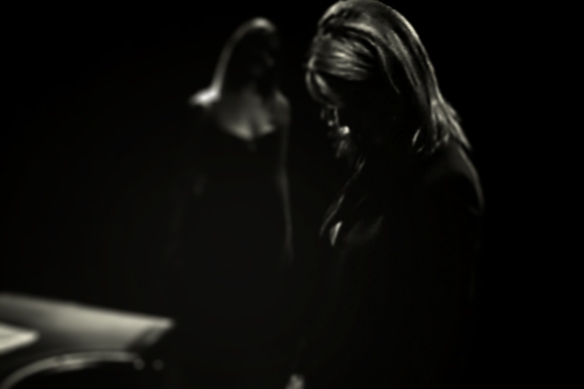
My blindness to what was going on, led me to act by them in a way that I must always be ashamed of, and I was very foolishly tempted to say and do many things which may well lay me open to unpleasant conjectures....

My blindness to what was going on, led me to act by them in a way that I must always be ashamed of, and I was very foolishly tempted to say and do many things which may well lay me open to unpleasant conjectures….

I blame Richard Prince. If you’re not familiar with Prince, he was the first photographer whose work sold for more than a million dollars. What made that amount even more staggering is his work was also the work of commercial photographer Sam Abell. Does that sound confusing? That’s because it is.

Sam Abell photographed the famous Marlboro Man advertisements. What Richard Prince did was re-photograph some of those advertising images. He removed the text, printed them very large, then presented them as a comment on American culture.
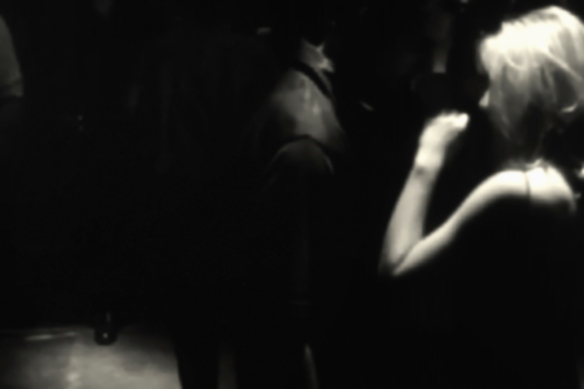
Afterwards he got worse, and became quite my shadow.  Many girls might have been taken in....

Afterwards he got worse, and became quite my shadow. Many girls might have been taken in….

Some folks would call that theft; Prince called it appropriation art. The idea is that by removing the image from its original context, new layers of meaning can be attached to the work. Abell’s original photograph was intended to create an association between Marlboro cigarettes and the robust life of a manly cowboy living and working in an idealized vision of the Old West. It was, in effect, a lie. A double lie, in fact. It not only associated smoking with a healthy lifestyle, it also invoked a nostalgic vision of an American West that never really existed. It was a lie used to sell cigarettes.

Richard Prince removed the Marlboro Man from that original context. In doing so, he gave the photograph a radically different interpretation and a different meaning. It became a comment on commercialism. The viewer has a different experience when looking at the re-photographed photograph — he’s no longer being sold a product, he’s being introduced to the idea of using romance as a marketing tool. Prince would argue that this, in effect, makes it a different photograph.
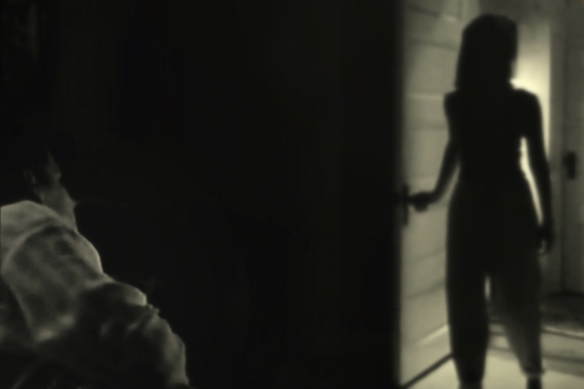
The key was in the door, and she had a strange fancy to look into it; not, however, with the smallest expectation of finding anything, but it was so very odd, after what Henry had said.

The key was in the door, and she had a strange fancy to look into it; not, however, with the smallest expectation of finding anything, but it was so very odd, after what Henry had said.

That concept — that simply by shifting the context of an image it can be turned into an entirely new image –fascinated me. It still does, in fact. I’m appalled that Prince made millions of dollars off Abell’s work, but I have to admit that even though the photographs of Abell and Prince are essentially the same, they DO have a different meaning — and Prince’s image is more interesting.
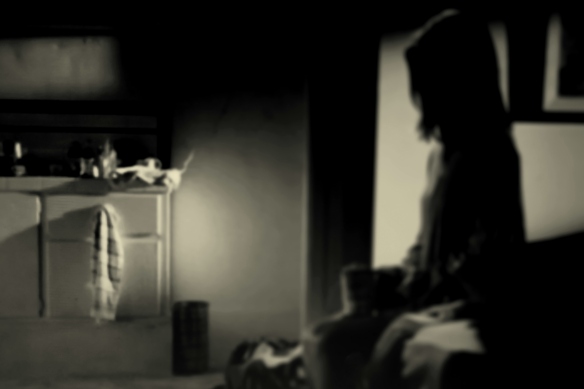
Anxious and uneasy, the period which passed in the drawing-room, before the gentlemen came, was wearisome and dull to a degree that almost made her uncivil.

Anxious and uneasy, the period which passed in the drawing-room, before the gentlemen came, was wearisome and dull to a degree that almost made her uncivil.

I decided I wanted to play around with the concept of appropriation art. By coincidence, as I was knocking around ideas for an appropriation project, Buffy the Vampire Slayer came on television. I’m a long-time, devoted fan of the Buffy television series. It occurred to me that Joss Whedon had, in effect, appropriated the vampire concept and turned it on its head by shifting the role of vampire slayer from the traditional virile and sober-minded male to a bubble-headed Valley Girl cheerleader. The television show used the tropes of vampire movies to examine the life crises of high school students.
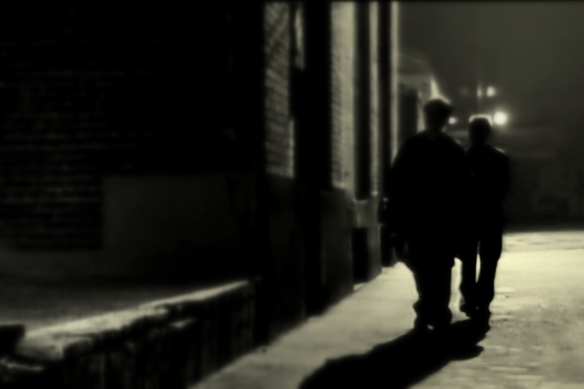
He had suffered, and he had learned to think: two advantages that he had never known before; and the self-reproach arising from the deplorable event in Wimpole Street, to which he felt himself accessory by all the dangerous intimacy of his unjustifiable theatre, made an impression on his mind....

He had suffered, and he had learned to think: two advantages that he had never known before; and the self-reproach arising from the deplorable event in Wimpole Street, to which he felt himself accessory by all the dangerous intimacy of his unjustifiable theatre, made an impression on his mind….

So I decided to steal Buffy. I mean appropriate Buffy. But I discovered it wasn’t enough to extract one particular moment from a television episode. It wasn’t enough to shift color photography to black and white. It wasn’t enough to manipulate the shadows. That certainly changed the image, but it didn’t really add any meaning to the image.

It needed something else. And by still another coincidence, I was engaged in an ongoing discussion with a friend about the novels of Jane Austen. I was arguing that you could read her novels as detective stories in which the modern notion of crime was replaced with social deviance. Murder was replaced by incivility. Jane Austen’s protagonists were all keen observers of life, all had a detective’s eye toward detail.
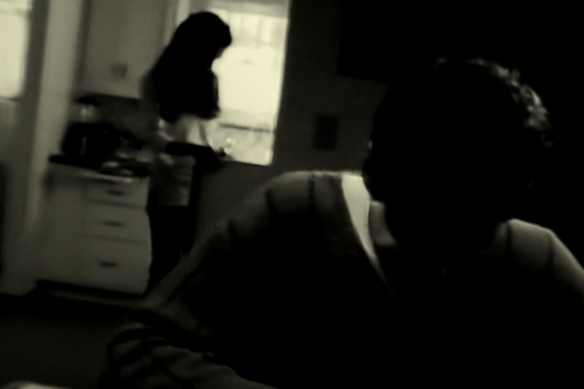
We cannot help ourselves. We live at home, quiet, confined, and our feelings prey upon us.

We cannot help ourselves. We live at home, quiet, confined, and our feelings prey upon us.

So there it was. I would steal an out-of-context moment from Buffy (or the spin-off series of Angel), then I would steal an  out-of-context line from a Jane Austen novel, after which I’d combine them with the intent of creating something altogether new. I hoped to give a new meaning to both the image and the text.

It was a lot harder than I thought it would be. I wanted to catch moments of visual drama. I wanted there to be some compositional tension within the frame. But I also wanted to be sure the faces of the characters were obscured. If the viewer sees Buffy, I reasoned, then the photograph becomes all about Buffy. There was, as you can imagine, a great deal of Photoshop work involved.

Once I had the photograph, I needed to search the novels of Jane Austen to find an appropriate line. It had to be a line that, when associated with the photograph, would convey a completely different meaning than it did in the story. And yet the line still had to be congruous with the image.

It took a lot of searching. Jane Austen did not write short novels.
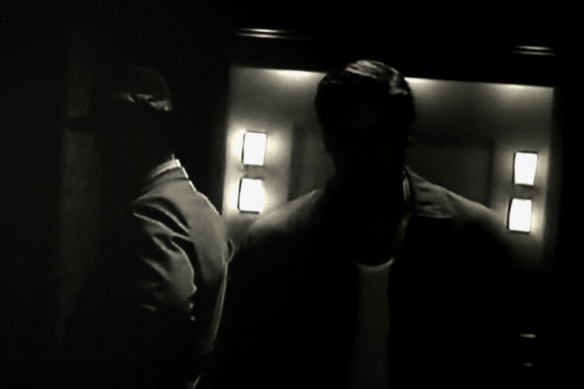
The invitation was refused.

The invitation was refused.

There are now just over thirty photographs in the series. That seems like a nice size for a project. I keep thinking about returning to the series and adding new images, but it would just be for my own amusement. As an experiment in appropriation art, the series is complete. I did what I wanted to do, I’ve learned what I wanted to learn.

The project convinced me that appropriation is a valid art technique. It’s certainly ethically dodgy if the appropriator is making buttloads of coin off another person’s original work. But the technique of appropriation itself has artistic integrity.

Or at least that’s what I tell myself.
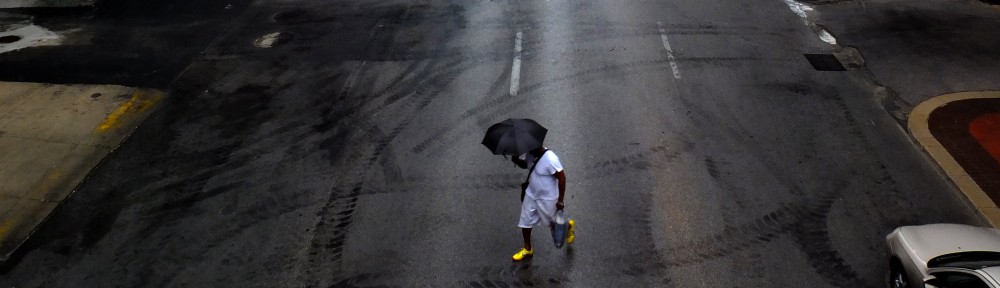
in which i answer a question about photo projects

Because I’m the Managing Editor of Utata.org, I get a hefty chunk of photography-related email. Most of it has to do with photography exhibitions, or photography books, or questions about Utata photo projects. Relatively little of my email deals with my own views on photography. But a few days ago I got an email that included the following questions:

I guess what I’m asking is how do you develop a personal photography project? Do you just pick a thing and start taking picture of it? Do you make up rules or guidelines before you start? How do you start a photography project?

I started to write back and basically say ‘Dude, I don’t have a clue how to start a project.’ But that sounded pretty stupid. The more I thought about it, the more I realized I must have some vague notion of how to go about it. I mean, I’ve done a number of photo projects. They couldn’t have all happened by accident. Could they?

So over the last few days I’ve found myself sporadically thinking about projects. This is what I discovered: each of the three projects I’ve included on this site (I have other photo projects; I just haven’t published them here) began in a different way. And since I do not want to write another post about guns, I’ve decided to write something about each of those three projects.

later i saw a red-haired woman in a blue sundress

later i saw a red-haired woman in a blue sundress

I’m going to begin with the Traffic Signals series, because it’s the simplest. Well, that’s not true — the Larking About in Alleys series is actually the simplest. But Traffic Signals is the oldest of the three projects. And, of course, I just checked and found that Faux Life is older by a year. But fuck it, I’m going to talk about Traffic Signals anyway.

The project as it exists now actually began with a different project. The Utata Storytellers Project of 2009 required us to make up to six photographs in which we would relate a story. We were only allowed a maximum of 35 words per photo. I kicked around a number of ideas for the gig, but came across my final project idea rather by accident.

the unquiet sky, shy as an alligator

the unquiet sky, shy as an alligator

I was standing at a crosswalk with some other pedestrians. There was a buzzing sound coming from the traffic signal. That buzzing ceased (or at least reduced in volume) when the light changed and we were allowed to cross the street. It struck me as odd and more than a little funny. It was as if the traffic signal was also sending out audible cues.

So I concocted a little talein which a person believed he was being given messages through the traffic lights and pedestrian signals. It’s called After the Bombs Dropped. For the photographs, I used an app called Poladroid, which mimics Polaroid photography. I thought it added a more authentic feel to the story.

angry birdsWhen the project was finished, I found I was still intrigued by traffic signals. I was fascinated by the fact that so many people — both drivers and pedestrians — obeyed them, even when there wasn’t any traffic on the streets. And yet even though they obeyed the signals, people never really looked at them. And they were everywhere. Everywhere.

So I kept photographing them. On the set in my flickr photostream, I continue to use the Poladroid app for the images. That aesthetic still appeals to me. But for my personal files (and here on this site) I use the app but dispense with the faux Polaroid border — primarily because the border looks goofy here. (It may look goofy on flickr as well, but hey — that’s flickr.)

restless

restless

I like to think the series is deceptively simple. As I said, traffic signals are everywhere. But while they’re ubiquitous, they’re not necessarily visually interesting. Most aren’t.

I’ve come to appreciate how difficult it is to photograph traffic signals in a way that creates a sense of drama. It’s not about documenting traffic signals; it’s about imparting a sense of tension within the frame.

it was a mistake to call her

it was a mistake to call her

I’m not always successful. But the challenge keeps me interested in the project. It also, I have to confess, annoys anybody I’m in a car with when I insist they either stop the vehicle or let me out and drive around the block until I get the photo.

It’s not quite an obsession, but it has an obsessive component to it. And happily the world is full of traffic signals, so it’s unlikely I’ll run out of material.

a trick of fog and mist

Fog. The weather forecast said — promised — there would be fog in the morning. So I arranged my schedule (okay, I don’t actually have anything even remotely resembling a schedule — but if I did, I’d have arranged it) so I could be downtown early in the morning. Because fog, right?

Here’s a meteorologically true thing: the only difference between fog and mist is their density as measured by the degree of visibility. They’re both just localized collections of water droplets suspended in the air. They’re essentially stratus clouds — flat, lazy, featureless clouds — hanging on at or just above ground level. Here’s the difference between fog and mist: if you can see for more than a kilometer, you’re in mist; if you can see less than a kilometer, you’re in fog.

waiting for the bus

waiting for the bus

I had both. Fog and mist. Most of the time there was a layer of fog about 10 to 20 meters above the ground, beneath which was mist. Sometimes the cloud would dip down and I was in fog; sometimes it lifted a wee bit and I was in mist.

It was very odd and strange, and even if it made photography confusing as hell, it made for an interesting walk. One moment visibility would be only a few hundred feet, the next you could see for a couple of block; one moment it was chilly and damp, and the next moment if was…well, it stayed chilly and damp, but the degree of chilliness and dampness shifted radically.

chill breeze by the river

chill breeze by the river

I was on the street by around 6:30 in the morning. At that hour, there weren’t a lot of people about. It’s been a long, long time since I’ve held a straight job, and I’d forgotten the simple fact that most folks go to work by themselves. Aside from car-poolers and folks who take public transportation, people don’t generally go to work in groups. Almost everybody I saw that morning was alone. One solitary person, moving purposefully through the fog/mist. It made them all seem isolated.

heading for the diner

heading for the diner

Isolated, but not unfriendly. I photographed several people as they walked toward me, and as they reached me I usually smiled and showed them their photo. Most of them paused long enough to admire themselves, make a joke, ask a question. The guy in the photograph below looked at his picture and said “That’s pretty good. But why did you take my picture?” I guess it was a good question because a very attractive young woman had been walking in front of him, and I didn’t shoot her photo. I said “Because you’re so purty.” He laughed, punched me gently in the arm, said “Fuck you,” and wandered off still laughing.

because you're so purty

because you’re so purty

I know that right now you’re almost certainly wondering about the etymology of fog and mist, because that’s just the sort of person you are. And aren’t you in luck, because I can tell you there’s some uncertainty about the etymology of ‘fog’ but not about ‘mist.’ Most linguists suggest fog is related to the Dutch vocht and German feucht (which, if there is any justice in the world, has to be pronounced fucked). The origins of ‘mist,’ on the other hand, are pretty clear. It comes from the Old English term mist (what a shock), which apparently referred to a ‘dimness of eyesight.’ That Old English term is believed to derive from the Proto-Indo-European meigh which meant ‘to urinate’ (and no, I’m not making this up).

In photographic terms, this means if you’re shooting in fog or mist your autofocus is fucked, which could leave you pissed.

on court street

on court street

Here’s a photographically true thing: as atmospheric conditions, both fog and mist can be dense enough to bitch-slap most autofocus systems. One of the things I’ve come to rely on with my little Fujifilm X10 is its quick and accurate autofocus, and even though it tried valiantly, the X10 wasn’t always successful.

At first it was a tad frustrating when I chimped a photo and saw it wasn’t in focus. Then I reminded myself that sharpness is a bourgeois concept. It’s also a relative notion. If the photo shows what you want it to show, that’s all that counts. Besides, black-and-white photography is more about form and line and shape and geometry than about clarity. Fog and mist are made for b&w work.

old woman

old woman

At one point I saw this stooped figure approach, moving in a slow rolling sort of gait that was oddly gorilla-like. I shot the photo above and another, and waited for the person to walk into the patch of light at the corner. It turned out to be an old Slavic-looking woman, which left me in sort of a moral quandary. Not in regard to shooting her photo; that seemed immediately inappropriate. The quandary was whether or not I should offer to carry her bag. It didn’t look particularly heavy, but that wasn’t the issue. However, it seemed a rather impertinent offer; I know how my own mother would have reacted to that offer. “What…do I look too old to carry my own bags?”

So I lowered my camera and stood there, waiting and trying to decide what to do. She shuffled on by without even looking up. And I continued on my way.

outside the bail bond office

outside the bail bond office

The fog started to lift pretty quickly after that. The X10’s autofocus breathed a sigh of relief and went back to work. There were more people on the street — some still making their way to work, some already working, some making deliveries, some just hanging out, some taking their dogs for their morning ‘walkies.’

The people with dogs were always willing to stop a moment and allow their dogs to be praised and admired. Here’s an odd thing: all of the dog-walkers I met that morning were happy to have their dogs photographed, but every single one of the people were reluctant to be photographed themselves.

in a hurry

in a hurry

Near the end of my walk I saw this woman in the photograph below standing along the promenade overlooking the riverwalk. I shot a couple frames of her standing there. She looked so sad and forlorn I felt I should speak to her. So I said “Excuse me?” and when she turned I told her I’d just taken her photograph and asked if she’d like to see it.

She smiled and said yes. When she saw it she laughed and said, “Oh good, you got the old lights on the bridge. I was just standing here admiring them.”

on the promenade

on the promenade

We chatted for maybe five minutes. She was just out taking a walk in the fog, and was as happy and cheerful as anybody I saw all morning. There was nothing the least bit sad or forlorn about her.

It was just another trick of the fog and mist.

in which i take another pointless walk

So I took a walk last Friday evening. Like most of my walks, there wasn’t any real plan or itinerary. I just start in a direction and wander. Sometimes I see interesting things; sometimes I don’t. I try not to expect too much, but I generally assume I’ll notice something intriguing along the way. And if I don’t, pffft. I had a nice walk anyway.

giant spider2This walk led me first to the Pappajohn sculpture garden. This used to be a scruffy neighborhood filled with tire warehouses and muffler dealers and small sewing machine repair shops. Now it’s a four and a half acre park — not quite in the heart of downtown Des Moines, but close. Call it the left subclavian artery of downtown Des Moines.

At the bottom of the frame in the photograph above you can see Spider by Louise Bourgeois, which I’m told is a portrait of her mother. Go figure sculptors.

Butterfield bronze horses

Butterfield bronze horses

I like modern art. Usually when you hear somebody say ‘I like modern art’ you can count on those four words being followed with a fifth: but. And that’s true this time. I like modern art, but I’m not always impressed by collections of modern art unless there’s some coherence to the collection. And that’s my problem with the Pappajohn sculpture park.

There’s a lot of wonderful work here. There’s an interesting De Kooning, a wonderfully weird pair of malformed heads by Ugo Rondinone, a couple of elegant and graceful bronze horses by Deborah Butterfield, and a cheerfully goofy latticework humanoind form by Jaume Plensa. A lot of good work. But there doesn’t seem to be anything to connect the sculptures thematically except that they’re modern.

It feels random, tossed together, aimless. Don’t get me wrong; I like the sculpture park. It just feels like a tax dodge.

Auto body service

Auto body service

A block or so away from the Pappajohn sculpture garden you can find the sort of businesses that used to inhabit that area. Small businesses surrounded by chain link fences topped with barbed wire, maybe patrolled by a beefy dog. Places like this auto-body shop. It’s not as pretty as the sculpture park, to be sure, but it’s a lot more consistent and internally coherent. Everything here feels like it belongs; the sculpture garden feels like it was placed there.

Give it another thirty or forty years and the Pappajohn garden will probably feel more organic. Probably. Maybe.

The walk ended near St. Ambrose Cathedral, where they were holding evening services. The only thing the cathedral has in common with the body shop is that they both feel natural and authentic where they are. St. Ambrose has been around for more than a century and a half. It began as a log hut, dedicated to St. Ambrose because of his tireless work against the Arian heresy (and our boy Ambrose must have been pretty effective because I doubt if many people have ever heard of the Arian heresy these days).

St. Ambrose cathedral

St. Ambrose cathedral

It was a pleasant way to spend a couple of hours. I was determined to learn what I could about the Arian heresy when I got home. But after about fifteen minutes of reading about the internecine squabbles of 4th century Christians over whether or not Jesus had an existence before he was born, I decided to have a beer and watch television.

good to have a plan

You’ve had those days. You wake up, you stumble out of bed, you manage to formulate a simple plan: empty your bladder, start the coffee, crawl back into a warm bed and read until the coffee’s ready. Then you look out the window.

And there’s fog.

Immediate change of plans. You ignore the warm bed and you forget the coffee (though you surrender to the tyranny of the bladder), you dress hurriedly, grab your camera, and bang out the door. Because, you know…fog. And you start to walk.

That’s exactly what I did recently. I headed for the oldest part of a once-small town that over the last couple of decades has evolved into a suburb. It’s just a few square blocks where the railroad used to run, but there are the small town equivalent of alleys. I’m usually drawn to alleyways, and in the fog even the unpaved alleys of this small town seemed attractive and mysterious.

foggy alleyI followed one alley to some old sheds near the railroad tracks on the outskirts of the town. Some of the sheds were clearly meant to house large equipment; others looked like they might have been used to store the freight that used to be shipped in and out of the town. Some were brick, some were corrugated siding, none were well-tended. My first thought was that the sheds would make great studio space. Or, with the field out back, maybe a manufacturing space for making artisanal kites (Is anybody doing that? Have I found myself a new career niche?).

shedsThe alleyway soon morphed into a dirt lane that ran parallel to the railroad tracks. It would be more accurate to say the lane ran parallel to where the tracks used to be. I don’t know when the rails were torn up, but they were long gone. Even the railroad ties had been pulled out and placed in piles.

Every twenty yards or so there was another disorderly heap of old, decaying railroad ties. There was something oddly attractive about the continuity of the evenly-spaced piles, coupled with the casual jumble of the piles themselves. Order and disorder, all part of the same process. That pleases me.

railroad tiesI followed the dirt lane until it turned out toward the countryside, then walked along the path where the tracks used to be. The fog was slowly beginning to dissipate, but the world remained remarkably quiet and still. There was nothing to hear but some surly crows, a flock of Canada Geese flying somewhere in the mist, and the occasional barking dog.

Part of the beauty of fog is that it’s so wonderfully disorienting. As it fades and you get a better sense of where you are, so much of the mystery evaporates. You’re just chilly and wet and walking along railroad tracks that aren’t even there.

absent the pretty paint of leavesEventually the bygone railroad tracks led to another suburban bike path, and I saw my first people of the day. A lone jogger running south, a bicyclist riding north. I said “g’morning” to both and got semi-social grunts in return. My guess is they were out there running and cycling despite the fog, not because of it.

Not that there’s anything wrong with that. It’s just a waste of good fog.

jogger & cyclistBefore long, the fog was just about burned off and I was left with nothing but a long chilly walk back to the house. When I got there, I renewed my earlier plan: start the coffee, back to bed, read until the coffee was ready or I fell back asleep — whichever came first.

It’s good to have a plan, if only because it’s so much fun to ignore it.

another thursday walk

I’ve mentioned this before, but I’ll say it again. I belong to a community of photographers and other deviants called Utata (well, I’m the managing editor). I’ve also said this before: we walk on Thursdays. We’ve been doing this as a group for 346 consecutive weeks. That’s more than six and a half years.

For the most part, our people take their Thursday Walks independently. We walk in Scandinavia and England, We walk in Austria and Canada and Switzerland. We walk in the American Midwest and in New England. We do it quietly, without a lot of fuss, and every week we post a few of the photographs we shoot during out walks.

working in the library on a cloudy dayYesterday was Thursday, and I began my walk at the public library. I love a library. All libraries. I love the very fact that they exist. A public library is such a radical concept. Information freely available to anybody who wants it — a whole world of literature and science and philosophy and knowledge, and all you have to do is go there and open a book and be willing to learn something.

After I left the library, I began to wander. I rarely have a plan for Thursday walks. I see something that might be interesting and I head in that direction. If it turns out not to be interesting, I keep going. Yesterday I heard two office workers saying that next week the roof of a nearby parking garage would close for the winter. So I went to the roof of the parking garage.

ventriloquismIt was a chilly, mildly windy day — cloudy in a way that was occasionally dramatic and occasionally oppressive. The wind seemed to channel itself down the widest streets, leaving the alleys and service roads more calm and almost warm. A good thing for me, since I seem to be drawn to alleys.

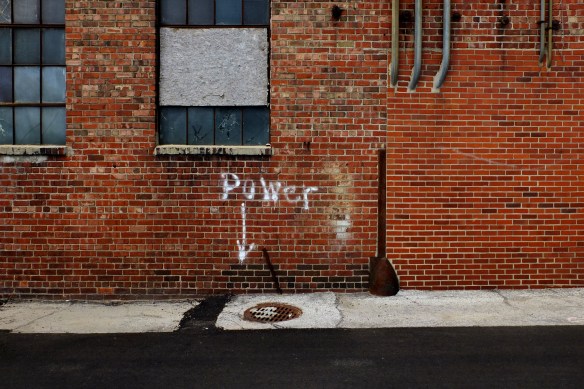
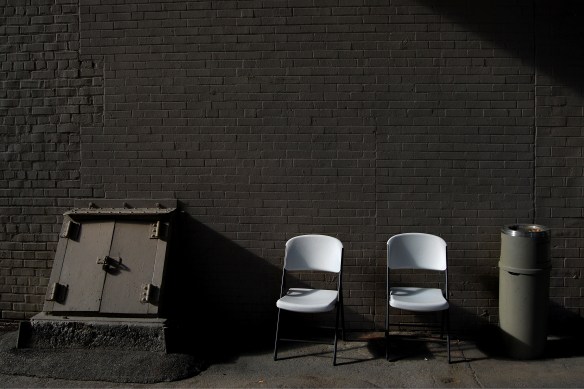
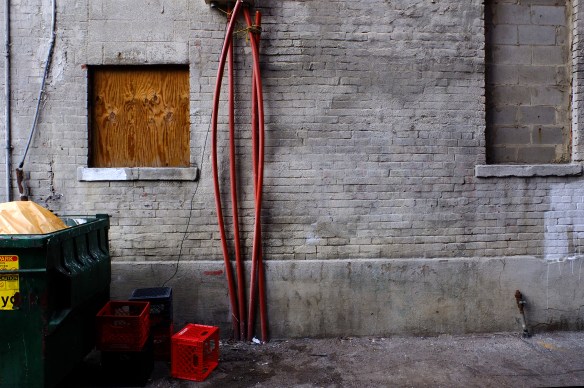
I don’t know why that is. Maybe it’s because nobody tries to make alleys pretty. Anything attractive in an alley is accidentally attractive — organically attractive. Alleys are messy and disorganized; alleys are where the people who work in the city’s shops and restaurants and offices go to have a smoke and relax. It’s where stuff gets delivered and hauled away. There’s just something honest about an alley.

in an alley nothing is ever quite straightAs I was shooting the photograph above, I heard footsteps coming down the alley. I turned to look and there was this guy, head down, smoking a cigarette, walking my way. He was wearing a bright red hoodie and his skin was so black it was almost purple. And I wanted his photograph. I wanted him to stand in his bright red hoodie against the wall, and I wanted it desperately bad because it would have made the most amazing photograph.

So I said “Hey. Do you mind if I take your photo. Up against the…” and he said “Fuck no” and kept walking. And he could not have said it any more perfectly. It wasn’t angry, it wasn’t dismissive or insulting, it was more of a practical I-don’t-have-time-for-this-bullshit reply. It was almost musical.

darling keep lid closedI kept walking. Down more alleys, along sidewalks, through the skywalk. No real plan or destination, just walking. I followed a florist’s Transit van down another alley. The van was a deep twilight blue and on its side was an image of yellow tulips, and I thought it might make an interesting photo if it parked in good spot in the alley. But it was just using the alley as a shortcut.

I did, though, find these dumpsters behind a restaurant. They’re not particularly interesting dumpsters, and I probably wouldn’t have stopped to photograph them. What stopped me wasn’t the visual, it was the olfactory. I stopped walking because there was an absolutely astonishing odor of grease. It was a staggering smell, overpowering and a tad nauseating, an odor unlike anything I’d encountered before. I noticed one of the dumpsters had a label that said “Grease Only – No Trash or Water.”

There’s a company called Darling that describes itself as “a provider of animal rendering, cooking oil and bakery waste recycling and recovery services.” This was one of their recovery bins. The bin has a warning label that says Darling and Keep Lid Closed. I mention this only because I saw the warning and couldn’t help thinking ‘Darlin’, I never dreamed of opening it.’

all them crowsAnd then there were crows.

It was dusk, going on twilight. By this point I’d been walking for about two and a half hours. My knees ached, I was cold, it was beginning to rain, and there were crows. Hundreds of crows, circling and roosting nineteen stories up on the Equitable Building. So I stood there on the sidewalk, obstructing foot traffic, looking up, ignoring the sprinkling rain, sore and tired, taking photographs of barely visible corvids.

It was perfect.