no defense

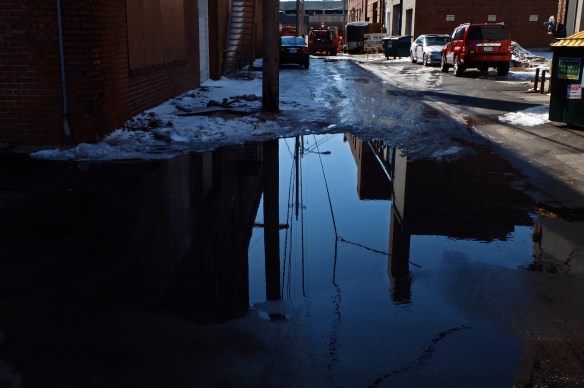
Freeze and melt — that’s been the pattern for the last week or so. Snow, melt, freeze, melt. It’s not so bad on the main streets and sidewalks, which are cleared and have enough car and foot traffic to keep things tidy. But it plays merry hell in the alleys.

A couple days ago I decided to wander back to Save the Date Alley to see if I’d gotten a response to my question. It was pretty treacherous footing. In the sunnier parts of the alleyway the ice and snow had partially melted, leaving a layer of water over the ice. There were occasional patches of snow, which gave a bit of traction, and even a few places with clear concrete — but for the most part, walking in the alley took a lot of care.

treacherous footingIt was slick enough that I considered giving up the idea and returning another day. Why risk breaking a bone just to satisfy my idle curiosity? But I could see some sort of construction was taking place down the alley — and it looked suspiciously near the spot where the Save the Date invitation (if it was an invitation) had been left.

I apparently have absolutely no defenses against curiosity, even idle curiosity. I wanted to know what was going on. So I slowly soldiered on.

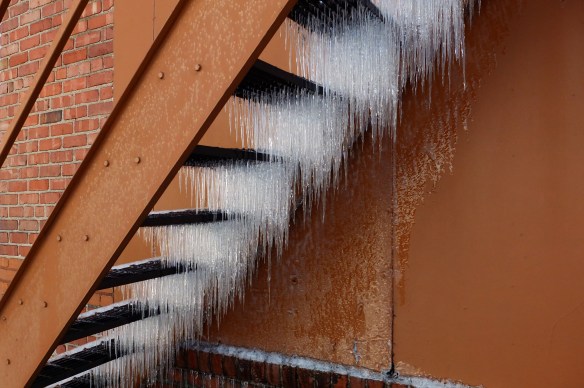
Until I got distracted by a fire escape.

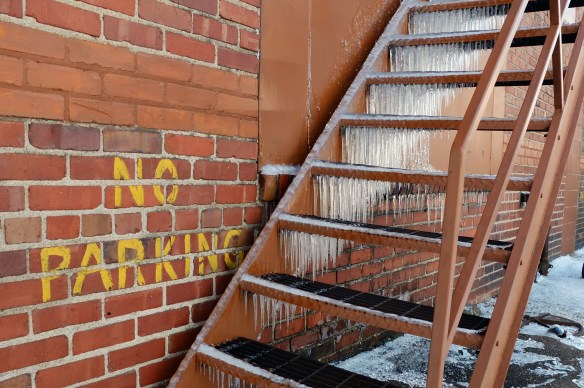
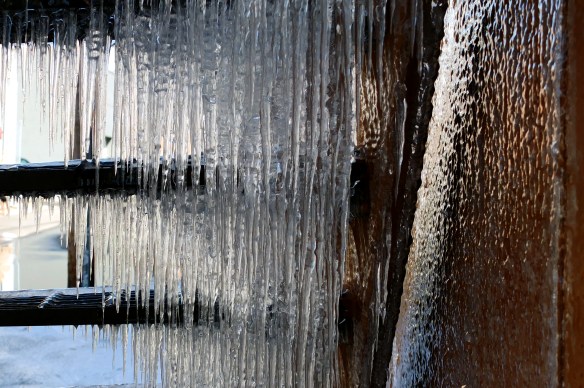
no parkingWell, not so much the fire escape itself, which isn’t all that interesting, but by the hundreds of icicles that formed beneath it. I think most folks are fascinated by icicles and how they form. And I suspect most folks feel a powerful impulse to touch them. Or knock them down. Or, of course, photograph them.

ice

The fire escape was in a shaded part of the alley. I’d been walking on the bright, sunny side. So I had to cross the alley, which doesn’t sound like much of a feat, but lawdy I’m telling you it was incredibly fucking difficult. It took me maybe three or four minutes to slowly slide across maybe ten feet of icy alley. And then, of course, the light sucked.

But I shot a few photos anyway, and even though they don’t give any real sense of how magnificent the icicles were, I’ve decided to include them here. I mean, if I can risk my aging bones to satisfy my curiosity, you can damned well spare a moment to glance at a couple of uninteresting photographs.

The child in me (and yeah, that’s an awfully big part of me) wanted to knock the icicles loose, just to hear the sound. Or at least I wanted to take off my gloves and maybe pull one loose. But the adult in me insisted the responsible thing to do was leave them untouched so the next idiot to slip-slide down the alley could enjoy them too.

stairciclesSo that’s what I did. I made the adult decision, then another three minutes sliding back to the less hazardous side of the alley (there is, I suppose, some irony to be found in the fact that I’m proud to have made an adult decision while in the midst of an entirely juvenile enterprise). And I was back on my way.

Here’s a true thing about alleys: they can be sort of generic. The alley entrance to a radiator repair shop isn’t very different from the alley entrance to an electronics store or a pet shop. So from a distance, it’s not always easy to tell one section of alleyway from another. But as I got closer, it became apparent that the construction was taking place very near the location where Save the Date and my question were to be found.

In fact, it was the very building.

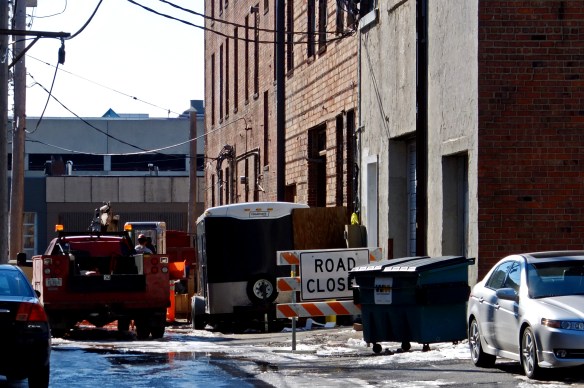
road closedI got as close as I could. I was able see workmen working, but I couldn’t tell what they were working on. I couldn’t see if they were working on the building or on the alley itself or on something altogether different. I tried shouting to get somebody’s attention, but there was a generator banging away loudly and a small diesel-powered Bobcat idling. Nobody heard me. Of else they just ignored me. Either way, I learned nothing.

I made my way back out to the street and approached the construction site from the other end of the alley. No joy there either.

So there we are. Save the Date suspense and drama. I’ll wait another week or so and return to the alley to see if Save the Date and my question are still there. If so, then I’ll keep going back to see if I get an answer. If not…well, I’ll probably keep going back anyway.

Seriously, I have no defenses against curiosity.

please keep out

So I’m getting ready to shoot a photo and this guy comes up to me — he’s maybe in his mid-to-late 20s, wearing skinny-jeans, a zippered hoodie, and one of those floppy-eared Tibetan-looking knit hats — he comes up and he says, “What is that, a little Leica?”

I tell him it’s a Fuji X10.

He says, “Fuji. Is that, like, Japanese?”

I say yes, it’s a Japanese company.

He says, “The Germans, they make great cameras.”

I take the shot, then agree with him.

He says, “You shouldn’t be shooting into the sun like that.”

I tell him I think it’ll be okay.

He says, “It’ll be over-exposed. Or under-exposed. I forget which. Over-exposed.”

I tell him I’m using spot metering, and take another shot.

He says, “Oh” then tells me he’s been thinking seriously about buying a Leica. “But they cost so much.”

I agree that they’re expensive cameras.

He says, “Spot metering,” then asks if he can see the photo.

please keep out

It’s not a great photo, but I knew that when I was shooting it. I just liked the shadows. And sometimes you just want to see what a camera can do. Anyway, I show him the preview on the LCD.

He nods and repeats himself. “Well. Spot metering. And you shot that right into the glare of the…uh…thing there. And that’s a Fuji?”

I tell him I think they have spot metering on Leicas too.

He nods happily and says, “Cool.”

NOTE: Here’s a thing I’ve observed since I started using the little X10: most often people don’t even notice the camera. But when they DO notice it, they sometimes ask me about it. Nobody ever asked about the Nikon DSLR, which is also a very fine camera. I think that ‘retro’ look confuses and interests people.

brutal bastard

You get that one moment. That’s it. You either get the shot or you don’t. And let’s face it, most often, you don’t. And in some types of photography, there’s no second chance. I love that. I hate that.

Yesterday was a cold, bright, sunny day. A good day for a guy with a fine little street camera to take a walk through the city. As I was walking along I saw this dark gash of an alleyway running between a building and a parking garage. I have a thing for alleys, so I decided to wander down it. But it was on the other side of the street; I had to wait for traffic to clear before I could jaywalk to the alley.

As I stood there I saw an obscure shape moving in the alley. A guy. A guy with a red hat. And I knew there might be a photograph to be made.

This is what I love: sometimes you can anticipate that moment. You can see the shot developing. You can visualize all the elements potentially moving into place. Potentially, that’s the key. It’s all about the potential, because any number of things can happen to totally fuck up the situation. A cloud might obscure the light. A car might pass in front of you at the critical moment. A passerby could throw off the balance of the composition.

I saw the guy with the red hat. A moment earlier I’d noticed a doorway with a red logo at about head level. I figured there was a good chance the guy was going to walk out of the dark alley and into the light. So I hurried to my right so I could include both the red hat and the red logo — and the moment I began moving I also began to kick myself in the ass. I was thinking “Idiot, you should have closed in on the alley and caught the guy stepping into the sunlight.” But it was too late to change my mind. I’d committed myself to a wide shot.

Sometimes the shot never comes together. You know that going in, of course. Sometimes all those elements you saw moving together simply move away from each other. The guy could turn around and go back down the alley. He could step out of the alley, but remove his red hat. Somebody could could open the door with red logo. So many things could go wrong.

But they didn’t. Things not only didn’t go wrong, they actually got better The guy stepped out of the alley and into the sunlight, just like I’d hoped he would. His red hat was almost perfectly in line with the red logo on the door, just as I’d hope it would. And then a little black and white dog followed him out.

So I took the shot.

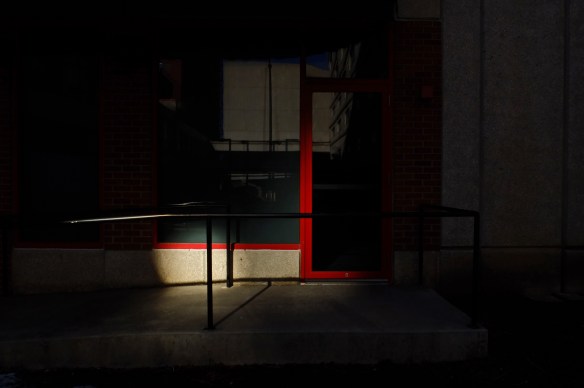
a guy and his dogIt was the shot I wanted. It was almost exactly as I’d envisioned it. But it doesn’t really work. Not at this scale.

The guy gets lost, the red hat gets lost, the red logo gets lost, even the little dog gets lost. I think the photo might work if it was printed very, very large — but dammit, it doesn’t work at this scale. It just doesn’t.

Even when all the elements do come together — even when it all coheres perfectly and organically, as if it was predestined — even when you get the shot you want, it might not actually be the shot you want.

It gets worse. I got the shot I wanted. I knew it as soon as I released the shutter. I’d no idea it wouldn’t turn out, of course, but at that moment I knew I’d got the shot. I felt satisfied and full of myself. For maybe half a second. Even as I was lowering the camera, I saw the guy hold something out in his hand. The little dog leaped up to get it. And I missed it.

Photography is a brutal bastard. And I must be masochistic, because I’m okay with that.


the questions we ask

Last week, while strolling down a relatively nice alley, I came across something peculiar written on a board covering a broken window. It said

Save the date
7•19•13

If you’re anything like me (and really, what are the odds of that?) you see something like that and you immediately start asking a whole series of completely unanswerable questions. What’s happening on that date? Why should I save it? Why would anybody put that request (if it is a request) on a board covering a broken window in an alley? Sure, it’s a relatively nice alley, but c’mon. For whom is this invitation (if it is an invitation) intended? Am I supposed to save the entire day? Just the evening? Is the event (assuming there is an event associated with that date) taking place in the alley? And finally, what the fuck, really?

There’s not much point in having questions if you don’t actually ask them, right? So I decided to ask them.

okay but whyI packed some chalk in a pocket of my jacket, stuck my little Fujifilm X10 in the other pocket, took myself right back to the alleyway, and…and I stood there, realizing I couldn’t ask all those questions. For one thing, I didn’t have enough chalk. Nor enough space. So I had to satisfy myself with asking just one question. It’s a wee bit hard to see in the small version, but I left a little note asking:

WHAT AM I SAVING THE DATE FOR?

Leo Babauta says the questions we ask determines the type of people we become. If so, it seems I’ve become the type of person who stands in alleys and asks ‘What the fuck?’

I’ll check back periodically (it’s a relatively nice alley, after all) to see if I get an answer. If an answer arrives, I’ll be sure to let y’all know.

save the date

So I’m walking down this alley, right? Walking down the alley, minding my own business mostly, and in the back of this building–it looks like it might have been a garage space at one time, or maybe some sort of small manufacturing enterprise that went toes up–on one of the boarded-over broken windows, I see this:

Save the date
7•19•13

Sometimes I see things and they don’t quite register in my brain until a few seconds later. I took maybe five or six steps and then my brain belatedly kicks in. Dude, my brain says, did you see that? And I’m all ‘Yeah, I saw it.” And my brain says Well? And I say ‘Okay’ and me and my brain turn around and retrace those five or six steps.

save the date2

And sure enough, my brain was right to insist we turn around. There it is. Save the date. (Okay, there’s also a cast-off blouse or jacket, stained with what appears to be blood; I didn’t examine it too closely because 1) I wasn’t about to pick it up without a pair of latex gloves and 2) I really do not want to be seen standing in an alley holding a bloody jacket in my hands.)

Save the date. I’m just taking it for granted that this isn’t like ‘Save the Whales.’ I don’t think the date is in any danger or is in any way threatened. I’m assuming whoever wrote that is suggesting I don’t make any plans for the 19th day of July because…because why?

Let’s just assume this (this what? Is it an invitation? an announcement? a command?) is a savvy niche marketing strategy, that it’s a direct approach targeting the ‘folks who wander down alleys’ demographic. And while we’re assuming, let’s also assume it’s not targeting a ‘folks who don’t mind standing in alleys holding bloody jackets’ demographic. That leads us inevitably to this question: Uhhh…what the fuck?

I realize this is a small broken window; there isn’t room to include a detailed account of what’s going to take place on that date. But a hint would have been nice.

So I go online to see if I can determine what’s happening on the 19th of July. There’s a Taylor Swift concert in Philadelphia. Wrong city, wrong demographic. Somebody named Tracy is getting married. But probably not in that alley (although that would be a wedding I’d definitely attend). There’s a synchronized swimming competition. Doesn’t sound like a likely candidate. There’s a bull riding event in Florida and a group called Train is appearing in Indianapolis on their Mermaids of Alcatraz tour. Nope, that’s not it. The Red Sox are playing the Dog-Ass Yankees at Fenway. That’s always a good time. And in Des Moines there’s a muscle car auction at the State Fairgrounds and the Civic Center is hosting a student performance of The Princess and the Pea. Probably not events you’d advertise in an alley.

I’m willing to save the date on my calendar (if I owned a calendar, which I don’t, but that’s not the point, is it–the point is this: ‘Why am I saving the date?’ A related point may be ‘Do you really think folks who wander down alleys are also folks who keep engagement calendars?’). I may have to return to the alley with a bit of paint and a brush and use one of the remaining boarded-over broken windows to request more information.

Okay but why am I
saving the date?

It wouldn’t be vandalism. It would just be an appeal for clarification. Right?

we’re still at war

It’s common knowledge that liberals hate America, right? We don’t support the troops, and the only reason we’re not burning the flag right this very minute is because we’re too busy queuing up in disorderly socialist lines for the privilege of spitting on wounded veterans.

At least that’s the litany we hear every fifteen minutes from conservative Republican outlets like FOX News. But thankfully, there exists a courageous news venue that unflaggingly keeps the troops in mind, that regularly reminds us that there are still men and women in uniform serving in a combat zone.

Spc. Andrew Harvey, a 1st Infantry Soldier, patrols along steep cliffs of the Korengal Valley's surrounding mountains during Operation Viper Shake, Afghanistan, April 21, 2009. Photo courtesy army.mil.

Spc. Andrew Harvey, a 1st Infantry Soldier, patrols along steep cliffs of the Korengal Valley’s surrounding mountains during Operation Viper Shake, Afghanistan, April 21, 2009. Photo courtesy army.mil.

Is it FOX News? No, it’s not. Is it the New York Times? Sadly, no. Maybe it’s TIME magazine? Nope.

It’s Mother Jones. That’s right, Mother Jones — the notoriously left-wing muckraking magazine. Since June of 2009, MoJo has been publishing We’re Still at War: Photo of the Day. It’s not published every single day, but several times a week they print a photograph of U.S. military forces either in a combat zone or training for deployment to a combat zone. It’s a small thing, but it serves as a constant reminder.

The sad thing is that the American public actually needs reminding.

COMBAT OUTPOST MIZAN, Afghanistan—US Army 1st Lt. Troy Peterson, right, platoon commander for 3rd Platoon, Fox Company, 2nd Squadron, 2nd Stryker Cavalry Regiment, assists his radio operator, US Army Pfc. Justin Cobbs, across a ravine during a dismounted patrol near Combat Outpost Mizan, Mizan District, Zabul Province, on Aug. 16, 2010. Photo via the US Army by Senior Airman Nathanael Callon.

COMBAT OUTPOST MIZAN, Afghanistan—US Army 1st Lt. Troy Peterson, right, platoon commander for 3rd Platoon, Fox Company, 2nd Squadron, 2nd Stryker Cavalry Regiment, assists his radio operator, US Army Pfc. Justin Cobbs, across a ravine during a dismounted patrol near Combat Outpost Mizan, Mizan District, Zabul Province, on Aug. 16, 2010. Photo via the US Army by Senior Airman Nathanael Callon.

It’s become shockingly easy to forget that we’re still at war. While we’re immersed in our daily lives–buying groceries, watching Downton Abbey, making fun of Justin Bieber–men and women are still fighting and killing and dying in Afghanistan. It’s easy to forget because most folks don’t have any meaningful connection to the war or the people fighting it.

There are about a million and a half active duty personnel serving in the U.S. military–the Army, Marines, Air Force, Navy, and Coast Guard. That sounds like a lot of people to have in military harness, but it’s less than half of one percent of our population. Of that million and a half troops, around 70,000 are currently serving in Afghanistan. That’s still a lot of people, but the odds are you don’t know any of them.

There’s never been a point in U.S. history in which the American public has been so separate from its military. There’s a fairly good chance you (whoever you are) have a family member who served in the military at some point in the past–probably World War II, maybe Korea, maybe Vietnam. But the odds of you knowing somebody currently on active duty are pretty slim. The odds of you knowing somebody who has served in Afghanistan or Iraq are even more slim. The odds of you knowing somebody who is currently stationed in Afghanistan are remote.

The sun sets behind U.S. Army Sgt. 1st Class Jamie R. Johnson, a platoon sergeant from Bayonet Company, 2nd Battalion, 327th Infantry Regiment, Task Force No Slack, in Afghanistan's Kunar Province March 17. Photo by U.S. Army Sgt. 1st Class Mark Burrell, 210th MPAD

The sun sets behind U.S. Army Sgt. 1st Class Jamie R. Johnson, a platoon sergeant from Bayonet Company, 2nd Battalion, 327th Infantry Regiment, Task Force No Slack, in Afghanistan’s Kunar Province March 17. Photo by U.S. Army Sgt. 1st Class Mark Burrell, 210th MPAD

Last year 301 U.S. troops were killed in Afghanistan. In 2011, 412 troops were killed there, and 496 were killed the year before that. That’s averaging more than one death a day for the last three years.

Unless one of those dead troops was a member of your family, it’s easy to ignore them. Their deaths were almost certainly not reported on the national news. They might have been given a solemn moment in the local news. But let’s face it–they were strangers. They are as distant from us as the murder of a drug dealer in Newark or the accidental shooting of a 13 year old girl in Ovid Township, Michigan. They are, in a very real and very sad way, nobody at all.

Spc. Jon Saladin, a paratrooper with the 82nd Airborne Division's 1st Brigade Combat Team, walks past an Afghan graveyard during a US–Afghan patrol on April 30, 2012, Ghazni province, Afghanistan. Saladin serves with Company A, 2nd Battalion, 504th Parachute Infantry Regiment. US Army photo by Sgt. Michael J. MacLeod.

Spc. Jon Saladin, a paratrooper with the 82nd Airborne Division’s 1st Brigade Combat Team, walks past an Afghan graveyard during a US–Afghan patrol on April 30, 2012, Ghazni province, Afghanistan. Saladin serves with Company A, 2nd Battalion, 504th Parachute Infantry Regiment. US Army photo by Sgt. Michael J. MacLeod.

Except these nobodies volunteered to put on a uniform and take risks in the service of their country. Well, our country. It’s our country too, right? We pay taxes after all (though let’s be honest, we try to pay as little as we can). But the troops sometimes have to pay in a more fundamental way.

So they deserve our support and our attention. They deserve more than we give them. Much more. Mother Jones publishes a photo of the troops a few times a week–it’s not much. It’s not much at all. But MoJo’s We’re Still at War: Photo of the Day is more attention than most news organizations give to the troops. And Mother Jones gives them a name.

Lance Cpl. Cassidy Zacharyasz provides overwatch for International Security Assistance Forces as they conduct a district transition assessment visit with Nawa District officials at the Nawa District Government Headquarters, Helmand province, Afghanistan, Jan. 29, 2013. U.S. Marine Corps photo by Sgt. John R. Rohrer

Lance Cpl. Cassidy Zacharyasz provides overwatch for International Security Assistance Forces as they conduct a district transition assessment visit with Nawa District officials at the Nawa District Government Headquarters, Helmand province, Afghanistan, Jan. 29, 2013. U.S. Marine Corps photo by Sgt. John R. Rohrer

Thanks to Mother Jones we know this:

In April of 2009, Spc. Andrew Harvey served in the Korengal Valley.
In August of 2010, 1st Lt. Troy Peterson and Pfc. Justin Cobbs served in Zabul Province.
In March of 2011, Sgt. 1st Class Jamie R. Johnson served in Kunar Province.
In April of 2012, Spc. Jon Saladin served in Ghazni province.
And just a few weeks ago Lance Cpl. Cassidy Zacharyasz was on duty in Helman Province.

These are real people. They have real families. They’re making real sacrifices. And we need to remember that, like it or not, we’re still at war.

self evident truths

I spent some time looking at the portraits from the Self Evident Truths project before I read the ‘About’ section. I like the photographs. They’re simple, unfussy, comfortable, direct, wonderfully relaxed portraits of ordinary people. I like them a lot.

On the landing page, the portraits scroll by at an unhurried pace — about the pace you’d expect if you were strolling through town and looked casually at the people coming toward you on the sidewalk. It’s pleasant and smile-making to just sit for a while and look at the faces that pass by.

self evident truths 2

Then I read the ‘About’ page. These are the first few lines on that page:

In 2010 iO Tillett Wright began a project called Self Evident Truths, photographing anyone that felt like they qualified to fall on some part of the LGBTQ spectrum, from bisexual, to transgender. Shot in simple black and white, in natural light, with no makeup or styling, the photos were intended to humanize the very varied face of gays in America today.

Intended to humanize. I read that and thought ‘We need to humanize gay folks?’ That notion seems so out of date. It feels like something activists would say in the 1990s.

Don’t get me wrong, I love the portraits. I love the foundational concept — I find something oddly pleasing about portraits of ordinary people categorized in some way. I’d love to see portraits of people who work in grocery stores, or people who are in bowling leagues, or people who frequent swap meets, or people who keep lists of the birds they see. I suspect they’d all look fairly similar to the people we see in the Self Evident Truths project.

But I can’t imagine shooting portraits of birders or bowlers or grocery store employees in order to humanize them. It’s 2013 — do we really need to humanize LGBTQ folks?

self evident truths 1

If the Montana legislature is any indication, then yeah, I guess maybe we do.

Yesterday the Montana legislature voted on a measure to strike an old Montana law that criminalized “sexual contact or sexual intercourse between two persons of the same sex.” The Montana Supreme Court ruled that law was unconstitutional in 1997, but the law remained on the books despite regular attempts to have it removed. Why? Because some Montana Republicans apparently felt that if they voted to remove the law, they’d get some of the gay on them. And you know, that stuff is hard to wash out. Or something like that.

This year was different. This year Montana Democrats garnered enough support to have the unconstitutional law stricken from the criminal code. The vote was 38-10. That’s right, ten Republicans still voted to retain the law even though it’s unconstitutional and even though it can’t be enforced. Lawdy.

Despite the fact that the U.S. Supreme Court has ruled them unconstitutional, there are still at least a dozen other states with anti-sodomy or anti-homosexual laws on the books. There are elected legislators in at least a dozen states who are so afraid of gay folks that they refuse to remove blatantly unconstitutional laws from their criminal codes.

But I still disagree with iO Tillett Wright and the Self Evident Truths project on this issue. I don’t think we need to ‘humanize’ gay folks. I think we need to humanize the people who hate gay folks.

self evident truths 3

Visit the Self Evident Truths site. Visit their shop. Buy prints of the portraits. Buy ‘We Are You’ t-shirts. Donate to the project if you can. But work to humanize bigots and assholes. Gay folks are already okay as they are.

Editorial note: When I say ‘gay folks’ I mean everybody in the LGBTQ mishpocha; I just get weary of the acronym. Also? It’s already totally fucking obvious, but for the record let me just point out that all the photos are from the Self Evident Truth project.

faire l’idiot dans les ruelles

I’m completely comfortable writing about photography in most circumstances. I’m less comfortable when I’m writing about — I started to say my photography, but that sounds so pretentious. I’m less comfortable writing about the photographs I shoot. But about a month ago I received an email asking me the following questions:

I guess what I’m asking is how do you develop a personal photography project? Do you just pick a thing and start taking picture of it? Do you make up rules or guidelines before you start? How do you start a photography project?

I nattered on about my approach to the Faux Life series and the Traffic Signal series. But it occurs to me that I haven’t really addressed the actual questions. Since I promised I’d write about each of the three photo series I’ve included on this site, I thought maybe I could use this third piece to at least attempt some answers.

in case you were wondering where the power was

in case you were wondering where the power was

Do you just pick a thing and start taking picture of it? Yes. Well, no. Sometimes.

With the Faux Life series I knew what I wanted before I shot the first photograph — but that’s a conceptual series. I had to develop the concept before I could shoot the series. So in that case, yes I picked a thing and started taking photos of it. The Traffic Signal series grew out of a different project — one that focused more on writing than on photography. It wasn’t until I’d shot some photos of traffic signals that I actually became interested in them as a distinct theme. So no, I didn’t just pick a thing and start taking photographs of it. I hadn’t even considered it as a thing until after I’d taken several photos in which traffic signals were featured.

With the Larking about in Alleys series I was doing just that. Larking about in alleys and shooting photos of stuff I saw there. I’d no idea of making it into a coherent series until a friend of mine (the delightful Beckett Gladney) suggested it.

tobacco row

tobacco row

Do you make up rules or guidelines before you start? Yes. Well, no. Sometimes.

Since the Faux Life series was conceptual, I obviously had to come up with some basic rules before I began shooting. 1) Rephotograph moments from the Buffy the Vampire Slayer (or Angel) television series, 2) shoot them in black-and-white, 3) post-process the images to shift the focus or make them more dramatic, 4) find an appropriate (or an inappropriate) line from a Jane Austen novel, 5) insure that both the image and the text combine to create something not found in either original.

Those were the ‘rules.’ But I discovered I had to be flexible within the confines of those rules. For example, I’d originally intended to rephotograph action sequences — chase scenes or fights. But they turned out to be surprisingly uninteresting. I learned that the more quiet and nuanced scene carried more emotional impact.

in an alley nothing is ever quite straight

in an alley nothing is ever quite straight

The Traffic Signals series was significantly easier because it had significantly fewer rules. Just the one, really: photograph a traffic signal in such a way that it provides an unexpected perspective of such a commonplace device. Simple.

On the other hand, Larking about in Alleys turned out to be surprisingly more difficult. Initially, I was truly just larking about — wandering idly through alleyways to see what I could see, and doing it for the simple reason that I enjoy seeing stuff not really intended to be seen. But once I began the series, I needed it to be cohesive and coherent. It had to require more than simply being IN an alley and shooting a photograph. The photo had to have (and yes, I realize how loopy this sounds) a certain alley quality. It had to have alleyness.

probably trespassing

probably trespassing

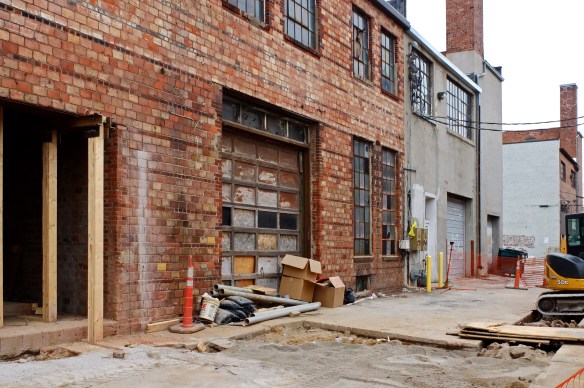
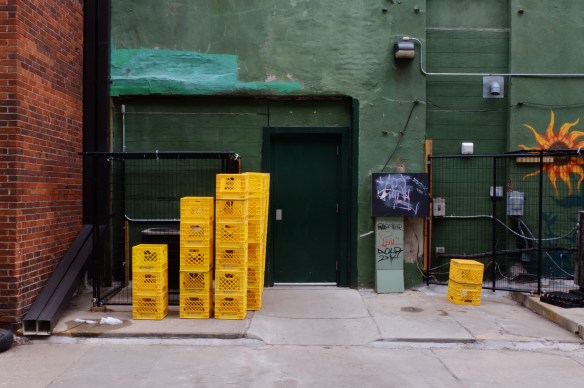
And that meant I had to think about alleys. Alleys in American cities are basically utilitarian. They’re working spaces rather than commercial spaces. They tend to be cosmetically ignored; nobody really cares how an alley looks. They tend to be narrow and confined, though they often open up unexpectedly into a wider space (as seen below). Alleys aren’t usually built for traffic — not in the sense of the efficient transport, by foot or vehicle, of goods or people from one place to another. For the most part, alleys aren’t intended to be thru-ways; they’re a temporary destination — a place to load and unload. Although they’re usually open to the public, the public isn’t expected to use them. The public most certainly isn’t expected to lark about in them.

alley opens into parking lot

alley opens into parking lot

Once I’d developed a sense of alleyness, I began trying to shoot photos that would suggest those alley qualities. It’s not as easy as you’d think.

But that’s it. That’s how I develop a photography project. Which is to say, that none of the three series on this website developed in the same way. I realize that’s not a particularly helpful answer to the questions. But hey, I’m a writer, not a photographer.

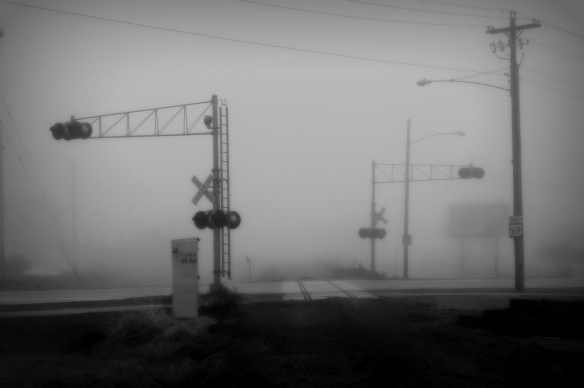
alley in the mist

alley in the mist

I don’t think it’s terribly difficult to start a photography project. I suspect it can be difficult to do something original, or to do it in an original way. And I have absolutely no help to offer about that.

Oh, and about the title of this piece? It’s my understanding (and many thanks to Sonya Butler) that Faire l’idiot dans les Ruelles is French for Larking about in Alleys. It sounds so much more amusing in French.