Unknown's avatar

About greg

Just another bozo on the bus.

come home to roost

It’s derived from the Old English term hrōst, which referred to the wooden framework of a roof. Old English birds would perch and sleep on old English hrōsts, and by the early 16th century that’s essentially what roost came to mean. As a noun, it generally denotes a place where birds sleep for the night; as a verb, it means to settle in for the night.

crows, roosting

crows, roosting

Roost is also the root of rooster, which refers to a male chicken. The term used to be roost cock or just cock, but during the Puritan movement of the 16th and 17th century, some folks became uncomfortable with the association of cock with the male sexual organ. So Puritans began calling male chickens roosters and on those rare occasions when they needed to refer to the male sexual organ they probably called it the ‘male sexual organ’ (which I suspect is one of the reasons the Puritan movement died out).

The term has worked its way into idiomatic expressions. To rule the roost means to be the controlling member of a family or group. There was a time when that was assumed to be somebody with a male sexual organ, though to assert that definition these days would be to risk the rooster becoming a capon (which, by the way, has the same etymological root as hatchet, which is alarmingly appropriate).

When wicked deeds or words cause discomfort to the originator, we say the chickens have come home to roost. That phrase actually comes from an 1810 poem by Robert Southey (who is best known for writing The Story of the Three Bears, which is now known as the story of Goldilocks). In his epic poem The Curse of Kehama, Southey wrote:

“Curses are like young chicken: they always come home to roost.”

Southey, it has to be said, stole the concept from Geoffrey Chaucer, who basically said the same thing (only with a lot more vowels) in The Parson’s Tale:

And ofte tyme swich cursynge wrongfully retorneth agayn to hym that curseth, as a bryd that retorneth agayn to his owene nest.

Modern bryds, of course, no longer need to retorneth agayn to their owene nests. Nor do they need an Old English hrōst. If they want to roost, all they have to do is find a convenient spot to plant their feathered butts and go to sleep.

just not the gays

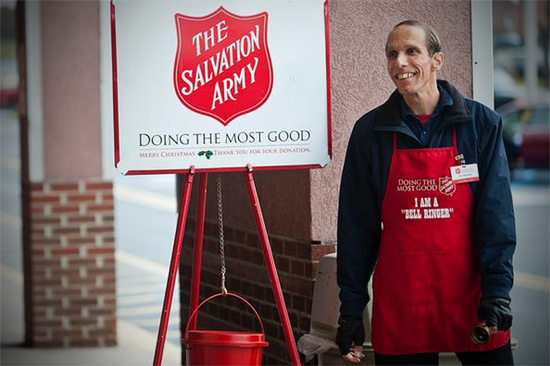
I want to give money to the Salvation Army’s ‘Red Kettle’ bell-ringers. I really want to support them as a group. But I won’t.

Don’t misunderstand me. I like and respect the Salvation Army. They do a lot of good work. They provide disaster relief when communities are ravaged by floods, tornadoes, and hurricanes. Their charity shops and thrift stores help a lot of poor people get decent clothing as well as inexpensive household goods and appliances. They offer a family tracing service that helps families restore contact with loved ones who’ve run away or become homeless for one reason or another. They do a LOT of good work, and they deserve a lot of credit and praise for it.

bell ringerBut this year, like last year and the year before, I’m not dropping so much as a dime in their red kettles. Why?

Because in 2001 the Salvation Army Western Territory made the courageous decision to offer domestic-partnership benefits to gay employees. I admired them for that. It wasn’t an easy thing for a Methodist-based church to do — but it was the right thing to do. And they took a lot of heat for it from other Christian groups. Among other things, the Salvation Army was accused of a “monstrous … appeasement of sin.” For two months the group was soundly chastised, scolded, castigated, and upbraided.

And hey, it worked. Two months after granting those benefits, the Salvation Army rescinded them.

As a church, the Salvation Army has an affirmative obligation to follow their moral code. They believe homosexual activity is a sin. “A relationship between same-sex individuals is a personal choice that people have the right to make,” according to the Salvation Army’s Maj. George Hood, the national community relations secretary. “But from a church viewpoint, we see that going against the will of God.” I think that’s monumentally stupid, but they have the absolute right to believe what they want

But by giving those benefits to same-sex couples, the Salvation Army essentially admitted it was the right thing to do. By taking back those benefits, the Salvation Army proved themselves to be cowardly and hypocritical. Had they not given benefits to same sex couples and then rescinded them I would have continued to give my wee bit of financial support to the Salvation Army for the good work they do. Despite the fact that I disagree with them about gay rights. I would have continued to drop cash in their kettles — if they had not shown themselves to be moral cowards.

just not the gaysWe help people the sign says. Just not the gays. Okay, that’s their right. Me? I give money to charities. Just not the Salvation Army.

another thursday walk

I’ve mentioned this before, but I’ll say it again. I belong to a community of photographers and other deviants called Utata (well, I’m the managing editor). I’ve also said this before: we walk on Thursdays. We’ve been doing this as a group for 346 consecutive weeks. That’s more than six and a half years.

For the most part, our people take their Thursday Walks independently. We walk in Scandinavia and England, We walk in Austria and Canada and Switzerland. We walk in the American Midwest and in New England. We do it quietly, without a lot of fuss, and every week we post a few of the photographs we shoot during out walks.

working in the library on a cloudy dayYesterday was Thursday, and I began my walk at the public library. I love a library. All libraries. I love the very fact that they exist. A public library is such a radical concept. Information freely available to anybody who wants it — a whole world of literature and science and philosophy and knowledge, and all you have to do is go there and open a book and be willing to learn something.

After I left the library, I began to wander. I rarely have a plan for Thursday walks. I see something that might be interesting and I head in that direction. If it turns out not to be interesting, I keep going. Yesterday I heard two office workers saying that next week the roof of a nearby parking garage would close for the winter. So I went to the roof of the parking garage.

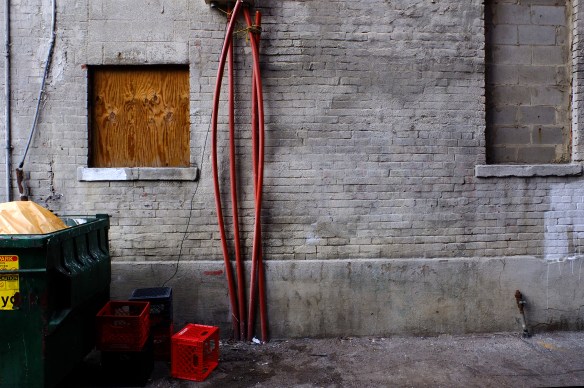
ventriloquismIt was a chilly, mildly windy day — cloudy in a way that was occasionally dramatic and occasionally oppressive. The wind seemed to channel itself down the widest streets, leaving the alleys and service roads more calm and almost warm. A good thing for me, since I seem to be drawn to alleys.

I don’t know why that is. Maybe it’s because nobody tries to make alleys pretty. Anything attractive in an alley is accidentally attractive — organically attractive. Alleys are messy and disorganized; alleys are where the people who work in the city’s shops and restaurants and offices go to have a smoke and relax. It’s where stuff gets delivered and hauled away. There’s just something honest about an alley.

in an alley nothing is ever quite straightAs I was shooting the photograph above, I heard footsteps coming down the alley. I turned to look and there was this guy, head down, smoking a cigarette, walking my way. He was wearing a bright red hoodie and his skin was so black it was almost purple. And I wanted his photograph. I wanted him to stand in his bright red hoodie against the wall, and I wanted it desperately bad because it would have made the most amazing photograph.

So I said “Hey. Do you mind if I take your photo. Up against the…” and he said “Fuck no” and kept walking. And he could not have said it any more perfectly. It wasn’t angry, it wasn’t dismissive or insulting, it was more of a practical I-don’t-have-time-for-this-bullshit reply. It was almost musical.

darling keep lid closedI kept walking. Down more alleys, along sidewalks, through the skywalk. No real plan or destination, just walking. I followed a florist’s Transit van down another alley. The van was a deep twilight blue and on its side was an image of yellow tulips, and I thought it might make an interesting photo if it parked in good spot in the alley. But it was just using the alley as a shortcut.

I did, though, find these dumpsters behind a restaurant. They’re not particularly interesting dumpsters, and I probably wouldn’t have stopped to photograph them. What stopped me wasn’t the visual, it was the olfactory. I stopped walking because there was an absolutely astonishing odor of grease. It was a staggering smell, overpowering and a tad nauseating, an odor unlike anything I’d encountered before. I noticed one of the dumpsters had a label that said “Grease Only – No Trash or Water.”

There’s a company called Darling that describes itself as “a provider of animal rendering, cooking oil and bakery waste recycling and recovery services.” This was one of their recovery bins. The bin has a warning label that says Darling and Keep Lid Closed. I mention this only because I saw the warning and couldn’t help thinking ‘Darlin’, I never dreamed of opening it.’

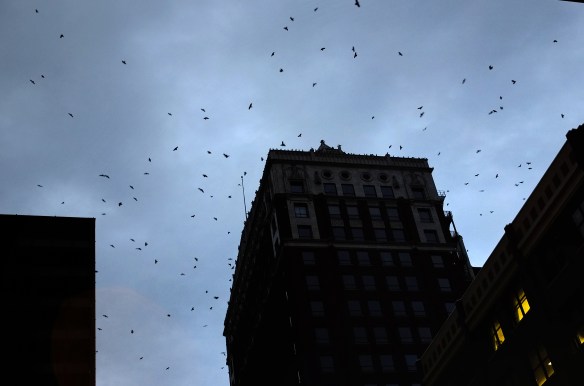
all them crowsAnd then there were crows.

It was dusk, going on twilight. By this point I’d been walking for about two and a half hours. My knees ached, I was cold, it was beginning to rain, and there were crows. Hundreds of crows, circling and roosting nineteen stories up on the Equitable Building. So I stood there on the sidewalk, obstructing foot traffic, looking up, ignoring the sprinkling rain, sore and tired, taking photographs of barely visible corvids.

It was perfect.

statistically verifiable facts

A few days ago, Jovan Belcher, a linebacker for the Kansas City Chiefs football team, shot his girlfriend, Kasandra Perkins, multiple times, killing her. He later drove to his team’s home stadium where he used a second handgun to shoot himself in the head. According to news reports, Belcher owned about eight firearms — all purchased legally. Belcher was 25 years old; Perkins was 22. They had a three month old daughter, Zoey.

jovan belcher

Last Sunday sports commentator Bob Costas made a brief (about 90 seconds) statement in which he quoted from a newspaper column written by Jason Whitlock. He said,

Our current gun culture simply ensures that more and more domestic disputes will end in the ultimate tragedy, and that more convenience-store confrontations over loud music coming from a car will leave more teenage boys bloodied and dead.

In the coming days, Belcher’s actions will be analyzed through the lens of concussions and head injuries. Who knows? Maybe brain damage triggered his violent overreaction to a fight with his girlfriend. What I believe is, if he didn’t possess/own a gun, he and Kasandra Perkins would both be alive today.

Predictably, that 90 second statement sparked an oversized reaction from gun nuts (and yes, if you get angry and alarmed because a sports commentator expresses a 90 second opinion suggesting there’s something wrong with American gun culture, then you’re a gun nut). Costas said nothing about gun control, he said nothing about the Second Amendment. He simply reiterated the point made by Whitlock: the easy availability of handguns does NOT make us safer; it only increases the probability of gun violence. But by expressing an opinion, Costas has been accused of treason, of attacking the Second Amendment, of insulting the American Way of Life.

Much of the criticism of Costas has included a litany of various ways people have been murdered in the US — baseball bats, crossbows, knives, ball peen hammers, spoons, cars, cast iron skillets,  etc. This is always followed by the inevitable and profoundly stupid question “Why don’t we outlaw cast iron skillets?” That notion is repeated in this YouTube rejoinder to Costas. The speaker repeats one of the most common and ridiculous arguments against sensible gun control. He says: “To blame a gun for man’s decision is to foolishly attribute free will to an inanimate object.”

The obvious flaw in that argument is the assumption that people are blaming the weapon for the violence. That’s nonsense. The gun isn’t responsible for the violence; the gun does, however, amplify the lethality of the violence. That’s the entire purpose of a gun — to inflict considerable damage and to do it from a distance. If they ever invent a cast iron skillet intentionally designed to inflict lethal damage from a distance, I’ll argue that skillet ought to be regulated too.

It astonishes me that there’s even a debate about this. Handguns facilitate lethal violence. It’s just that simple. Handguns make it easier to kill people spontaneously, to kill more people, to kill them more quickly. To say that isn’t an act of treason. To say that isn’t an assault on the Second Amendment. To say that isn’t an insult to the American Way of Life.

To say that handguns facilitate lethal violence is merely to state a statistically verifiable fact.

kasandra perkins & zoey belcher

Of course, nobody can say with any degree of certainty whether Kasandra Perkins and Jovan Belcher would be alive today if they didn’t live in a house full of guns. What we can say and what we need to say — and we need to say it much more often — is this: having a house full of guns significantly increased the odds that Belcher and Perkins and baby Zoey would die by violence. And that’s a fact.

UPDATE: It’s worth noting that the majority of the discussion about this case — in the media and on the internet — is about guns or about football. Almost nobody is talking about the fact that Kasandra Perkins was murdered.

Here are some more facts: Every day, three women are killed by their husbands, boyfriends, and lovers. More than 90% of the domestic murders in the US are committed by men against women, and 88% of those murders involve a firearm.

Yes, it’s important to examine America’s gun culture, and yes it’s important to investigate the damage (social, emotional and physical) football players suffer. But this was also a crime against a woman, and it’s shameful for us to ignore that.

a pretty good day

My day? How was my day? I’m glad you asked. My day didn’t go quite as planned.

My plan was simple. Most of my plans are simple. I’m not even sure you can call a vaguely elastic notion of ‘a nice lunch somewhere’ and ‘a walk someplace interesting’ a plan. But that was the extent of it. A nice lunch. A walk. What could possibly go wrong?

But first I had a minor problem to deal with. My debit card was about to expire. I’d called the bank before the Thanksgiving holiday to find out if a new card had been sent (I recently moved and was concerned the card might have been sent to the old address). I was assured the card had just been mailed to the correct address and I’d have it soon. But it still hadn’t arrived yesterday, so I called the bank again and spoke to a very polite young man named Michael.

Michael told me I needn’t be concerned, the card had probably been lost in the mail. But to be safe he could put a block on the debit card and send me a replacement debit card. He asked if it would be okay if he did that. I said “Why don’t you send a replacement, and I’ll keep using this one and keep an eye out for suspicious charges.” Michael didn’t think that was a wise course of action. It took a few more minutes of conversation before I finally realized Michael was just being polite; he was absolutely going to enforce a policy of blocking the existing card and issuing a replacement to protect me (and the bank) from fraud. And he was going to block the card NOW.

I checked my pockets; I had a total of US$19 in cash. Enough for lunch and a walk, but certainly not enough for the next few days. I asked Michael “What am I going to do for cash?” Simple — go to a branch of the bank, he said, and they’ll issue a temporary replacement card I could use until my permanent replacement card arrived.

So I went to the bank. A very polite young man named Terry said he was terribly sorry the post office had lost my renewed debit card, and he deeply regretted any inconvenience it caused me, but he’d be delighted to give me a temporary replacement card. He just needed to see a state-issued photo ID card. I gave him mine. It had expired. “Sorry,” polite Terry said. “You need to have a current state-issued photo ID card.” I showed him my Social Security card. No. I showed him my Veterans Administration card, issued by the federal government, complete with a brightly-colored photo of my smiling face. No. I showed him my voter registration card. No. I showed him various other forms of photo identification — everything from an ancient faculty ID card from Fordham University, to my library card, to my Utata business card, all with photos of me at various ages. No. I pointed out that it was highly unlikely I’d concoct an elaborate false identity spanning more than a decade just to obtain access to a temporary replacement debit card for an account with just a few hundred dollars in it, especially since I’d had an activated and working permanent debit card just an hour earlier.

Terry was very polite…but no. I needed to go to the Department of Motor Vehicles and get a new state-issued photo ID. On my return, he’d be over the moon to give me a temporary replacement debit card.

So I went to the DMV. Yesterday was the 29th day of November. Going to the DMV at the end of the month, when everybody who dawdled and/or forgot to renew their various licenses, is like a combination of attending a Palestinian funeral in Gaza (a mad, chaotic crush of people, all rending their clothes and wailing, wishing they too were dead) and an old-style Soviet bread line (an infinite number of somber, sad-faced, spiritless drones dressed in rags, waiting in line with bovine fatalism, without any real hope of getting anything remotely like what they’re standing in line to receive). To make matters worse, I arrived right at lunch time, when all the employed people who were delusional enough to think they could get their end-of-the-month DMV chores done during their lunch hour arrived. And when most of the DMV personnel went out to McDonalds for a Big Mac.

I got in line. I waited. I made it to the clerk — a polite middle-aged man named Raul. “I need to renew my state-issued photo ID,” I said. Raul would be absolutely delighted to renew my state-issued photo ID. Did I have a certified copy of my birth certificate? I told him the bank didn’t require a certified copy of my birth certificate to get a temporary replacement debit card…so no. “How about your passport?” No, I hadn’t brought my passport either (which wouldn’t have done any good anyway because it’s also expired). Raul said if I returned with a valid passport or a certified copy of my birth certificate, he would happily give me a new state-issued photo ID so I could get my temporary replacement debit card until my permanent replacement debit card arrived since my existing debit card had been blocked because the post office had apparently lost the renewal debit card.

Here’s something you may not know. In order to get a certified copy of your birth certificate, you need to go to the county courthouse and present a state-issued photo ID card or a valid passport. In order to get a valid passport, you have to present either a state-issued photo ID card or a certified copy of your birth certificate.

Happily, I actually had a certified copy of my birth certificate. So I returned to the house, found the birth certificate, returned to the DMV and Raul gave me a new state-issued photo ID, returned to the bank and Terry gave me a temporary replacement debit card. It took six hours. Then I had a very pleasant but very late lunch, and took a very short walk as the sun was beginning to give up.

During the walk I saw the best Men’s Toilet Ever:

menAnd I saw this quickly-walking woman who had no interest in having a cold beer:

cold beerBack at the house, the mail had been delivered. You can imagine how I felt as I approached the mailbox. But of course, the debit card hadn’t arrived while I was out getting the temporary replacement debit card. This is real life, not fiction, and real life rarely gives you a neat and tidy resolution.

In real life, mostly what you get is another day pretty much like the day before. Every so often real life drops in a day that’s twisted as a pretzel. But I kind of like pretzels, and even though my day didn’t go as planned, I thoroughly enjoyed most of it. It was still a pretty good day.

cause of death

There’s a very good chance you’ve never heard of Adnan Farhan Abd-al Latif. Wait…make that the late Adnan Farhan Abd Al Latif. He died in September. He died in his cell in a Guantanamo Bay detention center. A couple days after he died, a spokesman for the Department of Defense said “There is no apparent cause [of death], natural or self-inflicted.” No apparent cause of death. He just died, they said. End of story. Go on home, nothing to see here.

Except, of course, it really isn’t the end of the story and there really is something to see, although we might not want to look at it.

Immediately after the terrorist attacks on 9/11/2001, the U.S. cast an exceedingly wide net to catch anybody who might be even remotely connected to the plot. That response was extreme, to be sure, but mostly understandable under the circumstances. What is not understandable and what is indefensible is what the U.S. has done since then.

Adnan Farhan Abd-al Latif

Latif, a citizen of Yemen, was one of the people caught in that wide net. In December of 2001 he was (according to his testimony) traveling to Pakistan to obtain treatment for ongoing neurological issues stemming from an auto accident seven years earlier. He was seized by Pakistani police, who turned him over to U.S. authorities. It’s been widely documented that the CIA offered bounties of between US$7,000 to $25,000 to Afghan tribesmen and Pakistani police for capture of suspected al Qaeda or Taliban fighters. The Pakistanis routinely arrested foreigners and sold them to the U.S.

Latif was shipped to Guantanamo on Jan. 17, 2002 — one of the first people to be detained in Gitmo.The Bush administration claimed that the 779 people detained in Gitmo during the “war on terror” weren’t covered by the Geneva Conventions and therefore could be held without charge, without any due process, and without any sort of judicial review — and they could be held indefinitely. Forever.

The U.S. Supreme Court disagreed, and in 2004 they ordered that Guantanamo detainees were entitled to minimal due process. At the very least they had to be informed of the allegations made to justify their detention and given the right to try to refute them.

Latif was given a hearing in which no evidence was offered to support his detention. He was cleared to be released from custody. That was in 2005. He was cleared for release again in 2007, and once again in 2009. Each time, the release was blocked or delayed. In 2010 Federal District Judge Henry Kennedy Jr. ordered Latif’s release, saying his ongoing detention was unlawful. That ruling was also blocked.

After the first time his release was denied, Latif tried to commit suicide. He tried several times, in fact. He went on hunger strikes, during which he was forcibly fed through a tube inserted in his nose. He spent most of the last five years in solitary confinement, often with his hands in cuffs and his arms pinned to his sides by a body cuff in order to prevent him from more suicide attempts. In September, Latif apparently found a way to finally succeed.

Of the 779 men detained over the years at Guantanamo, only 167 remain there. Most of the detainees were found not to be a threat and were released without charge. About 70 were transferred to detention centers in their native countries. Eight to ten inmates died, several of them by suicide. Of the 167 men who remain, about half have been cleared for release. But they’re still in Gitmo.

“There is no apparent cause [of death], natural or self-inflicted,” says the Department of Defense of Adnan Farhan Abd-al Latif. He was 32 years old. He’d been held without charge at Guantanamo for 10 years, 7 months and 25 days — a third of his life. He’d been cleared for release for more than six years.

There’s a cause of death, right there.

whoop hallo

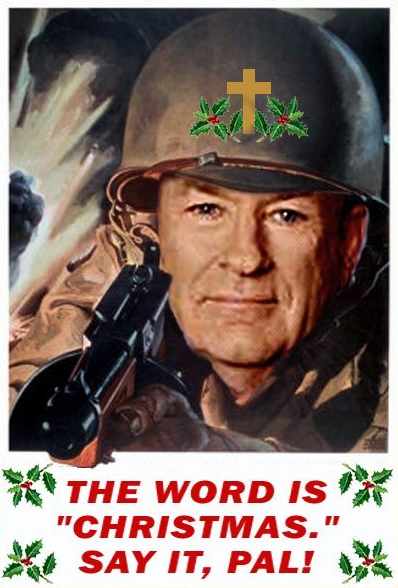
It’s that time of year again. Call me old-fashioned, but this is my favorite time of year. Each year the arrival of Thanksgiving means it’s time to renew the War on Christmas.

Yes, yes, I know — you’ve been seeing Holiday Christmas decorations and advertisements since Hallowe’en. It’s understandable that you might think the season of War on Christmas has been underway for a few weeks. But no, I’m a traditionalist; if waiting until after Thanksgiving to start the War on Christmas was good enough for our forefathers a decade and a half ago, it’s good enough for me. Once you abandon tradition, chaos follows.

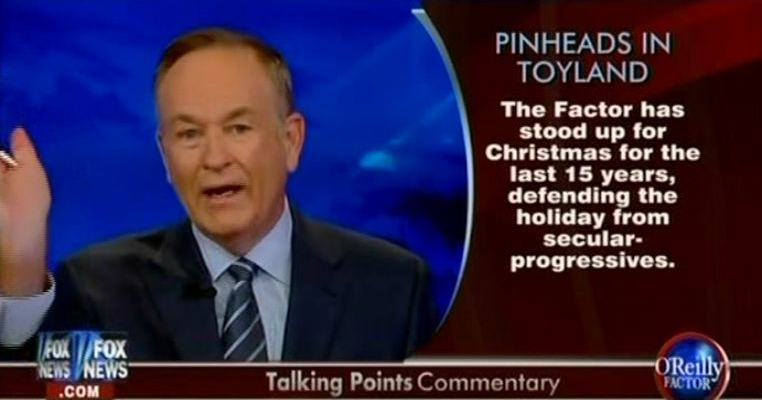
What makes this War on Christmas season so special? It’s because this is the time of year in which we’re reminded that some Christians are incapable of maintaining their faith in Christ without the constant validation of their belief system through advertisements from major American retailers. FOX News and Rush Limbaugh have convinced some folks that unless clerks and cashiers mechanically repeat the phrase “Merry Christmas” the religious significance of the holy day will be diminished. Bill O’Reilly has taught them that every time somebody says “Happy Holidays” or “Season’s Greetings” a bell stops ringing and an angel loses its wings.

Despite the fact that in every city, town, and village in the United States there’s a tax-free Christian church, they want you to believe Christianity is under attack. Despite the fact that the birthday of the Christ Child is a federal holiday, they want you to believe Christmas in danger. When you’re standing in the checkout line at a Big Box store to buy products made by cheap-ass child labor in some Blakeian ‘dark Satanic Mill’ outside of Mumbai, they want you to believe the real sin takes place if the cashier fails to say “Have a Merry Christmas.” They want Christians to be afraid.

And me…I’m happy to help. I don’t have anything against Christians (seriously, some of my best friends are Christians). But I am against stupidity. And c’mon, it’s hard to find a better example of stupidity than the War on Christmas. I sorta kinda feel anybody stupid enough to believe Christianity in the U.S. is at risk deserves to be made uncomfortable.

That makes me a cheerful soldier in the War on Christmas. Starting Friday, I will clatter merrily about town saying “Happy Holidays” and “Season’s Greetings” to friends and strangers alike. I will do my part in the War on Christmas. It’s my duty as a good citizen.

You’re either with Christmas — or you’re with the terrorists!

In fact, it pleases me to slightly misquote the estimable Ebenezer Scrooge: “I am as light as a feather, I am as happy as an angel, I am as merry as a schoolboy. I am as giddy as a drunken man. A Happy Holiday to everybody. Season’s Greetings to all the world. Hallo there. Whoop. Hallo.”