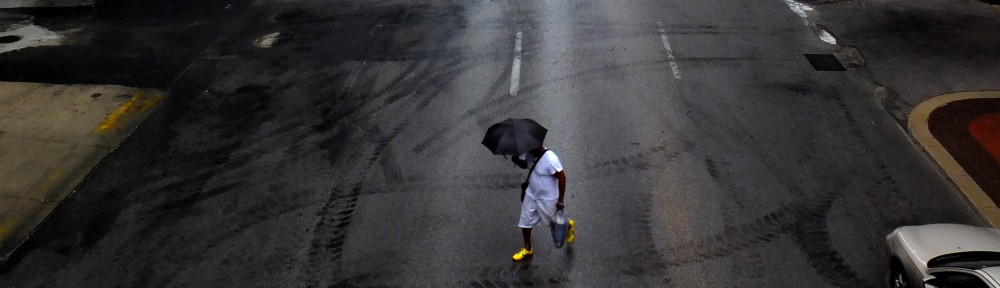
There was a freezing mist in the air on Friday. Great weather for sitting inside — for the reading of books and the making of soup. It was wretched weather for driving or for walking, or for being outside at all. But because the freezing mist coated the entire area in a thin, barely perceptible but incredibly lovely casing of ice, outside is where I went.
Driving on primary roads was treacherous, but it was relatively easy to drive on the secondary gravel roads that abound in the American Midwest. Gravel means traction, even in icy conditions. So that’s where I went. And this is what I saw.
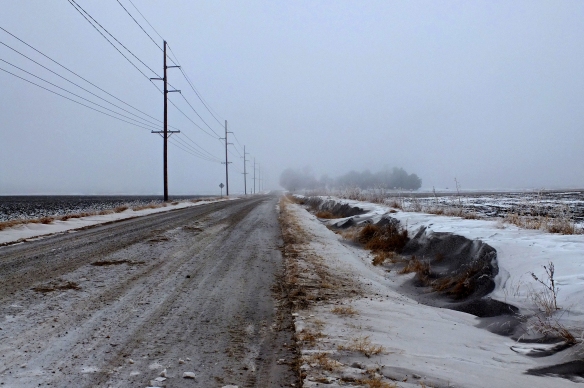
A great deal of nothing much. Eighty-five thousand years ago a glacier pushed its way through here. It hung around for about seventy thousand years, then gradually withdrew. It left behind a landscape that alternates between rolling hills and large swathes of flat terrain. Farmland. Good for growing things; not much to hold the eye.
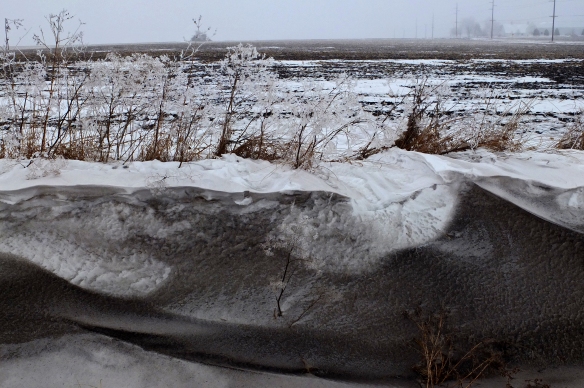
Or so it seemed at first. As I drove down this gravel road I found my eyes drawn to the ditch. At first I gave my attention to the ice-coated weeds, but I quickly found myself more interested by the wind-sculpted snow, and the abstract patterns created by the windblown topsoil.
There’s an East Asian form of ink-and-wash painting that’s generally referred to by the Japanese name sumi-e. Other East Asian cultures practice the art, and they each have different names for the style. The Chinese (who likely invented it) call it shui-mo hua; in Vietnam it’s called tranh thuỷ mặc, and it’s sumukhwa in the Koreas. There are minor differences between the styles, but in general the techniques and the approach are the same.
In essence, sumi-e paintings are created using subtle gradations of black ink diluted by water. The approach attempts to interpret the spirit of the subject rather than to create an accurate representation of it. If, for example, the painting was of a duck, the artist would be more concerned with instilling it with duckness — with a sense of the way a duck moves, with that absurdly duckish dignified waddle — rather than with a detailed illustration of the bird. There are variations of the style in which color is used, but in its purest form it’s just black and white and spirit.
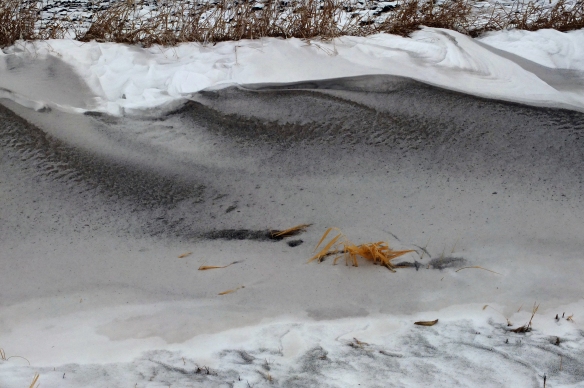
As I drove along, stopping periodically to get out of the car and walk the ditch, I realized I was seeing a sort of organic sumi-e. Not in the sense that some Cosmic Artist was at work interpreting the spirit of the wind along a quarter-mile stretch of earthen canvas, but in the sense that the wind itself had revealed something of how it moved, and did it largely in black and white.
The thing I found most intriguing, I think, was that the beauty of the dirty snow wasn’t limited by scale. I found the same delicate shading, the same unexpected lines and shapes, the same beautifully uneven distribution of soil whether I was looked at an area of a few inches or several yards.
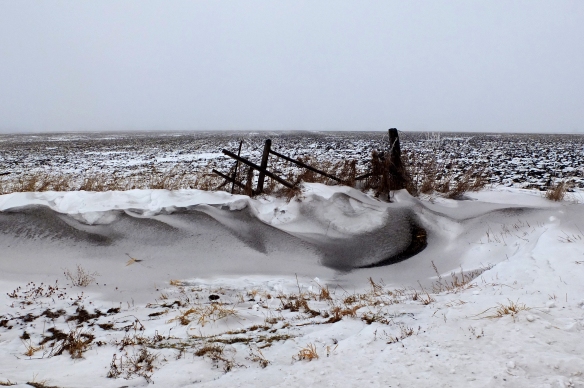
I suppose I was out exploring the freezing mist for about ninety minutes. I spent maybe fifteen minutes getting out of town and finding that road, and another fifteen getting back to the warm, dry house. The other hour was spent rambling down a quarter-mile stretch of gravel road, looking at dirty snow in a ditch.
I’ll be meeting my brother for breakfast this morning, and at some point he’ll ask me what I’ve been up to. And when I tell him I’d spent an hour out walking in the freezing mist, getting cold and wet, looking at a ditch, thinking about glaciers and East Asian art and unevenly distributed bits of soil, I know he’ll grin and shake his head — because it sounds ridiculous.
And maybe it is. But we live in a wonderfully ridiculous world, and even in a great deal of nothing there’s a lot to see.


