I’ve been accused (more than once) of overthinking everything. That accusation is often valid. I tend to overthink some stuff because it’s amusing to me and because it reminds me that everything is connected.
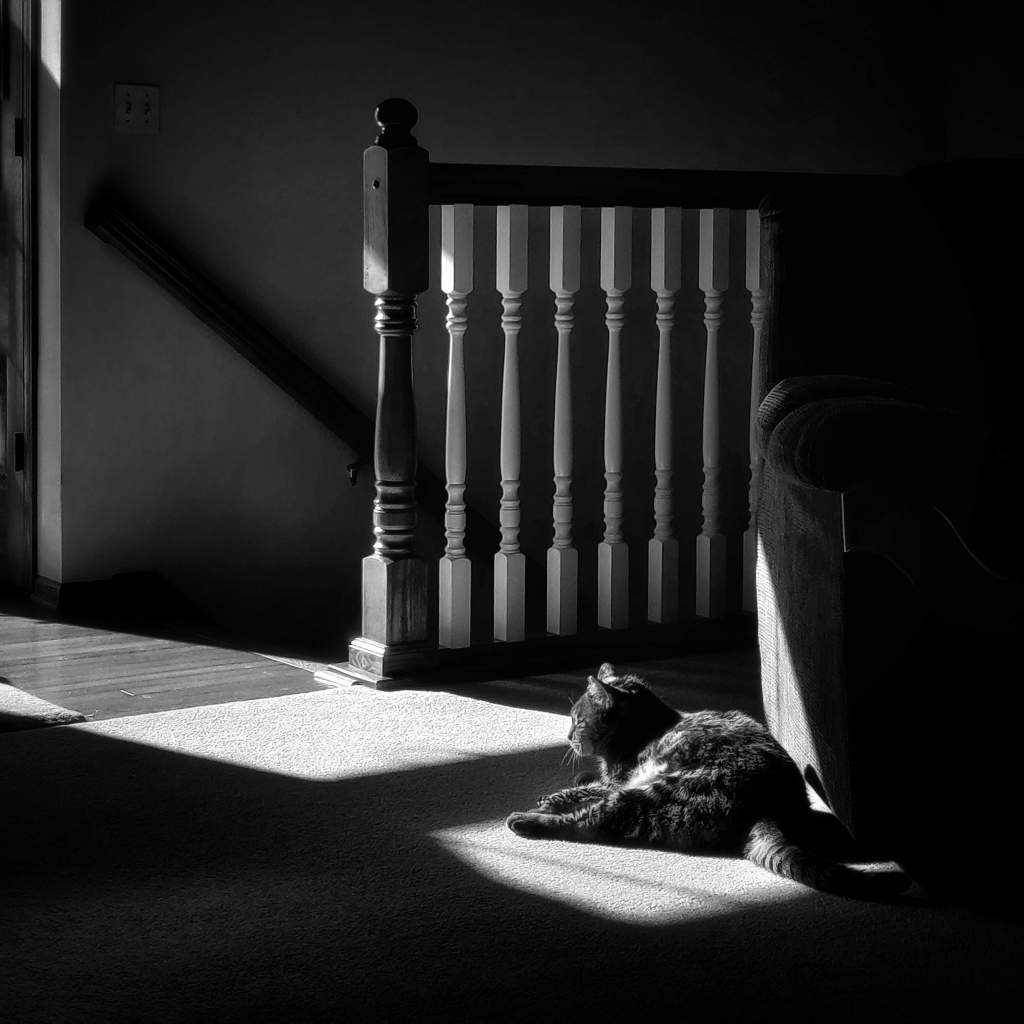
For example, this photograph. It’s just a cat sleeping in a patch of sunlight. Nothing significant, nothing particularly interesting in itself. But if you overthink it, it links together a series of at least ten seemingly unrelated facts.
FACT 1: I belong to an online global collective of photographers called Utata. This group, which has over 30,000 members, creates a variety of photographic ‘challenges’ or projects for its members to participate in. One of the current challenges involves photographing a collection of seven related things.
FACT 2: Pomegranates originated in a historical region called Mesopotamia which occupied the ancient Near East and Western Asia.
FACT 3: The cat that lives here likes to sleep in patches of radiant heat. On winter days, to please the cat, I open the front door to allow the sun to shine in.
FACT 4: For more than three thousand years, Aramaic was one of the prominent languages of the ancient Near East, which included regions of Mesopotamia.
FACT 5: A balustrade is a railing, often ornamental, supported by individual short posts or columns, which are called balusters.
FACT 6: Near the front door, where the cat likes to sleep in the winter sunlight, is a stairway leading to the basement; the stairway is protected by a balustrade.
FACT 7: The earliest examples of balustrades are found in sculptured Assyrian bas-relief murals, some of which have been dated back to a period between the 13th and 7th centuries B.C.
FACT 8: Assyria was an ancient Mesopotamian empire.
FACT 9: The term ‘baluster’ comes from the Aramaic balatz, which refers to the flower of the wild pomegranate. Balusters in the bas-relief murals had double curves, which resembled a half-opened pomegranate flower.
FACT 10: I noticed the cat sleeping in the sunlight from the open front door. The light illuminated seven of the balusters supporting the balustrade, meeting the requirements for the Utata photo challenge.
Does knowing those facts make this a better photograph? Nope. It’s still just a photograph of a cat sleeping in a patch of winter sunlight.
But surely you’ll agree there’s a certain delight in knowing that the cat is sleeping in a patch of sunlight beside a railing supported by posts that were originally named in an ancient almost-forgotten language because of their resemblance to the flower of a fruit that first grew in an empire that no longer exists.
Yesterday I came across a news item…wait, make that a ‘news’ item. I mean, there’s news, which is information important to me, and there’s ‘news’, which is information I might find momentarily interesting. Like, say, ‘sports news’ or ‘religious news’ or, in this case, ‘entertainment news’.
Yesterday I came across a ‘news’ item which informed me that the protagonist in a BBC/PBS show called (and I am not making this up) Miss Scarlet and the Duke was patterned after Miss Elizabeth Bennett (of Pride and Prejudice, I shouldn’t have to tell you that). You must allow me to tell you how ardently I admire Miss Bennett. I’ve always been of the opinion that her keen observational skills coupled with her lively wit and plucky nature would make her an excellent detective.
So, of course, I determined to watch the show. Last night I watched the first episode. Let me just say this: I know Miss Elizabeth Bennett. Miss Bennett is a friend of mine. Miss Eliza Scarlet is no Miss Elizabeth Bennett.
That’s not necessarily a bad thing. The differences between the two characters are actually important to the narrative. Miss Bennett, of course, is a gentleman’s daughter; Miss Scarlet is the daughter of a police detective. In addition, Miss Bennett is the product of the Regency Era, whereas Miss Scarlet is firmly planted in the Victorian. Finally, the pace of Miss Bennett’s life is determined by the rhythms of a rural and village existence; Miss Scarlet lives in London. Those differences–in social class, in social status, in societal change over time, and in environment–radically expand the parameters of Miss Scarlet as a character.
Being a police detective’s daughter in Victorian London allows the character of Miss Scarlet access to most of the common tropes of the modern criminal investigation show. This is both unfortunate and very convenient. It’s convenient in that it makes the nature of the show familiar to the viewer; it’s unfortunate since the viewer knows pretty much what to expect.
And the first episode of Miss Scarlet and the Duke meets that expectation. There’s nothing new, nothing original, nothing surprising. Basically we have a 21st century woman protagonist set in 19th century London, with a nod toward a more historically restrictive patriarchal system. In other words, we have a generically plucky woman detective who has to 1) strive to be taken seriously, 2) overcome obstacles presented by the patriarchy, 3) defy gender norms, but only to a certain degree, and 4) establish her independence.
That said, I think we can all agree that you can’t judge a television series on the basis of the first episode. Or even the second or third. But you can, I think, get some idea of the nature of the show. And Miss Scarlet and the Duke gives every impression of being…pleasant. It wasn’t exciting, it wasn’t intriguing, it wasn’t compelling, it wasn’t even particularly interesting. It was a mildly entertaining diversion that doesn’t require much on the part of the viewer. It was…pleasant.
That’s not a criticism; there’s a need for mildly entertaining diversions, especially during a pandemic. So let’s take a look at that first episode.
WARNING — ENGAGE SPOILER ALERT SYSTEM. SPOILERS FOLLOW. STOP READING IF YOU WANT TO AVOID SPOILERS.
Because it’s the first episode, a certain amount of narrative has to be spent introducing the characters. It opens with Eliza being led by a street urchin to an unsavory part of London. She’s paying the kid to lead her to a dead body. Not any particularly dead body. Just a random dead person. Why? So she can…investigate something? The body appears to be that of a woman we assume to be a one-eyed prostitute. She is, in fact, one-eyed and a prostitute. She is not, however, dead. Only drunk.
As a scene, it makes absolutely no sense–unless Eliza has some sort of necro-curious fetish, which doesn’t seem likely from PBS. The point is to show she’s eager to prove herself to her father, a retired police detective turned private investigator. Eager, but inexperienced. And not very competent. Not only does she not get a dead body, she doesn’t get her money back from the urchin.
Her father would be horrified, but he doesn’t learn of the encounter because he’s nowhere to be found (ooh, suspense). He’s not at his office, and his police protégé (Chief Inspector William ‘Duke’ Wellington) hasn’t seen him. Eliza assumes he’s either working a case or drunk. He’s not. He’s dead.
Eliza returns home to find a stranger–a doctor, no less– and her dead father in the drawing room. This stranger found her father dead and apparently brought his body home. I suspect in a later episode we’ll learn there’s something odd about her father’s death (because that’s how the Mystery Story Universe works). Possibly the doctor is involved (the Mystery Story Universe is predictable).
Before she can even begin to mourn, Eliza encounters a prospective client looking for her father. Needing the money, she lies to him, telling him her father will accept the case. This is where the actual plot begins. Oh lawdy, the plot. Let’s dispense with the plot as quickly as possible; it’s convoluted, and the least interesting thing about the first episode.
The client, a man dying of some undisclosed illness, is looking for his estranged niece, Tilly, his last living relative. She married unwisely and was cast off by the family. Now that he’s dying and has an estate to dispose of, he wants to find her again. Eliza finds Tilly working as the human target for a knife-throwing act in an unsavory dance hall in Soho. Tilly confesses her uncle was right–her husband, a once-widowed actor, was only interested in her uncle’s fortune. When he learned she was disowned, he disappeared. She’s willing to meet and reconcile with her dying uncle.
Case closed! No, of course not. The dying uncle turns out to be–and, again, I’m not making this up–Tilly’s husband in a fake beard. He’d learned of the uncle’s death, and as her husband in Victorian England, he basically has control of the estate she inherited. He has the estate, but he has no need of a wife. And yet he decides FOR REASONS that he must find her. Does he return to Soho where he left her? No. Does he look for her? No. Instead, he puts on a disguise and hires somebody to find her. Does that make any sense? No. Doesn’t matter. When Eliza brings Tilly and her husband together, he removes his disguise, calls in a pair of ruffians, and has Ivy hauled off to be committed. Which allows him to control the estate he’s already controlling. I know, I know…just go along with this.
The husband pays Eliza her fee. She feels awful (girls have all these emotions), so she decides FOR REASONS to investigate the husband’s first marriage. She discovers his first wife wasn’t actually dead (gasp)! This makes him a bigamist. Eliza threatens him with arrest, he threatens to strangle her, but she’s had a maid lace his tea with laudanum, knocking him out. She then calls her friend Chief Inspector Duke Wellington, who arrests the husband and chides Eliza for being a girl doing police work. Why didn’t Eliza simply notify Duke of the husband’s crime and let the police arrest him, avoiding the need to 1) risk her life and 2) spike the man’s tea with drugs? REASONS, that’s why.
Tilly is released from wherever she was committed to and everybody is happy, except the Duke who insists Eliza shouldn’t investigate anything because she’s a girl. The end.
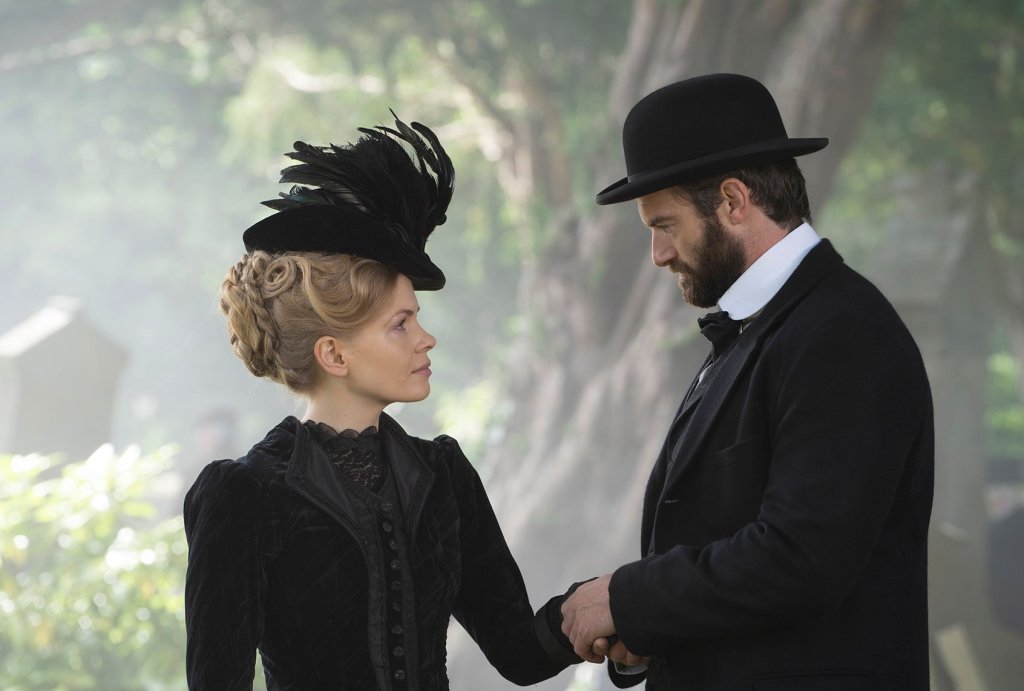
This sounds painfully bad…and it would be, if you were only interested in the plot. Or in the characters. But Miss Scarlet and the Duke is meant to be a confection. It’s a teacake, not a meal. It’s a show about Miss Scarlet’s costumes, and men with precise beards wearing bowler hats and long coats. It’s about stage sets depicting Victorian London, the drawing rooms, the taverns, the bawdy houses. It’s not meant to make you think.
Oh, Miss Scarlet takes on the patriarchy in a variety of non-threatening ways. She mocks the men for being protective and condescending, she out-thinks them, she finds a way around whatever attempts they make to keep her docile and biddable. The viewer understands that the patriarchy is awful, but isn’t it cute and clever how Eliza gets around it?
Only two scenes were potentially interesting, potentially dramatic. Eliza, in her search for Tilly, encounters Moses–the black man who ‘protects’ the women who work in the dance hall. There’s something awkward about the only person of color in the show being a criminal. But Eliza wants information about Tilly, Moses wants a bribe; she pays the bribe, he takes her coin purse. When he refuses to return the purse, Eliza flirts with him (Miss Elizabeth Bennett would have vapors). When Moses responds, Eliza quickly handcuffs him to a rail (a tangent: ratchet cuffs weren’t invented until the early 20th century). She then threatens to burn him alive unless he 1) returns the money and 2) tells her where to find Tilly.
The second scene was momentarily very distressing. Eliza is arrested during a raid on the dance hall where Tilly is employed. Three men take her by force to a room with an exam table, and are apparently about to ‘inspect’ her to see if she has a venereal disease. For a brief moment, there was nothing amusing or sugary about the show. Eliza quickly defuses the situation by claiming to be the preferred prostitute of Chief Inspector Wellington, who then rescues her. What was potentially traumatic and horrifying becomes somewhat comedic. Eliza is completely unfazed by that sexual assault.
Is Miss Scarlet and the Duke a good show? Not by most PBS standards. Is it worth watching? It’s a nice diversion. I’ll watch the next episode, if only for the set design and the costumes. Miss Scarlet knows how to wear a hat.
I suppose by most metrics, this is a bad photograph. It’s dark, except for where it’s maybe a tad overexposed. There’s nothing special about it, it’s not terribly attractive. It’s just a blue plaid shirt hanging on a stairway post. But I was drawn by the narrow band of December light and the way it slid through the transom over the doorway and sidled up against the shirt.
I saw it originally from another angle, and was captivated enough to go fetch a camera. An actual camera, not my phone. I moved to this angle, squatted down to get the perspective right, shifted over just enough so that the windows in the neighboring house seen through the kitchen window were balanced, and made the shot.
It probably didn’t take more than 15-20 seconds. It’s a semi-casual shot of an utterly ordinary moment. Eggleston might call it a ‘democratic’ moment, though I didn’t photograph it in a democratically Eggleston way. I probably took 14-19 seconds longer than Eggleston would have. You can jam a lot of pretentious formality into 15-20 seconds. He was all about the unpretentious impermanence of everything, after all, and the revolutionary notion that art existed everywhere and anything was worthy of being photographed. I believe in that approach, but haven’t liberated myself from the tyranny of composition. There’s always, always, some level of thoughtfulness in anything I photograph.
After I shot the photo, I chimped it just long enough to see if I got what I was after. What was I after? The light, obviously. But also the darkness–the nothingness of the stairway in the center. There’s really not much to see in the photo; there’s the shirt, the window, the handrail, part of a closet door. What’s not there is as important as what is. I was pleased with the photo.
Then I put the camera down and basically forgot about the photo until yesterday. Yesterday I bought a new card reader and uploaded the half dozen images from the camera. Most of the images were crap and immediately deleted, but this one sparked the memory of the moment I’d shot it.
I don’t often spend time looking at the photos I shoot. I shoot them, review them at some point, process a few, delete most of them, then I post some of the few I’ve processed. That’s it. I’m not very interested in seeing the photo after I’ve finished it. But I looked at this one for a bit, thinking about Eggleston and the democratic eye and the way the light fell and the enigmatic darkness…and I realized I was being a pretentious dick. It was just a murky photograph of a blue plaid shirt.
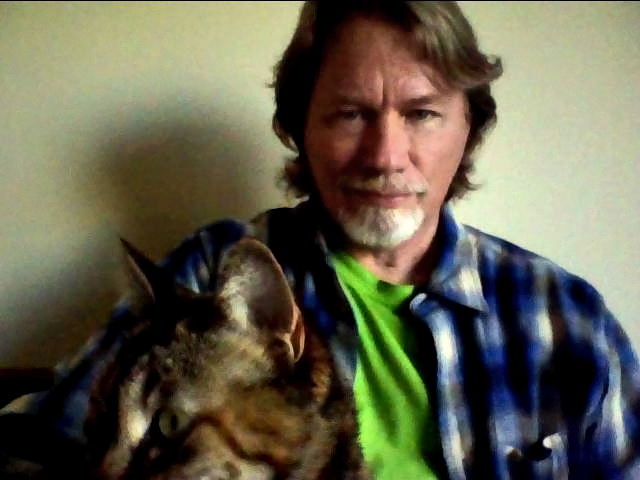
Self in a blue plaid shirt with occasional cat, 2013.
I’ve had that blue plaid shirt since 2001. I didn’t buy it; I sort of inherited it. It belonged to one of the guys who worked for the moving company that shifted my stuff from a small apartment on the Upper West Side of Manhattan to an old farm house in rural Pennsylvania. The shirt got left behind. I probably should have returned it, but the movers also walked away with my antique shepherd’s crook and a walking stick topped with a hand-carved morel mushroom made by my brother — so I figure they got the better end of the deal.
I’ve been wearing that guy’s shirt for two decades now. It’s a comfortable shirt. It’s a sort of utility shirt–a useful shirt, a practical shirt for knocking around in. I wear it around the house, I wear it when I go mushrooming in the Spring, I wear it like a light jacket when it’s chilly or breezy, I wear it to do yard work. It’s a shirt I don’t have to worry about; I don’t care if it gets snagged by thorns, I don’t care if it gets dirty, I don’t care if it gets stained. I don’t care because I didn’t buy it and even after two decades I tell myself it’s not really MY shirt.
Photo by Jody Miller, 2015(?)
But clearly, it is my shirt. After looking at that photo, I realized I’d taken other photographs that included that shirt. Of me wearing that shirt. Other folks had photographed me in that shirt. I realized how much time I’ve spent in that shirt. I realized I’ve grown fond of it. I realized I have a relationship with that shirt. I didn’t really know that; not until I stopped being a pretentious dick, thinking about that photograph as a photograph.
Which brings me back full circle to being a pretentious dick again. Howard Nemerov, the poet (and brother to photographer Diane Arbus) once wrote, “The camera wants to know.” I can’t really agree with that. I’m more inclined to agree with the Eggleston approach; the camera just wants to see. But sometimes the act of seeing helps the viewer to know.
This is what I know: I have a blue plaid shirt. It’s my shirt. I didn’t buy it, but I own that shirt. It belongs to me. Now that I know that, I’m going to try to forget it. Because if I think about it, it might change the way I wear the shirt, and I don’t want to do that. It’s a lived-in shirt, and it deserves to be lived in. I want to wear that shirt the way Eggleston shoots photographs.
Comrade Trump is gone. Uncle Joe Biden is the prez, with Kamala Harris as veep. Democracy has been resurrected. Winter will end. Bluebirds will sing again. Flowers will grow unbidden where Amanda Gorman walks. The breeze will be warm (or cool) and scented like apricots. All small towns will be called Bedford Falls. A cup of coffee will only cost a nickel.
Okay, maybe there’s some wishful thinking in there. But that’s sort of how it felt yesterday. That feeling won’t last, of course. Reality is a merciless sumbitch (as QAnon believers discovered yesterday); the Covid pandemic is still killing thousands of Americans every damned day, the climate is still massively fucked, and it’ll take a generation or so before anything like real racial/gender justice takes firm root.
But we deserve — hell, we need — a few days to just let the feeling that good things can still happen roll over us. Yes, there’s a LOT of work to do, but let’s not allow necessity to cast a shadow over the multitude of ways yesterday was special. Just one example: the undiluted joy of seeing the first woman — a woman who is black AND Asian — sworn in as Vice President of the United States by the first woman of color appointed to the US Supreme Court with her hand on a Bible that belonged to the first black man appointed to the US Supreme Court. That’s some serious history, right there.
So let’s not make a fuss about which particular bit of history yesterday was the most significant. It’s not a contest. And let’s not scold or castigate (now there’s an interesting word; it’s derived from the same root as ‘chaste’ and it originally meant ‘to make someone pure by correction or reproof’) other folks for enjoying a fashion decision, or an internet meme, or the selection of an entertainer that seems trivial compared to the magnitude of yesterday’s events. And for fuck’s sake, let’s not be assholes about ‘winning’. A bit of gloating is understandable and forgivable (did I spell that right? It doesn’t look right), but even though Trump and his followers treated us as the enemy, we shouldn’t prove them right.
I’m NOT saying we need to forgive and forget. Fuck that. But I am saying unity is important. There are people who ought to be investigated; if found responsible for awful behavior, they need to be held accountable. NOT for our pleasure or amusement, but because that’s how society is supposed to work. (On the other hand, if we get some measure of pleasure and amusement out of it, that’s gravy and we needn’t deny ourselves of it.)
I guess what I’m saying is this: yesterday was a good day. A really good day. Let’s not make any more of it than what it was, but let’s also not diminish or minimize any part of it. Yesterday was…let’s say yesterday was a peach Bellini. A cool, stimulating, mildly alcoholic cocktail with a delightful but subdued color palette. Was it a great peach Bellini? No, not really. Ideally a Bellini would be made with Prosecco and white peaches. Maybe this one was made with champagne instead of Prosecco, maybe with yellow peaches instead of white. But it was a very good Bellini, served properly, and at exactly the right moment.
Drink it, don’t diss it for not being perfect, don’t overstate its fine qualities, just enjoy it for what it is. Fizzy, refreshing, sweet, mellow, but stimulating.
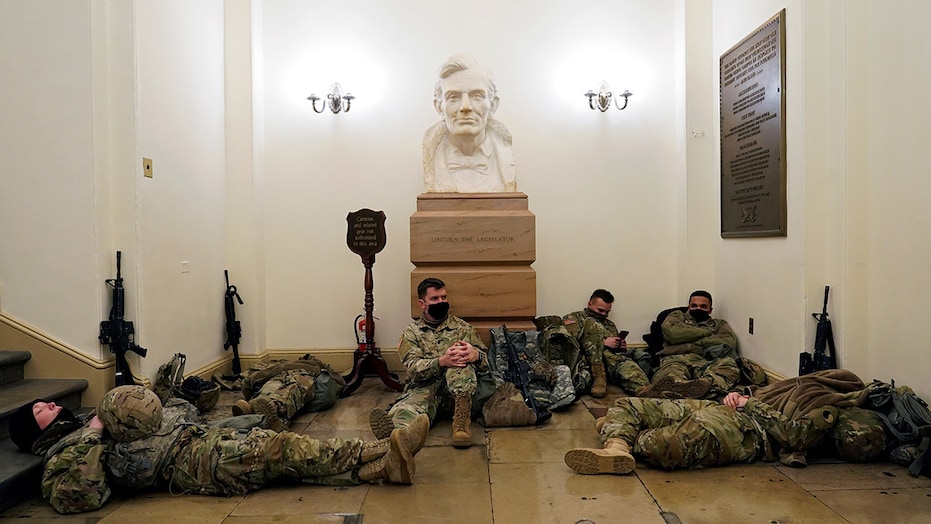
It’s hard to believe, isn’t it. Right now, today, we have about twenty thousand National Guard troops in Washington, DC to protect our government from our president. We have been forced to mobilize a military force larger than the military response we have stationed in Afghanistan or Iraq in order to insure that the insurrectionist followers of Donald Trump won’t disrupt the inauguration of the legitimately elected President of the United States.
That is completely fucking insane–and yet here we are. We’ve arrived at this unnerving moment of history because Trump, supported by sycophantic Republicans in Congress and in coordination with a nexus of unhinged right-wing anti-government cranks and conspiracy theorists (fueled in part by Russian social media disinformation trolls), refuses to acknowledge he lost the 2020 election. Even though Trump has apparently abandoned the demented fantasy that he might somehow, magically, still be declared the winner, he hasn’t yet abandoned his lies about the election being ‘stolen’. That lie hangs in the air, fouling any hope for reconciliation.
We had fed the heart on fantasies, The heart’s grown brutal from the fare
Billy B. Yeats wrote that in 1922. Ireland, after a couple of years of open warfare against British troops, had signed a treaty with the United Kingdom, granting independence to all but six of Ireland’s counties. The failure to establish full independence sparked the Irish Civil War, between those who insisted on full independence and those who were willing to accept partition in the hope that it would someday lead to a united Ireland. It led to Irish people fighting against “Irish soldiers of an Irish government set up by Irishmen.”
The poem is called The Stare’s Nest by My Window. Apparently in the west of Ireland ‘stare’ was the local term for a starling. I’d read the poem a number of times and loved the language of it, but it wasn’t until I was living in DC and had the chance to hear the poet Seamus Heaney read it aloud, that it actually made sense to me.
William Butler Yeats
When he wrote the poem, Yeats was living in a 16th century tower called Thoor Ballylee. Outside his window, honeybees were building a comb in the crevices of the crumbling masonry near an abandoned starling’s nest. Yeats uses all that as a metaphor for the Irish Civil War. The old tower is falling apart, the nest where mother starlings brought “grubs and flies” to feed the nestlings is empty, but bees are still at work creating a home filled with the sweetness of honey.
My wall is loosening; honey-bees, Come build in the empty house of the stare.
Outside his tower, in the real world, Irishmen were killing Irishmen. Yeats acknowledges that violence in the poem — “somewhere / A man is killed, or a house burned.” “Last night they trundled down the road / That dead young soldier in his blood.” He pleads for peace and rebuilding, for restoring the masonry of civil society, in a repeated refrain. “O honey-bees / Come build in the empty house of the stare.”
This is where we find ourselves now, here in the United States. We’re badly divided, but unlike the Irish in 1922, we’re not divided by competing notions of independence; we’re divided by willfully ugly lies, deliberately ugly rhetoric, and ugly conspiratorial fantasies created, spread, and often repeated by prominent Republicans.
We had fed the heart on fantasies, The heart’s grown brutal from the fare, More substance in our enmities Than in our love.
The masonry holding our society together has been eroded, often intentionally, by those who want to create uncertainty and fear in order to stay in power. Our hearts have grown brutal; our hate seems stronger than our love. We desperately want/need it to be repaired. I believe–I want to believe–it’s possible to repair the damage. I see all those troops camped out in the ornate halls of our government, and the possibility of Americans fighting Americans fills me with dread and sorrow. Like Yeats, I feel we are “closed in, and the key is turned / On our uncertainty.”
I have no clear idea what will happen over the coming months. I have hopes; I have fears. I take some small comfort in knowing that countless others throughout history have felt similar hopes and fears. The fact that we’re able to read their writing today is proof that folks generally muddle through somehow.
Here’s the entire poem, probably in violation of some copyright somewhere.
The Stare’s Nest by My Window (1922)
The bees build in the crevices Of loosening masonry, and there The mother birds bring grubs and flies. My wall is loosening; honey-bees, Come build in the empty house of the stare.
We are closed in, and the key is turned On our uncertainty; somewhere A man is killed, or a house burned. Yet no clear fact to be discerned: Come build in the empty house of the stare.
A barricade of stone or of wood; Some fourteen days of civil war: Last night they trundled down the road That dead young soldier in his blood: Come build in the empty house of the stare.
We had fed the heart on fantasies, The heart’s grown brutal from the fare, More substance in our enmities Than in our love; O honey-bees, Come build in the empty house of the stare.
I’m hearing/seeing a lot of variations on this theme:
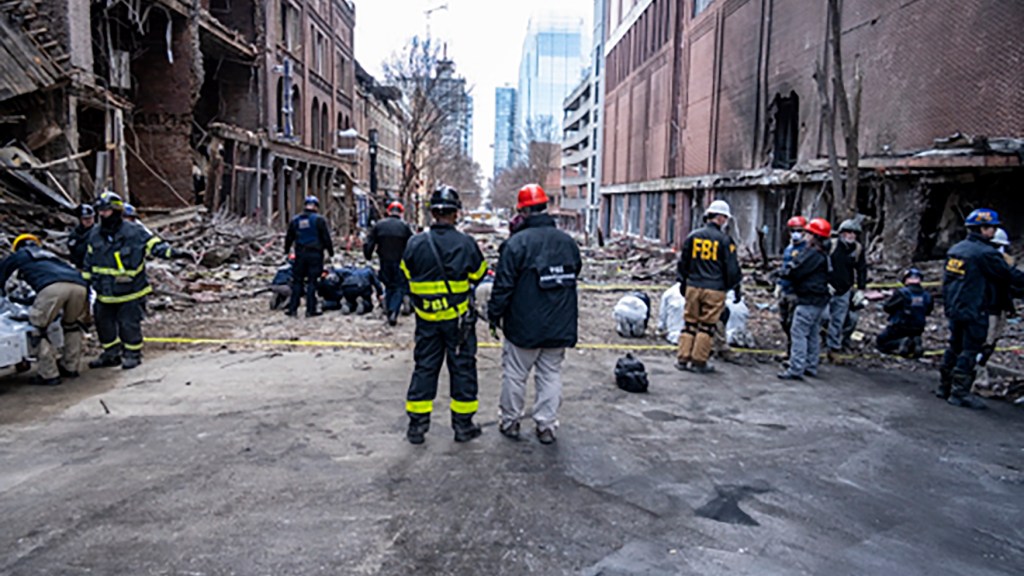
Unbelievable. Anthony Warner’s girlfriend reported he was making bombs in an RV eighteen months ago and the Nashville Police Department did nothing. If he’d been black or brown, they’d have found a reason to arrest him.
It sounds bad, doesn’t it. Really bad. I mean, Nashville police officers could have prevented the Christmas morning bombing if only they’d done what the police are supposed to do. Right?
Well, no. Here’s the problem with that. Folks are evaluating this case through a lens of known guilt. We KNOW Anthony Warner made a bomb in his RV, drove it into the city, blew it (and himself) up. We’re criticizing the police for not knowing in August of 2019 what we know right now. It’s like complaining that somebody bought the wrong Lotto ticket after seeing what the winning Lotto number is. Okay, that’s an unfortunate analogy; I’m not suggesting detonating a vehicle-borne improvised explosive device is anything like winning the Lotto. What I’m saying is the odds of knowing the winning Lotto number before the drawing is 1 in 292,201,338, but the odds of knowing the winning number after the drawing 1 in 1. We’re basing our understanding of an extremely improbable event after learning the probability was 100%.
Let’s look at what actually happened and evaluate the behavior of the police based on what they knew at the time. On August 21, 2019 MNPD received a report that Pamela Perry was suicidal and sitting on her porch with two handguns. Police arrived and found her with two unloaded pistols. She told the officers the firearms belonged to her boyfriend, Tony Warner. She didn’t want the guns in her house. She also told them Warner was making bombs in an RV parked behind his house, which was located about a mile and a half away. The officers called for an ambulance which took Ms. Perry to a mental health facility for an evaluation.
Based on what they knew at the time, the incident could have ended there. The officers could easily have dismissed Perry’s bomb-making claim as the delusions of a suicidal person. I mean, the police have a long history of ignoring the complaints of folks with mental health issues. Or they could have dismissed her allegation as baseless accusations made by an angry, unstable woman in an unhappy relationship. Again, the police have a long history of not listening to women and dismissing their concerns. I’m not saying that would have been appropriate; I’m just saying knowing only what they knew then nobody would have been surprised if, after the ambulance drove off with Perry, the officers had just continued with their routine patrol.
But they didn’t; they actually followed up on the claim. They spoke to the attorney (who was also the person who reported Perry was suicidal). He told them Warner had spoken about bomb-making and military stuff. So they went to Warner’s home and saw that there was, in fact, an RV parked in back yard behind a fence. There was no answer at the door, and they lacked any exigent circumstance to climb the fence and invade the privacy of a citizen. They didn’t even have enough information to ask a judge to issue a search warrant. All they had was the accusation of a suicidal person who was undergoing a psych evaluation at that very moment. So they informed their supervisors of the incident and sent a report to MNPD’s Hazardous Devices Unit.
The next day the Hazardous Devices Unit checked Warner’s police record — nothing but an old marijuana case (for which he’d been placed on probation). That could have been the end of the matter too. Knowing only what they knew then, nobody would have been surprised if the report was filed away and treated as a low priority. But they didn’t. They got in touch with the FBI, who had no record of Warner.
At that point, knowing only what they knew then, they let it go. All they had was 1) a claim by a possibly mentally ill person that her boyfriend, who had no serious criminal record, who had no known ties to violent groups, who was gainfully employed and owned a home in a decent suburb was making a bomb in an RV, and 2) he actually owned an RV. That’s it. That’s all they knew. There wasn’t any reasonable legal grounds to expend policing resources on any further investigation. So they let it go.
Had he been innocent, that would have been the end of it. And remember, in the US we’re all operating under the presumption of innocence. We don’t have to prove we’re innocent. Totalitarian regimes operate on an assumption of guilt.
But as we know now, Warner wasn’t innocent. He was doing exactly what his former girlfriend said he was doing.
The folks who say, “If he’d been black or brown, they’d have found a reason toinvestigate and/or arrest him” are correct. If he hadn’t been a suburban white guy with a job, the police might have leaned on him, pressured him, intimidated him. They might have cobbled together some excuse to barge into his home and search his property. But we’ve spent much of this year demonstrating against the casual, routine violation of the civil liberties of people of color. Are folks really suggesting the police should treat everybody as badly as they treat POC?
No, not really. What they’re saying is police should have violated Anthony Warner’s civil rights. Not everybody, just him. Why? Because we know he’s guilty. It’s easy to deny the rights of guilty people.
But here’s a horrible-wonderful thing about civil liberties: they apply to everybody, the guilty as well as the innocent. They have to apply to the guilty in order to protect the innocent, because we don’t always know who is guilty or innocent.
If we want to stop future Anthony Warners, the answer isn’t to give the police more power or to encourage them to ignore civil liberties. If we want to stop bomb-makers, we should make it more difficult to buy and sell (and re-sell) the common ingredients necessary for making bombs. It’s fairly easy to buy the ingredients to make a triacetone triperoxide explosive (I haven’t bothered to check, but I won’t be surprised to learn Warner had purchased significant amounts of hydrogen peroxide and acetone — the primary ingredients of TATP). If we can limit the monthly amount of Sudafed (“Provides Powerful Sinus or Cold Relief!”) an individual can purchase, we can do the same with bomb-making ingredients.
DISCLAIMER: I spent seven years as a criminal defense investigator. I’m not accustomed to defending the police. But I try to be consistent. The Nashville police followed the law. They didn’t let us down. We were let down by legislators and regulators who are in the pockets of pharma-chemical lobbies.
In the last week of December in 2018 I cobbled together a list of things I’d like to see in 2019. Last year, I did the same thing — a list of things I’d like to see in 2020. I figured, what the hell, I might as well do it again this year. Sure, I didn’t actually get to see any of the things on either list, but that’s not really the point. I don’t actually expect to see any of these things happen in 2021; I’d just like it if they did.
Consider this to be an addition to or an extension of the two prior lists, because I’d still like to see those things. I’ll repeat a few items from the two previous lists because I’d still very much like to see them. Anyway, here, in no particular order, are some things I’d like to see in 2021:
— A memorial to the hundreds of thousands of folks in the US who died from Covid-19. — Better and more ubiquitous public transportation (buses, trams, teleportation booths) that reached poor, working class, and suburban communities. — More bat houses. Bats are cool. — Universal selective service in the US. Not necessarily military service, but a couple years of compulsory national, state, or local service (2019). — The return of clotheslines. Best (and most picturesque) way ever to dry clothes. — Federal support for states that pass Idaho Stop/Delaware Yield laws for bicycles. — Speaking of which, I’d like to see cyclists stop putting speakers on their bikes. If you want to listen to music when you’re cycling, buy some goddamn earbuds. — Brett Kavanaugh busted for DWI (2019, 2020). — A global ban on leaf blowers. Leaf blowers are NOT cool. — A complete rewriting of the last season of Game of Thrones. I mean, c’mon. — Donald Trump and his family of grifters and traitors in handcuffs (2019, 2020). — Turtle ponds in new neighborhoods. Turtles are cool. — A minimum wage that would allow a single person to hold one job and be able to support a family. — Speaking of work, a new Works Project Administration that paid folks to build, repair, and beautify US infrastructure, and that hired artists of all types to contribute. Maybe tie that in with the universal selective service? Yeah, that would work. — The patriarchy smashed into tiny shards, those shard ground into dust, that dust buried deep in the earth, the earth above it salted so that nothing will grow there for a thousand years (2020). — Trees. I’d like to see more trees planted. All types of trees in all types of places. I like trees. Trees are cool. — Reality Winner released from prison (2020). — Small tax rebates for folks who allow/encourage wildlife to live in/on their suburban homes. I’m talking rabbits, opossum, squirrels, chipmunks, bats (of course), probably birds, groundhogs. I’ve no idea how that would actually work, but I like the idea. — And, of course, actual usable pockets in women’s clothes. It’s 2021, for fuck’s sake (2019, 2020).
As before, I’m sure there’s lots of other stuff. This is just off the top of my head; this is me killing time before I go run some errands.
What about you? What would you like to see in the coming year?
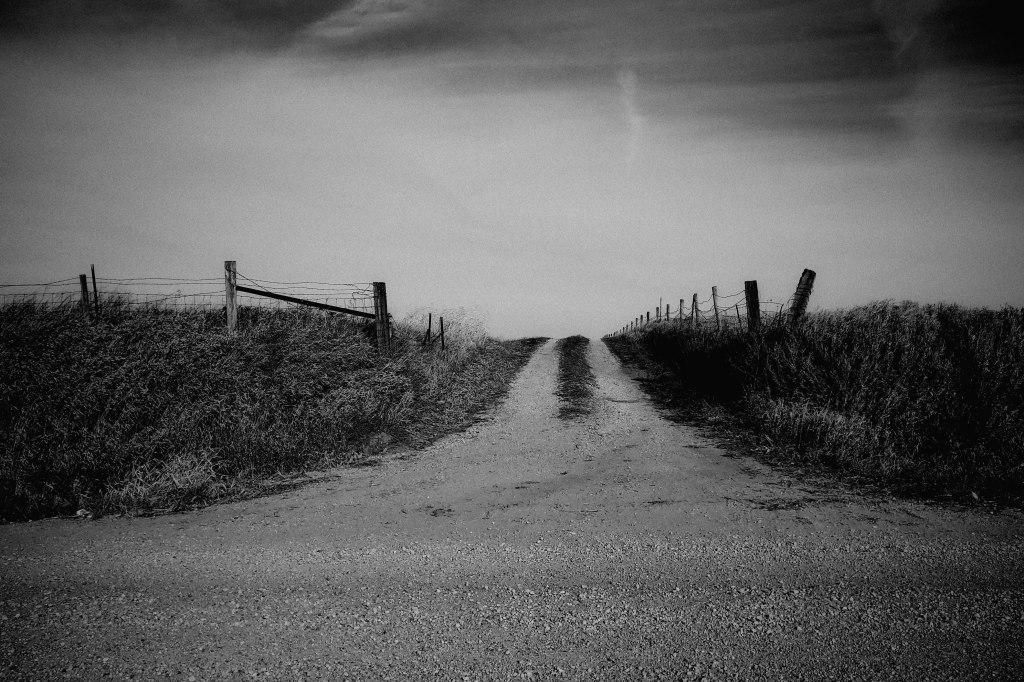
A week ago I posted the following photograph of a dirt road leading back into field that held a pioneer cemetery. It sparked a number of folks to ask a perfectly reasonable question: Dude, what the hell is a pioneer cemetery? I asked the same question the first time I came across a pioneer cemetery. I’m here to give y’all the answer.
Road to Sams pioneer cemetery
Let me amend that. I’m here to give a couple of answers. I mean the obvious answer is simple: a pioneer cemetery is a plot of ground where pioneers are buried. But that leads inevitably to the question: Dude, what the hell is a pioneer?
Let’s start there. The term ‘pioneer’ comes from the French pionnier, which originally referred to a type of specialized foot soldier — troops who were furnished with digging and cutting equipment and sent into new territories to prepare the way for an army. The root term is much older, medieval Latin, pedonem, which meant ‘foot soldier’. That’s also the root for the term ‘pawn’. In chess, pawns always move first; they’re essential, but disposable. The same applies to pioneers; they go first, they’re essential, but disposable.
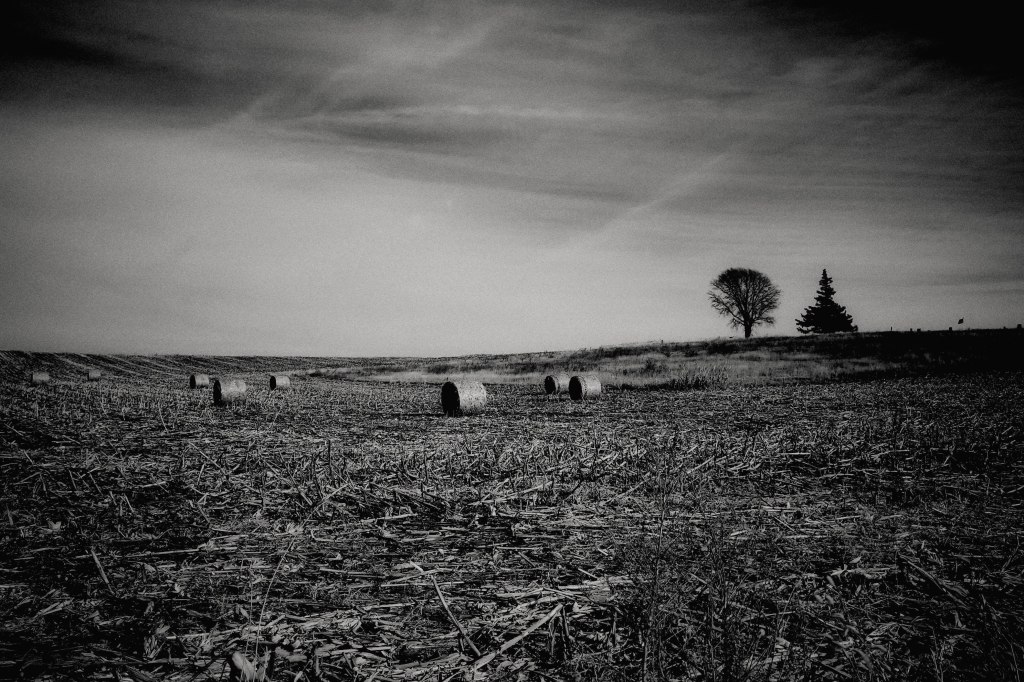
Sams pioneer cemetery is located on the rise by the trees.
In the US, the term ‘pioneer’ has a vaguely heroic connotation. I suppose that’s warranted because it takes a sort of courage — or maybe desperation — to take your family into unknown territory. And that’s what the early US pioneers were. They weren’t soldiers; they were mostly families of immigrants and first generation Americans. At the time, they were called settlers, or homesteaders, or sodbusters. They were families who loaded up wagons with their few possessions and pushed into largely unmapped territories, fording rivers and streams, in the hope they could find land they could farm. When they came to land they felt was promising, they stopped. They chopped down trees and built cabins out of the logs. They cleared trees and stones from the land by hand or with the help of livestock and created fields for crops. They planted and harvested, and they died and were buried.
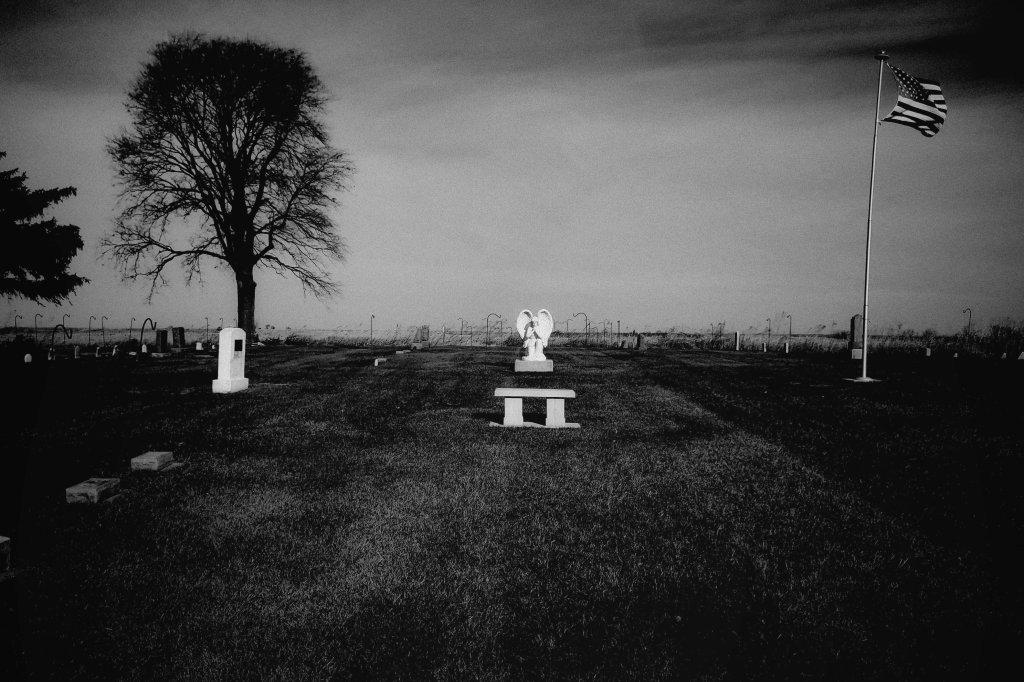
Sams pioneer cemetery.
Pioneer cemeteries are plots of land, often on family property, that these small, loosely formed farming communities agreed was sufficient to bury their dead. They’re the graves of the thousands of unremembered, ordinary people who turned wilderness into settlements.
We have to acknowledge the pluckiness of these pioneers, but we also need to be aware there was a very deep ugliness in what they were doing. In the US, pioneers were the leading edge of the concept of Manifest Destiny. The idea was promoted initially by John O’Sullivan, the son of an Irish immigrant. He wrote it was the new nation’s “manifest destiny to overspread the continent allotted by Providence for the free development of our yearly multiplying millions.” In essence, manifest destiny was a nice way of saying the expansion of white Europeans and their culture across the continent, displacing or killing the native tribes who’d actually lived there for centuries, was not only inevitable, it was also justified by god.
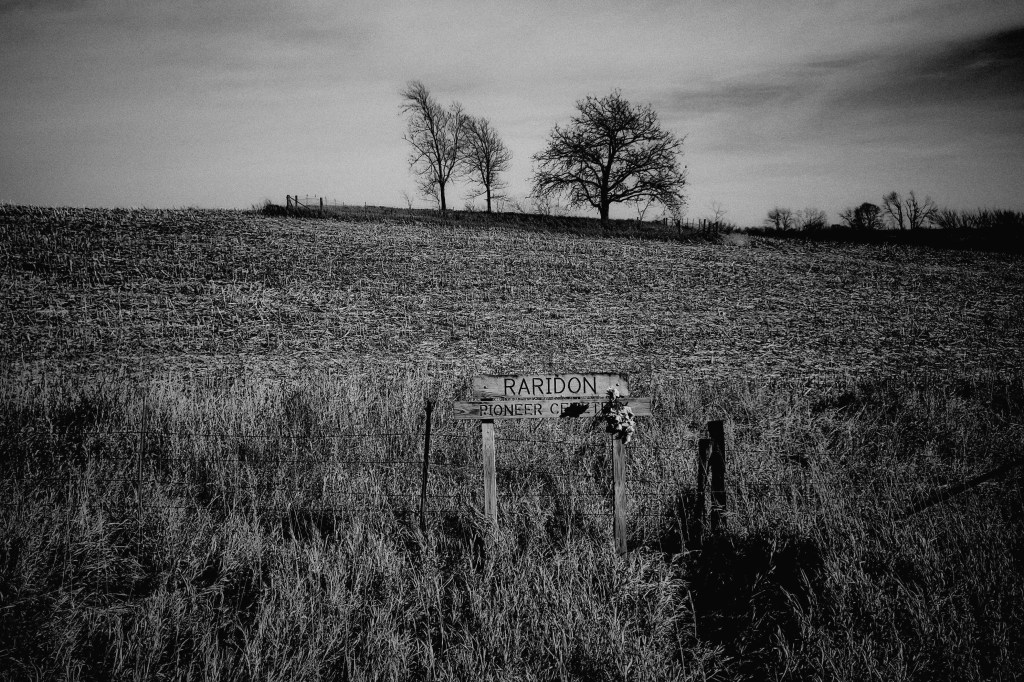
Raridon pioneer cemetery in the middle of a field.
There you have it. The pioneers were intrepid settlers struggling to create a life for themselves. And they were also sanctimonious invaders who were comfortable with the idea of pushing the indigenous people off their land, stealing it for themselves, and killing those natives who resisted.
That’s who the pioneers were — settlers who were almost as expendable as the natives they dislodged and supplanted. But not everybody buried in a pioneer cemetery was an actual pioneer. The pioneers created the conditions for permanent settlements; permanent settlements inevitably bring disputes; disputes require some forum for resolution. That means a bureaucracy, and bureaucracies demand definitions.
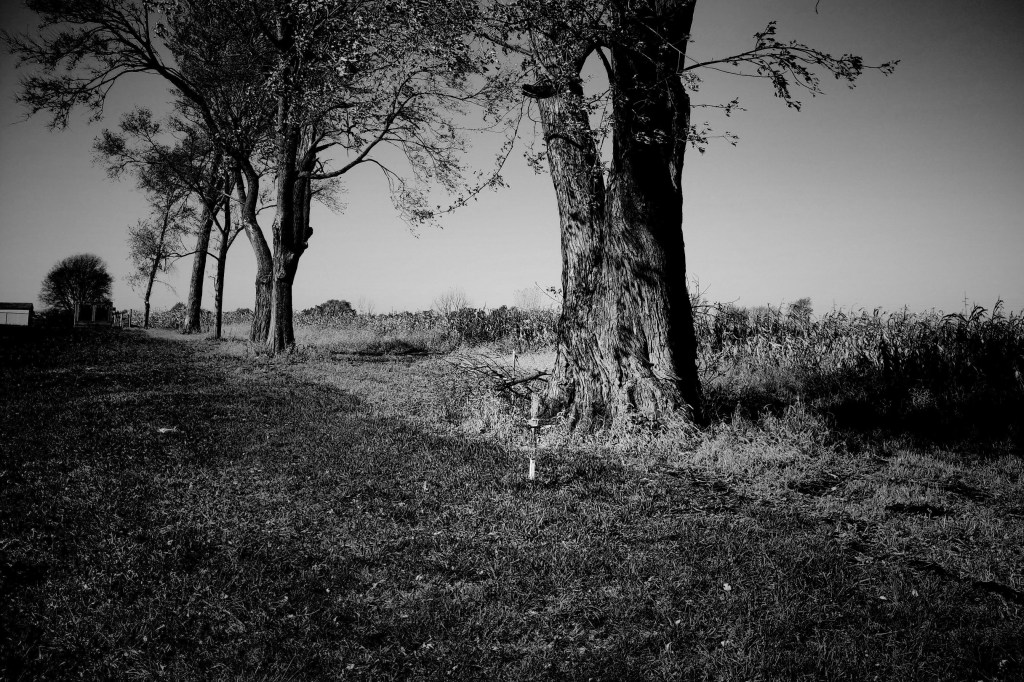
The Enterprise pioneer cemetery has only a single marked grave, a simple cross by a tree.
Which brings us back to the original question: Dude, what the hell is a pioneer cemetery? The bureaucratic answer depends on where you live; different states have different legal definitions of ‘pioneer cemetery’. In Iowa, where I live, the law defines it as a cemetery in which there have been no more than twelve burials in the preceding half century. In neighboring Nebraska, a pioneer cemetery is defined as an abandoned or neglected cemetery that was founded or situated on land “given, granted, donated, sold, or deeded to the founders of the cemetery prior to January 1, 1900.”
There is, I think, something weirdly admirable about a bureaucracy making a deliberate decision to recognize and honor the ordinary people who lived and died in small farming communities dating from the late 1700s. The bureaucracies may not care about the individual pioneer cemeteries, but they care about the notion that there are people buried and memorialized in remote, semi-forgotten patches of land.
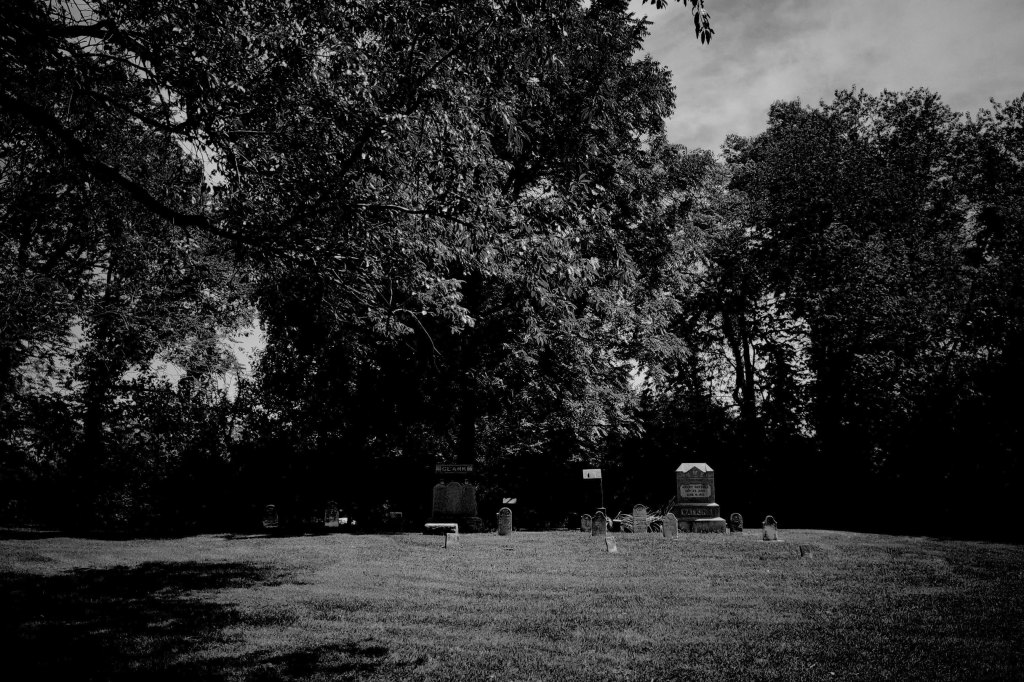
This pioneer cemetery could only be reached by steep path through overgrown brush under a canopy of old trees. Yet it was beautifully cared for by a local Boy Scout troop.
Most of the pioneer cemeteries I’ve visited are lonely places on patches of farmland or meadowland. They’re generally located on a low hill, most often with a small grove of trees. Some are only accessible by overgrown paths, or by vehicles with high ground clearance. A few pioneer cemeteries are well-tended; most aren’t. Many are overgrown with grass and weeds. Most have gravestones that are damaged, weathered, unreadable.
But all of them are full of stories. There are graves of soldiers — Civil War veterans, veterans of the world wars. You can tell by the dates which ones died in uniform. There are graves of wives who outlived their husbands, graves of mothers who died in childbirth, graves of the children they bore. There are lots of graves of infants, often with the number of months or weeks they lived.
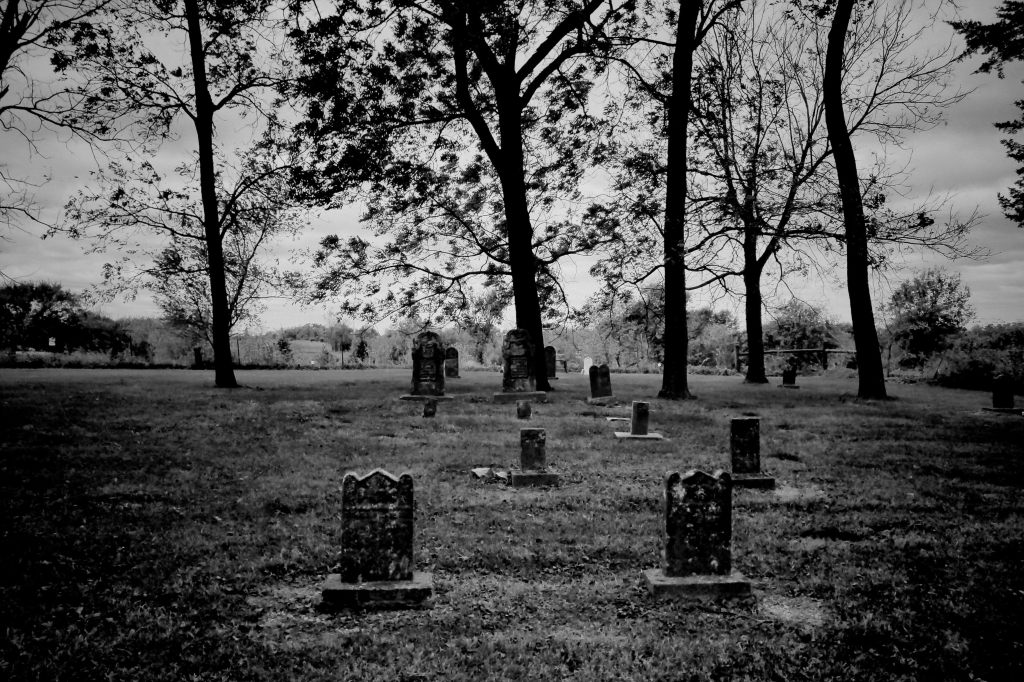
Trester pioneer cemetery
All cemeteries and graveyards tend to be quiet. Pioneer cemeteries are more than quiet. They’re silent. And yet they’re full of stories. Untold stories. Forgotten stories. The first person buried in what would eventually become the Slaughter pioneer cemetery was eight-year-old Hester Slaughter, who died of ‘the fever’ in the summer of 1846. She was buried in a corner of the family farm. There was no lumber mill in the region, so there was no sawn lumber to make a casket. Instead, the family split the trunk of a tree that had been chopped down to clear the land; they hollowed it out, placed poor Hester inside, closed it back up, and buried her. A total of 69 people would be buried in that small plot of land, including three Civil War veterans and a veteran of the War of 1812.
Among them is Bluford Sumpter, who served in the 39th Iowa Regiment in the Grand Army of the Republic during the Civil War. We don’t know the details of his story, but we know the 39th was active from November 24, 1862, to August 2, 1865. We know they were involved in a great number of battles and skirmishes. We know the 39th helped chase Confederate General Nathan Bedford Forrest (who would survive the war and help found the Ku Klux Klan) into Tennessee and suffered many casualties. We know they eventually deployed with Union General William Tecumseh Sherman in his brutal and savage march across the South that essentially ended the war. We assume Bluford Sumpter survived the war (since it was uncommon then to ship bodies home for burial), but there are no dates on his tombstone, so we don’t know when he died. We only know he was eventually buried in the Slaughter cemetery in Jasper County, Iowa.
Slaughter pioneer cemetery in the grove of trees in the middle of a field.
Also buried nearby is William Wimpigler, who has his own story. Wimpigler served in the Iowa 48th Battalion during the Civil War, He was one of the Hundred Days Men — a troop of volunteers raised in Midwest during the final days of the war; they agreed to serve one hundred days in order to free experienced troops for combat service. The 48th spent its hundred days at the Rock Island Barracks in Illinois, coincidentally guarding Confederate prisoners taken during Sherman’s campaign.
Both of those Civil War veterans are buried near eight-year-old Hester Slaughter in her hollowed out log coffin on what was once an unused parcel of her family’s farm. Every grave has a story. But we only know about those stories exist because the graves exist, and we only know those graves exist because some unnamed person in a bureaucracy decided it was worthwhile to officially recognize and record the existence of pioneer cemeteries.
That unknown bureaucrat has a story too. We all do. Few of them get told, but all of them are worth telling.












 gregfallis.com