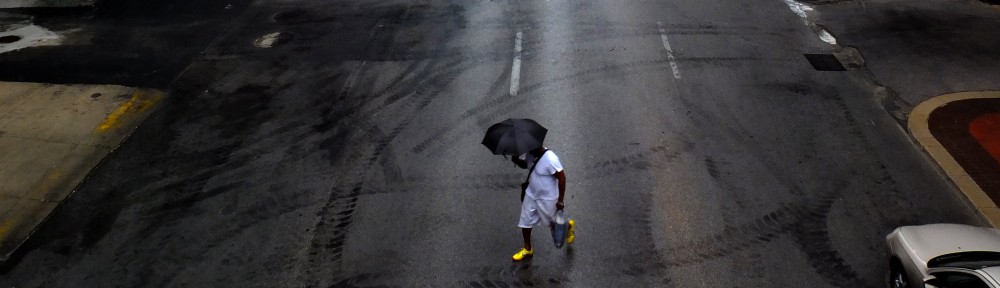
I can be a terribly annoying traveling companion. Unless I’m in a hurry — and I’m almost never in a hurry — I prefer to travel along secondary highways and county roads. That means driving more slowly on roads that are often poorly maintained; it means getting caught behind tractors for miles; it usually means no fast food for lunch; it means driving through small towns with absurdly conservative speed limits.
But I like the small towns. Small towns can surprise you. There’s always a chance you’ll come across something odd and/or fascinating and/or emotionally moving. On my way toward the Mississippi River last week, I came across a water tower in the shape of a teapot. And a billboard commemorating a local boy who’d been killed in Iraq. And a diner owned and operated by a guy with a hook for a hand. And a town named after a 19th century Muslim religious and military leader.
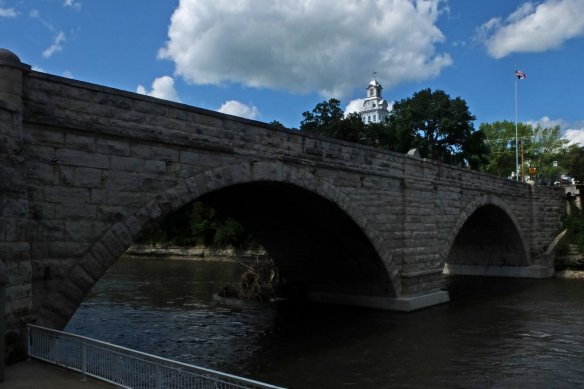
Elkader, Iowa
Seriously. I am NOT making this up. I’m talking about Elkader, Iowa, located on the banks of the Turkey River in Pony Hollow. Yes, that’s right — there’s actually a real place called Pony Hollow, through which the Turkey River runs. Elkader’s current population is about 1275, which is only about 800 people more than when the town was founded in 1846. Back then, it was nothing but a gristmill, a sawmill, and a blacksmith shop.
When the local leaders decided to name their new town, they chose to name it after one of the most respected men of the era: Emir Abd-al-Qādir ibn Muhieddine al-Hasani el Djezairi. He was a Sufi scholar, the Commander of the Faithful, a jihadist, an Algerian resistance leader, a poet, and a military leader.
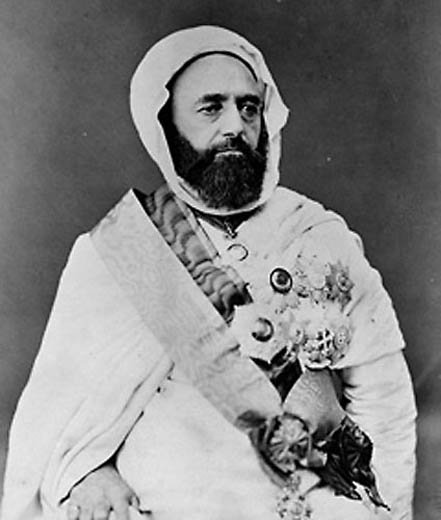
Abd-al-Qādir ibn Muhieddine al-Hasani el Djezairi
But you can’t name your town Abd-al-Qādir ibn Muhieddine al-Hasani el Djezairiville, no matter how much you respect the guy. Fortunately, he was usually just referred to as Abdelkader. So…Elkader. Which, let’s face it, is still a pretty odd name. So who was this guy? And why would Iowans name their town after him? I’m so glad you asked.
Abdelkader was born in Mascara, Algeria in 1808 (or somewhere around there — 19th century Algerian record-keeping left something to be desired). His father ran a religious school for Sufis, so it’s not surprising Abdelkader was a good student; he could read and write by age 5, and by 14 could recite the entire Qur’an by memory. When he was 17 he set out on the Hajj — the religious pilgrimage all Muslims are expected to make if possible. Afterwards he noodled around the Muslim religious and philosophical world for about five years. He was, it seems, something of a religious nerd.
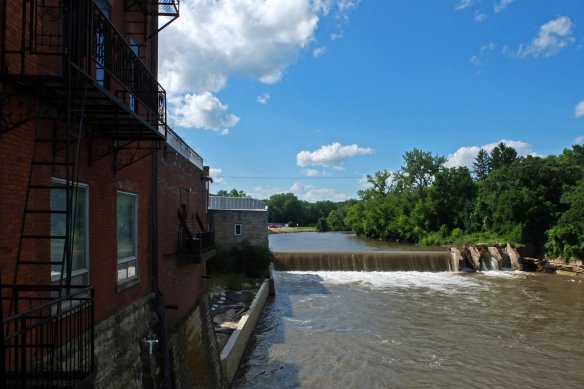
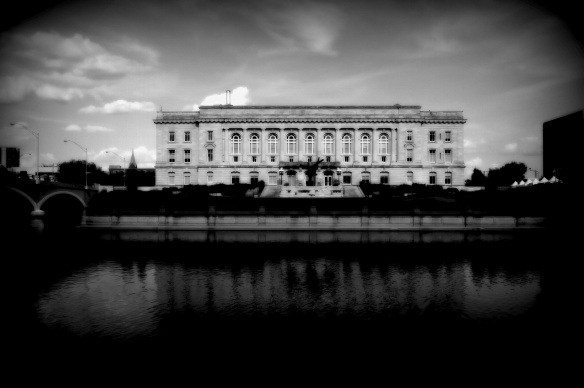
Elkader, dam on the Turkey River
In 1830, a few months after Abdelkader got home, France invaded Algeria. At that time, Algeria was ruled by the Ottoman Empire. France wanted to boot the Ottoman tyrants out of Algeria and replace them with…well, French tyrants. The people of Algeria weren’t particularly happy with Ottoman rule, but neither did they want to be ruled by the French. So Abdelkader found himself forced to shed his religious nerd role and start waging a guerrilla war against the infidel French. He became an Algerian nationalist.
And hey, he won. Sort of. For a while. He spanked the French, and at one point Abdelkader controlled a hefty chunk of Algeria. He established a benevolent theocracy; Jews and Christians were not only made welcome, they were given high government positions. He even earned the respect of the French soldiers who fought against him — not just as a warrior, but also as a kind and generous opponent. His treatment of French prisoners of war earned Abdelkader international praise. Although the French soldiers respected him, French leaders didn’t. They initiated a scorched-earth policy against the territories controlled by Abdelkader. The French destroyed the houses and farms of civilians, they burned the crops and slaughtered the livestock.
So after 17 years of fighting, Abdelkader surrendered. He was imprisoned in France for half a decade, then released on the condition that he never return to Algeria.
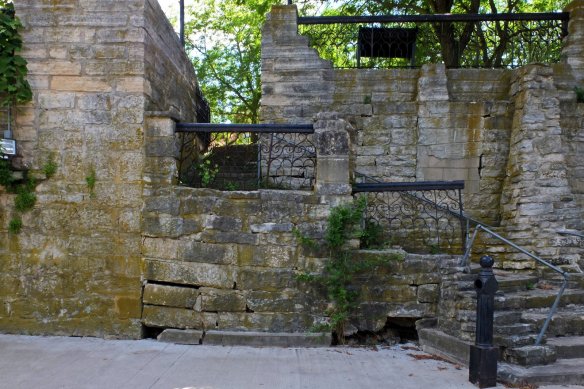
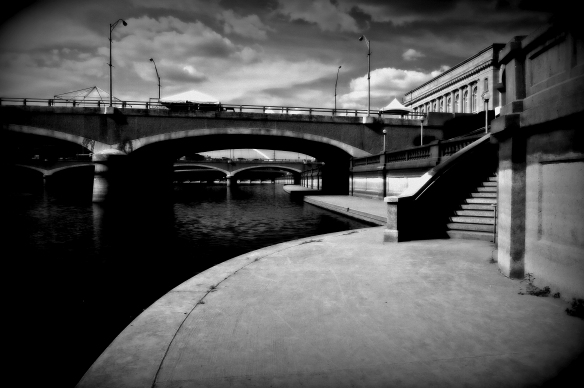
Elkader, stairs to the river walkway
He settled in Damascus, Syria and lived there in relative peace. Then in 1860 a conflict between Muslims and Christians broke out in other parts of Syria. The fighting spread rapidly; almost 400 Christian communities were destroyed, and maybe 20,000 Christians were killed.
When the conflict reached Damascus, Abdelkader intervened. He and his children and his followers went into the streets and rescued local Christians at great personal risk. He brought as many as possible into his home and his gardens and his courtyard — nuns, merchants, laborers, artisans, any Christian who was in danger. And he kept them safe.
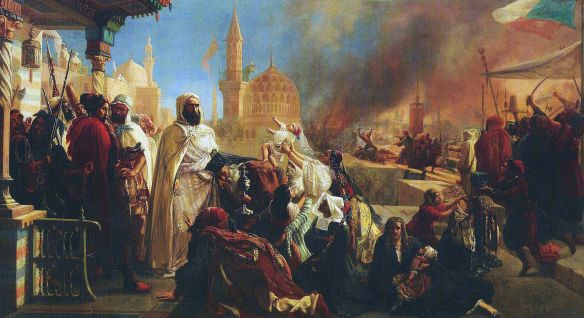
Abd-al-Qādir saving the Christians of Damascus
News of this spread, and Christians all over the world rushed to embrace Abdelkader. Greece bestowed on him the Grand Cross of the Redeemer (a poor grasp of irony, the Greeks). The Ottoman Empire issued him the Order of the Medjidie, First Class. The Vatican gave him the Order of Pius IX. The parliament of Great Britain sent Abdelkader a gold-inlaid shotgun. Not to be outdone, President Abraham Lincoln sent him a pair of inlaid pistols. Even France, which had imprisoned him and condemned him to exile, gave him the Grand Cross of the Légion d’honneur and offered him a pension (they didn’t let him return to Algeria, though — they’re French, not stupid).
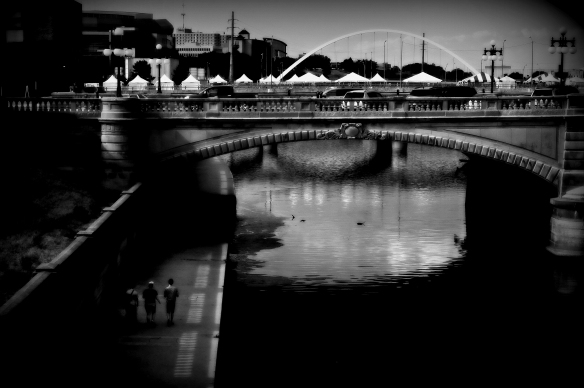
And in Iowa, they named a town after him. It’s not what you’d call a great town. It’s a tad beat-up. A little worn with age. Not very well-maintained. But the river is nice, and the bluffs that surround the town are picturesque. And they have a very fine stone bridge. Elkader is very proud of its bridge, and they want visitors to know it’s the largest stone double-arch bridge west of the Mississippi. Being west of the Mississippi is pretty important to the good people of Elkader; they also want folks to know they have the oldest continuously operated grocery store west of the Mississippi (Wilke’s Grocery, if you’re really curious).
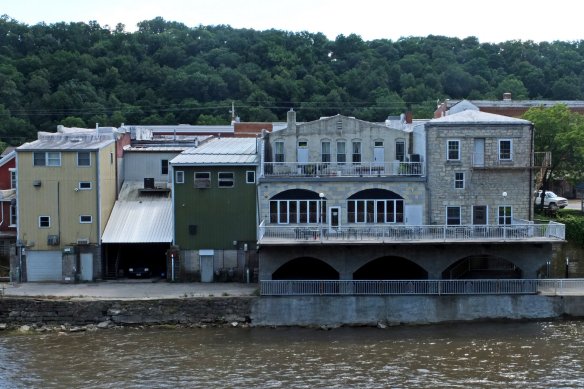
Elkader, houses along the Turkey River
For the most part, Elkader is just another small Midwestern country town. But the guys who named it did a better job than they could have imagines. The town’s name draws a small but steady stream of Algerian visitors. Algerian immigrants, Algerians touring the U.S., second and third generation Algerian-Americans. They all come to see the Iowa town named for one of their national heroes. One Algerian-American came to visit, and decided to stay. He and his partner opened an Algerian restaurant — Schera’s. Did I mention this guy is not only Algerian by birth, but also a Sufi Muslim? And he’s gay.
Yes, there’s a gay-owned Algerian restaurant in a small Iowa town named after an Islamic insurgent. And the remarkable thing about that fact? It doesn’t seem to be that big a deal. Oh, sure, there are some local folks who dislike the name of the town, and tried to change it after the 9/11 attacks (Elkader, they complained, sounds too much like al-Qaeda). And yeah, there are some folks who dislike gay people. And yes, there are even some people who object to the ‘foreignness’ of the food served at Schera’s. But basically nobody pays much attention to the people who make a fuss. The town has always been called Elkader, gay folks have been legally getting married in Iowa for half a decade, and you either like Algerian food or you don’t. No big deal.
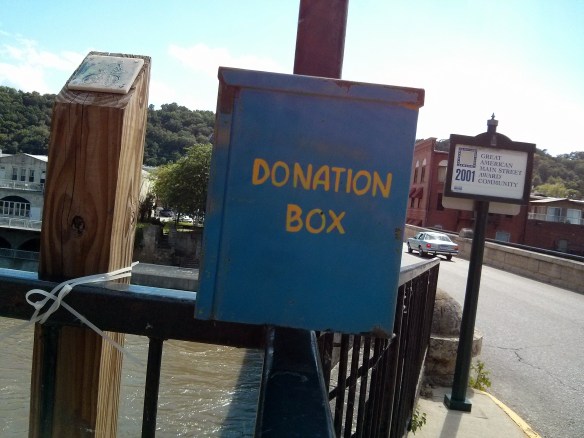
Elkader, bridge donation box
That’s just the way things are. They really are proud of their bridge, though, and with good reason. It really is a very fine bridge, east or west of the Mississippi. If you ever happen to find yourself in Elkader, they accept donations to maintain the bridge. Drop a buck or two in the box. It’s what Emir Abd-al-Qādir ibn Muhieddine al-Hasani el Djezairi would do.