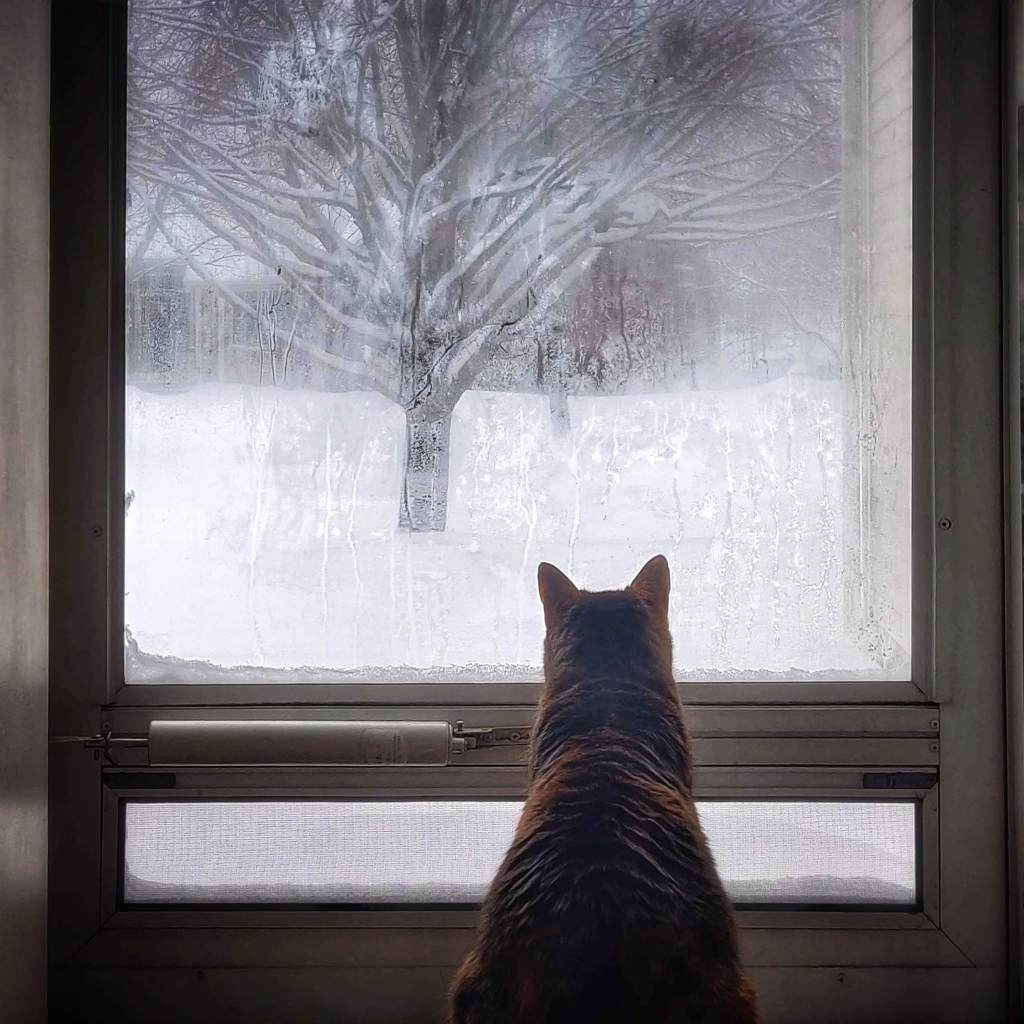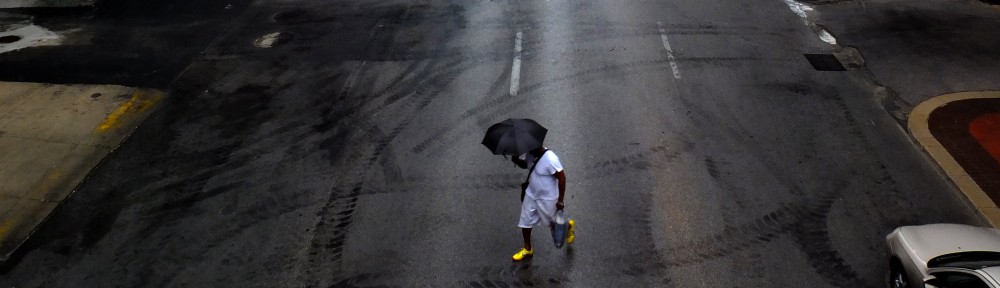
another ordinary day

Wake up, get myself dressed, wander into the kitchen, remember the cat isn’t going to be there, make coffee, read the news, get distracted by…something. That last bit? Getting distracted by…something? Story of my life, right there.

I’m not driven by ambition or security or responsibility or success (whatever that means), but I am ridiculously weak to curiosity. I have a compelling need to know stuff. Unfortunately, it’s rarely useful stuff. If you’re looking for somebody who knows how to repair something mechanical or build a cabinet or replace an electrical outlet, I’m completely fucking useless. But if you ever want to know the name of the brother of the last Saxon king of England or the history and etymology of ‘spatula’ or why jamon iberica is the best ham in the world, I’m your huckleberry.

I only know these things because I allow myself to be distracted by something. And following that distraction led to something else, which led me to something else, which ended up with me accumulating still more useless information. And that’s exactly what happened to me this morning.

In an online forum devoted to readers of the historical fiction of Dorothy Dunnett I came across a passing reference to St. Mary’s Loch–the site of a band of mercenaries in Dunnett’s work. Being familiar with the novel, I had a general notion of where the loch was located in Scotland, but (and this where it always starts…with that but) I decided to look at a map to get a more exact location. And I was curious why the loch was named for St. Mary.

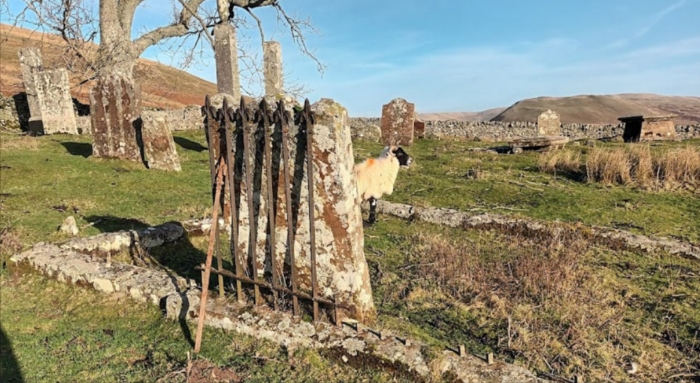
The answer to that last question was both obvious and easy to discover. It was named for a church dedicated to St. Mary. That church is gone now, but the graveyard is still there (and since this is about useless information, the difference between a graveyard and a cemetery is that a graveyard is associated with a churchyard, which requires a church; so this grave site is still a graveyard even though the church is gone).

St. Mary’s graveyard.

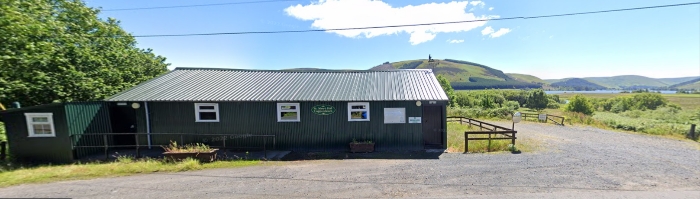
Information about the burial site led me to somebody’s blog post about St. Mary’s Loch, which included a reference to “the Hamlet of Cappercleuch with its couthy old, corrugated iron village hall.” Multiple sources of distraction here. What the fuck does couthy mean? (Spoiler: it’s a Scots term meaning ‘sociable, friendly, congenial, comfortable, snug.) And who wouldn’t want to see a couthy old, corrugated iron village hall?

That led me to Google Maps and Google Street View of Cappercleuch. It turns out that a corrugated iron village hall is…well, just that. It’s basically a rather ordinary, disappointing metal shed. Not particularly old, and certainly not very couthy.

St. Mary’s Hall at Cappercleuch — neither old nor couthy.

Still, as long as I was noodling about with Google Street View, I figured I may as well spend a few minutes looking at St. Mary’s Loch and seeing what else Cappercleuch had to offer. And within ninety seconds I came across another distraction. This:

What the hell is this?

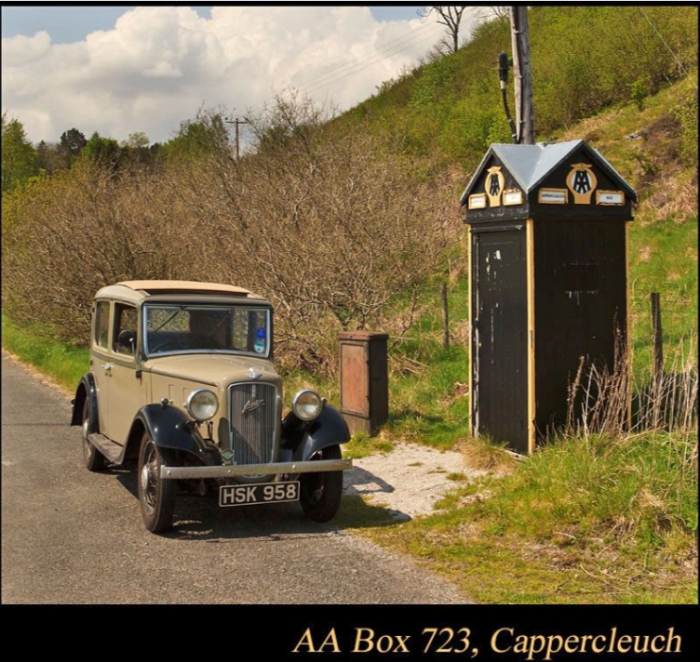
Reader, now THIS is a serious distraction. Just what the hell IS this? I mean, I can see what it is: a small, cross-gabled, distinctively decorated, phone-box sized structure. But what is its purpose? Why is it located just off the A708 motorway in Cappercleuch? (And if you’re curious enough to look for this on Google Maps, here’s a shortcut for you.)

The first thing I learned was that the A708 was one of the five most dangerous roads in proportion to traffic in all of Scotland. Or at least it was between 2007 and 2009. Not particularly helpful information, unless many of those accidents were because drivers were distracted by this weird boxy structure.

We can assume it’s not a Scots Tardis, but it has that ‘police box’ aura about it. It’s something official, certainly. The carefully crafted logo seems to confirm that. If we look closely, we can sort of see that it has the number 723 on the side. So, of course, the only thing for us to do is Google Box 723 Cappercleuch. And that gives us this:

I’m just going to assume you’ve made the same leap I did. AA stands for Automobile Association. It’s the UK version of AAA. AA boxes were an early form of roadside assistance in the UK. The first AA boxes were introduced in 1911. They were lit by oil lamps at night, and were sometimes referred to as “the lighthouses of the road.” The AA boxes contained maps to help folks who were lost, as well as a fire extinguisher, a lantern, and a telephone available to contact the AA for assistance. Members of the Automobile Association were issued with keys that fit all AA boxes in the UK.

By 1919 the AA had established a well-connected communication and assistance network of over a thousand roadside boxes, many of which were manned by yellow-uniformed ‘sentries’ who were there to offer free assistance.

Improvements in technology eventually made the AA boxes obsolete. By the late 1960s, the AA began to phase them out. In 2002 only 21 call boxes were still standing; AA shut down the entire network and made plans to dispose of the structures. The following year the boxes were listed as historic landmarks, and efforts were made to physically restore them. Apparently nineteen boxes still exist.

There’s a part of me, of course, that wants to use Google Maps to find them all. It shouldn’t be hard to do. There is absolutely NO REASON for me to do that, but at some point I probably will. Because that sort of pointless activity is my wheelhouse.

But it won’t be done today. I’ve learned some minimal self discipline over the years.

I’ve no idea how much of my day is spent giving in to my curiosity. I’m going to guess at least a couple of hours every day. There are folks who’ll consider this an inefficient use of my time.

Ain’t it great?

rabbit hole

I am weak to distraction. Doesn’t much matter what I’m doing, if I stumble across an interesting bit of information, an intriguing casual comment, a footnote in a book, almost anything that catches my eye and my imagination, I’m lost. I’ll stop what I’m doing and leap down that rabbit hole.

This morning on Twitter I came across a quote by novelist Henry Green, explaining the inspiration for his 1945 novel Loving. This is what he said:

I got the idea of Loving from a manservant in the Fire Service during the war. He was serving with me in the ranks, and he told me he had once asked the elderly butler who was over him what the old boy most liked in the world. The reply was: ‘Lying in bed on a summer morning, with the window open, listening to the church bells, eating buttered toast with cunty fingers.’ I saw the book in a flash.

It’s a great anecdote and an absolutely terrific line by the butler. So…there’s my rabbit hole. I tracked down the quotation. It was an interview conducted by novelist Terry Southern for The Paris Review (TPR) in 1958. Southern was also smitten with the butler’s line and used it to tweak the nose of the TPR’s editor. He wrote, “[Y]ou realize of course that the word ‘cunty’ makes the reply, gives it bite, insight, etc. I mean to say it simply would not do to rephrase it.”

Why was Southern pointing this out? Because five years earlier, TPR’s debut issue had included one of Southern’s short stories in which the term shit had been edited out. Instead of one character telling another “Don’t get your shit hot” TPR printed “Don’t get hot.” That’s a much weaker line.

Southern felt so strongly about the editing that he demanded TPR issue a correction in the following issue. And hey, they did. Sort of. Here’s their disappointing correction:

Terry Southern is most anxious that The Paris Review point out the absence of two words from his story The Accident (issue one): the sentence “don’t get hot” should have read “don’t get your crap hot,” an omission for which we apologize to all concerned.

The non-correction correction infuriated Southern, of course. So he was delighted (and absolutely correct) to force TPR to include cunty in the interview.

This made me happy for a couple of reasons. First, of course, is the butler’s line itself, which is simple but poetic. Second, because every writer likes to see an editor put in their place (even though editors are almost always right, damn it). Third, because I had a similar experience years ago.

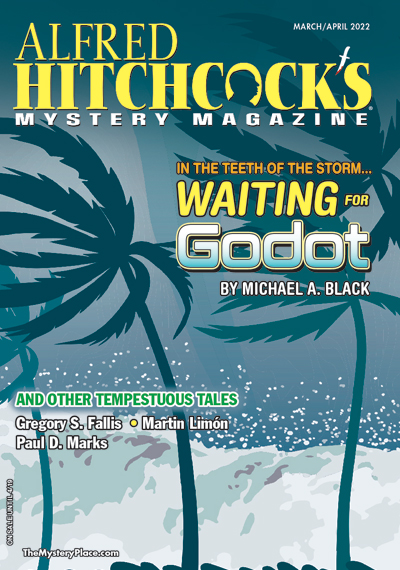
I’d written a short story called Maybe the Horse Will Learn to Sing, which was published in Alfred Hitchcock’s Mystery Magazine. The story included this line:

So in trying to tweak Sweeney’s nose all I’d managed to do was to step on my own dick. There’s a lesson there, I suspect.

AHMM wanted to change that line to read, step on my own foot or something equally awful. Since I wanted to get paid, I agreed to change the line to some other weak analogy (I can’t recall what the final version was). The following year, however, that story was included in the 1999 anthology The Best American Mystery Stories, edited by Ed McBain and Otto Penzler. When I was asked permission to reprint the story, I agreed on the condition that they change the line back to the original. Penzler laughed and agreed it was a better line. That laugh was worth as much to me as the check.

So, that was today’s totally pointless but (for me) entertaining rabbit hole. That was probably 90 minutes out of my morning, including writing this pointless but (again, for me) entertaining blog post.

drive-by

I went for a drive on Thursday.

No, wait. It would be more accurate to say I went for a ride; I didn’t do any driving, I was just a passenger. It would be even more accurate to say four of us decided to visit a small town and have lunch in some local cafe (or diner or bakery or brewery or whatever passes for a lunch spot in that particular small town), and while we were out, I shot some photos. This is something we do periodically. After we eat we tend to tool around fairly randomly and see what there is to see. We may tour the town (if it’s big enough to actually tour), we may wander along the surrounding back roads.

I generally sit in the front passenger seat and shoot photos. Sometimes we stop and I shoot photos, sometimes I shoot photos out the window, sometimes I convince the driver (my very patient and obliging brother) to stop, turn around, drive back to something I thought might make an interesting photo.

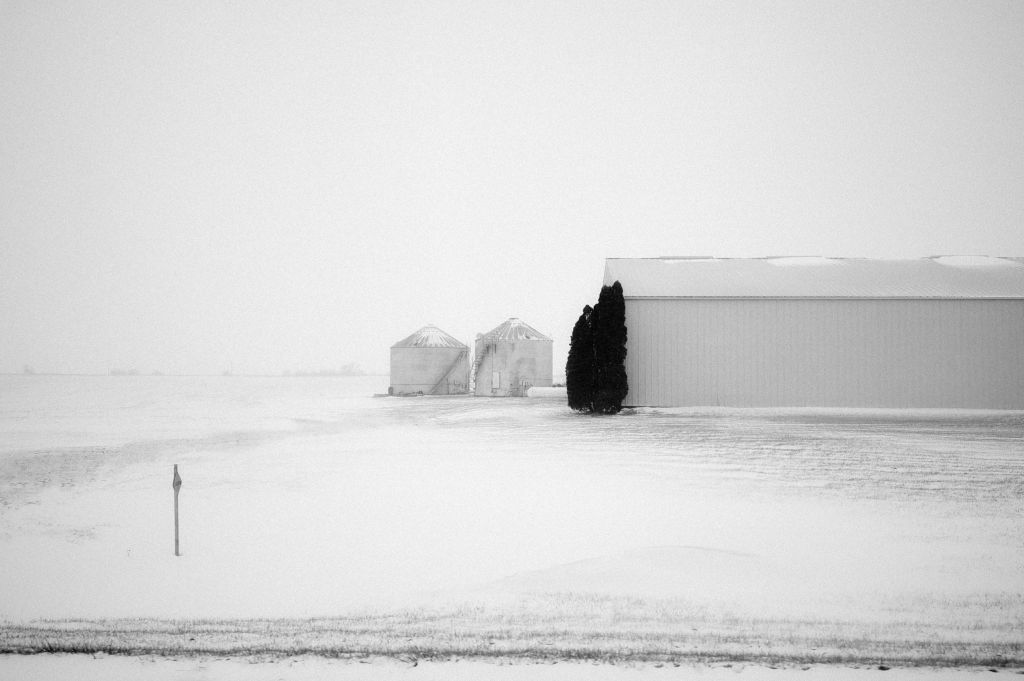
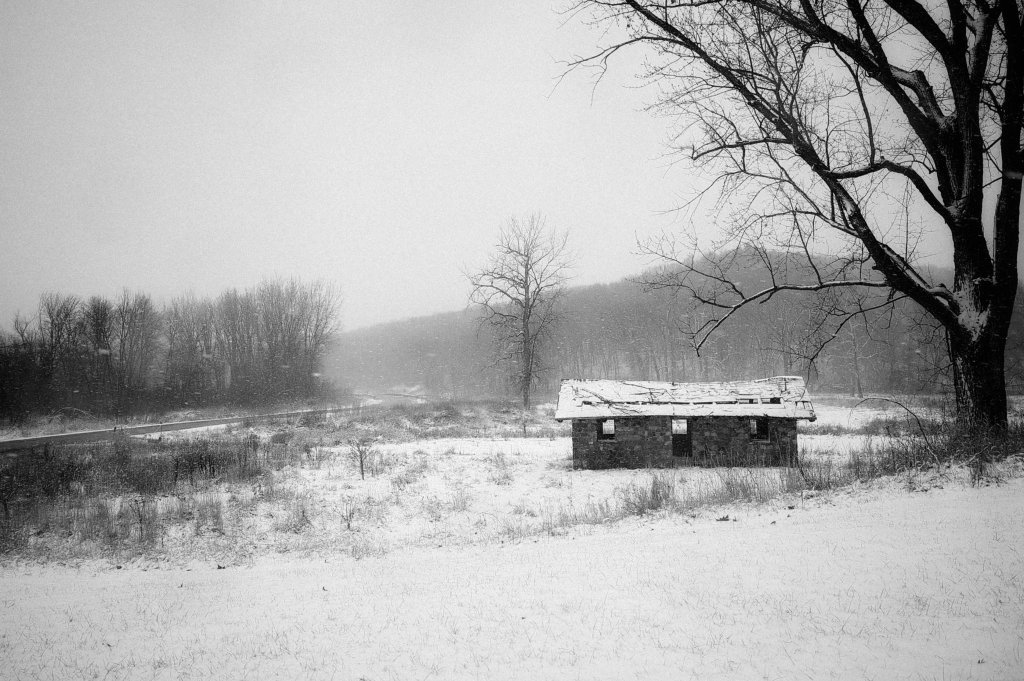
My point, if you can call it that, is that on Thursday we…well, we did that. It was a chilly, occasionally breezy day with a steady fall of exceedingly fine snow. I don’t mean fine in terms of high quality or excellence (although as snow goes, it was pretty fine); I mean fine in terms of texture and delicacy. It was mostly a light, powdery sort of snow; it made the world look like it had been dusted with a sprinkling of powdered sugar.

Two things. One, I used to bring one of my cameras on these ventures, but for the last few years I’ve mostly used my phone for this sort of photography. Two, in winter I tend to shoot in black-and-white. I know it makes more sense to shoot in color and convert it to b&w; you have greater control over the final image. But there’s some weird trigger in my brain that says, “Hey, old sock, if you’re going to make black-and-white photos, commit to it.” It doesn’t make any sense, but there it is.

Over the years I’ve used half a dozen different dedicated b&w phone apps. So far, I keep gravitating back to an app called Vignette, which is a very flexible app that allows you to create a number of different camera profiles. I bang it around until I get a b&w setting that meets my general needs and aesthetic, then save it. Every time I buy a new phone, I sort of recreate that setting (although the recreated version is never quite the same as the previous, I’m okay with that).

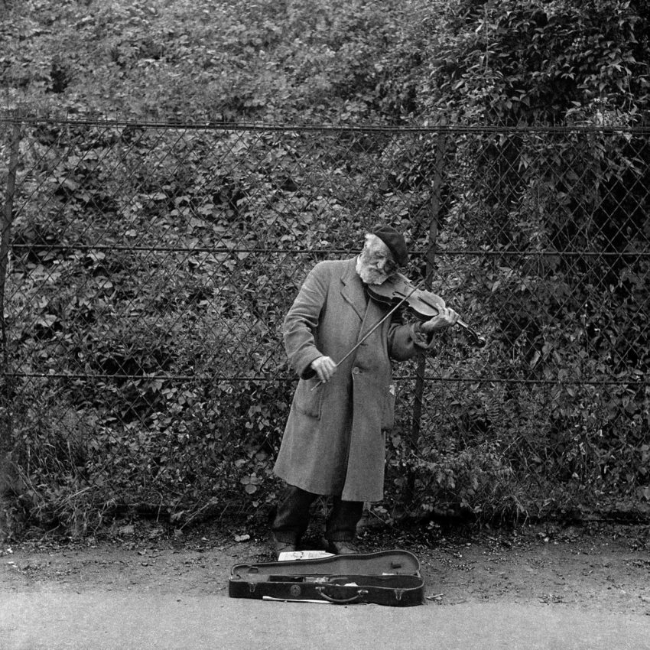
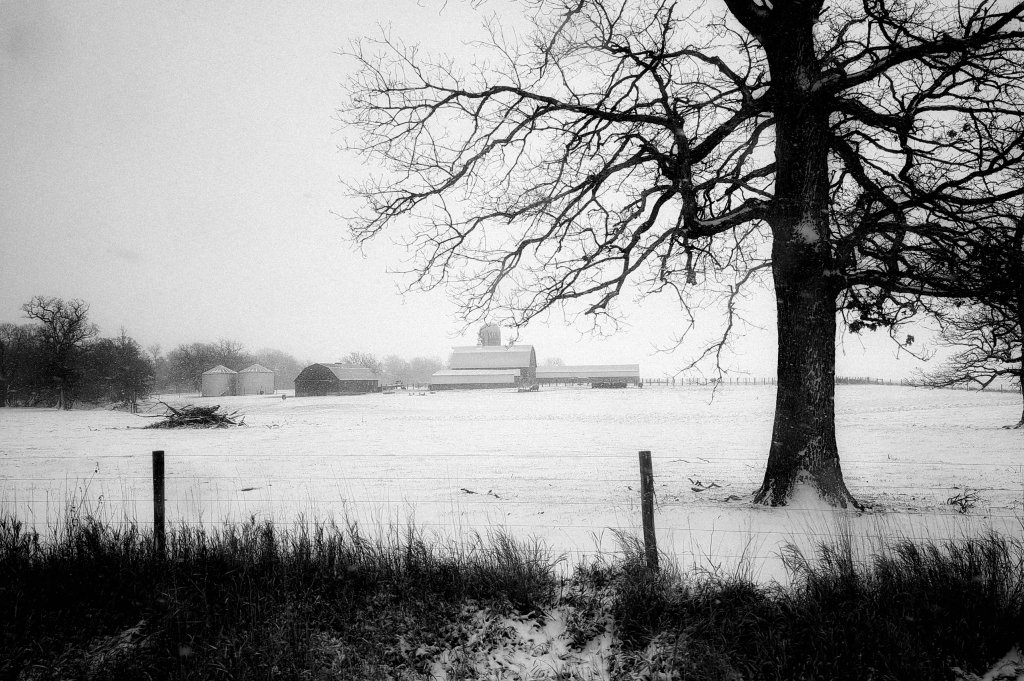
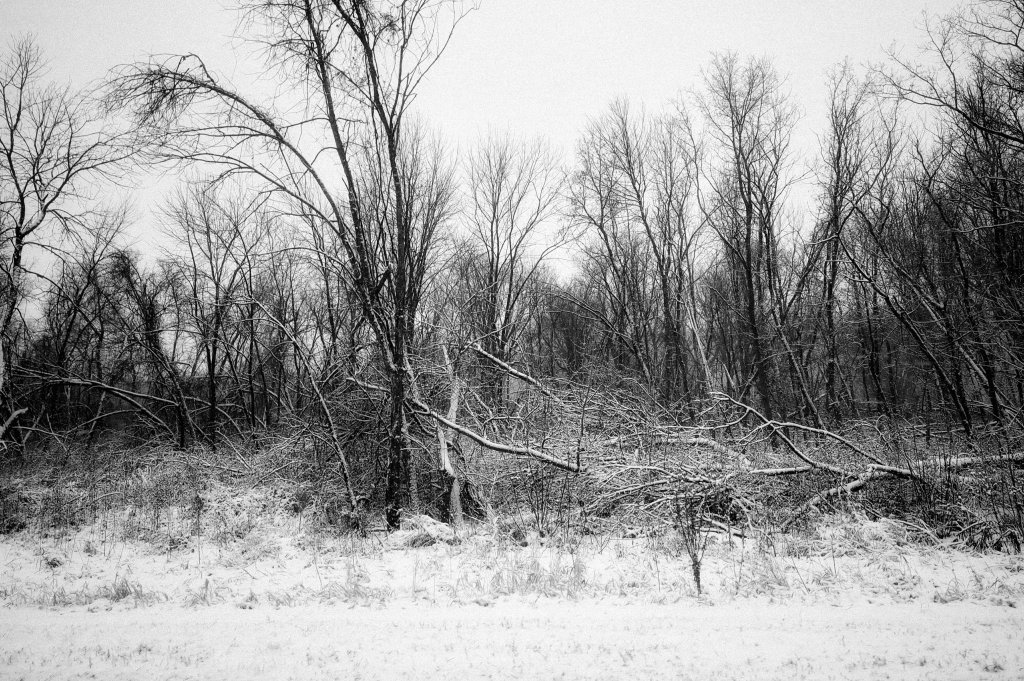
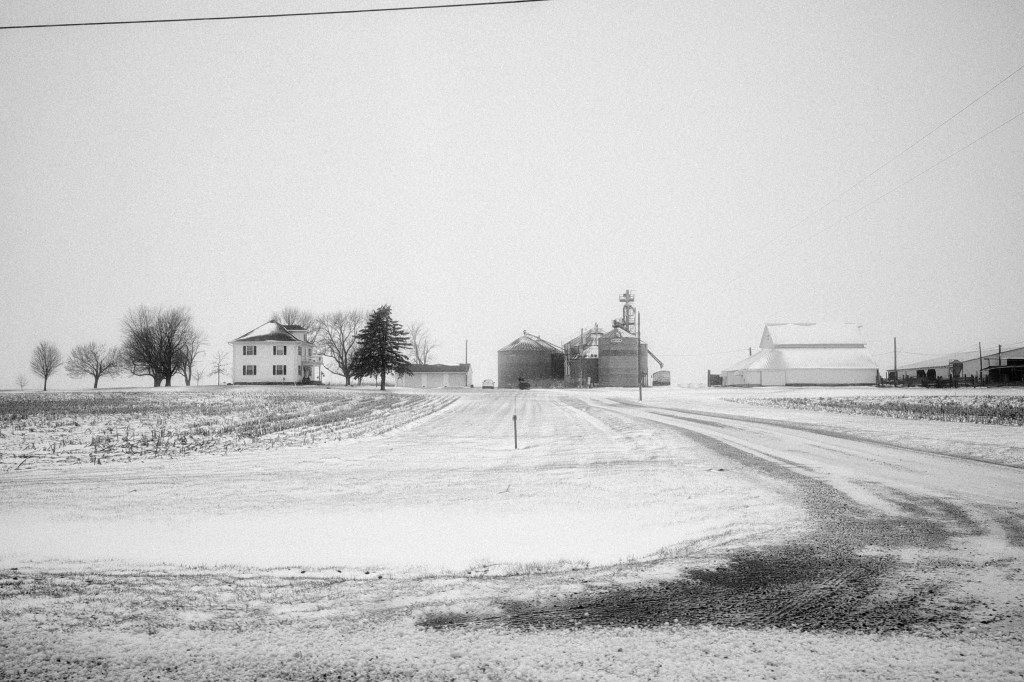
All of the photos here are drive-by photos. They were shot through the passenger side window (which, of course, was closed because it’s fucking winter here). There’s always a part of me that wishes the window was perfectly transparent, and a conflicting part of me that likes the fact that the window conditions change and the photos change accordingly. The window might be a tad foggy with condensation, or it might be streaked with water or melting snow, or even spattered with mud or road grime. It all finds its way into the photo.

Drive-by photography is ridiculous. It’s all about predicting an image–seeing what’s up ahead and visualizing what it might look like when you get there. If that’s loopy enough, you then have to anticipate what’s coming and try to time the shutter release (okay, there’s no actual shutter in a cellphone, I know that, but you know what I mean) to correspond with what you hope will be a proper composition. That’s another issue with the Vignette app: the shutter lags. Just a moment, but it’s a fairly predictable moment. Which means if you’re using Vignette to shoot a drive-by photo, you have to factor that lag into the equation.

Half the fun of drive-by shooting, of course, is not quite knowing what you’re going to get. You make a number of guesses and predictions based on your experience and intuition and your understanding of the technical concerns, and hope for a good result. Most times, you guess wrong. But sometimes you guess just right and the photo is what you hope it will be. I guessed right (or close enough to right) on the photos you see here. None of them has been cropped, but most of them have been rotated slightly to straighten the horizon line.

The snow helped. Not just because it was pretty, but because we were driving more slowly. That gave me more time to evaluate the shot and a larger margin of error.

There are few finer ways to spend a weekday, when all the normal employed people are at work and out of the way. Good company, good food (usually), good drink (usually), and the serendipitous exploration of some place we have no real reason to visit other than whim. I count myself very fortunate that I get to do this.

i don’t know what i’ll do tomorrow

The cat is dead.

I can hardly believe I wrote those words. But they’re true and there it is. My morning companion, my afternoon nap buddy, my evening pest, is dead. I know there are people who object to that term and I understand, but it’s necessary for me. The only way I can accept her absence is to acknowledge the fact that she’s dead. Nothing else would prevent her from being here with me. No rainbow bridge could stop her.

I’ve written about the cat before (here and here). I’ve always referred to her as “the cat.” She had an actual name, Abby, though I’m not sure I’ve ever used it. I really don’t know why. I always told folks I didn’t use her name because it seemed presumptuous for a human to attach a human name to an independent non-human being. I’d tell folks I didn’t use her name because I respected her autonomy. There’s probably some truth in that. I’m not sure how much.

I’d say she was an odd cat, but that’s true of every cat I’ve known. She was a small, stubborn, commanding creature. She liked things a certain way; she liked predictable ritual behavior. Every morning we’d check the perimeter, which basically amounted to the two of us standing at the back door and looking out at the yard; some mornings she’d stand or sit on my foot as I stood there. It was just a few moments, but we did it every morning. 

We did something similar every evening. I’d got in the habit of retiring to the basement at some point between eight-thirty and nine PM, where I’d write or watch television. She adapted to that and every single evening she’d come striding into the living room around that time, and she’d make it clear I needed to pet and feed her, and get my ass downstairs. She’d sit and stare at me if I didn’t follow the ritual. If I resisted, she’d move a bit closer and keep staring. The cat ran a tight ship. 

I don’t know what I’ll do tomorrow. 

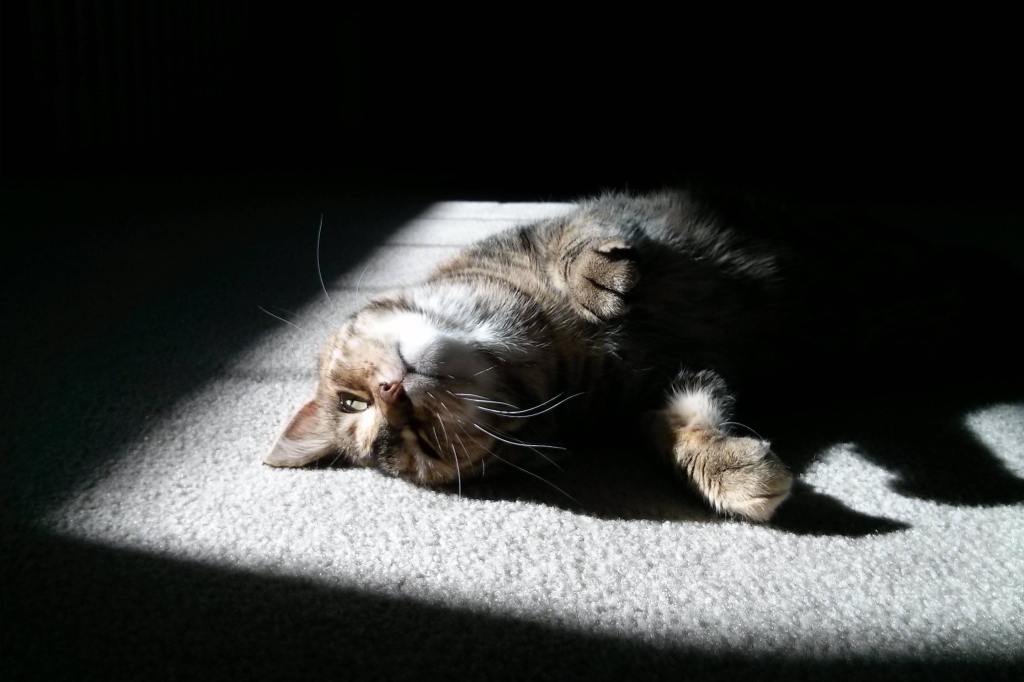
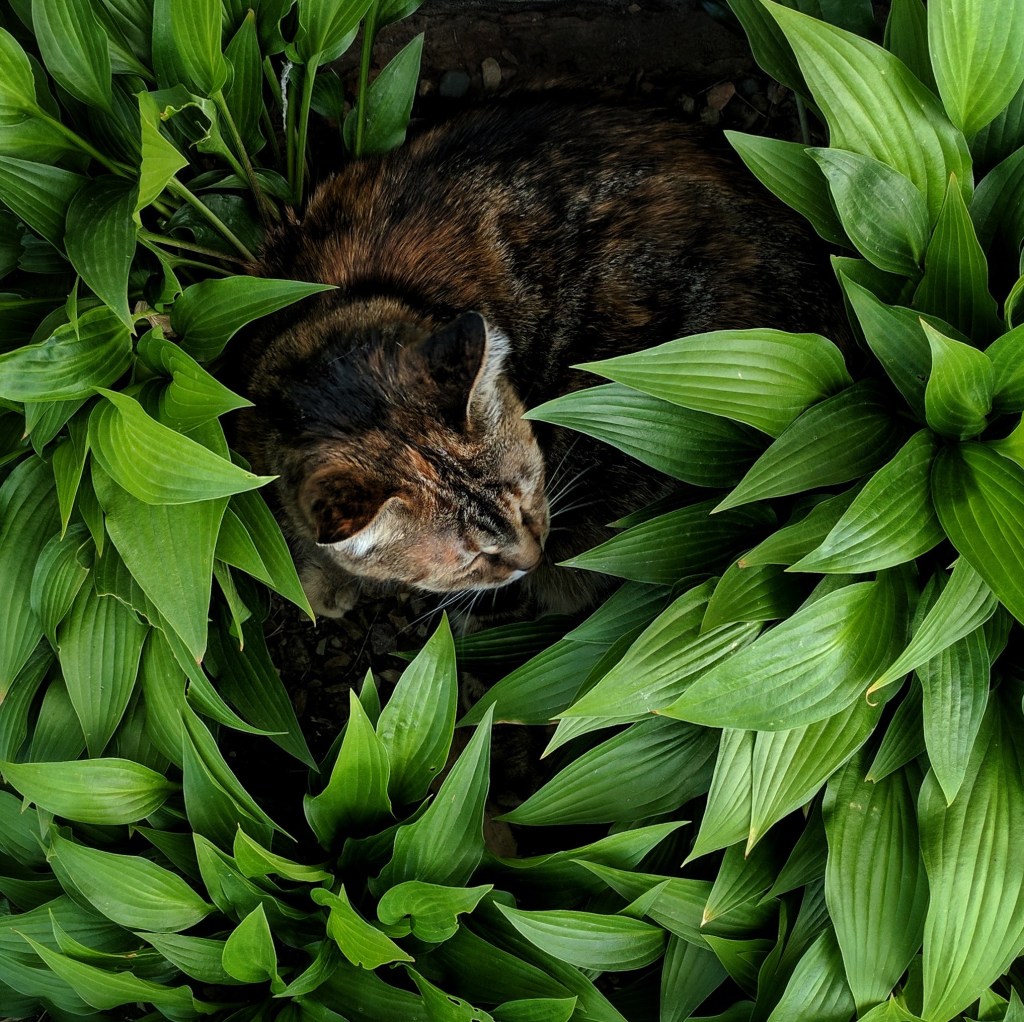
Like most cats, she napped a lot. In the summer she liked to nap in the hostas; she’d bury herself amongst the leaves and act as if she was invisible. In the colder months she liked to nap in a patch of sunlight. Or on my lap. I say she ‘liked’ it, but the truth was she was insistent. She wanted me to sit a certain way, with one leg tucked under the other. If I sat wrong, she’d fuss and fidget until I sat properly. She made me her nap monkey; she decided when and how the napping was to be done, and I just tipped my hat and went along.

She’ll never nap on my lap again. 

She wasn’t a talkative cat; she communicated mostly by staring at you. Sometimes, if you failed to notice her staring, she’d rear up and gently tap your arm. “Hey, pay attention to me.” I never thought of myself as the sort of person who talked to animals, but I surely became one. I talked to the cat often. I never talked ‘baby talk’ to her. Not once. We had adult conversations. She had a peculiar purr–it was more of a stuttering rhythmic grunt than a traditional purr. And she was stingy with it; she didn’t purr much. But when she did–when she was really contented and happy–it was the most wonderful sound.

I’ll never hear that sound again.

I’ll never hear that sound again. She’ll never nap on my lap again. She’ll never send me downstairs to work again. We’ll never check the perimeter again. I miss her so much.

I’m not prepared to miss her. I was prepared for her to die; we knew it was coming and having too much experience with death, I was ready for it. But I wasn’t ready…I’m still not ready…for how much I miss her.

I don’t know what I’ll do tomorrow.

the intersection of rigged, crooked, and evil

I want to be optimistic about the mid-term elections. And I kinda sorta am, because I know there are more Democrats than Republicans.

But I also know that having a majority of voters isn’t enough anymore. I know Republicans have wildly gerrymandered Congressional districts to give themselves an advantage, I know Republicans have pretty much decided in advance NOT to accept any result other than a victory, I know Republicans are doing everything they can get away with (and they can get away with a LOT) to make it more difficult for Democratic voters to vote, and I know the news media is generally unwilling to report that a LOT of Republican candidates are flat out lying. I know that Republicans maintain a media advantage. I know there’s a massive double standard for reporting on Democrats and Republicans.

Here’s an example: yesterday Comrade Trump (on his Twitter-facsimile) wrote this:

Our Country is Rigged, Crooked, and Evil.

And not a single major news source reported it. Imagine if a Democrat had said that. Imagine if Nancy Pelosi or Joe Biden or Barack Obama had said “Our country is evil.” Every Republican would be screaming in outrage, every news agency would make it a major story, every evening news broadcast would cover it and it would be endlessly repeated in every GOP political advert in every state. Any Democrat who said that would be vilified, and rightly so. But Trump can say it and all it elicits is a shrug. Because that’s what we expect from MAGA assholes.

(Tangent: to create an image to illustrate this, I typed Trump’s line into the ‘detailed description’ box of DALL-E2 to see what it would generate. What it generated was this: “It looks like this request may not follow our content policy.” Even artificial intelligence is offended by the line. I had to modify Trump’s words to make the description more palatable to the AI, which then generated the following image.)

“Our cities are rigged, crooked, and in ruins.”

I don’t believe our country is generally rigged, crooked, and evil. I DO believe many of the systems of the US are rigged against the poor and minorities. I also believe capitalism is inherently crooked. I’m not sure I believe in the concept of evil, though I’ve seen enough awful, horrible things that I can’t deny the possibility that it exists.

But if there is an intersection of rigged, crooked, and evil, it’s manifested in MAGA and the MAGA vision of America.

I want to be optimistic. I want to be convinced that enough Americans believe in democracy to vote to save it. I want to be confident that representative democracy is strong enough to stand up to MAGA. I really, really, really want to be optimistic.

But I’m just not. I’m not optimistic, but I’m hopeful. And I’m afraid of being hopeful.

on the buying of books

I used to read everything. For years, I always had two books going–a novel and some work of nonfiction. The novels were almost always literary fiction (with the occasional dip into genre fiction); the nonfiction could be anything at all. Plate tectonics, a biography of Isadora Duncan, a history of clocks, the Boer war, a book on beekeeping. Seriously, I’d read anything and I read all the time–two or three books a week. I was basically a book slut.

Over the years, my reading habits have changed. That’s due partly to technology. In 2011, I was given a Nook–the ebook reader developed by Barnes & Noble. I didn’t ask for it and didn’t really want it. I was of the opinion that reading on an electronic device couldn’t be truly satisfying. I believed there was a feel and a scent that belongs to a physical book and it contributes to the reading experience.

Maybe it does. But it doesn’t contribute that much–at least for me. I’ll never go back to reading physical books.

The best thing about e-books is also the worst thing: the ease with which you can buy a book. I absolutely love hearing somebody talk about a book, and being able to buy it and have it in my collection 90 seconds later. I love having all my books with me and easily accessible at any time, wherever I go. I still have a Nook (which, by the way, is terrible tech, but it’s good enough to keep by the bed for late night/early morning reading), but most of my reading is done on a tablet.

Most of my nonfiction reading is now comprised of the weird, interesting, esoteric stuff I can access in online magazines or blogs or websites. The biggest change in my reading habits has been a shift from literary fiction to genre fiction.

This is partly because buying e-books has freed me from the tyranny of cover art. I used to have very strict cover art rules (mostly applied to genre fiction). For example, I would not buy a book with a cover featuring a woman warrior in ‘sexy’ armor. Or a detective in a trench coat. Or a skeleton. Or a goddamn dragon. In fact, I refused to buy a book if it had the word ‘dragon’ in the title.

That changed when a friend whose literary taste I respected, suggested a novel called His Majesty’s Dragon, by Naomi Novik. The title was bad enough, but it also had a dragon on the cover. It was described to me as ‘Jane Austen, but with witty dragons.’ Witty dragons, for fuck’s sake. But buying it online meant I didn’t have to hand the book and my credit card to an actual person, who’d look at me like I was the sort of person who’d buy a book with a dragon on the cover.

The novel turned out to be smart, funny, well-written, full of adventure, completely charming, and the dragon…well, she was witty. Even before I finished reading the novel, I bought the second book in the series (which also had a dragon on the cover).

That novel sort of broke the genre dam. I’ve discovered that the large ideas that drive what I used to think of as ‘serious’ literary fiction also exist in genre fiction–and often in a more accessible form. For example, Novik’s dragon series intelligently examines gender norms, as well as civil rights and liberties–both for women and for dragons. This may sound stupid, but it works.

For the last five years or so, I’ve been reading mostly genre fiction. Now the vast majority of my reading is divided between a metric buttload of genres. Cozy mysteries, hard scifi, detective fiction, mannerpunk, historical fiction, a smattering of fantasy, police procedurals, some urban fantasy, speculative fiction, military scifi, slipstream, almost anything.

But there are exceptions. I’m still reluctant to buy a novel that features elves or dwarves. I’m still skeptical of any novel that deals with magic or the supernatural, unless the writer provides some sort of internally consistent ‘rules’ for how the supernatural stuff works. I’ve written about this before, and I’ll repeat something I said then:

If a writer is only using the supernatural as a convenient way to move the story forward, that writer is not respecting the reader. As far as that goes, the writer isn’t respecting the craft of writing. As goofy as it sounds, ghosts (and the readers of supernatural stories) are better served when the ghosts have rules. It’s really that simple. And by the way, that’s also true for witches, and necromancers, and kitchen boys who inherit magic rings, and vampire librarians, and half-demon private detectives, and travel journalists who find a djinn in an antique bottle, and and and.

I’ve strayed a bit from my point (if you can call it a point–and really, who would be surprised by me straying from it?), which is that e-books have changed what I read. It essentially liberated genre fiction for me; it allowed me to see the great beauty of its flexibility, of its capacity blending ideas and concepts and approaches from different genre forms.

The only problem with e-books is the problem of impulse control. I buy a LOT more books on impulse, which is sometimes a bad idea. I have bought some truly awful novels on impulse. On the other hand, I once bought a novel based entirely on a nine-word blurb (Lesbian necromancers explore a haunted gothic palace in space) and it became one of my favorite books. The cover art was dramatic, but doesn’t do justice to the brilliant and charming complexity of the novel. When I was halfway through Tamsyn Muir’s Gideon the Ninth, I wanted to recommend it to a friend. So I did a google search for reviews to help me describe it. The review on NPR said the novel “…is too funny to be horror, too gooey to be science fiction, has too many spaceships and autodoors to be fantasy, and has far more bloody dismemberings than your average parlor romance.” That review leaves out the humor, the fencing, and the love story.

I have friends who continue to limit their reading to serious mainstream literary fiction. I actually feel sort of sorry for them. They’ll never get to meet clever dragons during the Napoleonic wars or lesbian necromancers in space, and their world will be the poorer for it.

house of nope — or my ‘game of thrones’ evolution

At some point in the late 1990s a friend who knew I was skeptical about fantasy fiction passionately suggested I read A Game of Thrones. It was, she said, the first novel in a proposed trilogy, and unlike anything she’d ever read before.

So I read it. And hey, it was good. Even a fantasy fiction skeptic like me could appreciate the unpredictability of the narrative. About a year later, the second novel of the series was published. It was equally good, and I became fully invested in the narrative.

A year after that, the third book–and by then the author, G.R.R. Martin felt the original trilogy would require a fourth book. The story was strong enough that I was willing to wait for a fourth book and the end of the ‘trilogy.’

It was a long wait. Five years. Sure, I had to re-read the first three books to remember what was going on, but I didn’t mind. Except that now Martin was saying the story required six books. At least six. I was less invested in the narrative, so I wasn’t sure I wanted to wait another five years for the fifth book.

House of Nope

It took six years. And I bought it for a couple of reasons. First, why not? I wasn’t as invested in the story itself, but there were characters I loved and I wanted to see what happened to them. Second, HBO was producing a television series based on the novels. I told myself that meant G.R.R. Martin must be about to release the final book(s). Otherwise why would HBO even begin the series? It would be monumentally stupid for them to start filming such an expensive (and expansive) series without having an ending. Right?

I made a conscious decision not to watch the HBO series. I liked the books and I figured the series would be a pale version of the story (let’s face it, the book is almost always better than the movie or television series). I figured I might watch it after I’d read the final book, which I expected to be released in the not-too-distant future.

A couple of years went by. I heard a LOT of friends talking about the series. I decided it couldn’t hurt to watch the first episode. You know, just to confirm that it sucked. Besides, I was almost out of patience waiting for G.R.R. Martin to churn out another book. One episode wouldn’t ruin the books for me.

That first episode? It didn’t suck. It was actually pretty good. I seem to recall there was a lot of gratuitous tits and ass, but that’s what you expect from HBO. In any event, Tyrion was perfect and the cinematography was astonishingly good.

So I started watching the series. Not binge-watching, but every couple of nights I’d watch another episode. I told myself it would be okay, because surely the final book(s) would be published soon. Right? I mean, the series couldn’t continue if the books weren’t finished. Right?

Nope. The series moved beyond the books. The source material had stalled, but the screenwriters–presumably with Martin’s help/approval–continued the story. And…well, it wasn’t as good. There were some amazing battle scenes, and I was still invested in a few of the characters, so I continued to watch. But battle scenes are just that–scenes. Individual scenes don’t move the narrative very far. You have to string a lot of scenes together to create a narrative. The individual character story arcs became simple, almost cartoonish. Everything felt rushed. Some aspects of the show became sort of dumb. In fact, some aspects were completely fucking stupid. Worse, they were stupid without being interesting (yes, it’s possible to be both stupid and interesting at the same time–remember LOST?)

And then the series ended. It ended stupidly, as if the writers had lost interest. As if the writers had given up and just wanted to be done with the whole thing. It wasn’t just that the story resolution was disappointing, it was–and I don’t know how else to put this–it was wrong. It felt wrong. It was cheap.

For those of us who believe passionately in the power of a narrative, there’s no betrayal worse than a resolution that cheapens the narrative. I won’t claim the HBO series was any sort of masterpiece, but it had been good, solid television. Ending it the way they did was like–you remember that 19th century painting Ecce Homo that was ‘restored’ by an elderly amateur? Yeah, that’s how Game of Thrones ended.

Now HBO is producing House of the Dragons, a GoT prequel. G.R.R. Martin apparently signed the deal back in 2018/19, when he was still promising to finish A Game of Thrones. Will the series be any good? I don’t know. And I don’t care. I simply don’t trust either HBO or G.R.R. Martin enough to care. I’ve lost all interest in anything Game of Thrones-related. If Martin ever actually produces a final volume in the book series, I can’t imagine caring enough to read it.

The sad thing is, House of the Dragons has a lot of narrative promise. But we’ve been lied to before.

That said, if HBO would string together a compilation of every scene involving Tyrion and release it as a show, I’d watch the hell out of it. Same for Brienne of Tarth. And Bronn. And of course, Arya Underfoot. Now that would be good television.

House of the Dragon? Fuck that.

what i need

I went to the market to buy beer. I was wandering up and down the aisle, looking at all the local and near-local craft beers, and one of the employees looked at me, smiled, and asked, “Whaddaya need?”

What do I need?

I need some relief from the heat. I need a rain shower. I need a thunderstorm. I need to feel that storm. I need thunder and lightning. I need to go outside in the storm in all my clothes, outside in the wind and the rain, and get soaking wet. I need to run around and around the house barefooted in the thunderstorm, like I used to do as a kid (to my momma’s horror). I need to be able to run again, run like I could when I was 16 years old and still had knees that worked. I need to run and jump like a pagan in a storm. I need to run through the woods at night. I need to be alone in someplace very big and very wild. I need to feel the tension of being near a large, wild animal, holding my breath, trying to be still so it won’t know I’m there. I need to leap over bonfires. I need to leap over stone fences. I need to run and scream in wild delight and know that I’m still part of a natural world where wonderful and awful things can and will happen.

What do I need?

I told him I needed a simple summer lager from a semi-local craft brewery. Or maybe a local ale. Something that could hold its own against a sandwich made with provolone, ham, prosciuttini, cappacuolo, salami, and pepperoni.

I left with a six-pack of Backpocket Brewery’s Tipsy in Tijuana and a four-pack of Mistress Brewing’s Daisy Ale.