I held off on watching Murderbot on AppleTV until last night. Why? For reasons.
I don’t recall what prompted me to buy All Systems Red, the first of the Murderbot diaries. It might have been a recommendation from a friend, maybe I read a review, I really don’t remember. I recall being skeptical, though. The name Murderbot seemed silly, offputting.
But I bought it and damn. Then I had to wait a few months to buy the next one. The first four installments came pretty quickly, as I recall, and each one solidified my feeling for the character. Now, of course, I’ve read (and loved) every Murderbot story that’s been published. And I’ve read them more than once.
And that’s exactly why I avoided the television series. I figured there was at least a 90% chance the series would screw it up. How could it not? I mean, I know what SecUnit looks like. I know the sound of its voice. Any actor chosen to portray SecUnit would almost certainly be wrong. Alexander Skarsgård is an excellent actor, but he’s NOT SecUnit (at least not in my head). Kate Box (from Deadloch) could probably do it. Maybe Gwendoline Christie (Brienne of Tarth from Game of Thrones). But Alexander Skarsgård?
So my expectations of the show were low. I fully expected to dislike it.
Reader, I was wrong.
As I said, last night I decided to watch the first episode. Well, I decided to watch the first ten minutes. And I’ll say this: the first five minutes of Murderbot was somewhat painful. SecUnit’s voice was wrong. Its attitude was SO wrong. In the stories, when SecUnit refers to humans as ‘assholes’ it’s simply making an observation; in Skarsgård’s voice, it sounded judgmental. Early in the series, SecUnit doesn’t care enough about humans to judge them.
But then…damn it, the show began to seduce me. It’s not MY Murderbot, but…I don’t know, that first episode was…good? Good enough that I watched the second episode. Which was better. And yes, now I’m hooked.
Skarsgård is very, very good at evoking SecUnit’s discomfort at being forced to associate with humans. I still think his voice is wrong, but goddamnit he’s SO good at looking at a wall like it’s a comfort blanket. He may not be MY SecUnit, but he’s really effective as A SecUnit.
None of the other characters were quite right (in my head). Except Mensah (played by Noma Dumezweni), who was perfect. Her ability to depict patient compassion without being annoying is wonderful to watch. And, again, the more I watched, the more I enjoyed the crew. They’re not MY PreservationAux survey team, but they’re a damned good and engaging PreservationAux survey team. Allowances must be made when translating the written word to the screen.
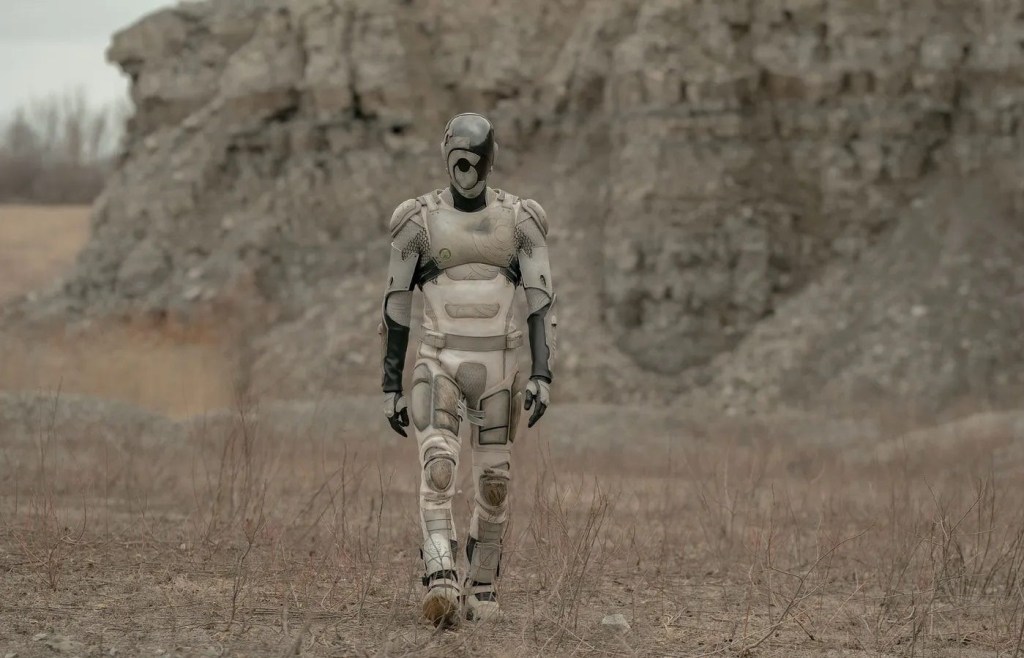
By the end of the first episode, I realized I needed to divorce MY SecUnit from AppleTV’s SecUnit and MY PreservationAux survey team from the show’s team to more fully enjoy the series. My SecUnit is still (and always will be) the best, but their version is really watchable and very entertaining.
I’m still a wee bit skeptical. I’m prepared to be disappointed, because so much of SecUnit’s development takes place INSIDE its head–what it’s thinking, what it’s feeling (it is seriously uncomfortable with emotion), and how its behavior is shaped by its thinking and feeling (and yes, it’s an ‘it’ rather than a gendered being).
But it looks like Skarsgård might have the acting chops to pull off SecUnit’s internal struggle to adamantly deny its humanity while still insisting on its personhood. To me, that’s the heart of the Murderbot Diaries. So far, Skarsgård’s ability to mute his facial expressions while still depicting unwelcome emotions has been spot on. It’s just a fraction of an emotion away from deadpan (and yes, I think Kate Box would have done it better).
So tonight I’ll watch another episode. Maybe two (I suck at binge-watching). I can say without any hesitation that it’s the second-best Murderbot ever.





 gregfallis.com