bus stops


You’re either on the bus or off the bus. If you’re on the bus, and you get left behind, then you’ll find it again. If you’re off the bus in the first place — then it won’t make a damn.
(Ken Kesey – The Electric Kool-Aid Acid Test)

I’ve written about the GeoGuessr game before. It continues to be fun and challenging, and I still play once or twice a week. I find I’m approaching the game differently, though. I’m still always lost, of course, and trying to figure out where the hell I am — but now I’m also looking for recurring, universal scenes. Clothes hanging on outdoor clothes lines. Solitary cyclists riding down isolated roads. Couples walking, holding hands. Bus stops. A village in Latvia, a small town in west Texas, a city in Scandinavia — doesn’t matter. Folks still need to dry their laundry, they still hold hands, they still wait on the bus.
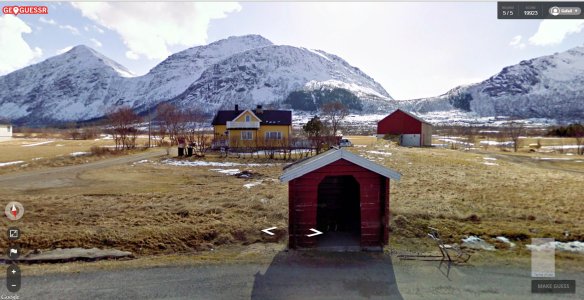
A bus stop in Norway

A bus stop in Norway

I’ve become particularly interested in bus stops — partly because they’re ubiquitous, partly because they’re the most democratic form of public transport. It’s true that, outside of major metropolitan areas, buses are most commonly used by the poor and working classes, but the bus stops for everybody — and you don’t need a reservation.

Near Stega Mala, Poland

Near Stega Mala, Poland

We can thank John Greenwood for that. In the early 19th century, Greenwood was a toll gate keeper on the Manchester-to-Liverpool turnpike. Yes, they actually had turnpikes back then — the monarchy built a few decent roads and charged travelers a fee to use them. The fees were collected at various points along the road, which were marked by a shelter and a pike stretched across the road. Once the fee was paid, the pike was turned and the travelers were able to continue. These turnpikes were mostly used by merchants who needed to transport their goods quickly, or by the merchant classes who could afford to book a seat on a coach. Ordinary people took ordinary roads, which were messier and more dangerous.

Near Boa Vista, Brazil

Near Boa Vista, Brazil

Greenwood changed all that in 1824; he bought a horse and a wagon and began the first mass transport service for ordinary folks. All they had to do was show up at the appointed spot at the appointed time (no reservation necessary) and pay a small fee to ride in the wagon. A similar service was developed two years later in the French city of Nantes. A retired military officer who’d built a heated bath house on the outskirts of the city devised a transport system for getting clients to and from the baths. His clients would gather at the Place du Commerce, outside a shop owned by a Monsieur Omnès, whose motto was  Omnès Omnibus — all for all. You can figure out the rest.

Outside of Arvik, Norway

Outside of Arvik, Norway

The concept of a bus network is fundamentally simple: a series of designated routes with consistent designated arrival/departure times and stable designated boarding locations with predetermined fees. It’s a predictable, reliable, efficient dynamical transportation system, and bus stops act as fixed point attractors. Riders know where to go and when to be there.

And yet it’s an incredibly elastic concept. The same basic approach can be molded to work anywhere under almost any condition. It works in the mountains, it works in the desert; it works in totalitarian nations, it works in democracies; it works in urban centers, it works in rural areas. Buses just make sense — so it’s not at all surprising to find bus stops scattered throughout the Google Street View universe.

Portstewart, Ireland

Portstewart, Ireland

What IS surprising, though, is the diversity of design. Some bus stops are elaborately designed structures, some are purely utilitarian; some have shelters to protect riders from the elements, some are merely wide spots in the road; some are meticulously cared for, some are trash magnets; some are designed to make the wait as comfortable as possible for the riders, some…well, aren’t.

Near Calilegua, Argentina

Near Calilegua, Argentina

Over the years I’ve become a fan of the bus. I often prefer to take the bus than drive. Of course, I have some advantages over most bus riders. I’m rarely in a hurry and I rarely have to be anywhere at any specific time, so I don’t mind if the bus ride is slow and stops often. The pace of a municipal bus suits me.

I enjoy looking out through the large bus windows. These days I find myself living in a rather dull, middle class, suburban neighborhood; the bus takes back through the sorts of poor, working class neighborhoods I grew up in. As a kid, I never felt there was anything interesting or beautiful about those neighborhoods. Now I see variety and diversity that’s entirely absent from where I live — variety in the people who live there, in the houses they live in, in the clothes they wear, in the level of life on the street. It makes me appreciate experiences I used to take for granted.

Sudovice, Slovakia

Sudovice, Slovakia

Among the Hopi and Pueblo peoples of the American Southwest there’s a creation legend involving Grandmother Spider. She existed in the world before it became the world. Before there were places. She spun a web that spanned the entirety of the incipient universe. It connected everything that was to exist, thereby creating — and linking — all places.

She’d have been a great bus driver.

Rural South Africa

Rural South Africa
 

every year, this happens

This happens to me every year. I know summer is going to end. I know approximately when it’s going to end. I know that when autumn is here, I’ll love it.

I know all that — and yet every year this happens to me. There are a few days when the shock of summer’s end makes me…what? Not sad, really. Because, as I said, I love autumn. Not melancholy; I’ve never been able to carry off gloom and brooding. I’m okay at a bit of foreboding, but gloom and melancholy just aren’t in my repertoire. I’m not even disconsolate, because I’m easily comforted.

end of summer part 1

Wistful. I guess that’s it. The end of summer makes me wistful. I am full of wist. Wist, by the way, used to be the past tense of wit — and I’m talking about wit as a verb. As a verb, it meant ‘to know, to be aware or conscious of.’ You see it in other words: witless, dimwit, unwitting. The term witness originally meant to formally attest to a thing you actually know to be true.

Wistful, then, meant to be keenly aware of something you once knew to be true. It’s only a small step from that to the more modern meaning: a pensive yearning for something now gone.

end of summer, part 2

I will miss grilling out supper. I’ll miss sitting outside on a hot day, drinking a cold beer. I’ll miss going through my entire day barefooted. I’ll miss the freedom and comfort of wearing shorts. I’ll miss picking herbs from my window-boxes and cooking with them. I’ll miss the heat — that deep, penetrating, bone-heat that loosens my aging joints. I’ll miss the long days. I’ll miss the whirring of my old box fan. I’ll miss the breeze coming through the open windows and screen doors. I’ll miss leaving the deck door open so the cat can wander in and out at will, along with occasional wasps and flies and twice this year, a butterfly.

Hell, I’m already missing those things, and summer’s only been gone about ten minutes.

end of summer part 3

But at some point this week, I’ll pack up my shorts and put them away. And I’ll unpack my sweaters and scarfs and gloves and caps and soft flannel shirts. Oh, and flannel sheets. It won’t be cold enough for flannel sheets until autumn is over, but lawdy who doesn’t love sleeping in flannel sheets?

And pretty soon it’ll be time to start cooking soups and stews. Time for cooking chili and cornbread. Sometime in the next couple of weeks, I start baking beer bread again, and eating it warm with real butter. It’ll be time for eggnog before long, though it will annoy me that they begin selling it earlier every year (eggnog, by law, shouldn’t be consumed until the week before Thanksgiving). I look forward to walking in the woods, with all the dead leaves underfoot.

I love autumn. I’ll enjoy the hell out of it. I always do.

But still, I’ll have to wear shoes.

somewhat true detective

“Yo, Greg, you should watch True Detective.” That’s what everybody kept telling me. “Great acting,” they said. “Lyrical cinematography, complex characters, clever plot,” they said, “all wrapped up in a realistic crime drama that takes place in the South. You’ll love it.”

So I watched it. The entire first season — eight hour-long episodes — over the last four weeks. And hey, they were mostly right. I did love it. The acting was terrific, just like folks told me (I swear, Matthew McConaughey never blinked once during the entire season), and the cinematography was artful. I suppose the characters could be seen as complex, but they’re pretty much right off the Stock Character–Complex Model shelf. We’ve all seen the Marty Hart character before, the hard-working detective who drinks too much and thinks too little. And the Rust Cohle character is basically Serpico, the Cerebral Cop, quoting big chunks of Thomas Ligotti, who is the High Lord of Anhedonia. It’s the quality of the acting that makes these characters interesting, not the characters themselves.

true detective tree2

The plot? Well, it was fairly predictable. Let’s face it, there’s nothing original about two detectives solving a nasty crime committed by powerful people who use their influence to hinder the investigation. That said, the plot was elevated by being beautifully structured and through the mostly masterful pacing. I say ‘mostly’ masterful pacing because there were a few scenes that were stretched out because apparently HBO requires a certain number of minutes devoted to young women showing their tits and ass. (Disclaimer: I’m not opposed to tits or ass so long as they’re organic to the story and don’t disrupt the pacing; but c’mon, the only reason they included some of the sex scenes — including the pointless image in the opening sequence where we see a woman’s naked ass above a pair of spiked stiletto heels — is to attract a young male audience.)

But a realistic crime drama? Well, no — but nobody really expects this sort of show to be realistic. Real life investigation can be pretty dull, after all. However, I did appreciate how the writer, Nic Pizzolatto, demonstrated that good detective work often involves a buttload of time sitting alone in a room sifting through old files and public records. That facet of investigation almost never makes it to the screen. It doesn’t quite make up for Pizzolatto’s wholesale lifting of dialog from Ligotti, but you have to give the guy props when he deserves them.

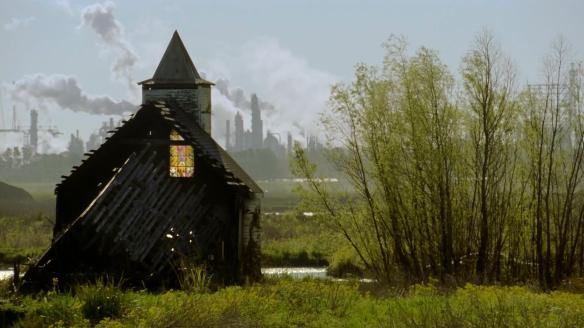
So yeah, True Detective was excellent television and I’m really glad folks recommended it to me. But nobody — not one person — told me that True Detective was a classic Southern Gothic story. And lawdy, that’s the heart of the whole goddamn thing.

true detective house

Some of you are probably saying “Southern Gothic? I have never heard of this Southern Gothic. Qu’est-ce que c’est Southern Gothic?” Allow me to ‘splain.

Southern Gothic is a highly atmospheric literary genre grounded in the decay — both physical and moral — of the Old South aristocracy. Southern Gothic (and I’m just going to start calling it SG on account of I’m lazy) stories usually involve the decline of Southern gentility into perversion, grotesquerie, and madness. The descendants of antebellum families that once owned plantations and slaves have been reduced to living in house trailers parked out in the country, and they’re working odd jobs. The slaves are gone, the plantations either sold to Yankees or fallen into dilapidation (or worse, turned into tourist venues). The cotton fields have been plowed under, replaced by strip malls and big box stores.

The characters in SG stories struggle to understand the world around them and find some way to fit their lives into modern society. Drug addition, alcoholism, confused sexuality, sexual paraphilia, mental and physical deformities, religious depravity or fanaticism, poverty, alienation, violence, the supernatural, illegitimacy — tie all that up with a bow of futile and pointless family pride and you’ve got yourself a classic SG story.

true-detective-episode-2

That sort of moral and spiritual degradation isn’t unique to the Southern Gothic genre; literature and film are full of examples of the moral corruption of European aristocrats. We’re talking everything from Count Dracula to the Marquis de Sade to Charles II of England. It’s not just power that corrupts — it’s also unquestioned privilege. Privilege allowed folks to whip and/or rape the young village boys and girls without any fear of consequence. Society can take that privilege away, but the desire to continue whipping and raping doesn’t necessarily go with it. That means the unwholesome behavior has to become more secretive. That’s been universally true. What makes the corruption of SG stories unique, I think, is its relationship to heat and defeat.

Heat is debilitating. It reveals itself through sweat, and sweat lubricates Southern Gothic stories. Sweat, not perspiration. In SG literature, sweat suggests either labor or animal lust. It suggests either being out in the field doing a job — which indicates a lower social status — or you’re driven by a sexual desire so strong that you ignore the fact that it’s just too damned hot to fuck. Either way, sweat suggests you’re not the master of your own behavior. All the decent, privileged people, after all, are sitting on the porch, sipping something cool and fanning themselves. They may perspire, but they do not sweat.

true detective detectives

In True Detective, we see all the main characters sweating — all but the Reverend Billy Lee Tuttle, who is never seen outside an air-conditioned building. He’s metaphorically still sitting on the porch, watching the lower classes laboring away. Except, of course, when he puts on a Mardi Gras masque and works up a sweat doing something really horrific to young girls. (We never actually see what he does; all we know is that it makes hardened law enforcement types scream when they see it.)

But more than the Southern heat, it’s Southern defeat that really counts. Yeah, we’re talking about the American Civil War again. We’re talking about the cultural resentment at the loss of status, property, income, and privilege. Loss — that’s really the wrong term. In SG stories characters don’t feel they lost their former status; they feel it was taken from them — stolen from them — and that sparks a deep, underlying current of bitterness.

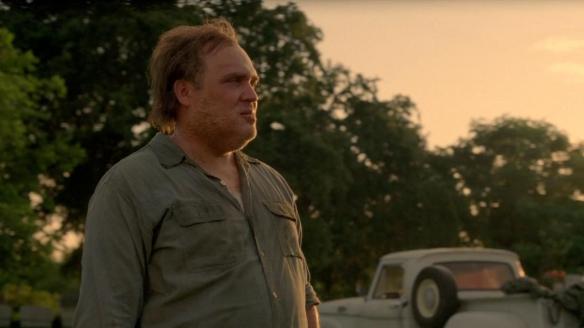
In True Detective we see echoes of that bitterness mostly in the character of Errol Childress — the chubby, scarred, perpetually sweaty pervert who is descended from an illegitimate branch of the Tuttle family tree. He’s not only been deprived of the privilege his ancestors enjoyed, he’s even deprived of their name. At one point, the two detectives who are investigating Cohle happen across Childress and ask directions. They drive off while he’s still speaking — an insult he’s able to shrug off because, as he says, “My family’s been here a long time.”

true detective childress

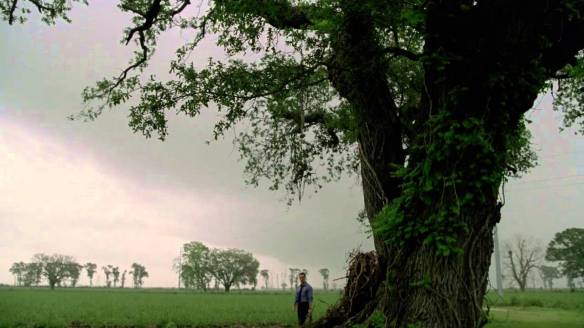
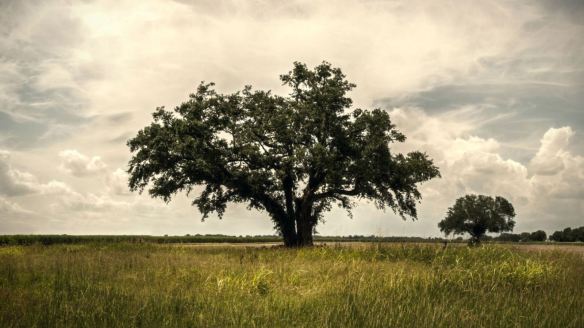
There’s another thing we see a lot in Southern Gothic stories: symbolism. At the beginning of the series and very near the end (and periodically throughout), we see an old, gnarled tree standing alone in a corn field. The tree looks ancient, like it’s been there forever; its roots are deep in the land. The field, on the other hand, is relatively new and the crops are planted around the tree. The depravity of the Tuttle/Childress clan has been around a long time; it’s anchored to the land and it’s still here despite recent changes of society. Society, in fact, has shaped itself around the Tuttles, and left them largely undisturbed (while the Childress family has been left in a sort of socio-cultural backwater). The Tuttle/Childress family tree has many branches, and branches show up all over the show as bizarre clues and as set decorations. The symbolism is obvious, but not overwhelming.

There are lots of flaws and problems with True Detective. For example, it never bothers to explain the references to The King in Yellow or Carcosa (both of which come from classic gothic horror stories) or their significance in the murders committed by Childress. And then there’s this: what’s the story purpose of Cohle having visual hallucinations? They’re almost completely ignored except in the first and last episodes, and I can’t see how they contribute in any material way to either the plot or the character development.

true detective tree

But the flaws and problems are, I think, minor when compared to the overall success of the show (and I’m talking about artistic success, not commercial success). True Detective was an absolute pleasure to watch. But dammit, it’s not really a detective story. It’s Southern Gothic, baby, right down to its depraved heart.

memorial my ass

Yeah, I pretty much dislike Memorial Day. Don’t get me wrong; the idea of honoring the men and women who died while serving the nation — that I respect. But that’s not really what Memorial Day is anymore. Now it’s mostly a day to say something nice about veterans, maybe see a parade, go shopping, then eat a hamburger. And you can usually skip right to the hamburger.

The thing is, a lot of folks don’t even understand Memorial Day. They get it confused with Veterans Day, which is a different beast altogether. The confusion is understandable, on account of they’re both about people in uniforms and big big big shopping discounts and picnics with hamburgers.

Ice-Memorial-Day-Sale-Event

Allow me to ‘splain the differences. Memorial Day is the one where you say nice things about folks that actually died while in uniform.  Veterans Day is the one where you offer ritual thanks for everybody who put on military harness — dead, living, somewhere in between (and if you think that’s just a figure of speech, go visit a VA hospital).

I like Veterans Day. That’s what we call it in the U.S., although most Western nations call it Armistice Day or Remembrance Day. I like it because it still retains some meaning. It’s still celebrated on the same day — the anniversary of the end of the First World War. The 11th day of the 11th month.SM-Memorial-Day-Maddness-mattress-hub-0515-homepage

Memorial Day used to have meaning. It began as Decoration Day — a day when folks would decorate the graves of soldiers who died during the American Civil War. It was an organic holiday. It began spontaneously, on different days, in different years, in different parts of the nation. Folks just went to cemeteries where Civil War troops were buried and decorated the graves. You know, out of respect.

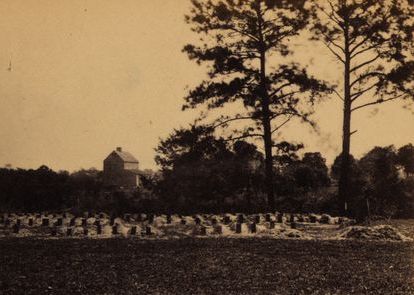
One of the earliest Decoration Day events took place in Charleston, South Carolina. Union prisoners of war had been interned at the Washington Race Course and Jockey Club. More than 250 of them died and were buried in a mass grave behind the grandstand. In April of 1865, a small group of freed slaves reburied the bodies in individual graves. They constructed a fence around the burial site, and put up an arched entryway with the inscription Martyrs of the Race Course. Then on the first day of May, some ten thousand former slaves and some white missionaries decorated the cemetery with flowers, and they held a picnic on the site.

New graves of Union soldiers at the Washington Race Course

New graves of Union soldiers at the Washington Race Course

Now that is a serious show of respect. Over time, Decoration Day became Memorial Day and through some sort of osmotic agreement, it was celebrated throughout the nation on May 30th. At least it was until 1968, when everything changed. But I’ll come back to that in a bit. First let’s reduce this national holiday to the personal level.

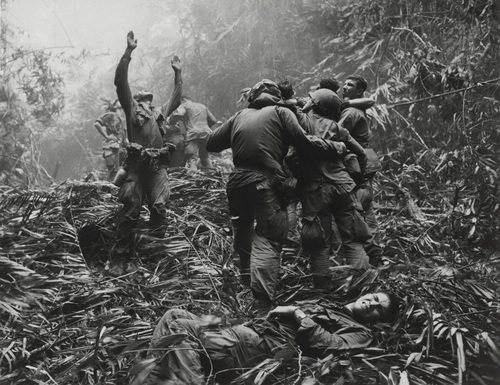
In April of that same year, 1968, a young photographer named Art Greenspon shot this photograph in the jungle southwest of Hue. Alpha Company of the 101st Airborne had walked into an ambush. Several killed, more wounded. Bad weather prevented any medevac until the following day. So the troops sat awake all night, in the rain, with their wounded and dead, wondering if they’d get hit again. The next day, when the rain lifted enough for a medevac, Greenspon got this shot of a soldier directing the chopper. By that point it had rained so long and hard that when Greenspon tried to rewind the film in his camera, it stuck to the pressure plate.

Here’s some military esoterica for you: the first choppers take the wounded; the last choppers take the bodies. The bodies can wait; they’re not going to get any more dead. Greenspon flew out on a chopper filled with body bags. When he got back to his base, he discovered most of the shots weren’t usable. This one was.
greenspon vietnam

Art Greenspon was paid US$15 for that photograph. That’s all he’s ever been paid for it. A week later he and another photographer, Charles Eggleston, found themselves in a firefight outside of Saigon. Eggleston was hit by rifle fire and killed. One of the bullets passed through Eggleston’s hand, which slowed the round enough that when it hit Greenspon in the face, it didn’t kill him. Instead, the bullet lodged in his sinus cavity. In order to remove the bullet and minimize the facial scarring, the surgeons broke his cheekbone from inside his mouth.

Two months after that, during the darkest days of the war in Vietnam, Congress passed the Uniform Monday Holiday Act. The intent of the act was to change the date on which four holidays were traditionally celebrated in order to create three-day weekends. Great news for workers and a boon to commercial enterprises. The effect, however, was to trivialize those holidays. Now Presidents Day, Columbus Day, Labor Day, and Memorial Day are all about mattress sales and potato salad. We’re not really thinking about the men and women dying in jungles or deserts; we’re thinking about buying summer clothes.

Nello-Olivo-memorial-sales-event

Oh, we’ll still say nice things about the men and women who died in uniform. We’ll still have parades (that very few people attend), and politicians will still give speeches (that very few people will listen to), but mostly we’re just glad to have that extra day on the weekend, and a chance to save a buck on a mattress, and hey, it’s a good time of year for a picnic.

But Memorial Day isn’t — or shouldn’t be — about picnics. It’s about the people Art Greenspon flew with in that chopper; it’s about those bodies in the bags.

So yeah, I pretty much dislike Memorial Day. I don’t want to see the parade. I don’t want to buy a pair of cheap-ass flip-flops. I don’t want to hear any fucking politician thanking the troops for their sacrifice.

I want politicians to stop sacrificing them.

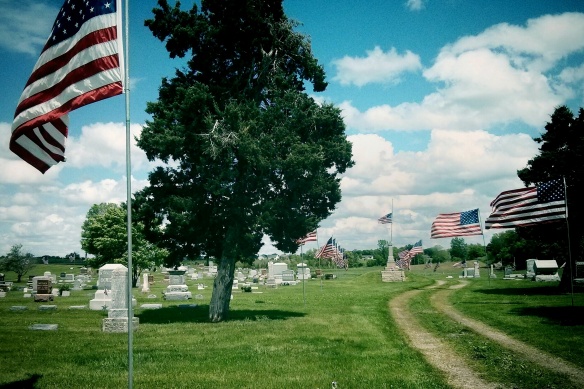
ADDENDUM: Last year on Memorial Day I wrote about my accidental visit to the local cemetery in the small town of Maxwell, Iowa. This year, while running around, I made an intentional detour to Maxwell. It looks exactly the same as it did last year (and probably for the last umpty-ump years) — flags lining the tiny town center, and all over the cemetery.

Maxwell, IA. Memorial Day, 2015

Maxwell, IA. Memorial Day, 2015

It doesn’t make up for the apathy and commercialism, but there’s something innocent and fundamentally decent about the way these small towns continue to honor their dead.

american sniper

I wrote about Chris Kyle a couple of years ago, shortly after he was murdered on a Texas gun range. I didn’t know very much about Kyle at the time. I was familiar with his name, of course, and I’d heard about some of his exploits. I was aware he’d worked with a couple of ghost writers and had published an autobiography, though I hadn’t yet read it (I bought it a few months later and labored through it). I knew just enough about Chris Kyle to say he was “one of those guys — the ones they make American movies about.” And hey, they did. American Sniper.

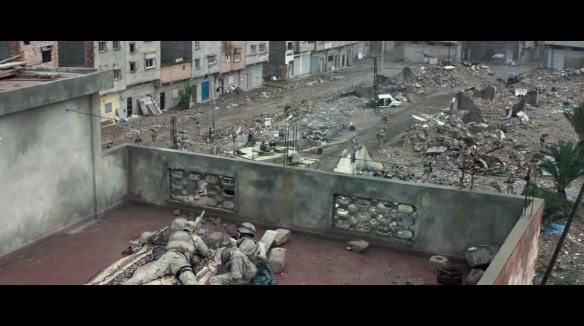
Scene from American Sniper

Scene from American Sniper

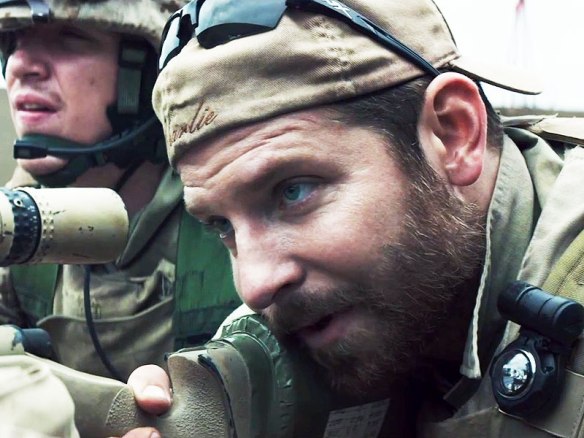
Last weekend I watched the movie. I watched it during brunch, at a ‘brewhouse’ theater where you could have a mimosa and a mediocre omelet while you watched the actor playing Chris Kyle stretched out on a rooftop, picking off Iraqis. As a movie — more specifically, as a war movie — it mostly worked. There were lots of explosions, some nicely directed scenes of urban combat, and enough attention to military detail to please anybody who likes that stuff (and yeah, I admit it, I like military hardware). I also thought it did a fine job of showing how destructive repeated deployments were to the troops and their families. So yeah, as a war movie, it was pretty good. But the thing about war movies is that they aren’t really about war; they’re about the people who fight in wars. War is the environment in which the movie takes place. There’s no concern about why the characters are at war, or the socio-political events that led to war. American Sniper mostly ignores all that. Oh, there are a couple of bullshit scenes showing an attack on a U.S. embassy, and the collapse of the WTC on 9/11 — neither of which had anything to do with the invasion of Iraq. But all that matters to the movie is the suggestion that there are bad guys who need killing, and Chris Kyle is just the guy to do it. And that’s as faithful as the movie gets to Kyle’s autobiography. The movie has almost no nuance, Kyle’s book has none at all. Chris Kyle was not a nuanced sort of guy. Where the movie shows Kyle emotionally distressed after having to decide whether or not to shoot a woman and a child, Kyle’s account of the event shows no distress at all. None. Of course, in the book Kyle only kills the mother — but he makes it perfectly clear it didn’t bother him.

Bradley Cooper (as Chris Kyle) sighting in on an Iraqi mother

Bradley Cooper (as Chris Kyle) sighting in on an Iraqi mother

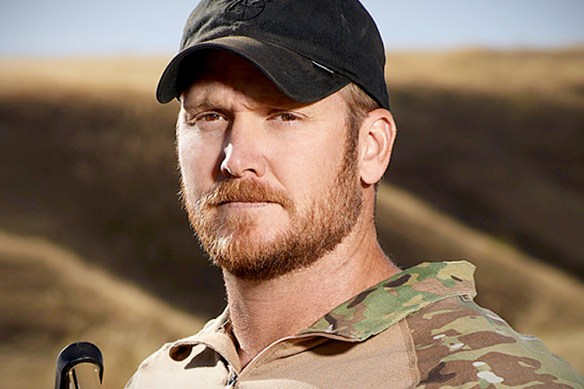
There are a LOT of discrepancies between the movie and the book. There are a LOT of discrepancies between the book and the facts. Chris Kyle, to be blunt, lied about a lot of things in the book. When I first wrote about him, I stated that “[b]y all accounts, Chris Kyle was a nice guy. A nice guy who killed a couple hundred people.” He was a nice guy who thought killing ‘bad guys’ was fun. Chris Kyle claimed to be a simple person, but there really are no simple people. He wasn’t any one thing. He probably was a nice guy. Most of the time. Unless he had a reason to kill you. Unless he believed he had a reason to kill you. He was a hero. A hero who shot people in the back when they weren’t looking. But also a hero who wanted to be the first guy through the door when clearing a building. He was, I’m told, a good husband and father, who was also perfectly shitty at being a husband and father. He was a liar. He was a damned good soldier. Some folks, having read his book and seen the movie, are calling Kyle a sociopath. They may be right. But if you have to have a military, you want people like Chris Kyle in it. If you’re going to send people to war, you want to send people like Kyle. You want sensible and rational leaders, but you also want a sprinkling of semi-disciplined sociopaths.

Kyle on a training course after retiring from the Navy

Kyle on a training course after retiring from the Navy

One of the best novels written about war and the people who fight wars is Piece of Cake, by Derek Robinson. It’s about RAF Hurricane pilots in WWII. There’s one scene in which a character describes a group of fighter pilots.

“They’re all a bit mad, you know. They wouldn’t do it unless there was a damn good chance of getting killed, would they? So they can’t be completely normal. They’re not what you’d call model citizens, any of them. More like vandals, I suppose. They’re just itching to be turned loose with an eight-gun Hurricane on some lumbering great bomber. I mean, that’s your average fighter pilot’s attitude, isn’t it. Show him something, anything really, and deep down inside, his first reaction is: What sort of a mess could I make of that with a couple of three-second bursts? Herd of cows, double-decker bus, garden party — makes no difference what it is, that’s the thought in the back his mind. Not surprising, really. I’ve often thought it’s a damn good job they’re in the RAF, otherwise they’d all be out there blowing up banks.”

Replace ‘RAF pilot’ with ‘Navy SEAL’ and you have Chris Kyle. When I wrote about him before, I said “I haven’t a clue whether I’d have liked him or not, but I can guarantee you this: I’d have loved to have a beer with him. This was a guy with stories to tell.” I stand by that. The stories he told might not be true, but they’d be worth listening to.

Chris Kyle

Chris Kyle

I also said this: “Chris Kyle deserved better than this — better than to have been shot down on a gun range in Texas.” I’m not so sure about that anymore. Maybe that IS what he deserved, I don’t know. It’s a sad end, no mistake — but I suspect Kyle would have preferred to be shot down rather than die of old age. And I suspect he’d be okay with being killed while trying to help another soldier.

As for the movie — hey, it’s just a movie. Nobody expects truth from a movie. Especially a war movie. The only thing you should expect from a war movie is drama and explosions and heroic sacrifice. You know, the sort of stuff that will lure future Chris Kyles into joining the military. Which is where they belong.

Maybe the saddest thing about the life and death of Chris Kyle is that it’s been turned into entertainment — something to watch in a brewhouse theater, while sipping a mimosa and eating a mediocre omelet.

ADDENDUM: In the piece I referred to “a couple of bullshit scenes showing an attack on a U.S. embassy, and the collapse of the WTC on 9/11 — neither of which had anything to do with the invasion of Iraq.” That’s inaccurate. As Doug Gastélum pointed out, those events were used as the foundation for the invasion of Iraq. It would have been more accurate to say Iraq had nothing to do with the attacks of 9/11 or the bombing of the U.S. embassy. We just invaded the nation anyway.

As Texas Governor Rick Perry would say, oops.

football v. fútbol — it ain’t just sports

People know I like fútbol. They also know I periodically mock conservatives. So it’s only natural, I suppose, that yesterday and today I’ve been bombarded with emails and IMs suggesting I write something about Ann Coulter’s column on hating soccer.

But c’mon…who the fuck is Ann Coulter? Really, who is she that anybody should give a rat’s ass about what she has to say about anything? Does she make policy? No. Does she have any influence (outside the perpetual rage machine)? No. Does anybody who actually has influence or makes policy listen to her? No. So who cares what that sad, pathetic, hateful woman has to say? Not me.

BUT, there’s something worth noting about her idiotic anti-fútbol rant. A lot of people (and I mean people less sad, less pathetic, less hateful — people who actually have influence and make policy) share Coulter’s dislike and distrust of fútbol. That attitude is one of the reasons the United States has been rubbish in our recent military conflicts. Yeah, it doesn’t help that we’ve been fighting the wrong wars for the wrong reasons against the wrong people in the wrong places — but that’s a policy matter. I’m just talking about how the sports we play influence the way we approach armed conflict.

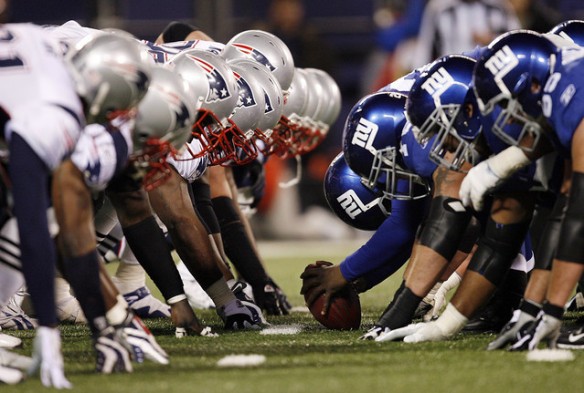
This is football

This is football

Here’s my point: the U.S. is a football nation; the places where we’ve been engaged in combat are fútbol nations. We’re talking two different sports with radically different philosophies. Those philosophies can be seen as metaphors for the ways we wage war. American football is a great metaphor for waging large-scale land and sea wars. The U.S. totally kicked ass in World War II. But for your more modern asymmetrical conflicts, fútbol is the ticket.

This is fútbol

This is futbol

Here’s why. Football is centralized and authoritarian. Command and authority is channeled through coaches and advisers who aren’t even on the field. The information is relayed to a single individual who reveals those orders to the players. In other words, you’ve got old guys who don’t have any skin in the game making most of the decisions. This is thought to be a good thing, because their decisions can be made in a cold, dispassionate, logical way. Most of the individual players on the field don’t need to know what’s going on overall; they just need to follow instructions and do their fucking job. On the other hand, it means if communications fail, or if the defense takes out the quarterback, the team on the field is thoroughly fucked.

Fútbol, on the other hand, is decentralized and democratic. For the most part, once the match begins the coaches are relegated to standing on the sidelines, screaming. Almost all the decisions are made in real-time by the players on the field. Every member of the team is expected to know what’s going on. If one player is removed — even if he’s the best player — the rest of the team can carry on.

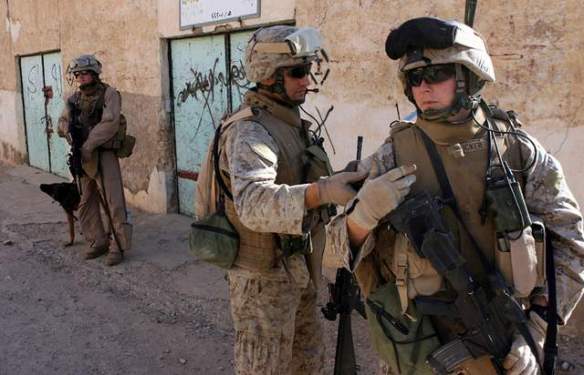
US military in Iraq

US military in Iraq

Football is played by specialists. Individual players have narrowly defined functions, from which they don’t/can’t stray. Only certain players are allowed to move the ball (except in very specific circumstances). The quarterback can’t throw a pass or hand off the ball to the offensive tackle. Why? Because he’s the goddam offensive tackle; his job is to bang into people, not to move the ball. Make sense of that, if you can.

Fútbol is played by generalists. The only truly specialized position is that of goalkeeper. All the other players play both offense and defense, and are prepared to shift from one to the other without notice. Anybody can move the ball and score.

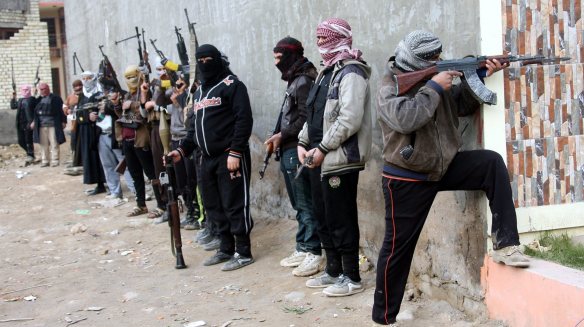
Insurgents in Iraq

Insurgents in Iraq

Football is a game of interruptions. Since the decisions are mostly made by people who aren’t actually playing the game, the game comes to a halt every few seconds while new instructions are given to the players. During that halt, substitutions are brought in for specific plays. The players need to memorize their duties for a large number of different plays, but those duties are pretty tightly limited. If the quarterback calls an end run, the offensive tackle has to remember to bang into that specific guy; it the play is a passing play, he needs to bang into that other specific guy. The offensive tackle doesn’t need to know what the wide receivers are going to do, or what the tight end is going to do. Why? Because he’s the goddam offensive tackle, and he just needs to know who to bang into.

Fútbol has few interruptions. Game play, for the most part, is continuous. There are few substitutions. Instructions from off the field are rare. Players are expected to pay attention to what’s going on all over the pitch and improvise as necessary.

Football is a game of explosive violence, so players have to be armored. That armor is tailored to the position the player occupies on the field — a wide receiver wears different gear than an offensive tackle. For a kid to become a good football player, he needs access to all that gear, which ain’t cheap. That means joining an organization (usually a school). An organization means outside control — coaches, sponsors, etc. The organization looks out for the organization, which isn’t always good news for the people playing the game.

Teens playing football

Teens playing football

Fútbol requires a ball. Maybe some shin guards. Maybe a goal area. Kids can play the game anywhere. You can learn most fútbol skills without joining any organization; all you need is people to play with.

Teens playing fútbol

Teens playing fútbol

Football is about rigid control of territory. It’s about concentrating power at certain locations on the field. It’s about one guy directly delivering the ball to one other guy, and everybody else in support roles.

Fútbol doesn’t care all that much about territory. Control of the ball is more important. Fútbol is about dispersing power all over the pitch. It’s about loose, flexible coordination of indirect attacks from unexpected directions by several different players.

Football is World War I and World War II. Fútbol is insurgency and guerrilla warfare. This is how the U.S. has been fighting wars. We’re playing football; they’re playing fútbol. We’re great at banging into things really hard; they’re great at dodging and controlling the ball without using their hands. Head-to-head straight-up violence, we’re your daddy. Subtle, improvised, unexpected violence, we’re their bitch.

These aren’t just my thoughts, by the way. Joel Cassman and David Lai published an article in the Armed Forces Journal titled Football vs. Soccer, American Warfare in an era of unconventional threats. You should read the entire article. Sad, pathetic, hateful Ann Coulter should read the article. The fuckwits who keep arguing that we should send U.S. troops into combat should read the article.

Here’s the really sad thing: it was written way back in 2003. And we’re still trying to impose football onto the fútbol pitch.

to dedicate a portion of that field

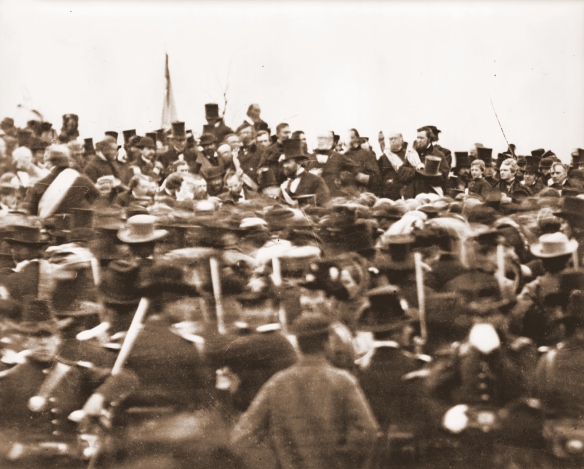
There was a great deal of fuss yesterday about the 150th anniversary of Abraham Lincoln’s Gettysburg Address. And rightly so; it’s beautifully written — simple, eloquent, thoughtful. In fact, it’s hard these days to appreciate just how thoughtful it was.

That’s partly because we tend to think of it as a ‘speech’ — as an act of public oratory. A stirring and moving speech, to be sure, but basically we tend to see it just a speech given to an audience to dedicate a cemetery.

Abraham Lincoln at Gettysburg

Abraham Lincoln at Gettysburg

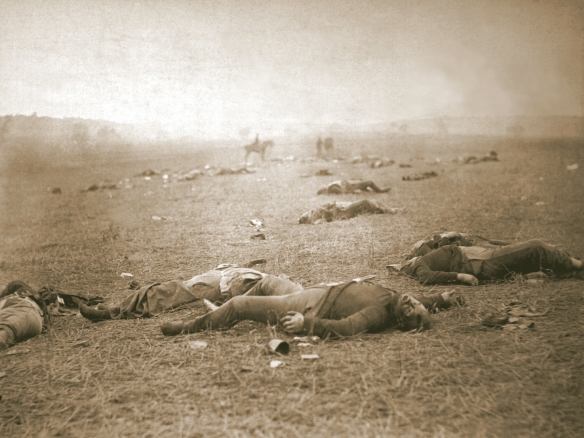
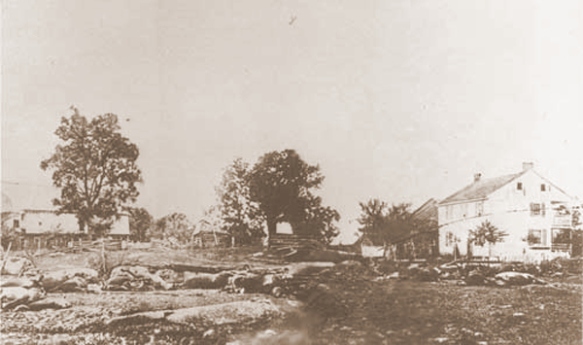
A cemetery. A burial ground. A graveyard. Yes, we all know the Gettysburg Address was to dedicate the ground on which the Battle of Gettysburg was fought. For us, that’s history. For Lincoln, it was a recent event. The dedication took place only four months after the horrific three-day battle. Nearly eight thousand men were killed. Nearly thirty thousand were wounded or went missing (‘missing’ might mean the men ran away; it might mean they were simply obliterated). Many of the wounded were still convalescing in Gettysburg when Lincoln gave his short remarks. Coffins were still stacked at the railway station where he arrived.

The battle had been so savage and so many people had died that almost immediately afterwards it was clear that something astonishing and awful (and I mean awful in the oldest sense of the term) had taken place at Gettysburg. Something so appalling that it was necessary for the entire nation to pause a moment and recognize it.

Dead troops at Gettysburg

Dead troops at Gettysburg

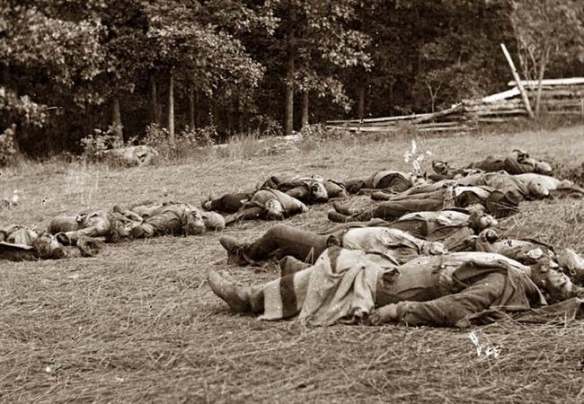
Why did Lincoln wait four months to dedicate the battleground? Because it took that long to gather the dead, try to identify them, and rebury them. That’s right, rebury them. We forget that the battle took place in the first week of July. Try to imagine eight thousand human bodies (many of which were dismembered) scattered over several hundred acres. Imagine five thousand dead mules and horses. Imagine the July heat, and the stench of decomposition. The noise of bluebottle flies was said to be deafening.

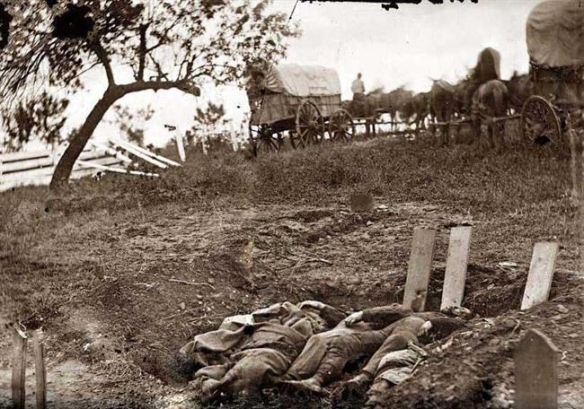
Now try to imagine the task of cleaning all that up using Civil War-era technology. Picks, shovels, muscle. The horses were burned; the men mostly buried in quickly-dug shallow graves, many of which were later washed open by heavy rains that fell in the second week of July.

Confederate dead in shallow graves at Gettysburg

Confederate dead in shallow graves at Gettysburg

The grisly work was done by Union troops, by captured Confederate soldiers, and by unfortunate townsfolk who’d been dragooned by the authorities. The town of Gettysburg, at the time of the battle, only had a population of about 2500. Fewer than half the number of the dead.

In the four months between the battle and the dedication, the organizers bought the land on which the battle was fought, they laid out a design for where the graves would be dug, they re-interred most of those bodies, they telegraphed invitations and coordinated a public dedication (Lincoln, by the way, wasn’t the main speaker; his job was to present some brief closing remarks after the main speaker was finished).

To do all that in 120 days was a remarkable feat.

Dead horses at Gettysburg

Dead horses at Gettysburg

And don’t forget this: the war wasn’t over. The outcome was still very much in doubt. There’d never been anything on the North American continent remotely like the ongoing slaughter of that war. They were more than two years into the war, there were already nearly a quarter of a million casualties, and nobody could guess how much longer it would last. That’s what Lincoln faced when he went to Gettysburg. Read his speech with that in mind, and you’ll see he wasn’t just dedicating a national cemetery; he was telling the nation there was more to come, and asking them to maintain their resolve.

Lincoln spoke about the “unfinished work” and “the great task remaining before us.” He acknowledged the uncertainty of whether the nation “or any nation so conceived and so dedicated, can long endure.” Despite all that, he talked about the necessity of an “increased devotion to that cause for which they gave the last full measure of devotion.”

Confederate dead laid out for burial at Gettysburg

Confederate dead laid out for burial at Gettysburg

To stand on the site where so much death and destruction had taken place, to tell the public there would be more of the same, and to ask the public to accept the necessity of sacrifice on that scale in order to maintain an ideal — that’s just astonishing. What’s even more astonishing is this: the people agreed to accept that burden. The war would stagger on for another year and a half after Gettysburg. Tens of thousands more would die. Lincoln himself would give the last full measure of devotion before the end.

Think about that. Then think about this: there are people in this nation today who talk of seceding from the Union because they dislike a health care policy. There are people in this nation today who talk about secession because they believe the president isn’t a Christian, or because they feel their taxes are too high, or that someday they might not be able to purchase high capacity ammunition magazines.

And those people consider themselves to be patriots.

it ain’t just the zombies

I’ve avoided writing about The Walking Dead because, as improbable it sounds, there are people who don’t share my perfectly normal interest in zombies. But almost everybody I know is interested in art and photography. The cinematography of TWD is always compelling — but sadly most zombie fans don’t recognize the artistry involved in constructing those shots. That artistry was apparent in the most recent episode.

A word of warning: this WILL CONTAIN SPOILERS.

wd1

In order to really appreciate the photography, it’s necessary to give a bit of background information. Here’s what you need to know: 1) a zombie apocalypse has taken place; only a few survivors exist, 2) everybody is infected with the zombie virus, though it’s dormant in the living, 3) a zombie bite is always fatal, 4) everybody who dies — including those who die of natural causes — becomes a zombie,  5) the only way to ‘kill’ a zombie is to destroy its brain.

A group of survivors has taken residence in an old prison, where they can live in relative safety inside its walls. However, some sort of lethal flu-like syndrome has infected many of the survivors — and when they die…you get the picture. The most recent episode is called Isolation. On the most obvious level, it refers to the fact that the survivors are attempting to isolate their members who’ve contracted the ‘flu.’

wd2

On a deeper level, though, the episode is about human isolation. The geographic isolation of the small group of humans in a world of hungry zombies. Their physical isolation inside the walls of the prison (which, after all, is designed to isolate convicts from the citizenry, and from each other). The medical isolation of the sick from the healthy. The psychological isolation of the survivors from each other. And the terrible emotional isolation of the individual survivors from their own feelings.

And all of that is depicted on the screen — through the writing and the acting, of course, but also through the camera work.

wd4

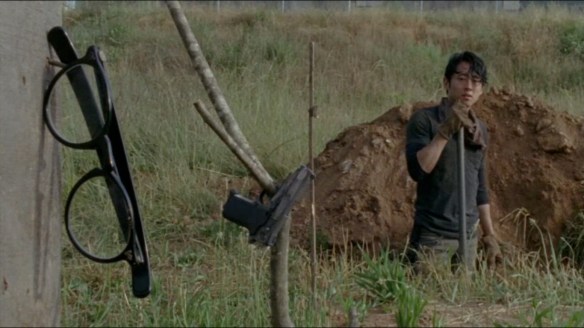
Notice how often the cinematographer uses the entire frame — not just from side to side, but from front to back. He deliberately stacks subjects on various planes within the frame. In the foreground of the first shot above we see a pair of eyeglasses attached to a simple grave-marker. Viewers will recognize the glasses as belonging to a young boy, the first victim of the mysterious flu. In the previous episode the boy died, became zombiefied, and had to be killed. In the middle-ground, a pistol — a killing tool, necessity in TWD world. In the background is Glenn, who is clearly exhausted — he’s exhausted both physically and emotionally, exhausted in almost every possible way (the boy with the eyeglasses was attacking Glenn at the time he was killed).

Everything in that shot — Glenn, the dead boy, the handgun — is linked thematically. Every element is isolated from the others. And yet every element is also inextricably linked to the others. The photography supports and enhances those themes.

wd7

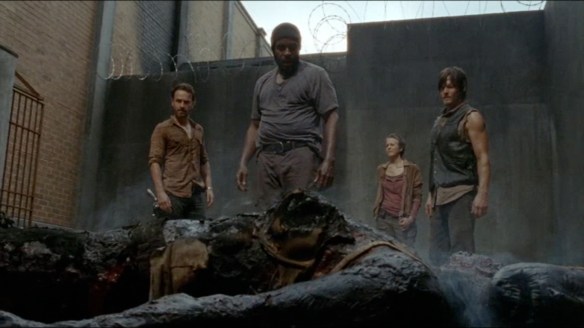
The same is true of the second shot. In the foreground, two bodies belonging to people who’d displayed symptoms of the illness. They’d been isolated; but somebody entered the isolation area, killed them, dragged their bodies outside, and set fire to them (much of the episode revolves around discovering who murdered these two). In the front middle-ground is the lover of one of the victims — a man obviously in shock. In the rear middle-ground are Rick and Daryl, leaders of the group of survivors. And in the background is Carol, the only one not looking directly at the bodies. At the end of the episode, Carol is revealed as the murderer.

Again, everyone and everything in the frame is thematically linked to everything else. And again, they’re all isolated from each other.

wd9

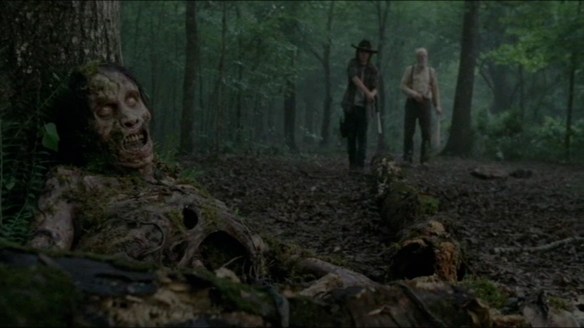
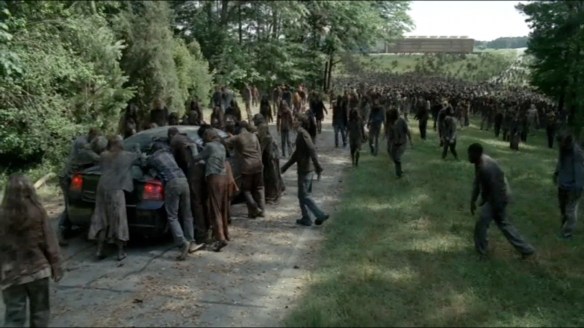
The director and cinematographer also use the frame to instill a sense of confinement. Everything seems to be crowding in on the characters. Even in the scenes that take place outdoors, the characters are somehow confined. In the woods they’re hemmed in by the trees, and by lurking zombies. On the open road — that most American venue — they find themselves quickly enclosed by a herd of zombies, trapped in the vehicle that’s supposed to grant them freedom of movement.

This happens in scene after scene in the episode. The frame is filled in every direction, thematically tight, and psychologically crowded. All those cascading claustrophobic moments create an aura of dread and despair in the viewer. It’s subtle, but very effective.

wd11

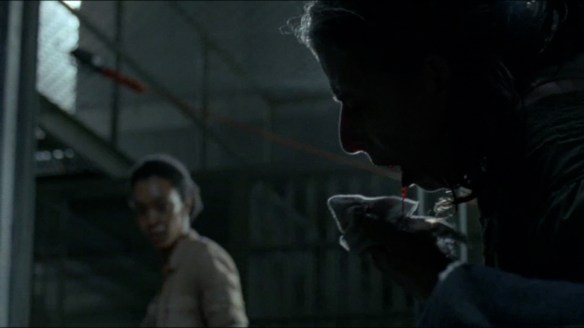
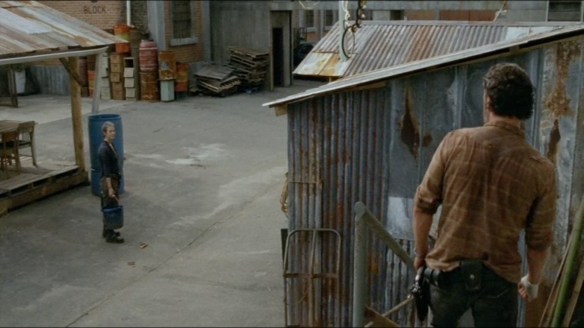
In the final sequence of the episode Rick is reluctantly preparing himself to ask Carol if she’s the person who killed and burned the two flu-sufferers. They’re filmed far apart; he’s high above her, in a rather judgmental position. She’s small and far below, waiting. He gradually comes down to her level — physically, emotionally, ethically — and asks the question he doesn’t want to ask.

The tension is palpable. She answers simply — yes. And walks away, the distance between them growing. And yet they’re both still linked, both still confined, both even more isolated.

I began watching The Walking Dead for the zombies. I still like it for that reason. Zombies are just flat out cool. But I appreciate TWD for the quality of the acting, the occasionally brilliant writing, and for the consistently amazing camera work.