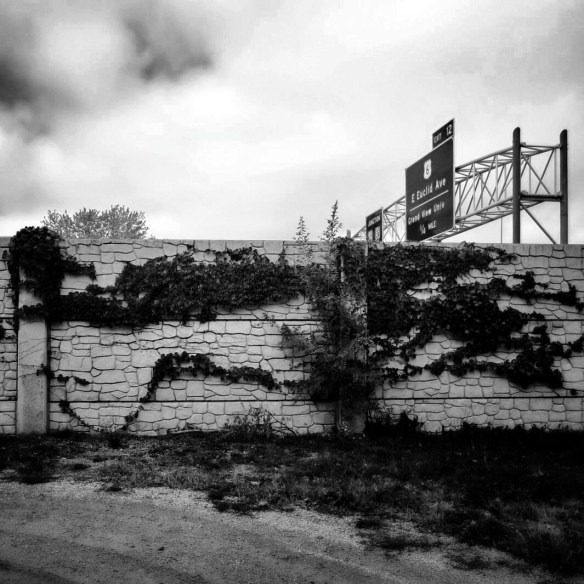
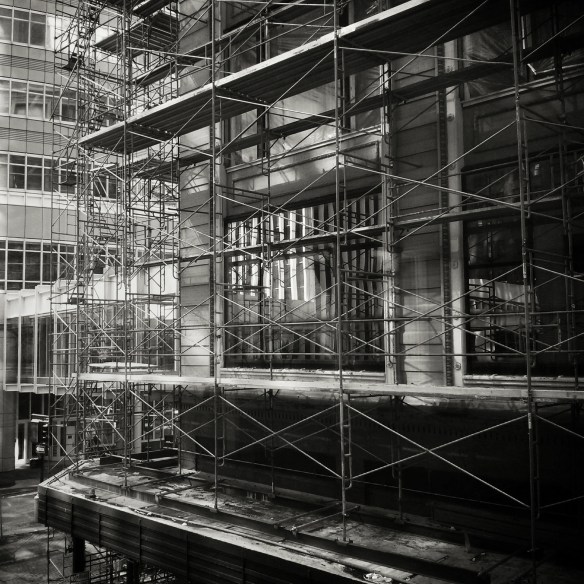
a dream

I have a dream.

Okay, it’s not as good as the Rev. Martin Luther King’s dream. His was a most excellent dream. It’s really difficult for any dream to compete with one in which the sons of former slaves and the sons of former slave owners are all sitting down together at the table of brotherhood. That’s some seriously fine dreaming, right there. It remains only a dream, of course, but nobody can deny the quality of the dreaming involved.

My dream is less ambitious than Dr. King’s, though it’s equally unlikely to come to pass. Almost everybody will say they support Dr. King’s dream — even if they don’t. Very few would support my dream. Still, I think it’s a perfectly fine dream and I like it.

Here’s my dream: reinstate the draft.

WPA - painting figures for museum dioramas.

WPA – painting figures for museum dioramas.

No, seriously, that’s my dream. Conscription. Not military conscription, but conscription for national service. I would like for every citizen in the United States to perform two years of mandatory national service.

That’s right, mandatory. All those folks who talk about how great this nation is, I’d like them to actually put some skin in the game. Talk is cheap and all that. And all those folks who talk about how lousy this nation is, I want to give them an opportunity to improve it. It’s easy to complain. Actually fixing stuff is inconvenient.

WPA - collecting fossils in Texas.

WPA – collecting fossils in Texas.

Two years of service. I don’t care what sort of service they engage in. I don’t care if they spend a couple of years working in the national parks, or helping old folks, or rebuilding roads and bridges and dams, or assisting in archaeological digs, or researching a cure for breast cancer, or documenting historic buildings, or restoring native prairie grasses, or updating and upgrading FBI computer systems, or responding to natural disasters, or painting murals in post offices, or cleaning beaches befouled with pollution, or gathering oral histories of the people who built the Alaskan Highway, or earthquake-proofing old structures, or teaching and promoting traditional rural arts and crafts, or cataloging beetles at the Smithsonian, or yeah — carrying a weapon and walking a post in Afghanistan.

WPA - sculpture workshop.

WPA – sculpture workshop.

Two years of service, right out of high school. Would it fuck up the career plans of some folks? Yeah, sure it would. But mostly it would fuck up the career plans of the privileged classes — and let’s face it, their privilege would survive and they’d still have lots of advantages over ordinary folks. Giving up a couple of years to improve the nation that gave them their privilege isn’t asking too much.

Two years of service, without exception (aside for extreme physical, psychological, or emotional disability). Two years, no deferments and damned few exemptions. College can wait. Only child of disabled parents? There’s bound to be some sort of national service that can be served locally. Doesn’t matter who you are or where you’re from or what your situation is, there’s stuff you can do to improve and support the nation.

WPA - relocating beaver.

WPA – relocating beaver.

The photographs here illustrate projects sponsored by the Work Projects Administration back in the 1930s and 40s. It was essentially an employment project, and over its lifetime it employed millions of people to engage in all manner of public works. Most of the work back then involved unskilled labor — building roads and all that. But they also employed artists and musicians and writers and actors to create and perform and document works of art for public consumption. People did things that were worthwhile.

The people employed by the WPA were just looking for work, of course. They needed a job. My dream would simply shift the motivation behind the work. It would be less about needing to make a buck and put food on the table, and more about providing a national service.

That’s it, that’s my dream. Two years of service. Two years serving other folks, serving something larger than personal interests, serving the nation. It’s not too much to ask; it may be too much to expect.

Which is why it’s a dream.

every year, this happens

This happens to me every year. I know summer is going to end. I know approximately when it’s going to end. I know that when autumn is here, I’ll love it.

I know all that — and yet every year this happens to me. There are a few days when the shock of summer’s end makes me…what? Not sad, really. Because, as I said, I love autumn. Not melancholy; I’ve never been able to carry off gloom and brooding. I’m okay at a bit of foreboding, but gloom and melancholy just aren’t in my repertoire. I’m not even disconsolate, because I’m easily comforted.

end of summer part 1

Wistful. I guess that’s it. The end of summer makes me wistful. I am full of wist. Wist, by the way, used to be the past tense of wit — and I’m talking about wit as a verb. As a verb, it meant ‘to know, to be aware or conscious of.’ You see it in other words: witless, dimwit, unwitting. The term witness originally meant to formally attest to a thing you actually know to be true.

Wistful, then, meant to be keenly aware of something you once knew to be true. It’s only a small step from that to the more modern meaning: a pensive yearning for something now gone.

end of summer, part 2

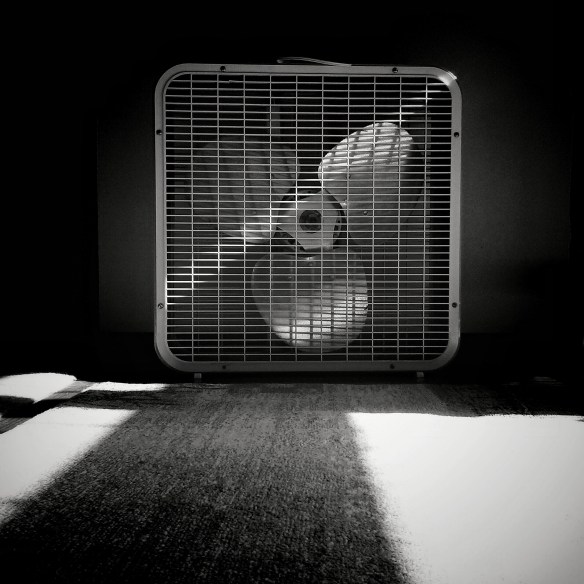
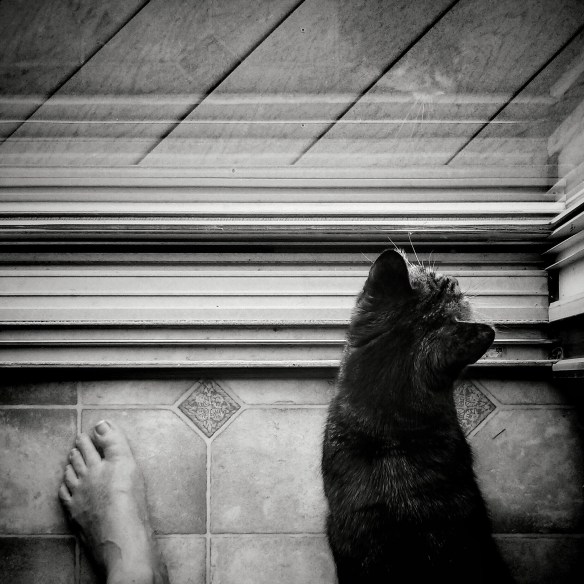
I will miss grilling out supper. I’ll miss sitting outside on a hot day, drinking a cold beer. I’ll miss going through my entire day barefooted. I’ll miss the freedom and comfort of wearing shorts. I’ll miss picking herbs from my window-boxes and cooking with them. I’ll miss the heat — that deep, penetrating, bone-heat that loosens my aging joints. I’ll miss the long days. I’ll miss the whirring of my old box fan. I’ll miss the breeze coming through the open windows and screen doors. I’ll miss leaving the deck door open so the cat can wander in and out at will, along with occasional wasps and flies and twice this year, a butterfly.

Hell, I’m already missing those things, and summer’s only been gone about ten minutes.

end of summer part 3

But at some point this week, I’ll pack up my shorts and put them away. And I’ll unpack my sweaters and scarfs and gloves and caps and soft flannel shirts. Oh, and flannel sheets. It won’t be cold enough for flannel sheets until autumn is over, but lawdy who doesn’t love sleeping in flannel sheets?

And pretty soon it’ll be time to start cooking soups and stews. Time for cooking chili and cornbread. Sometime in the next couple of weeks, I start baking beer bread again, and eating it warm with real butter. It’ll be time for eggnog before long, though it will annoy me that they begin selling it earlier every year (eggnog, by law, shouldn’t be consumed until the week before Thanksgiving). I look forward to walking in the woods, with all the dead leaves underfoot.

I love autumn. I’ll enjoy the hell out of it. I always do.

But still, I’ll have to wear shoes.

in which i travel the world and get cheerfully lost

A couple years ago a friend alerted me to Google’s Chrome Experiments, a curious and interesting group of browser-based games and art projects. At the time there were maybe five or six hundred projects, and while I thought some of them were pretty cool and worth exploring, I was busy. So I bookmarked the URL and, as so often happens with stuff I bookmark, I promptly forgot all about it.

Maybe six months ago I heard that Chrome Experiments had reached the 1000 projects mark. That revived my interest. I found my old sadly neglected bookmark and began to noodle around, exploring the various projects at random until I stumbled upon a game called GeoGuessr — and basically pissed away all my free time for about a week. Maybe two weeks. Possibly three. Now I’m more moderate in my GeoGuessr time; I play once or twice a week — but the game still fascinates me.

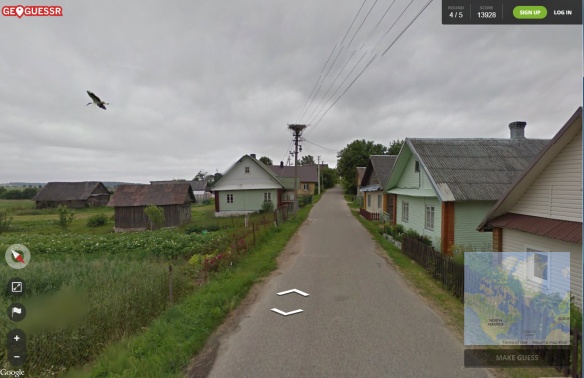
geo estonia village

As the name suggests, it’s a game based on geography. The concept is simple. Using Google Maps’ Street View, the game drops you on a random street somewhere in the world. I use the term ‘street’ loosely, It might be an actual street. Or it might be a gravel road in a remote corner of the Ukraine, or an on-ramp of an Interstate Highway in the United States, or a dirt path along a newly planted field in Spain, or a back street in a mid-sized Brazilian city, or a boulevard in a major urban area in Russia, or in a suburban housing estate in Wales, or a secondary road in Croatia.

In fact, since the Google-cam can be worn as a backpack, Street View has expanded to include places not accessible to vehicles. I’ve found myself beginning a GeoGuessr game on a ski slope in Utah and on a hiking path to a Hindu temple in India.

Croatia

The ostensible goal of the game is to use the visual cues and clues of your surroundings to determine your location. You ‘travel’ down roads in search of those cues and clues, then you make a guess about your location and mark it on a map  You accrue points based on how accurate your guess is. Each game has five rounds — five different geographical locations — and at the end, you’re given a total score.

That’s it. As I said, the concept of the game is simple. Part of the attraction, of course, is the puzzle aspect — trying to figure out where the hell you are. That’s fun. Frustrating fun, sometimes. Challenging fun. But still fun.

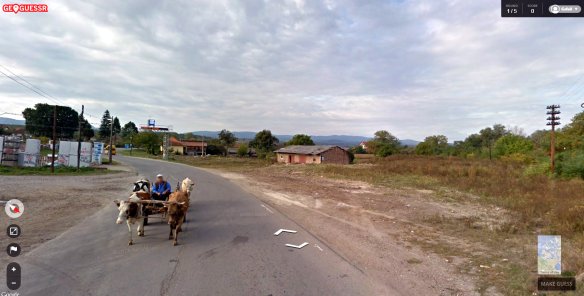
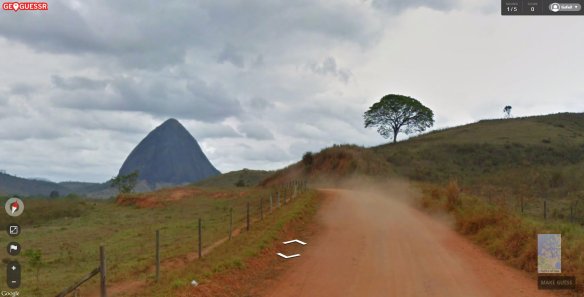
geo dirt road somewhere4

But for me, figuring out my location (and earning a high score) is secondary. What draws me repeatedly back to the game is the power of the unexpected. The GoogleCam isn’t just mapping streets; it’s also moving through the daily events of the world, and the world is jammed full of weird, absurd, profoundly beautiful, desperately sad, fascinating stuff. Roadside shrines to gods and memorials to victims of traffic accidents. Prostitutes plying their trade along the street. Mountains that come straight out of an Indiana Jones movie. Astonishing poverty. Exotic coastlines that make you think of pirates or castaways.

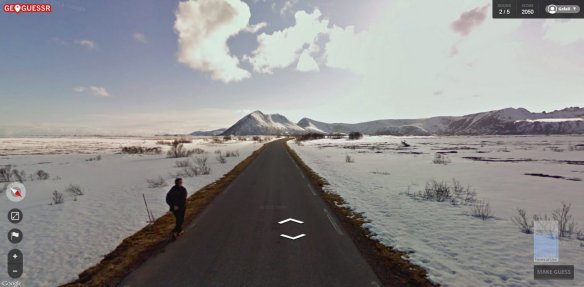
The randomness of GeoGuessr inserts you into unexpected locations where ordinary people are going about their ordinary daily lives. The reality of these lives — which are often radically different from my own — is fascinating. Kids playing stickball in the street. A young man meditating in a remote Hindu temple. A recent single-car accident in some remote road. A man walking by himself on some lonely stretch of road in northern Norway. A woman hitchhiking in South Africa. And the GoogleCam records it all with a completely dispassionate objectivity.

geo guy walking northern tip of Norway

I do enjoy the game aspects. There’s something fulfilling about being dropped at a random spot in the world and being able to locate that spot on a map within a few meters. Yet after I’ve figured out the location, I often continue to ramble around, intrigued by the ordinariness of life in other parts of the world.

I’ve begun to collect screen captures of bus stops. I’m thinking about collecting images of railroad crossings. And maybe bicycle riders. And people walking their dogs. These are things that are universal, and yet they’re all so very distinctive. The people waiting for a bus in South Africa probably have a lot in common for the people waiting for a bus in Russia. The cyclist in northern Spain probably has something in common with the cyclist in Australia, and the one on that mountain road in Utah.

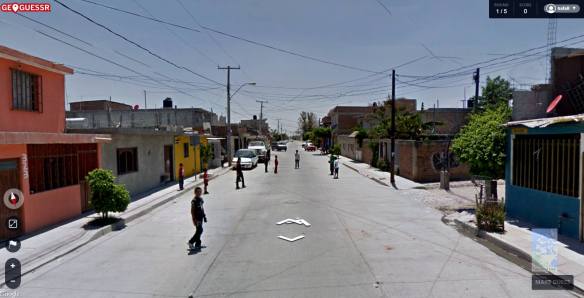
stickball

Some of you who read this will be tempted to play GeoGuessr. Give into that temptation. You should be aware, though, that it’s an enormous time-suck. You’ll promise yourself you’ll only play for half an hour — but then you find yourself wondering what’s around the next corner, or over than next hill, or through that tunnel. You’ll wonder what that building is, and you’ll want to check out that overgrown cemetery, maybe follow that alleyway down toward the docks. So let me repeat this: it’s an enormous time-suck.

Play it anyway.

a stick-thing

So I’m taking my walk, working out plot issues, being all serious in my head, and I see this old Ford F150 pickup start to pull out of a driveway ahead of me. As I approach, an old guy in the driver’s seat rolls down his window. He’s got to be maybe 75-80 years old. I figure he’s lost or something, going to ask me directions.

So I slow down and take off my sunglasses. People are less nervous if they can see your eyes. You take off your sunglasses and you seem more trustworthy and honest. It’s stupid, but there it is. Anyway, I take off my sunglasses and the old guy leans out and says, “I’m going to give you a free pen.”

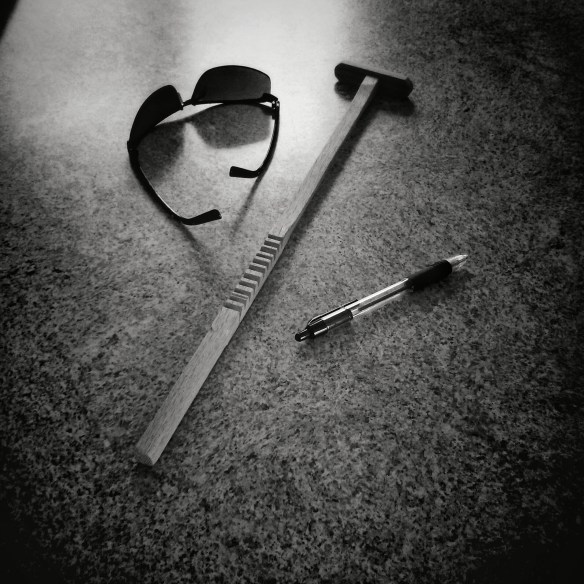
And he hands me an ink pen. Which I accept, because what else are you gonna do? Then he pulls out another pen and this stick-thing, with grooves on it and a sort of propeller on the end. He says, “I made one of these for my brother when he was trying to quit smoking. You rub the pen along the ridges and it makes it spin.” And he demonstrates. He rubs the pen vigorously along the ridges and sure enough, the propeller spins.

“Very cool,” I say. Because, again, what else are you gonna do? Also, because I’m starting to like this guy. He’s having so much fun making the propeller spin. He tells me “You have to rub it at on the angle, and if you rub the other angle, it spins the other way.” And again, he demonstrates. Sure enough, it spins the other way.

The stick-thing.

The stick-thing and the ink pen.

He hands me the stick and says, “You do it.” So I do. When the propeller starts to spin, I realize I’m making a mistake, so I fumble with it a bit. “Show me again,” I ask him.

And he laughs and does. First one angle, then the other. “You have to apply pressure,” he tells me. “Try it again.”

This time I make it work, which pleases him enormously. “You look like you could use two,” he says, and reaches for another stick-thing. He’s got maybe five or six in the other seat of the pickup. I tell him one is enough, on account of I’m taking a walk.

“What do you call it?” I ask him. He shrugs and says “It’s just a stick-thing I make.”

Then I ask if I can take his photo. “No no,” he says, “no no nonono, you don’t want my picture.” I tell him I really would like his photo. But he just shakes his head and laughs and rolls up the window. So I wave and he pulls out of the driveway and I continue my walk.

walking and washing the dishes

Much of what I do for a living requires (or allows) me to sit in a little room and think about stuff, then write something about the stuff I’ve thought about. Some of the stuff I think about is real stuff that’s actually happening in the real world; some of it is just shit I’m making up, and some of it is shit other folks have made up but aren’t entirely happy with. But I think and I write, and yeah, it’s a pretty weird gig.

The nice thing — one of the nice things — about the gig is that it’s not governed by space. I may be physically sitting in that little room, but my mind and imagination are pretty much unfettered. All those clichés you’ve heard about your thoughts only being limited by the stretch of your imagination — corny, but true. It’s a pretty sweet gig for my mind. My body, though, resents the little room. My body wants to get up and move around.

So almost every day I indulge my body’s wishes. I go for a walk or a bike ride. I ride the bike for the fun in it. Sometimes I’ll run errands on my bike, and yeah, that’s good for my body and for the environment and all — but mostly it’s just fun.
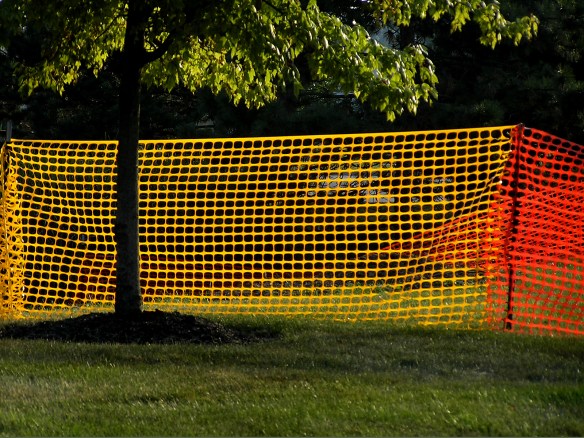
But here’s the thing about a bike: you have to pay attention. Cars and trucks will run into you, pedestrians will step directly in your way (even if you call out ‘On your left’ as you approach), dogs will chase you (so will geese, by the way — and that’s a lot more alarming than it sounds), the streets have potholes, the bike trails sometimes have walnuts or other detritus scattered around. When I’m cycling, I have to keep a big chunk of my mind constantly engaged with the world around me. I enjoy that, partly because it makes it impossible to think about whatever I’d been thinking about in that little room.

Walking, though — totally different. Walking doesn’t require the same level of situational awareness that cycling does. Sure, you have to pay enough attention to avoid stepping in dog shit or tripping over a curb, but basically walking doesn’t require much in the way of immediate vigilance.
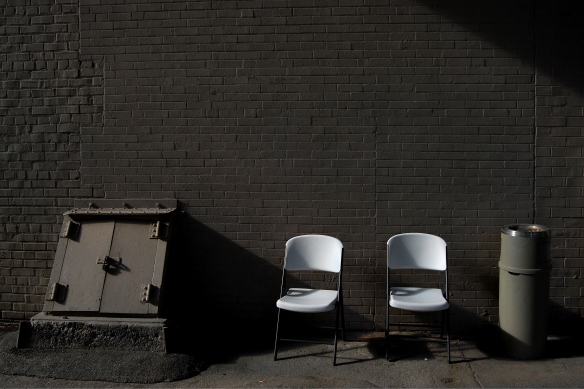
tobacco row

So I walk a lot, and I walk all over. Suburban neighborhoods, bike paths, city streets, alleys, hiking trails, country roads, the city skywalk. I walk year around, regardless of the season (though rarely in the rain). Sometimes I tote a camera. Most often, I don’t — though with a smartphone you always have a camera with you. Sometimes I take photos of stuff I see when I’m walking. All the photos you see here were shot while I was taking a walk.

I do three types of walking. Some of it is just utilitarian — a way to get somewhere and do something. You know, drop off a package at the local FedEx office, buy a clove of garlic, that sort of thing. Ordinary chores and tasks that are located nearby and aren’t particularly time-dependent.
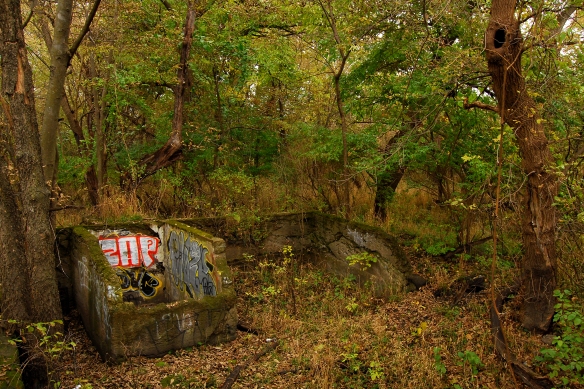
somebody lived here once

Most often, though, I walk and think — usually about something I’m writing. Or want to write. Or have been paid to write. That type of walking is essentially an extension of sitting and thinking in that little room, only without the sitting or the little room. Without the four walls and the computer screen in front of me, I’m generally more relaxed and flexible in my thinking. When I’m walking, I’m not distracted by the words on the screen. Instead, I’m thinking about what those words need to do.

I also walk as a form of meditation. A million years ago I briefly belonged to one of those strict, formal Zen communities where meditation practice was regimented. It was a group activity, with a starting time and a stopping time. You enter the zendo, make gassho to your zafu (which is basically bowing to the cushion you sit on), sit in orderly lines, wait for somebody to tap a brass bowl, which gives out a lovely tone that’s the signal to get to meditating. You sit very still, focus on your breathing, release all distracting thoughts. While you’re meditating some guy walks quietly around, watching to make sure you’re actually meditating and not thinking about what you’re going to make for supper or whether you should adopt a cat. If he thinks you’ve allowed yourself to become distracted, he whacks you with a little stick.
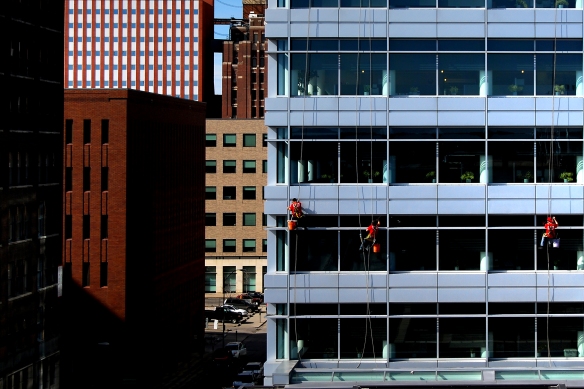
three guys in red

It works for some folks. It didn’t work for me. After a few months of that, I stopped going. I didn’t abandon Buddhism, but I abandoned meditation. Years later I stumbled across an article that mentioned a monk named Thich Nhat Hanh and walking meditation. No rows of cushions, no regimented starting or stopping time, and no guy behind me with a fucking stick — sounded good to me. So I did some reading, talked to some people, gave it a try.

It’s still about breathing. But walking meditation creates rhythm between your breathing and your steps. The heart of the idea, according to Thich Nhat Hanh, is to ‘arrive’ with every step — which sounds awfully buddha-buddha, but is really pretty simple. It just means being aware of every step, connecting with every step. My walking meditation is slower than my usual walking pace. I breathe in for three steps, out for four steps. It’s that simple.
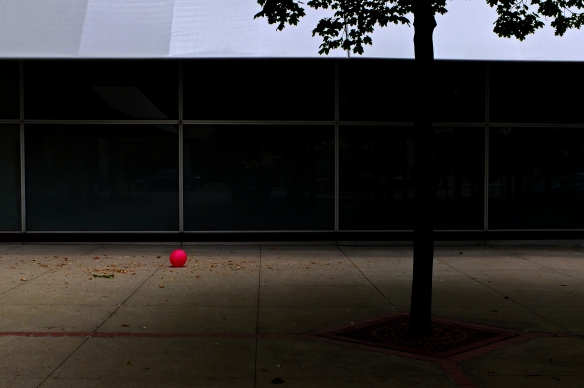
red balloon

And it’s easy to transition from my utility walking or work-walking into walking meditation. When I decide to meditate, I usually start by thinking of a simple Buddhist poem.

Washing the dishes
Is bathing the Buddha

And that triggers the meditation. I breathe in with the first line, and breathe out with the second. After a bit, the words becoming nothing but sounds and lose their meaning, and then it’s all about the rhythm. Everything else slides away. Easy peasy, lemon breezy.

I meditate until — well, until I stop meditating. It might a couple of minutes — it might be twenty. Doesn’t really matter. The meditation shifts back to plain walking, but I feel more refreshed and creative.
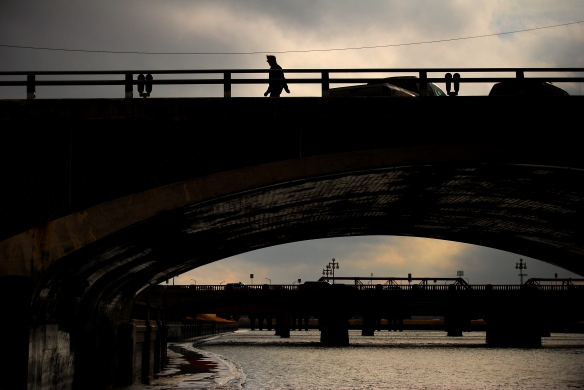
guy onna bridge

I had a point when I began writing this. I’ve completely forgotten what it was. Something about walking, probably. Or maybe something about writing. I’m pretty sure it wasn’t about meditation. It could have been about how sitting too long in a little room thinking about stuff can turn your mind into guava jelly.

Clearly, I’ve been sitting in this little room too long.
intercession, and all that

Today, apparently, is the National Day of Prayer. I wasn’t aware of that. I was completely and utterly ignorant that the United States has a National Day of Prayer. I’m not at all sure why we need a National Day of Prayer, but we have one and it’s today.

I learned today is the National Day of Prayer when a friend asked me, saying “Hey, Greg, did you know today is the National Day of Prayer?” He then urged me to go to the National Day of Prayer website and “leave a snarky comment”. When I asked why I’d want to do that, he said “You’re good at snarky comments.” Which didn’t really answer the question (does that count as a snarky comment?).

I did go to the website, on account of I’m curious about stuff like this. And I discovered the mission of the National Day of Prayer, which is

[T]o communicate with every individual the need for personal repentance and prayer, to create appropriate materials, and to mobilize the Christian community to intercede for America’s leaders and its families.

Well. Okay, then. Good on the Christians, I guess. Very thoughtful of them to pray on behalf of America’s leaders (seriously, it IS thoughtful, though I’d be interested to hear some of those prayers involving President Obama). The website also states:

The National Day of Prayer belongs to all Americans. It is a day that transcends differences, bringing together citizens from all backgrounds.

All Americans. Transcends differences. All backgrounds. Unless, it seems, you’re not Christian. That difference, not quite transcended. (Is that snarky? I guess it’s kind of snarky.) Still, thoughtful and all that. The website also includes the official prayer for the National Day of Prayer. Which is pretty old school, with bits about being humbled and broken, and cries for mercy, and a reference to ‘you are our only hope’ (and I’m sorry, I cannot hear that phrase without mentally adding ‘Obi-wan’ and c’mon, you did the same thing, fess up).

There’s a National Day of Prayer video, because you can’t have any sort of national day without a video.

It’s a racially diverse video. There’s young white woman whose boyfriend tells her he just wants to be friends, there’s a hard-working white laborer whose boss tells him he has to work late, there’s a middle-class white woman whose middle-class white husband doesn’t believe in the Bible, and there’s a black kid in sneakers who lives in a neighborhood where other black kids gamble on the sidewalk. The National Day of Prayer apparently allowed the black kid to walk right through a group of thugs shooting dice, caused the middle-class white husband to join his wife reading the Bible, informed the hard-working white guy that he should work even harder, and…well, the young white woman still doesn’t have a boyfriend, but at least she’s white and has a nice sofa on which to cry. So there’s that.

I noodled around for a bit on the National Day of Prayer website, but I didn’t leave a snarky comment. Not because there’s no snark-worthy material there, but because why should I go out of my way to offend Christians? That just seems silly and spiteful. Yes, there are Christians who, despite the fact that we have an actual National Day of Prayer (not to mention national Christian holidays), continue to believe Christians are somehow being suppressed and victimized. And yes, there are a lot of Christians who are astonishing hypocrites.

But so what? Most of the people I know are Christian in some sense, and most of them are good people. I can’t blame them because they share some religious beliefs with people who are total assholes.

But you know what would be cool? If we, as a nation, had a National Day of Not Being a Dick. That would be cool. Or a National Day of Maybe We Should Trust Women to Make Their Own Reproductive Decisions. I’d also like to see a National Day of Get Off Your Ass and Take a Walk or Ride a Bike. Or how about a National Day to Eat Vegan? I’m not a vegan, or even a vegetarian, but I think it would be worthwhile for people to consider the moral consequences of their food choices. I can think of a LOT of national days that seem more relevant and important than a National Day of Prayer specifically for Christians.

If I prayed — if I believed in Something or Someone to pray to — I’d pray for something like that. Even if there wasn’t a national day for it.


so sad so cool

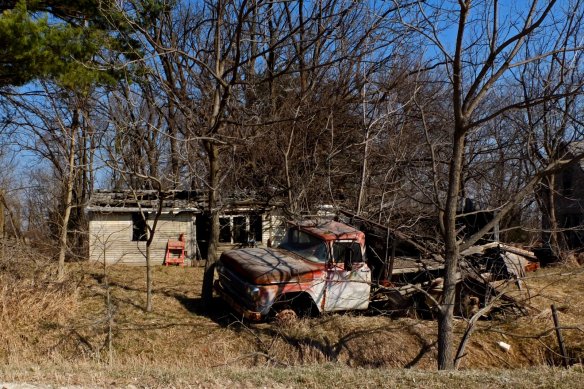
The truck, that was the first thing I noticed — just off the road, on the other side of a deep, grassy ditch. At some point in time it had been a serious truck. Not a gentleman farmer’s pick-up that could also be used to run errands, but a full-sized working truck built to haul serious payloads. Now it was basically a ruin; sitting lop-sided in the dead grass. It had been sitting there so long it had actually settled into the soil.

truck2

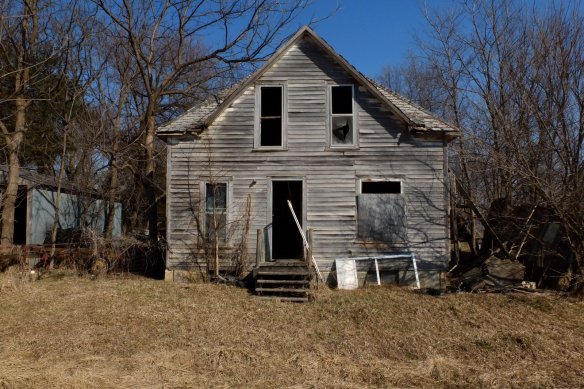
Beyond the truck was a house. A small farmstead, really — the house, a collapsed barn, a few small outbuildings, some sheds, a scattering of grain bins, rusted farm equipment. There was surprisingly little vandalism, aside from a few shattered windows and maybe the front door, which had been torn from its hinges. Most of the damage appeared to be the result of weather and long neglect. The property was clearly abandoned, and had been for some time.

It’s a curious term, abandon. It connotes a complete giving up, an absolute and total acknowledgment that there will be no return, a total surrender. Perhaps whoever lived there had originally intended to return — but at some point there had to be a moment of recognition that it would never happen. There’s something profoundly sad about that.

abandoned farmhouse2

Here’s an odd thing: I couldn’t bring myself to enter the house. I mounted the stairs and stood in the doorway, but I was reluctant to go inside. Not because it wasn’t safe (the house itself seemed pretty stable), and not because it would be trespassing (legally, I was already trespassing). I was unwilling to go inside because it felt wrong. It felt like a violation, somehow. What makes it odd is that at one point in my life I had a job that involved routinely trespassing and violating the privacy of other folks. But back then I was getting paid; to trespass in the house for no reason other than my own amusement seemed like some sort of transgression.

However, I didn’t feel that way about the other buildings on the property. I noodled around in them without any compunction at all. This one, for example.

music room2

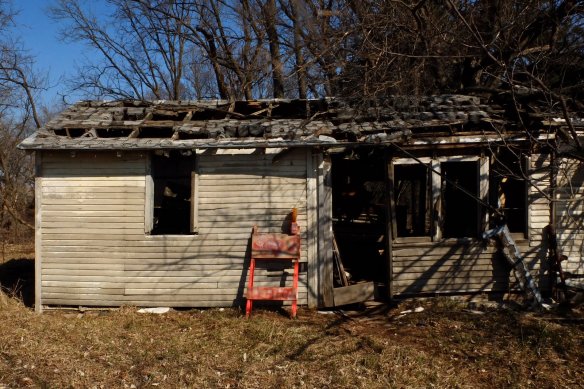
It was just a few yards away from the main house. The roof had caved in a long time ago, and the debris made it almost impossible to walk around. It didn’t help that there were obvious nails and shards of broken glass lying about (combined with the fact that I was wearing sneakers). Still, it was easy to tell the building had most recently been used as a sort of office or studio.

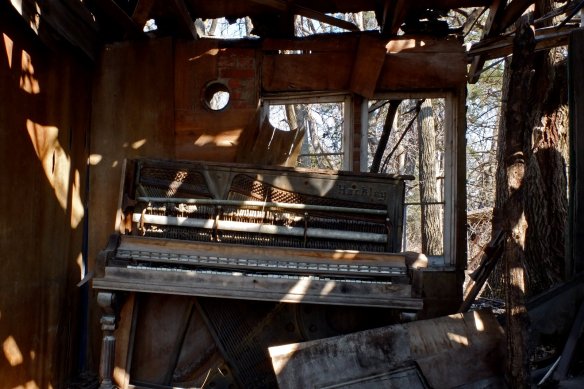
The bones of an old Hackley upright piano occupied the main room.

piano also2

In 1863, at the height of the American Civil War, Milo J. Chase began building pianos in Grand Rapids, Michigan. A few years later, his company was reorganized as Chase-Hackley Pianos. The company had a good reputation as builders of durable, medium quality instruments. The pianos could be bought directly from the manufacturers, which allowed buyers to avoid sales and additional shipping charges. This made Chase and Hackley pianos popular with rural and farm families — at least until they went out of business in 1930, victims of the Great Depression.

It’s easy to imagine farm kids sitting in front of this old Hackley, struggling away at some painful version of Clair de Lune.

tractor again2

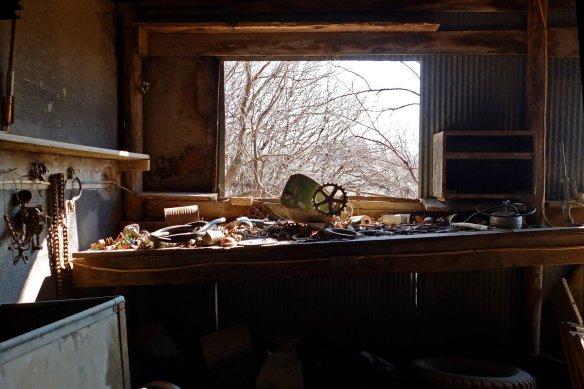
Behind the house were a variety of small, slowly collapsing sheds and workshops, as well as well as some farm equipment — all of which suggest that at one time this was a rather successful farming operation. There was a woodworking shed, a machine and tool shed, and a couple of storage buildings — all of which were in some stage of dilapidation. Only a few had working doors; none had functioning windows.

As with the house, most of the damage was a result of time and weather — and in some cases, animals. One bench was littered with raccoon shit, there were what appeared to be small mammal nests under some of the workbenches, and paw prints in the dust.

shed again2

The barn was the most severely damaged structure on the farmstead. The roof and one wall had completely collapsed, two of the other walls were pretty unstable, and the fourth wall seemed to be supported primarily by stacked bales of old hay. I wouldn’t have gone inside at all, except that I could see some bones — and bones make me stupid.

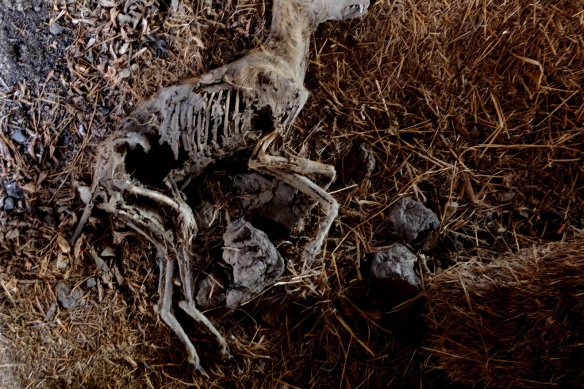
So I crouched down and groucho-walked inside to look at them. It was dark, of course, and what I first thought was an old sack turned out to be the semi-mummified remains of a dog. It appeared to have died of exposure or natural causes rather than violence, and was eviscerated by other creatures after death. The roof was too low at that point to allow me to examine the dog closely. I couldn’t even photograph it properly; I had to hold the camera out at arm’s length and shoot blindly. This is the only shot that was in focus — which is probably just as well.

family dog2

I didn’t stay at the farmstead very long. Places to go, people to meet, and all that. But the entire time I was there, I was very aware of my own internal dissonance. I’m not a terribly self-reflective person under most circumstances. I don’t spend much (or any) time thinking about what I feel, or wondering why I do stuff. Yet I was conscious of being torn between feeling This is so sad and thinking This is so cool.

Because it was so sad and it was so cool, and it still is. I’ll almost certainly go back at some point when I have more time to explore. Maybe I’ll even overcome my conscience and actually go inside the house.

in which i enrich my life in small ways

There’s a Stop&Rob convenience store about a mile from where I live. I slide in there once or twice a week during my daily walk/bike ride, mainly because they sell these amazingly good freshly-baked chocolate turtle cookies. Or maybe they’re chocolate tortoise cookies. I can never remember, though I know the difference when it comes to the non-baked goods turtles and tortoises. Regardless, they’re spectacularly good and are a nice reward for having taken a walk or a bike ride (by the way, the cookies are NOT made from actual turtles or tortoises, and as far as I can tell have absolutely nothing to do with the Chellonii (which, I’m told, is the proper term, even though I normally just call them Chellonians)).

This afternoon, as I was heading home from my walk, I stopped in for my cookiie. The woman in front of me at the register was all a-fluster. She’d tried to buy some lottery tickets, but had either asked for the wrong species of lottery or the clerk had made an error and printed out the wrong lottery tickets. Either way, she was rejecting the tickets and demanding the clerk give her the tickets she actually meant to purchase.

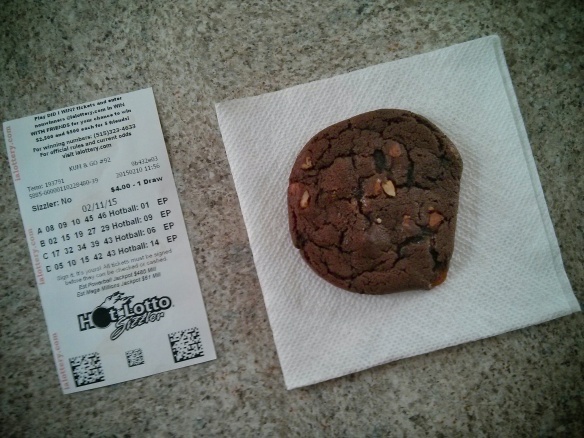
Things I bought today that will NOT be laundered

Things I bought today that will NOT be laundered

I occasionally buy a lottery ticket along with my cookie. It’s stupid, I know, but it’s not even close to the stupidest thing I do routinely in my daily life. Maybe every couple of months, based on nothing in particular, I’ll buy a ticket. It usually ends up in a shirt or pants pocket, where I only remember it when I’m about to do my laundry. Or, just as often, after I’ve done my laundry.

Lottery tickets, if you weren’t aware, aren’t designed to go through a laundry cycle. It turns them into a strangely compact and totally illegible wad of paper. Now, by my math (and my math, admittedly, is singularly pathetic math, but I’m pretty confident in this), a lottery ticket that’s utterly illegible only slightly reduces your odds of winning — so it’s no great loss if the ticket is laundered. Consider this a public service announcement.

At any rate, the woman had rejected her tickets and the clerk (a young woman with a tattoo on her forearm that appeared to depict a seahorse being ridden by Batman, though I never really got a very good look at it and it seems really unlikely that she’d have a tattoo of Batman riding a seahorse, so I’m probably wrong about this) was clearly baffled as to what she should do. So I offered to buy them.

The idea of buying rejected lottery tickets has a bizarre but powerful appeal. Well, it does to me. I have no idea what bizarre but powerful thing appeals to you (and knowing some of you, it really doesn’t bear thinking about). A rejected lottery ticket has no statistically better chance of winning, but it has a sort of poetic aura of despair and futility that is well worth four American dollars. It’s entirely possible that from now on I will only buy rejected lottery tickets.

So I’m back now from my walk, I’m in the process of eating the cookie, and I’ve set the lottery ticket aside to prevent it from being laundered. I’m feeling stupidly pleased with myself.

UPDATE: Four separate entries consisting of seventeen unique numbers, and not one single number of those seventeen matched any of the winning numbers. In effect, my ticket said “You lose four bucks.”

Still worth it, though.