the humanness of things

“I don’t believe in coincidences.” You’ve heard that line spoken in every detective show that’s ever been on television. It’s ridiculous, of course, because coincidences exist. I mean, that’s why we have a word for it.

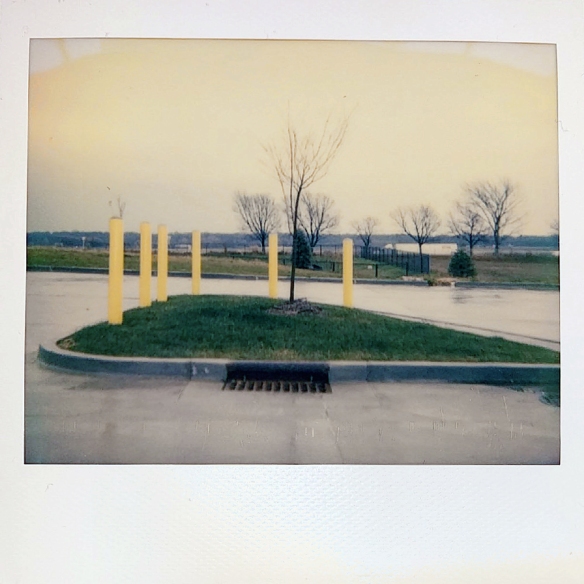
For example, about a week ago I was shooting a photograph of some yellow bollards at the very back of a massive and nearly empty parking area of a big box store. I was using an old Polaroid Spectra 2 camera, trying to get a feel for what the camera could do, using Impossible Project color film, trying to get a feel for what the film could do. In other words, I was experimenting.

family-of-bollards

Before I took the shot, however, a car pulled up and the driver rolled down his window. He was an old guy (and as I say that I realize he was probably around my age — maybe even a bit younger), and he grinned at me and my Polaroid camera and asked “How do you use your camera?”

I’d had a similar question from a police officer a couple of weeks earlier (there’s a coincidence for you — and coincidentally, one of the photos I shot before the arrival of the police officer was of a yellow bollard). With that encounter in mind I launched into an explanation of how I used the camera as a descriptive tool, a device designed to record a small but precise rectangle of the reality in front of the lens. I was prepared to elaborate on that idea — to spell out how the decisions of what to include in the frame and what to exclude from the frame were expressive decisions, and so even if the final image seemed mundane — like, say, a group of yellow bollards — there were still aesthetic aspects to be considered, as well as the notion that mundane objects and structures can be interpreted as a manifestation of humanness. In other words, my decision of what to include in the frame is, in part, a reflection of some other person’s past decision to…

“No,” the old guy interrupted. He said, “No, I mean, the camera. The camera. How do you use that camera? I thought they stopped making Polaroid film.” So I told him about the Impossible Project. Then I shot the photo.

That photo, coincidentally, sparked a brief discussion on Facebook because apparently relatively few people were aware those posts are called bollards. And coincidentally, this morning on Facebook I learned that William Christenberry had died.

Just over a decade ago I admitted that although I’d been shooting photographs for years and I knew how to operate a camera, I was pretty ignorant about the history of the craft. I had only the barest notion of what had been done in photography in the past, or who had done it, or what they were thinking when they did it. So I decided to educate myself, and I decided to share my education with a group of friends in a Flickr group called Utata. I’d pick a photographer, do some research, write a short article based on the research, and we’d discuss it in the group. We called it the Sunday Salon.

christenberry1

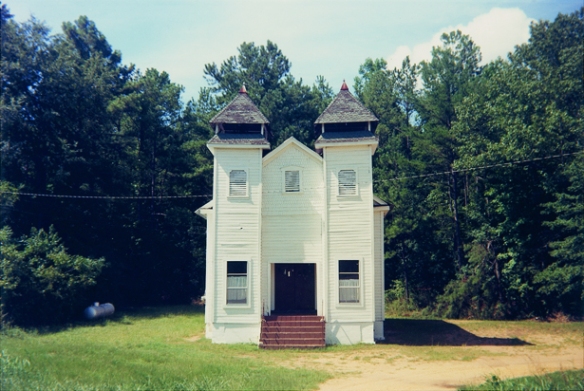
One of the first photographers I picked for the Sunday Salon was William Christenberry. Why? Because I came across his name somewhere and liked it. I didn’t know anything about his photography, and when I began to look at his photographs, they didn’t make a lick of sense to me. I saw an old black-and while photo of a dilapidated juke joint somewhere in Alabama. Then I saw a photo of the same building, only this time it was in color. Then another photo of the same place, and another and another — all of the same building.

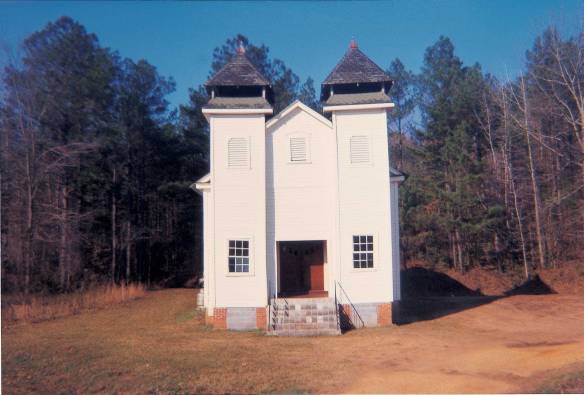
I began to get it. This guy wasn’t just photographing the building; he was photographing the history of the building. Christenberry wasn’t trying to make art — at least not at first. He was just creating a document, a description of how particular structures evolved and devolved. He went back to the same places year after year to record how things change.

christenberry2

A building may be static, but the world around it is dynamic. What happens in the world is reflecting by the changes to a building. Wind and rain have an effect, the settling of the structure into the soil has an effect. Paint fades, shutters have to be replaced, buildings begin to tilt. Humans very obviously have an effect; they do the painting, they replace the shutters, they repair the damage.

Over time, Christenberry’s simple documentation process became deliberate, thoughtful art. His first photographs were shot using an old Brownie camera given to him when he was young, but as the project progressed, so did his use of technology. He eventually began to shoot with a Deardorff 8×10 view camera. Christenberry even began to take measurements of some of the buildings and recreated them as sculptures.

christenberry3

“What I really feel very strongly about,” Christenberry once said, “and I hope reflects in all aspects of my work, is the human touch, the humanness of things, the positive and sometimes the negative and sometimes the sad.”

There it is. The humanness of things. Those half-dozen yellow bollards? Somebody deliberately put them there. Somebody designed the shape of that small area, somebody chose to plant a tree in the middle of it, somebody decided what type of tree to plant. Somebody designed that parking lot. The humanness of things is always there.

I believe in coincidence. I love coincidence. I enjoy the weird, improbable chain that links an encounter with the police to an old guy in a parking lot asking about an old camera to a discussion on the etymology of the term bollard to the work of William Christenberry to a photograph of yellow bollards. I believe in coincidence and I believe in the humanness of things, and wouldn’t the world be terribly dull and uninteresting without them.

i took a walk a couple of weeks ago

I like to walk. I like to walk without any purpose, without any goal or objective, without any particular destination. But occasionally I walk with the idea of shooting photographs. Most often that happens on a Thursday (largely because I belong to Utata — an international group of photographers who walk on Thursdays; I’ve written about this before: here, here, and here).

So it wasn’t unusual for me to take a walk on Thursday, the 11th day of November, 2016. I needed a walk that day. I needed it because Donald J. (for Jackass) Trump had just been elected President of These United States. A quiet, contemplative walk on a gray, chilly day that seemed to hold the promise of a gray, chilly future.

And that was how I felt even before I got stopped by a police officer. But I’m getting ahead of myself.

tire-swing

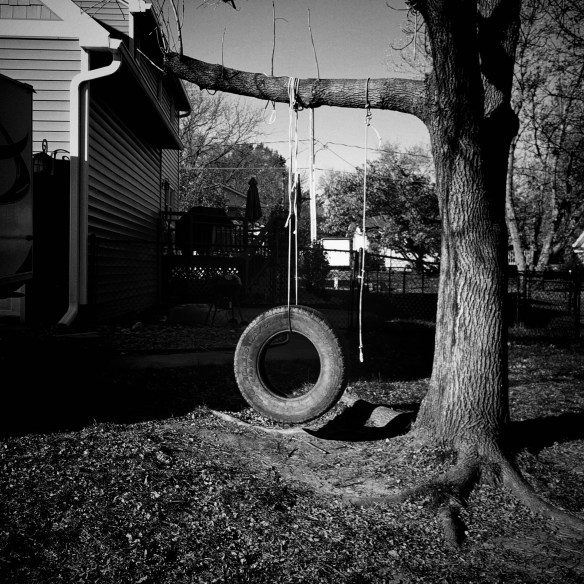
I wasn’t really in the mood to shoot photographs, so I didn’t bother to take a camera. Just my cell phone. It was this tire swing that first made me pull out my phone and open my favorite black-and-white camera app. It seemed a perfect metaphor for my mood. Sort of sad, sort of nostalgic, sort of pathetic. Lost innocence and all that.

I was near a semi-industrial commercial area, so wandered over there and strolled along behind the various shops. You know, that area where the shop owners keep their trash and deliveries get made and isn’t meant to attract customers. I’ve always liked the lack of pretense in alleyways and the backs of shops. And, again, it suited my mood.

fence-and-trash-can

This wasn’t an actual alley, though it served the same purpose. I’ve wandered along behind these buildings before; it’s always remarkably tidy. The morning light gave it a certain shabby elegance that contrasted well with the bright, functional geometry of the buildings.

At some point I’d stopped thinking about Trump and started to enjoy myself. That’s the thing about photography, isn’t it. It draws you outside of yourself. And that’s especially true, I think, of black-and-white photography, since you’re paying more attention to shape and line and structure.

bollard

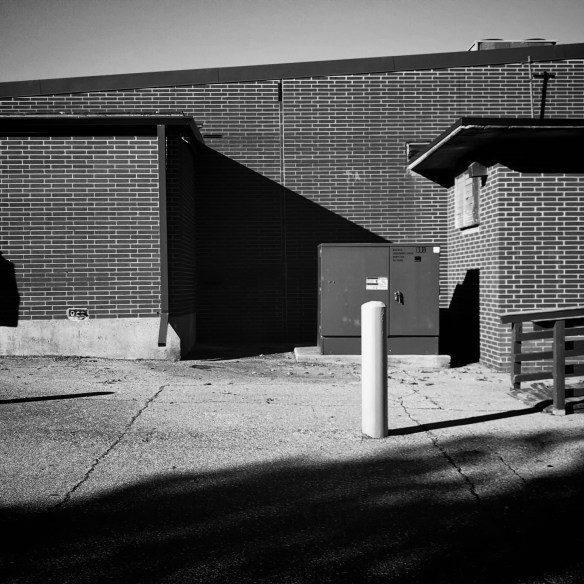
Everything gets reduced to what’s in the frame. Not just what’s in the center of the frame, but what’s on the periphery. A step or two to the right, and that bit of shadow from a vent disappears. A step or two to the left, and the bollard disrupts the lock on the electrical whatsit, and the ramp is no longer obviously a ramp.

I know this because I actually took those steps to the left and the right before deciding this was the composition I wanted. (I learned to shoot with film, and since film was expensive and processing it was pain the ass, I learned to pay very close attention to composition; get it right the first time, shoot one frame — maybe two — and move on. I’m a stingy photographer.)

broken-adirondack-chair

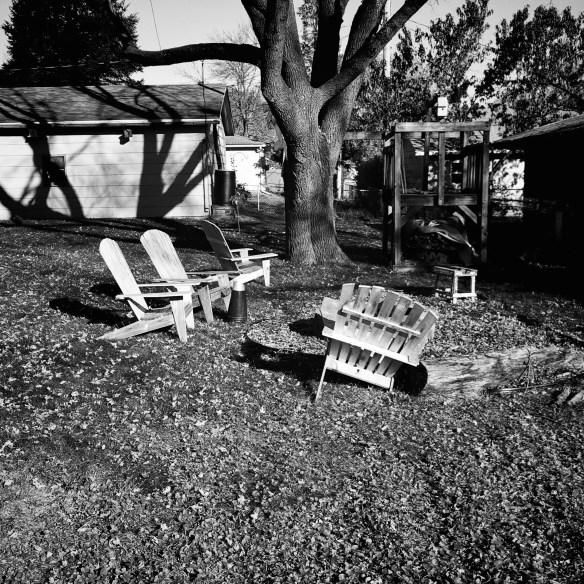
There’s usually a sort of fuzzy area between semi-industrial commercial shops and the more comfortably suburban, well-groomed neighborhoods — an area where the houses might need a bit of paint, where the lawns aren’t quite as tidy, where the kids’ toys haven’t been picked up, where the cars and trucks are a few years older and are showing a bit of rust. It’s the Almost American Dream zone. I grew up in that zone.

Remember that police officer I mentioned earlier? This is where he shows up. I was just about out of the Almost American Dream zone when he arrived.

packers-fan

He was very polite. Young white kid, buzz cut, nice smile. He rolled down his window, said “How’re you doing?” I considered telling him I’d voted for Hillary, so how the hell would I be doing. And that’s basically what I said, though I moderated the last bit. He nodded and said he couldn’t believe it either. Then he said something to this effect: “We got a call about somebody walking behind the shops and taking pictures with a phone. That you?”

I admitted it was. He said one of the shop owners was concerned that somebody might be casing the joint (he actually said “casing the joint”), and then asked if he could have my name.

A short digression here. I worked as a criminal defense investigator for about seven years. I’ve been stopped and questioned and actively harassed by police officers more times than I can count. I know my rights. As a pedestrian legally walking along a public way and minding my own business, I’m not required to identify myself to the police. However, if the officer is investigating a possible crime it becomes a tad tricky. And given that there might be some dispute whether the area behind these particular shops is a public way, it becomes a tad trickier. So I told the officer I was going to reach into my pocket and get my wallet (as a white guy, the odds that the police would shoot me for reaching for my wallet are really really really slim — but still).

I showed him my driver’s licence. He asked the obvious question. “Why were you taking pictures behind those shops?” So I told him. Thursday walks, Utata, light and shadow, alleyway geometry.

hoop

Then he asked the really difficult question. “Can I see your photos?”

The obvious answer is no. No, you can’t see my photos. No, because you have no legal right to see them, and I have no obligation to show them to you. The fact that he’d asked to see them rather than issuing a command didn’t matter. The fact that he’d asked politely didn’t matter. Courtesy counts, but it doesn’t trump civil rights.

On the other hand, I didn’t want a fuss. Hillary had just lost the election; I didn’t have the energy to make a passionate civil liberties argument. So I offered a compromise. I told the officer I was reluctant to show him the photos as a matter of principle, but I understood why he wanted to see them. I said “If you agree that you have no legal right to see the photos, I’ll show them to you.”

I got lucky, probably. This guy had a sense of humor. He laughed a bit, then agreed he had no legal right to see the photographs. So I showed him the photos. More than anything else, he was surprised to see that the photos were actually shot in black-and-white. He wasn’t aware there were black-and-white apps. He wasn’t aware you could shoot square format with a phone.

So I took my phone back, turned and shot the photo of the basketball hoop and shadow, and showed it to him. He asked for the name of the app. Then I asked if I could take his photo, and he said this (or something like this): “You have the right to take my picture so long as it doesn’t interfere with the performance of my duties…but I’d rather you didn’t.”

So I didn’t. I thought about it, but I didn’t. As he drove away, I wished I had. Sort of.

Postscript: I began to write about this on the day it happened. But the sad fact is, I was still too discouraged about the election to write more than a couple of paragraphs. I’ve noodled around with this post off and on, but I’m still pretty gutted by Hillary’s loss — and seeing these photos reminded me of how grim I’ve felt since the election. It reminds me of how much stuff I’ve put off, how many things I’ve been procrastinating about, how much normal stuff I’ve been avoiding.

I had a good encounter with a police officer — something positive happened to me — and I just couldn’t maintain that feeling. That sucks. It has to change. Maybe finishing this and publishing it is the spark I need. And now I suppose I have to append the ‘confessional crap’ tag to this. I hate confessional crap.

sure enough gettin’ worse

It’s been a week now. Seven days since I woke up and discovered it wasn’t just another PTSD nightmare. Donald Trump really no shit actually won the election. A full week, and folks I’ve been struggling.

Here’s the thing: I’m a Buddhist. I’m not a particularly good Buddhist, but for the most part I try to abide by the basic tenets of Buddhism. I don’t often talk about this Buddhist stuff because 1) who cares? and 2) it’s nobody’s business. But I’ve been struggling, because one concept lies at the heart of all the various Buddhist groups: compassion. So I’ve been trying to practice compassion for Trump voters.

It ain’t easy. For example, I read a New York Times column by Rabbi Michael Lerner entitled Stop Shaming Trump Supporters. I’m going to quote a chunk of his column:

The right has been very successful at persuading working people that they are vulnerable not because they themselves have failed, but because of the selfishness of some other villain (African-Americans, feminists, immigrants, Muslims, Jews, liberals, progressives; the list keeps growing).

Instead of challenging this ideology of shame, the left has buttressed it by blaming white people as a whole for slavery, genocide of the Native Americans and a host of other sins, as though whiteness itself was something about which people ought to be ashamed. The rage many white working-class people feel in response is rooted in the sense that once again, as has happened to them throughout their lives, they are being misunderstood.

No. As Donald J. Grabbembythepussy would say, wrong. The left has NOT been blaming white people as a whole. The right has been telling white people that the left has been blaming them — and a LOT of white folks have fallen for that lie. The political right-wing has also promoted the lie that the ‘failure’ of some groups of white folks been the fault of “some other villain”. Rabbi Lerner has got the wrong end of the stick.

Here’s where I begin to struggle. When I was formally studying Buddhism I was taught the greatest impediment to compassion is our attachment to a personal belief about how the world should be. I was also taught that compassion and forgiveness went together like peanut butter and milk chocolate. I have no problem feeling a good Buddhist level of compassion for folks who’ve been lied to and whose suffering is exacerbated by their acceptance of those lies. It’s the forgiveness component that’s kicking my ass.

Which leads me to this: if you voted for a candidate who is racist, sexist, homophobic, and xenophobic, then even if you’re not personally racist, sexist, homophobic, or xenophobic, you’re at the very least willing to support racism, sexism, homophobia, and xenophobia. I can feel compassion for folks who are scared of other races, who are fearful of women, who are anxious about folks who are different. But right now I’m just not capable of being forgiving of such bullshit.

And if you voted for a candidate who explicitly advocates torture and the revenge killing of the families of terrorists, then even if you’re not personally in favor of torture and revenge killing, you’re at the very least willing to support torture and revenge killing. I can feel compassion for folks who are so afraid of the world around them that they think hurting other people is the only way to protect themselves. But right now I’m just not capable of being forgiving of such bullshit.

So right now, this week, I’m struggling. Right now, this week, I’m in Mose Allison’s camp. Everybody cryin’ mercy, when they don’t know the meaning of the word. Right now, this week, I have no time for racists who suddenly feel safe to be racists, and who whine when they get called on their racism.

Right now, this week — and maybe the next, and maybe the week after that — I’ll do my damnedest to be compassionate, but I’m putting a hold on the forgiveness. I figure the Buddha would understand. That dude had compassion down.

Postscript: I just found out Mose Allison died yesterday, Fuck me with a chainsaw.

proust – pivot – lipton

There’s a semi-interesting article in The New Yorker titled How the Proust Questionnaire Went From Literary Curio to Prestige Personality Quiz. I say ‘semi-interesting’ because it takes what I think is an interesting idea — the evolution of a questionnaire a lot of folks are familiar with — and turns it into a fairly pretentious exercise (which is a thing most of us love and hate about The New Yorker). The New Yorker is one of the few places where you’ll find a line like this:

It’s safe to say that, today, the Sainte-Beuvian paradigm has triumphed—if not among literary critics, then certainly in the culture at large.

I guess that IS safe to say, if only because hardly anybody would know what the fuck you were talking about, unless they’d read the article in The New Yorker. And maybe not even then. But despite that, it’s actually interesting to have some glimpse into the origins of the questionnaire.

I became familiar with the questionnaire because of James Lipton’s odd talk show, Inside the Actors Studio. Lipton interviews actors (or directors, and an occasional screenwriter) about their craft. It began in 1994 as a sort of filmed seminar for students in the Actors Studio Drama School — a one-one-one informal but intensely personal interview with somebody who actually works in the business. Over time it’s become a popular show in its own right. The show often reaches a pretension level that can rival The New Yorker, but I’ve never seen an episode that wasn’t worth watching. That said, I wouldn’t entirely disagree with the Sunday Times critic who described the show as:

“[J]ust a chat show on satellite, but the veil of education and posterity is held decorously high, so everybody turns up and talks with a smile.”

Each episode ends with Lipton asking a series of ten questions that he attributes to French television personality Bernard Pivot, who did a similar show devoted to writers. Pivot said his list of questions was inspired by Marcel Proust. Proust got the idea from a popular 18th century parlor game he learned from Antoinette Faure. And the green grass grows all around, all around. If you’re really curious about all this, then you’re probably the sort of person the article in The New Yorker was written for, and you should probably go read it.

Most folks, though, are primarily interested in the questionnaire — the actual ten questions themselves. Some of the questions are pedestrian, some are silly, some are insightful, but it was always interesting to see how various actors/directors/writers would answer them.

Obviously, I’m going to give the questions and my own answers — but I’m genuinely curious to see how other folks would answer them as well. So, here we go:

What is your favorite word? Ownself. It’s a Southernism, I think. At least I’ve never heard anybody outside of the Deep South use it in the same way as Southern folk do. It means ‘yourself’ or ‘myself;, of course, but in a more deeply personal and possessive sort of way. Saying “my ownself” or “your ownself” emphasizes the ownership of whatever the hell you’re talking about. For example, saying “I’ll do it myself” doesn’t carry the same level of investment or commitment as “I’ll do it my ownself”, which is less invested than “I’ll do it my own damn self.”

What is your least favorite word? Any hateful slur — kike, nigger, faggot, pick one.

What turns you on? Smart people.

What turns you off? Willfully stupid people. You know, folks who are capable of learning and understanding, but either can’t be bothered to learn or refuse to learn because it would make them doubt something they believed. Willfully stupid people can fuck right off.

What sound or noise do you love? Water rippling around stones.

What sound or noise do you hate? Leaf blowers. I fucking hate leaf blowers.

What is your favorite curse word? I don’t really have a favorite. I’m sort of partial to ‘cocksucker’, though it’s not an expression I use. I like it because it was used beautifully and creatively in the HBO series Deadwood. HBO’s The Wire did something similar with ‘motherfucker’, but The Wire‘s motherfucker lacked the deep, profound sense of commitment to obscenity that we saw in Deadwood‘s cocksucker.

What profession other than your own would you like to attempt? Architect, maybe. Or investigative epidemiologist.

What profession would you not like to do? Anything to do with accounting.

If heaven exists, what would you like to hear God say when you arrive at the pearly gates? I always have trouble with this premise. It’s like saying “If you had your own personal dragon, what would you do with it?” But you have to play the game by the rules, so IF heaven existed and IF there was a god waiting to greet me, I guess I’d like to hear her say “Hi, come on in, we have an extensive library. And there are no leaf blowers.”

So that’s me. What about you?

nobody cares

“Sometimes I feel like I should just give up.”

One of my writing students recently said that. In fact, I hear that with distressing regularity from my students. (As an aside, it still occasionally strikes me as improbable that I’ve become a Person Who Has Students.) That statement is almost never posed as a question, but the question is always there as a not-very-subtle subtext. Should I just give up? And that question always masks another question, which is generally phrased as another statement: I’m never going to be good enough to get published, am I.

The question at the heart of all this is an awkward question. It requires a graceful answer. It also requires an honest answer. As a Person Who Has Students, it’s my experience that honesty and grace don’t always dovetail together.

The graceful response is easy. “No, of course you shouldn’t give up. If you approach your writing with diligence and sincerity, you can become good enough to get published.” There’s some measure of truth in that. If you work hard at any craft — writing, cabinetry, weaving, brick-laying, pottery — you can improve. Most of my students have the capacity to be good enough to get published.

But most won’t. That’s the honest answer. Hard work doesn’t guarantee mastery, and mastery doesn’t guarantee success. The unwelcome Truth is that while most of my students have the capacity to improve, relatively few will actually fulfill that capacity; they either lack the necessary persistence or are prevented by circumstance from achieving it. And even whose who ARE good enough, may still not be good enough. Even if they produce excellent work, the first publisher to read it may reject it. And so might the second and third. And the fourth and and and.

Nobody cares about your zombie novel

Nobody cares about your zombie novel

Instead of responding directly to my student, I asked a question: “What matters most to you — writing a good story or getting published?” Everybody wants both, of course — and logically one should follow the other. If you write a good story, it’s got a better chance of getting published. But knowing which of those matters most changes your approach. If getting published matters most, then you let the marketplace direct the work. If the marketplace is hot for zombies, then you write zombies. Some folks will sneer at that, but there’s nothing wrong with it. It’s a professional approach  Getting paid for your work is a wonderful thing, and the best way to get paid is to give the market what it wants. And down at the bone, a good zombie story is first and foremost a good story — just with zombies.

If it’s the writing itself that matters most, then your approach is different and the reward is different. In that case, story takes precedence over the marketplace. You might still write a story about zombies, but it’s the story that’s driving the process, not the zombies. And I’m going to repeat myself: down at the bone, a good zombie story is first and foremost a good story. It’s an issue of whether you’re writing a good zombie story or a good story that has zombies in it. In either case, it’s got to be a good story.

A few days after my chat with the student, I came across this video by Ted Forbes. You should watch it. Not right now, necessarily (because c’mon, I want you to keep reading this, don’t I) but at some point take a few minutes and watch it. It’s called Nobody Cares About Your Photography.

I don’t know Ted Forbes; we’re ‘friends’ on Facebook, which just about the most tenuous sort of human connection possible. I don’t think I’ve ever exchanged a word with him, but I watch his Art of Photography videos. I don’t always care about the subject matter, but it’s always worthwhile to listen to anybody who’s passionate about something talk intelligently about it. I’m pretty confident that if you listened to somebody talk passionately and with intelligence about lawn bowling, you’d learn something you could use in writing. Or in photography.

Forbes says nobody cares about your photography — and he’s basically right. In the same way, nobody cares about your writing. There are SO many writers out there (and so many photographers or lawn bowlers) that it’s easy for you, as an individual, to be ignored. And if you’re proficient enough to care about your work and intelligent enough to wonder about your place, you’ll almost certainly at some point wonder if you should just give up.

Forbes, I think, makes two important, related points. He says No more easy shots and The world needs work that matters. What the hell does that even mean? And how does it translate into writing?

I don’t think he’s saying you need to be trying to create work that will be of historical importance (if he IS saying that, then the poor guy is delusional — but still worth watching). I think when he says No more easy shots he’s basically saying not to do the same old shit you’ve always done just because you’ve always done it. Do different shit, or do that old shit differently. Don’t relax, don’t sit down, don’t do it in your sleep.

And when he says The world needs work that matters I don’t think he’s saying the work must be Very Important Work. I think he’s saying to think about what the work actually means and how it fits into our culture. That sounds impressive as hell, doesn’t it. But consider the works of P.G. Wodehouse. It’s fluff. But it’s incredibly well-written fluff. It’s not easy to write comedic fiction that light-hearted.

Does the writing of P.G. Wodehouse matter? I’d say it does. People need a bright, witty escape from the world. They need it and deserve it. The question isn’t whether the world needs another novel about zombies — or about elves, or former special ops soldiers, or a sharp-witted nanny who is kidnapped by Barbary pirates. The question isn’t whether anybody really cares about your elven special ops zombie romance novel. They don’t.

But they do care about stories. They care about what stories do. About what stories make them feel. About the things stories inspire them to think about.

The world needs good stories. Stories matter. Grace matters, honesty matters, passion matters, intelligence matters. Stories will always matter. You may not write one that finds its way to an enthusiastic reader. But you can try. If you can approach your work with grace, honesty, passion, and intelligence, then it might matter. It might.

Lawn bowling

Lawn bowling

If it doesn’t — well, there’s always lawn bowling.


michael herr — there it is

Michael Herr died a couple of days ago. There’s a pretty good chance you won’t be familiar with the name, but if you’ve ever seen a movie about the war in Vietnam — hell, if you’ve even heard there was a war in Vietnam — then Michael Herr has shaped your understanding of the world.

He was a correspondent for Esquire magazine who covered Vietnam from 1967 to 1969. Well, covered isn’t the right term. He didn’t report the news from the war; he reported the experience of Vietnam — and in 1977 he turned all those experiences into an astonishing book called Dispatches. It’s not a history of the war; it’s not a morality tale, it’s not one of those ‘war is hell’ stories; it’s a semi-hallucinatory account of what one war was like for one correspondent. Herr sort of dolphined through Vietnam — sometimes dancing lightly across the surface, and sometimes diving so deep that light barely penetrates.

Going out at night the medics gave you pills, Dexedrine breath like dead snakes kept too long in a jar.

That’s the first line of the first chapter of Dispatches. The entire book is filled with lines like that — lines so beautiful you read them two or three times, lines so full of dread and horror you wish you hadn’t read them at all because you know they’ll stick like cockleburs in your brain — and if you’ve already got a head half-packed with memories you wish you didn’t have, you don’t really need any more. And yet you’re grateful for the beauty and horror of those lines because they ring true, all the way down to the bone.

Herr wrote the voice-over narration for Francis Ford Coppola’s Apocalypse Now, and helped write the screenplay for Full Metal Jacket, the film by Stanley Kubrick. But nothing compares to Dispatches. Michael Herr was one of the writers who revealed to me the actual power of good writing. Dispatches had a profound effect on my life — on how I saw the world, on how I related to my family, even on how I’ve done the various jobs I’ve had.

Vietnam is what we had instead of happy childhoods.

I never served in Vietnam. I did my four years in military harness toward the end of the war, and I did every fucking thing I could do to keep my ass in the States. Both of my older brothers went through Vietnam, though. Marines, both of them. One completed a full thirteen month tour and came back physically whole, but emotionally fucked up. The other brother was only there for about five months, then spent about twice that long in the Great Lakes Naval Hospital getting rehab for the leg he nearly lost. He was in Recon; his team was essentially inserted into an ambush; they were hit even before they could set up a perimeter. Now he has a chunk of steel instead of a thigh bone, receives a disability check every month from Uncle Sugar, and the State of Iowa gives him a license plate that gives him a preferred parking space.

Herr wrote a great deal about the Marines. He spent a lot of time with them. Marines re-taking the city of Hue, Marines under siege in Khe Sanh. If those names aren’t familiar to you, and there’s probably no reason they should be, just imagine the worst combat scenes you’ve seen in movies, then add some 60s rock. Reading about Marines in Dispatches helped me understand my brothers; it helped me love them.

Herr also wrote about LURPs — the guys who did the Army’s long-range recon patrols. That was helpful because I eventually ended up working with a former-4th Division LURP. We were both private investigators specializing in criminal defense work, and sometimes that meant going to scary places and asking nosy questions of scary people. This guy was a little crazy and a little scary himself, so he fit right in. We worked as a team — he’d be armed; I wouldn’t (I didn’t like carrying a firearm — not because I object to them, but because I felt a gun would make me over-confident and less situationally aware; being frightened kept me alert).

Being a LURP had taught him two things in detail. First, how to keep watch. When we’d go someplace dangerous, he’d sidle off quietly to one side and just keep watch while I’d approach the subject and do the talking. He’d take up a position, silent and relaxed and vigilant, and he’d sort of blend into the woodwork. It also taught him about violence — to avoid it when possible, and to commit to it when it was necessary. Overwhelming, sudden, sharp violence.

Knowing he was there never stopped me from being scared, but there was tremendous comfort in knowing I wasn’t alone. I learned to trust him totally. Trust is a word folks toss around a tad too freely, I think. When I say I trusted this guy, what I mean was I was confident that if things went Oh Shit, he’d step up. No hesitation. He might not be able to save me from getting hurt, but I knew he wouldn’t leave me — and that means a lot.

I don’t think we’d have become friends if Dispatches hadn’t allowed me to peek into the experiences guys like him had gone through. In fact, I’m not sure we were really friends at all; we had very little in common. Just that bond of trust. I think it meant a lot to him that I trusted him so much.

I guess Dispatches served me as a sort of guidebook, offering insights into people I loved and relied on. The book is almost 40 years old, and it still helps me keep the horizon line fairly straight. When I have my own terrifying PTSD moments and nightmares, it actually helps to know mine are a mild version — that I’ve had pretty good luck to limit my own personal horror show to the occasional moment of panic and sweaty, gasping nightmare.

Hell, it even helps me just to remember this brief passage from Dispatches. Herr wrote about the practice of saying “good luck” to somebody:

…and though I meant it every time I said it, it was meaningless. It was like telling someone going out in a storm not to get any on him, it was the same as saying “Gee, I hope you don’t get killed or wounded or see anything that drives you insane.”

Obviously I haven’t been killed. The only physical wound I’ve received came from a rather aggressive Rottweiler. And I’ve only seen things that wake me at night, occasionally leaving me too afraid to go back to sleep. That’s unpleasant, but it truly counts as good luck, and because of Dispatches I’m able to be thankful for it.

Michael Herr

Michael Herr

I wanted to include a photo of Michael Herr from his Vietnam days — but I couldn’t find any that are worth a damn. He describes one, though:

Dana [Stone] used to do a far-out thing, he’d take pictures of us under fire and give them to us as presents. there’s one of me on the ramp of a Chinook at Cam Lo, only the blur of my right foot to show that I’m not totally paralyzed, twenty-seven pushing fifty, reaching back for my helmet and the delusion of cover. Behind me inside the chopper there’s a door gunner in a huge dark helmet, a corpse is laid out on the seat, and in front of me there’s a black Marine, leaning in and staring with raw raving fear toward the incoming rounds, all four of us caught there together while Dana crouched down behind the camera, laughing. “You fuck,” I said to him when he gave me the print, and he said, “I thought you ought to know what you look like.”

That’s the photograph I wanted to show. Not this trench-coated guy in a suit and tie. It’s not that the Michael Herr on the ramp of that Chinook is the real Michael Herr, but it’s the Michael Herr who exists in my imagination.

interruptions

This is why it’s so hard for me to get things done.

I took a short walk this morning. I try to take a walk every day, even if it’s just a short stroll to the local Stop & Rob for a cookie. Round trip, a walk to the S&R is about 1.75 miles. If I’m not interrupted, it takes me maybe forty minutes to get there, buy my cookie, return home, and re-park my ass in front of the computer.

But I’m always interrupted. Always. Almost. This morning I walked by an old couple (I call them old but they’re probably not all that much older than I am, really) sitting in lawn chairs inside their garage. “Hot,” the old guy called out. And he was right, it was already closing in on 90F. Anyway I stopped and chatted with them for a bit. He was a retired something-or-other in some insurance-related business; she never said what she did. We chatted about the weather for a bit. They seemed nice, and they clearly liked each other, and that was that. On I went.

After I’d gone thirty yards or so I thought “I should have taken their photograph.” Opportunity lost, right there.

At the S&R I bought a frosted sugar cookie, put it in a bag to tote home, and headed out. I was only a few steps out the door when this guy says “Excuse me,” so of course I stopped. He wanted to know how to get to Oskaloosa — which, believe it or not, is an actual name of an actual town. I knew the name of the town, but didn’t have a clue where it was. But I had my phone, so it only took a moment to call up a map and get directions.

He wondered why his phone wouldn’t do that. He had a Samsung something or other with Google Maps, so I had him tap on the little microphone skeuomorph (which is a real word, though WordPress doesn’t seem to think so) and say “Give me directions to Oskaloosa.” And hey, his phone gave him directions, and he was happy.

He thanked me, said he thought he detected a little Dixie in my voice, and I told him I’d spent a chunk of my life in the Deep South. He said he was from Baton Rouge, and was in Iowa working on constructing a pipeline (one whose construction I opposed, but he didn’t need to know that). We chatted a bit more, then he asked if I’d ever had any gratons.

If you’ve never spent much time in Cajun country, you may not know that gratons are what other Southern folk call ‘cracklings’, and if you’ve never spent much time in the American South you may not know what ‘cracklings’ are. As far as that goes, you may not want to know what ‘cracklings’ are. But I’m gonna tell you: they’re fried chunks of pig skin and fat. Here, look:

gratons

Now, I don’t eat much meat anymore. And I realize that even dedicated carnivores are likely to turn their faces away from gratons. But I grew up eating stuff like this. He asked if I’d ever had any, and I said yes, and he opened up his car door and pulled out a container about the size of a coffee can full of spicy home-made gratons. Not those commercial pork rinds you might see in truck stops, but the real thing. I took one, popped it in my mouth, and it was hot. Even though my head said I should be disgusted, my mouth was telling me I was home. It’s hard to escape your culture.

It must have shown on my face, on account of he laughed and said “Here, have some more.” So I held out the bag I had my cookie in, and he dumped in a bunch of gratons. We shook hands and that was that. On I went. After I’d gone thirty yards or so I thought “I should have taken his photograph.” Another opportunity lost, right there.

I managed to get home without further incident. Less than two miles, 75 minutes, two conversations with strangers, and a bag of spicy gratons (which reminds me — Public Service Announcement: Cajun spices do NOT improve a frosted sugar cookie). Just another morning.

And this is why it’s so hard for me to get things done.

fuck you sexual harasser

I can remember being in high school, riding around in a car with my buddies, passing a couple of girls on the street, and the guys leaning out the windows, laughing and shouting. I don’t recall what they shouted. Probably something like “Hey baby, looking good.” I remember thinking it was a stupid thing to do — not because I thought it was harassing or threatening, but simply because it didn’t seem to me like an effective way to pick up girls.

I never gave much thought to cat-calling as a young man. It was just something some guys did. I did four years in the military and heard male troops catcall women, and didn’t think much about it. I did four years in college and heard undergrads catcall women, and didn’t think much about it. Then I became a counselor in the psychiatric/security unit of a prison for women. The inmates taught me a LOT about what life was like for women — or at least what life was like for women who ended up in prison. Every few weeks I’d be assigned weekend duty. That sometimes included taking low-risk inmates on local excursions — a movie, maybe. Maybe a trip to a nearby park. Maybe a visit to a local diner so they could get to eat something other than prison food. It wasn’t unusual for me to drive a prison van with six to eight women convicts into town, herd them into the local theater, buy them all popcorn, and watch a movie with them.

And it wasn’t unusual for local young men, seeing us all walk down the street, to shout out the windows of their pickups at the women. When that happened, I noticed a lot of the women would tense up. And I paid attention, though not entirely for the right reasons. I paid attention in part because I’d been trained to notice body language. But I was also very aware that when any group of inmates start to tense up, you’d best pay attention.

A big chunk of my job was to try to understand and help these women, so on various occasions I’d talk to some of them about their reaction to the cat-calling. I remember one of them saying something like “When I hear that, I get ready to run. They gonna have to catch me, if they want to rape me.” That’s when I first started to get it. I still tended to put that anxiety down to druggie paranoia and living in bad neighborhoods — but I got the first real inkling of what it was like for those women to move through the world.

Years later I was living with a woman — a feminist criminologist. She opened my eyes in a lot of ways. One of the many things I learned was that an intellectual understanding of feminism doesn’t give you any meaningful insight into how women have to live. There was a night when she asked me to go with her to fetch something from a local market. I was busy doing something and didn’t really want to interrupt it. I figured she just wanted me along for company. But she explained there wasn’t any safe place for her to park at the market — which made no sense to me, since there was plenty of parking spaces nearby. What she meant, though, was 1) a lot of navy men often went to that market for beer and 2) there wasn’t a street light she could park beneath. She needed to park under a street light, she said, to be sure nobody was hiding in or near the car.

And I began to understand a bit more. I could run to the market to buy a clove of garlic without a second thought. For her, a run to the market required strategies to stay safe. And it wasn’t just a run to the market at night — it was going to the gym in the morning, it was getting off work in the evening, it was going to the mall, it was taking the dog for a walk. Taking the damned dog for a damned walk, and just by doing that she knew there was a decent chance she’d get harassed. Just walking down a street with a dog.

To me, this was a revelation. To her, it was so glaringly obvious that it hardly needed to be mentioned. And this was a woman who taught feminist thinking.

And you know what? I still don’t get it. Not really. I mean, I get it when I think about it. But as a guy, I rarely have to think about it. Which is why I’m both ashamed and grateful when a woman reminds me. And that’s what happened this morning. A friend of mine, Lori Andrews, posted this on Facebook:

I just got cat called with “mommy”. Of course I was far enough away that I couldn’t identify which construction worker did it. But here is what I wanted to say to him.

I have hated you my entire life. You drove beside me when I was a child and terrified me. You followed me and tried to touch me when I was a young woman. You have yelled at me from cars, broken my reverie in quiet walks, assaulted me verbally on my bike. You still talk about me and call out to me just out of view but always in earshot. Always when just I alone can hear it and no passers by are aware. Every day of my life I have endured your endless taunts and frightening threats. I’m 48 years old.

Fuck you sexual harasser. Fuck you.

It’s difficult for me to imagine the ridiculous lengths women have to go through every day just to avoid being harassed or harmed. Most of my life I’ve been in careers that required me to try to understand what life is like for other people. I like to think I’m pretty good at it. But every time I come across an experience like Lori’s, I’m reminded that I still don’t really get it. Despite having the lesson repeated to me countless times by so many women, it still doesn’t entirely register in my brain that women deal with this shit every day.

Here’s proof of that: earlier today I mentioned to a woman friend that I was thinking about writing a blog post about cat-calling because another friend had posted about an incident on Facebook. I said something like “More women should talk about this crap, so men will be reminded of just how hateful and pernicious it is.” My friend said “Why should it be a woman’s responsibility to remind men not to be assholes?”

There’s no good way for me to end this post. There’s nothing I can say that won’t come across as self-serving, or patronizing, or stupid in some way. But this has been on my mind all morning and it’s important that this stuff gets discussed.

I want to thank Lori for allowing me to quote her Facebook post and use her name. And I want to thank all the women who responded to her Facebook post, and as long as I’m at it, I should thank all the women who’ve been patient with me over the years. It’s not your responsibility to remind men not to be assholes — but thank you for doing it anyway.