In his letter summarizing the findings of the Mueller final report, AG Barr says this about his decision not to pursue an obstruction of justice case against Comrade Trump:
After reviewing the Special Counsel’s final report on these issues; consulting with Department officials, including the Office of Legal Counsel; and applying the principles of federal prosecution that guide our charging decisions, Deputy Attorney General Rod Rosenstein and I have concluded that the evidence developed during the Special Counsel’s investigation is not sufficient to establish that the President committed an obstruction-of-justice offense.
I highlighted that one section for a reason. There’s actually a Department of Justice manual that articulates the Principles of Federal Prosecution for criminal and civil matters. It lays out reasons for initiating or declining prosecution. The manual says:
[A]s a matter of fundamental fairness and in the interest of the efficient administration of justice, no prosecution should be initiated against any person unless the attorney for the government believes that the admissible evidence is sufficient to obtain and sustain a guilty verdict by an unbiased trier of fact.
Admissible evidence. Not all the evidence, only the evidence that’s admissible. Since Mueller’s mandate includes a counter-intelligence aspect, it’s possible — and maybe even likely — evidence exists that can’t be admitted in open court without compromising counter-intel methods and practices.
Remember too, that it’s Barr’s opinion that Trump didn’t commit obstruction — an opinion he’d actually argued for prior to being selected by Trump to be the Attorney General. Mueller, according to Barr’s memo, “did not draw a conclusion” whether Trump should face obstruction charges.
Why would Mueller decline to make that decision? The answer might be in that same Principles of Federal Prosecution manual. In the section that describes conditions for declining prosecution, the manual includes this:
[T]he attorney for the government’s belief that a person’s conduct constitutes a federal offense and that the admissible evidence will probably be sufficient to obtain and sustain a conviction is not sufficient standing by itself to commence or recommend prosecution. The prosecution must also serve a substantial federal interest, and the prosecutor must assess whether, in his/her judgment, the person is subject to effective prosecution in another jurisdiction; and whether there exists an adequate non-criminal alternative to prosecution.
In other words, the prosecutor can believe there’s enough evidence to convict the accused BUT still decide NOT to prosecute the case IF
- he feels prosecution wouldn’t serve a federal interest. Mueller might feel that charging a sitting president with a crime would be harmful to governance.
- the accused is subject to prosecution in another jurisdiction. We know Trump is facing possible criminal charges in the Southern District of New York, in the Eastern District of Virginia, in the District of Columbia, and in New York state. Perhaps Mueller thought one or more of those jurisdictions had a better case against Trump.
- there’s a non-criminal alternative to prosecution. Like, say, impeachment.
Obviously, I don’t know what Mueller was thinking. What I do know — and what Mueller’s prosecutions demonstrate — is that every guilty plea or guilty verdict he obtained included the accused lying to Congress and/or the FBI. And what did they lie about? Their connections with Russia. Those connections might not directly link them to collusion, but there’s a pattern of behavior that’s obvious.
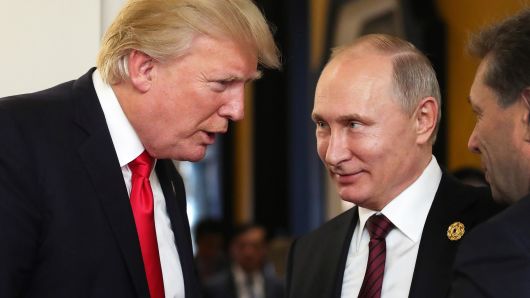
There was some seriously nasty skullduggery taking place between Trump, his people, and Russian agents. It may not have been actually criminal. It may have been criminal but not prosecutable. It may have been criminal and prosecutable, but not convictable. It may have been criminal and prosecutable and convictable, but not in the best interests of the US government.
But there’s a Russia-shaped piece of the puzzle that’s missing, and right now we can only guess what it represents.



 gregfallis.com