In the central public park of Glendale, California there’s a bronze statue of a young Asian woman seated in a chair. A bird is perched on her shoulder. Next to her is an empty chair.
It’s an attractive statue. Simple, but pleasing to the eye. At first glance, it’s a charming but rather innocuous work of public art. On the surface there’s nothing the least bit controversial about it. A closer look reveals the young woman’s hands are clenched into fists, which seems strangely at odds with her tranquil expression. But really, who takes a closer look at public art?
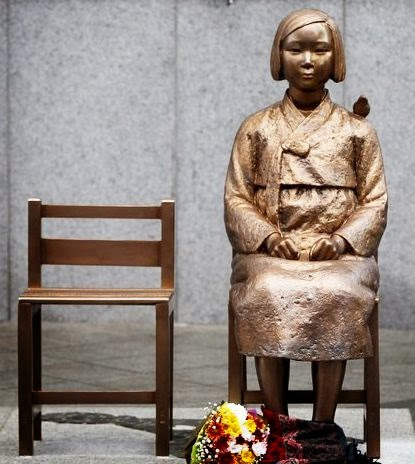
Comfort Woman Peace Monument
This isn’t just a work of public art, though. It’s a memorial. It’s a physical reminder of a historical event. It’s a work of art intended to preserve the memory of that event. It’s not a celebration of the event; it’s an indictment. The statue is called the ‘Comfort Woman’ Peace Monument.
And isn’t that a lovely phrase? Comfort Woman. It sounds so pleasant. It’s a translation of the Japanese term, ianfu, which is a euphemism for shōfu. Shōfu means ‘prostitute.’ But the memorial in the park in Glendale isn’t about prostitutes; it’s about a system of sexual slavery organized by the Imperial Army of Japan during World War Two.
Historically, wherever you find armies you find prostitution. The Imperial Army made it part of the bureaucracy. Even before WWII they organized ‘comfort stations’ in which Japanese soldiers could buy the services of Japanese prostitutes who’d been recruited from the lower classes. When Japan’s army expanded and they invaded China in 1937, the government began to send the daughters of those who opposed the war to serve in the ‘comfort stations.’ They also began to recruit local Chinese women, offering them food and clothing — which, given the Imperial Army’s practice of confiscating food supplies, was an effective form of coercion.
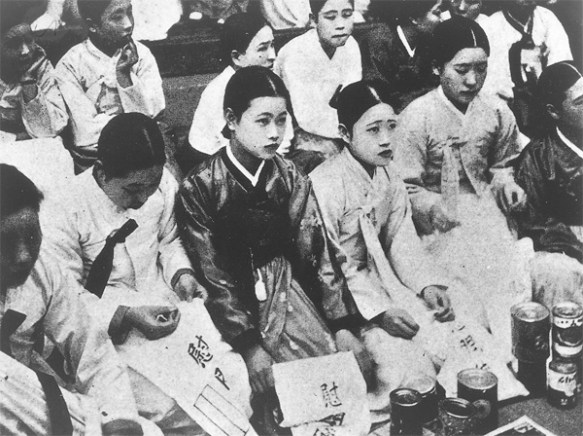
Young women ‘recruited’ to work in ‘comfort stations’.
Even so, the Imperial Army’s attempts at recruitment weren’t enough. So they began kidnapping local women. Eventually more that 2000 ‘comfort stations’ were organized throughout the war zone. Nobody knows how many women were kidnapped and forced into sexual slavery; estimates range from 20,000 to more that 400,000. Let’s split the difference — say 200,000. That’s around the population of Tacoma, Washington or Shreveport, Louisiana. Most of the women were from Korea, China, and the Philippines.
It’s been suggested (though there’s no actual data to rely on) that around three-quarters of the women forced into working the ‘comfort stations’ died there. We do know that most of the survivors were left infertile due to venereal disease or forced abortions. According to one Japanese soldier who testified at a war crimes tribunal:
“The women cried out, but it didn’t matter to us whether the women lived or died. We were the emperor’s soldiers. Whether in military brothels or in the villages, we raped without reluctance.”
After the war, nobody paid much attention to the ‘comfort women.’ That’s not really accurate. Nobody paid any attention to the ‘comfort women.’ Not until 1983, when Seiji Yoshida published a book called My War Crimes, in which he claimed to have helped kidnap some 2000 Korean women from rural areas to serve as ‘comfort women.’ Curiously, it appears Yoshida didn’t actually participate in raids to kidnap women; he’d lied about it. Nevertheless, his book was enough to rouse the righteous anger of women who’d survived the system. They began to come forward, to identify themselves and talk openly about their experiences.
Only a few at first. Then more and more until it became an international movement.
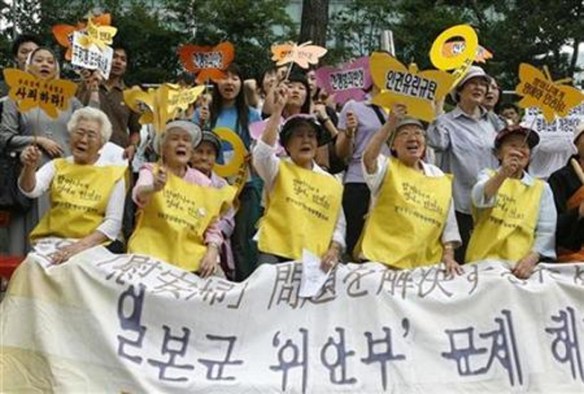
The fact that the issue of the ‘comfort women’ was ignored for so long, coupled with the mass destruction of documents by the Japanese government in the last days of war, makes it impossible to know with any certainty the exact dimensions of the sexual slavery that took place. Until 1993, the Japanese government refused to acknowledge their army had even engaged in the systematic sexual slavery of women during the war. Even after that admission a great many Japanese — including many who hold high government office — refuse to accept or admit coercion was involved in the ‘comfort women’ system.
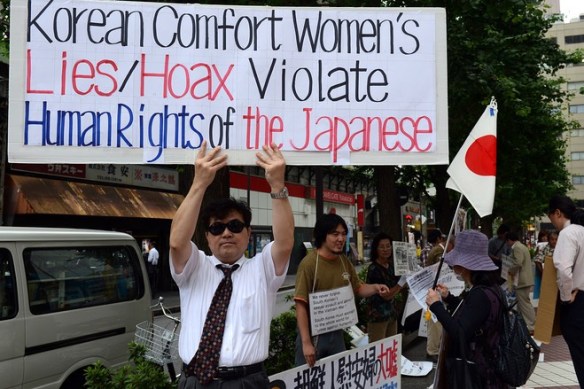
Eventually, the Japanese government offered an official apology to the women who’d been forced to serve in ‘comfort stations.’ However, just a week ago, Cabinet Secretary Yoshihide Suga stated Japan may reconsider that apology.
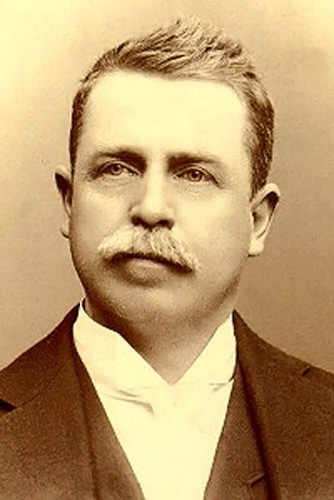
So maybe we shouldn’t be surprised that after the Comfort Women Peace Memorial was unveiled in Glendale, there was a lawsuit to have it removed. The suit was brought by two Japanese-American citizens supported by a corporation that says it’s devoted to providing “accurate and fact-based educational resources to the public…concerning the history of World War II and related events, with an emphasis on Japan’s role.”
Why do they want the statue removed? The corporation (GAHT-US) claims the memorial presents “an unfairly biased portrayal of the Japanese government’s purported involvement with comfort women during the Second World War.” As a result, members of GAHT-US who live in or near Glendale
“…suffer feelings of exclusion, discomfort, and anger by the continued presence of the Public Monument, and the controversial and disputed stance on the debate surrounding comfort women that it perpetuates.”
Plaintiff Koichi Mera “disagrees with and is offended by the position espoused by” the city of Glendale. He’d like to visit that park and avail himself of its beauty, but
“…as a result of his alienation due to the Public Monument, he avoids doing so. In addition, the presence of the Public Monument diminishes Mera’s enjoyment of the Central Park and its Adult Recreation Center.”
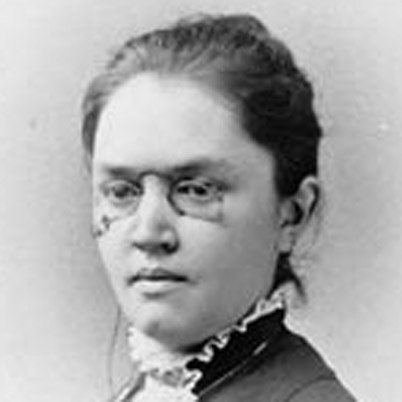
Plaintiff Michiko Shiota Gingery, who was born in Japan, now lives in Glendale and is a founding member of the city’s Sister City Committee. She believes the statue “presents an unfairly one-sided portrayal” of the ‘comfort women’ issue. She feels the statue’s presence in Glendale’s public park is “a significant obstacle in maintaining friendly relations among Glendale’s sister-cities.” (Although Gingery mentions the sister city of Higashiosaka, Japan in her suit, she neglects to mention the sister cities of Goseong and Gimpo, both of which are in South Korea.)
Gingery also asserts she’d
“like to use Glendale’s Central Park and the Adult Recreation Center located within Central Park. But she now avoids doing so because she is offended by the Public Monument’s pointed expression of disapproval of Japan and the Japanese people. In addition, the presence of the Public Monument diminishes Gingery’s enjoyment of the Central Park.”
And so, they feel the monument must be removed.
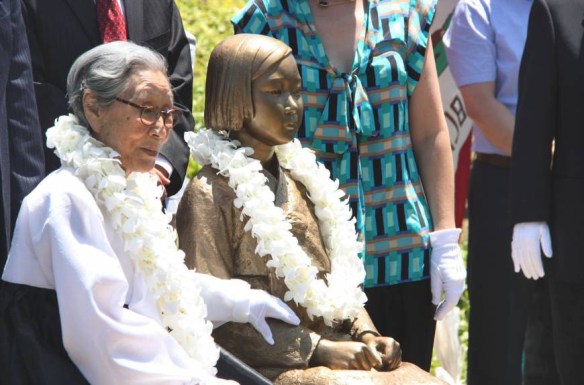
Kim Bok-Dong, 87 years old
When the monument was unveiled back in July, 87-year-old Kim Bok-Dong was present. Bok-Dong was fifteen years old when the Japanese Army forced her to become a ‘comfort woman.’ For the next eight years her life was unregulated hell.
“Every Sunday, soldiers came to the brothel from 8 a.m. until 5 p.m., and on Saturday from noon until 5 p.m., plus weekdays. It was very hard to handle. I couldn’t stand at the end of the weekend. Since I had to deal with too many soldiers, I was physically broken.”
I don’t doubt that Mr. Mera and Ms. Gingery and all the members of GAHT-US are made uncomfortable by the statue in Glendale’s park. I’m sure they’re telling the truth when they say their enjoyment of the park has been diminished. I’m convinced they’re sincere when they say the statue causes them to ‘suffer feelings of exclusion, discomfort, and anger.’
I felt much the same when I visited the Japanese Internment exhibit at the Smithsonian many years ago. I suspect I’d feel something similar if I visited Hiroshima. Sometimes governments do horrible horrible things, especially in times of war. We’re supposed to be made uncomfortable by those things. We’re supposed to be ashamed and angry by those things. Our enjoyment ought to be diminished, even if we weren’t personally involved or responsible.
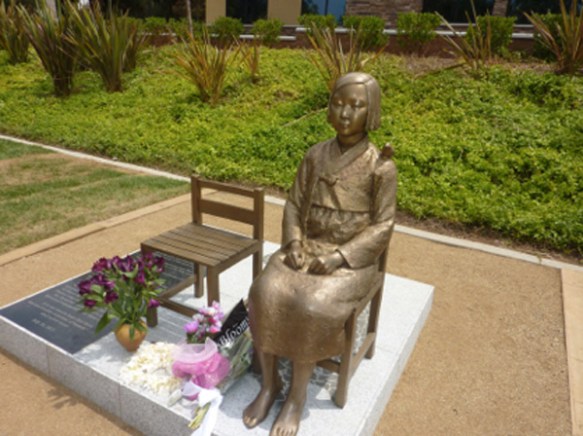
That empty chair next to the young woman? According to the plaque that accompanies the memorial, it symbolizes the “survivors who are dying of old age without having yet witnessed justice.” I think you could argue the chair is empty because it’s waiting for the next atrocity to fill it.
If there was justice in the world, there’d be copies of that statue — one for every woman lured or forced into sexual slavery — in cities all over the globe. And one for every black person lynched in the U.S. And one for every person who died in the attacks of 9/11. And one for every Iraqi civilian killed as collateral damage during an unprovoked invasion. And one for every Aborigine slaughtered in Australia. And one for every Jew and communist and Rom and gay person killed by the Nazis. And and and and. Every public square in every city in every nation in the world should have at least — at the very least — one similar statue reminding us that our governments are capable of allowing such crimes against humanity.
That’s never going to happen, of course. So for now we’ll have to settle for one modest bronze in a public park in Glendale, California. It’s a start.