in which i travel the world and get cheerfully lost

A couple years ago a friend alerted me to Google’s Chrome Experiments, a curious and interesting group of browser-based games and art projects. At the time there were maybe five or six hundred projects, and while I thought some of them were pretty cool and worth exploring, I was busy. So I bookmarked the URL and, as so often happens with stuff I bookmark, I promptly forgot all about it.

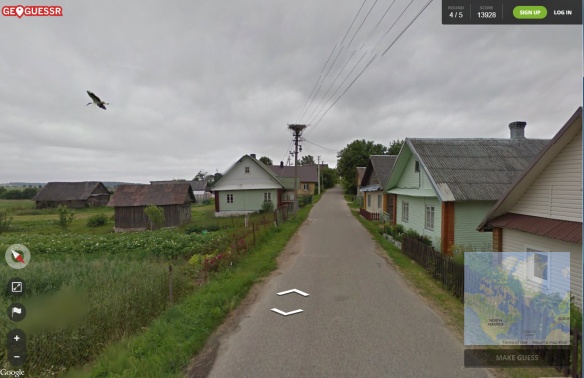
Maybe six months ago I heard that Chrome Experiments had reached the 1000 projects mark. That revived my interest. I found my old sadly neglected bookmark and began to noodle around, exploring the various projects at random until I stumbled upon a game called GeoGuessr — and basically pissed away all my free time for about a week. Maybe two weeks. Possibly three. Now I’m more moderate in my GeoGuessr time; I play once or twice a week — but the game still fascinates me.

geo estonia village

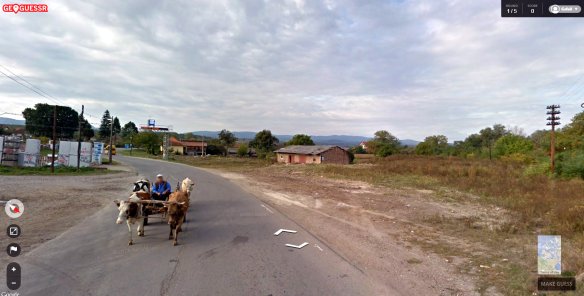
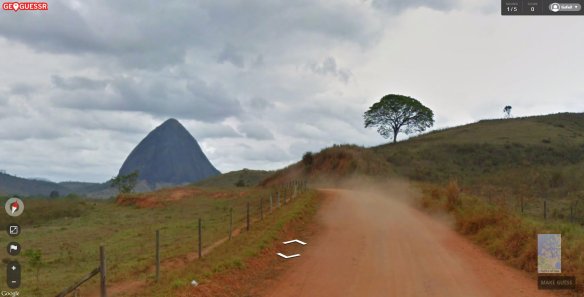
As the name suggests, it’s a game based on geography. The concept is simple. Using Google Maps’ Street View, the game drops you on a random street somewhere in the world. I use the term ‘street’ loosely, It might be an actual street. Or it might be a gravel road in a remote corner of the Ukraine, or an on-ramp of an Interstate Highway in the United States, or a dirt path along a newly planted field in Spain, or a back street in a mid-sized Brazilian city, or a boulevard in a major urban area in Russia, or in a suburban housing estate in Wales, or a secondary road in Croatia.

In fact, since the Google-cam can be worn as a backpack, Street View has expanded to include places not accessible to vehicles. I’ve found myself beginning a GeoGuessr game on a ski slope in Utah and on a hiking path to a Hindu temple in India.

Croatia

The ostensible goal of the game is to use the visual cues and clues of your surroundings to determine your location. You ‘travel’ down roads in search of those cues and clues, then you make a guess about your location and mark it on a map  You accrue points based on how accurate your guess is. Each game has five rounds — five different geographical locations — and at the end, you’re given a total score.

That’s it. As I said, the concept of the game is simple. Part of the attraction, of course, is the puzzle aspect — trying to figure out where the hell you are. That’s fun. Frustrating fun, sometimes. Challenging fun. But still fun.

geo dirt road somewhere4

But for me, figuring out my location (and earning a high score) is secondary. What draws me repeatedly back to the game is the power of the unexpected. The GoogleCam isn’t just mapping streets; it’s also moving through the daily events of the world, and the world is jammed full of weird, absurd, profoundly beautiful, desperately sad, fascinating stuff. Roadside shrines to gods and memorials to victims of traffic accidents. Prostitutes plying their trade along the street. Mountains that come straight out of an Indiana Jones movie. Astonishing poverty. Exotic coastlines that make you think of pirates or castaways.

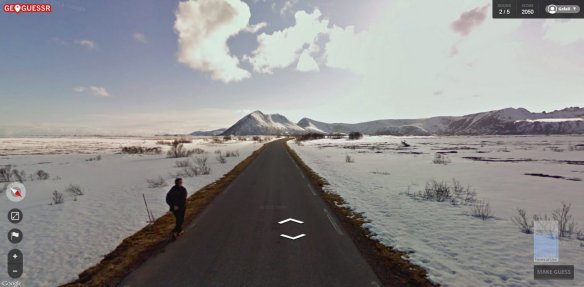
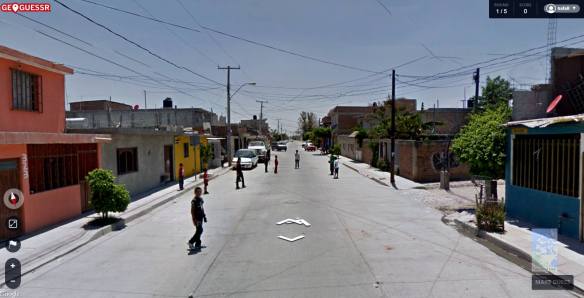
The randomness of GeoGuessr inserts you into unexpected locations where ordinary people are going about their ordinary daily lives. The reality of these lives — which are often radically different from my own — is fascinating. Kids playing stickball in the street. A young man meditating in a remote Hindu temple. A recent single-car accident in some remote road. A man walking by himself on some lonely stretch of road in northern Norway. A woman hitchhiking in South Africa. And the GoogleCam records it all with a completely dispassionate objectivity.

geo guy walking northern tip of Norway

I do enjoy the game aspects. There’s something fulfilling about being dropped at a random spot in the world and being able to locate that spot on a map within a few meters. Yet after I’ve figured out the location, I often continue to ramble around, intrigued by the ordinariness of life in other parts of the world.

I’ve begun to collect screen captures of bus stops. I’m thinking about collecting images of railroad crossings. And maybe bicycle riders. And people walking their dogs. These are things that are universal, and yet they’re all so very distinctive. The people waiting for a bus in South Africa probably have a lot in common for the people waiting for a bus in Russia. The cyclist in northern Spain probably has something in common with the cyclist in Australia, and the one on that mountain road in Utah.

stickball

Some of you who read this will be tempted to play GeoGuessr. Give into that temptation. You should be aware, though, that it’s an enormous time-suck. You’ll promise yourself you’ll only play for half an hour — but then you find yourself wondering what’s around the next corner, or over than next hill, or through that tunnel. You’ll wonder what that building is, and you’ll want to check out that overgrown cemetery, maybe follow that alleyway down toward the docks. So let me repeat this: it’s an enormous time-suck.

Play it anyway.

i know what you’re thinking

It’s Monday and I have work to do. A lot of work. SO much work. I do NOT have time to noodle around on Teh Intertubes, avoiding all the very important work that needs doing. Seriously, I have an excess of work to do. If work to do was testosterone, I’d be Chuck Norris. I have work to do like Trump has hair — it’s an imposing, structurally improbable amount of work. The amount of work I have to do would intimidate a border collie.

It’s a lot of work, is what I’m saying. And I’d actually be doing all that work (I’m confident about this) except I somehow found myself (and I suspect I have a good reason for doing this) scanning some conservative websites (probably I was doing research, I bet) and I discovered that a LOT of conservatives are terribly upset about gay Doritos.

gay doritos2

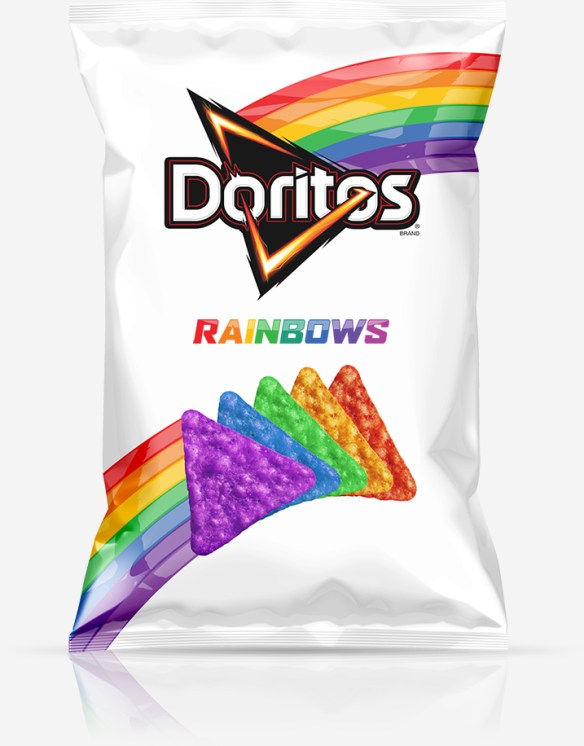
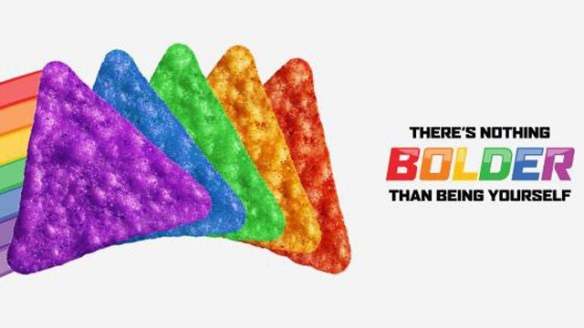
Oh my sweet Jeebus on a waffle, gay Doritos, you guys! I had no idea gay Doritos even existed. I was gobsmacked. Who knew the constellation of snack foods extends to sexual preference? Gay Doritos! Okay, officially they’re called Rainbow Doritos, but c’mon people — ain’t nobody in Western society that thinks these chips are in any way representative of colorful meteorological phenomena. Nope, dude, these are most definitely gay Doritos. And like anything that could possibly be even remotely gay, conservatives have spent a LOT of time thinking about these chips.

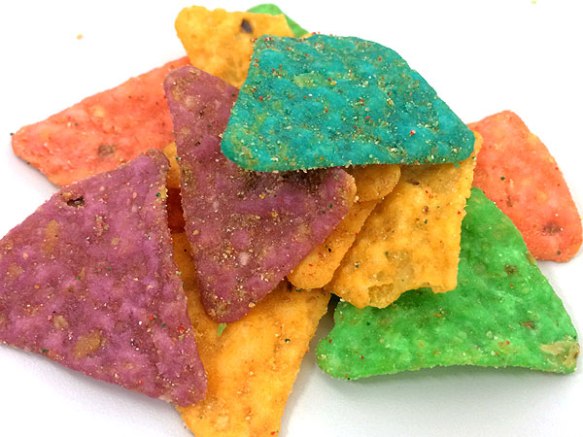
The chips come in several colors. The green are homosexual, the pink are lesbian, and the purple ones are transgendered Doritos.

Trans chips, you guys! According to The American Thinker (and no, I’m not making that up; that’s an actual conservative site — though I think they they’re confused about the definition of ‘America’ and ‘thinking’), the purple chips only look purple but “actually feel yellow and demand the right to commingle in the snack bags that have only yellow ones.” In other words, the purple chips want to use the same bathrooms as yellow chips.

gay doritos3

Conservatives are really pissed off about this, on account of Doritos are an important element of the nutritious American conservative sports-related diet. How is any decent, god-fearing American heterosexual man supposed to enjoy watching two teams of sweaty men dressed in tight, bun-hugging uniforms grapple with each other if gay sex is forced down their throats in the form of their favorite snack food?

Also, think of the children!

Doritos are a product marketed to children, so they make the perfect gateway snack to introduce children to the joys of homosexuality.

Gay Doritos are a gateway snack, you guys! How could this happen in America? Blame noted Christian-hater and pervert-activist Dan Savage and his It Gets Better project. Real conservatives hate Savage, who has “called on Ben Carson and Mike Huckabee to do a certain love act on him” (okay, he said Carson and Huckabee should “suck my dick” but I’m not entirely convinced the invitation was sincere). Most of the world understands the It Gets Better project is attempting to prevent LGBT kids from killing themselves, but a lot of conservatives think the movement is probably secretly recruiting decent young hetero kids to get gay. Why else would they be flooding the snack food aisle of your local market with gay Doritos?

gay doritos

Well, okay, maybe they not actually flooding the snack food aisles. And okay, maybe gay Doritos aren’t even in your local market at all. And yeah, okay, maybe they’re not in any store. Okay, maybe the only way to buy gay Doritos is to deliberately point your browser to a specific website and order them. And okay, maybe you have to make a donation of at least US$10 in order to get them. But dammit, gay Doritos exist in the real world and conservatives intend to do something about it.

In fact, they intend to do two things about it. First, boycott!

“I think we need to boycott Pepsi and all related Frito-Lay products to deliver a message to Pepsi that if they are going to push gay propaganda on our kids, we are not going to give their products lip service any longer”

Lip service. I declare, sometimes I think these guys must be trolling us. They can’t be that fucking stupid — except, you know, they repeatedly demonstrate they’re that fucking stupid. The second thing they’re doing (and I swear, I am NOT making this up):

[W]e should push other companies to launch pro-heterosexual campaigns.  Perhaps we could persuade a hot dog maker and a hot dog bun company to do a joint effort promoting man-woman relationships. Until we try sexualizing food like the left does, we’ll never know.  And if we think like the left, we desperately need to find out.

That’s SO fucking stupid that I had to stop what I was doing and 1) bang my head against the desk and 2) check to make sure American Thinker is not a spoof site. You guys, it’s not a spoof site!

gay doritos4

Now, I know what you’re thinking. You’re thinking I’m going to give ten of my hard-earned dollars to It Gets Better and buy a bag of gay Doritos and have them delivered to Kim Davis at her office. You guys ought to be ashamed of yourselves for thinking that. It would be silly to send gay Doritos to:

Kim Davis
Clerk of Court
600 West Main Street Room 102
Morehead, KY 40351


queen of the monkey house

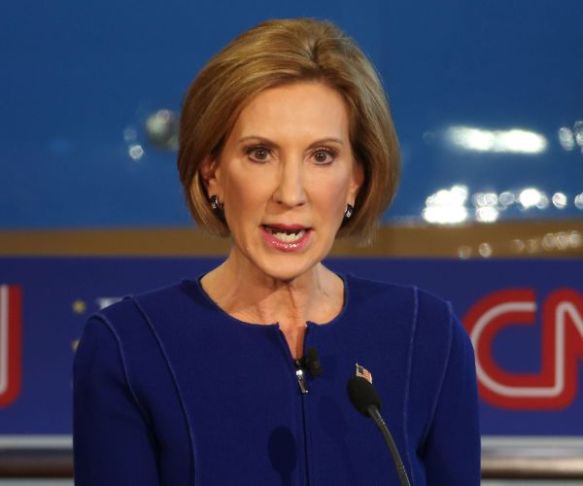
I keep reading that Carly Fiorina won the most recent GOP presidential candidate debate. And I keep asking myself two questions. First, what does it mean to ‘win’ a debate when all the candidates are liars, frauds, or buffoons? Does it mean you’ve out-lied, out-frauded, or out-buffooned the others? The second question I ask myself is this: who gives a rat’s ass who won or lost the GOP debate?

Because here’s the thing — every day it’s becoming increasingly clear that the Republican party lost its damn mind. They’ve either abandoned reality or they’ve somehow become untethered from it. The GOP used to be a party of principled conservatives. Sure, they had the usual scattering of rascals and double-dealing asshats that occupy every political party — but they were actually interested in governing. Then they became more concerned with ideological purity than governance, and eventually evolved into the current party of delusional thinkers. They’re no longer driven by principle or even ideology; they’re driven by pure belief.

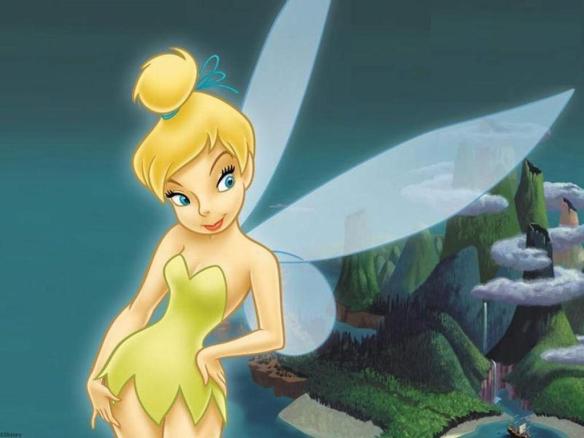
This is not Tinkerbell

This is not Tinkerbell

Let’s face it, belief by itself is a pretty shitty foundation for policy. The fact is, it’s pretty easy to have false beliefs — beliefs based on incomplete information, or flawed information, or inaccurate information. Here’s an example. Until recently, I shared the common belief that sharks don’t get cancer. It turns out there’s plenty of evidence to indicate sharks are, in fact, subject to cancer just like every other creature.

Rational people (and I like to think of myself as a rational person), when presented with evidence that contradicts their beliefs, adjust their beliefs to incorporate the new evidence. I now accept that sharks get cancer. I’m not particularly happy about it, because sharks are cool — but I accept it as reality. A persistent false belief held in contradiction to sound, testable evidence and factual reality is a delusion.

If belief, by itself, is a shitty foundation for policy, then policy driven by delusion is a total fucking disaster. And that brings me back to Carly Fiorina, today’s Queen of the Monkey House. Every article I’ve seen that claims she ‘won’ the last debate includes a reference to her impassioned denunciation of Planned Parenthood.

“As regards Planned Parenthood, anyone who has watched this videotape, I dare Hillary Clinton, Barack Obama to watch these tapes. Watch a fully formed fetus on the table, its heart beating, its legs kicking while someone says we have to keep it alive to harvest its brain. This is about the character of our nation, and if we will not stand up in and force President Obama to veto this bill, shame on us.”

That’s some dramatic shit, right there. It’s total fiction, but it’s dramatic. Fiorina says she saw that video with her own surgically-enhanced eyes. But nobody has been able to find any video showing anything at all like that. It doesn’t exist.

Think about this for a moment. Carly Fiorina ‘won’ the debate by passionately denouncing a women’s health care organization for engaging in acts they don’t do, based on having seen a video that doesn’t exist. That’s delusional.

This is not Tinkerbell either.

This is not Tinkerbell either.

The modern Republican party is the Party of Delusion. More than half of Republicans believe President Obama is a Muslim. Up to 70% of Republicans think climate change is a hoax. Two-thirds don’t believe in evolution. A third to a half think vaccines cause autism. Almost half of Republicans believe weapons of mass destruction were found in Iraq. A third of Republicans expressed belief that the Jade Helm military exercise was an Obama conspiracy to — well, there’s no real consensus about the purpose of the conspiracy, but dammit they’re sure that Muslim sumbitch was up to something.

Reality is a cold, heartless motherfucker. It doesn’t respect faith or belief. No matter how many times you click your heels and repeat There’s no place like home, there’s no place like home, you’re not going to open your eyes and find yourself in Kansas. No matter how hard you clap your hands or how sincerely you believe in fairies, you’re not going to save Tinkerbell. The reality is Kansas a fucking economic disaster because of Republican policies — and if you want to save Tink your best bet is to get her enrolled in Obamacare.

And no, this is not Tinkerbell either.

And no, this is not Tinkerbell either.

You can maybe win a debate by passionately defending your delusions, but it’s no way to run a county.

Editorial Note: Since we’re talking about reality here, it should be noted that Tinkerbell was NOT the shapely little sprite you see in the Disney cartoons. Barrie described her as being “slightly inclined to embonpoint.” In other words, she was plump and bosomy. Facts is facts, people. Accept it.


street

I love street photography. I love the energy of it. I love the unplanned immediacy of street photography. I love the connection between the photographer and what’s taking place within the frame, and I love the connection between the viewer and the image itself. When you look at a good street photo, the photographer disappears — it feels as if it’s just you and what’s happening in the photo, unfiltered by any photographer. I love street photography.

Wait, let me amend that — I love street photography when it’s done well. But here are a couple of true things: first, it’s really difficult to do it well. And second, it’s even more difficult to do it well with consistency. Good street photography is hard. Bad street photography, on the other hand, is incredibly easy.

I should also point out that although I love street photography, I’m not a street photographer. I sometimes shoot photographs on the street (though I’m more likely to shoot in alleys), but street photography isn’t entirely about location. It’s about the ways people inhabit and move through public spaces. Most of the photographs I shoot in public spaces are urban landscapes. If there are people in the photographs, they’re incidental.
acting blind

That said, I often see good street photographic moments when I’m out noodling around. I’m a completely fucking brilliant mental street photographer. But brilliant mental street photography doesn’t translate to the camera. It’s one thing to see a street moment and think ‘There — that’s it.’ It’s entirely another thing to anticipate that moment, put yourself in the right spot, and have your camera ready to shoot it. That’s one of the reasons I’m not a street photographer. I’m just not willing to walk around with a camera always at hand, ready to snatch that exact moment when everything comes into alignment.

But last week, as I was wandering around downtown, it occurred to me that I do always have a camera at hand. My smartphone. It’s not a great camera, but so what? It’s quiet and unobtrusive, which is pretty important for street work. I have an app called Lenka that shoots basic black-and-white images. This clearly isn’t the optimal arrangement for street photography, but it’s what I had with me. You have to work within your limitations.

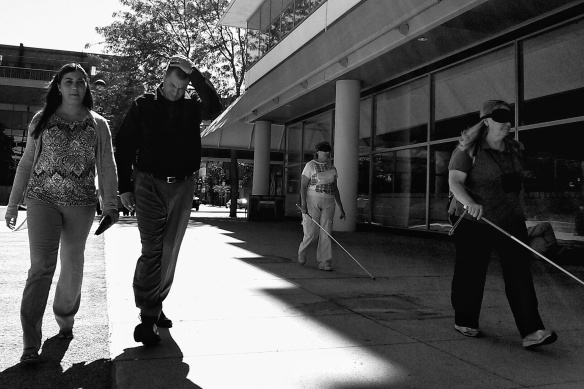
I set the app to allow me to take a photo by pressing the volume button on my phone (so I wouldn’t have to fuss about with using the phone as a viewfinder) and went off try some street. Almost immediately, I came across a small group of folks learning to be blind. The headquarters of the National Federation of the Blind is located downtown, and I assume that’s why we so often see a group of blindfolded people with canes being escorted around town. I took a couple of shots without looking.
the hub


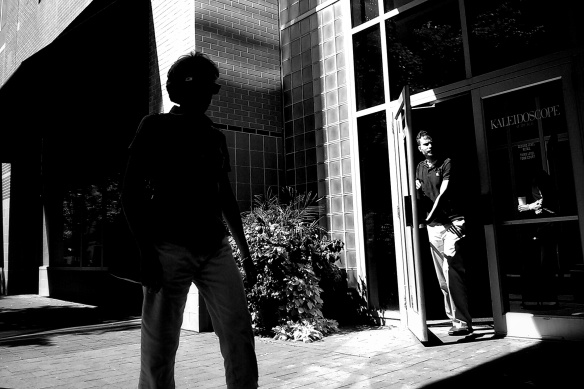
They weren’t great photos, but they were enough to encourage me to keep trying. I wandered around, saw some interesting folks, took some shots. I tried not to focus too much on people who looked interesting, because those were mostly folks who were marginalized because of addiction or abuse or weight or some other social condition. I tried to look for visually interesting situations instead.

Then I ran into this old drunk guy.
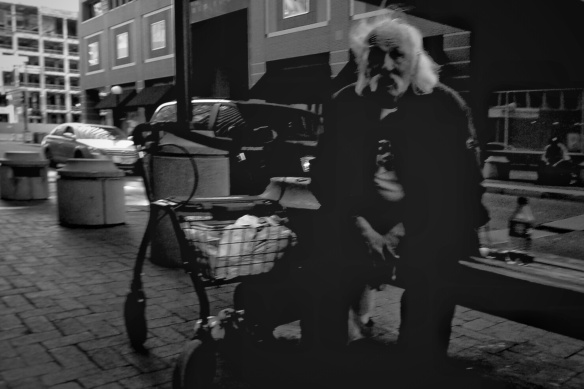
old drunk sitting

He immediately panhandled me, asking for spare change. I don’t carry much money; I use a debit card for everything. The only cash I had was a couple of twenties. So I told him I didn’t have any change — and I surreptitiously took his photo without looking. Shameful behavior on my part. Doubly shameful in that the photo was blurry.

The guy grinned and offered to take a twenty, which was a nice move on his part. It made me like him enough that I wanted to give him something. I told him I was heading for the drug store across the street and down the block, but if he was around when I came back that way, I’d hand over a little something — and I surreptitiously took his photo again. Still without looking; still shameful. This time the photo was badly exposed.
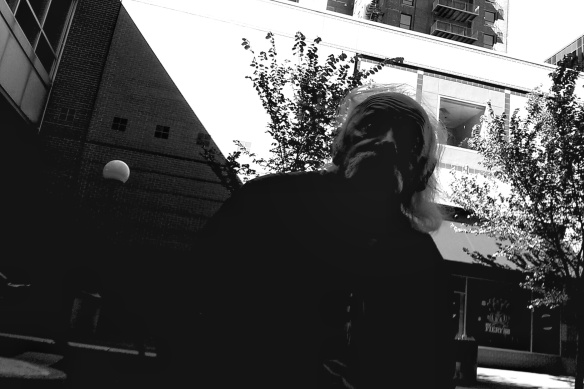
old drunk panhandling

So I went to the drug store, bought a cupcake for myself and a chicken salad sandwich for the old drunk guy. When I came out of the store, the ODG was hobbling across the street with his walker. I’d told him I was going to give him something and dammit, he was going to make sure I didn’t forget. I gave him the sandwich and a couple of bucks (and yes, I knew he’d spend the money on booze). Again, I surreptitiously took his photo. Again, it didn’t turn out well; badly expose and blurry.

That’s what you get for shooting without looking, I suppose.

IMG_1441830833485-01


Having done my part to support the local alcoholic community, I kept on wandering and shooting. Every so often I’d stop and find a place to sit and chimp the photos. Most of them were bad. Some were really bad. But mostly I was okay with them. If nothing else, I was learning to get the framing right. Mostly. Partly. That’s hard to do when you’re shooting from the hip.

The light was getting increasingly harsh, the shadows were radical — great conditions for urban landscape photos, but not what you’d call street-friendly if you’re relying on shooting blind with a smartphone. Almost everything I shot was badly (or weirdly) exposed.
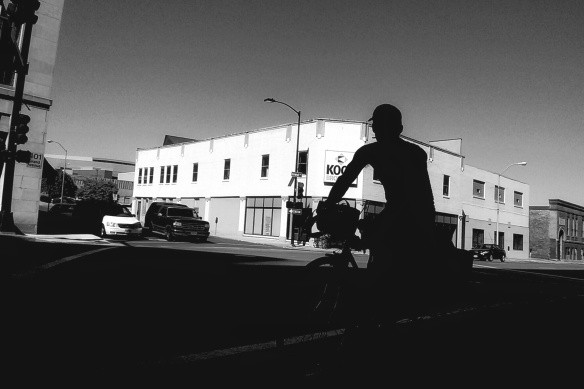
cyclist in shadow

I decided to end the experiment. I knew a nice, quiet, dark space nearby (okay, let’s just call it a tavern), so I headed there for a cool drink and a chance to evaluate the photos. On the way there I came across the old drunk guy again. He’d taken off his shoes, put them in the basket of his walker (along with the uneaten chicken salad sandwich), and laid himself out on a public bench for a nap. Or to sleep it off.

And hey, I took his photograph one more time. Shameless again.
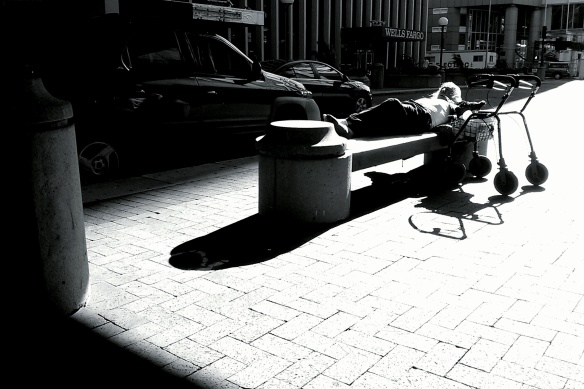
stll drunk

I learned four things from the experiment. First, I’m not a good street photographer. I’m okay with that. I’m not a rotten street photographer either. I can improve. If I decide to. Second, street work has a moral component. In the U.S. you pretty much have the right to photograph anything and anybody in the public arena. Doesn’t mean you should, though. Third, if you have a moral discussion with yourself before you shoot a photo, you’ll probably lose the shot.

Earlier I mentioned I tried not to focus too much on people who only looked interesting, because they tended to be folks who were marginalized in some way. Shooting photos of those folks would (or easily could) be exploitative — even if that wasn’t my intent, and even if I never showed the images to anybody. It would, in effect, be turning them into props; it would not be treating them as people.

There was a specific moment during the day I made a rule for myself. Shoot first, decide later if the photograph was ethical. Here’s how I came by that rule. I saw another drunk guy. The old man I’d met earlier was clearly an alcoholic, but he seemed pretty self-aware of his condition. He was friendly, with a sort of style and charm about him. He was clearly intoxicated, but not sloppy drunk. He was a sad case, but he was in control of himself and I liked him.

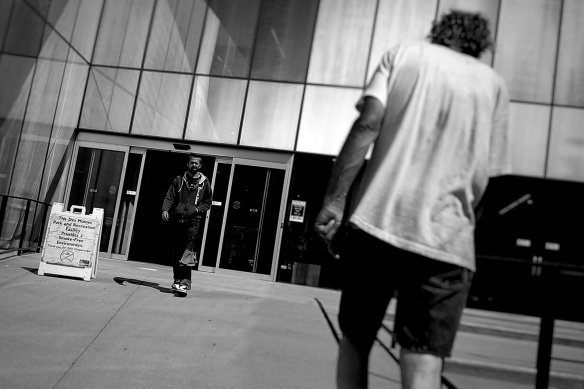
The other drunk guy was probably in his late 20s. He was staggering drunk. Oblivious to the world drunk. Slobbering and probably in dubious control of his bladder drunk. High school drunk. There was nothing likable or charming or self-aware about him. I could feel compassion for him and his situation, but I still recognized he was pretty disgusting. And he was heading up the sidewalk toward the public library.
young drunk


I hurried to catch up. I didn’t feel any need or desire to photograph the guy himself, but I thought it might be interesting to photograph the reactions of the people he met in the library. I took a single shot when a library patron came out of the library as the drunk guy approached. And then I thought it would be cruel to photograph those reactions; it would be demeaning to the drunk guy himself, and to the people he encountered. The photos wouldn’t be about anything but condemnation for a man who had some serious problems.

So I turned off my phone and put it in my pocket. I felt I’d made the right decision when, as these two guys approached each other, the library patron looked completely repelled. But as they got closer the library guy’s face shifted from loathing to concern. He stopped and spoke to the drunk guy; I couldn’t hear, but I assume he was asking if the drunk guy was okay. The drunk guy just lifted a hand — maybe in acknowledgement, maybe in denial, maybe a suggestion that the library guy should mind his own business, I don’t know — and he just kept zombie-shuffling toward the library.

I’d turned my camera off. I missed that shot. It had the potential to be a truly good street photo. It was a strangely non-judgmental moment. Almost sweet, on the part of the library patron. And that’s then I decided shoot first; decide its value later.

I said I learned four things from the experiment. Here’s the fourth: a sincere attempt at street photography (for me, at any rate) is oddly dissociative. It’s a combination of being very aware of yourself and the world around you, yet being somewhat removed from it. Until — and this is the freaky part — until you see the elements of a photo possibly coming together. At that point you become intensely aware. Of everything. The light, the geometry of the background, the spatial relationships of what’s in the frame, and you start plotting vectors of interception — where it’s all going to come together and where you need to be at that point to shoot the photograph. And it’s both exciting and terribly frustrating because oftentimes you’re also hyper-aware that you’re almost certainly NOT going to be in the right spot at the right moment and you’re going to miss the shot.

I love street photography — when it’s done well. I doubt I’ll ever be terribly good at it, but I’ll periodically continue the experiment. If nothing else, it’s great fun.
po-faced

Okay, let’s address this ‘po-faced’ issue, shall we? I’ve been using this perfectly good term in conversation all week (well, for years actually, but much more often in this last week or so), and I declare, every time I use it people look at me like I’ve suddenly begun speaking Urdu.

I haven’t been speaking Urdu, people.

So, what does it mean, po-faced? In general, it means to be humorless and disapproving. But the definition doesn’t convey the richness of the term. To really appreciate po-faced you need to understand its origin.

There’s some disagreement about the etymology. Some claim the term is derived from ‘poker face’. I call bullshit. A poker face is one that’s devoid of expression; it’s a face that doesn’t give away any information. It’s a perfectly fine phrase, poker face, but it lacks the depth and emotional content of po-faced.

I favor the interpretation that suggests ‘po’ comes from pot de chambre. A chamber pot. It’s pronounced poe de shambra. Po-faced, then, refers to the expression on a person’s face upon encountering a chamber pot that’s — well, let’s say it’s after being used. A sort of mild attempt to disguise feelings of disgust and disapproval.

Wait. Maybe this will help.

kim davis

Po-faced. Any questions?

right in the neck

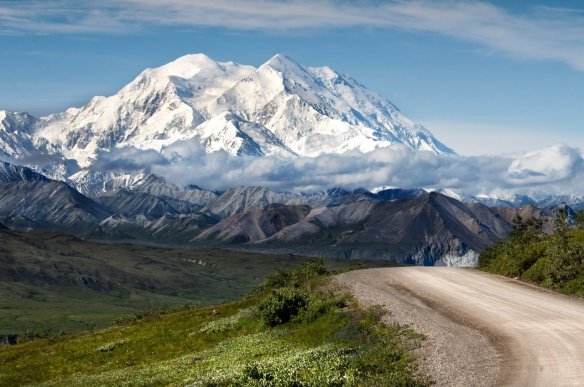
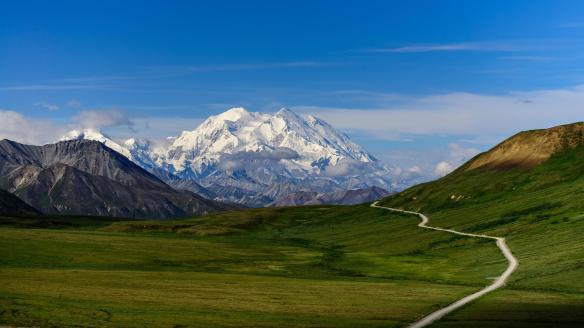
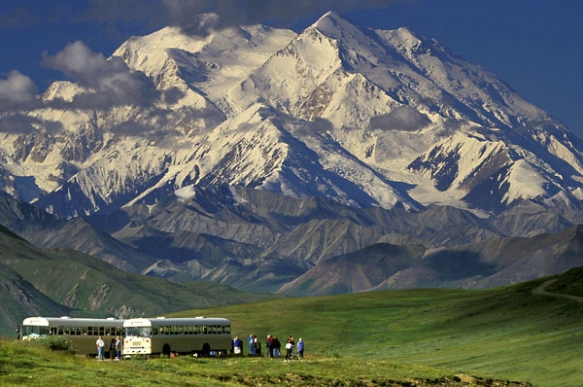
The Athabaskan people who lived near the mountain called it Denali, which meant ‘the high one.’ It’s a pretty name for a mountain. I like it. Another local tribe, the Dina’ena, called it Doleika, which meant ‘big mountain,’ which is less poetic but still pretty accurate. It really is a big mountain.

The Russians moved into the neighborhood in 1783; they called the mountain Bolshaya Gora, which also means ‘big mountain.’ They didn’t really change the name; they just said it in Russian, which is appropriate. But the Russians left in 1867, and I suspect folks in the area just continued to refer to it the ‘big mountain’ in whatever language they happened to have handy at the moment. Because it really IS a big mountain.

denali2

Then in the late 1880s, the white folks in the region decided to call it Densmore’s Peak, after Frank Densmore — a gold prospector who was, apparently, inordinately fond of the mountain. I don’t have any solid evidence to base this on, but I’m going to guess the natives continued to call it Denali or Doleika regardless of what the white folks did. Because what did the white folks know about it? Fuck them in the neck.

Then politics happened. A guy named William Dickey, who’d been prospecting for gold in the Susitna River, returned to the Lower Forty-eight and wrote an article about Alaska for the New York Sun newspaper. This was January of 1897, shortly after Republican William McKinley had been elected President of These United States. McKinley, you see, was a proponent of the gold standard (on which to base U.S. currency) — and Dickey was a Republican who’d been a gold prospector. McKinley’s Democratic opponent in the election, William Jennings Bryan, was in favor of a silver standard rather than a gold standard. Dickey had met a lot of silver prospectors while in Alaska, and they all favored the Democrat. This is all important information because in his article, Dickey made this rather suspect claim:

We named our great peak Mount McKinley, after William McKinley of Ohio, who had been nominated for the Presidency.

Whether that was true or not, it struck a chord for Republicans in Congress, and twenty years later they made the name official: Mount McKinley. They also named the area around the mountain McKinley National Park. Basically, it was Republicans saying ‘fuck you in the neck’ to Democrats (and to all the native folks in Alaska).denali3

It seems nobody in Alaska liked the name, and most folks just continued to call the mountain Denali. Who cared what the people south of Canada called it? In the 1970s, Alaska made the practical decision to officially change the name back to the original Denali. They petitioned the U.S. Board on Geographic Names (yes, there’s actually a government agency that oversees geographic names) to do the same. And hey, the board seemed open to the idea.

Then politics happened again. The Republican Congressman who represented the Ohio district when William McKinley spent most of his life (a complete jackass named Ralph Regula) intervened and basically stopped the process. Basically, he was saying ‘fuck you in the neck’ to the people of Alaska. The people of Alaska sort of shrugged off the whole fuss and in 1975 the Alaska Board of Geographic Names (yes, the state has its own government agency to oversee its geographic names) went ahead and changed the name anyway.

In 1980, President Jimmy Carter decided to change the name of the park from McKinley National Park to Denali National Park and Preserve. Basically, he was saying ‘fuck you in the neck back’ to Congressman Regula. But while the president was authorized to change the name of the park, Regula could still prevent him from changing the name of the actual mountain, which officially remained Mount McKinley. Basically, Regula was telling the president ‘re-fuck you in the neck.’Denali1

And that’s how things stayed until Regula retired. At that point Alaska again petitioned the Board on Geographic Names to change the damn name. Then politics happened yet again. Two members of Congress from Ohio — both Democrats — decided to carry on Regula’s profoundly stupid fight to retain the name of Mount McKinley. Basically, it looked like Ohio saying ‘fuck you in the neck’ to Alaska.

But the people of Ohio spoke out and told their members of Congress to grow the fuck up and stop interfering with Alaskan politics. And they did. So today, President Obama is officially authorizing the Board on Geographic Names to recognize what Alaskans have always recognized — that the mountain deserves to be called Denali because it really IS a big, high mountain.

And hey, guess what. Politics are happening. Republicans — and particularly those from Ohio — are rebuking the president’s decision. Speaker of the House John Boehner stated he was “deeply disappointed in this decision.” Senator Rob Portman decried the decision as “yet another example of the President going around Congress.”

And, of course, the proud patriots of FreeRepublic are voicing their considered opinions on the issue.

— Why not call it Glorious Jihad?

— If Hussein cared about what the people of Alaska thought, he would ask Valerie for permission to open up the northern slope for drilling. Alaskans want that, too.

— Obonzo didn’t do jack. He’s going up there to fundraise and kiss some minority @$$ for his ‘RAT comrades up there. Everyone in Alaska already refers to the mountain as Denali. The bastard Kenyan didn’t need to do anything. This is just another one of his “historical” In Yo Face Whitey Moments.

— Mount Barack….in honor of Bareback Mountain

— stupid bammy has to interject himself into normal people’s lives like the narcissist he is

— This is the work of a tyrant.

— I’m surprised it’s not going to be Kilimanjaro to make Zero feel more at home.

— Islam could easily be involved. Pakistan is close. Jihadis are everywhere.

To be fair, not everybody on FreeRepublic is a lunatic. Many of them have pointed out the fact that most Alaskans want the mountain to be called Denali. They don’t necessarily object to renaming the mountain; they just object to President Obama renaming the mountain. Basically, the people of FreeRepublic are saying ‘fuck you in the neck’ to the president.

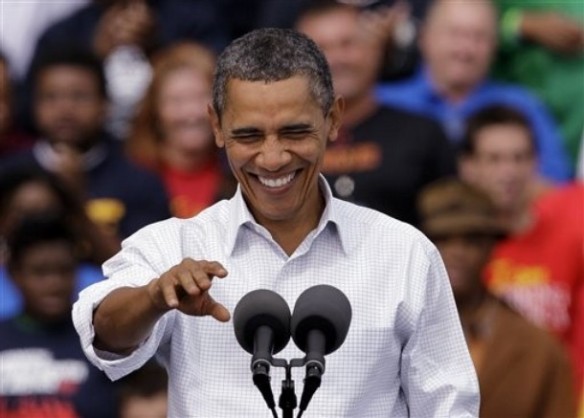
Barack Obama

But hey, it’s a done deal now. And it’ll be Obama’s smiling face we’ll see standing in front of Denali on the national news tonight. And guess what he’s basically symbolically saying to the folks of FreeRepublic.

Right in the neck.

it seems some mass shootings aren’t mass enough

Sometimes I find myself sitting around and thinking You know, this situation is pretty fucked up. I was thinking that after yesterday’s mass shooting. Which by the most commonly used definition of the term wasn’t actually a mass shooting.

A culture is pretty fucked up when there has to be a debate over how to define ‘mass shooting’. Here’s the most commonly used definition:

Shootings at a public place in which the shooter murdered four or more people, excluding domestic, gang, and drug violence, in a single episode.

There are at least three problems with this definition. Here’s the first and most obvious problem: murdered. This definition only counts bodies. You go to your neighborhood cineplex and wound half a dozen people but only kill a couple of them, it’s not going to count as a mass shooting. That’s pretty much fucked up, right there.

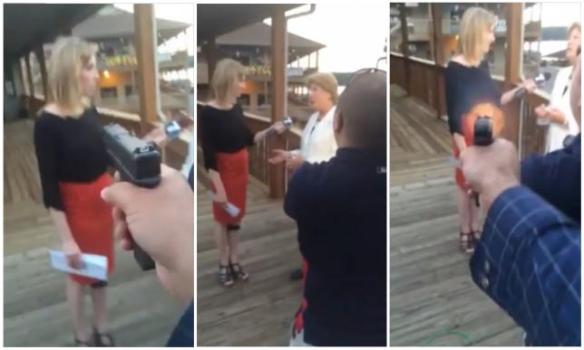
wdbj_shooter

Not a mass shooter.

Second problem: excluding domestic, gang, and drug violence. I can sort of understand why researchers would choose to exclude gang and drug violence. That sort of violence is incidental to other behaviors — the violence is a consequence of gang/drug activity. You get involved in gangs or the drug trade, you’re voluntarily assuming a certain amount of risk. It’s like BASE jumping in that sense. So if you kill a half-dozen folks when your drug deal goes bad, it’s not going to count as a mass shooting. That’s fucked up.

But domestic violence? Why exclude that? It’s the most common sort of violence faced by the public. In fact, if you include domestic violence, the number of mass shootings skyrockets — even if you restrict the definition of mass shooting to those that produce multiple corpses. The research is limited, but it all suggests that the vast majority of mass shootings take place in a domestic situation — a house or an apartment.

What we’re talking about here is male violence against women. Almost all mass shooters are men, and the most common type of mass shooting is a man shooting members of his family (or his ex’s family, or his girlfriend’s family, or the family of a woman who rejected him). Most of those victims are women and kids. You get pissed off and kill a bunch of folks you claim to love — folks who aren’t strangers — it doesn’t count as a mass shooting. Maybe they’ll count it if you do it in at the local McDonald’s. Maybe. But otherwise it’s just another domestic murder. You know what that is? It’s fucked up, is what it is.

And here’s the third problem with that definition: in which the shooter murdered. The shooter isn’t included in the butcher’s bill. Now, I understand the emotion behind excluding the shooter. The sumbitch doing the shooting doesn’t deserve to be considered a victim. But it’s still part of the episode; he’s still dead or wounded. And let’s be honest, that’s often just as intentional as the shooting of the other folks. You shuffle over to the local mall and open fire, kill three people, wound half a dozen more, then eat your Glock, it’s not going to count as a mass shooting. That is totally fucked up.

Not mass shooting victims.

Not mass shooting victims.

The shooting yesterday? Not a mass shooting. Not the one in Brooklyn Center, Minnesota in which four people were wounded. Not the one in Chicago, where only one of the four people who were shot actually died. Not the one in West Palm Beach, in which two were wounded and two were killed. And not the one in Virginia — the one that was televised, the one that left three people dead (yes, I’m including the shooter) and one wounded.

That’s six dead and ten wounded. Yesterday. And not one of them is considered a mass shooting. Fucked up, is what it is. We’re talking 33 shooting incidents in August (so far) with 40 dead and 124 wounded — and not one of them is considered a mass shooting. That’s fucked up on so many levels.

What if we broaden the definition of mass shooting?

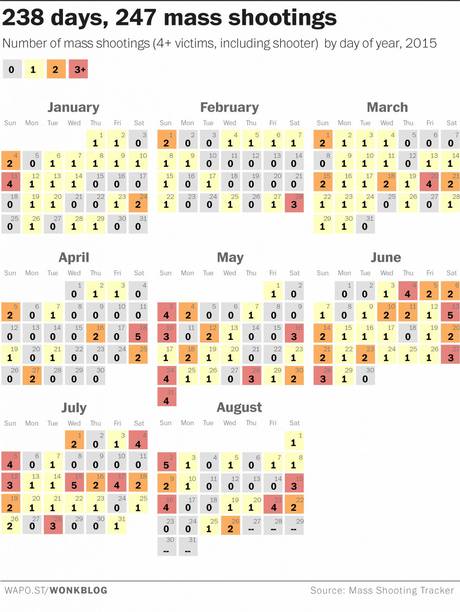
Shootings in which four or more people are killed or wounded in a single episode.

Makes sense, doesn’t it. There’s actually a crowd-sourced mass shooting tracker that uses that definition. By that definition there have been 248 mass shootings so far in 2015. That’s as of fifteen hours ago. There’ll be more today. You can count on it. And the fact that you can count on another mass shooting today — one that will go uncounted because not enough people died, or because the wrong people died, or because the dead weren’t littering a public place — that’s fucked up beyond all recognition.

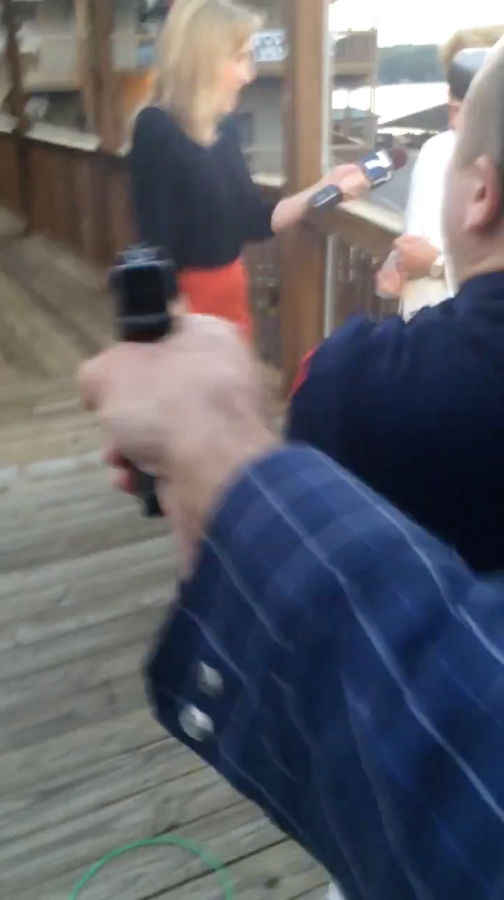
And here’s another thing that’s fucked up. The guy who shot the reporter and cameraman in Virginia recorded the non-mass shooting on his phone and posted it to Facebook and Twitter. That’s fucked up in ways beyond the obvious ‘What sort of twisted individual would put that shit on social media?’ way. It’s fucked up because research shows that mass shootings that get publicized tend to be contagious. They spark more mass shootings, often with the same weapons used in the initial mass shooting.

People who, for one reason or another, are fucked up in some way often model their behavior on the behavior of other folks. Some highly publicized behaviors, like teen suicides or hate crimes, establish what social psychologists call a path of action — a complete narrative in which the person can visualize their steps and their effects. And that path of action helps them follow through on the act — whether it’s suicide, bashing trans folks, or shooting a whole bunch of people.

So it’s fairly safe to assume we’ll see more homemade first person shooter videos. This may become a trend. Which brings me back to my original thought. This situation is pretty fucked up.

UPDATE: As of January 2016, the mass shooting tracker mentioned above revised its definition of a mass shooting to exclude the shooter. The new definition is “Four or more shot and/or killed in a single event [incident], at the same general time and location, not including the shooter.”

My initial response is that excluding the shooter from the body count seems unnecessarily judgmental, as if including the shooter would suggest sympathy for him. On further reflection, though, the definition includes the wounded as well as the dead — and it makes sense to exclude the shooter if he was wounded by law enforcement in their efforts to stop the shooting.

boom, and they’re gone

This fuckwit is campaigning to be the Republican nominee for President of These United States — and they’re taking him seriously. What’s wrong with these people?

“We have excellent military leaders. We need to employ their expertise because this is a war we are fighting. That’s the bottom line.”

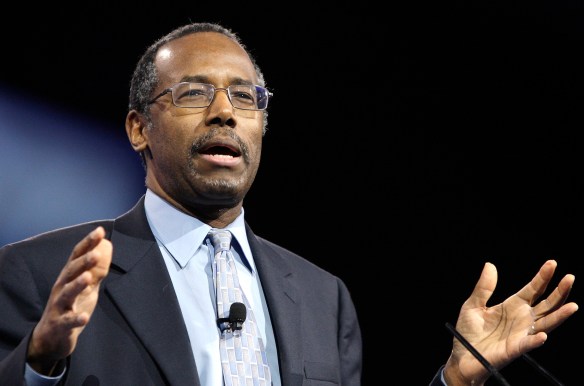
That’s Dr. Ben Carson. And that war we’re fighting? He’s talking — and I swear I am NOT making this up — he’s talking about the border between These United States and Mexico. And he said that in response to a question about whether the US should consider drone strikes on American soil to secure the border.

Dr. Ben Carson doesn't really LOOK crazy, but apparently is.

Dr. Ben Carson doesn’t really LOOK crazy, but apparently is.

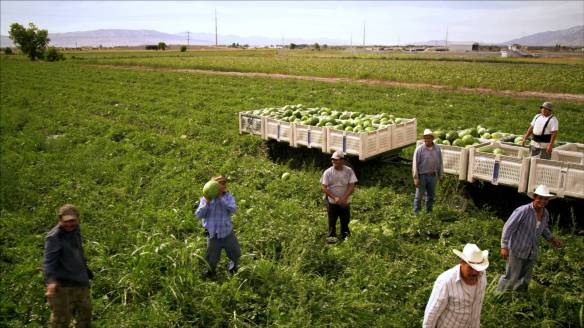
Drone strikes. Drone strikes. You know, like we’ve been doing in Yemen and Somalia and Pakistan. This fucking lunatic thinks drone strikes are worth considering to prevent folks from illegally crossing the border to pick the watermelons you’ll be eating at your next picnic. Oh, and did I mention that Carson, as I write this, is in second place among the candidates for the Republican nomination for president? He is. Second. And what makes this even crazier is he’s running second behind Donald Trump (whose border policy, I believe, is to build a giant Wall O’ Trump — it’ll be yoooge, classy — and he’ll hire frat boys to stand guard on top of it, and if they see a brown person approach from the South they’ll shit in their own hand and fling it at the poor bastard).

Drone strikes. You know, because this is a war we’re fighting. If we have to ram a missile up some brown person’s ass, well you can’t make an omelet and all that.

“You look at some of these caves and things out there, one drone strike, boom, and they’re gone.”

Boom! Just like in the Road Runner cartoons. Of course, it costs between US$2,500 and $3,500 per flight hour to run surveillance drones. You want a strike drone — one that can fire missiles; say a Predator or a Reaper — the costs go up dramatically. It takes a team of about 180 people to operate and maintain each of those sumbitches. Also? Each Hellfire missile costs around $60,000 — and you can only use them once, you know.

Watermelon terrorists, for the love of Jeebus, won't somebody DO something?

Watermelon terrorists, for the love of Jeebus, won’t somebody DO something?

It’ll add up pretty quick, drone strikes against illegal immigrants. But hey, war, right? If that’s what it takes, then that’s what it takes. If we can provide just one decent law-abiding American the opportunity to find a career in the lucrative field of watermelon harvesting, it’ll be worth it.

Second. He’s running second. To Trump. Just saying. It is to weep.

UPDATE: I was joking about the Wall O’ Trump — but this just in (and really, I swear I’m NOT making this up):

Trump waxed on almost poetically about the wall that could bear his name on the Southwest border. “I want it to be so beautiful because maybe someday they’re going to call it the Trump wall,” he said.

Lawdy.