in which I look at an old photo (part 6)

As I’ve explained elsewhere, about a year ago I came across an article on some photo website that suggested looking at and analyzing your old photos as if they were made by a different person. The idea seemed a wee bit silly to me, but I was just coming out of a photographic slump…so what the hell, I thought I’d try it.

That slump is long dead now, though I suspect it had more to do with buying a camera that fits my approach to photography than with this practice of looking at old photos. That said, I’ve found some unexpected value in looking at my old photographs. I’m not learning anything new about photography (as I recall, the article was about evaluating or improving your compositional skills or something), but I’ve been surprised to find a weird sense of formality in my photos.

I don’t think of myself as being a formal photographer. I tend to shoot sparingly (I learned photography in the film era, which meant every shot cost money and I was rather poor), but quickly. I’ve been doing this photo stuff long enough that I don’t really think much when it comes to composition. I just put myself or my subject in a position that feels right, then take the photo. While I don’t believe there are any rules that MUST BE OBEYED, I do think there are some very strong photographic suggestions that ought to be considered. For example, if you’re making an informal portrait, you should be reluctant to have your subject strike a pose and you should avoid putting your subject in the center of the frame.

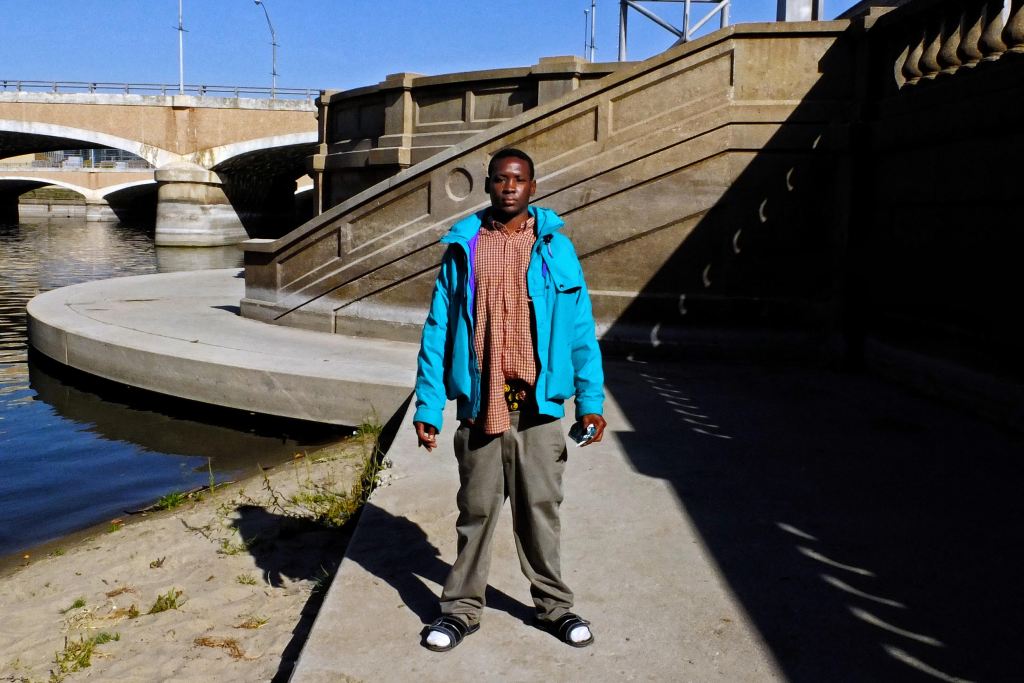
10;29 AM, Wednesday, October 3, 2012

Like this. This is Sakim. I’ll tell you about Sakim in a moment. First, the photo. It’s everything you don’t want in an informal portrait–stiff pose, center of the frame. But (to me, at any rate) it works as a photograph. Why? Partly because of the composition; all the lines direct your eye to him and the angle of his arms matches the angle of the light on the sidewalk. It also works partly because this genuinely represents this particular person at this particular moment.

I was noodling along the riverwalk when I saw Sakim approaching. He was wearing a black baseball cap with smiley faces on it, drinking juice from a soft packet, and walking in a sort of marching gait that I associate with psychiatric patients. I’ve worked with a lot of psychiatric patients, mostly in a prison setting. I’m comfortable encountering them in unscripted public settings. I’ve found folks with emotional issues are often eager to visit with people IF those people are relaxed around them. Of course, the opposite is also true; some folks just want to be left alone. You can’t always tell until you start visiting with them.

I don’t recall how we struck up a conversation, but based on past experience I suspect I initiated it. I do recall he had a soft, gentle, deeply accented voice. We spoke about the weather (it was warm for October, but Sakim said it was chillier than where he was from) and his juice (he didn’t mind that his juice was warm). He wasn’t entirely comfortable having a conversation, but I had the feeling he didn’t really want the conversation to end. My sense was that he didn’t quite know how to have a casual conversation and was always concerned that he wasn’t doing it right.

After a few moments I asked if I could take his photo and he agreed. He took his cap off and stuck it down the front of his pants (which was disappointing–I really wanted him to leave it on, but I didn’t want him to feel like he’d made a mistake by taking it off). Then he struck this awkward pose. He had the sun to his back, which left his face in shadow, so I asked if we could trade places. He struck the same pose again. I told him he could relax. He said he was relaxed. Without lifting the camera to my eye, I recall asking him to take a couple steps this way and that way until it felt like he was in the right position, then I raised the camera and took a single shot. I showed him the photo and thanked him; he said “Okay” or something, then he turned around and went marching off.

Sakim never smiled the entire time we talked. Never showed any emotional affect at all. The entire encounter couldn’t have taken more than 3-5 minutes. I left feeling like I’d sort of failed him somehow.

When I got home and looked at the day’s photos, I almost deleted this one. I was only looking at Sakim and thinking about his awkward attempt to engage with a stranger. It’s NOT a good photo of him. He looks a little sad and distant. But even though it violated my sense of informal portraiture, and even though it’s not a good photo of Sakim, I felt it still worked as a photograph. Despite that, I’m not sure I ever posted it on social media.

If nothing else, this practice of looking at old photographs has reminded me of my 3-5 minutes with Sakim. It’s been almost 13 years. I hope he’s okay.

iron photographer on bluesky

Iron Photographer, qu’est-ce que c’est? Think Iron Chef…only with photography. Iron Chef, if you’re not familiar with it, was probably the original televised cooking competition. Starting back in the 1990s, the show required contestants to improvise a multi-course meal around a surprise theme ingredient–asparagus, for example, or eel, or peaches. The chefs had to be creative and resourceful.

Back in 2006, at the dawn of the digital photography era, in a Flickr group called Utata, we decided to purloin that concept and apply it to photography. Instead of a theme ingredient, Jamelah Vincent (@jamelah.bsky.social) and I provided three photographic elements and challenged our group members to use them to create an artful photograph. After more than 250 Iron Photographer challenges, we retired the project.

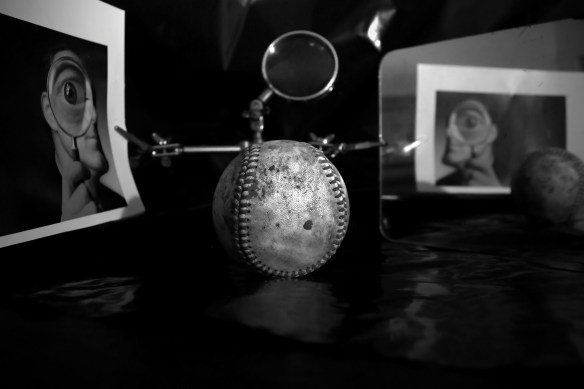
1) Something round, 2) a reflection, 3) black-and-white – Greg

Now we’re bringing Iron Photographer back on Bluesky. On the 1st and 15th day of each month, we’ll post the three elements of a new IP challenge.

Unlike the Iron Chef model, Iron Photographer is NOT a competition. There are no winners, no losers, no judges. It’s simply a challenge; an invitation to stretch your imagination and creative skills.

Usually (but not always) the challenge is comprised of two compositional elements and one artistic element. For example, 1) something with stripes, 2) a food item, 3) shot slightly out of focus. The challenge is to find a way to photograph those three elements in an expressive way. It doesn’t have to be Art; but it should be artful, if that makes sense.

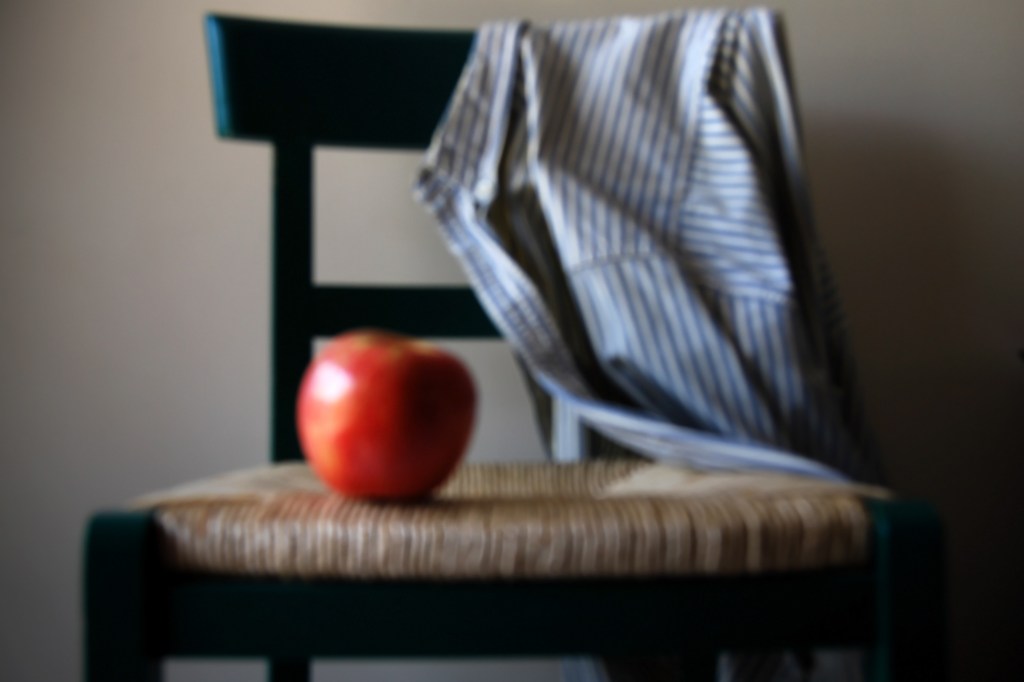
1) something with stripes, 2) a food item, 3) shot slightly out of focus – Greg

Every photographer interprets the compositional elements for themselves. You decide on the food item (I chose an apple; you might choose an egg, or a chuck roast, or some tofu, or a handful of chia seeds), you decide on the thing with stripes (I picked a shirt; you might choose a lawn chair, or a beach towel, or a tabby cat). The compositional elements are usually broad and expansive enough to provide the photographer with lots of options. You can almost always find–and photograph–the IP elements in your home or apartment.

The artistic element, on the other hand, is meant to be fixed, though it’s often flexible. You decide what “slightly out of focus” means, but the shot MUST be slightly out of focus. If the third element is ‘Dutch angle,’ you decide HOW tilted the frame should be. On the other hand, if the artistic element is ‘square format’ then the format has to be square. Not squarish; square.

Jamelah note: Sometimes you just rip off Greg’s idea because you can’t help yourself.

1) something with stripes, 2) a food item, 3) shot slightly out of focus – Jamelah

That’s basically it. That’s all there is to it. Iron Photographer is really that simple. And really that complex and convoluted, because while the photograph has to feature the selected compositional elements, it’s not limited to those elements.

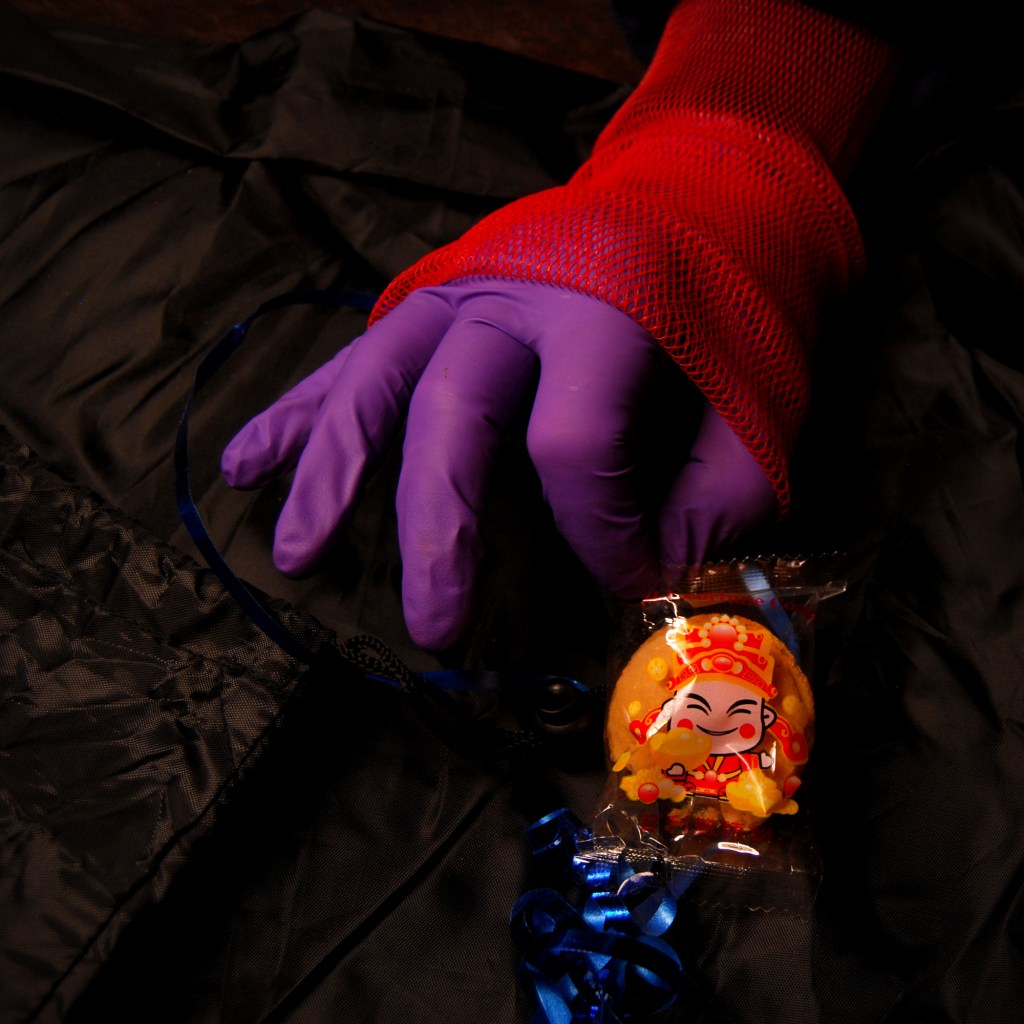
For example, in the photograph below the three elements are: 1) a plastic bag, 2) the color red, 3) shot in square format. Again, the only concrete element is the square format. You decide what constitutes a plastic bag and you decide on the red thing, but you can also include any elements you think might contribute to the photo.

1) a plastic bag, 2) the color red, 3) square format – Greg

I chose a weirdly racist plastic wrapper of a fortune cookie. Is that really a bag? I say it has enough ‘bagness’ to qualify. You may disagree. For the red element, I used some mesh that held some apples from the fruit market. But the purple latex glove? The bit of blue ribbon? I included that stuff simply because it pleased me.

I found Iron Photographer to be a creative Get Out of Jail Free card. You can do whatever you want. It doesn’t have to make sense.

1) Self portrait, 2) umbrella, 3) in a bathroom – Jamelah

Let me repeat that: it doesn’t have to make sense. That, to me, has always been the most wonderful thing about Iron Photographer. There’s NO LOGICAL REASON FOR THESE PHOTOGRAPHS TO EXIST. There’s absolutely no earthly reason for Jamelah to balance herself on the side of a bathtub with an umbrella–except for Iron Photographer. If you participate in this gig, you WILL take photographs nobody has ever taken before. Guaranteed.

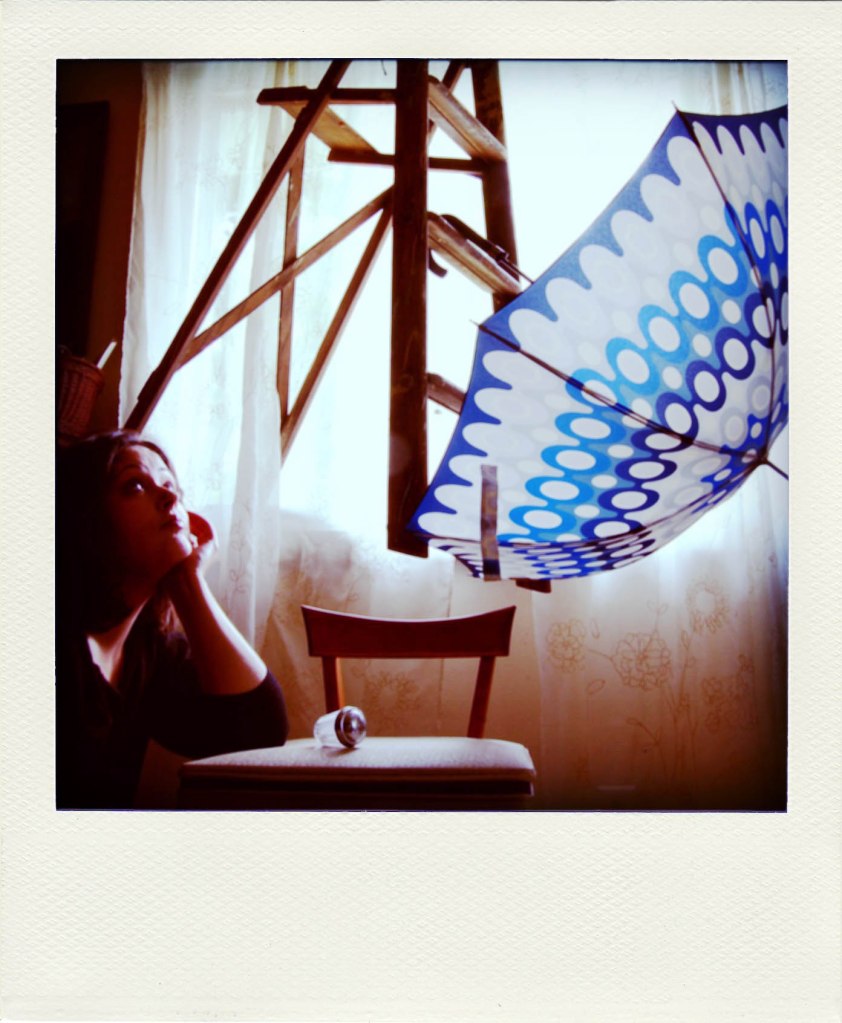
Jamelah Note: One thing about Iron Photographer, aside from the other things, is that if you let it, it’ll push you to try things that don’t seem like a great idea, but you just want to see — maybe I could do this? For example, I tied a ladder to the ceiling because I wondered if I could tie a ladder to the ceiling. When the elements for this particular challenge — 1) an umbrella, 2) a chair, and 3) Polaroid-ish — came together, I immediately started thinking about umbrellas open indoors and bad luck and then I spent an afternoon using jute twine to tie a pretty damn heavy wooden step ladder to some plant hooks in my living room ceiling and wound up with this. As I like to say, stand back. I’m being weird.

1) an umbrella, 2) a chair, and 3) Polaroid-ish – Jamelah

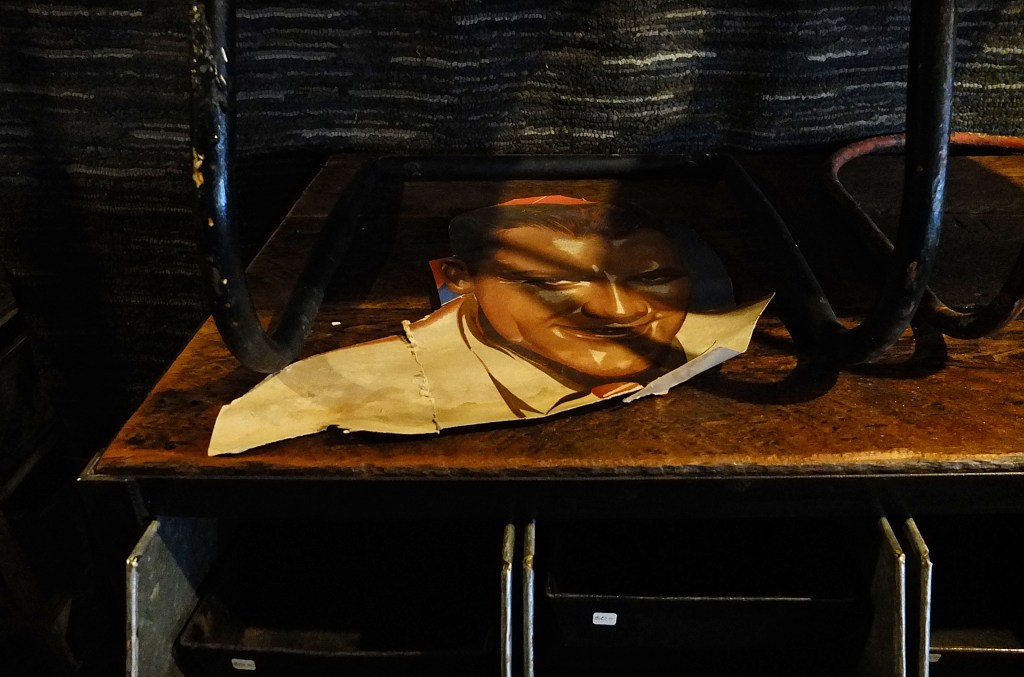
You’ll also find yourself thinking about the elements. How do you interpret them? How can you combine them in an artful way? A table, something tough, weird shadows. A table is a table, and shadows are shadows…but what does ‘something tough’ mean? What is tough? An old boot, sure. Maybe a 3000 piece jigsaw puzzle. Or a musical score that’s difficult to play. What about a piece of an old movie poster with legendary tough guy Jimmy Cagney? YOU get to define ‘tough.’

1) something tough, 2) a table, 3) weird shadows

Iron Photographer encourages you to try new and weird things. It prompts you to find creative ways to combine disparate photographic elements that may not appear to go together. It gives you permission to try crazy shit. Iron Photographer is less about taking photographs than making photographs.

And best of all, photographers at any skill level can participate. Beginners, advanced amateurs, professionals, it doesn’t matter; all you need is some imagination and a camera.

Jamelah Note:  Iron Photographer offers an opportunity to learn new techniques and figure out how to make them work. Never tried noir or processing in sepia or cinematic aspect ratio or lightpainting? Iron Photographer will give you a chance.

you have to be there

The question came up again today. “Is there a relationship between the way you write and the way you shoot photographs?” Somebody asked me a similar question a couple of years ago, and this was my response:

My response was pretty simple: Never thought about it. And then, of course, I started thinking about it.

And, of course, since the question came up again, I started thinking about it again. The last time I was asked the question (yeah, I actually had to go back and find that blog post and re-read it to know how I responded last time), I focused on writing and photography as matters of craft. I said they were two very different crafts, and…

[W]hile writing and photography are both vehicles for self-expression, they’re completely different vehicles. Asking if me if I write the same way I shoot photos is like asking me if I drive a truck the same way I paddle a kayak.

That’s still true. But this morning it occurred to me that there’s another fundamental difference between the two crafts. It’s this:

Photography is the only medium of self expression that requires you to be physically present.

You can paint a picture of a house on the edge of a mountain meadow without being there. You can write a scene that takes place in 17th century Venice or on the planet Tralfamadore. You can dance the Dance of the Sugar Plum Fairy without being in an enchanted garden. But to shoot a photograph, you have to be there. (Yeah, sure, you can set up a tripod and rig some sort of timed or remotely triggered shutter release, but c’mon, you know what I mean.)

I can write anywhere. To shoot a photo, I have to be there. Right there, at that precise spot in that precise moment. Five seconds earlier, five seconds later, it’s a different moment. Five inches higher, five inches to the right, it’s a different photo. When you shoot a photo, you’re right there.

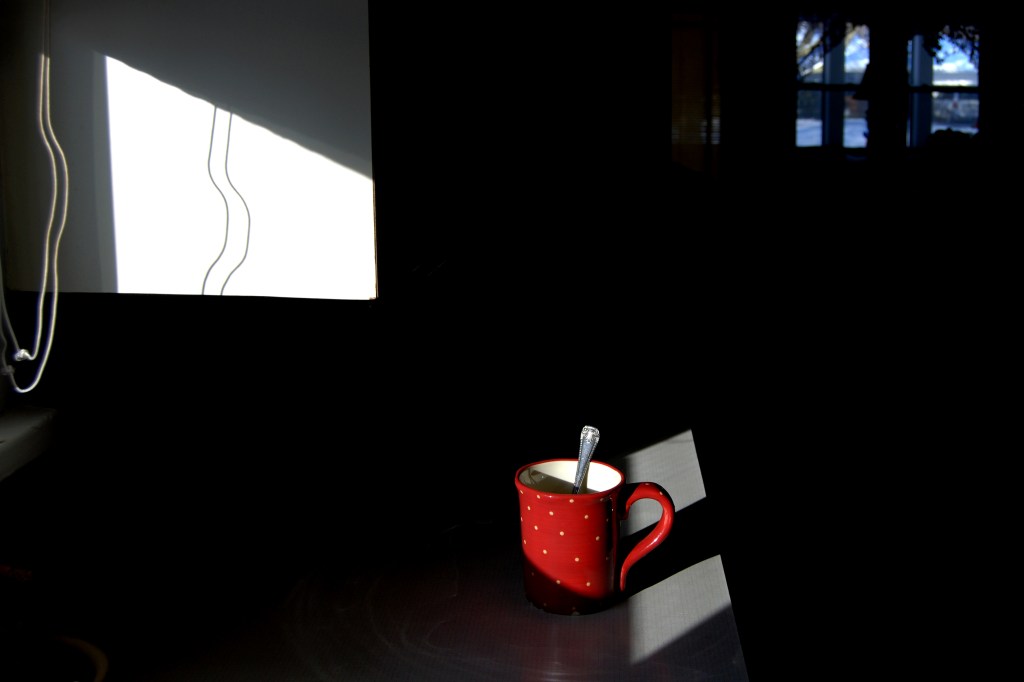
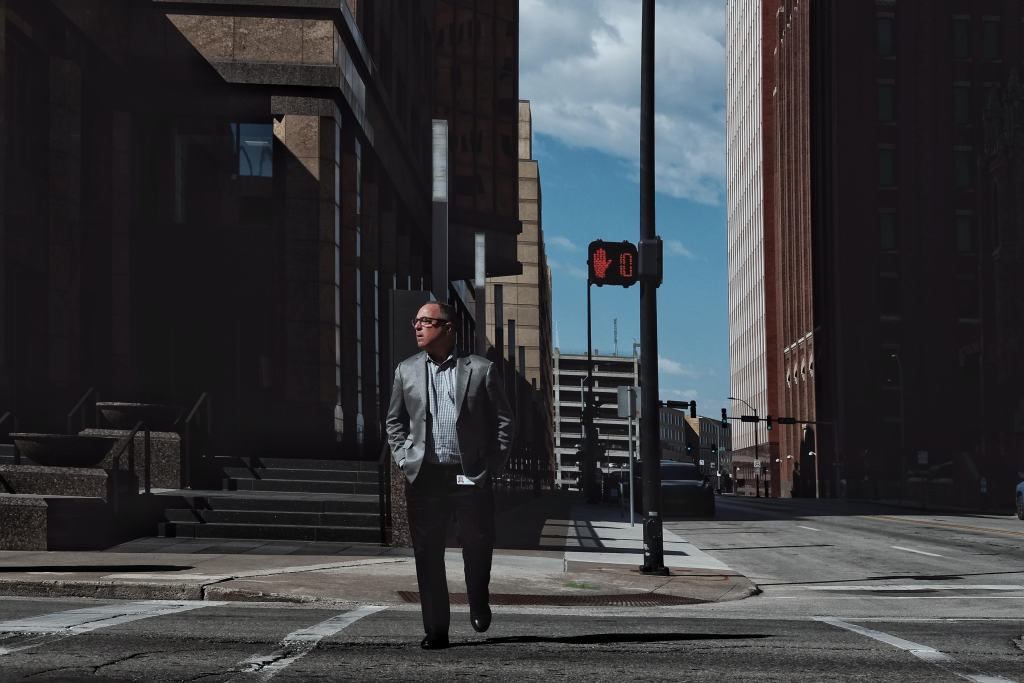
This isn’t to say photography is more real, or more powerful. I could write a scene…or, better yet, a poem…about the way light falls on a coffee cup that would be as emotional or more emotional than a photo. I could write a scene about a man crossing a street as the light is ten seconds away from turning green that would be full of tension.

A photograph is just now. That both limits its power AND gives it power. A photograph is a real moment as it’s happening.

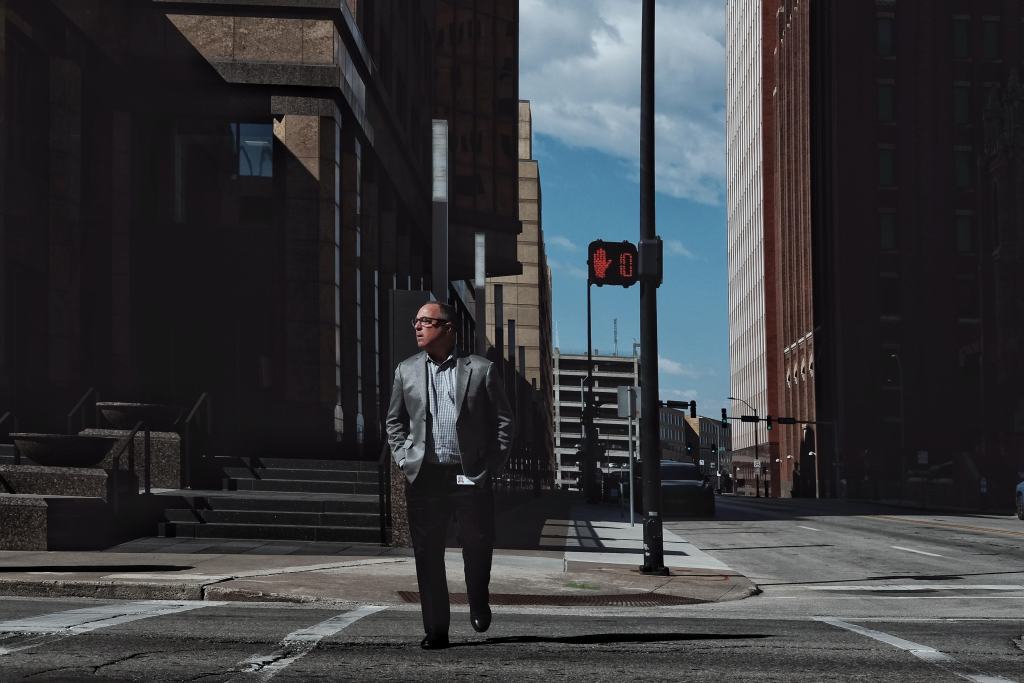
I hear a lot of people saying stuff like, “This photo tells a story.” No, it doesn’t. A story has a beginning, an ending, and a middle. Again, a photograph is just right now. It might suggest a story, but it’s the viewer who supplies it. It’s not inherent in the photo. A story is what’s taking place outside the frame, what the guy is looking at, why he’s looking, what he’s NOT seeing. A story is what’s in his pockets, what he’s thinking, where he’s going, where’s he’s been, what he did when he was there.

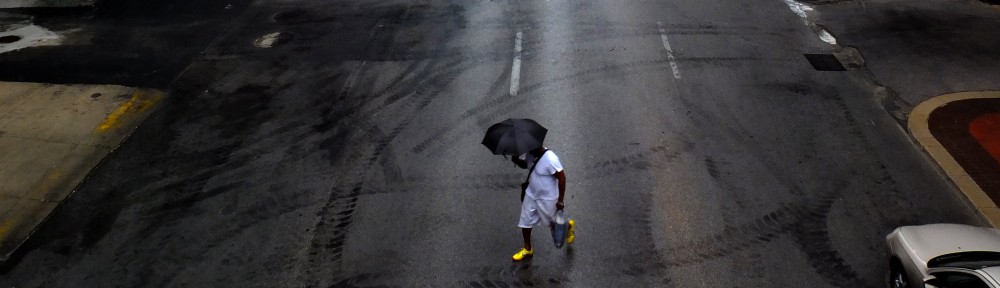
The photo is just a guy with his hands in his pocket, crossing the street while the Don’t Walk warning is flashing.

Back to the question. “Is there a relationship between the way you write and the way you shoot photographs?” Sort of. They both require practice to be consistently good, they both require a certain degree of disciplined composition, they both require a weird merging of passion and control. And (for me, at least), both writing and photography require me to be open and welcoming to the moment. Sometimes a random thought will completely change what I’m writing.

The difference is I can edit and correct what I’ve written. Reality isn’t so easily revised.

EDITORIAL NOTE: This isn’t really relevant to what I’ve just written, but it’s been a while since I’ve mentioned how critical it is to burn the patriarchy to the ground. Burn it, gather the ashes, grind the ashes into dust. Wait for a high wind then scatter the dust so that no two particles exist within a mile of each other. Then bake some bread and eat it with butter and honey.

in which I look at an old photo (part 5)

Right, quick recap: Back in the Spring of last year I was slowly emerging from a photographic funk. I hadn’t picked up an actual camera in…I don’t know, months, Several months. This had happened to me once before (see the endnote if you’re interested). Anyway, for whatever reason, I was coming out of that funk and starting to think about photography again.

That included reading about photography again. I came across an article on some photo website that suggested looking at and analyzing your old photos as if they were made by a different person. That seemed ridiculous to me. I’m not terribly interested in my old photos; I mean, I’ve already seen them, right? Why would I want to look at them again, especially when there are lots of photos by other people that I haven’t seen?

But I thought I’d give it a try now and then. This is my fifth time in nine months. I’m still not comfortable in doing this. But several years ago I wrote about Alfred Stieglitz and his notion of practicing in public. The idea, as I interpreted it at the time, is that if you’re serious about photography, you’ve got to be willing show your whole ass in public. So that’s sort of what I’m doing. So, here we go:

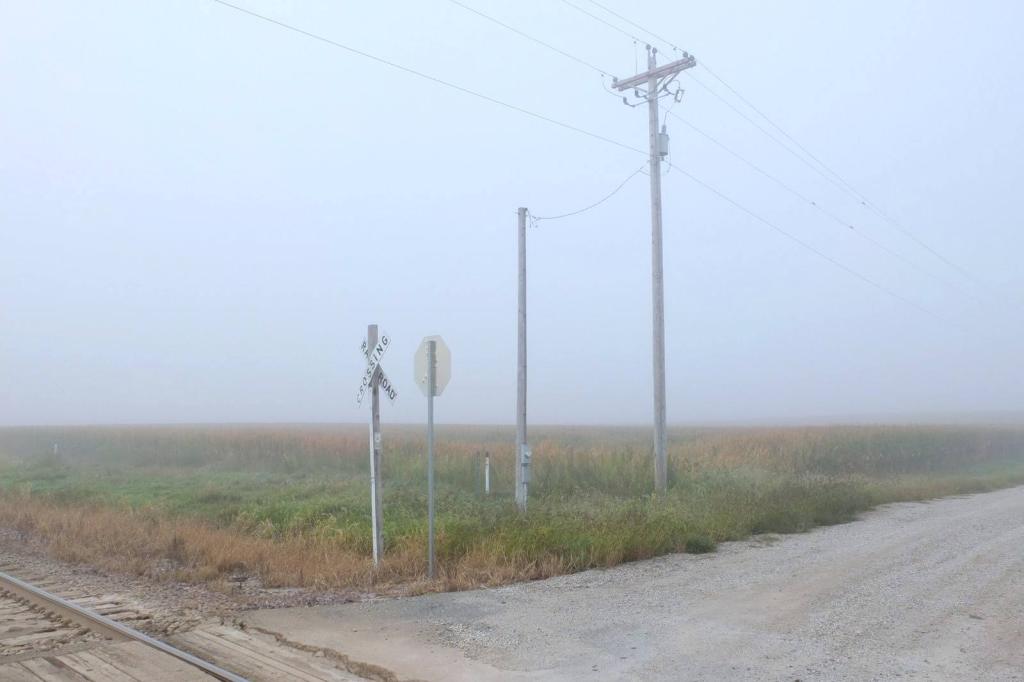
The metadata informs me I shot this photo on September 18, 2014 at 9:03 in the morning with my old Fujifilm X10 (ƒ/4.5, 1/450, ISO 200). It’s one of six photographs I shot that misty morning. I tend to be parsimonious when I shoot–a habit from the days when I couldn’t afford to piss away film.

I don’t remember anything about that day, but it’s clear to me why I stopped long enough to take this particular photo. It’s all about those angular lines. The railroad tracks, the dirt road, the rising line of poles, the telephone wires, and that terrifyingly flat horizon line (although I’m living in Iowa, I’m not a country boy, and I’m always a tad freaked out when I find myself in the flattest and most open parts of the Midwest countryside. There’s so much sky and so little to break up the horizon. It always reminds me that I’m on the surface of a planet, which makes me feel incredibly small and unimportant; that’s both humbling and sort of a nice reminder that everything is temporary when seen on a planetary scale).

I’m sort of surprised I didn’t shoot this photo in monochrome. If line and form are the predominant features inside the frame, I tend to opt for black-and-white (okay, yet another tangent, sorry. It’s silly, I know, but I deliberately choose to shoot in either color or in monochrome. I almost never turn a color photo into monochrome, though that process certainly gives the photographer a LOT more control over the final image). I have to assume that at the time I took the photo, I thought the mist-muted colors added something to composition. Maybe it does. I’m not curious enough to process the image in b&w to find out. I mean, this is the photo I chose to shoot, and there it is.

I like this photograph. I think I’d like it no matter who shot it. I like the simplicity of it. I like the balance. I like the emptiness.

So, is there any real value in this whole ‘looking at an old photo’ bullshit? I kind of hate to admit it, but I think there is. I may not be learning anything new, but the practice does reinforce the reality that I see and react to the world differently than regular people. That’s true of all photographers; it has to be. It validates the willingness to stop your car at some random spot, and get out in the chill mist, simply because you’re smitten by a series of visual lines that other folks wouldn’t notice.

So I’ll probably do this old photo business again in the not-too-distant future.

ENDNOTE: My first long-term photographic funk came at the end of my career as a criminal defense investigator. I used my cameras a LOT as a PI, but in a very technical forensic way. The photos I took for my work were all potential evidence to be used in court. The work was very object oriented. The photos were sometimes technically challenging (I once had to photograph the undercarriage of a wrecked car, which involved some tricky lighting and wide angle lenses while lying on a roller beneath the vehicle, which was claustrophobic as fuck). The problem was that there was no joy in that sort of forensic photography. Blood spatter patterns might be visually interesting, but it’s hard to appreciate when you’re shooting them. When I ended that career, I stuffed my cameras into my Sam Spade Conjurer’s Kit and stuck it in a closet, where it sat for about 3-4 years. I had no desire to hold a camera in my hand in all that time.

reflected

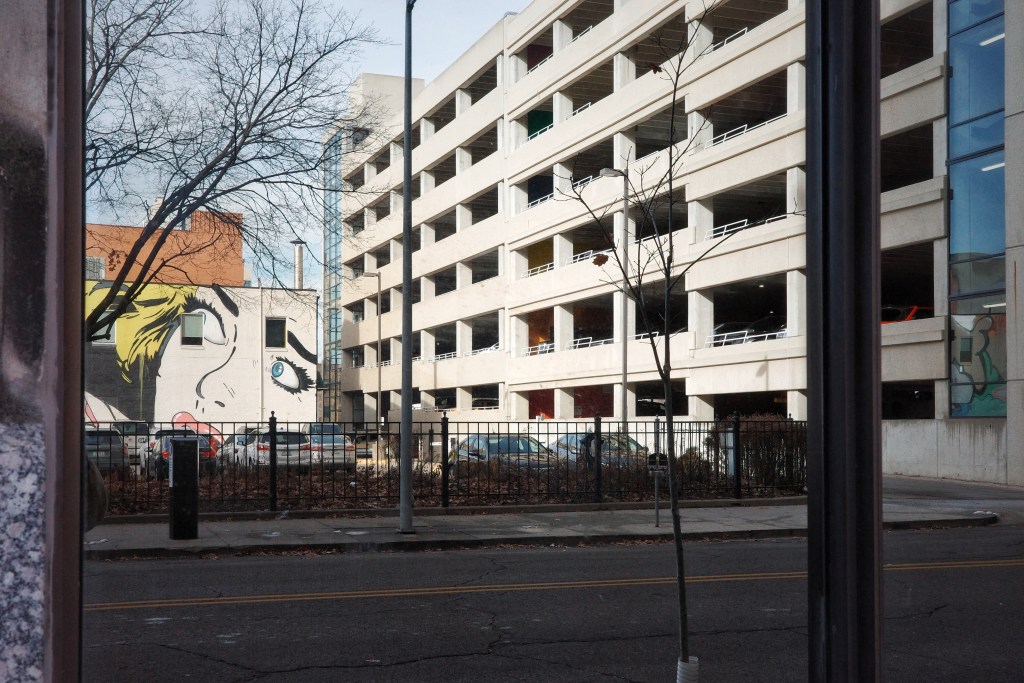
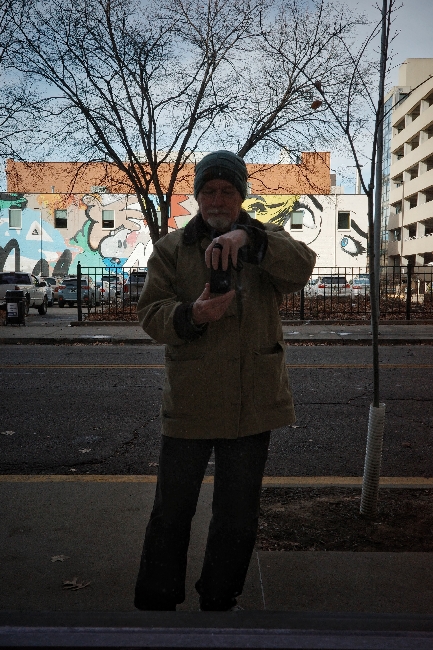
So here’s me, noodling around the city, shooting photos (okay, I know it’s way too soon for a tangent, but let me just say that I’m totally smitten with my Ricoh GR3X, oh lawdy, it’s SO much fun to shoot) and basically having as fine a time as is possible on a cold January day. The sun’s out, the sky is blue, the people I meet on the street are uniformly pleasant and smiling despite the chill in the air. It’s a nice way to spend an hour or so.

As I’m walking along I notice a mural reflected in a window. The mural includes a massive cartoon-styled woman’s face, showing alarm or horror. It’s cool, but it’s not particularly photo-worthy. But what the hell, I take a shot. Why not? I keep walking and keep looking at the mural hoping a better shot will appear, and then I reach a spot where I’m also in the reflection. There’s a giant cartoon hand reaching for me, and I’m thinking that must be the reason the giant woman is so alarmed. Still not photo-worthy (in fact, it’s even less photo-worthy), but it amuses me. So what the hell, I take a shot.

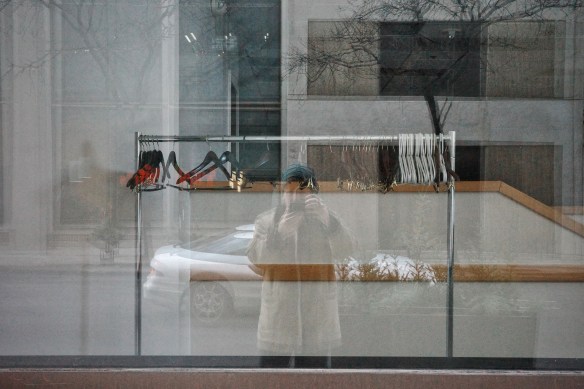
And I keep on walking (which is what you do on a photo-walk, after all). I stop now and then when the light or shadow catches my attention. I notice a particularly fine bollard. A stack of tires in an alley. There’s an ambulance and a fire truck flashing their lights in front of a hotel, but the light sucks and whatever is happening is happening inside the hotel and there’s nothing to see, so I keep walking. And I see an empty shop window, with a clothes rack devoid of clothes but with a fine collection of empty hangers. The lines are nice, the light is acceptable and there’s me again, reflected in the window along with a nice bare tree. So what the hell, I take a shot.

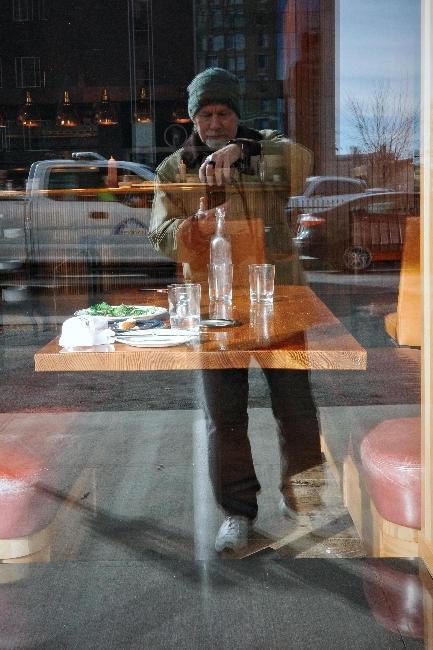
And I keep walking. Down along the river, which is running low. There’s about a million Canada Geese milling about as the ice is breaking up, making a colossal noise, and ignoring the mallards that are paddling around, minding their own business. Then I’m down a street with nice shops and fine restaurants, and the light is catching a table through a window, with the remains of somebody’s salad and an empty water carafe (which is a lovely word to say aloud; French, from the Arabic gharraf meaning “a drinking cup”; go ahead, say it out loud, nice and slow…isn’t it nice?). And, once again, there’s me in the reflection, ruining what might have been a nice photo. But what the hell, I take a shot.

This is a thing I seem to do…reflection selfies. They’re never good photographs, they’re never interesting photographs, and I almost never post those photos (for the reasons just stated). They’re more of a reflex action–like when your doctor taps your patellar tendon with a rubber mallet. I see myself reflected in a window, my shutter finger jerks. It’s a reflection reflex.

But as I was sorting through the day’s photos, deciding which ones were worth keeping, I found myself reflecting on my reflection reflex and c’mon, there’s no way I’m not going to use that phrase. So yeah, this blog post exists solely so I can write ‘reflecting on reflex reflections.’

the curious incident of the diner at midday

Here’s one of those photography ethics things. I was sitting in a booth in a quintessential American lunch-car diner with my camera on the table. While looking at the menu, I heard the sound of stressed voices coming from across the diner. I glanced over, saw two women who I thought had a family resemblance staring at each other. The light was nice and the scene had some drama. What to do?

  1. Mind your own business?
  2. Turn your camera on the table and shoot a quick photo without looking?
  3. Pick up your camera and photograph the situation?

Obviously, the most ethical thing to do is 1) Mind your own business. I had no idea what the situation was, it had nothing to do with me, and the two women involved would almost certainly prefer to be ignored.

But if you’ve ever practiced street photography–or if you’ve ever wanted to practice street photography–you know that people are often most interesting and most honest during emotionally charged moments. And those moments are almost always worth photographing. So some/many photographers would at least consider options 2 and 3.

You have to be a complete asshole to choose option 3; to pick up your camera and openly, deliberately invade their privacy. Option 3, however, has the dubious advantage of being honest and direct, whereas option 2 is, let’s face it, sort of underhanded. The thing about option 2–shooting without looking, without composing–is you’re allowing the fickle Gods of Photography determine if you get a decent shot or not. If the shot sucks, then it will get binned and nobody has to think about it.

If the result works as a photograph, then both options 2 and 3 set up a secondary ethics challenge: do you further violate the privacy of these two women by posting it? If you choose to post it, do you post it on a very public social media platform (like, say, BlueSky or Instagram) or on a significantly less popular platform (like, say, your blog)?

Obviously, I chose option 2. Well, sort of. I mean, it’s not like I sat there and considered all the ethical questions. I took the photograph without considering anything at all, completely unhindered by any thought process. I turned the camera on, turned it toward their table, touched the shutter release, turned the camera off, and didn’t think about it again until I got home and looked at my photos.

And hey, I got lucky. It’s a pretty good shot (in my opinion).

This is the shot in question.

Obviously, I decided to post the photos here, on my personal blog. I’ll also post links to the blog on Facebook and BlueSky. How do I justify this? I’m relying on the Men in Black defense. If you’re in a public place: don’t start nothing, won’t be nothing. If you raise voices in a public setting, the public will look at you. Sure, few of them will take your photo, but a photograph is essentially nothing more than an extended look. You don’t have a reasonable expectation of privacy in a public setting.

Another thing: I’ve no idea what these women were talking about. I don’t know if they were arguing, if they were upset with each other or with something else, if their distress was sincere or in jest, if one was distressed and the other wasn’t. I don’t know because I didn’t pay any attention to them (other than to note their voices were momentarily raised). They could have been outraged by the portions or the size of their bill, for all I know.

That said, it’s important (to me, at any rate) not to fully absolve myself. The women may not have had a reasonable expectation of privacy while talking to each other in a very public diner, but I didn’t have to pay attention to them. While I didn’t make any effort to take a good photograph, the fact remains that by taking any photograph I invaded what they probably thought of as a private moment.

Was it worth it? I don’t know. I think it’s an interesting photograph. The chance that either of them will ever see this…or that anybody they know will ever see this…are incredibly slim. I could probably legitimately make the ‘No harm, no foul’ argument. But maybe this type of photography is a social harm in and of itself. I don’t know.

Here’s the thing: I spent several years as a private investigator. Much of my work (which was primarily criminal defense investigation) involved making ethical decisions in the immediate moment–and there was rarely any obviously correct decision in those moments. So I’m used to questioning my ethics. It’s easier with photography. With photography, you can always take the shot and delete it later IF you decide it was inappropriate or unethical. In photography, you have that leeway.

Looking at the photo, I don’t think the level of tension between the two women is terribly obvious–unless you’re looking for it. I don’t think there’s any ethical reason NOT to publish it. Others may disagree, but I’m comfortable with my decision.

small love story

I’m at the Christkindlmarket and I see this guy and his dog sitting at a table. He’s holding the dog and the dog is leaning against him. I know it sounds ridiculous, but the moment I saw them I thought, “Madonna and child.” I blame all the Christmas stuff for that. I’m not a Christian, but I’m a fan of any holiday that’s (supposed to be) about love and sharing.

Anyway, I’ve got my little Ricoh GR3X in hand as I approach them, and the guy knows why I’m coming. I could see it on his face, the recognition that I wanted to photograph his dog. And it obviously pleased him. I barely got the words out…”Would you mind if I…?” before he said, “Sure.”

The dog, though, seemed a tad uncertain, so I slowed down. Instead of the close-up I’d intended, I stayed back a bit. Instead of shifting my position to isolate the guy and his dog from other people from the frame, I stayed still. Instead of shooting 3-4 frames, I took only one. I moved slowly to take the photo.

I said something like, “He’s a wee bit shy, isn’t he.” The guy said the dog was timid around other people, which is why he’d brought him to the Christkindlmarket and why he was holding him. He wanted the dog to feel safe and protected, but he also wanted him to get used to being around other people.

I didn’t even try to pet the dog, though I wanted to. I didn’t try to shoot more photos of them, though I very much wanted to. I figured the little guy was dealing with enough already.

In the end I said something like, “You’ve got yourself a little buddy.” He said, “I sure do.” And I walked away. But seeing them together lifted my spirits–which, given the world as it is today, was quite a feat. The obvious bond between them, the care the guy was taking with the dog, the trust the dog had in the guy — it was lovely, and I was weirdly proud of them both.

I could have taken a better photograph of them. They deserve a better photo. But it might have made the dog nervous, and no photo would be worth that.

lesson learned

I’ve had my Ricoh GR3x for a wee bit more than five months now. Long enough to be pretty familiar with it. Long enough, in fact, to get cocky with it. It’s SO fucking GOOD for shooting quickly and intuitively. So good that I’m starting to get sloppy with composition.

I’m usually pretty deliberate when I shoot photos. I know what I want in the frame, and I know what I don’t want. I’m usually conscious of where I should be standing in order to get the image I want. I’m usually patient. Usually. But I’m so comfortable with this new camera that I’m becoming less disciplined. Sometimes that’s good. Sometimes…not so much.

Here’s an example. I was walking down the street on a grey, sullen day when a burst of sunshine broke through the cloud cover, briefly illuminating a white building. I was immediately taken by the light and all of those lovely vertical lines. There was a sweet green patch of bike lane, some dead brown leaves still clinging to a tree, a guy in a hoodie waiting at the crosswalk. There was a wet patch on the sidewalk where a recycling bin had probably been sitting, and it mirrored the patch of turf in which the tree had been planted.

There were a LOT of elements and shapes all working together. So the Ricoh came out of my pocket, and I glanced at the screen, and took a snap as I walked. I mean, I didn’t even pause.

I chimped a quick look at the image without missing a step, and lawdy, I was so smug. Not so much with the image itself (it’s not a great photo) as with the way I shot it–on the move. It wasn’t until I got home and downloaded it that I realized I’d fucked up.

Cut off the top of the light pole.

It’s not a huge deal, partly because, as I said, it’s not a great photo to begin with. But it’s a reminder that speed and convenience aren’t always benefits. If I’d paused for a moment…if I’d taken a half step backward…if I’d followed one of the very basic rules of composition (check the edges of the goddamned frame), it…well, it still wouldn’t be a great photograph, but it would have been a properly composed one. I tell myself, “Self, if I’d paused I might have lost the light!” Which is true. But it’s also true that I wasn’t concerned with the light any more than I was concerned about the composition. I was only thinking about how cool it was to be able shoot that quickly and with such confidence. The confidence was misplaced.

Lesson learned.

(Maybe. Some lessons need to be learned repeatedly.)