oblique nouveau-neo-new topographics

Twice in the last couple of weeks I’ve been asked about my ‘photographic style.’ The first time I basically said “Dunno, never thought about it.” I mean, who thinks about stuff like that? The second time I said “New Topo, laid on its side, and turned 45 degrees to the left.” I said it as a joke, but after I said it, I sorta kinda became the type of person who thinks about stuff like that. And hey, it turned out to be sorta kinda true.

Back in 1975 a guy named William Jenkins curated an exhibition of a new school of landscape photography: the New Topographics movement. Landscape photography to that point in time had generally followed the path of landscape painting, which for the most part consisted of romantic depictions of ‘undisturbed’ nature. We either had the Ansel Adams approach (epic vistas photographed on a grand scale in black and white) or the Eliot Porter approach (intimate color images of a few trees or a handful of leaves scattered on a pond). Nothing wrong with either approach, but that was basically it.
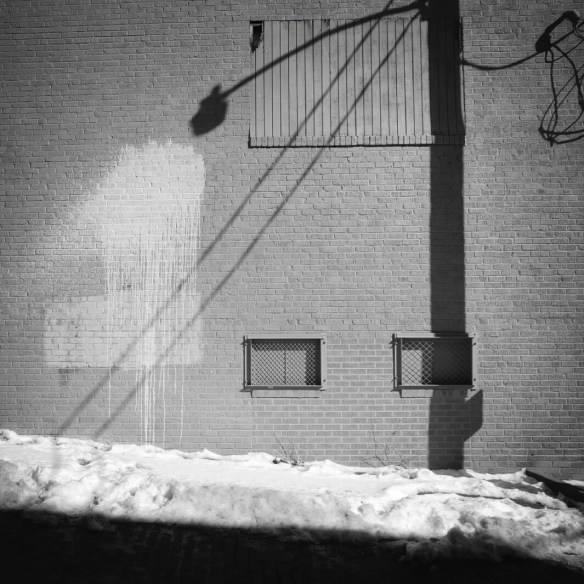
Traditional New Topo approach

Traditional New Topo approach

Then along came Jenkins and his New Topo crew. His exhibition consisted of 168 black-and-white prints of warehouses, industrial sites, suburban tract housing, filling stations. The idea behind the exhibition was to present the modern landscape as it actually existed rather than in an idealized way. Most art photographers used the camera as a device for self-expression. The New Topographics photographers reduced the camera to its most basic function.

The camera, after all, is a tool that records everything in front of the lens. Every goddamned thing, not just the pretty stuff or the majestic stuff. And it records it all with the same precision. It records with a detached, unemotional, deadpan eye. That’s all a camera does. With that idea in mind, New Topo photographers deliberately attempted to remove any notion of ‘artistry’ from the act of photography. Their intent was to depict the objects in front of the lens in a way that merely mapped their surface. In other words, to reduce the subject of the photograph to an essentially topographic state.

Neo-New Topo

Neo-New Topo

The exhibition garnered a lot of attention. Not all of it was positive. Hell, relatively little of it was positive. Most folks thought the photographs were bland, uninteresting, boring, even ugly. And hey, those folks were right. I tend to agree. In my opinion, a lot of those photos really were butt-ugly. But they were interesting.

People who thought about photography as an art — not just viewed it, but consciously and deliberately thought about what photography was and could be — those folks found the exhibition fascinating. Why? In part because they realized the emotionally detached camera opened up a visual world in which people could see the stuff that had previously been filtered out. The ugly stuff. The old tires, the broken sidewalks, the trash cans, the old telephone wires, the litter. All the crap photographers normally worked hard to exclude from their photographs.
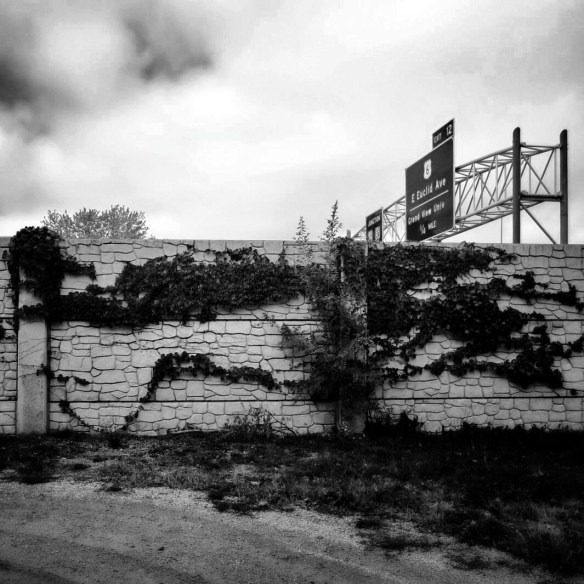
Nouveau-Neo-New Topo

Nouveau-Neo-New Topo

But there was a problem. Humankind has spent something like twelve thousand years unconsciously building the foundation of aesthetics. It’s really difficult to just toss all that aside. It’s hard NOT to look for beauty, hard NOT to try to include that beauty in a photograph. That’s a lot of human nature to overcome.

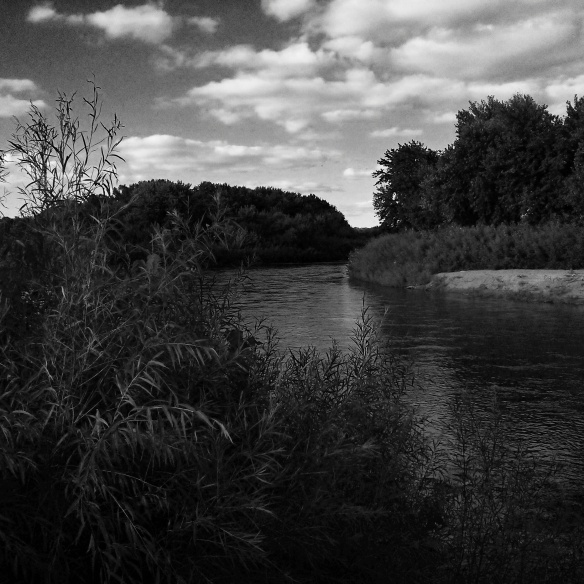
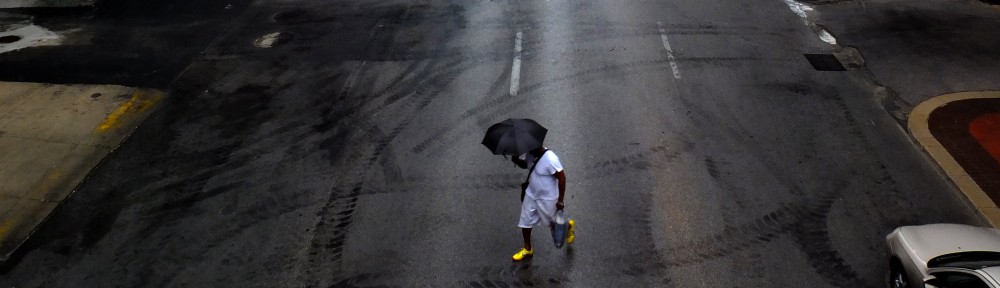
So a sort of Neo-New Topographics style emerged fairly quickly (and yeah, I just made that name up). It’s a style in which photographers still photographed the same anonymous human-shaped landscapes, and continued to objectively map the surfaces of whatever is in front of the lens — but with the recognition that even industrial sites and warehouses can be beautiful. And after that, a Nouveau-Neo-New Topo approach, in which photographers actively sought out what beauty can be found through surface mapping.

Oblique Nouveau-Neo-New Topo

Oblique Nouveau-Neo-New Topo

That idea has become a big chunk of my photographic patch. Over the last few years I’ve been working in a sort of Oblique Nouveau-Neo-New Topo style. Surface mapping at a slant. New Topo, laid on its side, and turned 45 degrees. Because I prefer my surface to have depth. I like a surface that extends itself. A surface that sort of falls away.

ONNNT (which is also the sound a Canada Goose makes when landing in icy water)

ONNNT (which is also the sound a Canada Goose makes when landing in icy water)

I can’t really say that’s my ‘style’ since I shoot all sorts of crap. But when I’m deliberately looking and seeing photographically, that’s pretty much my default approach. Find an interesting surface — then either photograph it straight or find an angle that allows the eye to shift off into the distance. Oblique Nouveau-Neo-New Topo. Takes longer to say than to shoot.

But hey, at least now I have a response the next time somebody asks me about my photographic style. ONNNT.

The photo that sparked the question the second time.

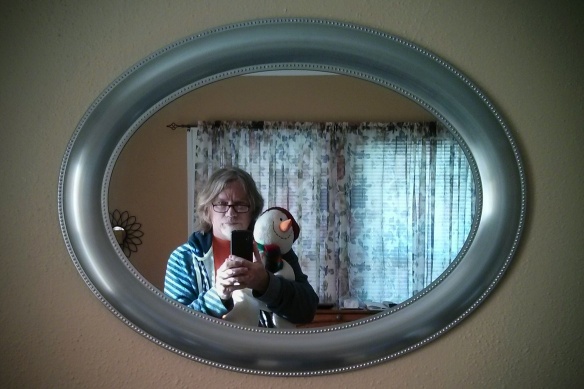
The photo that sparked the question the second time.

i received a note from a friend

Ten days ago, as I was packing to go house-sit for my brother, I received a note from a friend.

That sounds so simple, so mundane. I received a note from a friend. But it wasn’t just a note. It was a hand-written note. Hand-written in ink. Written in ink with a lovely, idiosyncratic fist. Written in ink on fine paper — paper thoughtfully chosen, with a graphic that holds a personal meaning to me. Written in ink and posted in an envelope with a delightful and eccentric selection of postage stamps

Hand-written in ink. Think about that. When putting ink to paper, the writer has only one chance. There’s no possibility to correct a mistake in ink, so the writing must be exact. But perfect exactitude in writing usually feels mechanical — pretty, perhaps, but without any true sense of personality. So in order to write fluidly and expressively in ink, the writer must be relaxed but deliberate.

There’s a concept in Buddhism called mushin, which is generally translated as ‘no mind.’ Basically, that means emptying the mind of crap-baggage like ego and expectation and fear. The idea is that letting go of any concern about the end product allows you to be focused on what you’re doing with a level of intensity that wouldn’t be possible to achieve if you were consciously thinking about it. Mushin in writing is to write unencumbered by expectations, free of the burden of perfection, embracing imperfection, accepting the perfect beauty of the imperfect.

note and pear

I received a note from a friend. But he’s not a traditional friend. I’ve never met Fernando. I’d very much like to — but if I never do meet him, that’s perfectly okay. The internet, after all, has completely redefined the concept of friendship. It’s no longer limited by physical proximity; instead it’s grounded in shared interests. I ‘get’ Fernando. I may not always understand him, but I ‘get’ him. So yes, even though I’ve never met him, he’s definitely a friend. A friend made possible only through of the existence of the internet.

So ten days ago I received a note from a friend while I was packing to go house-sit. I read the note. Read it again. Knew I wanted to write about it, and set it on a table so I’d remember to take it with me. It was still there on the table when I got back home last night.

Here are the last two lines of the note:

There are just too few people one crosses paths in life that one can stop and make an effort to appreciate. (Their [something] is to be punished by trying to figure out my handwriting).

Fernando’s handwriting is…let’s say it’s free of the burden of perfection. And that makes it absolutely perfect.

okay, yeah, that’s pretty weird

Let’s just acknowledge that everybody’s life is weird. They’re all weird in different ways, sure — but the weirdness is there. It’s built into the system; you can’t get around it. Most of the time we don’t even notice the weirdness of our own lives. It’s so much easier to see the weirdness of other folks.

Today, though, some of the weirdness of my life bled through. First off, it’s my birthday. That’s not a big deal and there’s nothing weird about it. Everybody has a birthday. The only thing weird about mine is that I happen to be house-sitting for my brother (who is larking about on the beaches of Puerto Vallarta), so I’m sitting here alone in a strange house that’s decorated with about a thousand snowmen. Not actual snowmen (nor those creepy-cool snowmen from Doctor Who), just holiday decoration snowmen.

me in the mirror

It’s also a little weird to get a lot of birthday greetings. The greetings themselves aren’t particularly weird (well, some of them are a tad weird), but as I read through them all I’m reminded that I have a pretty odd range of friends and acquaintances. Lots of writers, lots of artists, lots of librarians, some lawyers, some regular working folks, a few gun nuts, a few scientists and mathematicians, a former nun, lots of tech-related people, some folks who work as advocates for mostly lefty causes. There are more women than men, more liberals than conservatives, more straight folks than gay, more folks from the US than any other place, but all in all it’s a pretty eclectic group.

Most folks just say ‘Happy birthday’ and leave it at that, which is nice and simple and direct. I’m a big fan of simple. One person wants me to use the occasion of my birthday to ‘reflect on your life and this past year, and consider what it’s all meant.’ This person hopes I ‘gain a deeper understanding of what it means to be you’ and wants me to ‘examine what you’re feeling today and why you’re feeling it’. It’s very sincere and earnest and I appreciate this person’s concern — but at the same time I’m thinking ‘Don’t you fucking know me at all?’

Seriously, I can’t remember the last time I felt the need to try to understand what I’m feeling. I figure if I’m feeling it, that’s good enough. And a deeper understanding of what it means to be me? I don’t even know what that means. Don’t get me wrong; it’s sweet that somebody is concerned about my spiritual growth. If that’s what the concern is. But lawdy, I’ve been me my entire life — there’s not much new to learn, and frankly that makes thinking about myself as a person pretty dull. It’s more fun to think about other folks. I’m used to my own patch of weird; I’m a lot more interested in the weirdness of others.

That said, my patch of weird expanded a little today. I discovered that a few days ago I was featured on a website called Nail Art Design. I swear, I am NOT making this up. There’s actually a website about nail art, and there’s actually a photo of me wearing red nail polish and holding a snow shovel.

Let me just repeat that. There’s a photograph of me wearing red nail polish and holding a snow shovel on Nail Art Design.

Even I have to admit that’s a little weird.

completely unexpected

So I’m at the supermarket on a Thursday afternoon, right? All the decent hard-working people are at their offices, or doing their jobs. It’s mostly old folks and young mothers pushing around carts. It’s the best time for shopping, because I can take my time and look at all the products, and not feel like I’m disrupting the shopping experience of the other people in the market.

I’m always delighted by how ridiculously large the market is, and how many variations there are of the same product. The cereal aisle, for example. There must be half a dozen different types of cinnamon-flavored cereal. Maybe twice that many chocolate-flavored cereals. And really, how different can they be? A dozen or so different types of macaroni and cheese in a box. The absurdity of it — and I’m torn between delight and horror. Is there really a need for twenty-five feet of shelves displaying so many mass-produced pickle variations?

And then there’s the astonishing cookie aisle. The Great Wall of Cookies. There was a period of a year or so when I was moderately young when my breakfast consisted of two Oreos and a glass of milk. But I couldn’t tell you the last time I’d bought a mass-produced sandwich cookie.

Until I saw these:

IMG_20141107_121355_1

Watermelon Oreos. Watermelon. I don’t even remember picking them up. It was like my hand went all Dr. Strangelove on me and just snatched a package off the shelf and deposited it in the cart. Watermelon Oreos. No way I could pass them up.

The entire concept of an Oreo that tastes like watermelon — it’s a sort of genius. It’s like somebody sat down in the Oreo Factory and asked “What possible flavor can we come up with that will alarm the senses enough to draw attention but not so much that potential customers will vomit in the aisles?” Just think of all the possibilities they had to reject in order to come up with Watermelon Oreos. Tuna Oreos, Okra Oreos, Lima Bean Oreos. Liver and Onion Oreos. Fried Clam Oreos.

So yeah, I bought them. It was the happiest purchase I’ve made in a long time. Seeing the package in my cart was completely smile-making. I walked around the market beaming at everybody. Like post-Ghost-of-Christmas-Yet-to-Come Ebenezer Scrooge on Christmas morning. I bought them with something akin to joy.

And I ate one when I got home. I didn’t expect it would actually taste like watermelon. In fact, I hoped it wouldn’t. Because c’mon, watermelon and Oreo? It’s an anomaly in the constellation of flavors. And, of course, it didn’t taste remotely like watermelon. First off, the cookie smelled like a floral dish-washing soap — something with a label like Lilac Breeze. It tasted like sugar filtered through fresh anti-freeze. It was really quite a remarkable flavor. I ate half a second cookie just to be sure I wasn’t hallucinating.

The cat was curious, so I offered her a small piece (the cat, I should say, doesn’t eat human food — never has — and I didn’t expect her to actually eat this, but I was as curious as she was and wondered how she’d respond).

20141107134002_1

She sniffed at it for a brief moment, then attempted to cover it up. It could have been worse. Mind you, this is an animal that spends a significant portion of every day splayed out like a Martha Graham dancer, and carefully grooming her butt.

I don’t recall what the cookies cost. Two or three bucks, I suppose. Worth every penny. Not as a cookie, but as an experience. I’d have happily spent that much just for the joy of knowing that something as unlikely as Watermelon Oreos exist. I mean, you can get a cookie any old day. But you only discover Watermelon Oreos once in a lifetime.

if you don’t vote, you suck

I really enjoy voting. I enjoy the process — going to my local polling place on election day, standing in line with other voters, seeing the volunteers, buying a treat from whatever local school or church or charity group has set up a table outside the polling place. It makes me feel connected to the community. It makes me feel all citizeny. It makes me feel patriotic.

But this year I’m not doing it. Oh, I’m voting. In fact, I’ve already voted. I voted a couple of weeks ago. This year I voted by absentee ballot. Why the change? Curiosity. I wanted to see what it was like. I’ve never voted with an absentee ballot before.

20141011142339_1

Here are some of the things I discovered about voting absentee. First, it’s dead easy. The ballot comes right to your door, you open it, fill it out, follow the instructions, send it back in. Easy peasy lemon squeezy. You can do it while drinking your morning coffee. You can do it in your pajamas. Of course, you can go to your local polling place in your pajamas too, if you want — it’s a free country.

Second, I feel like I did a better job of voting. When I vote in person there are usually some candidates for local office that are complete cyphers to me. I’ve no idea who they are or what they stand for. Offices like the Public Hospital Board or the Soil and Agriculture Commission. I didn’t even know there was a Soil and Agriculture Commission. But with a ballot in front of me and a computer at hand, I was able to make a more informed vote for the Soil and Agriculture Commission (I voted for the former nun — you can never go very wrong voting for a former nun; they have a moral center that informs their decisions, but they also have whatever doubts that sparked them to jack the wimple).

Third, I learned the Secretary of State is pretty damned anal compulsive when it comes to filling out the ballot. You have to use a black ink pen. No blue ink, no green ink, and sure as hell no red ink (what, are you some sort of commie?). Also, you have to fill in the oval completely. No check marks, no Xs, no smiley faces (this ain’t high school). You fail to follow the instructions, your vote gets scrapped.

DSC_0020_1

Finally, I learned that vote security is fairly tight. After you fill out the ballot, you put it in an envelope labeled Secrecy Envelope, and seal the envelope. The Secrecy Envelope is then placed in an Affidavit Envelope, which you have to sign and date and seal that as well. The Affidavit Envelope is then placed in the Return Envelope, which also has to be sealed. All of these envelopes are the old-fashioned lick-and-seal type, not the fancy new remove-a-strip-and-press type. If you want to vote Absentee, you have to be willing to sacrifice a lot of saliva.

Drop the envelope in the mail, and you’ve done your civic duty. It’s not as viscerally fulfilling as going to your polling place and doing it (and by ‘it’ I mean voting) in the privacy of the voting booth, but it’s really that easy. So why do so few people do it?

In Iowa, during presidential election years, about 74% of registered voters actually vote. That’s not great, but it’s almost 15% higher than the national average. Voter participation drops rather dramatically in midterm elections. Only about 54% of registered Iowans vote, which is still better than the national average of around 38%. Only a third to a half of all registered voters cast a ballot in the midterm elections. That’s pretty damned pathetic.

Sure, election campaigns are frustrating and annoying. I totally get that. Sure, attack advertising turns off voters. And sure, we’ll all be glad when we don’t have to see another campaign advert on television. And sure, we’ll all be glad when the election is over. But will we be glad about the result?

Here’s the thing: if you don’t vote, you suck. I don’t care how discouraged you are — if you don’t vote, you suck. I don’t care what your reasons are for not voting — if you don’t vote, you suck. You suck as a citizen. If you don’t vote, you don’t get to call yourself a patriot. If you don’t vote, you deserve whatever shitty government you get. If you don’t vote, then fuck you in the neck.

It’s SO easy to vote. So easy, and so important. And if you can’t be bothered to vote, then you suck. It’s that simple. Don’t suck. Go vote.

warm boot

Ninety percent of the work I do takes place in my head. The other ten percent involves shifting that work from my head to the computer through my fingers. Because so much of my work involves the creative writing of other folks, I spend a lot of time thinking about odd stuff, asking myself odd questions, researching odd topics.

Example? Sure, here’s one. Last week, I found myself exploring the history, function, and evolution of the lapel — complete with tangents on why we only see peaked lapels on formal evening wear, and the sad decline of the boutonnière loop on the reverse of the lapel. Here’s another issue I dealt with last week: at what point, in a science fiction mystery set in a massive orbiting space colony, does the number of sapient species living in the colony cease to create the illusion of the diversity of life in the known universe and begin to become a distraction from the story?

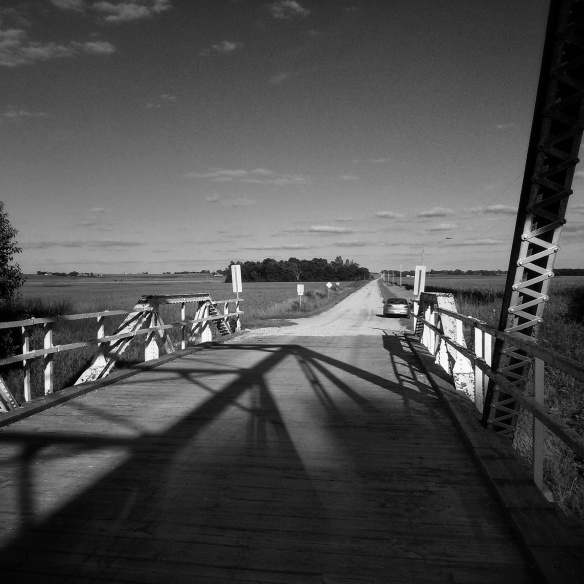
Where the gravel road intersects the line of trees is a bridge spanning a river.

Where the gravel road intersects the line of trees is a bridge spanning a river.

I do most of this thinking and wondering and questioning and researching in a small office with a window that looks out on a deeply uninteresting suburban street. I periodically shift to the kitchen table, where the windows look out on some deeply uninteresting suburban back yards. The absence of anything visually interesting is usually a good thing; it makes it easier to stay inside my head, where almost everything is interesting.

But I also need to regularly reset my brain, so once or twice a week I either bang into the city or I go lounge around the countryside — which I tend to think of as either a cold boot or a warm boot (do people even use those terms anymore to describe different levels of rebooting a computer?). The city is a cold boot. A complete re-start. The countryside is a warm boot. Restarting without going through the rigorous Power On Self Test.

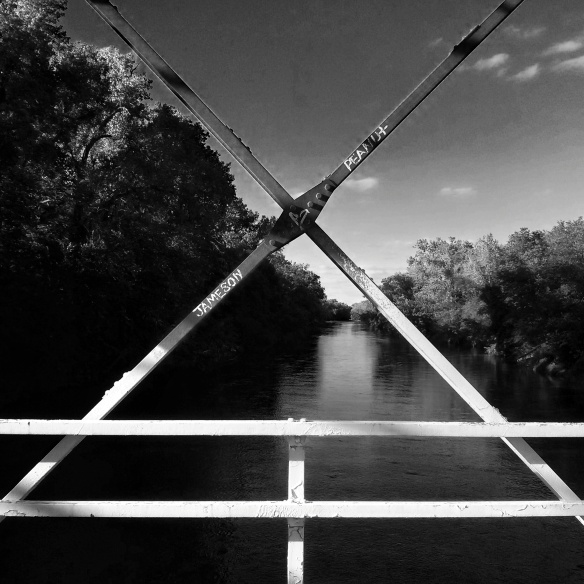
Jameson and Peanut

Jameson and Peanut

A couple of days ago I did a warm boot. Got in the car late one afternoon, went looking for a bridge over a river. Any bridge, any river. It’s really a pretty easy task. There are rivers, creeks, brooks, and streams all over the Midwest. The same with roads. At some point all those roads have to intersect with all those rivers, creeks, brooks, and streams. And that means a bridge.

Fifteen — maybe twenty — minutes later I was standing on a classic steel truss bridge spanning the South Skunk River. These used to be pretty common bridges; easy to build, practical, sturdy. They began making them out of wood in the 1870s, moved to cast iron a few decades later, then to steel in the early 1900s. Engineers still make various forms of truss bridge, but these old steel units on secondary or gravel roads are gradually being replaced by safer, more easily built, less expensive (and much less interesting) concrete beam bridges.

Perfectly understandable from a governance perspective. But it’s still rather sad. There’s simply no romance in a concrete beam bridge. No struts on which Peanut and Jameson can record their love.

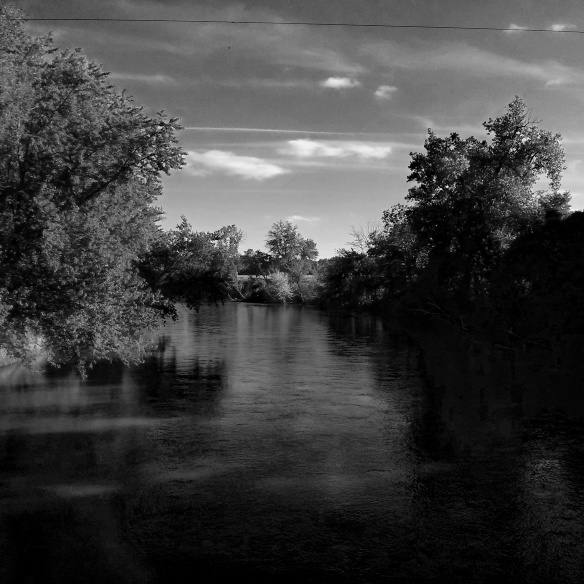
Skunk River

Skunk River

It’s a nice river though, the South Skunk. Hundred and eighty-five miles long. Add another ninety-five miles after it joins up with the North Skunk and they both meander down into the Mississippi.

It’s not actually named for skunks, by the way. Back in the mid-17th century when the French coureurs de bois and voyageurs were wandering around in the wilderness, they often (and I mean seriously often) failed to properly translate the names given to local geographical landmarks by the native peoples. The local Sauk and Meskwaki tribes told the French explorers that the river was Chicaqua, a term meaning ‘having a powerful smell.’ The Indians were apparently referring to the onions that grew wild along the banks. But since they’d also used the same term in describing skunks…well, there it is. The Skunk River.

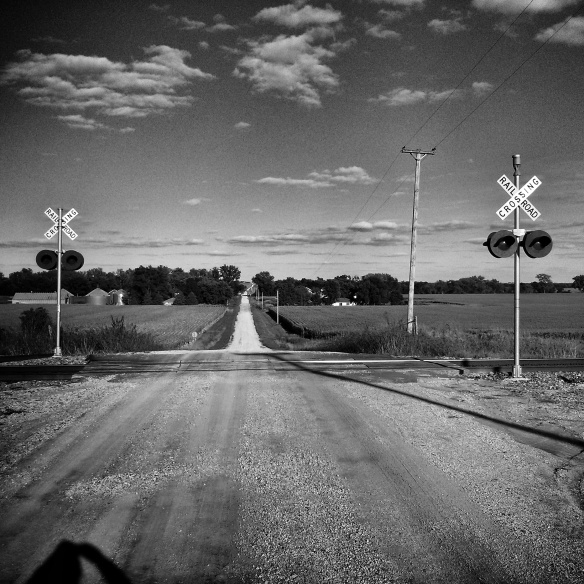
Long and straight, heading due east.

Long and straight, heading due east.

I noodled around on the bridge for a while, no longer thinking about aliens or the sociology of fashion, then got back in the car and headed farther upriver. But this is the Midwest, and the roads rarely follow the course of geological features. The secondary highways and gravel roads are long and straight, laid out east-west and north-south on a grid.

That’s the work of Thomas Jefferson. I don’t mean to suggest Jefferson was out in Iowa with a surveyor’s theodolite (that’s that little telescope-looking thing). It’s just that he came up with the concept of the Public Land Survey System. After the Revolutionary War, the new U.S. government needed to raise some cash, and find a way to reward the soldiers who’d fought. The solution was pretty obvious: there was a whole lot of land unoccupied by white folks — give it to the troops.

But first that new land had to be surveyed. It took years to actually implement the system. It wasn’t until white folks began to ‘civilize’ Ohio that the government began to apply the system. It’s really pretty simple. They established east-west baselines and north-south meridians, divided the territory into square townships (never mind if there were any actual towns there yet), made each township six miles by six miles, divided the townships into thirty-six sections of 640 acres each, set aside one section (always Section 16) for a school, and when it came time to lay down roads all they had to do was follow the grid.

Canoe access farther up the South Skunk.

Canoe access farther up the South Skunk.

Which is what I did. I followed the grid. A couple of miles east, eight miles north, a few miles west, cross over the soulless, ugly little concrete beam bridge, and there’s the river. With a canoe access marker, telling me how far downriver the next canoe access point is.

The brain is rebooted. I go home and the problem with the alien species saturation point seems a lot more clear. Later when a friend asked “How was your day?” I replied, “It was busy.” “Yeah? What did you do?”

And really, what could I say? I drove on roads laid out on principles designed by the third President of the United States, and stood on a bridge probably built during the Depression of the 1930s over a river mis-named by French explorers a hundred years before Thomas Jefferson was born — all to distract myself from thinking about aliens and lapels.

Instead I said “I went for a drive and thought about some stuff.” Which sparked a long, long silence during which I swear I could hear my friend thinking “What? Are you fucking kidding me? That’s what you call busy?

“And I made my final selections for my fantasy football team,” I said. That seemed to satisfy him.

uncomfortable confessional crap

You know, you get so used to your life that sometimes you fail to recognize how odd it is. Or how odd it seems to other people.

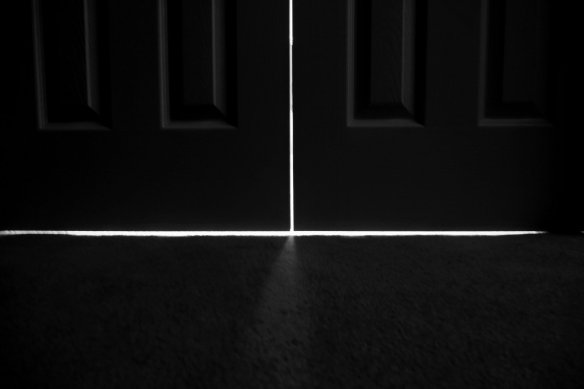
I was reminded of this recently. It was a pretty ordinary situation; I was with a friend in a dimly-lit hallway and there was a bit of light peeking out from beneath a closed door. I must have hesitated a bit before opening the door. Well, no, I know I hesitated a moment. I always do.

“What was that about?” my friend asked.

“What was what about?”

“That pause before you opened the door.”

pause a moment

I don’t talk about myself very often. I don’t really spend much time thinking about myself. I’m not very self-reflective. I’ve lived with myself my entire life, so there’s nothing really new there for me to learn. I’m aware that other people don’t hesitate before opening a door that has a light shining underneath it — but it doesn’t occur to me that it’s odd that I do it.

But when somebody else notices it, you sort of have to explain. And how do you do that? How do you tell somebody that when you approach a door in a dimly-lit hallway — a door with a light shining underneath it — that you hesitate because you always remember opening a similar door with a similar light and finding a dead guy hanging from a pipe? How do you do that without sounding all dramatic?

Because it’s really not dramatic. There’s just a moment — and seriously, it’s just a very brief moment — when you have to suppress an old spark of fear. I know I’m not going to open that door and see a dead guy hanging from a pipe. But my brain always says “Okay, prepare yourself for something horrible, then open the door.” And I open it and everything is okay.

I was a medic in the military. For most of my military career I was assigned to a large medical center, in a unit called Special Functions. I was part of a team that responded primarily to respiratory and cardiac emergencies. Most of what we did took place within the medical center; cardiac arrests, respiratory arrests, that sort of thing. But sometimes we’d be sent out on ambulance runs.

I don’t recall what sparked this particular run; somebody must have assumed there was a living person in some sort of respiratory distress. But there wasn’t. We responded to a hotel where somebody from the base worked part-time on a maintenance crew. The hotel staff directed us to the basement. Some sort of heating and air-conditioning facility.

So…dimly-lit hallway, light shining out from under the door.

The guy had been dead for a few days. All the bodily fluids had drained to his extremities, so his arms and legs were bloated and dark purple. His neck had stretched about a foot, so his feet were almost touching the floor. We were afraid that if we cut him down, the impact would cause his bloated feet to explode, so another medic and I had to support him while a third cut the — I don’t recall if it was a rope or a belt or a cord. Whatever he’d hung himself with. And, of course, there was the stink of putrefaction.

The whole event was pretty ghastly, but really it was just one of a number of ghastly things I’ve seen or done. I won’t say you get used to ghastly stuff, but you do become sort of inured to it. There have been other experiences that gave me nightmares for years, but that wasn’t one of them.

And yet I still flash on the image when I’m in a dimly-lit hallway and I see light under a doorway. To me, it’s not a big deal. Explaining it to somebody, though, is sort of embarrassing. Not because of what happened, but because of the way they look at you.

My friend said “You should talk about that stuff. You should write about it. Maybe you’ll get over it. Put it behind you.” So I said I would, because that was the easiest thing to say.

But here’s the thing: why would I want to put it behind me? Ugly things happen. They happen to everybody. I don’t want to forget them. I don’t mind that the memory of ugly things sometimes cause some minor disruption in my life. Ugly things are supposed to cause some disruption.

I know now what I should have said to my friend: “I still open the door. I always open the door. I’ll keep opening the door.” Because as long as you can open the door, that’s really all that matters.

my morning, interrupted

So I’m sitting here, right? It’s 9:30 on a Saturday morning, I’m drinking a cup of cold brew, looking out the window at drizzly-cloudy day, getting ready to read my students’ work. And the doorbell rings.

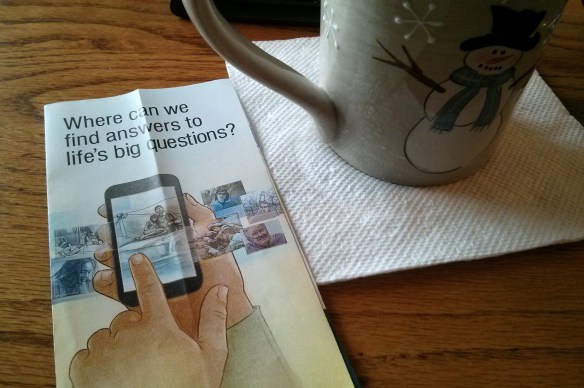
Guy in a suit. Young guy, white, earnest glasses, unsmiling. Right, Jehovah’s Witness. I open the door, he mutters something, hands me a pamphlet, and turns away. I didn’t even get a chance to say ‘Good morning.’ Not much of a witness — but hey, it’s 9:30 on a Saturday morning and it’s drizzly-cloudy. Who can blame him for wanting to finish his chores and go find a dry place where he can get a cup of…do Jehovah’s Witnesses drink coffee?

JW

Where can we find answers to life’s big questions? The pamphlet seems to suggest we can find them on our smartphone. Android phone, by the looks of it. Sorry, Siri. But what ARE life’s big questions? They’re listed on the back. Which of these big questions concerns you most? They’re not the questions I would have asked. Which is maybe one of the many reasons I’m not a Jehovah’s Witness.

What is the meaning of life?

Is God to blame for our suffering?

What happens when you die?

I’m a tad disturbed by the way the last two questions are phrased. Is God to blame for OUR suffering, and what happens when YOU die. Our suffering, your death. They don’t want to come right out and say ‘Dude, we know what’s going to happen when WE die, but you? Different story, bud.’

I don’t know…all I wanted was a cup of cold brew coffee, a few minutes to scan the news, then get my homework out of the way. Now I’m faced with these three questions. Fucking doorbell. Never should have answered the door. Never get out of the boat (no idea why Apocalypse Now popped into my brain).

Okay…meaning of life. I don’t know. Not very concerned about it. Eat well, get to know some interesting people, be curious, help other folks when you can. That ought to do it.

Is God to blame for our suffering? I don’t know. I don’t believe in god. But sure, why not? If you’re going to go to all the fuss and bother of believing in god, you might as well give him something to do. Shoulder the blame–that ought to keep him busy. And everybody who claims to speak for god, let’s hand them a share of the blame too. And let’s give a portion to all those young guys who ring doorbells at 9:30 on a Saturday morning — they sure as hell added to my suffering.

Right, what’s next? Oh…what happens when you die? I don’t know. Does it matter? I mean, regardless of what happens you’re still going to do it. It’s not like it’s optional. I totally get the idea that a lot of folks believe that if you live your life a certain way, then after you’re dead you get to join god’s special club. Like if you practice the clarinet, maybe you’ll get to play with the marching band. Or maybe you’ll just piss away a lot of time playing the clarinet. I don’t know. Can’t get very concerned about it.

By the way, I did a Google image search of ‘god clarinet’ to find a visual to include in this post. So okay, I don’t know the meaning of life and I don’t know what happens when you die, but I think this has to figure into it somehow:

clarinet cries for mercy

Seriously, you ought to do that image search. Brilliant. And that earnest young man who rang my doorbell this morning? If not for him, I’d have never seen this. Maybe there really is a god and this is his plan.

Her plan.

One of those. Praise Jeebus.