good morning and welcome to the waffle house

I woke up around 0530 this morning. I don’t sleep as much as I used to, though I generally sleep better. I have fewer nightmares, which is good. Fewer and less intense. And I seem to be better at remembering good dreams. This morning I remember dreaming about ordering breakfast at a Waffle House.

I’m sitting here in the kitchen in the heart of the American Midwest, drinking my cold brew coffee, craving hash browns, covered and chunked. Unless you’ve spent some time in a Waffle House–which is to say, unless you’ve lived in the American South–that won’t mean much to you. It’s probably been twenty years since I’ve set foot in a Waffle House, but I know in my bones I can walk into any Waffle House in any town and ask for hash browns covered and chunked, and they’ll know exactly what I want. It’s not code, exactly; it’s culture. I could make my own hash browns, of course. I could add some diced up ham and cover it all with melted cheese. But it wouldn’t be the same.
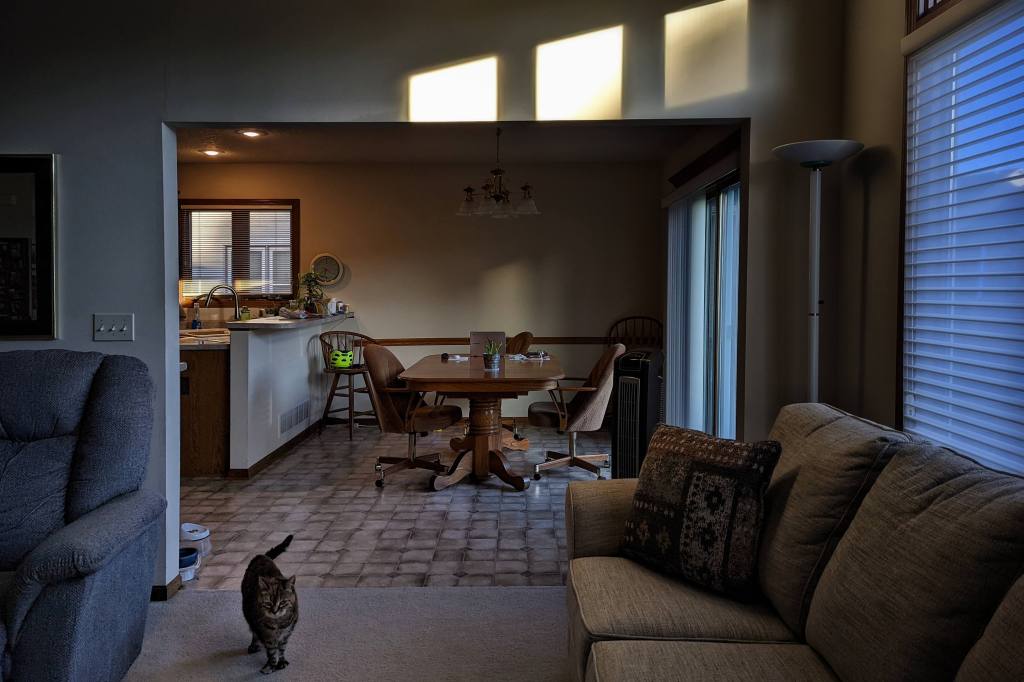
It’s 44F this morning. Unreasonably and unseasonably chilly, so I’ve been forced to put on socks and sweat pants–which I sorta kinda resent (I mean, c’mon, we’re three weeks into May, for fuck’s sake) and sorta kinda enjoy (it’s not so much the warm feet, although I like that; it’s that brief delicious pleasure of sliding my feet into warm socks). It feels like a late October morning in the South. The cat clearly thinks the chilly weather is bullshit, so is seeking extra attention this morning. I’m okay with that. Cats are warm.
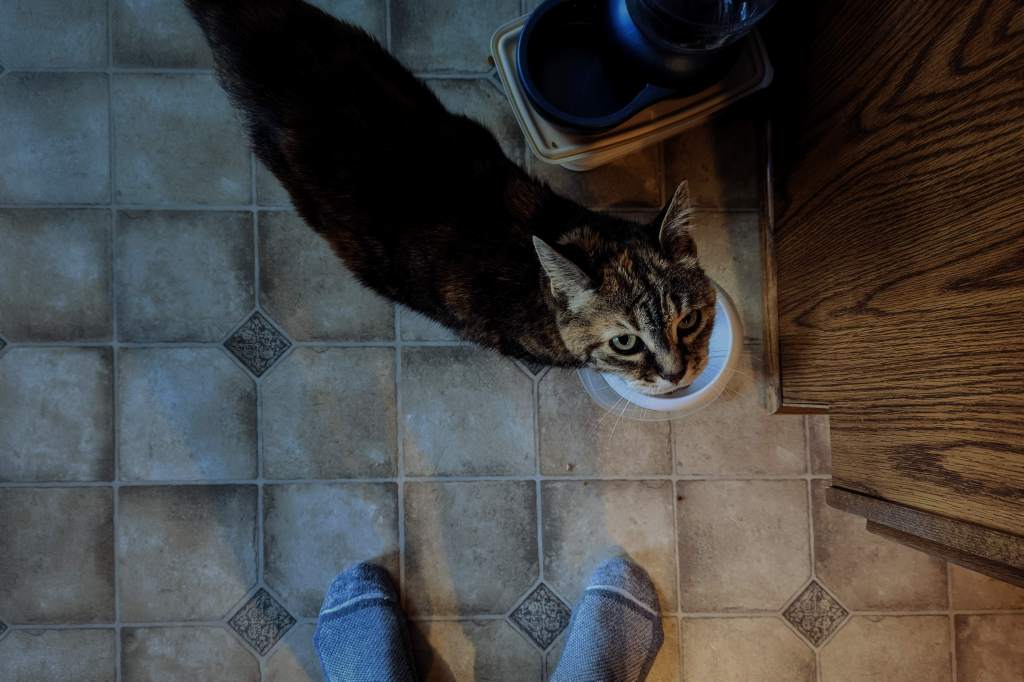
The cool weather and the Waffle House dream have me feeling particularly nostalgic and Southern today. I enjoy the quiet too much to put on music, but in my head I’ve been hearing Mahalia Jackson, Mattie Moss Clark, and Tennessee Ernie Ford singing gospel music. I’m not even remotely Christian, but that was the Sunday morning music I grew up with. Snatches of Just a Closer Walk with Thee will drift through my head for a while this morning. As the sun comes up and the coffee disappears and the cat retreats to some quiet spot where she can curl up and sleep undisturbed, that music will gradually fade away again.

There. I’ve rinsed out my coffee mug. I’ve done today’s Wordle. I’ve read all the news I want to read (it’s still to early to read the news and pay attention; I’ll come back to it later, when I’m more willing to deal with reality). The sun has come up enough that I can turn off the kitchen lights. I’d say it’s time to start getting on with the day, but that sounds like I have some sort of plan or agenda to be accomplished. I don’t. I’ll read a bit, maybe go for a bike ride, give some thought to what to prepare for supper, do a few household chores. Since I woke up early, at some point I may take a nap.
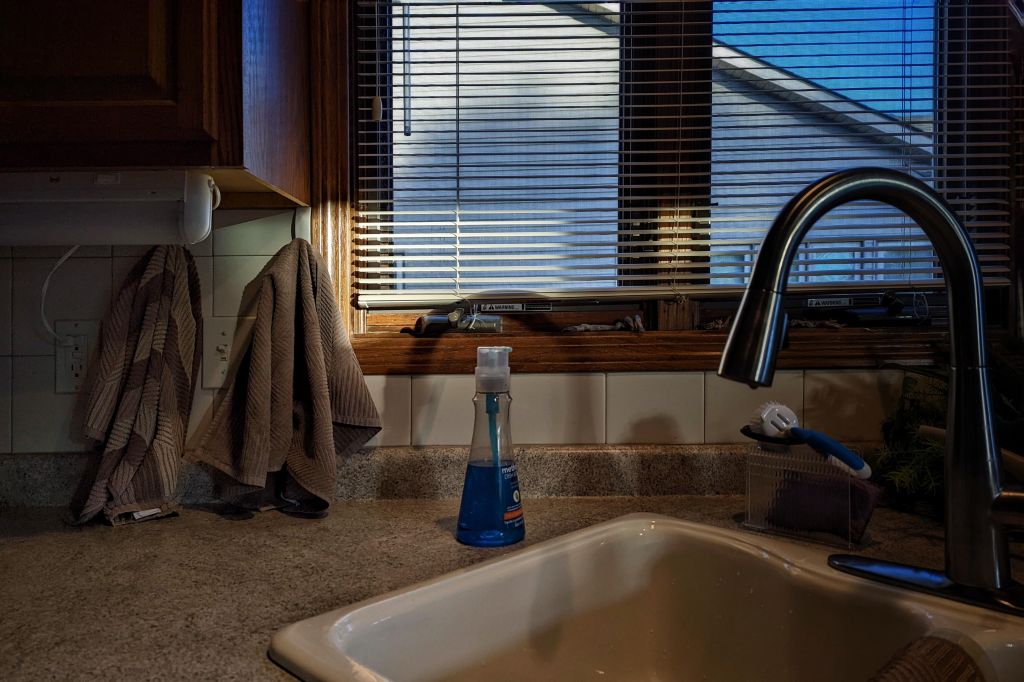
There’s a verse of the gospel song Just a Closer Walk with Thee that rarely gets included in the more popular covers. It goes:

Through this world of toil and snares,
If I falter, Lord, who cares?

I know the lyric is meant to suggest the Lord cares, but since I don’t believe in any lord, I like to interpret the lyric as more tolerant and forgiving. It’s not a license to fuck up, but it acknowledges the universality of fucking up. Everybody fucks up. And everybody is welcome at the Waffle House. Doesn’t matter what you’ve done, if you ask for your hash browns chunked and covered, that’s what you’ll get.
attrition

Every morning this week I’ve sat here at the keyboard and started to write a post about the situation in Ukraine. Every single morning I’ve put a couple hundred words in a row, and every morning I’ve deleted them all.

I mean, what is there to say? Well, obviously there’s a LOT to say–the military situation, the refugee situation, the NATO situation, the war crimes situation, and on and on and on. But the internet is awash in experts opining and analyzing all that. What is there for ME to say? Is there anything I can contribute that’s meaningful?

Not much. I can express opinions, but my opinions about Ukraine aren’t very much different from most folks. And as for those folks whose opinions support Russia and Putin–what is there to say to or about them? Not much, other than ‘Russian warship, go fuck yourself’.

The problem (for me) is that it’s hard to write about anything else at the moment. Everything else seems trivial. Art? Clarence Thomas in the hospital? Republican hypocrisy? Pickleball? The January 6th prosecutions? The arrival of Spring and getting back on the bike? Voter suppression? The latest research on crows? Today’s hearing on the nomination of Ketanji Brown Jackson to the Supreme Court? There are lots of things that occupy my mind and my time besides Ukraine. It’s just that none of them seem as important. None of them ARE as important.

What makes this all the more awful is that the war in Ukraine has become something of a stalemate. It’s turning into a war of attrition–the ugliest, cruelest, and most brutal form of war. A war of attrition isn’t about territorial control; it’s about imposing as much suffering as possible in every way possible in order to force the enemy to give up. It’s about wearing away at the very foundations of a sustainable life–food and shelter. It’s about reducing towns and cities to uninhabitable rubble.

But here’s the truly awful thing: I suspect–I fear–the American public will begin to treat the war of attrition in the same way they’ve treated the global pandemic. They’ll get bored with it. It’ll be normalized, in the same way they’ve come to accept a thousand deaths a week from Covid as normal. In the same way they’ve come to accept extreme weather disasters as normal. Instead of being tortured from a death by a thousand cuts, those cuts will be seen as routine. (By the way, if you google ‘death by a thousand cuts’ most of the results will refer to a song by Taylor Swift rather than lingchi, the ancient Chinese method of torture and execution–how’s that for normalization?)

NOTHING ABOUT THE WAR IN UKRAINE IS NORMAL.

So, what are we to do? What am I to do? Carry on as usual with this blog? I guess the only answer is to try to find some sort of balance. Write about the stuff that interests me, even if some of that stuff is trivial. But also keep talking about the suffering of the people of Ukraine, and about the deliberate cruelty of Putin, and about the policies of nations that support–or fail to support–Ukraine.

That’s what I’ve decided to do. But it feels a little like attrition.

just to explain why i took a photo

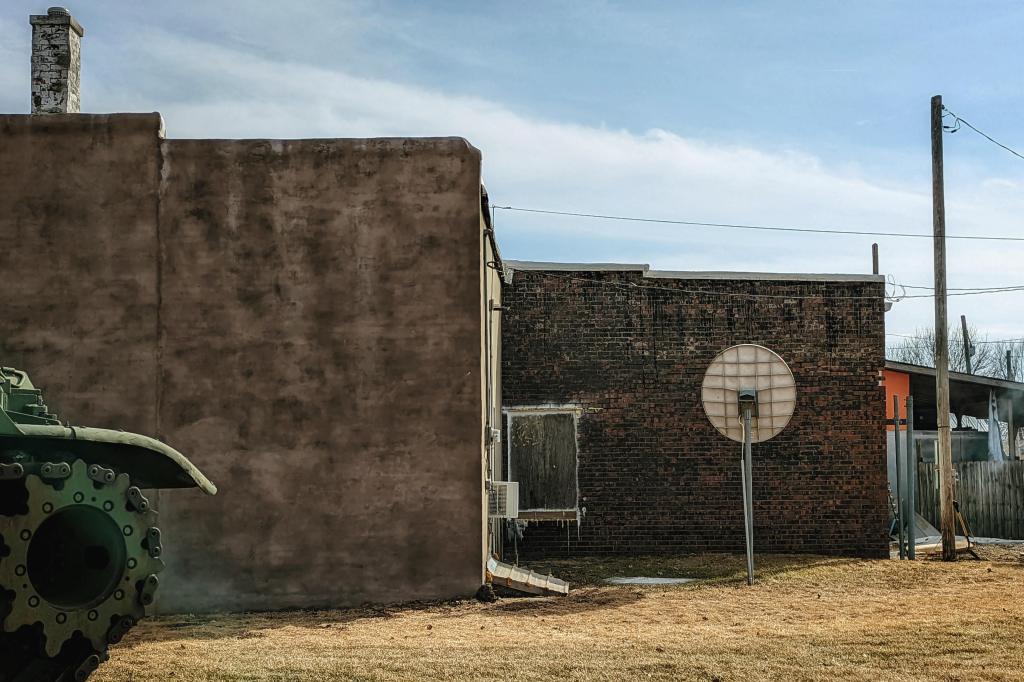
Last week while out noodling around I came across a tank. When I say ‘tank’ I mean a decommissioned military tank. An M60 battle tank, to be exact. It’s fairly common when the military starts scrapping old tanks, they offer them to small towns to use as memorials, or to ‘decorate’ public parks or town squares or wherever the hell a small town would like to park one. The US military stopped deploying M60s in 1997.

But this isn’t about the tank, really. It’s about how I photographed it. Which was like this:

A friend asked me a couple of questions about the photo. First, what the hell is this a photograph of? Second, if it’s a photograph of a tank, why didn’t I include the whole tank? Those are valid questions. But they’re difficult to answer.

They’re difficult to answer for several reasons. The primary reason is that I’ve been shooting photos for so long that I rarely actually think about composition. I just kind of know what I want in the frame. Another reason it’s difficult to explain is because shooting a photo seems like it’s just a matter of releasing the shutter (or, with a cell phone, poking the whatsit that initiates the photo). But that moment is the result of a fairly complex process.

I wasn’t paying much attention to the process when I shot this, but I’ll try to recreate my thinking. Obviously, it began by getting out of the car to look at the tank because…well, there was a tank and I wanted to look at it. As I walked around it, I was attracted to that cascade of squarish shapes made by the building–so many different-sized squares of different textures. Then there was that white circle that sort of balanced the round rear tread wheel of the tank. And then there were those sweet vertical lines of the chimney and the light pole. And then I was drawn to that tiny splash of red, and that diagonal slant of the roof of the shed, and even the spade leaning against the light pole. All of those things appealed to me, both individually and as a collective.

I’d be lying if I said I noted all that stuff in that order, but when you’re lining up a shot it’s like your brain is ticking off boxes in a list. That works, that works, that doesn’t–so move a bit, that works. And then there’s some point when your synapses seem to agree that you’ve got all–or most–of the stuff you want in the frame, and you take the photo.

I’d probably have taken that photo even if the tank wasn’t there, because the light and the geometry appealed to me. But it was the tank that drew me to that spot and to me, that wee bit of tank is important to the composition. So, to me, it’s still a photo of the tank. The rest of the tank is implied.

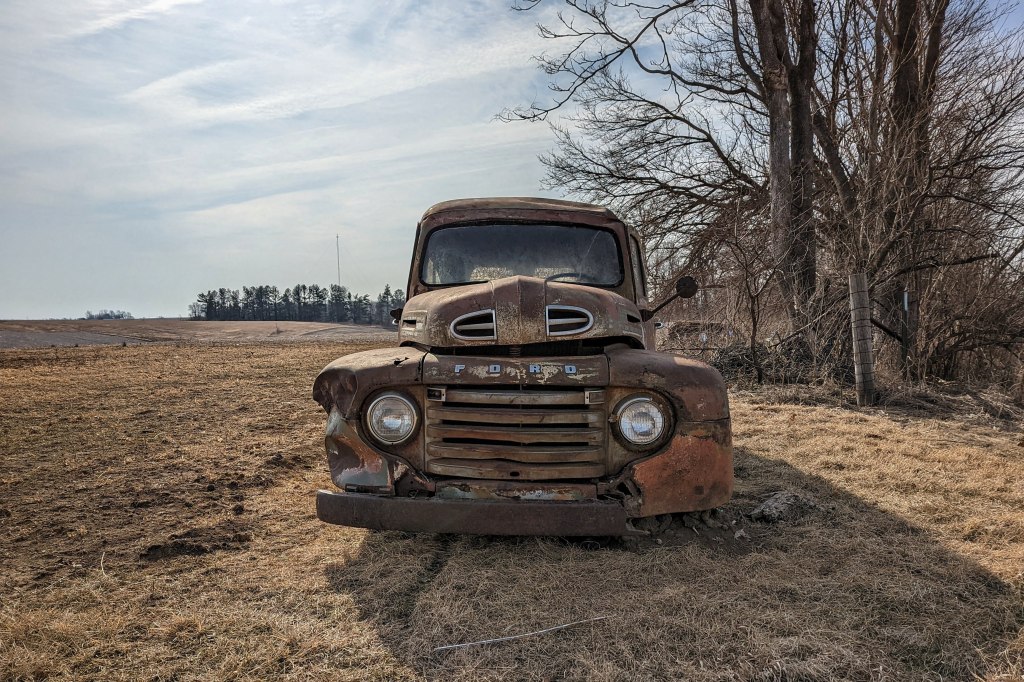
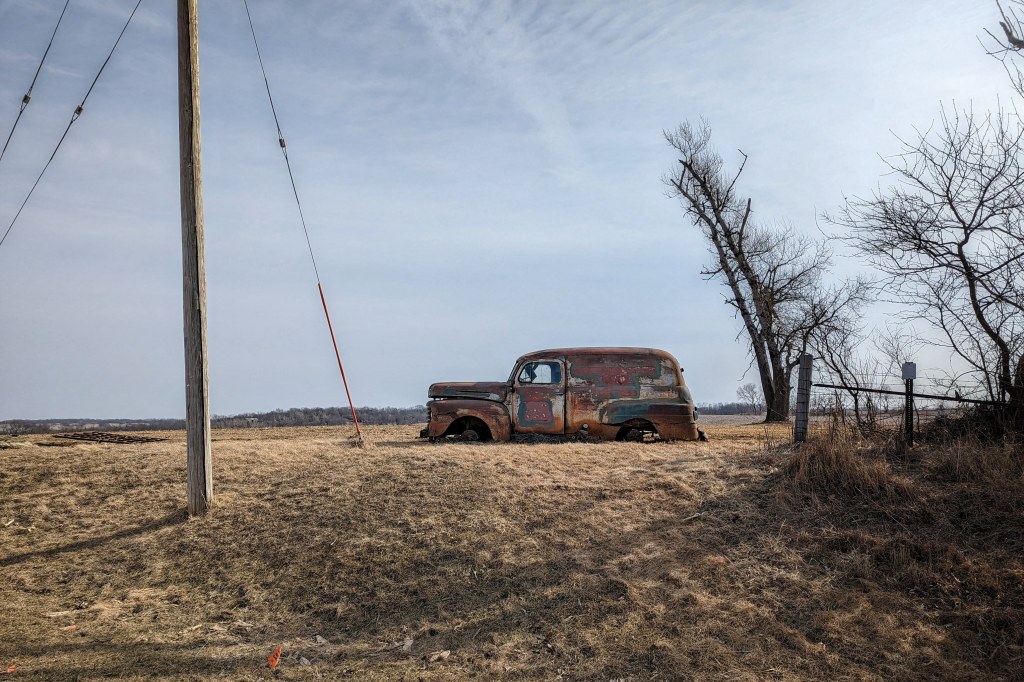
Wait…I think I can explain this better. That same day, I took a photo of an old, rusted out Ford panel truck. Three photos, in fact, but only one photo mattered. Here’s the first photo.

There’s nothing wrong with this as a photo. Again, I composed it intuitively, without a lot of thought. It’s got good lines. The curve of that tree is nice; it sorta kinda follows the shape of the truck. There’s a decent balance to the composition. It’s a perfectly adequate photo, a decent documentation of an old, rusted out Ford panel truck. Nothing wrong with it, but not terribly interesting.

So I got closer. Changed the perspective.

Again, there’s nothing wrong with this photo. Again, the composition was casual but deliberate. However, you’ve probably seen ten thousand photos almost exactly like this. A rusty wreck of a vehicle–an artifact of an outdated civilization cast aside in a living environment that will continue to grow while the artifact slowly degrades into nothingness. The best thing about this photo is that it places the panel truck in a larger landscape, which emphasizes how out of place it is. But basically, there’s nothing new to see in this photo.

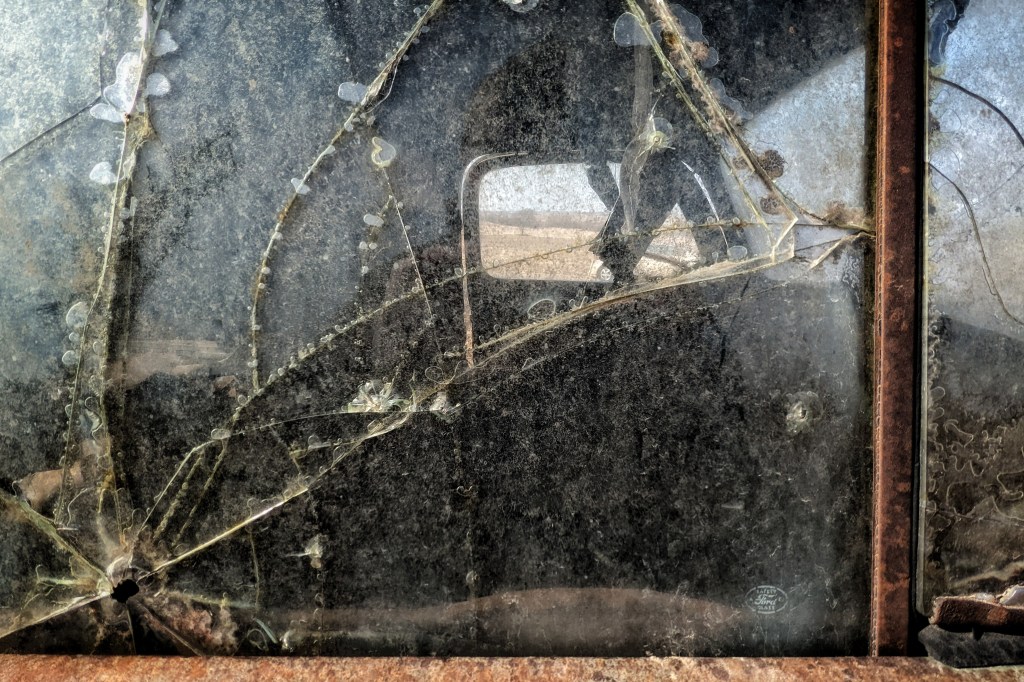
So I got closer and changed the perspective again.

This is the photo that mattered. I took a bit more care with the composition. I knew I wanted the rust, I knew I wanted the suggestion of a large landscape through the windows, and I knew I wanted the lines of the shattered window and those bubbles formed by the thin layer of ice.

The actual old, rusted out Ford panel truck wasn’t really important; it’s the idea of the old, rusted out Ford panel truck that mattered. It’s a photo of an abandoned vehicle in the same way the first photo is a photo of a tank. The old, rusted out Ford panel truck is implied; you only need to see enough of it to hint at its existence.

The photo of the tank and the final photo of the panel truck are both photos of things that don’t belong there. Was I actually thinking of that when I took those photos? Nope. But after you’ve shot enough photos, a sort of algorithm develops in your brain. It’s like you know at the cellular level that everything in the frame matters, so you become very deliberate about what you keep in and what you keep out.

What you choose to include and exclude is grounded on why you’re shooting the photo. And that’s the thing. You may not be consciously aware that you’re shooting a photo of things that don’t belong where they are, but there’s some chunk of your brain that’s is actively registering that fact. If the tank or the panel truck were what mattered, you’d just photograph the tank and the panel truck. But you keep looking and moving and shifting around until your brain is at least semi-satisfied. Then you take the photo.

Okay, I’ve made the mistake of re-reading this (which I generally try to avoid in these blog posts). It sounds to me like I’m talking bullshit here (which is why I generally avoid re-reading these blog posts). But I’m still convinced that this is how I shoot photos. I can’t tell you how many times I’ve approached something that I wanted to photograph–that I felt was very photographable–and then walked away without taking a single shot because I couldn’t get what I wanted in the frame. There was something in the frame I didn’t want, or something I wanted but couldn’t include. My mind knew it, even if I wasn’t immediately aware of it.

The photographer Marc Riboud once said, “I photograph the way a musician hums.” That makes sense to me. Musicians, even when they’re just idly humming, know without thinking which notes work and which notes don’t. The wrong note ruins the composition.

And there it is.

are bure bampot

Okay, Instagram. As some of you know, I have two IG accounts–one under my own name (or something like it) for the sort of snapshots everybody shoots and another under the pseudonym Knuckles Dobrovic for photo projects (I wrote about my introduction to the devil of IG here).

The first project was more an exercise than an actual photography project. It was basically my way of learning how to use Instagram. I put a thing on a patio table and photographed it. Almost every day for about a year, at different times, with different things, in all sorts of weather. It’s just as ridiculous as it sounds, but it was fun. That project (cleverly titled Things On A Table) started in 2013 and ended in the summer of 2014. At the end of that project, I wrote this:

I’ll probably come up with some other sort of project, simply because I’ve grown fond of the name Knuckles Dobrovic. I realize that’s a stupid reason. I don’t care. I’ve no objection to doing things for stupid reasons.

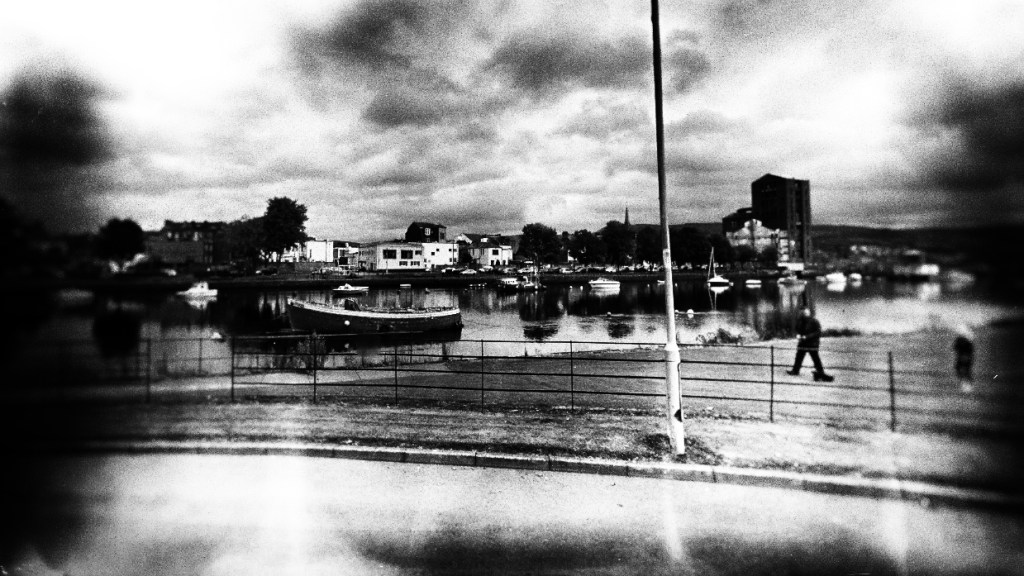
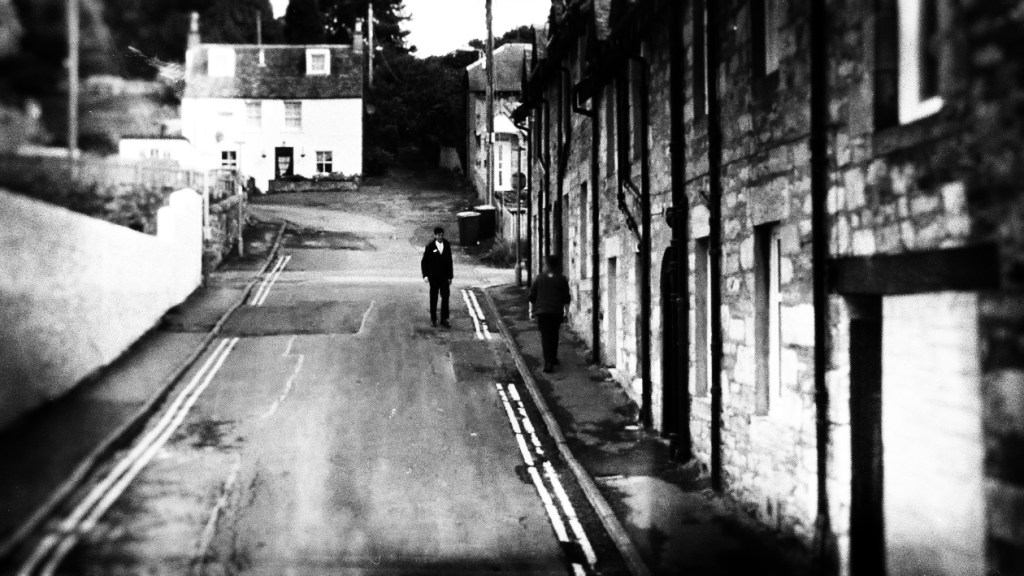
Portsoy

The Knuckles account sat idle for about four years. In January of 2018, I started a second project, which was more pretentious than my first, but equally ridiculous. During my daily walks, I’d stopped periodically and photograph something at my feet–some leaves, a crack in the sidewalk, a lost glove. I decided to layer two or three photos taken on the same day to create a single image. It was weird fun, and it made me happy. That project lasted for about ten months. Then I put Knuckles back on the shelf, where he sat for about four months.

The third project took root while I was playing the game Geoguessr, which involves Google Street View. The game basically drops the player somewhere in the GSV world and you’re supposed to figure out where you are–rural Finland, suburban Arizona, a forest in Brazil, a street in Thailand. I loved the randomness of it; I spent most of the game just wandering around and looking at stuff. So I decided to appropriate images from GSV, modify them a bit, and turn them into black-and-white images. Because it was an art project and art projects are famously pretentious, I decided to limit the project to 100 images–sort of an homage to Hiroshige’s ukiyo-e series, One Hundred Views of Edo (which is actually 119 paintings, but let’s not get fussy). It was the only Knuckles project I was sorry to end.

Maryport

The fourth project was sparked by the onset of the pandemic. The world seemed isolated and a tad disjointed, and I wanted to express that feeling of social dislocation. So I took some of my daily snapshots, diddled with the color a wee bit, digitally sliced it in thirds, then re-arranged the pieces. The result was a photo that didn’t quite make sense, so I called the project Slightly Dislocated. It was fun at first, because the process could be applied to almost any photo style–street photos, landscapes, still lifes, anything but portraiture. But after a few months, it felt forced. The project lacked energy and passion and I just stopped doing it. The last photo of this project was posted in March.

North Queensferry

Now I actively dislike the project. I’ve considered deleting it, but that seems somehow cowardly. If you make a mistake, you should just accept it and move on, not try to hide it. However, even though I haven’t posted anything to the Knuckles account in months, I continue to get notifications about it. It’s like a constant reminder of how much I dislike the last project. The only non-cowardly way to resolve that is to start a new project, one I’d actually enjoy, something to get rid of the bad taste left by the Dislocated project.

A few days ago, when it was cold and windy and my knees hurt, I sat at the computer sliding back and forth between social media, the Geoguessr game, and the work I was supposed to be doing. Three things happened. First, I read a comment about Daidō Moriyama in a forum devoted to Japanese photography. He’s basically the godfather of the are-bure-bokeh style of photography. Are-bure-bokeh roughly translates as “rough, coarse/crude, out of focus.” The style developed in post-war Japan, and it conveyed the way Japanese society was fragmented and alienated and shocked following two atomic explosions and a military occupation by a radically different culture. We’re talking about high contrast black-and-white photos, sometimes savagely abstract, sometimes ordinary but with a sort of leaden feel, sometimes almost frighteningly hallucinatory. It’s a style I’ve been drawn to, but I’ve never seriously attempted to recreate.

Dumbarton

The second thing–almost immediately after seeing the Moriyama comment, I came across a comment in another venue in which somebody was called “a total bampot.” That’s a Scots term, which means “an idiot, a foolish person, a nutcase.” For reasons I can’t begin to fathom, the phrase are-bure-bampot sprouted in my mind, and stuck there.

Flimby

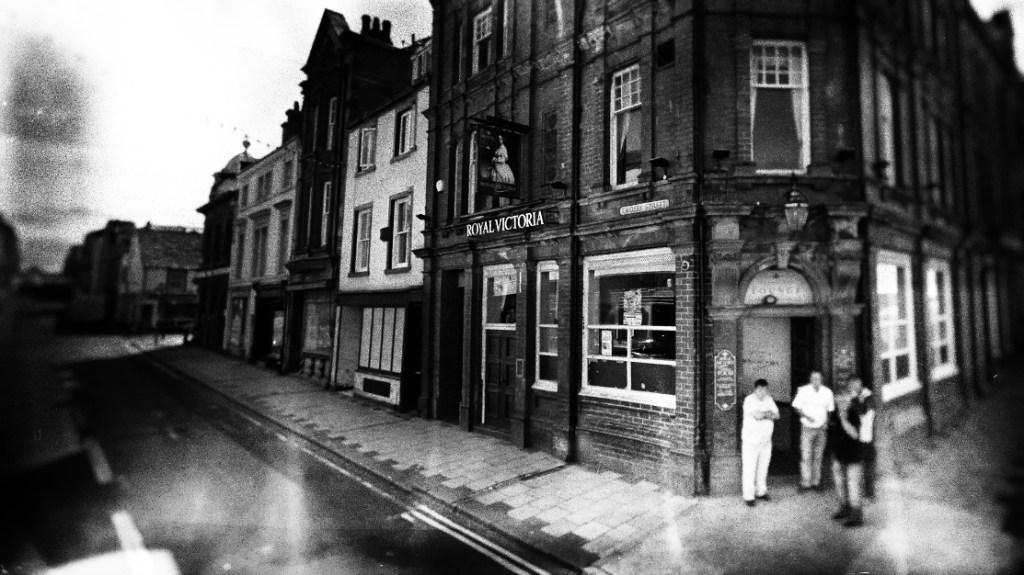
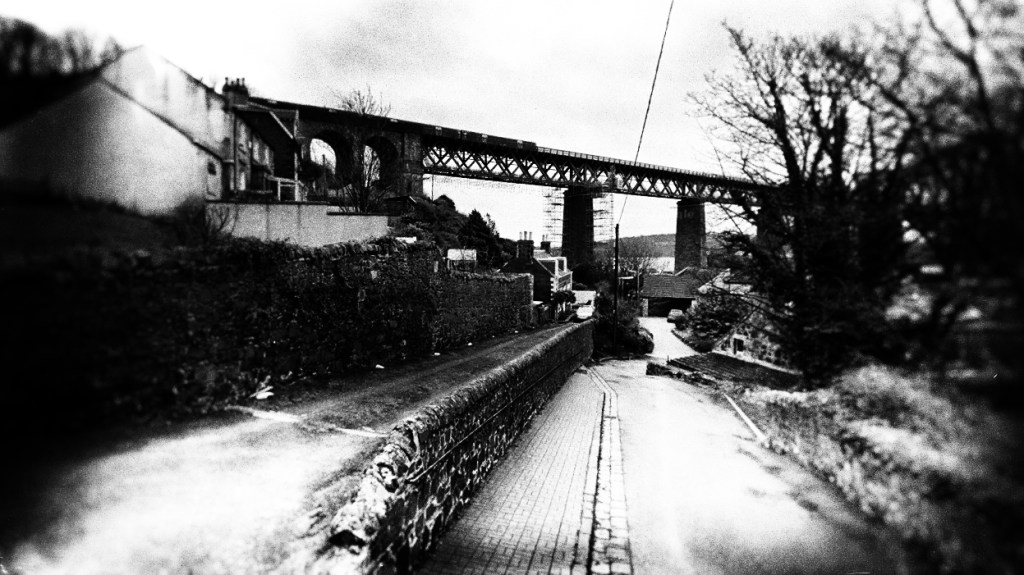
The third thing–after doing a bit of work, I turned back to Geoguesser and found myself someplace on the coast of Scotland (it turned out to be Portsoy). And hey bingo, there was the burr of an idea for a project. An idiotic idea, but still. What if I applied the are-bure-bokeh approach to Google Street View images from Scotland? Are-bure-bampot.

It’s…well, it’s idiotic. A post-war style of Japanese photography applied to Google Street View images of Scotland? Madness. But it would allow me after a fashion to return to the project I’d enjoyed the most, and it would still fall well within what I consider the Knuckles Project Parameters. It would 1) be simple and grow out of something I’d do in an ordinary day, 2) include an element of randomness and serendipity, 3) maybe not be entirely original (how many project are?), but the result would still be uniquely mine, and 4) wouldn’t require any extraordinary effort.

Pitlochry

So what the hell, I tried it. I’ve only made a few images–and only posted three of them on the Knuckles IG account–but so far it amuses me. They’re clearly not in the classic Moriyama style, but I’m okay with that. I’ll keep at it for a while and see what happens. Are-bure-bampot. Rough, coarse/crude, idiotic. Yeah, that has a certain appeal.

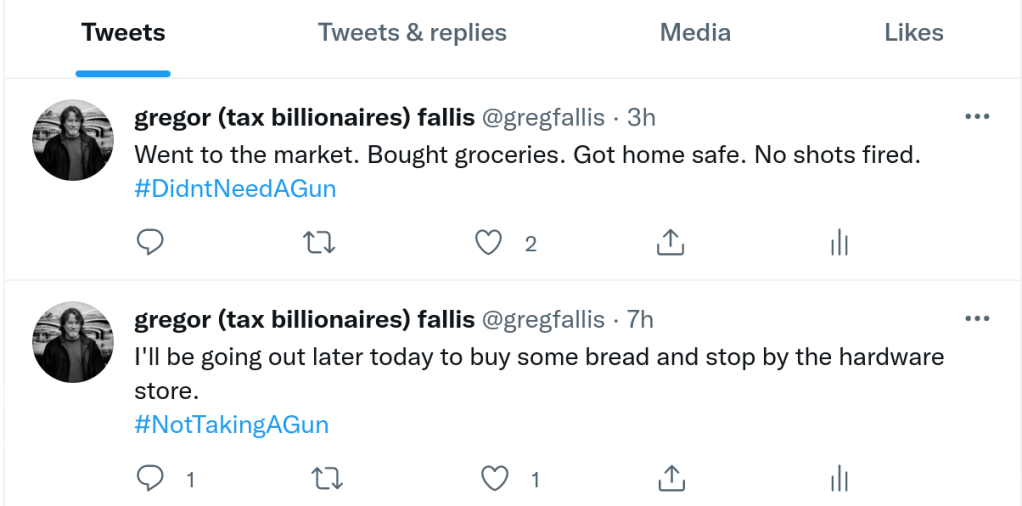
#NotTakingaGun

I’ve got to run to the market later today. Maybe I’ll also make a lightning stop at a hardware store, I don’t know. But in any event, I won’t be taking a gun with me. Because there’s absolutely no need to.

Also, okay, I don’t own a gun. So realistically I couldn’t take a gun with me even if I wanted to. Which I don’t. I don’t own a gun for the same reason I’m not taking one to the market. I don’t need a gun. I have zero use for a gun.

I’ve no need for a gun, but I rather like them. They’re incredibly efficient tech, they make a loud noise (sometimes I enjoy making a loud noise), they can make a hole suddenly appear in a target a distance away (which is actually sort of cool), and if you fire them at night, you see flame come out (which is very cool). Guns can be fun to shoot. But I don’t have any need for one.

I’ve been in situations where I could justify owning and carrying a gun. I spent several years as a private investigator specializing in criminal defense work. Most folks think that if you’re working to defend an accused criminal, other criminals will like you. Not so. The thing is, defending an accused criminal often means finding and revealing other criminals who may be guilty of the crime. Or they might have information that could implicate them in some way. Information they DO NOT want you to have.

And let’s face it, nobody–not even an innocent person–wants a stranger asking them nosy, impertinent, personal questions. It tends to piss people off. And here’s another thing: criminals don’t keep normal business hours. Which means a lot of the time you end up asking criminals nosy, impertinent, personal questions at their home, or in a bar, or when they’re with friends (who are often criminals as well).

As a PI, I had a concealed carry permit. I considered carrying a gun several times. But I was always concerned that if I had a gun, I’d get too confident. I’d get cocky, take more chances, take more stupid chances–because I’d be carrying protection. I never carried a gun because I know how easy it is to make a really bad impulsive decision. On those occasions where I had to enter a situation where there was a realistic chance I’d get hurt, I took a partner. Reliable guy–he’d been a LRRP in Vietnam and a police detective. He’d be armed, he’d enter the bar before me and take up a position. I’d come in a bit later and do my thing. And if it all started to go sideways, I knew he’d step up. So I felt…not safe, certainly not safe enough to be cocky, but I felt the odds of getting seriously hurt were low enough to risk.

My point, such as it is, is this: I know what it’s like to be afraid that somebody might realistically decide to assault you. Or stab you. Or pull a gun and shoot you. Genuinely afraid. Not-sure-you-can-control-your-bladder afraid. And yet, despite being in those situations multiple times, I’ve never actually had to physically defend myself. Or have somebody else defend me.

So yeah, I can go buy groceries without carrying a gun. And so can you and everybody else.

Some folks will insist that the only way to preserve a legal right is to use it. There’s some truth in that. But the gun-toting folks who make that argument are almost always the same folks who are willing–even eager–to make it more difficult to exercise other legal rights. To vote, to get an abortion, to marry somebody you love, to peacefully protest.

There’s really only one reason to carry a gun: to shoot something or somebody. You don’t have to intend to shoot something or somebody, but carrying a gun indicates you’re prepared to do that. There’s only one genuine motivation for carrying a gun. Fear. You’re either afraid somebody or something may harm you, or you’re afraid somebody or something will harm somebody else.

People who are genuinely afraid to leave the house unless they’re strapped are exactly the sort of people who shouldn’t be armed. You can’t trust a scared person to make good decisions. Scared people are much more likely to make really bad decisions. But I suspect folks who are genuinely that frightened are a very small minority. I suspect the vast majority of people who insist on being armed when they leave home are either fantasists who like to imagine themselves as tough and heroic, or assholes who just want to intimidate other folks. Or they’re both–fantasists who are also assholes.

Regardless of their reason for wanting to carry a gun, the fact is they don’t need to. They’re far more likely to need to carry a flashlight, or an umbrella, or a breath mint, maybe a magnet. I mean, those things actually come in handy sometimes. A gun? Almost never.

I think I’m going to start announcing this on Twitter whenever I have an errand to run. “I’m going to the market for cheese. I’m #NotTakingAGun.” It’s silly, but that’s the point. Taking a gun to go buy cheese is silly.

EDITORIAL NOTE: Okay, I did it. Went shopping, made it home safely. Notified Twitter.

pissing in the soup

I’m tired. Tired and disappointed and angry, but mostly tired.

I worked as an election official on Tuesday. I suspect the local election (mayor, city council, school board) was pretty similar to most other elections in the US. Our small election team (five of us plus a precinct captain) had worked together before, so everything ran smoothly. We arrived at our polling station at 6AM and worked until 9PM. We’d expected a decent turnout; I figured we’d get 400, maybe 500 voters. Enough to keep us modestly busy.

We had over 1200 voters. I only had time for a short 30 minute break all day–just enough time to eat a sandwich. As far as I could tell, we had a representative sample of the local population–mostly white, with a broad spectrum of age, gender, and political perspectives. There were voters wearing ‘Nevertheless, She Persisted’ t-shirts and voters wearing NRA trucker hats, we had a young woman with a ‘Merry Meet’ Wiccan pin and one beefy guy in camo pants wearing a III% t-shirt. Nobody wore a MAGA hat.

The election was fair; it was busy, but went exactly as planned. Every registered voter got to vote. If somebody showed up and wasn’t registered, we registered them on the spot and let them vote. If a voter came to the wrong precinct, we printed them a map with directions to the correct polling station. I’m proud of the way we handled the voting process.

The election was fair; the campaigning was not.

Although the city council and school board positions are technically non-partisan (there were no political affiliations listed by the candidate’s names on the ballot), Republicans won across the board. Democrats ran campaigns based on compassion tempered by science. Republicans ran campaign based on misinformation, lies, and fear. Democrats supported mask and vaccine mandates; Republicans said parents know more about their kids’ health than scientists. Democrats said education should be diverse and prepare students for the world they live in; Republicans said Critical Race Theory taught white students to hate themselves and trans kids would destroy sports.

The election was fair; the campaigning was not; the reporting was stenographic. Reporters presented the candidate’s positions accurately, but without presenting any factual support. If a candidate said, “Leading scientists say vaccines are dangerous and I only want to protect the children” then that’s what was reported, without any indication that it was fatuous bullshit. If a candidate claimed that CRT was dangerous and shouldn’t be taught in school, that’s what was reported, regardless of the fact that CRT isn’t taught in any public high school, junior high school, or grade school–and not even in most undergraduate college courses. If a candidate lied, reporters just relayed the unfiltered lie to the public.

Looks good, looks healthy — but is it?

If campaigns are allowed–even encouraged–to be dishonest, then an honest election has little practical relevance. I’m proud to have helped facilitate a fair election process, but I can’t help being disappointed. Not because it’s not the outcome I wanted, but because the outcome is tainted. It’s like running a spotless, orderly, professional kitchen that allows some cooks to piss in the soup. The kitchen is clean, the soup looks good, but it’s still got piss in it.

So I’m tired. Tired and disappointed and angry, but mostly tired. Tired physically and emotionally, disappointed in a system that fails to require candidates to speak honestly, and angry that our system favors liars, con artists, and fear mongers. I’m tired and disappointed and angry, but today I’m still mostly tired.

Tomorrow, I’ll go back to being angry.

a needle and a mile of 2-0 nylon

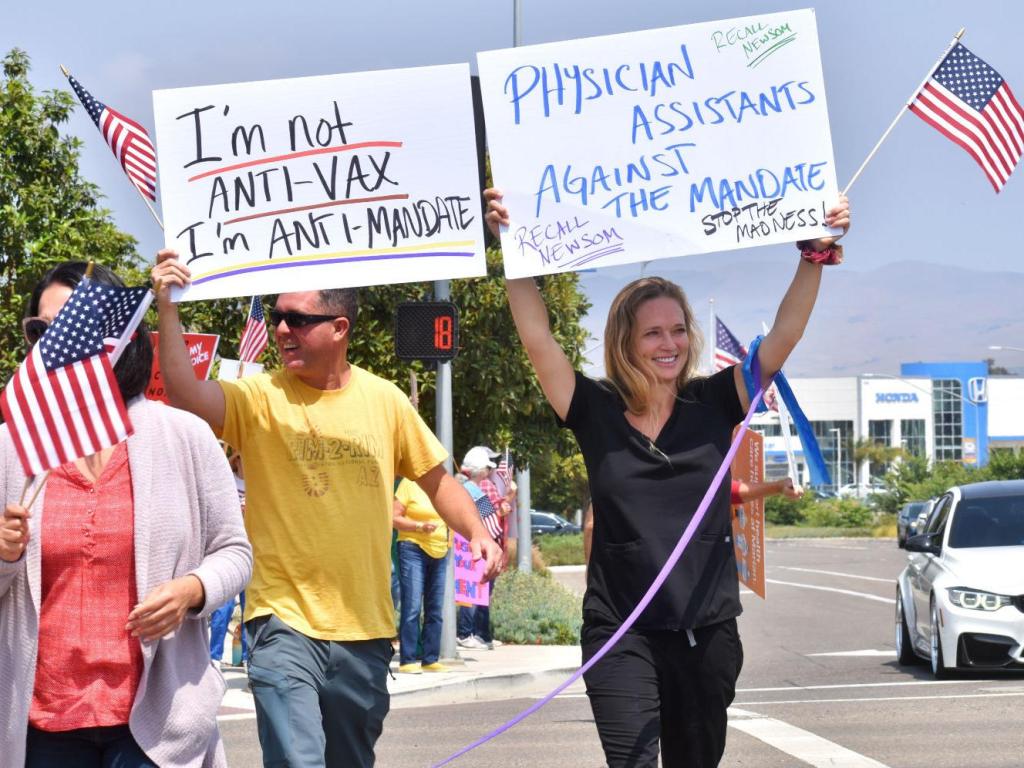
Nurses who refuse to get vaccinated, firefighters and police officers who refuse to get vaxxed, airline pilots rejecting the vax–I’m so fucking sick of these privileged assholes. If it were anything other than a political posturing, I might be more tolerant. But I’m convinced that 99% of it grows out of pig-headed Trumpist pouting and free-floating, unfocused rage.

A million years ago, I was a medic. (Yes, this is related…sorta kinda after a fashion; I’ll get there eventually.) After a year or so of doing basic medic stuff, I was assigned to a newly-developed team in a major medical center. It was called the Special Functions unit. One of our secondary duties was to respond to any medical crisis that might involve respiratory impairment–you know, difficulty with breathing. Here’s a true thing: almost every medical crisis involves some difficulty with breathing.

Although it wasn’t our original purpose, we became a support squad for emergencies. If there was a cardiac arrest, we responded with the cardiac arrest team; if there was a fire, we responded with the base fire department; if there was a suicide attempt or an accident involving a military vehicle or a premature birth or a crisis that required an ambulance, we often rode along; if there was a mass casualty/injury event, we were called to the emergency room. Technically, our role was to insure the patient/victim kept breathing while others worked on the injuries/wounds–but, of course, we were also expected to lend a hand with whatever needed to be done.

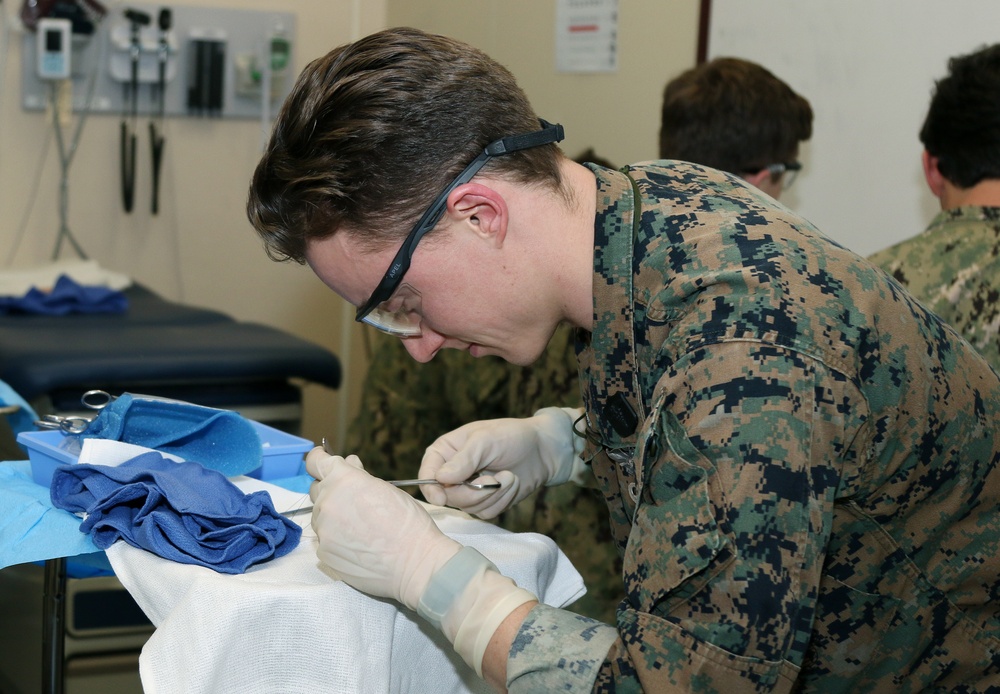
I mention all this because of one particular incident. A drunken brawl at one of the barracks. Because it was a mass injury event, I was called to the ER. Nobody was having trouble breathing, but since I was there, I was expected to help out with the brawlers–most of whom were still drunk and still belligerent. One guy had a cut on his forehead. It was a simple straight-line cut, maybe an inch and a half long, shallow, but bloody. All I had to do was debride it and suture it shut. Simple, if the guy was sober.

I should point out, this was a military medical center. In a civilian hospital, I wouldn’t have been allowed to suture wounds–not because I didn’t know how to do it, but because of liability issues. In the military, you’re allowed–even required–to do stuff that would make a civilian hospital administrator curl up in horror.

So I had to suture the cut on this guy’s forehead. But he refused to lie still. He was still drunk, still angry, still wanting to find the guy who’d hit him in the head. You can’t suture anybody who’s unwilling to lie still for more than about thirty seconds; hell, you can’t even maintain a sterile field. I mentioned this to a passing ER doctor, who looked down at the guy on the gurney and said, “If you don’t lie still, he (he nodded at me) is going to suture your ear to the pillow.” Then the doctor walked off.

Reader, I sutured that poor motherfucker’s ear to the pillow. Just one loose stitch, through his earlobe and into the pillow case. It wouldn’t have actually held him down, of course, but it was enough to shock him and keep him immobile–and I mean fucking frozen in place–until I sutured his head wound.

This was almost certainly criminal, even in the military. But it allowed me to treat his wound, it gave him a moment to abandon any desire to continue the fight, it may have kept him from a court martial, and it helped restore some order to a chaotic Emergency Room, which benefited everybody.

My point? All of these fuckwits who are refusing to get vaxxed against Covid for bullshit reasons? I want to suture their ears to pillows until they come to their senses and get the jab. I know it’s wrong. I know it’s a violation of their rights, including the right to bodily integrity. But give me a needle and a few miles of 2-0 nylon and I’d get this nation vaxxed.

It’s seriously time to stop appeasing and appealing to the people who are politically opposed to keeping the US alive and healthy.

on digital books, a lime green glass, and d’Artagnan

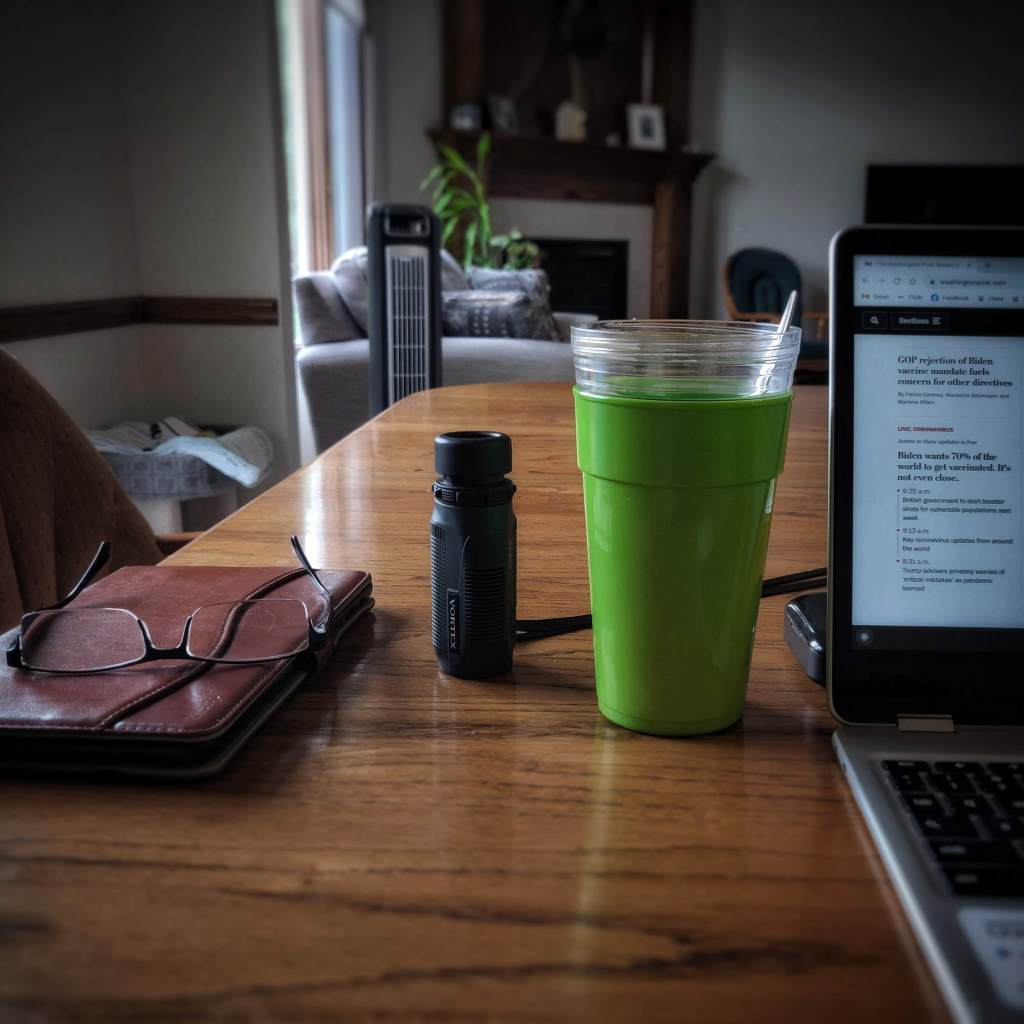
From some indeterminate point in May to an equally vague point in September, I drink cold brew coffee in the morning. I drink it from a lime green plastic glass — because something about that color appeals to me in a summer sort of way, and because I like the clicky sound made by the iced tea spoon when I stir it. In September — at the end of this week, in fact — I’ll shift back to hot coffee, which I drink in a brown metal insulated mug.

I could, of course, drink the coffee in any sort of container and it would taste as good, but I choose those two because they please me. They’re a part of my morning ritual. Greet the cat, check the perimeter (with the cat, of course), feed the cat, get my coffee, read the news. I live a fairly irregular and unscheduled life, so that morning ritual provides a sort of ground-level continuity — a semi-stable foundation to begin the day.

What does that have to do with digital books? Nothing, in a material way — but they’re related in a sort of philosophical way. Recently a friend mentioned they couldn’t bring themselves to buy an e-book reader, and asked me how I could bring myself to abandon physical books. This is my answer.

A lot of people have a relationship with books that’s similar to my relationship with my lime green plastic glass. The thing is, physical objects can develop a certain presence that stems from the object’s personal history with the user. We’ve all experienced this. Maybe you have a favorite shirt — something faded and worn and not suitable to wear in public, but imbued with memories and a weird sort of affection that makes it impossible to discard. Maybe you have a screwdriver or soup ladle inherited from a grandparent, or a some old work gloves loaned to you by a friend who moved away before you could return them, or an early Baywatch poster that’s sort of embarrassing now but still un-throw-awayable — something (some thing) that has a personal meaning to you and only you.

So, how could I abandon physical books? How could I give up that tactile experience of holding a book in my hand? How could I shift away from the sound and feel of turning a physical page? Didn’t I miss the particular smell of a book? How could I reduce a great novel to nothing more than a collection of digitized ones and zeros?

I get that notion. I totally do. There are absolutely some physical experiences that clearly lose something important when they’re de-objectified, when objects are turned into information. The ringing of a church-bell, for example; we can digitally reproduce that sound, but we can’t reproduce the experience, the physicality of a ringing bell, the way the sound waves impact our bodies.

But for me, the impact of a book — and especially of a novel — isn’t in the substance of the paper and the binding, it’s in the ideas generated by the story. It’s in the unique and intensely personal interpretation of what’s written. For me, it’s the writing that matters more than the way it’s presented; it doesn’t matter to me if the words are printed on a physical page or digitally reproduced on a screen.

Originally, I thought it would matter. In fact, I refused to buy an e-book reader because I was concerned it would degrade the experience of reading. But then, back in 2010, I was given a Nook, an e-reader developed by and for Barnes & Noble booksellers. It came with a couple of classic novels already loaded — both of which I’d read and re-read several times. Pride and Prejudice and The Three Musketeers. Because it was a gift, I felt obligated to at least try using the Nook. So I started to re-read the story of Charles de Batz de Castelmore d’Artagnan and his ridiculous quest to become a musketeer — and by the time I finished the third paragraph, I was caught up in the narrative.

Imagine to yourself a Don Quixote of eighteen; a Don Quixote without his corselet, without his coat of mail, without his cuisses; a Don Quixote clothed in a woolen doublet, the blue color of which had faded into a nameless shade between lees of wine and a heavenly azure; face long and brown; high cheek bones, a sign of sagacity; the maxillary muscles enormously developed, an infallible sign by which a Gascon may always be detected, even without his cap—and our young man wore a cap set off with a sort of feather; the eye open and intelligent; the nose hooked, but finely chiseled. Too big for a youth, too small for a grown man, an experienced eye might have taken him for a farmer’s son upon a journey had it not been for the long sword which, dangling from a leather baldric, hit against the calves of its owner as he walked, and against the rough side of his steed when he was on horseback.

That pair of sentences would make any modern editor have a seizure, but they set the tone for this particular novel. More importantly, they create an image in my mind of the character d’Artagnan. Reading it digitized — like it is here — creates the same image in my mind as reading it on a printed page. That mental image has nothing to do with the medium that created it, paper or digital. It’s unique to me; your mental image of young d’Artagnan is probably different, because…well, fuck. I have to go off on a tangent here. I’ve been trying to reduce the number of tangents in these blog posts, but damn it, here we go.

That’s d’Artagnan, right there.

I think we can all agree that with very few exceptions, books are better than the movies made from those books. One reason for that is because the characters in movies rarely resemble the characters we create in our mind when we read a novel. But on occasion, a character is so perfectly cast that we impose that actor’s face on the character in the novel. And the 1973 film adaptation directed by Richard Lester has permanently imprinted the face of Michael York on my personal interpretation of d’Artagnan. Now and for the rest of my life, when I read The Three Musketeers, I see Michael York.

Right, tangent over, and back to my point, which is as follows: some physical objects, though routine contact with people, develop an almost mystical connection to the person who possesses them. I have a relationship with my lime green glass, for example. My cold brew coffee would taste as good in a ceramic mug, but the glass means something to me. But my relationship with books, and particularly novels, is different. That relationship is grounded in the ideas created through the writing, not in the device that contains them.

When it comes to books, my interest is in the cold brew, not the lime green plastic glass.