musings

Somebody (I don’t remember who) at some point in time (I also don’t remember when) asked me how I decided what to write about on this blog. I don’t remember what my answer was, but…okay, wait. I should point out there’s absolutely nothing wrong with my memory. It’s just that who asked the question and when it was asked and what my answer was–none of that’s important, except as a ridiculous way to introduce what I’m about to say. Well, write. You know what I mean.

Probably the reason I don’t remember what my answer was is that I’ve no idea how I decide what to write about. Something somewhere sparks a thought and I write about it. That’s it. Anyway, after yesterday’s post, my friend Anne said this:

“Beautiful photos, and really lovely musings.”

Musings. It sounds so intellectual, doesn’t it. But dude, IT IS NOT. I know this on account of the fact that ‘muse’ came up in a conversation I had years ago (and no, I don’t remember when, but I’m pretty sure I remember who…again, it doesn’t matter). I’d just assumed that ‘musing’ had something to do with the Muses. You know, the nine daughters of Zeus who were goddesses of the arts and sciences? Those Muses. I mean, that would seem to make sense, right?

Nope. Well, mostly nope. Etymologists suggest the modern word probably has been influenced in sense by capital ‘M’ Muse. There’s a lot of elasticity in ‘probably’. Doesn’t matter, because in fact, small ‘m’ muse comes…wait. Do I need to define ‘muse’? Probably not, but what the hell.

Muse: verb (mused, musing) 1 intrans (often muse on something) to reflect or ponder silently. 2 to say something in a reflective way. 3 intrans to gaze contemplatively. musing adj thoughtful; reflective. noun 1 (musings) literary thoughts. 2 the act of musing.

There you have it. As I was saying, small ‘m’ muse comes from the Old French muser, which meant “to ponder, dream, wonder’ and/or “to loiter, waste time.” This, in turn, came from the Gallo-Roman musa, meaning “snout”. It was apparently a term used in hunting. So basically, ‘musing’ referred to the act of standing around, sniffing the air like a dog who’s lost the scent. The term muzzle, by the way, is derived from the same root.

Dog, musing in a field; not that different from me musing in a junk shop.

So in essence, Anne was saying I stood around in that shop with my nose in the air, sniffing like a dog. Which would be rather rude and insulting except that it really isn’t that far from the truth. The place had a fairly distinct pong; sort of a melange of dust, must, wood chips, organic decay (remember, it was also a plant shop), and old pillows. And I did sort of root around like a curious puppy.

clutter

An untidy accumulation of objects, or the confused overcrowded state caused by it. From an Old English variant of clotern, meaning ‘to form clots, to heap on,’ which was derived from clott, meaning ‘a round mass or lump’. You know…clutter.

Most folks don’t like clutter. It makes them uncomfortable, uneasy, anxious, unsettled. Clutter, we’re told, “creates indecision and distractions, consuming attention and making unfettered happiness a real chore.” We are told, “Order is Heaven’s first law.” The problem, of course, is we fear disorder. We fear chaos. So we attempt (and to some extent, succeed) to impose a sense of order on…well, everything.

I confess, I can find “unfettered happiness” in cluttered spaces. Other people’s cluttered spaces, I should say. Not my own. I like to visit clutter; I don’t necessarily want to live or work in it. And it’s not just cluttered spaces in general that I enjoy. I’ve no interest at all in well-organized clutter. A room encumbered with stacks of old newspapers and magazines, a cellar jammed with tins of food, an office filled with dusty ledgers and technical manuals–no thank you.

No, what I like–what I find stimulating, what brings me some perverse joy–is random clutter. Clutter that contains surprises, clutter that holds unexpected stuff, clutter that’s arbitrary and unpredictable, that’s what I’m after. It’s a fairly rare phenomenon. I’ve encountered it occasionally in old sheds or farmhouse mudrooms, a bit more often in old school hardware stores. I found it at West End Architectural Salvage and Coffee Shop before it became a sort of high-end esoteric antique store. I found it at Fairground Hardware before it closed.

Everywhere you turn you find yourself saying, “Wait…what? Why are there taxidermied Canada Geese next to the Allen wrenches, which are beside the cans of spray paint? Who puts PVC pipe and vintage Melmac dishes together, along with toy trains and light bulbs? Putty knives and puppets and metal screws? What? Halloween decorations? And…wait, canned goods?

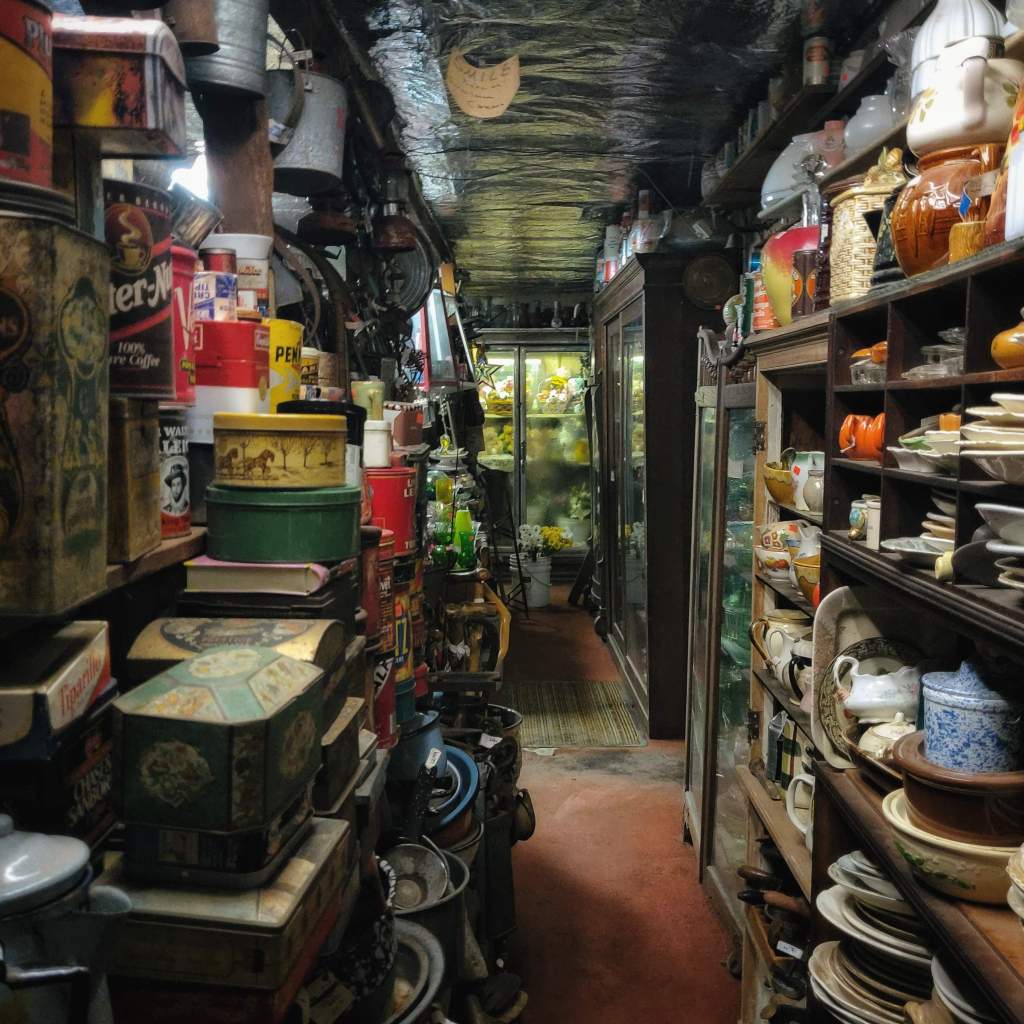
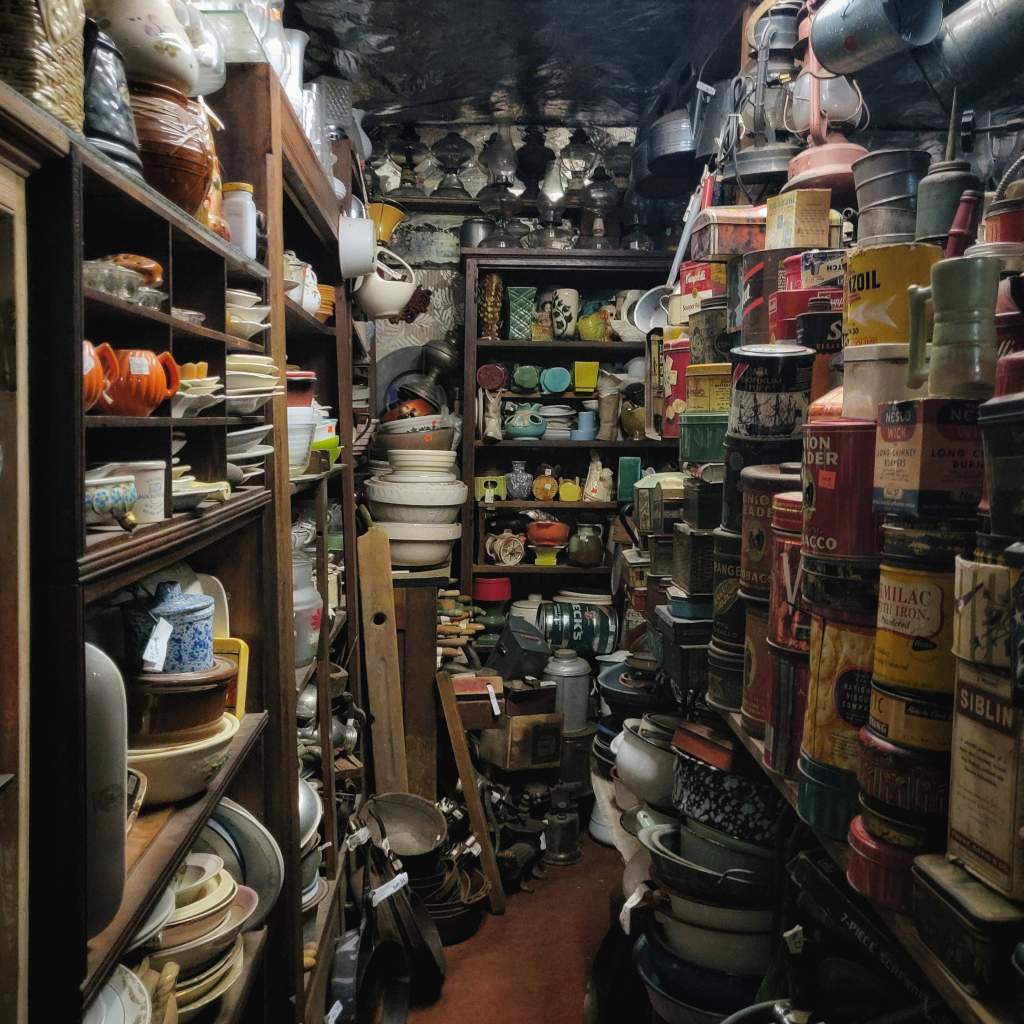
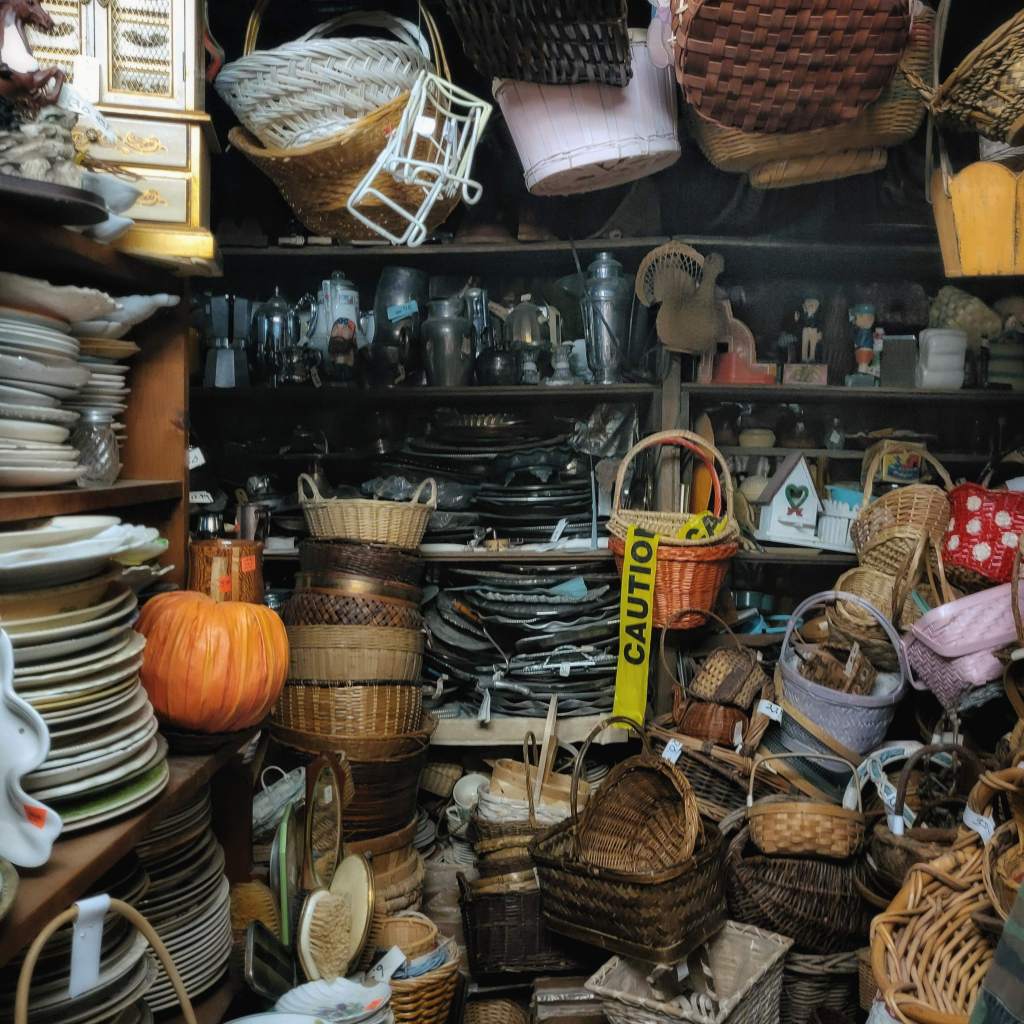
A couple of weeks ago I stumbled across an antique store/junk yard/plant shop/maze that was a celebration of clutter. Poorly lighted narrow aisles of overfilled shelves with often random semi-related stuff accumulating on the floor, sometimes forcing you to walk sideways. I say ‘random semi-related stuff’ because there was a sort of micro-taxonomy occurring–small clusters of items that belonged in the same (or a similar) category, but scattered among wildly unrelated clusters. Stacks of wooden boxes beside a stockpile of china dishes; a pile of wicker baskets under a shelf of brass candlesticks, under a shelf of religious figurines; a collection of antique toy trains next to a group of chamber pots and jugs sitting on a cabinet containing china bells.

The place was…well, disordered, to be polite. Everywhere you looked you saw something that somehow both belonged right there and yet was completely out of place. It was like walking through some other person’s dream-state–or perhaps wandering through a stranger’s memories; you recognized almost everything you saw, but even though nothing was quite where you thought it ought to be, you sensed it was where it was supposed to be. Which, I realize, doesn’t make any sense.

The poet Czesław Miłosz wrote about the “mystery of things, little sensations of time…all infinity can be contained in this stone corner, between the fireplace and the oak chest.” That’s how I feel in these cluttered spaces…as if thousands of people have dropped moments out of their lives onto all these dusty shelves, and I get to wander through them, sampling them, touching them, knowing that they’re real…or were real at one time…and now would be entirely forgotten if not for the curious people who look at them, wonder about them, then move on.

Miłosz was talking about ‘mystery’ in the older sense of the term–not as a curiosity to be explored and understood, but as a phenomenon that transcends the rational world. These baskets and bowls, these canisters and candlesticks aren’t physically imbued with some mystical connection to their previous owners. These objects aren’t haunted. But they do spark the imagination. Each of these things has a story. They remind us that those previous owners existed, that they lived lives and those lives intersected with these things, and somehow these things eventually made their way here, to these dim and dusty shelves.

I admit, it would be oppressive to spend a great deal of time in such cluttered spaces. It’s too dark, it’s too dusty, it’s too gravid with memory. But for a measured chunk of time, noodling through these dim aisles can be just as entrancing as it would be to wander like Kai Lung “unchecked through a garden of bright images.”

this was supposed to be a few scattered thoughts

I’m a tad brain-weary this morning. I worked as an election volunteer yesterday–15 hours of civic duty helping people vote on a school board issue–so rather than attempt to organize some coherent thought on a single subject or theme, I’m just going to natter on for a bit.

First Thought: The election was briefly disrupted yesterday by a pipe bomb. That’s right, some fuckwit placed a pipe bomb outside one of the election sites (not the one at which I volunteered). That’s right, a pipe bomb. A fucking pipe bomb. Over an election on how the local school district should spend its capital improvement funds. You know, do we want to improve classrooms and build new playground equipment–issues like that. We don’t know who planted the bomb (yet) or what his motives were (and yeah, I’m assuming it’s a guy…sue me), but to me it seems likely the would-be bomber will turn out to be some young Trump-crazed asshole who thinks the best way to ‘protect democracy’ is to attack elections.

Post-Trump democracy in action.

The good news is the local police acted quickly. A bomb squad from the Fire Marshall’s office showed up (as did the ATF and the FBI), and safely detonated the bomb. The bomb was found around 0920 and the election site was back up and helping voters by 1230. That makes me proud. The polling site was only closed for three hours. That’s the best way to say ‘Fuck you’ to the bomber.

Second Thought: Speaking of civic pride, there’s a village in Perthshire, Scotland called Aberfeldy. It’s just a small market village on the River Tay, population a wee bit under 2000. The name Aberfeldy comes from the Pictish term aber meaning ‘the mouth of a river’ and the Gaelic Peallaidh, which translates as ‘shaggy’. But–and this is SO cool–Pealladh is also the name of a local fay being which is said to abide in the river. ‘The shaggy one’ is considered a harmless sub-species of fuath, the generic class of Scots spirits/sprites that inhabit the sea, tidal rivers, fresh water rivers, and lochs.

Now that’s a fountain.

You’re probably asking, “Greg, old sock, what’s all that fae business got to do with civil pride?” It’s a good question (and stop calling me ‘old sock’). Here’s the answer: this village, inhabited by fewer than two thousand souls and one water sprite, has the most astonishing water fountain in the town square. Just look at that beauty. It was donated in 1885 by the Marquis of Breadalbane (no, really, Breadalbane, isn’t that a great name?). Now THAT is civic pride. Even Robert Burns (and there is nobody more Scottish than Burns) appreciated this little village. He wrote a poem called The Birks of Aberfeldy.

Now Simmer blinks on flowery braes,
And o’er the crystal streamlets plays;
Come let us spend the lightsome days,
In the birks of Aberfeldy!

Third Thought: Among the many stupid, hateful, vindictive, anti-democracy voting laws Republicans are pushing through state legislatures this year, this one stands out. The Georgia GOP wants to interpret an existing law that prohibits giving or receiving money/gifts for registering voters, or voting for a particular candidate to include folks handing out snacks or water to voters standing in long lines while waiting to vote.

It’s not enough to make it harder for certain groups to vote, it’s not enough to reduce their opportunities to vote, it’s not enough to reduce the hours in which they can vote, the Georgia GOP also wants to punish anybody who tries to ease the burden of voting. If there’s a Hell (and I’m afraid I don’t believe there is), there ought to be an especially severe section for deliberately cruel and corrupt politicians.

That would also include governors (and I’m particularly thinking of the singularly vile governor of Texas here, though the governors of Iowa, Missouri, North Dakota, and Mississippi are very nearly as horrible) who knowingly and willfully put the health and safety of their citizens at risk. Abbott of Texas not only completely lifted ALL Covid precautions statewide, his order also prohibited city and/or county governments from requiring masks or limiting business operation. He basically ordered them to stop doing anything to protect their citizens.

Just a few months ago Texas was paying prison inmates US$2 an hour to move Covid corpses into mobile refrigerated morgues.

Abbott did this while his state is still averaging over 200 Covid deaths each day. Texas has the the third-highest Covid body count in the country. It’s 45th among states in terms of the percentage of the population that’s been vaccinated. And by the way, every Republican member of Congress from Texas opposes Uncle Joe’s Covid relief bill. They know they can vote against it and still benefit from the cash when Democrats pass it. That’s how awful they are.

Remember when Comrade President Trump decided to stop federal funding for ‘anarchist jurisdictions’ that ‘refused to undertake reasonable measures to counteract criminal activities’? He was talking about states and cities that refused to call the National Guard to stop Black Lives Matters protests. But maybe that idea has some merit. Maybe Uncle Joe should consider limiting funding for anarchist jurisdictions that refuse to undertake reasonable measures to counteract the pandemic.

I wonder if Republicans would object to that.

Okay, remember when I started this post? I said I was too brain weary to ‘attempt to organize some coherent thought on a single subject or theme’? It turns out my brain was organizing stuff without my knowledge. Turns out there WAS a theme. Civic duty. Civic pride. Civic responsibility. Civic pride isn’t about being ‘the best’ or ‘first among’ or any of that ‘We’re Number One!’ sort of nonsense; it’s about putting in the effort to make the lives of your citizens a bit better. Civic pride is helping your people vote, it’s keeping your people safe, it’s a ridiculously ornate water fountain in a small village.

Civic pride. Governor Abbott doesn’t have any. The jackass who planted the pipe bomb doesn’t have any. The village of Aberfeldy does. “Come, let us spend the lightsome days / In the birks of Aberfeldy.” There are no lightsome days when you’re loading bodies into refrigerated trucks.

seven white balusters & a cat

I’ve been accused (more than once) of overthinking everything. That accusation is often valid. I tend to overthink some stuff because it’s amusing to me and because it reminds me that everything is connected.

For example, this photograph. It’s just a cat sleeping in a patch of sunlight. Nothing significant, nothing particularly interesting in itself. But if you overthink it, it links together a series of at least ten seemingly unrelated facts.

FACT 1: I belong to an online global collective of photographers called Utata. This group, which has over 30,000 members, creates a variety of photographic ‘challenges’ or projects for its members to participate in. One of the current challenges involves photographing a collection of seven related things.

FACT 2: Pomegranates originated in a historical region called Mesopotamia which occupied the ancient Near East and Western Asia.

FACT 3: The cat that lives here likes to sleep in patches of radiant heat. On winter days, to please the cat, I open the front door to allow the sun to shine in.

FACT 4: For more than three thousand years, Aramaic was one of the prominent languages of the ancient Near East, which included regions of Mesopotamia.

FACT 5: A balustrade is a railing, often ornamental, supported by individual short posts or columns, which are called balusters.

FACT 6: Near the front door, where the cat likes to sleep in the winter sunlight, is a stairway leading to the basement; the stairway is protected by a balustrade.

FACT 7: The earliest examples of balustrades are found in sculptured Assyrian bas-relief murals, some of which have been dated back to a period between the 13th and 7th centuries B.C.

FACT 8: Assyria was an ancient Mesopotamian empire.

FACT 9: The term ‘baluster’ comes from the Aramaic balatz, which refers to the flower of the wild pomegranate. Balusters in the bas-relief murals had double curves, which resembled a half-opened pomegranate flower.

FACT 10: I noticed the cat sleeping in the sunlight from the open front door. The light illuminated seven of the balusters supporting the balustrade, meeting the requirements for the Utata photo challenge.

Does knowing those facts make this a better photograph? Nope. It’s still just a photograph of a cat sleeping in a patch of winter sunlight.

But surely you’ll agree there’s a certain delight in knowing that the cat is sleeping in a patch of sunlight beside a railing supported by posts that were originally named in an ancient almost-forgotten language because of their resemblance to the flower of a fruit that first grew in an empire that no longer exists.

quō vādis, y’all

Okay, Republicans, quō vādis and all that. Whither goest thou? To where are you marching? Where in the holy hell do you go from here? After a couple decades of shifting your focus away from policy and governance and investing almost exclusively in ‘owning the libs,’ what comes next? Where do you go when your party has lost control of both Congress and the presidency, and is now defined almost entirely by unquestioned subservience to a leader who’s been impeached twice? What comes after supporting the only president in U.S. history to foment a violent assault on the nation’s Capitol building? Seriously Republicans, quō fucking vādis?

Lacking leadership, the GOP is content to march angrily off in all directions at once.

Quick tangent. You may be asking, “Greg, old sock, why the Latin? Why quō vādis?” Because it’s appropriate in a couple of ways. First, it’s appropriate because most Republicans call themselves Christians, and the Latin phrase comes from a Biblical story. Well, sort of Biblical. It’s in the Acts of Peter, which is one of the apocryphal gospels. I’m going to resist the temptation to explain the apocryphal gospels, because that would require me to go off on a tangent within this current tangent. If you’re curious, do the research.

Second, the Latin is appropriate because of the lesson of the story. So, here’s the story. Around thirty years after Jesus got crucified, Peter, the apostle, goes to Rome to preach the gospel. While he’s there, he gets in a fuss with a guy named Simon Magus (again, if you’re interested, do the research), after which Peter decides it would be a good idea for him to leave town for a bit. Let the fuss die down. As he’s on his way, Peter meets Jesus toting a cross. Remember, Jesus had been dead for three decades at this point. Also, that cross? It talks. (I am NOT making that up; this talking cross may help explain why the Acts of Peter was shifted into the apocrypha). Anyway, Peter asks Jesus, “Quō vādis?” This is usually translated as “Whither goest thou?” or more simply, “Where are you going?” A more accurate translation, I’m told, would be “To where are you marching?” but the intent is the same. Jesus answers, “Rōmam eō iterum crucifīgī,” which means “I’m going to Rome to be crucified again.”

“No, really. I’m going to get crucified again. It’s my job. You should try it.”

This is the Biblical lesson. Sometimes you need to stop, think about what you’re doing and why you’re doing it, then turn around and get back to doing the good work you know you’re supposed to be doing. It gives Peter the courage to return to Rome and keep preaching. Unfortunately for Peter, he gets crucified on his return to Rome. Upside down, apparently.

So yeah, it didn’t end pretty for Peter, but the idea is still sound. The question and the answer are still important. Where are you going, Republicans? What’s your intended destination? What’s the purpose of your journey? What’s the nature of your good work? Where does the Republican Party go after they’ve attempted to overturn a fair election…and failed? Where do they go after they’ve shrugged off a violent insurrection?

Think about it. A hundred and twenty-one Republicans in the House objected to the Electoral College vote–and that was after the insurrection threatened their own safety. A hundred and ninety-seven of them voted against the second articles of impeachment. Forty-three of the fifty Republicans in the Senate voted to acquit Trump of inciting the insurrection–an insurrection that was not only intended to disrupt and/or stop the peaceful transfer of power to the legitimately elected president, but also threatened the lives of the next three people in the line of presidential succession.

“Wait…Jesus gets killed? That’s how it ends? Seriously?”

The only good thing about this is that some Republicans are asking themselves about the future of their party. Susan Collins, the tower of Jello representing Maine, said this:

“I think we need to get away from the idea that the Republican Party is just one person and adherence to just one leader.”

She thinks that’s what the GOP needs. But her comment is a sad example of the very problem Republicans are facing. Instead of addressing the actual issue–instead of trying to figure out a viable future direction of the party–Republicans are concentrating their energy on whether or not they should remain faithful to an unfaithful, dishonest, failed former president. That simply reinforces the notion that they ARE a party of just one person, just one leader. Without Trump, the Republican Party is rudderless. Without Trump, there is…well, nothing.

Don’t forget, for the first time since 1854, the GOP didn’t bother to craft a party platform for a presidential 2020 election. They basically said their party platform was whatever Trump wanted at any given moment. There is no longer any traditionally conservative governing philosophy that unites Republicans and shapes their policy positions. There is absolutely nothing that moves the GOP forward except the entertainment value of “owning the libs.”

Do they try to regroup? If so, as what? As a traditional center-right conservative political party? Do they gather together and concoct a political party platform? Do they get caught up in some sort of political mitosis and split into two different political parties? Do they just continue to drift randomly, driven only by opposing whatever Democrats propose and the haphazard, arbitrary, volatile anger and resentment of their base? Do they organize and morph into a violent guerrilla insurrectionist movement?

Live Trump or die.

I don’t have any answers. I know what I’d like. I’d like to see the GOP reform into a functioning organization with moderate, conservative values and policies I can oppose but still understand. I’d like them to be a traditional loyal opposition party. But that seems unlikely. Hell, nothing seems likely. No particular possible future seems more likely than any other; it all seems pretty aimless and accidental.

I haven’t a clue what comes next. But I’m genuinely curious, and a wee bit fearful.

miss scarlet knows how to wear a hat

Yesterday I came across a news item…wait, make that a ‘news’ item. I mean, there’s news, which is information important to me, and there’s ‘news’, which is information I might find momentarily interesting. Like, say, ‘sports news’ or ‘religious news’ or, in this case, ‘entertainment news’.

Yesterday I came across a ‘news’ item which informed me that the protagonist in a BBC/PBS show called (and I am not making this up) Miss Scarlet and the Duke was patterned after Miss Elizabeth Bennett (of Pride and Prejudice, I shouldn’t have to tell you that). You must allow me to tell you how ardently I admire Miss Bennett. I’ve always been of the opinion that her keen observational skills coupled with her lively wit and plucky nature would make her an excellent detective.

So, of course, I determined to watch the show. Last night I watched the first episode. Let me just say this: I know Miss Elizabeth Bennett. Miss Bennett is a friend of mine. Miss Eliza Scarlet is no Miss Elizabeth Bennett.

That’s not necessarily a bad thing. The differences between the two characters are actually important to the narrative. Miss Bennett, of course, is a gentleman’s daughter; Miss Scarlet is the daughter of a police detective. In addition, Miss Bennett is the product of the Regency Era, whereas Miss Scarlet is firmly planted in the Victorian. Finally, the pace of Miss Bennett’s life is determined by the rhythms of a rural and village existence; Miss Scarlet lives in London. Those differences–in social class, in social status, in societal change over time, and in environment–radically expand the parameters of Miss Scarlet as a character.

Being a police detective’s daughter in Victorian London allows the character of Miss Scarlet access to most of the common tropes of the modern criminal investigation show. This is both unfortunate and very convenient. It’s convenient in that it makes the nature of the show familiar to the viewer; it’s unfortunate since the viewer knows pretty much what to expect.

And the first episode of Miss Scarlet and the Duke meets that expectation. There’s nothing new, nothing original, nothing surprising. Basically we have a 21st century woman protagonist set in 19th century London, with a nod toward a more historically restrictive patriarchal system. In other words, we have a generically plucky woman detective who has to 1) strive to be taken seriously, 2) overcome obstacles presented by the patriarchy, 3) defy gender norms, but only to a certain degree, and 4) establish her independence.

That said, I think we can all agree that you can’t judge a television series on the basis of the first episode. Or even the second or third. But you can, I think, get some idea of the nature of the show. And Miss Scarlet and the Duke gives every impression of being…pleasant. It wasn’t exciting, it wasn’t intriguing, it wasn’t compelling, it wasn’t even particularly interesting. It was a mildly entertaining diversion that doesn’t require much on the part of the viewer. It was…pleasant.

That’s not a criticism; there’s a need for mildly entertaining diversions, especially during a pandemic. So let’s take a look at that first episode.

WARNING — ENGAGE SPOILER ALERT SYSTEM. SPOILERS FOLLOW. STOP READING IF YOU WANT TO AVOID SPOILERS.

Because it’s the first episode, a certain amount of narrative has to be spent introducing the characters. It opens with Eliza being led by a street urchin to an unsavory part of London. She’s paying the kid to lead her to a dead body. Not any particularly dead body. Just a random dead person. Why? So she can…investigate something? The body appears to be that of a woman we assume to be a one-eyed prostitute. She is, in fact, one-eyed and a prostitute. She is not, however, dead. Only drunk.

As a scene, it makes absolutely no sense–unless Eliza has some sort of necro-curious fetish, which doesn’t seem likely from PBS. The point is to show she’s eager to prove herself to her father, a retired police detective turned private investigator. Eager, but inexperienced. And not very competent. Not only does she not get a dead body, she doesn’t get her money back from the urchin.

Her father would be horrified, but he doesn’t learn of the encounter because he’s nowhere to be found (ooh, suspense). He’s not at his office, and his police protégé (Chief Inspector William ‘Duke’ Wellington) hasn’t seen him. Eliza assumes he’s either working a case or drunk. He’s not. He’s dead.

Eliza returns home to find a stranger–a doctor, no less– and her dead father in the drawing room. This stranger found her father dead and apparently brought his body home. I suspect in a later episode we’ll learn there’s something odd about her father’s death (because that’s how the Mystery Story Universe works). Possibly the doctor is involved (the Mystery Story Universe is predictable).

Before she can even begin to mourn, Eliza encounters a prospective client looking for her father. Needing the money, she lies to him, telling him her father will accept the case. This is where the actual plot begins. Oh lawdy, the plot. Let’s dispense with the plot as quickly as possible; it’s convoluted, and the least interesting thing about the first episode.

The client, a man dying of some undisclosed illness, is looking for his estranged niece, Tilly, his last living relative. She married unwisely and was cast off by the family. Now that he’s dying and has an estate to dispose of, he wants to find her again. Eliza finds Tilly working as the human target for a knife-throwing act in an unsavory dance hall in Soho. Tilly confesses her uncle was right–her husband, a once-widowed actor, was only interested in her uncle’s fortune. When he learned she was disowned, he disappeared. She’s willing to meet and reconcile with her dying uncle.

Case closed! No, of course not. The dying uncle turns out to be–and, again, I’m not making this up–Tilly’s husband in a fake beard. He’d learned of the uncle’s death, and as her husband in Victorian England, he basically has control of the estate she inherited. He has the estate, but he has no need of a wife. And yet he decides FOR REASONS that he must find her. Does he return to Soho where he left her? No. Does he look for her? No. Instead, he puts on a disguise and hires somebody to find her. Does that make any sense? No. Doesn’t matter. When Eliza brings Tilly and her husband together, he removes his disguise, calls in a pair of ruffians, and has Ivy hauled off to be committed. Which allows him to control the estate he’s already controlling. I know, I know…just go along with this.

The husband pays Eliza her fee. She feels awful (girls have all these emotions), so she decides FOR REASONS to investigate the husband’s first marriage. She discovers his first wife wasn’t actually dead (gasp)! This makes him a bigamist. Eliza threatens him with arrest, he threatens to strangle her, but she’s had a maid lace his tea with laudanum, knocking him out. She then calls her friend Chief Inspector Duke Wellington, who arrests the husband and chides Eliza for being a girl doing police work. Why didn’t Eliza simply notify Duke of the husband’s crime and let the police arrest him, avoiding the need to 1) risk her life and 2) spike the man’s tea with drugs? REASONS, that’s why.

Tilly is released from wherever she was committed to and everybody is happy, except the Duke who insists Eliza shouldn’t investigate anything because she’s a girl. The end.

This sounds painfully bad…and it would be, if you were only interested in the plot. Or in the characters. But Miss Scarlet and the Duke is meant to be a confection. It’s a teacake, not a meal. It’s a show about Miss Scarlet’s costumes, and men with precise beards wearing bowler hats and long coats. It’s about stage sets depicting Victorian London, the drawing rooms, the taverns, the bawdy houses. It’s not meant to make you think.

Oh, Miss Scarlet takes on the patriarchy in a variety of non-threatening ways. She mocks the men for being protective and condescending, she out-thinks them, she finds a way around whatever attempts they make to keep her docile and biddable. The viewer understands that the patriarchy is awful, but isn’t it cute and clever how Eliza gets around it?

Only two scenes were potentially interesting, potentially dramatic. Eliza, in her search for Tilly, encounters Moses–the black man who ‘protects’ the women who work in the dance hall. There’s something awkward about the only person of color in the show being a criminal. But Eliza wants information about Tilly, Moses wants a bribe; she pays the bribe, he takes her coin purse. When he refuses to return the purse, Eliza flirts with him (Miss Elizabeth Bennett would have vapors). When Moses responds, Eliza quickly handcuffs him to a rail (a tangent: ratchet cuffs weren’t invented until the early 20th century). She then threatens to burn him alive unless he 1) returns the money and 2) tells her where to find Tilly.

The second scene was momentarily very distressing. Eliza is arrested during a raid on the dance hall where Tilly is employed. Three men take her by force to a room with an exam table, and are apparently about to ‘inspect’ her to see if she has a venereal disease. For a brief moment, there was nothing amusing or sugary about the show. Eliza quickly defuses the situation by claiming to be the preferred prostitute of Chief Inspector Wellington, who then rescues her. What was potentially traumatic and horrifying becomes somewhat comedic. Eliza is completely unfazed by that sexual assault.

Is Miss Scarlet and the Duke a good show? Not by most PBS standards. Is it worth watching? It’s a nice diversion. I’ll watch the next episode, if only for the set design and the costumes. Miss Scarlet knows how to wear a hat.

monkey’s paw impeachment moment

At the beginning of the 20th century W.W. Jacobs, a former post office clerk turned short story writer, published an anthology of his work — The Lady of the Barge. It was a collection of three types of stories: the misadventures of sailors ashore, celebrations of artful dodgers in slow-witted villages, and what were called ‘tales of the macabre’. Included in the collection was The Monkey’s Paw.

It’s the story of the White family — Mr. and Mrs. White and their son Herbert — who receive a visit from Sergeant-Major Morris, a villager who’d recently returned after 21 years spent in the British Army in India. Morris regales them with tales of “wild scenes and doughty deeds; of wars and plagues and strange peoples.” Mr. White had heard something about a mummified monkey’s paw.

“It had a spell put on it by an old fakir,” said the sergeant-major, “a very holy man. He wanted to show that fate ruled people’s lives, and that those who interfered with it did so to their sorrow. He put a spell on it so that three separate men could each have three wishes from it.”

Morris tells how he’d obtained the paw from its original owner. “I don’t know what [his] first two [wishes] were, but the third was for death.” He refuses to discuss his own wishes, but suddenly throws the paw into the White’s fireplace. Mr. White retrieves it over the Sergeant-Major’s objections. Later, Herbert encourages his father to use the paw and make a wish. Mr. White wishes for 200 pounds, the amount needed to pay of their home.

The following day Herbert goes to work at the nearby factory. The wish of the night before is forgotten. That evening a man from the factory arrives with the unfortunate news: Herbert was caught in the machinery and killed. The factory “admit no liability at all, but in consideration of your son’s services, they wish to present you with a certain sum as compensation.” It’s 200 pounds, of course.

“He has been dead ten days, and besides he – I would not tell you else, but – I could only recognize him by his clothing. If he was too terrible for you to see then, how now?”

Ten days later, after the funeral, Mrs. White insists her husband use the monkey’s paw to “wish our boy alive again.” He’s reluctant, but eventually gives in. Later that night, there’s a knock at the door. Mrs. White wants to answer it; her husband resists. She breaks away from him, he finds the monkey’s paw and “frantically breathed his third and last wish.”

The knocking stops. Mrs. White opens the door.

A cold wind rushed up the staircase, and a long loud wail of disappointment and misery from his wife gave him courage to run down to her side, and then to the gate beyond. The street lamp flickering opposite shone on a quiet and deserted road.

Why am I telling you about this 120-year-old story? Because yesterday, the House impeachment managers had a monkey’s paw moment. They wished for the power to call witnesses, and that wish was granted. But the wish came with an enormous price for interfering with fate.

I don’t believe in fate or destiny (or any other unchangeable, predetermined course of events) but I’m not innocent. I knew — we all knew — Republicans would vote to acquit Comrade Trump, the most mendacious and corrupt being ever to inhabit the White House. Evidence didn’t matter. We knew that. And most of us knew that if the Democrats used the monkey’s paw, there’d be a price to pay.

I wanted them to do it anyway. Almost everybody I know wanted them to do it anyway. When they didn’t call witnesses, most of us immediately assumed the Republicans played tough and the Democrats caved — because that’s been our experience. But in fact, we were all Mrs. White, wanting to resurrect the mutilated body of her dead son. We could have had witnesses. Maybe witnesses for weeks. Witnesses testifying to Trump’s appalling behavior. It would be so satisfying. It would be…well, profoundly stupid. No competent lawyer wants to put a hostile witness on the stand, even under oath. The risks are too great.

And now we’ve learned the Republicans threatened to filibuster Biden’s appointments and the Covid relief bill (and probably everything on the Biden agenda) if the House managers called witnesses. To call witnesses would have born out the fakir’s warning: those who interfered with [fate] did so to their sorrow. Even though I don’t belief in fate, I believe Jamie Raskin did the wise thing; he threw the monkey’s paw back into the fire.

And so things happened pretty much as we all expected. Senate Republicans did what we knew they’d do. It wasn’t fate, but it’s close enough that it makes no difference. Raskin didn’t use the monkey’s paw again; we didn’t get the 200 pounds to pay off our mortgage. But at least we didn’t end up with a ten-day-old mutilated corpse on our doorstep. So there’s that. Plus, the fact that seven Republicans showed a degree of honor and decency by refusing to follow the GOP lie is actually a sort of victory.

But lawdy, that mummified monkey’s paw is still awfully tempting.

i have a blue plaid shirt

I suppose by most metrics, this is a bad photograph. It’s dark, except for where it’s maybe a tad overexposed. There’s nothing special about it, it’s not terribly attractive. It’s just a blue plaid shirt hanging on a stairway post. But I was drawn by the narrow band of December light and the way it slid through the transom over the doorway and sidled up against the shirt.

I saw it originally from another angle, and was captivated enough to go fetch a camera. An actual camera, not my phone. I moved to this angle, squatted down to get the perspective right, shifted over just enough so that the windows in the neighboring house seen through the kitchen window were balanced, and made the shot.

It probably didn’t take more than 15-20 seconds. It’s a semi-casual shot of an utterly ordinary moment. Eggleston might call it a ‘democratic’ moment, though I didn’t photograph it in a democratically Eggleston way. I probably took 14-19 seconds longer than Eggleston would have. You can jam a lot of pretentious formality into 15-20 seconds. He was all about the unpretentious impermanence of everything, after all, and the revolutionary notion that art existed everywhere and anything was worthy of being photographed. I believe in that approach, but haven’t liberated myself from the tyranny of composition. There’s always, always, some level of thoughtfulness in anything I photograph.

After I shot the photo, I chimped it just long enough to see if I got what I was after. What was I after? The light, obviously. But also the darkness–the nothingness of the stairway in the center. There’s really not much to see in the photo; there’s the shirt, the window, the handrail, part of a closet door. What’s not there is as important as what is. I was pleased with the photo.

Then I put the camera down and basically forgot about the photo until yesterday. Yesterday I bought a new card reader and uploaded the half dozen images from the camera. Most of the images were crap and immediately deleted, but this one sparked the memory of the moment I’d shot it.

I don’t often spend time looking at the photos I shoot. I shoot them, review them at some point, process a few, delete most of them, then I post some of the few I’ve processed. That’s it. I’m not very interested in seeing the photo after I’ve finished it. But I looked at this one for a bit, thinking about Eggleston and the democratic eye and the way the light fell and the enigmatic darkness…and I realized I was being a pretentious dick. It was just a murky photograph of a blue plaid shirt.

Self in a blue plaid shirt with occasional cat, 2013.

I’ve had that blue plaid shirt since 2001. I didn’t buy it; I sort of inherited it. It belonged to one of the guys who worked for the moving company that shifted my stuff from a small apartment on the Upper West Side of Manhattan to an old farm house in rural Pennsylvania. The shirt got left behind. I probably should have returned it, but the movers also walked away with my antique shepherd’s crook and a walking stick topped with a hand-carved morel mushroom made by my brother — so I figure they got the better end of the deal.

I’ve been wearing that guy’s shirt for two decades now. It’s a comfortable shirt. It’s a sort of utility shirt–a useful shirt, a practical shirt for knocking around in. I wear it around the house, I wear it when I go mushrooming in the Spring, I wear it like a light jacket when it’s chilly or breezy, I wear it to do yard work. It’s a shirt I don’t have to worry about; I don’t care if it gets snagged by thorns, I don’t care if it gets dirty, I don’t care if it gets stained. I don’t care because I didn’t buy it and even after two decades I tell myself it’s not really MY shirt.

Photo by Jody Miller, 2015(?)

But clearly, it is my shirt. After looking at that photo, I realized I’d taken other photographs that included that shirt. Of me wearing that shirt. Other folks had photographed me in that shirt. I realized how much time I’ve spent in that shirt. I realized I’ve grown fond of it. I realized I have a relationship with that shirt. I didn’t really know that; not until I stopped being a pretentious dick, thinking about that photograph as a photograph.

Which brings me back full circle to being a pretentious dick again. Howard Nemerov, the poet (and brother to photographer Diane Arbus) once wrote, “The camera wants to know.” I can’t really agree with that. I’m more inclined to agree with the Eggleston approach; the camera just wants to see. But sometimes the act of seeing helps the viewer to know.

This is what I know: I have a blue plaid shirt. It’s my shirt. I didn’t buy it, but I own that shirt. It belongs to me. Now that I know that, I’m going to try to forget it. Because if I think about it, it might change the way I wear the shirt, and I don’t want to do that. It’s a lived-in shirt, and it deserves to be lived in. I want to wear that shirt the way Eggleston shoots photographs.

See? Full circle.