jesus and gun safety

I’m not a Christian; I need to say that right up front. I’m not a Christian, but I’ve read the Bible — both the Old and New Testaments. I’m not a Christian, but I respect the teachings of Jesus. So I was more than a little bit surprised when I was sent a link to this article in the National Review Online: The Biblical and Natural Right of Self-Defense.

The author, David French, makes this the the basic premise of his argument:

Simply put, self defense is a biblical and natural right of man.

He then cites passages in the Old and New Testaments that he suggests supports his argument. I won’t debate his Old Testament arguments because the Old Testament is full of behaviors we no longer tolerate in modern society (like animal sacrifices and slavery). But I can’t help but wonder about his use of the New Testament to support his notion that Jesus would support the Second Amendment.
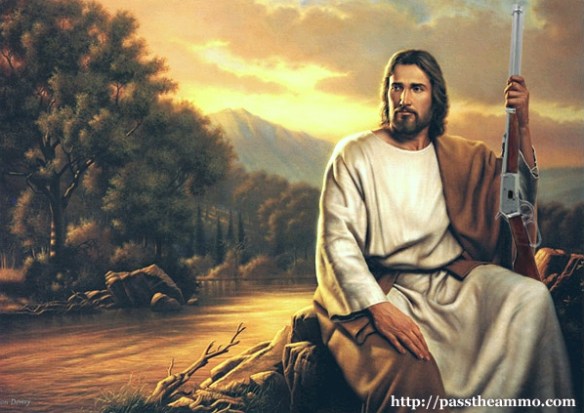
jesus, armed

French mentions that the disciples of Jesus carried weapons, and that they did it on his command. And hey, he’s right. In Luke 22 Jesus does, in fact, tell his followers to purchase some swords.

Then said he unto them, But now, he that hath a purse, let him take it, and likewise his scrip: and he that hath no sword, let him sell his garment, and buy one.

Let’s put aside the argument that in the original Attic Greek (the language in which the Gospel of Luke was written) there’s some dispute whether there’s actually any mention of a ‘sword’ at all. According to Strong’s Concordance, the Greek word μάχαιρα is the term under discussion. That apparently translates into machaira, which leads to the question: just what the hell is a machaira? Homer (yes, that Homer — the guy who wrote the Iliad and the Odyssey) described a machaira as a knife; Xenophon (another ancient Greek) indicated it was a long knife or short sword useful for cavalry. Both of those men lived a few centuries before Jesus was born, and nobody seems really sure what was considered to be a machaira at the time Luke was written (which was around a century after Jesus died). But for the sake of this discussion, let’s agree to assume it’s a sword.

So the question you have to ask is why? Why did Jesus want his followers to have swords? French would have you believe the answer is self-defense. But if that was the case, why would Jesus think two swords was enough to defend thirteen people?

And they said, Lord, behold, here are two swords. And he said unto them, It is enough.

Jesus may not have been a great military commander, but he wasn’t stupid. He had to know two swords in the hands of his untrained followers would be useless against Roman legionnaires. So why would he think two swords were enough for his purpose?

It would depend on what his actual purpose was. If you’re a Christian, I’d suggest the answer lies in the passage that lies immediately between the two I just quoted:

For I say unto you, that this that is written must yet be accomplished in me, And he was reckoned among the transgressors: for the things concerning me have an end.

In other words, in order to fulfill the scriptures Jesus had to be viewed as a transgressor and arrested. It seems likely he intended to provoke the authorities into arresting him. He’d done something similar a few days earlier; that fuss with the money-changers in the Temple was clearly a provocation. Wandering around with some armed followers could be an effective way of getting the Romans to act.
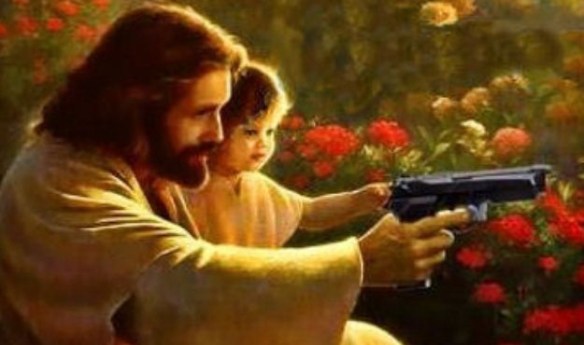
jesus, child, and glock

If Jesus had intended the swords to be used in self-defense, then he wouldn’t have prevented them from actually being used for self-defense — which is exactly what he did later that evening. When the Romans came to arrest him, one of his disciples drew his weapon and separated a slave from his ear.

  And, behold, one of them which were with Jesus stretched out his hand, and drew his sword, and struck a servant of the high priest’s, and smote off his ear.
Then said Jesus unto him, Put up again thy sword into his place: for all they that take the sword shall perish with the sword.
Thinkest thou that I cannot now pray to my Father, and he shall presently give me more than twelve legions of angels?
But how then shall the scriptures be fulfilled, that thus it must be?

Again, Jesus is saying he has to be arrested and punished in order for the scriptures to be fulfilled. The swords weren’t for fighting; they weren’t for self-defense; they weren’t for personal protection. If he needed personal protection, he says he could hit up God for a dozen legions of angels. That’s a LOT of angels. So it seems probable the swords were intended to incite the authorities to act. A lot of non-violent religious leaders have used similar tactics — Gandhi forced the British to arrest him, Martin Luther King forced the police to arrest him.

It’s also worth recalling that after his disciple smote off the slave’s ear, Jesus re-attached it. Still later, when he’s presented to Pontius Pilate to answer for his ‘crimes,’ Jesus specifically says his followers are not fighting and defending themselves. Pilate asks him if he’s the King of the Jews. And what did Jesus say?

Jesus answered, My kingdom is not of this world: if my kingdom were of this world, then would my servants fight, that I should not be delivered to the Jews: but now is my kingdom not from hence.

If my kingdom were of this world, then would my servants fight. That seems pretty clear. At no point in the Bible does Jesus ever advocate violence; not in self-defense and certainly not in defense of property.

  But I say unto you, That ye resist not evil: but whosoever shall smite thee on thy right cheek, turn to him the other also.

And if any man will sue thee at the law, and take away thy coat, let him have thy cloke also.

Nonviolence, even in the face of monstrous brutality, was the hallmark of early Christianity. All those early Christian martyrs didn’t inspire their followers by going all Bruce Willis on the Romans. They did it by courageously applying their faith even when it meant their certain death; even when it meant the deaths of their loved ones.

David French, in his article, says:

The idea that one is required to surrender his life — or the lives of his family, neighbors, or even strangers — in the face of armed attack is alien to scripture.

Sorry dude, it’s not only NOT alien to scripture, it’s essential to scripture. It’s fundamental to Christianity. If French wants to ignore the New Testament in favor of the much harsher Old Testament, I’m okay with that — so long, of course, as he’s consistent and is willing to exact appropriate punishment for folks who refuse to leave grapes in their vineyard for the poor to gather (Leviticus 19:10) and makes immigrants as welcome as natives (Leviticus 19:34).

But if he’s going to bring Jesus into it, I think he’d do well to actually read what Jesus is supposed to have said and believed:

  Thou shalt love thy neighbour as thyself. There is none other commandment greater than these.

And the scribe said unto him, Well, Master, thou hast said the truth: for there is one God; and there is none other but he:

And to love him with all the heart, and with all the understanding, and with all the soul, and with all the strength, and to love [his] neighbour as himself, is more than all whole burnt offerings and sacrifices.

And there it is. It’s pretty pathetic that a non-Christian should have to remind David French of that.
the integrity of theft

Whenever somebody asks me about ‘my work’ I automatically assume they’re talking about writing, not photography (although it now occurs to me that I almost never discuss writing on this blog — which is probably something I’d think about if I was even remotely self-reflective). I don’t think of photography as ‘my work.’ I don’t even think about it in terms of ‘my photography.’ I think about it as ‘the photographs I shoot,’ which is a subtle but meaningful distinction. At least it’s meaningful to me.

Don’t get me wrong; I take photography seriously. I just don’t take myself seriously as a photographer. So it feels odd to me to write about the photographs I shoot. But a few days ago I mentioned I received an email in which I was asked the following questions:

I guess what I’m asking is how do you develop a personal photography project? Do you just pick a thing and start taking picture of it? Do you make up rules or guidelines before you start? How do you start a photography project?

I decided to take the questions seriously and try to answer them — at least insofar as the three photo series I’ve included on this site. Last time I talked about the Traffic Signals series. Today I’m going to explain the origins of the Faux Life series.

My blindness to what was going on, led me to act by them in a way that I must always be ashamed of, and I was very foolishly tempted to say and do many things which may well lay me open to unpleasant conjectures....

My blindness to what was going on, led me to act by them in a way that I must always be ashamed of, and I was very foolishly tempted to say and do many things which may well lay me open to unpleasant conjectures….

I blame Richard Prince. If you’re not familiar with Prince, he was the first photographer whose work sold for more than a million dollars. What made that amount even more staggering is his work was also the work of commercial photographer Sam Abell. Does that sound confusing? That’s because it is.

Sam Abell photographed the famous Marlboro Man advertisements. What Richard Prince did was re-photograph some of those advertising images. He removed the text, printed them very large, then presented them as a comment on American culture.

Afterwards he got worse, and became quite my shadow.  Many girls might have been taken in....

Afterwards he got worse, and became quite my shadow. Many girls might have been taken in….

Some folks would call that theft; Prince called it appropriation art. The idea is that by removing the image from its original context, new layers of meaning can be attached to the work. Abell’s original photograph was intended to create an association between Marlboro cigarettes and the robust life of a manly cowboy living and working in an idealized vision of the Old West. It was, in effect, a lie. A double lie, in fact. It not only associated smoking with a healthy lifestyle, it also invoked a nostalgic vision of an American West that never really existed. It was a lie used to sell cigarettes.

Richard Prince removed the Marlboro Man from that original context. In doing so, he gave the photograph a radically different interpretation and a different meaning. It became a comment on commercialism. The viewer has a different experience when looking at the re-photographed photograph — he’s no longer being sold a product, he’s being introduced to the idea of using romance as a marketing tool. Prince would argue that this, in effect, makes it a different photograph.

The key was in the door, and she had a strange fancy to look into it; not, however, with the smallest expectation of finding anything, but it was so very odd, after what Henry had said.

The key was in the door, and she had a strange fancy to look into it; not, however, with the smallest expectation of finding anything, but it was so very odd, after what Henry had said.

That concept — that simply by shifting the context of an image it can be turned into an entirely new image –fascinated me. It still does, in fact. I’m appalled that Prince made millions of dollars off Abell’s work, but I have to admit that even though the photographs of Abell and Prince are essentially the same, they DO have a different meaning — and Prince’s image is more interesting.

Anxious and uneasy, the period which passed in the drawing-room, before the gentlemen came, was wearisome and dull to a degree that almost made her uncivil.

Anxious and uneasy, the period which passed in the drawing-room, before the gentlemen came, was wearisome and dull to a degree that almost made her uncivil.

I decided I wanted to play around with the concept of appropriation art. By coincidence, as I was knocking around ideas for an appropriation project, Buffy the Vampire Slayer came on television. I’m a long-time, devoted fan of the Buffy television series. It occurred to me that Joss Whedon had, in effect, appropriated the vampire concept and turned it on its head by shifting the role of vampire slayer from the traditional virile and sober-minded male to a bubble-headed Valley Girl cheerleader. The television show used the tropes of vampire movies to examine the life crises of high school students.

He had suffered, and he had learned to think: two advantages that he had never known before; and the self-reproach arising from the deplorable event in Wimpole Street, to which he felt himself accessory by all the dangerous intimacy of his unjustifiable theatre, made an impression on his mind....

He had suffered, and he had learned to think: two advantages that he had never known before; and the self-reproach arising from the deplorable event in Wimpole Street, to which he felt himself accessory by all the dangerous intimacy of his unjustifiable theatre, made an impression on his mind….

So I decided to steal Buffy. I mean appropriate Buffy. But I discovered it wasn’t enough to extract one particular moment from a television episode. It wasn’t enough to shift color photography to black and white. It wasn’t enough to manipulate the shadows. That certainly changed the image, but it didn’t really add any meaning to the image.

It needed something else. And by still another coincidence, I was engaged in an ongoing discussion with a friend about the novels of Jane Austen. I was arguing that you could read her novels as detective stories in which the modern notion of crime was replaced with social deviance. Murder was replaced by incivility. Jane Austen’s protagonists were all keen observers of life, all had a detective’s eye toward detail.

We cannot help ourselves. We live at home, quiet, confined, and our feelings prey upon us.

We cannot help ourselves. We live at home, quiet, confined, and our feelings prey upon us.

So there it was. I would steal an out-of-context moment from Buffy (or the spin-off series of Angel), then I would steal an  out-of-context line from a Jane Austen novel, after which I’d combine them with the intent of creating something altogether new. I hoped to give a new meaning to both the image and the text.

It was a lot harder than I thought it would be. I wanted to catch moments of visual drama. I wanted there to be some compositional tension within the frame. But I also wanted to be sure the faces of the characters were obscured. If the viewer sees Buffy, I reasoned, then the photograph becomes all about Buffy. There was, as you can imagine, a great deal of Photoshop work involved.

Once I had the photograph, I needed to search the novels of Jane Austen to find an appropriate line. It had to be a line that, when associated with the photograph, would convey a completely different meaning than it did in the story. And yet the line still had to be congruous with the image.

It took a lot of searching. Jane Austen did not write short novels.

The invitation was refused.

The invitation was refused.

There are now just over thirty photographs in the series. That seems like a nice size for a project. I keep thinking about returning to the series and adding new images, but it would just be for my own amusement. As an experiment in appropriation art, the series is complete. I did what I wanted to do, I’ve learned what I wanted to learn.

The project convinced me that appropriation is a valid art technique. It’s certainly ethically dodgy if the appropriator is making buttloads of coin off another person’s original work. But the technique of appropriation itself has artistic integrity.

Or at least that’s what I tell myself.

what you need to ignore for this to work

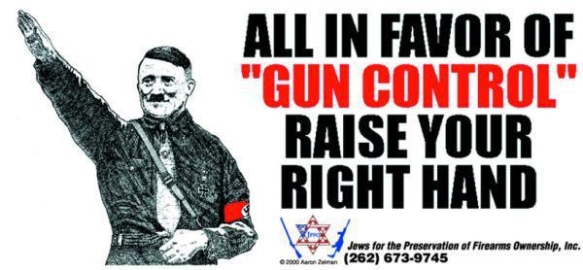
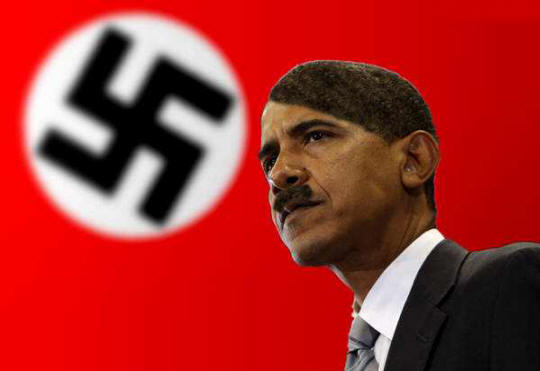
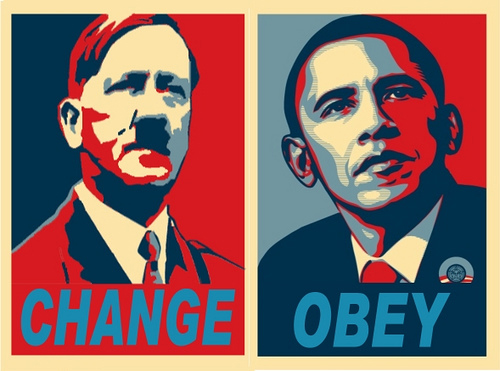
I keep seeing phenomenally stupid shit like this from Second Amendment absolutists. Hitler imposed gun control, then created a totalitarian state and killed everybody!! Obama wants to impose some gun control measures!! Obama and Hitler are exactly the same!!!

hitler gun control

Let me just say I have nothing personal against stupid people. Some of my best friends are stupid. On occasion, I’ve been known to be stupid my ownself. But Jeebus on toast, guys, does anybody really need to be THIS stupid?

See, here’s the problem with the whole ‘Hitler imposed gun control’ meme. In order to make that claim, you have to ignore a LOT of the historical record. Document archives,  contemporaneous newspaper articles, history books — you just have to ignore them. All of them. You have to ignore a buttload of stuff that happened even before Adolf Hitler came to power. And then you have to ignore what Hitler actually did. That’s a whole lot of serious ignoring.

obama hitler 2

For example, you have to ignore the basic fact that Germany lost World War One. The Great War. The War to End All Wars. You know…the war you saw in Season Two of Downton Abbey. You have to entirely ignore the fact that the Treaty of Versailles imposed strict limitations on the German military AND on the amounts and types of weapons that Germans could own, as well as regulating shooting clubs. To comply with that treaty, the post-war German government passed the Regulations on Weapons Ownership act, which declared:

“[A]ll firearms, as well as all kinds of firearms ammunition, are to be surrendered immediately.”

Got that? All firearms and all ammunition. Surrendered. Immediately. Now that’s some serious gun control, right there. But you have to ignore that for this ‘Obama is Hitler’ business to work.

A decade later, in 1928, some of those restrictions were eased. The German government passed the Law on Firearms and Ammunition, which allowed German citizens to possess personal firearms. But they didn’t make it easy. You had to obtain a permit to own a gun. You had to obtain another permit to sell a gun. You had to have a different permit to carry the gun. And, of course, all of those guns had to be registered. But you have to ignore all of that, remember, if you want to buy the Obama = Hitler concept.

obama hitler

So there was all of that gun control, and Adolf Hitler had nothing to do with it. Hitler didn’t become Chancellor of Germany until 1933. Did he then impose stricter gun control? Nofuckingway. He relaxed them. Well, only for members of the Nazi Party, true. They no longer needed a permit to buy or carry a handgun. But it was the first step.

Hitler did nothing else for five years, then in 1938 the Nazis passed the German Weapons Act. Gun control, right? Nofuckingway. The new law eased gun restrictions even more. The law reduced the legal age for gun ownership from 20 to 18 years. It no longer required German citizens to obtain a permit to buy and possess rifles and shotguns. Permits to carry those weapons were extended from one to three years. All limits on the number of weapons or the amount of ammunition were eliminated. Firearms still had to be registered, but now any German citizen could get one. But you have to ignore all that, remember, to meet the ‘Obama and Hitler, brothers in gun control’ notion.

Later in 1938, the government enacted the Regulations Against Jews’ Possession of Weapons Act, which essentially prohibited Jews — even those who were citizens of Germany — from owning weapons. Yay, finally something Second Amendment absolutists don’t have to ignore. Gun control!

Of course, they still have to ignore the fact that by that time Jews were also prohibited from being employed by the government, from practicing law, from practicing medicine on Gentiles, from teaching, from marrying or having sexual relations with persons of ‘German or German-related blood,’ from holding public office, from serving in the military, from voting, from being citizens. Not to mention the fact that Jews were required to carry special Jewish identity cards and wear yellow stars on their clothing. Denying them access to firearms was just one of the rights Jews were denied. That stuff, you have to ignore in order to play ‘Obama, Hitler — what’s the difference?’.

obama hitler again

Second Amendment absolutists would have you ignore the historical record and believe Adolf Hitler imposed strict gun control on the German citizenry. They’d have you believe Hitler was able to become the supreme leader of Germany because the populace had been disarmed. They’d have you believe that if the people of Germany had been armed, the Holocaust would never have happened.

That’s complete and utter bullshit. Adolf Hitler became the supreme leader of Germany because the German people adored him and elected him. He didn’t slaughter millions of innocent people because they were unarmed; he slaughtered them because the citizenry allowed him to do it. And while Hitler did forbid Jews and communists and Romani people from owning weapons, that was just one of the human rights they were deprived — all with the  consent of the people.

But you need to ignore all that in order to accept Obama as Hitler.

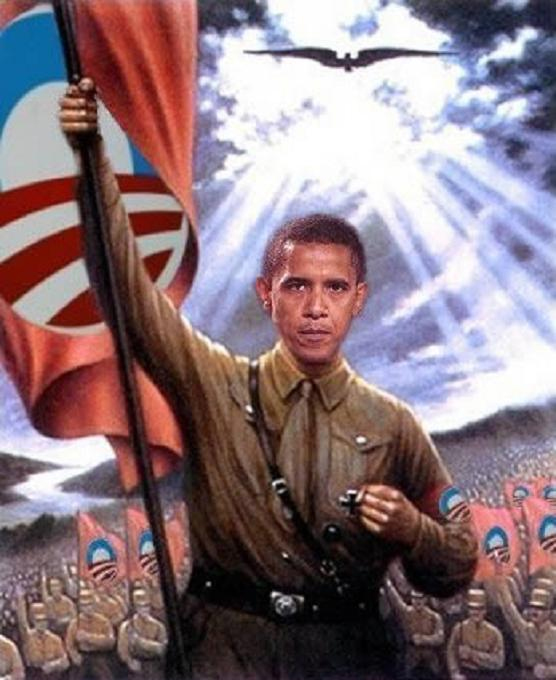
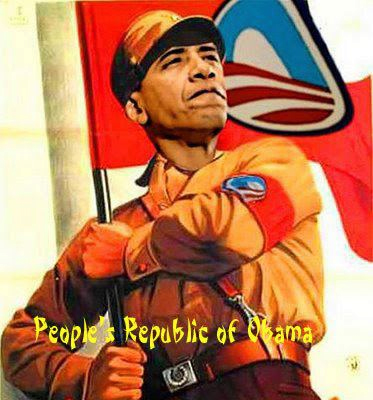
obama nazi

To compare President Obama’s small, sensible steps toward some minimal firearm safety legislation to Hitler’s practices isn’t just offensive, it’s profoundly stupid. It’s stupid on several levels. And somewhere around the lowest level of stupid, you find the folks who aren’t even able to keep their totalitarian dictatorships straight. Like in the poster above. Obama as a  Sturmabteilung brownshirt along with a faux Chinese font intended to be suggestive of Maoist Marxist-Leninism? Really?

For fucks sake, people, a little totalitarian consistency — is that really too much to ask? There’s got to be a limit to how much you can expect people to ignore.

in which i answer a question about photo projects

Because I’m the Managing Editor of Utata.org, I get a hefty chunk of photography-related email. Most of it has to do with photography exhibitions, or photography books, or questions about Utata photo projects. Relatively little of my email deals with my own views on photography. But a few days ago I got an email that included the following questions:

I guess what I’m asking is how do you develop a personal photography project? Do you just pick a thing and start taking picture of it? Do you make up rules or guidelines before you start? How do you start a photography project?

I started to write back and basically say ‘Dude, I don’t have a clue how to start a project.’ But that sounded pretty stupid. The more I thought about it, the more I realized I must have some vague notion of how to go about it. I mean, I’ve done a number of photo projects. They couldn’t have all happened by accident. Could they?

So over the last few days I’ve found myself sporadically thinking about projects. This is what I discovered: each of the three projects I’ve included on this site (I have other photo projects; I just haven’t published them here) began in a different way. And since I do not want to write another post about guns, I’ve decided to write something about each of those three projects.

later i saw a red-haired woman in a blue sundress

later i saw a red-haired woman in a blue sundress

I’m going to begin with the Traffic Signals series, because it’s the simplest. Well, that’s not true — the Larking About in Alleys series is actually the simplest. But Traffic Signals is the oldest of the three projects. And, of course, I just checked and found that Faux Life is older by a year. But fuck it, I’m going to talk about Traffic Signals anyway.

The project as it exists now actually began with a different project. The Utata Storytellers Project of 2009 required us to make up to six photographs in which we would relate a story. We were only allowed a maximum of 35 words per photo. I kicked around a number of ideas for the gig, but came across my final project idea rather by accident.

the unquiet sky, shy as an alligator

the unquiet sky, shy as an alligator

I was standing at a crosswalk with some other pedestrians. There was a buzzing sound coming from the traffic signal. That buzzing ceased (or at least reduced in volume) when the light changed and we were allowed to cross the street. It struck me as odd and more than a little funny. It was as if the traffic signal was also sending out audible cues.

So I concocted a little talein which a person believed he was being given messages through the traffic lights and pedestrian signals. It’s called After the Bombs Dropped. For the photographs, I used an app called Poladroid, which mimics Polaroid photography. I thought it added a more authentic feel to the story.

angry birdsWhen the project was finished, I found I was still intrigued by traffic signals. I was fascinated by the fact that so many people — both drivers and pedestrians — obeyed them, even when there wasn’t any traffic on the streets. And yet even though they obeyed the signals, people never really looked at them. And they were everywhere. Everywhere.

So I kept photographing them. On the set in my flickr photostream, I continue to use the Poladroid app for the images. That aesthetic still appeals to me. But for my personal files (and here on this site) I use the app but dispense with the faux Polaroid border — primarily because the border looks goofy here. (It may look goofy on flickr as well, but hey — that’s flickr.)

restless

restless

I like to think the series is deceptively simple. As I said, traffic signals are everywhere. But while they’re ubiquitous, they’re not necessarily visually interesting. Most aren’t.

I’ve come to appreciate how difficult it is to photograph traffic signals in a way that creates a sense of drama. It’s not about documenting traffic signals; it’s about imparting a sense of tension within the frame.

it was a mistake to call her

it was a mistake to call her

I’m not always successful. But the challenge keeps me interested in the project. It also, I have to confess, annoys anybody I’m in a car with when I insist they either stop the vehicle or let me out and drive around the block until I get the photo.

It’s not quite an obsession, but it has an obsessive component to it. And happily the world is full of traffic signals, so it’s unlikely I’ll run out of material.

a quick response…

…to the guy (I assume it’s a guy) who sent me an email me saying

[T]here’s nothing paranoid about standing up against tyranny. obama is paranoid about an armed citizenry and wants us disarmed.

Dude, look up ‘tyranny’ in the dictionary. The fact that you can, without fear of reprisal, publicly call the President of the United States a tyrant is confirmation that you’re NOT living under tyranny. The fact that on Gun Appreciation Day groups of people all over the United States were able to peaceably assemble in public and openly denounce the elected leader of the nation in the most objectionable terms is a testament to the fact that you’re not living under tyranny.

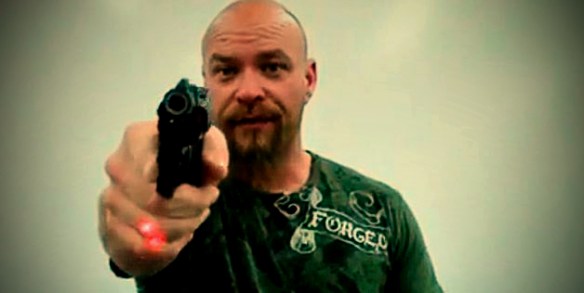
james yeagerThe fact that THIS guy is still free to walk the streets and continue to post videos and own firearms (even if he’s not legally allowed to carry them concealed at the moment) is verification that you’re not living under tyranny.

And another thing — the fact that you think you’re living under tyranny is evidence that you’re paranoid.


paranoia and romantic defiance

It was an odd day, to be sure. It certainly highlighted the centrality of guns in the minds of many US citizens. Even the name of the event — Gun Appreciation Day — struck a strange chord. These are the folks who tell us guns are tools — and you can’t blame the tool, they say, for how a person uses it. But we’ve never had a Drill Press Appreciation Day, or a Chainsaws Across America rally. The name itself is evidence that guns are different. They’re not just tools. Not even close.

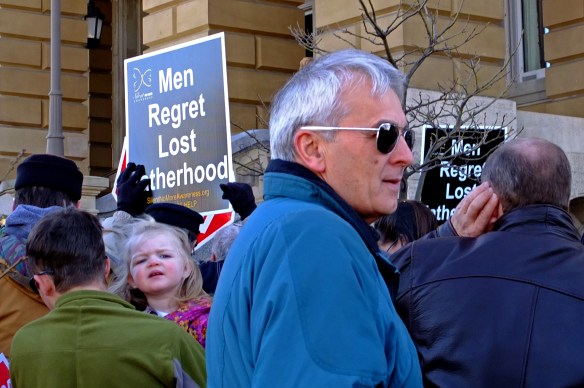
My cousin and I attended the local Gun Appreciation Day event, which was held on the grounds of the State Capitol building. We arrived about half an hour early and joined the crowd that had already gathered. It wasn’t quite what we’d expected — mostly white, middle-class families with young kids. Even more surprising, the gender distribution was about equally divided — nearly as many women as men. Everybody was dressed neatly in a style I think of as ‘conservative casual.’

lost fatherhoodIt was the Pro-Life rally demonstrating on the anniversary of the passage of Roe v. Wade. The Pro-gun rally was a wee bit farther away, on a different terrace.

There was no crowd at the pro-gun rally — not at first. There were a few men sort of scattered about the area, standing alone or in pairs. I wandered around until I found one of the event organizers, who pointed out the designated assembly spot. I then played border collie for a bit, herding some of the early arrivals to the rally point.

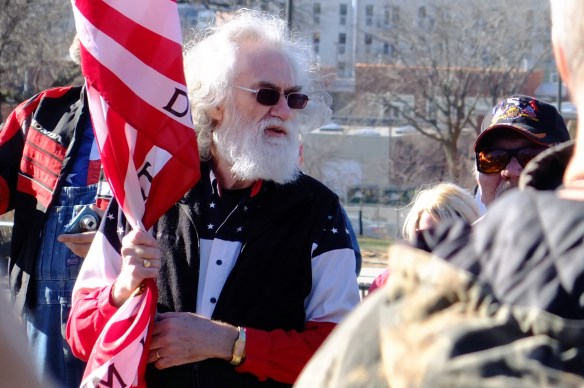
old guy with flagA sizable crowd did eventually gather. I estimated the crowd to be maybe three hundred people. The organizers have claimed an attendance of over six hundred. Maybe more showed up after I left.

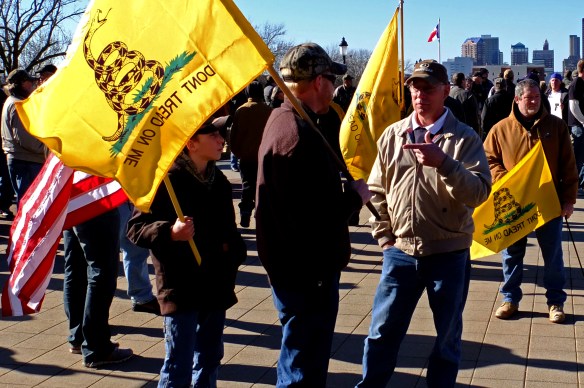
These were the people I’d been expecting to find at Gun Appreciation Day. Almost exclusively male, almost exclusively white (though to be fair, this is Iowa — so ‘almost exclusively white’ is sort of redundant). Lots of camouflage jackets, lots of ball caps with NRA logos or the icons of sports teams. Lots of beards. Lots of stoic faces. Lots of flags. Several American flags, a scattering of Naval jacks, and lots of Gadsden flags (the yellow Don’t Tread on Me flag designed during the American Revolution by Christopher Gadsden).

dont tread times threeFor the most part, people were awfully quiet waiting for the rally to begin. These were the sort of men who are reluctant to start a conversation with another guy — a guy they don’t know. Once you got them talking, though, they were uniformly cheerful and friendly. In a way, these guys weren’t very different from, say, collectors of Beanie Babies or Star Trek memorabilia. If you engaged them in a conversation about guns, they were positively chatty. At the merest mention of black powder muzzle loaders or the relative merits of a 16 inch upper barrel receiver for an AR-15, these guys would happily natter away for hours.

You expect peculiarities at any gathering of people with esoteric interests. On one level, these guys were no more eccentric than a gathering of the Society for Creative Anachronism or the Baker Street Irregulars. On another level, of course, these folks are radically different. And that difference, in my opinion, lies in a strange mixture of paranoia and romanticism.

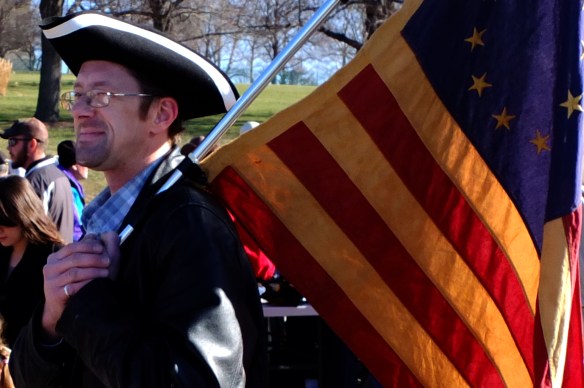
tricornFrom the comments I heard from the people in the crowd, and from the speeches given by the organizers, it seems clear many of these folks are driven in large measure by the romantic mythos of the ‘frontiersman.’ The mythos is rather contradictory — it involves a lone man, but one with a family that requires protection from savages. It’s all about self-sufficiency, but self-sufficiency within a network of similar ‘lone men with families’ who all bond together in times of need.

In this mythos, the frontiersman acts as both a stepping-stone and a bulwark between the wilderness and civilization. The uncivilized frontier is dark and full of danger, but the frontiersman manfully shoulders the burden of protecting civilization while being partially shunned by it. Whether it’s Natty Bumppo in The Last of the Mohicans or Aragorn in The Lord of the Rings or the Jack Nicholson character in A Few Good Men, the frontiersman stands at the border of a dangerous world and defends those who can’t or won’t defend themselves — women, children, and men who aren’t suited or capable of doing a man’s job.

There’s also the romance of defiance at work here. The concept of standing up against tyranny is very attractive, of course. But the rallying cry of “You can have my gun when you pry it from my cold dead hands” is only meaningful if somebody is actually trying to take your gun. If not, then it’s just sad and pathetic blustering.

There was a great deal of bluster in the speeches yesterday. There they stood, those gallant speakers, on the grounds of the State Capitol, having been issued a permit by the government to hold a rally in which they could give speeches describing their courageous stance against governmental tyranny. They were, in effect, exercising their Constitutional rights by freely and publicly stating they were being denied their Constitutional rights.

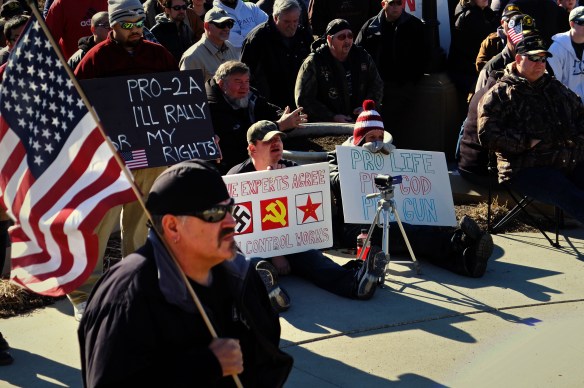
pro life pro god pro gunAlthough I’m convinced a deep strain of heroic romanticism influenced a lot of the folks at Gun Appreciation Day, there was also a more disturbing facet — paranoia. There was a pervasive sense of fear among many of these people. They seem to truly believe they are under attack — that somebody is actively seeking to do them harm, that somebody is out to get them in some way. There was a stone-solid conviction among the people at the rally that they absolutely needed multiple firearms with high capacity magazines to protect themselves from…well, from lots of things. Despite all their protestations of courage, the heart of their argument is grounded in fear.

They’re afraid somebody will attack them in their homes. Not just somebody, but several somebodies. One woman at the rally said limiting ammunition magazines to ten rounds would would make it difficult to defend her family against multiple intruders. They’re also afraid somebody will attack them on the street, so they need to be armed all the time.

greatest dangerThey’re afraid in their homes, they’re afraid on the streets, and they’re afraid of their own government. Those fears seem primarily grounded in wild suppositions about what the government might do and incorrect information about what the government has actually done.

They carried signs proclaiming Those who make peaceful revolution impossible make armed revolution inevitable. They carried signs with fictional quotations by Thomas JeffersonThe strongest reason for people to retain the right to keep and bear arms is, as a last resort, to protect themselves against tyranny in government. Paranoia combined with romantic defiance against a threat that doesn’t exist — it’s an unhealthy but intoxicating mix.

But perhaps the strangest thing about the day is this: I was certain that many of the people at the rally were carrying concealed weapons. The organizers think as many as half of the people there were armed. That’s probably an exaggeration, but even if only a quarter of them were carrying, that’s a LOT of guns.

red white blueAnd yet I didn’t feel particularly safe. To be fair, I didn’t feel particularly at risk either. I’m pretty sure, though, that if a shot was fired at that rally, an awful lot of innocent people would have been wounded — and possibly killed — in the chaos of the returning fire.

It was an odd but instructive day. I rather doubt I learned what the organizers of Gun Appreciation Day would have wanted me to learn, but I left the rally feeling all the more convinced of the need for sensible gun control legislation.

finger demons

“There is evil prowling in the world…”

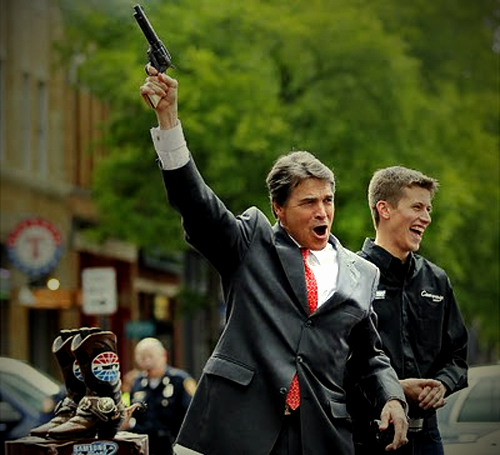
Evil, you guys! Evil, right out there in the world, just a-prowling along, according to Rick Perry, the Republican Governor of Texas. You can be assured, Gov. Perry knows evil when he sees it, and he knows where it comes from: it comes from demons.

“Guns require a finger to pull the trigger. The sad young man who did that in Newtown was clearly haunted by demons.”

Demons, you guys! Demons in that kid’s trigger finger! Can you eradicate demons with laws? Why no, you cannot. But so long as demons inhabit the trigger fingers of weak and wicked people who have access to innocent firearms, something must be done. We cannot stand idly by and allow these horrific finger-related tragedies to continue. Gov. Rick Perry, Texas Republican, knows how to fight demons:

“Let us all return to our places of worship and pray for help. Above all, let us pray for our children.”

I know. I know you were expecting Gov. Rick Perry of Texas to take a more active stance against demonic-possessed trigger fingers. You were maybe expecting him to advocate amputation of the offending digit. So was I — I totally thought R. Perry, the elected Republican Governor of Texas, was going to be all “Off with their fingers!” But no. Texas Gov. Perry is taking a more modest, non-confrontational approach. We can pray the demons right out of those fingers. You know…to protect the children.

Gov. Rick Perry of Texas and his demon-free Republican finger

Gov. Rick Perry of Texas and his demon-free Republican finger protecting children

In related news, tomorrow is the First Annual Gun Appreciation Day. Oh, we’re happy to show how much we care about the victims of finger-demon violence, but Americans have been reluctant to demonstrate just how much we esteem and cherish guns. That ends tomorrow, you guys.

gun appreciation day

Some of you may feel it’s inappropriate to hold Gun Appreciation Day 48 hours before Martin Luther King Day. But Larry Ward, the singular genius behind Gun Appreciation Day, is convinced Dr. King would be totally honored by having his birthday associated with Gun Appreciation Day. In an interview on CNN, Ward (and I don’t know his political affiliation, but I’m willing to guess he’s a Republican — though he may not be from Texas) said this:

“I think Martin Luther King, Jr. would agree with me if he were alive today that if African Americans had been given the right to keep and bear arms from day one of the country’s founding, perhaps slavery might not have been a chapter in our history.”

You guys, if he hadn’t been shot down in cold blood is there any doubt that Martin Luther King would agree that had slave-owners issued firearms to their slaves, then maybe slavery wouldn’t exist and lawdy I think I got stupider just writing that.

Larry Ward is one of the most passionate, if inarticulate, spokesmen for responsible gun ownership. In the following interview with a citizen-journalist, Ward argues:

“[W]e can’t stop them from grabbing a weapon and walking into a school or a private place or a post office or a mall.”

By ‘them’ Ward means felons and the mentally ill (and presumably people possessed by finger demons, though he failed to address that particular issue). And because we can’t stop them, there’s no point in passing legislation that might stop them. Obviously. Here’s the interview:

He’s pretty charismatic, that Larry Ward, isn’t he. You’re probably thinking tomorrow’s Gun Appreciation Day will be massively popular with everybody. But no! You guys, there are people out there who apparently don’t appreciate guns. Seriously, I’m not making that up. In fact, a group called United for Change USA has offered a petition to prevent Gun Appreciation Day from taking place. In their petition, they say:

This is an outrage and a slap in the face to Americans who value life and freedom!

Clearly, the best way to respond to a slap in the face to Americans who value life and freedom is to prevent people you disagree with from expressing their point of view.

I may attend the local Gun Appreciation Day event tomorrow. Not because I appreciate guns all that much, but because I appreciate free speech a lot. But first I’ll need to wrap my fingers in tin-foil dipped in holy water. I don’t want any pesky finger demons to disrupt my appreciation of guns.

by any means necessary

Tomorrow President Obama is supposed to announce his new gun policy proposals. Yesterday, Steve Stockman (why yes, he IS a Republican from Texas) objected to those new proposals — whatever they are.

Yes, you read that correctly. Texas Republican Steve Stockman is objecting to the proposals President Obama hasn’t yet made. I guess he doesn’t want to wait until the last minute to start his objecting. Texas Republican Steve Stockman is so incensed by the proposals the president hasn’t yet made that he’s threatening to defund the White House and to file articles of impeachment.

In his press release, Stockman says “The President’s actions are an existential threat to this nation.” He warns that he “will seek to thwart this action by any means necessary.”

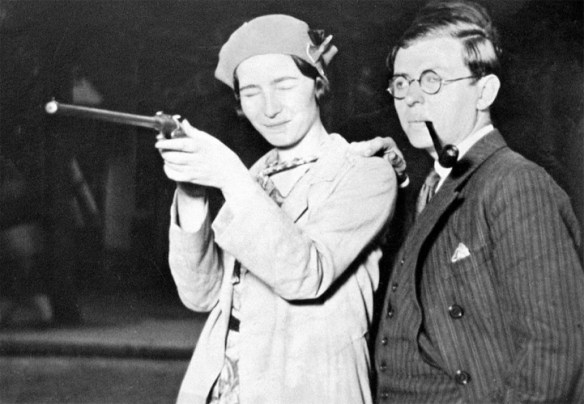
Texas Republican Steve Stockman (No, wait...that's Jean-Paul Sartre...sorry)

Texas Republican Steve Stockman (No, wait…that’s Jean Paul Sartre…sorry)

By any means necessary. That’s an interesting phrase, isn’t it. Sartre said it first, though I’m not sure if Sartre and Stockman would agree on gun control.

“I was not the one to invent lies: they were created in a society divided by class and each of us inherited lies when we were born. It is not by refusing to lie that we will abolish lies: it is by eradicating class by any means necessary.” — Jean Paul Sartre

Texas Republican Steve Stockman — probably not really into eradicating class. Just a guess on my part.

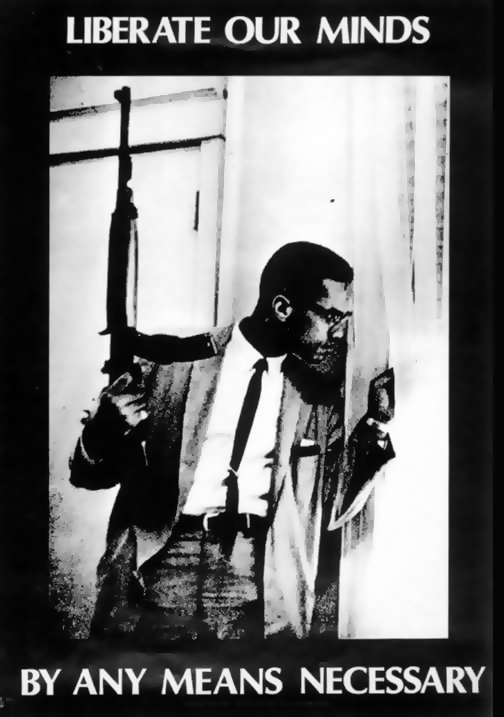
The phrase was repeated by Malcolm X, who oddly enough probably would agree with Stockman on gun control, though I doubt Stockman would be comfortable living next door to Malcolm X.

Texas Republican Steve Stockman (No, wait...that's Malcolm X...sorry)

Texas Republican Steve Stockman (No, wait…that’s Malcolm X…sorry)

“We declare our right on this earth to be a man, to be a human being, to be respected as a human being, to be given the rights of a human being in this society, on this earth, in this day, which we intend to bring into existence by any means necessary.” — Malcolm X

Texas Republican Steve Stockman — probably not really interested in Malcolm X’s rights as a human being. Just a guess.

Malcolm wanted black folks to be armed. Probably to protect themselves from people like Texas Republican Steve Stockman. It was in response to the Black Panther Party acquiring military-style weapons and brandishing them in public that some of the most stringent gun control measures in modern U.S. history were passed. Don Mulford, a conservative Republican state assemblyman in California, proposed legislation prohibiting the carrying of a loaded weapon in any California city. Republican Governor Ronald Reagan happily signed the law. Imagine a law like that being proposed today (or tomorrow, by President Obama).

Texas Republican Steve Stockman probably thinks Don Mulford and Ronald Reagan were socialists from Kenya. And maybe gay. Just a guess on my part.

Texas Republican Steve Stockman

Texas Republican Steve Stockman

Texas Republican Steve Stockman wants to be very clear about the seriousness of the danger posed by President Obama’s yet-to-be-announced proposals:

“The President’s actions are not just an attack on the Constitution and a violation of his sworn oath of office – they are a direct attack on Americans that place all of us in danger.” — Texas Republican Steve Stockman

Sartre, Malcolm X, Texas Republican Steve Stockman. By any means necessary. Great minds think alike.

Phenomenally stupid minds also think alike. Did I mention that Steve Stockman is a Republican from Texas?