I’ve written about the Iowa State Fair before, because c’mon — it’s the Iowa State Fair, and who doesn’t love a state fair? Or a county fair, for that matter.
People have been holding and attending fairs since the Romans invented them. They were astonishing assholes, those Romans, but you have to give them credit for spreading the concept of a fair all across Europe. Of course, they did that by conquering most of the various tribes of Europe. While I suspect those tribes would have preferred not being conquered to having a local fair, the fair is still a great idea.
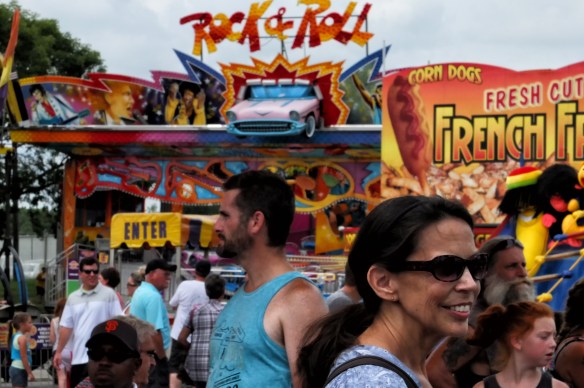
Rock & Roll
In concept, the Iowa State Fair continues to follow the Roman model. It’s a temporary event, it’s about gathering livestock for display and for sale, it’s about marketing of wares, it’s about entertainment of the masses, and it’s about giving young folks a way of meeting new young folks. It’s an amusing way for folks to buy a new goat and acquire a new pan while expanding the gene pool. Everybody wins — except for most of the folks who get caught up in tossing a ring at a milk bottle.
Expanding the gene pool.
If you’re one of those people who always categorize things into groups of threes (and it appears today I’m one of those people) there are three types of folks you’ll see at the fair. First, there are the folks who work there — the people who sell the food, the carnies who set up and operate the midway rides, the folks who sit in the information booths and tell you where you can find the bacon-wrapped barbecue ribs, the fair security staff.

Dishing up freshly made ice cream.
It’s got to be hard work — if only because even in the best of circumstances people tend to treat service workers terribly. I suspect it’s even worse at a state fair, if only because fairs aren’t known for their efficiency. That said, the woman in the image above was fast and friendly and made buying ice cream a pleasure.
There are also the people who are at the fair for exhibition purposes — the artisans who demonstrate arcane or traditional skills like blacksmithing, the kids who enter their goats and sheep and chickens and assorted livestock for judging, the dedicated hobbyists who show curious people how to go about carving a figure of a beaver using a small chainsaw.
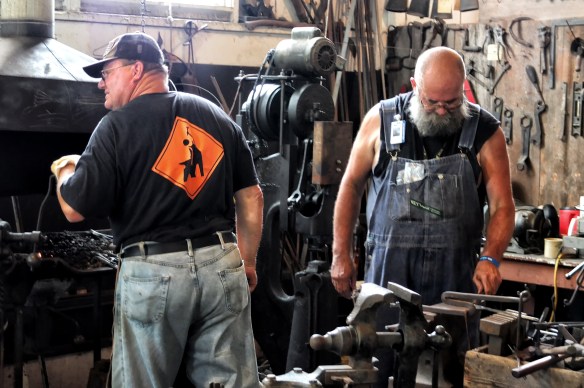
Blacksmiths doing blacksmith stuff.
One of my favorite things about attending the fair is seeing the farm families that come from all over the state to have their livestock judged. There’s something charming about it. These kids have raised their sheep and llamas and pigs, and they want to show them off. And during the ten days of the fair, a lot of them basically set up small camps in the barns.
There are separate barns for different species. There are a couple of horse barns, a sheep barn, a barn for pigs, another for cows. They’re massive, these barns. The horse barn is over 90,000 square feet with more than 400 stalls for horses. It also has showers (for people as well as horses). The sheep barn is even more massive — more than 140,000 square feet. You can pack a lot of sheep and people into 140,000 square feet.
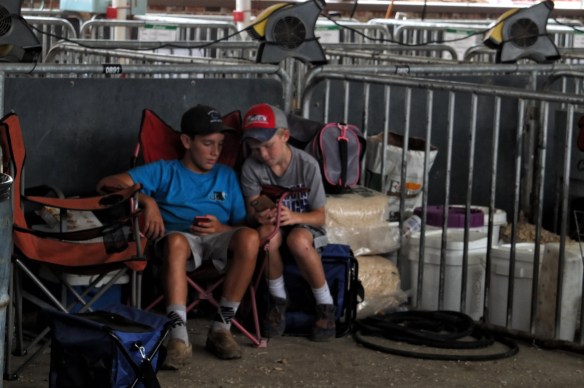
Pokemon among the sheep.
The exhibitors who stay in these barns do many of the same sorts of things they’d be doing at home. They catch Pokemon (the fairgrounds are littered with Pokestops), they take care of their livestock, they visit with their neighbors, they shop and eat, they hang out with friends, they…well, they expand the gene pool.
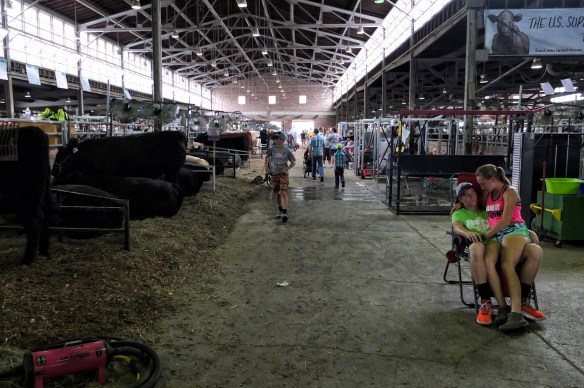
Canoodling in the Cattle Barn.

Hanging out in the Horse Barn.
But most of the folks you see at the Iowa State Fair are people like me. By that I mean visitors. People who aren’t employed by the fair or exhibiting something at the fair. Visitors are just there to have fun. We’re ordinary folks. We may be old folks or kids, we may be round or flat, we may be tall or short, but we’re all basically on the same old Roman (or Star Trek) mission: to explore strange new worlds, to seek out new life and new civilizations.
The Romans (and the peoples they conquered) might be astonished by the technology of the Iowa State Fair, but they’d recognize the atmosphere. One of the benefits of ancient fairs was it allowed for the dissemination of information. That still happens.
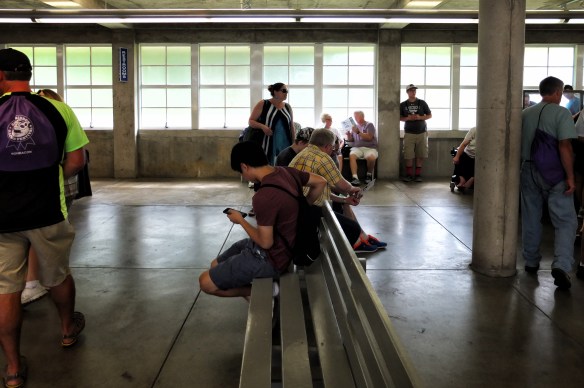
Consuming information.
I basically go to the Iowa State Fair for three reasons. Reason One: to eat the sort of food you know you should never eat on account of it’s SO bad for you. I’m talking about fried everything on a damned stick, probably wrapped in bacon.
Reason Two: to look at goats. Well, goats and llamas and weird chickens and rabbits the size of Jack Russell terriers and a really really really big pig. I’ve never lived on a farm so my experience with livestock is pretty much limited to looking at them in pens at the fair.
Reason Three: people. I like people. I like to watch them. I like to see a LOT of different sorts of people. I like to see those people reacting to other people.

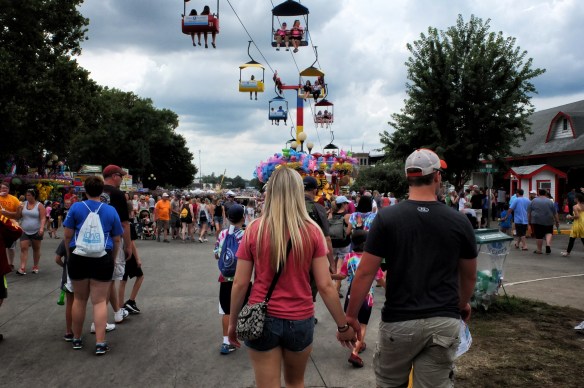
Waiting for the ride to begin.
There are some things people want to see more than other things. I mean, the number of fair-goers who want to see ornate, detailed dollhouses are minuscule compared to the number that want to see the fair’s Biggest Hog. I am NOT making this up, by the way. People line up every year to see the biggest hog. The pen holding the biggest hog is surrounded by a crowd. This year the pig was (and again, I’m not making this up) named Lug Nut. Or maybe Lugnut (it’s not clear, but because I think Lug Nut is more visually appealing, that’s what I’m going with). Lug Nut weighed in at 1148 pounds. I had to wait about ten minutes to get close to Lug Nut’s pen to actually see the beast. The photograph below was shot at about minute nine.

In line to see an exceedingly large hog.
There was a sign attached to Lug Nut’s pen warning people to keep their hands and fingers away from the pig. I can only guess Lug Nut would, if given a chance, eat the hands and fingers. You don’t get to 1148 pounds by being discriminating in your diet. (I have photos of Lug Nut, by the way — maybe I’ll do another installment.)
But as popular as the big hog is, there’s absolutely nothing at the Iowa State Fair that’s comparable to the popularity of the Butter Cow. Every year for over a century, the fair has found somebody to carve a cow out of butter. Since the mid-1990s, the Butter Cow has been accompanied by ‘companion’ butter sculptures. This year the cow was accompanied by butter figures from — and I swear I am NOT making this up — Star Trek. I’m serious. There’s a butter starship Enterprise and a butter Captain James T. Kirk (and maybe some other crew members). It actually makes a weird sort of sense. Kirk, after all, will be born in Riverside, Iowa in a couple hundred years
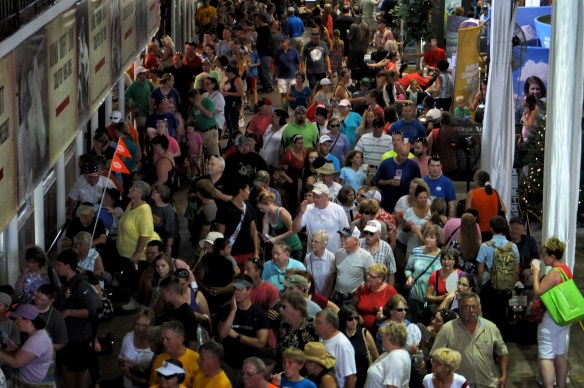
The line(s) to see the butter cow and butter Enterprise crew.
Not that I got to see the Butter Cow or Butter Kirk. As you can see, the line to view these treasures was Soviet long and moved at a Soviet pace (though it was somewhat more colorful that most Soviet-era lines). There were too many other things to see, too many other places to go — so I went and saw those things instead.
But that’s the nature of a fair, isn’t it. By design, there’s always something else to see and do. That’s what brings you back year after year, even if you’ve already seen it and done it before.. Let’s face it, if you’ve seen one huge pig, you don’t really need to see another — a huge pig is a huge pig is a huge pig, as the poet said. Last year’s prize apples and award-winning goat are pretty much going to be like this year’s apples and goats. Next year’s blacksmithing demonstration will be pretty much like this year’s, and the new Fried Thing On a Stick won’t be radically different from the current Fried Thing On a Stick.
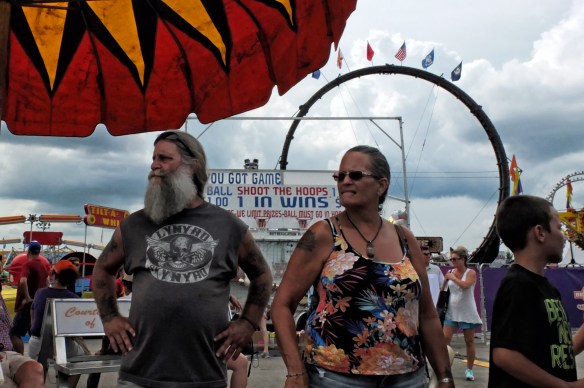
Probably not their first Iowa State Fair. Probably not their last.
And yet folks keep returning to the fair. For decades, they keep returning. Why? Because it’s always different and it’s always the same, and there’s excitement and comfort in that. Because it’s the fair, and what else are you going to do?
The Romans may have been imperialist assholes, but credit where it’s due: they gave us the fair.