defending the wrong people

I have a Twitter account that I completely neglect. I have friends, though, who sporadically alert me to Interesting Stuff That Happens On Twitter. It didn’t take long for them to inform me that the Republican National Committee tweeted this:

Exclusive: Republicans Launch Willie Horton-Style Attack on Kaine

Kaine, of course, is Democratic Vice Presidential candidate Tim Kaine. But there are probably a lot of folks who aren’t familiar with the name Willie Horton. He was featured in a racist campaign advertisement used by George H.W. Bush against Democrat Michael Dukakis in the 1988 election. Here’s the original ad:

This is unquestionably one of the most notorious political attack ads in US election history It was the brainchild of Bush campaign manager, Lee Atwater, one of the most vile and venomous political ratfuckers of modern political history. That’s not an exaggeration. You want proof? Here’s something Atwater said in a 1981 interview:

“You start out in 1954 by saying, ‘Nigger, nigger, nigger.’ By 1968 you can’t say ‘nigger’ — that hurts you. Backfires. So you say stuff like forced busing, states’ rights and all that stuff. You’re getting so abstract now [that] you’re talking about cutting taxes, and all these things you’re talking about are totally economic things and a byproduct of them is blacks get hurt worse than whites. And subconsciously maybe that is part of it. I’m not saying that. But I’m saying that if it is getting that abstract, and that coded, that we are doing away with the racial problem one way or the other. You follow me — because obviously sitting around saying, ‘We want to cut this,’ is much more abstract than even the busing thing, and a hell of a lot more abstract than ‘Nigger, nigger.'”

Atwater was a sort of evil genius. He gave a lot of serious, creative thought about ways to encode racism into political speech. He was an early adopter of ‘dog whistle’ campaigning, devising methods for emphasizing race that non-racists might not even hear. For example, Atwater shortened Horton’s given name, William — the name he went by — to Willie. Why? Because he thought Willie sounded more black. Atwater said this about the Horton ad:

“By the time we’re finished, they’re going to wonder whether Willie Horton is Dukakis’ running mate.”

And hey, it worked. Bush won the election. At the end of his life, however, when he knew he was dying, Atwater apologized to Dukakis for the “naked cruelty” of the campaign he ran. A lot of people doubt the sincerity of that apology.

Lee Atwater, with Strom Thurmond and Ronald Reagan.

Lee Atwater, with Strom Thurmond and Ronald Reagan.

Atwater died in 1991. This is 2016, and in 2016 the Republican National Committee is seemingly proud to return to the naked cruelty of Atwater and the Willie Horton style of campaigning. The RNC quickly deleted their tweet about running a Willie Horton ad. The ad is still out there, of course. And the message is still the same: associate your opponent with the ‘wrong people’ — but do it in a coded way that doesn’t appear hateful.

Here’s the anti-Kaine advert:

The ad concludes by stating: “Tim Kaine, he has a passion for defending the wrong people. America deserves better.”

I spent seven years as a criminal defense investigator, working to defend the ‘wrong’ people. I helped defend murderers, rapists, arsonists, armed robbers, gun traffickers, and child molesters. I helped defend them knowing that almost all of them were guilty. They weren’t always guilty of the crime they were charged with, but most of them were guilty of something — sometimes guilty of something not as bad, sometimes guilty of something even worse.

Some of you — maybe most of you — are asking the obvious question: how could you defend somebody you knew was guilty of a heinous crime? It’s a valid question. There’s an answer that I believe is valid, though not everybody agrees — and even those folks who agree with the answer in the abstract find it uncomfortable to accept in practice. I often found it uncomfortable too. Here’s the answer:

Sometimes the police make mistakes.

That’s it, basically. Sometimes the police arrest an innocent person. I like to believe that most often the police are truly certain they’ve arrested the right person — but sometimes they’re just flat-out wrong. And in order to protect the folks who are truly, factually innocent of the crime they’re charged with, it’s necessary to force the police and the prosecutor to prove their case beyond a reasonable doubt every single time. Every single time. Even if the defendant is clearly, blatantly, obviously guilty, we have to hold the prosecution to a high standard of proof. Because if we don’t — if we fail to protect the legal rights of every person every single time — then it becomes easier for them to convict those who are truly innocent.

Tim Kaine defended accused murderers — defended guilty murderers. Nobody does that because they support murder. They do it because the believe in — and are willing to do ugly work to defend — the legitimacy of the Constitution of the United States. That may not be popular, but it’s patriotic.

When the Republican National Committee attacks Tim Kaine for defending accused criminals, they’re actually undermining the U.S. Constitution. They’re basically suggesting there are citizens who are the ‘wrong people’ and as such, they don’t deserve the same rights as ‘decent’ people.

Of course, they’ve been suggesting that for a long time. They suggest the wrong people shouldn’t be allowed to marry, they shouldn’t be allowed to adopt, they shouldn’t be allowed to serve in the military or receive food assistance if they’re poor or be guaranteed safe working conditions or receive financial assistance if they’ve lost their job or become citizens of the United States.

They’ve become very good at suggesting stuff about gays and Muslims and women and poor folks and people of color. Because 2016 and you can’t say ‘nigger nigger nigger’ out loud anymore.
which, of course, he has every right to do

A friend of mine — well, not really a friend. An acquaintance, really. A guy I know only from brief discussions online or through email. Anyway, this guy tells me he’s disappointed and dejected about the election. He was an early Bernie or Buster, and vowed he’d never vote for Hillary Clinton. After she got the nomination, he moped for a while, then decided he’d vote for a third-party candidate — which, of course, he has every right to do.

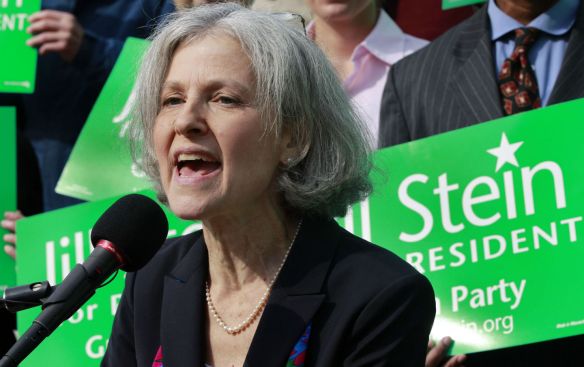
He attached himself to Jill Stein. She was a progressive, he said, and she’d gain a LOT more supporters if only she was given a chance to be heard. Then, sadly, she was given a chance to be heard. He heard her praise the Brexit vote in England; she called it “a victory for those who believe in the right of self-determination.” Then, after she drew some flak from folks who pointed out the Brexit vote was driven in large measure by Islamophobia and racism, he heard Stein revise her opinion and speak out against it. He became disillusioned not just by her swift change of heart, but by her attempt to disguise the fact that she changed her mind. He became even more disillusioned when she appeared to stake out positions that were both pro-vaccine and anti-vaccine, depending on the audience she was addressing at the moment. Then she appeared to suggest that wi-fi might be hazardous to the physical health of children. And finally, she refused to release any of her tax records — which, of course, she has every right to do.

jill-stein-green-placard

So, my disillusioned friend (acquaintance, whatever) decided to support Gary Johnson instead. Okay, he admitted Johnson wasn’t exactly a progressive, but he was a libertarian who believed in legalizing marijuana. My friend said if Johnson was given a chance to be heard, he’d gain a LOT more support from progressive Democrats. Then Johnson, sadly, was given a chance to be heard. And what did my friend hear? This: “Aleppo? What’s Aleppo?” That was bad, but probably forgivable. But failing to be able to name a single foreign leader he admired? Well, that’s pretty much inexcusable. I mean, Johnson has the absolute right to be ignorant of foreign leaders, but it’s not exactly a quality that inspires confidence, is it.

gary-johnson

So here’s my friend — he sure as hell won’t vote for Trump and he’s pretty much lost faith in both third-party candidates, but he’s sworn he’ll never vote for Hillary. What to do? Now he’s talking about just staying home; not voting at all — which, of course, he has every right to do.

He has an absolute right to stay home, sit on his ass, and let other folks shoulder the responsibility for choosing who’s going to run These United States. He has an absolute right to see this election only in terms of himself. If he can’t vote for the perfect candidate, he has the absolute right to sit in a dark room and pout.

And why should he vote? I mean, he’s not gay — so really, what does it matter to him if a Trump administration fights to limit the civil rights of gay folks. And he’s white and middle class, so it won’t disrupt his lifestyle if a Trump administration makes life more difficult for poor black folks. He’s already got a Master’s degree, so if a Trump administration makes it harder for regular folks to go to college, it won’t affect him. And he CAN vote IF he wants to, so who cares if a Trump administration makes it harder for minority communities to vote? And hey, he lives in a red state, which means Trump is almost certain to win his state anyway — so his vote doesn’t really matter, right?

No. Wrong. Very wrong. It matters. Of course it matters. The popular vote may not determine who wins the presidency, but the popular vote matters in terms of authenticity and legitimacy. Even if Trump DOES win that state, the size of the victory matters. It matters whether the victory is by a large majority or by a slim margin.

votescountbanner

It also matters in terms of respect. I don’t really care if my friend hates Hillary Clinton. I DO care if he fails to reject Donald Trump. If his reaction to a Trump victory in his town, in his county, in his state is a noncommittal shrug — then I lose respect for him. If he has a chance to voice his disapproval of Donald Trump and fails to do so — then I lose respect for him. Let me be clear: I think Trump is a popcorn fart; I don’t think he has any real chance of winning. But it’s not enough for him to lose; it’s important that he be soundly rejected by the American people.

If my friend/acquaintance/whatever goes to the polls and votes for Stein or Johnson — or even just writes in the name of Bernie Sanders — I’ll think he’s wasting his vote, but it won’t cause me to lose respect for him. But if he stays home and refuses to cast any vote at all, that makes him a narcissistic, self-centered prick.

Of course, he absolutely has the right to be a narcissistic, self-centered prick.

what trump forgot last night

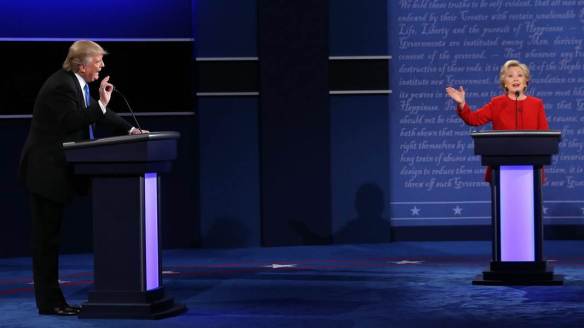
The best thing about last night’s debate? It perfectly encapsulated both candidates. It was a distillation of the qualities and defects of both Hillary Clinton and Donald Trump.

Clinton did what she’s done her entire life. She prepared. She studied, she armed herself with facts and figures, she practiced, she devised various strategies for different possible scenarios. When she walked out on stage she was confident, in control, ready to debate. She knew what to expect and was ready to deal with it.

And Trump did what he’d done his entire life. He winged it. He didn’t bother to study, he didn’t prepare, he didn’t practice. He figured he knew what he needed to know and assumed his ability to out-talk, out-negotiate, and out-bamboozle his opponent would be enough for him to succeed. When he walked out on stage he was cocky, but sadly unprepared. He had no idea what he was in for, and didn’t know how to handle it.

trump-clinton-debate

Why was he so unprepared? The qualities that have allowed Trump to be successful at business simply aren’t the qualities needed to win a debate with a serious candidate (or to run a democratic nation). When Clinton accused him of ‘cheering’ the housing crisis, Trump truthfully and accurately replied “That’s called business.” When she accused him of paying zero federal income tax, he said “That makes me smart.” When she referred to the Justice Department’s lawsuits against Trump for racial discrimination, he said, “[Y]es, when I was very young, I went into my father’s company, had a real estate company in Brooklyn and Queens, and we, along with many, many other companies throughout the country — it was a federal lawsuit — were sued. We settled the suit with zero — with no admission of guilt. It was very easy to do.” When she brought up his multiple bankruptcies, Trump said, “I take advantage of the laws of the nation because I’m running a company. My obligation right now is to do well for myself, my family, my employees, for my companies. And that’s what I do.”

And there it is; that’s what he does. More accurately, that’s what his lawyers do. Profiting off home foreclosures — that’s business. Not paying taxes — that’s smart. Settling a discrimination case without an admission of guilt — easy. Avoiding liability by declaring bankruptcy — just taking advantage of the law. That’s why you hire lawyers, right?

That’s what got left out of all those exchanges last night — Trump’s lawyers. When he talks about his successful business negotiations, what he really means is he has enough money to hire good lawyers. He doesn’t have to go to the negotiation table prepared; his lawyers do all the preparation. He doesn’t have to know the details of the issue; he’s hired people to do that for him. He can sit in a room with business opponents and, in effect, say “This is what I want; this is how it’s going to be.” But then he leaves the room and lets the lawyers pound out the details. Trump’s lawyers have made him a lot of money. Trump seems to think having a lot of money and a lot of lawyers is the same as being smart and powerful.

Last night we saw one candidate who was willing do the dull, un-glamorous grunt work necessary to succeed. We saw the other candidate who was largely lost at sea without a cadre of legal fluffers doing the hard work for him. Last night Trump failed to bring his checkbook and his team of lawyers (and maybe Sean Hannity) to the debate stage.

ambiguity in transit

All good photography is social. At a minimum, good photography requires two parties: the person who shoots the photo and the person who looks at it.

Don’t get me wrong; I’m not saying a photographer can’t do excellent work in isolation. You can shoot the most astonishing photographs, but like the work of Miroslav Tichý, if nobody ever sees them they’re just a form of wanking (not that there’s anything wrong with that). I’m not talking about photography as an act or the photograph as an object; I’m talking about photography as a mode of communication, as a tool for expression. After all, that’s how most of us use photography, even if all we’re communicating is ‘Dude, look at the cup of coffee I had this morning.’

This is where that ‘social’ business comes in; this is where photography, in my opinion, gets really interesting. Because the viewer isn’t bound by the photographer’s intent. The viewer is free to develop his own meaning from the photo. The photographer might be saying  ‘Dude, look at the cup of coffee I had this morning’ but the viewer might be hearing ‘Lawdy, what a ridiculous wanker.’

I’m not saying anything new here, obviously. I’m sure Susan Sontag had something densely clever to say about the photographer-viewer dialectic. I’m only saying it now because I recently had the unusual (for me, at any rate) and weird experience of being both photographer and viewer of the same image.

probably-notta-democrat

As a photographer, this was one of those photos you shoot on instinct. I noticed the guy’s t-shirt as he was walking in my general direction. I had the camera near my eye already, so I looked through the viewfinder, noticed the woman and child, reframed the shot, and snapped the shutter release. It was your basic f/8 and be there shot. A photo originally intended to be about the guy ended up being about the group.

I wasn’t necessarily trying to say anything with this photograph. I brought the camera to my eye because of the guy’s t-shirt, so my immediate motivation was political. But once I was looking through the viewfinder, it became more about the arrangement of elements within the frame (and yeah, at that moment these weren’t ‘people’ to me, they were just compositional elements in motion). The only tension I was interested in at that moment was aesthetic tension.

But a few days later, when I got around to actually looking at the photo, there seemed to be something emotionally disquieting and maybe distressing taking place. I wasn’t evaluating the photo as the maker of the photograph, I was looking at it as viewer — as if I was seeing a photo shot by somebody else. It was an oddly dissociative experience. But I didn’t give it much thought to it until I posted the photo on Instagram and Facebook, and other people reacted to it.

Some folks who saw the photo had interpretations similar to mine — that there was some emotional discord taking place. Others saw the photograph in political terms — either as being pro-Trump or anti-Trump. Here’s a sampling of the comments I received through Facebook, on Instagram, and through emails and texts:

That poor little girl, though. I hope that’s not her father.

Why are you posting pro-trump fotos? Thought you were for Hillary?

the lookon the kid’s face, my god…

That poor child doesn’t stand a chance.

Classic Lib move, presenting Trump supporters as mean angry old white men.

Are they fighting? Was the wife frightend? Did you think aoubt intervening?

Why di I feel sorry for that family?

Is this guy a Trump supporter? I don’t know. Probably. Or he might just be somebody who hates Hillary Clinton. Are these three people together? I’ve no idea. When I shot the photo I had the general impression they were a family unit, but it’s possible they’re unrelated and were just moving in the same general direction at about the same pace. Was this an emotionally strained situation? I don’t know. I didn’t sense it at the time, but again, I only saw these folks for a moment, and in that moment I was focused on shooting the photo.

I don’t know how much of what I experienced as a viewer of this photograph is actually IN the photo and how much I’ve brought TO the photo.

Wim Wenders said, “The most political decision you make is where you direct people’s eyes.” I’m not convinced that’s actually the most political decision you can make, but it IS a political decision. Politics on a very basic level certainly shaped my decision to shoot this photo. And politics has certainly shaped the response to it. But the politics of the act of photography (at least in this case) have nothing to do with the politics of viewing it.

I guess that’s how photography is supposed to work.

the black death, cheap pans, and trump

So last week Donald Trump promised to make a ‘big announcement’ about President Barack Obama’s…no, wait. First, we should probably talk about the social and economic upheaval that followed the Black Plague in the 14th century, because…no, wait. It might make more sense to explain the Dutch language spoken from about 1100-1500 CE is known as Middle Dutch. That’s only important because…no, wait.

Okay, let’s try that again. The Black Plague killed off a hefty chunk of the population of Europe, right? Right. One result of that was the loss of village merchants. Before the plague if you needed a pan, you’d walk into the village and buy a pan. No big deal, easy peasy lemon squeezy. But then the plague comes and your local pan dealer goes toes up, and suddenly there’s no place to buy a pan. And you need a pan, right? What are you going to do — cook your porridge in a boot?

Business opportunity! There was a surge of wandering pedlars who traveled from village to village in the Low Countries selling and repairing cheap wares: pots and pans, knives and scissors, cheap jugs and pitchers. These wares were known as hoken and the men who sold and repaired them were called hokesters. They not only sold and repaired pans, the best hokesters regaled their customers with news and gossip from other villages.

You need a pan? I got a pan. Such a pan, shiny, best ever, people tell me.

You need a pan? I got a pan. Such a pan, shiny, best ever, people tell me. People love my pans, I can tell you that. 

But there were also shady hokesters. They were basically con men who charmed their customers, played on their vanity, fed into their prejudices, encouraged their desire to win a bargain through haggling, said whatever they needed to say in order to sell them some cheap-ass, shoddy hoken that soon needed to be repaired or replaced. These asshole hokesters effectively created a revolving market. They’d sell you a shiny cheap-ass pan that dented easily or broke because it was good for business. They could either charge you to repair it or sell you another cheap-ass pan, which would also break soon.

Over time, the population of Europe recovered from the Black Plague. Honest pedlars set up shops in town, and you could buy a damned pan without much fuss again. Only the shifty hokesters continued to travel the pan circuit. The Middle Dutch word hokester morphed into the modern term huckster.

Which brings us to Donald J. Trump.

The news media is constantly baffled by Trump’s willingness to say completely different things to different audiences, without any regard to consistency. They continue to view him as a person running for political office — but he’s not. He’s just a huckster selling his product. Everything he says and does is said and done to move a product — and Trump’s product is his name. Not Trump as a person; Trump as a product. Here’s what’s important to remember: a huckster says whatever he thinks will entice the customers in front of him right now to buy his product. He’s not interested in what he said to a different set of customers yesterday. It doesn’t matter. He’s already sold them a shiny cheap-ass pan, and he’s moved on. A huckster shifts his pitch to entice the customer at hand.

What, your pan broke? It happens, pans break. Pans break. They break, trust me. If you want, I can sell you a better pan.

What, your pan broke? It happens, pans break. Pans break. They break, trust me. If you want, I can sell you a better pan.

Trump isn’t driven by ideology, or principle, or religion, or concern for the public, or any of the other motivations that drive politicians. He’s driven by the desire to move the product.

Is Trump a racist? Maybe, I don’t know. He may not give a shit about race. But he’ll play along with racists if he can sell them a shiny pan. Is he anti-Muslim? Maybe. Maybe he’s go no interest in religion at all. But if it helps him unload some cheap-ass scissors, he’ll say anti-Muslim shit all day long. Is he a patriot? Don’t know, but there’s product to be moved and if waving a flag will help move it, then he’ll be Betsy fucking Ross for a couple of hours.

Trump is a huckster, plain and simple. A huckster on a very big stage, but still a huckster. He’s selling shiny, cheap-ass pots and pans to chumps. There’s always somebody who’ll buy that shit.


trump-level derangement & gazoony rays

I haven’t written much lately about Donald Trump, the Republican nominee for President of These United States, for the following reasons:

  1. The tsunami of offensive, idiotic shit Trump says is just overwhelming; no human can keep up with it — not writers, not readers. It would take a damned cyborg to process the daily load of Trump bullshit.
  2. The phrase Donald Trump, the Republican nominee for President of These United States is troubling in itself. I recognize all those words individually, but they make no sense when arranged in that order.
  3. C’mon, seriously, what is there to say about this guy?

But there are some Trump moments that are so entirely deranged that they bear repeating, if only as evidence that there’s a reason the term ‘deranged’ exists. Yesterday in Florida (of course, it had to be Florida), we saw two (2) such moments take place within minutes of each other. According to the New York Times, Trump said this:

“[W]hen Iran, when they circle our beautiful destroyers with their little boats and they make gestures at our people that they shouldn’t be allowed to make, they will be shot out of the water.”

Got that? If Iranian sailors in small craft approach a U.S. warship and make rude gestures, we should obliterate them. That’s deranged, of course, but it’s ‘normal’ derangement. I mean, it falls into the conventional range of crazy. What makes it deranged on a Trump scale is that moments later he said this about Hillary Clinton:

“She’s trigger happy.”

He wants to blow Iranian sailors out of the water for making rude gestures, but she’s trigger happy. This is the key to understanding Trump-level derangement. It creates a neural state in which a sentence spoken aloud exists independently, entirely devoid of any context or connection to the sentences that precede or follow it. Make a rude gesture and die. She is trigger-happy. To a ‘normal’ human, that would seem inconsistent. Not to Trump, though, because they’re two totally separate and completely unrelated sentences.

But that’s just ONE of the deranged Trump moments that took place in public yesterday in Florida. The other? Trump said Clinton:

“…is being so protected. She could walk into this arena right now and shoot somebody with 20,000 people watching, right smack in the middle of the heart, and she wouldn’t be prosecuted. Okay? That’s what’s happening.”

In case you were wondering what was happening, that’s it right there. Hillary Clinton can shoot somebody and not get prosecuted. That’s altogether different from what Trump said about himself back in January. He said:

“I could stand in the middle of Fifth Avenue and shoot somebody, and I wouldn’t lose any voters, okay?”

Again, to a ‘normal’ person, it would seem hypocritical to complain that one’s opponent could get away with shooting somebody after having bragged about personally being able to get away…wait. Wait just one fucking minute. What sort of person uses the capacity to get away with shooting another person as a metric for…well, for anything? I mean, Jeebus Caliber, what the fuck?

Trump emitting high-power Gazoony Rays

Trump emitting high-power Gazoony Rays

See, this is why I don’t write much about Trump. His level of derangement distorts all normal measures of derangement. Instead of being appalled by his bluster about being able to shoot somebody and not lose voters — which is REALLY APPALLING — you find yourself instead examining his hypocrisy about other folks being able to shoot…fuck me, I’m doing it again.

There’s only one possible explanation for this — only one explanation that makes any sense at all. Donald Trump must be emitting extremely powerful Mind-Distorting Gazoony Rays. There’s no other explanation.

thoughts on sand

I was walking along the lake shore, not thinking about anything in particular. Just casually looking at the birds, watching the dragonflies that hunt the small ponds along the lake, listening to the gulls arguing, enjoying the way the sand shifted under my feet. Here’s an interesting thing about sand: it behaves more like a liquid when it’s dry, and more like a solid when it’s wet.

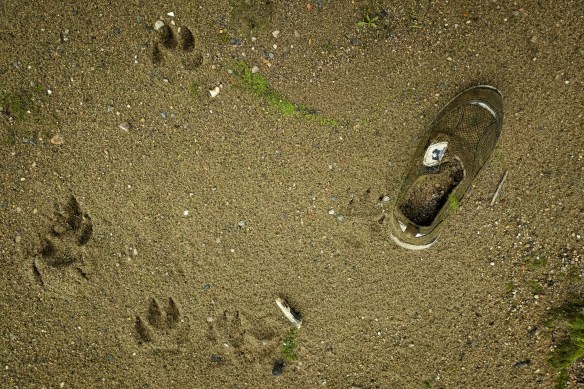
I was just walking in the sand by the lake, idly scanning the ground for interesting chunks of driftwood or colorful stones. And I saw this:

sand3

Somebody had lost a beach shoe. Nothing really out of the ordinary. And a dog had padded by. Also pretty common; lots of people take their dogs to the lake. At some point, a raccoon had wandered along the same bit of sand; the woods around the lake are a haven for raccoon. And now I was standing there. That layering of temporal events pleased me for some reason — four creatures had crossed that same little patch of sand, separated only by a period of time.

This sort of thing happens to me all the time. I see something, and neurons start firing in my brain. I saw that lost beach shoe and the dog’s paw print and the raccoon track, and thoughts start turning over in my mind. Because it wasn’t just us that had crossed that bit of sand. Dozens of creatures had walked, slithered, or hopped across that same spot. Thousands of dozens. Millions of thousands of dozens. I mean, some three hundred million years ago, this entire area was under water; it was the sandy bottom of a great inland sea — a sea that dried up, only to be replaced by another inland sea a couple hundred million years later. Then that sea dried up as well. Now there’s just sand.

sand1


Well, not just sand. There’s also a lake. Six thousand acres of water. Almost ten square miles. Not a natural lake, though. Technically, it’s a reservoir — a man-made lake; an intentional containment of the Des Moines River. The lake was created about 50 years ago to try to control the periodic flooding that plagued the city of Des Moines for over a century. The flooding also troubled the native people who’d settled at the confluence of the Des Moines and Raccoon Rivers seven thousand years earlier.

We know people lived here seven thousand years ago because we’ve found their bodies. A woman and a child, well-preserved skeletons sealed in a layer of sandy clay deposited by a sudden flood. It’s only relatively recently that humans developed the technology (and the audacity and arrogance) to dam up the river and create a lake. The dam and the lake hasn’t put an end to the flooding, but it’s certainly reduced the damage.

sand5

A lost beach shoe and a raccoon print in the sand, and my mind went caroming off of disappearing Paleozoic seas and banging into ancient human settlements and human high-handedness toward nature. But even while a chunk of my brain was knocking around notions of time and human presumption, I couldn’t help being drawn by how gracefully the water and wind have shaped the lake shore.

I found myself paying attention to how the moisture content of the sand shifted its color along with its consistency — how the farther I got from the water, the more pale the sand became. I started to notice how the granularity of the sand changed — how some was more coarse and some was incredibly fine. I paid more attention to how the wind revealed layers of different color in the sand, how driftwood bleached into various subtle shades.

sand4

There was something wonderful and beautiful about how dried leaves gathered gracefully in fluid self-organized, breeze-driven groups. There was something fascinating about how different waterlines arranged themselves; you could gauge the strength of various storms by the arrangements of the detritus and the driftwood and how far they’d been driven from the waterline by the wind and the waves.

None of this is stable. It’s changing all the time. The change is sometimes radical and quick and violent, but mostly it’s slow. I know I can return to this same spot in a couple of weeks and find that same driftwood log and those same weeds; I know I can return in six months and find that same log, though it will likely be surrounded by different detritus. There is continuity. Continuity, but not sameness.

sand6

There’s a good chance that the next time I return to the lake, that lost beach shoe will still be there. The dog’s paw print and the raccoon track probably won’t. The sand, though, it’ll still be there. Long after I’m dead and gone, long after that shoe disintegrates, long after the driftwood deteriorates into nothing, the sand will still be there.

There are people who collect sand as a hobby. They’re called arenophiles. The word comes from the Latin term for sand: harena. That’s also the root of the word arena. What does sand have to do with an arena? The Romans understood that the best and easiest way to soak up the blood spilled from their arena spectacles — the gladiator fights, the chariot races, the beast contests — was to lay down a layer of sand. Before there was a Coliseum, there was sand.

There’s always sand.


corruption, probably, right?

A couple of days ago I responded to a comment about the ‘rampant corruption’ of the Clinton Foundation. Basically I said “What corruption? Show me the corruption. Show me anything like actual evidence that there’s corruption.” Because, you know, there wasn’t any corruption.

Today I got this in my email:

If theres no corruption how come the new york Times is writing about the corruption.

I’m not sure why this person refused to capitalize New York but did capitalize Times, but let’s just ignore that. There was a link to this article by Eric Lichtblau: Emails Raise New Questions About Clinton Foundation Ties to State Dept. That sounds pretty bad, doesn’t it. I mean, questions are being raised! Questions! So I read the article, on account of I wanted to find out what those ominous questions were and why they were raised. You might want to read the article your ownself, just to reassure yourself that I am NOT MAKING THIS UP.

Are you ready for this: Okay, here we go. A guy named Douglas J. Band, who’d worked as an adviser to President Bill Clinton and was still working for him as part of the Clinton Foundation, sent an email to Huma Abedin asking for diplomatic passports for himself and two other aides to Bill Clinton. They’d all held diplomatic passports during their earlier tenure at the White House. Abedin responded that the issue would be ‘figured out’. This is how Eric Lichtblau characterized the exchange:

Mr. Band did not explain in the email exchange why he and the others needed the diplomatic passports, and Ms. Abedin did not ask.

A mystery! Surely if everything was above-board, Band would have explained exactly why he and his buddies needed those passports, right? And if Abedin wasn’t complicit in this conspiracy, she’d have asked why they needed those passports, right? So obviously something untoward, possibly sinister, and certainly majorly corrupt is taking place here, right? Right?

Nope.

Band and the other two wanted those diplomatic passports because ordinary citizens can’t get into North Korea without them. Wait…what? North Korea? Why would these people want to go to North Korea? Obviously something untoward, possibly sinister, and certainly majorly corrupt is taking place here, right? Right?

Still nope.

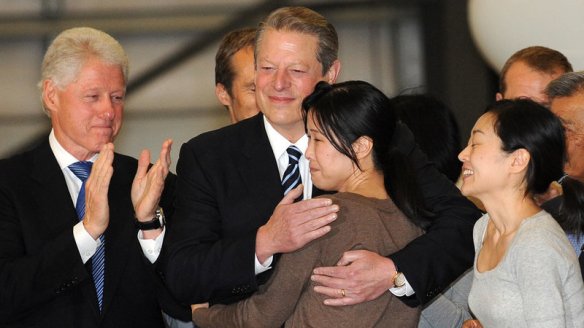
Bill Clinton was on his way to North Korea to secure the release of two American journalists — Euna Lee and Laura Ling — who’d been falsely imprisoned as spies. The two women had been held for more than five months, and had just been sentenced by a North Korean court to serve twelve years at hard labor. Band and the others wanted to go along on the diplomatic rescue mission. Which is why they asked for the diplomatic passports. And since the State Department knew this rescue mission was going to take place, Band didn’t need to explain why they wanted the passports, and Huma Abedin didn’t need to ask them why the passports were needed.

clinton-gore-ling-lee

And guess what? Because nobody at the State Department could see any necessary reason for Band and the other two aides to accompany the former president, their request for diplomatic passports was denied. Which is why they’re not included in the photograph of two newly free journalists smiling and crying.

Got that? These guys asked for diplomatic passports in order to enter North Korea to help imprisoned journalists — and were denied. And how does the new york Times characterize this humanitarian request?

Emails Raise New Questions About Clinton Foundation Ties to State Dept.

New questions, my pale pink ass. There are NO questions at all to be raised about the Clinton Foundation or its ties to the State Department.

Here are some questions that should be raised: 1) Who the hell is Eric Lichtbrau? 2) How the hell is he employed as a journalist? And 3) What the fuck is wrong with the new york Times?