I’m trying to find a balance here between honesty and modesty. Here’s the thing: I mostly write short detective fiction. I write with the intent of selling my stories to one or two magazines–Alfred Hitchcock’s Mystery Magazine or Ellery Queen’s Mystery Magazine.
Why those two? Because when I wrote my first short detective story, I checked to see who published the most prestigious mystery magazines, and the answer was AHMM and EQMM. I figure if you’re going to get rejected, you may as well get rejected by the best.
This is where the honesty and modesty business comes in. I’m a good writer. Not a prolific writer, but a careful, deliberate writer. I’ve sold every story I’ve submitted to those magazines, with one exception (which, of course, I think was an error on their part). When you consider the acceptance rate for those magazines is about 3-4%, that’s a pretty good record. I’ve had stories included in Best Of anthologies, I have a story in Alfred Hitchcock’s 50th Anniversary anthology, I’ve won an Edgar for Best Short Story.
So yeah, I think I’m a good writer, but I don’t have much attachment to the finished product. I’ve written about this before.
Once I finish writing a piece of fiction, I seem to lose all emotional attachment to it. I’ve done what I wanted to do with it, I’ve written the story, and now it’s done. I submit the story to a magazine; they either accept it (and send me a check) or reject it (and send me a rejection letter), but that’s their job. My job is over. Time to do something else. The finished story is old news; it just doesn’t seem very important anymore.
So it’s been a weird experience for me to get frustrated over a story that’s actually been accepted. Here’s what happened. I wrote a story, submitted it, didn’t think about it for a few months. I finished writing another story and was getting ready to submit it, which reminded me I hadn’t heard back about the other story (I submitted that story to the other magazine). This was last October. I wrote the editor, asking for an update.
The update? “We like your story and want to buy it.” BUT there was some corporate issues which prevented them from issuing contracts; I was asked if I could be patient for a few weeks while they got the issue settled? I said yes, of course. In mid-December I got an email saying I should get a contract “in the next 2-3 weeks.” I was fine with that. Then on 1/2/25, I was told “your story is at the top of the list for when we can request contracts again.” On 1/24/25, I got an email saying, “you can expect a contract in mid February.”
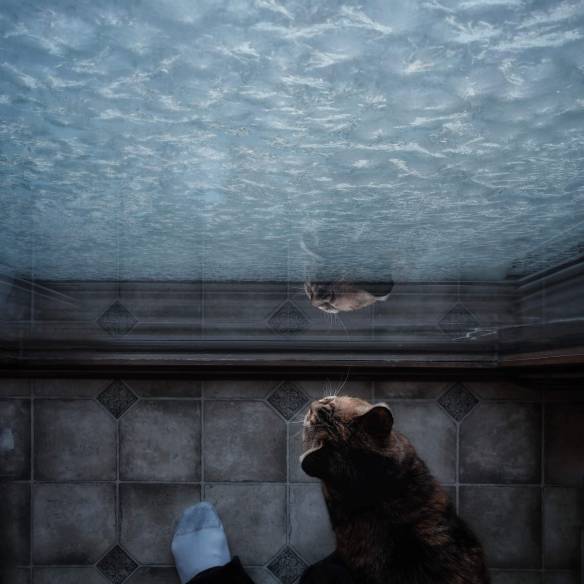
No, this old photo isn’t how I write; just how I feel at the moment.
Mid-February came; no contract. It was annoying, not just because the contract was taking so long, but because for the first time, I felt emotionally involved in the product. It pissed me off that I cared about the story as a product. I told myself, “It’s just a story. It’s just words in a row. It’s just something I made up. I should be happy that somebody somewhere wants to give me actual money for sitting in a room and making shit up.”
A couple of weeks ago, I learned that the company that publishes those two magazines (and also publishes two of the best known science fiction magazines) had been purchased by another company. That explained the long delay in the contract. But I was still frustrated and annoyed.
So this morning, five fucking months after I was told the magazine wanted to buy my story, I wrote a polite email to the editor saying how much I’ve appreciated working with the staff of the magazine, but that this long delay was a shabby way to treat writers. I said I wanted to withdraw the submission.
I didn’t send the email. Why? Because, as I said earlier, I’m a careful, deliberate writer; I wanted to re-read it and make sure it was correct before I sent it. And I went to the gym.
While I was at the gym, I got an email with the contract.
That should settle the issue, right? But I’m sitting here, still annoyed as fuck. Partly because the email came from a different editor (what happened to the woman I’m used to dealing with?), partly because of the long delay, partly because this contract pays half on acceptance and half on publication (all the previous contracts paid on acceptance), and partly because goddamnit goddamnit goddamnit, I don’t know I’m just pissed.
The rational part of me says, “Just sign the damned thing and take the coin.” It says, “Don’t fuck up a relationship with a magazine that’s been good to me.” It says, “Give the new people a chance to get their shit together.” The irrational part of me wants to reject the contract because goddamnit goddamnit goddamnit, I don’t know I’m just pissed.
I’m also aware that a LOT of my anger is displaced fury at what’s going on in the US right now. I’m not used to being angry. I hate it. But here we are.
And the thing is, I KNOW what I’m going to do. I’m not in this for the money (nobody who writes short fiction is in it for the money, but being offered an extra US$700+ for sitting in a room and making shit up…well, that’s nice and it’ll buy a few eggs.
SPOILERS HERE! THERE WILL BE SPOILERS INITIATE SPOILER ALERT SYSTEM ALL THE SPOILERS FIT TO PRINT
Okay, I’ve watched all three episodes (yes, I’m including The Church on Ruby Road as an episode) of the newest version of Doctor Who…and I’m concerned.
I’m not concerned about Ncuti Gatwa as The Doctor. He seems to be a natural Doctor, which perhaps is because unlike every other new Doctor, he didn’t have to go through the whole ‘Who am I this time?’ fuss. And I’m not concerned about Millie Gibson as Ruby Sunday, although she’s at risk of being perky. Nor am I concerned about the basic plot structure of these three episodes; they all seem like classic Doctor Who events. They fit perfectly in the Doctor approach as described by Neil Gaiman:
[T]here’s a blue box. It’s bigger on the inside than it is on the outside. It can go anywhere in time and space and sometimes even where it’s meant to go. And when it turns up, there’s a bloke in it called The Doctor and there will be stuff wrong and he will do his best to sort it out.
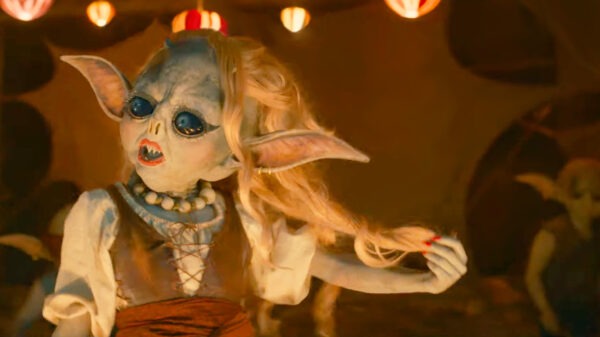
We see that in each of these three episodes. We’ve had a baby kidnapped by goblins; we’ve had babies abandoned in space who are threatened by a snot monster, and we’ve had a villain who has essentially stolen music from the world. These are all great Doctor Who scenarios—they’re all classic problems for the Doctor and Ruby to ‘sort out.’ I’m not concerned about any of this.
The goblin musical number from The Church on Ruby Road.
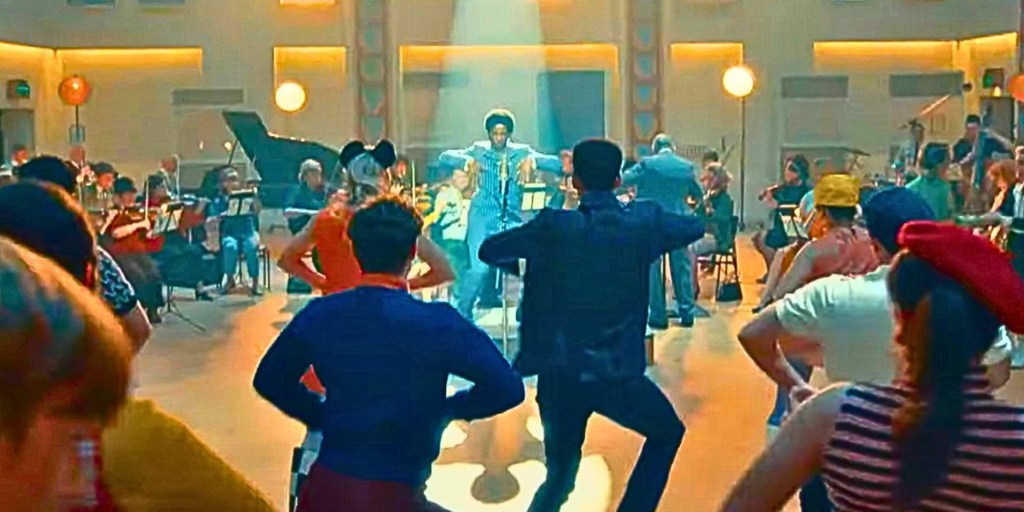
What I AM concerned about is the nature of the show itself. Of the three episodes so far, two of them have included musical numbers. I’m talking about incorporating theatrical singing (and dancing) as a part of the narrative (as opposed to something organic but incidental WITHIN the episode…like hearing music on the radio or a band performing). What the fuck is that about?
I’m not opposed to singing and dancing…but why? What’s the point? Did the singing and dancing contribute to the story? No. Did it develop the characters? No. This is Doctor Who filmed like Disney’s Little Mermaid or Moana. It’s turning Doctor Who into Singing in the Rain or Guys and Dolls.
The song & dance number from The Devil’s Chord
Don’t get me wrong. I like musicals. On any given day, you might find me humming or singing tunes from My Fair Lady. I’d be perfectly fine with an actual musical episode (like the brilliant Buffy the Vampire Slayer sixth season episode Once More with Feeling), but personally, I don’t want a Doctor who might, at any moment, burst into song and dance instead of acting and using dialog.
The thing is, the musical numbers in those two episodes were superfluous. They didn’t contribute to the story in any meaningful way. In fact, I’d argue they diminished the show. I’d argue they distracted the viewer from the events within the story world.
So there it is. I love Doctor Who, but I’m concerned about the direction the show is taking. I’m excited about Ncuti Gatwa as The Doctor. I think Millie Gibson as Ruby Sunday shows a lot of promise. I’ll continue to watch Doctor Who, but I’ve lost some of my enthusiasm for it. I’m uneasy about the next episodes. I hope the new relationship with Disney doesn’t result in a Disneyfied Doctor. But that seems to be a real risk.
EDITORIAL NOTE: That said, the end scene in which The Doctor and Ruby recreate the dancing on the piano moment from Tom Hanks’ movie Big while on the zebra crosswalk from the Beatles’ Abbey Road album was fucking brilliant.
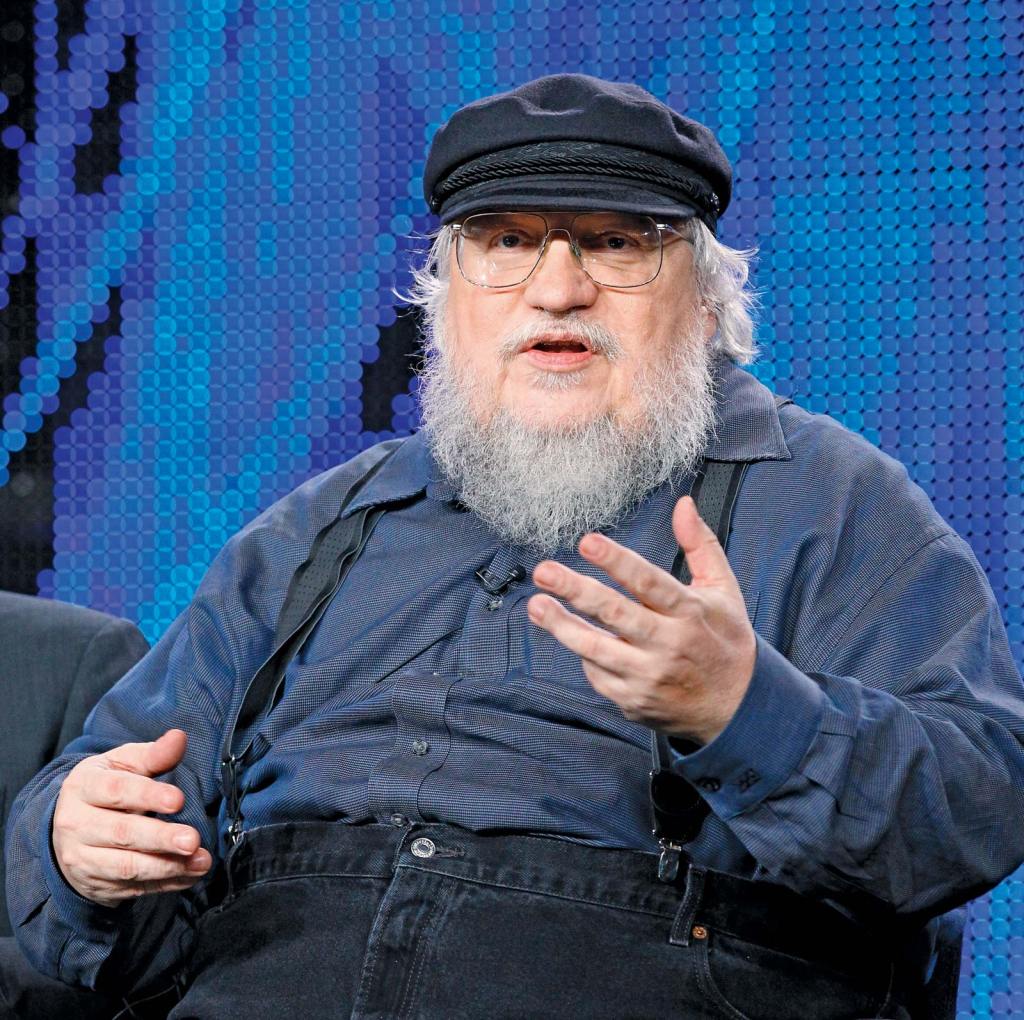
You know George R.R. Martin, right? The writer. The guy who wrote 5/7ths of a very good fantasy fiction series, which was turned into 7/8ths of a pretty good HBO series? Well, it’s being reported that HBO has given him a five-year deal worth “mid-eight figures” to develop other series based on the Game of Thrones universe.
HBO has deep pockets, to be sure–but I’m thinking it’s idiotic to pay him that much coin. I mean, the guy does good work. There are problems with it, of course–the sexism and racism and all that–but the overall dramatic quality of the work is very good. He just doesn’t finish the work. He’s like a master cabinetmaker who designs and creates a beautiful, original kitchen, but doesn’t bother to install the cabinets. They’re just left sitting there on the floor, pretty but incomplete. And as for George R.R. Martin’s GoT universe? At this point, who cares?
Don’t get me wrong. I still remember when a friend told me I should read the original novel, A Game of Thrones. I’d gone through a period where I read some fantasy fiction, but I’d largely gone off of the genre. It all seemed predictable and derivative. This isn’t a verbatim conversation, but it went something like this:
Him: You’ve got to read this book. You’ll love it. It’s unlike anything you’ve read. Me: Are there elves in it? Him: No elves. Me: Dwarves? Him: No. Well, yes, but not like Dwarf Dwarves. There’s a character who is a dwarf. Me: But not with a long beard and an innate skill for metallurgy. Him: Right. Me: Okay then. What about dragons? Are there dragons? Him: No. Well, yes, but not like Dragon dragons. Mostly just eggs. Me: I don’t know. Him: You’ll love it, trust me. Me: I don’t know. Him: You know how when you read a book you pretty much know who the heroes and bad guys are? You pretty much know who’s going to die and who won’t? Me: Yeah. Him: Well, that doesn’t apply here.
And hey, he was right. It was unlike anything I’d read, and I did love it. The characters were wildly diverse, mostly complex, but they still managed to be internally consistent. It was clearly fantasy, but the fantasy elements felt grounded. I mean, sure there was magic; you have to expect that in fantasy fiction. But it wasn’t airy fartsy magic–you know, a wizard in a goofy hat holding up a staff and firing off balls of lightning. The magic was magic in the same way menstrual fluid is blood–it was messy, maybe, but basic and honest.
And yeah, there was no way to guess who was going to live or die. Main characters were killed. Not killed in noble, honorable, heroic ways. Killed ugly for stupid reasons. Killed ugly and pointlessly (well, not pointlessly in terms of the narrative, but pointlessly in terms of the story world). They just got killed or maimed, and there it was. Nobody in the story was safe. It was awful and completely glorious. Okay, as the story progressed and the novels got longer and more popular, the main characters became safer. But the precedent had been set, and you were never quite sure if they were really safe.
I had to wait almost a year for the second book in the series to be published. And it was worth the wait. A Clash of Kings was as good as the first novel. We knew at that point it was going to be a trilogy. The third novel, A Storm of Swords, also took about a year and was equally good. By then Martin had decided there’d be six books. That was a tad concerning; six books is a LOT of story. But if Martin could maintain the quality of the work and the novels were published at a reasonable rate, then yay.
We had to wait five years for the fourth book, A Feast for Crows. Five years. Half a decade. Still, it was quite a good novel. But lawdy what a long wait. The only good thing about that long wait was that, just before the fourth novel was published, I had time to re-read the three earlier books so I could remember what had happened.
Then I waited six years for the fifth book. Six years. It only took two years for Magellan to circumnavigate the globe in a goddamn carrack (with a similar body count, by the way). Six years, and by then Martin had decided there’d be maybe seven books in the series. Seven fucking books. Maybe. I bought the book, whatever it was called, and read it, but by that point I’d rather lost my excitement about the story. There were a few characters I was still interested in (Tyrion and Arya, of course), but the story itself had pretty much lost its meaning for me. I sort of recall enjoying the fifth book, but it felt bloated and sluggish, like it had overeaten and just wanted to take a nap.
That was ten years ago, and we’re still waiting for the sixth book. Wait, that’s not true. I’m not waiting for it at all. I no longer care if the sixth or seventh novels ever get published. I watched the HBO series, and for me the story is done. I’m told the series ending may be different from the ending of the novels, but Jeebus on toast, who cares?
Look, George. R.R. Martin gave us three really solid novels, as well as a couple of pretty good ones. That’s no small thing. But he’s let his readers down. He built up their expectations, then failed to meet them. He effectively promised–and continues to repeat that promise–that he’d finish this story. He should either plant his ass in a chair and finish it or just admit that he’s done–that the story is going to remain unfinished. He needs to be honest with the readers, who are rightfully disappointed in him.
We also have a legit reason to be disappointed in HBO. They produced six good seasons of Martin’s story–and one season that was only okay, as well as the massively awful final season. But that’s also partially down to Martin. The HBO series was flawed but mostly solid so long as they had access to the source material–the novels. When they tried to go beyond the novels, even with Martin’s help, the quality of the story suffered.
Maybe the new HBO-Martin projects will be good television. Maybe it’s clever of HBO to buy access to Martin’s story world, but leave Martin himself out of it. Maybe they can produce good work if they decide not to rely on Martin for anything other than ideas. I don’t know.
What I know is this: I don’t much care what George. R.R. Martin is doing now. Or what he promises he’s going to do. I’m grateful for his early work, but that’s it. I don’t care that HBO is preparing more shows based on his story world. I’m grateful for the few good seasons of GoT, and that’s it.
But the promise of more of Martin’s work? Pardon me while I yawn.
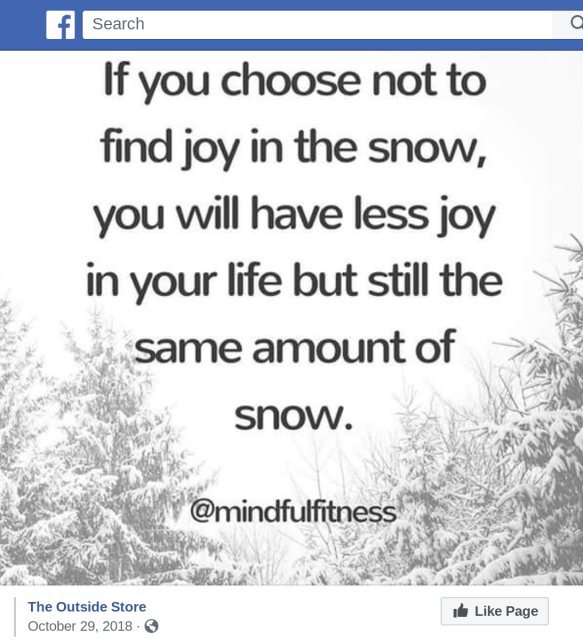
I’ve been seeing this particular meme popping up in social media for a couple of weeks now. I generally find this stuff easy to ignore — especially the lightweight pseudo-Zen philosophical near-aphorisms that sound profound but aren’t. But for some mysterious reason I find this particular meme more annoying than most (although, now I think of it, the reason isn’t at all mysterious; the reason is because it’s almost officially winter and soon I’ll be dealing with the reality of snow).
This is bullshit. It stinks of Zen, which is to say it has the appearance of Zen philosophy without the substance. It co-opts the notion of mindfulness; mindful fitness may be a real thing, but it exists outside of a hashtag. It suggests I’m somehow at fault for NOT finding joy in snow. It suggests joy is something I can somehow force myself to experience rather than a spontaneous reaction to the moment. It suggests I’m unwilling to ‘find’ joy in snow, and that my unwillingness is a personal failing. It also suggests joy is quantifiable, that it’s something you can add to or subtract from and measure against some sort of baseline standard.
That’s all bullshit. That’s not how joy works. Joy isn’t an emotion you elect to feel; it’s a natural, unpremeditated experience. Being open to joy can be a conscious decision, but it’s not a response you can compel. You can choose not to be miserable about a given situation — or at least not to give in to misery — but you simply can’t strong-arm or manipulate yourself into experiencing joy.
The idea behind this meme is laudable. It’s saying snow will happen independent of your emotions, that it will fall regardless of how you feel about it, that snow is a natural event over which you have no control, so you may as well get some pleasure out of it. (Well, the real point of the meme is to get you to visit a website and buy snow-related sports products, which will bring joy to the business owners.) I actually like the idea behind the meme — the non-capitalist part, but the meme itself is misleading and it’s bullshit.
There are a LOT of natural events that will take place independent of your emotions and regardless of how you feel about them. Some of them are pleasant. A rainbow, for example, or the way leaves change in autumn. Other events aren’t pleasant. A flood, or a drought. An earthquake, or a mudslide, or a volcanic eruption. Or, if you live in California, a wildfire.
If you choose not to find joy in the wildfire, you will have less joy in your life but still the same amount of fire.
See how massively stupid that is? I’ve been through natural disasters — floods and tornadoes and hurricanes. None of them brought me joy. (That’s not entirely true; I felt a weird fierce joy at seeing a tornado, while still dreading what it could do.) I can honestly say that even while dealing with the ugly aftermath of those events, there hasn’t been a single day when I didn’t experience some sort of momentary joy.
It’s going to snow here. It’s inevitable. When that happens, I absolutely WILL feel joy watching it fall. I’ll probably feel some degree of joy when I take a walk in the snow. But I can also guarantee you I’m NOT going to feel joy when I have to shovel it off the driveway and sidewalks. There IS a certain meditative contentment in the repetitive act of shoveling, and some emotional gratification in doing it well. But that ain’t joy.
It wasn’t bad, the final episode of Game of Thrones. It was, as always, beautifully filmed; there were some wonderful, genuinely touching emotional moments and it provided a sort of emotional closure for most of the major characters. I can’t say enough about the acting of Peter Dinklage, particularly in the second most critical scene in the episode, and especially because that entire scene made no sense whatsoever.
It wasn’t bad. But let’s remember what Cersei told Eddard Stark in Season One:
“When you play the game of thrones, you win or you die. There is no middle ground.”
It wasn’t bad, the final episode. But it tried for the middle ground. It didn’t try to win; it tried not to lose. It tried to be safe. And the result was — not bad. The result was insipid.
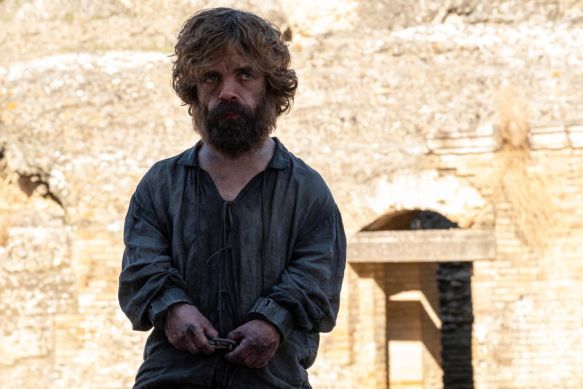
It wasn’t bad, but the behavior of the characters lacked internal consistency. They behaved in ways that contradicted seven earlier seasons. Let’s start with the scene I mentioned a moment ago, in which Tyrion, shackled and unkempt, addresses ‘the most powerful people in Westeros’. Remember, he was imprisoned for betraying his queen and was only spared immediate execution because she was assassinated.
Why was Tyrion addressing anybody at all? The context of the scene suggests they ordered Grey Worm to bring both Tyrion and Jon Snow to appear before those powerful people, but why was Grey Worm following their orders at all? Why did Grey Worm even allow those powerful people into what was left of the city, when they were, for all intents and purposes, beseiging the city? It makes no sense. It was clear Daenerys wanted Tyrion executed — why didn’t Grey Worm just execute him? And why, when Tyrion tells those people they should choose a king or queen, did Grey Worm support that decision? The entire scene makes no sense whatsoever.
Condemned Prisoner Decides Future of Westeros.
Tyrion tells the assembly, “There’s nothing in the world more powerful than a good story.” He then says, “Who has a better story than Bran the Broken?” It’s a good line, and Dinklage delivers it beautifully. But it makes no sense. It’s not just that Bran’s story isn’t as powerful as Arya’s story, or Sansa’s, or even Sam Tarly’s story. It’s that Bran’s story isn’t even Bran’s story. He was just there for it. Bran’s story is the story of Hodor, and Osha the wildling, and Jojen Reed and his sister Meera. Bran’s story is the story of all the people who helped him escape and kept him alive. It wasn’t his fault, but Bran was just a passive passenger in his story. To say his is the best story makes no sense.
And let’s not forget that when Bran became the Three-Eyed Raven, he apparently became at least semi-omniscient. He knows what has happened and, it seems, what will happen. He doesn’t try to influence events. Or maybe he can’t influence them; we don’t know. But it means he knew thousands would be slaughtered at Winterfell, and tens of thousands would be slaughtered in King’s Landing. He knew all those folks would suffer and die in order to create a situation in which he would be named King of the Seven Kingdoms. He knew all that and said nothing to minimize the slaughter. And despite that, none of those powerful people had a problem with him as king. It makes no sense whatsoever.
In his speech, Tyrion states, “From now on rulers will not be born, they will be chosen on this spot by the lords and ladies of Westeros to serve the realm.” Why is Tyrion, a condemned man, deciding by himself how the future rulers of Westeros will be chosen? He asks Bran, “If we choose you, will you wear the crown?” If WE choose you? Why does Tyrion have a voice in the decision? Yes, he’s presumably the head of what’s left of House Lannister, but he’s also a condemned prisoner. He not only murdered his father (and his lover, but women characters have been pretty expendable in this show), he’s betrayed two queens–his sister and Dany. These are not commendable qualities. It makes no sense whatsoever for ‘the most powerful people in Westeros’ to let him make such important decisions. The entire scene makes no sense.
It’s not just that scene, though. Throughout the episode, several primary characters behave in ways that simply aren’t internally consistent with their character development to that point. Consider Ser Brienne (whose story is more powerful than Bran’s, by the way). The one defining characteristic of Brienne is her rigid adherence to a code of knightly honor and duty. She swore fealty to Sansa (“I will shield your back and keep your counsel, and give my life for yours if need be. I swear it by the old gods and the new.”) and Sansa accepted it. But Brienne abandons her duty to Sansa and becomes King’s Guard to Bran. It makes no sense.
Sam Tarly (whose story is also more powerful than Bran’s) only wanted to read books and learn stuff. As a member of the Night Watch he was sent to Oldtown to become a maester, but absconded from the Citadel with some stolen books. Why? To travel (with Gilly and a baby) all the way back north to Castle Black in order to inform Jon Snow that he was actually the true heir to the Iron Throne. Sam also insisted Jon tell Dany who he really was. But despite his friendship with Jon Snow, despite the fact that his insistence that Jon reveal his rightful place on the throne, despite all that, in the last episode Samwell suddenly decides NOT to stand up for Jon as the rightful King of the Seven Kingdoms? And, in fact, is the very first to cast his support for Bran as King? It makes no sense.
Bronn (another story more powerful than Bran’s) is a low-born, whore-mongering, duplicitous sell-sword who openly supports whoever will pay him the most. He’s given Highgarden (for betraying Cersei by not assassinating Tyrion and Jaime), the castle once belonging to House Tyrell. Okay, that makes some sense in the context of the show. But in the last episode he’s also made Master of Coin and given a seat on the Small Council? No, that makes no sense whatsoever.
Daenerys. Throughout the show, she’s been a wonderfully complex, multi-faceted character. At times utterly pragmatic, at times compassionate, always driven, always concerned about the less powerful. Until the final episode, when she inexplicably turned into a Harlequin romance character. She’d just spent a few hours riding her dragon, immolating tens of thousands of people — which I suspect is hot, dirty work. But somehow she appears relaxed, clean, her hair perfect (who dresses her and does her hair post-massacre?). The fierce woman who’d always tried to protect ordinary folks is suddenly channeling Cersei Lannister: the ordinary people don’t get to choose what’s good for them. You can make an argument that Dany deliberately chose to slaughter an entire city in order to convince the rest of the realm to stand down. That would be horrible, but internally consistent to the character. We saw her do something like that when she crucified the Masters of Meereen. But in this final episode, she decides the little people of the world shouldn’t have a choice in their lives? It makes no sense whatsoever.
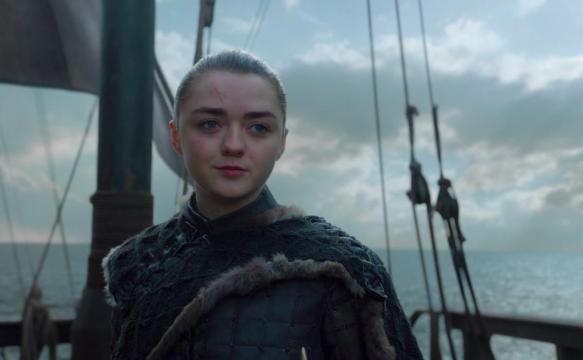
A Girl Has a Ship and Heads West.
Jon Snow, born to brood. Loved two women and a dire wolf; betrayed both women for the sake of his personal notions of duty and honor. He was the most consistently inconsistent character. I was okay with that, because he seemed completely unaware he was being hypocritical. He encouraged Mance Rayder to bend the knee to Stannis, saying the survival of the wildlings was more important than his pride. But he himself refused to bend the knee to Stannis because of his duty to the Night Watch. He also refused to bend the knee to Dany — until Cersei said she’d only support the war against the Dead if Jon Snow, as King of the North, agreed not to choose sides. Then he bent the knee to Daenerys, at the worst possible time, because of his own notions of duty and honor. His inconsistency is annoying, but completely in character.
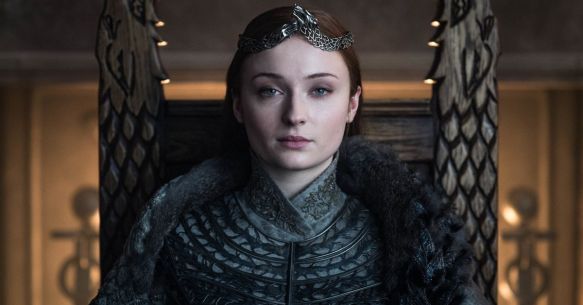
The same is true of the other remaining Starks — Sansa and Arya. Sansa stands up for the North and demands it be an independent kingdom, and Bran agrees (an immediate display of royal nepotism that doesn’t seem to bother any of the others). Arya sets off to go someplace nobody has gone before. Those were wonderful story arcs, and they remained wonderfully consistent and in character.
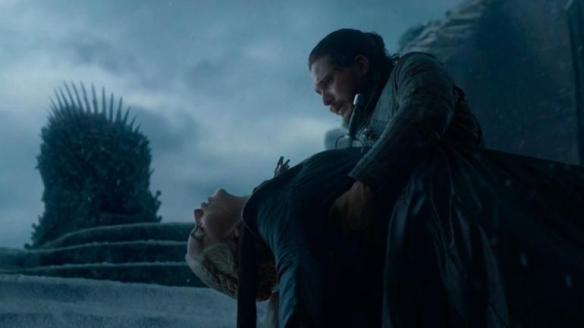
Betrays Two Women, Gets Re-united with His Direwolf.
Most folks, I suspect, aren’t going to care if the final episode made sense or not. They’ll mostly either hate the ending because it wasn’t what they wanted, or they’ll love it because it was predictably bittersweet. Sure, Dany gets murdered by the man she loves and trusts, but it’s presented in a way that’s supposed to make us feel sad for poor Jon Snow.
But the Iron Throne got melted, and that was nice. Tyrion is Hand of the King for the third time, which is nice. Sam gets the maester gig at King’s Landing, also nice. Brienne gets to write Jaime’s name in a logbook and fudge his record so it doesn’t reflect how reliably awful he was, and that’s nice. Bronn can afford the best brothels, nice for him. Jon is reunited with his direwolf, very nice. And, of course, Sansa and Arya get to fulfill their dreams, which is exceedingly nice. So it’s not an unhappy ending. And did you notice, as Jon is leading the wildlings back north of the wall — a blade of grass growing through the snow. Winter, it seems, is over.
It wasn’t bad, the final episode. But it could have been much much better. And as insipid as it was, the final episode can’t diminish what was a powerful and compelling television series.
I’m not particularly moved by the U.S. flag. Don’t get me wrong — I’m a patriot. I joined the military and did my four years in uniform. I’ve spent most of my life engaged in some form of public service — prison counselor, criminal defense investigator, teacher. I stand up when they play the national anthem at ball games. But I’m not a flag-waver. The flag just doesn’t move me as a symbol. It’s been brandished too often by too many hypocrites for too many cynical reasons for me to get very emotional about it.
However, there are two exceptions. First, I get weepy every time I see a military funeral. I’m going to guess a lot of you have only seen a military funeral on television or in the movies. Even so, you know there’s a military tradition that involves folding the flag and presenting it to the next of kin. Believe it or not, there wasn’t any actual written protocol for this ceremony until about five or six years ago. There was, however, the awesome weight of tradition, and tradition is a very big deal in the military.
By tradition, when the flag was presented to the next of kin the Casualty Assistance Officer (yeah, they actually have a title for this person; it’s the military) would kneel, offer the flag, and then say some variation of this:
This flag is presented on behalf of a grateful nation as an expression of appreciation for the honorable and faithful service rendered by your loved one.
The moment I hear the words a grateful nation I get totally choked up and by the time they get to honorable and faithful service I’ve been known to cry like a fucking baby. Partly because it’s so often a lie. The service was real. I’m not going to judge whether it was honorable or faithful, the fact is that person served. But let’s face it — the nation is rarely very grateful.
The other exception to my flag-related apathy is Memorial Day. This wasn’t always the case. As a holiday, Memorial Day has pretty much lost all meaning. I’ve written about this before. I’ve written about how ‘patriotic’ Republicans treat one of their own on Memorial Day. And three years ago I wrote about accidentally stumbling across a cemetery in a small town in Iowa on Memorial Day.
I went back to Maxwell, Iowa last year and again yesterday. I keep going back because the good people of Maxwell make Memorial Day feel like it’s supposed to feel. The flags they display are large, and they display a lot of them. But what moves me isn’t the number or size of the flags; it’s about the simple act of recognizing and acknowledging service. Maxwell shows appreciation for the inherent sacrifice of serving.
These weren’t necessarily big sacrifices. Very few of the veterans in Maxwell’s cemetery died while in uniform. They weren’t all heroes (when you call everyone a hero you devalue actual heroism). They were just ordinary folks who felt they owed something to their country or their community. The vast majority of the veterans did their time in military harness, came home, got a job, and lived an ordinary life. And each year, on this one day, the town of Maxwell basically says ‘Thank you.’ They don’t just say it to the dead who served in the military, mind you. The town also puts little flags on the graves of volunteer firefighters and police officers — red for firefighters, blue for police. It’s all about service, regardless of its form.
There’s a good chance, if you live in the US, that over the Memorial Day weekend you’ll pass by a cemetery, and you’ll have seen all those little flags scattered amongst the tombstones. Think about this: somebody put those flags there. Somebody walked out into the cemetery with a little chart showing where the bodies of veterans are located, and planted a little flag by each of those graves. In a few days, they’ll collect those flags and everything will go back to normal until next year. The vast majority of veteran’s graves will go unremembered. Nobody will visit their graves, except the persons planting those flags.
That’s probably not true in a small town like Maxwell. In a town of only a few hundred people, there’s a good chance whoever put those small flags by those graves knew the deceased. Or knew his kin. Maybe they learned geography or math from the person, or maybe grew up with the person’s grandson, or maybe bought their used car. There’s a good chance whoever put those flags in place in Maxwell wasn’t a stranger.
That moves me. It moves me in a very different way than when I visit the graves of my own family’s veterans. It moves me because what I see in Maxwell isn’t just honoring the dead, they’re honoring of the concept of service. It reminds me that service — the act of doing work for the benefit of the community — works both ways. By honoring service itself, the community of Maxwell makes itself worthy of that service. That’s a lesson for every community — every community across scales: neighborhood, small town, city, state, nation.
If you want a proud professional military, be sure you create a nation worthy of pride. If you want a good police force, make sure the city serves and protects everybody who lives there. If you want good teachers, give them good schools and provide them with the material they need to teach. It’s really very simple. If you want good service, give people a good reason to serve.
I’ll probably go back to Maxwell again next year. It doesn’t make me feel any more patriotic, and it won’t really change how I feel about the flag. But it reminds me that the reasons so many of us put on the uniform are valid. It reminds me service is honorable.
Yeah, I pretty much dislike Memorial Day. Don’t get me wrong; the idea of honoring the men and women who died while serving the nation — that I respect. But that’s not really what Memorial Day is anymore. Now it’s mostly a day to say something nice about veterans, maybe see a parade, go shopping, then eat a hamburger. And you can usually skip right to the hamburger.
The thing is, a lot of folks don’t even understand Memorial Day. They get it confused with Veterans Day, which is a different beast altogether. The confusion is understandable, on account of they’re both about people in uniforms and big big big shopping discounts and picnics with hamburgers.
Allow me to ‘splain the differences. Memorial Day is the one where you say nice things about folks that actually died while in uniform. Veterans Day is the one where you offer ritual thanks for everybody who put on military harness — dead, living, somewhere in between (and if you think that’s just a figure of speech, go visit a VA hospital).
I like Veterans Day. That’s what we call it in the U.S., although most Western nations call it Armistice Day or Remembrance Day. I like it because it still retains some meaning. It’s still celebrated on the same day — the anniversary of the end of the First World War. The 11th day of the 11th month.
Memorial Day used to have meaning. It began as Decoration Day — a day when folks would decorate the graves of soldiers who died during the American Civil War. It was an organic holiday. It began spontaneously, on different days, in different years, in different parts of the nation. Folks just went to cemeteries where Civil War troops were buried and decorated the graves. You know, out of respect.
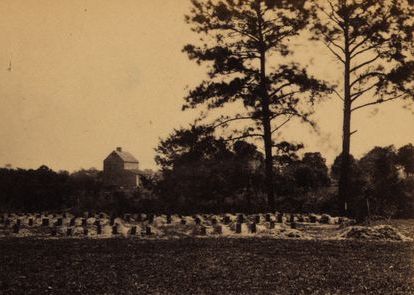
One of the earliest Decoration Day events took place in Charleston, South Carolina. Union prisoners of war had been interned at the Washington Race Course and Jockey Club. More than 250 of them died and were buried in a mass grave behind the grandstand. In April of 1865, a small group of freed slaves reburied the bodies in individual graves. They constructed a fence around the burial site, and put up an arched entryway with the inscription Martyrs of the Race Course. Then on the first day of May, some ten thousand former slaves and some white missionaries decorated the cemetery with flowers, and they held a picnic on the site.
New graves of Union soldiers at the Washington Race Course
Now that is a serious show of respect. Over time, Decoration Day became Memorial Day and through some sort of osmotic agreement, it was celebrated throughout the nation on May 30th. At least it was until 1968, when everything changed. But I’ll come back to that in a bit. First let’s reduce this national holiday to the personal level.
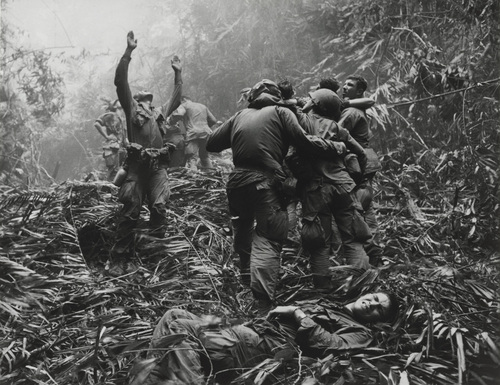
In April of that same year, 1968, a young photographer named Art Greenspon shot this photograph in the jungle southwest of Hue. Alpha Company of the 101st Airborne had walked into an ambush. Several killed, more wounded. Bad weather prevented any medevac until the following day. So the troops sat awake all night, in the rain, with their wounded and dead, wondering if they’d get hit again. The next day, when the rain lifted enough for a medevac, Greenspon got this shot of a soldier directing the chopper. By that point it had rained so long and hard that when Greenspon tried to rewind the film in his camera, it stuck to the pressure plate.
Here’s some military esoterica for you: the first choppers take the wounded; the last choppers take the bodies. The bodies can wait; they’re not going to get any more dead. Greenspon flew out on a chopper filled with body bags. When he got back to his base, he discovered most of the shots weren’t usable. This one was.
Art Greenspon was paid US$15 for that photograph. That’s all he’s ever been paid for it. A week later he and another photographer, Charles Eggleston, found themselves in a firefight outside of Saigon. Eggleston was hit by rifle fire and killed. One of the bullets passed through Eggleston’s hand, which slowed the round enough that when it hit Greenspon in the face, it didn’t kill him. Instead, the bullet lodged in his sinus cavity. In order to remove the bullet and minimize the facial scarring, the surgeons broke his cheekbone from inside his mouth.
Two months after that, during the darkest days of the war in Vietnam, Congress passed the Uniform Monday Holiday Act. The intent of the act was to change the date on which four holidays were traditionally celebrated in order to create three-day weekends. Great news for workers and a boon to commercial enterprises. The effect, however, was to trivialize those holidays. Now Presidents Day, Columbus Day, Labor Day, and Memorial Day are all about mattress sales and potato salad. We’re not really thinking about the men and women dying in jungles or deserts; we’re thinking about buying summer clothes.
Oh, we’ll still say nice things about the men and women who died in uniform. We’ll still have parades (that very few people attend), and politicians will still give speeches (that very few people will listen to), but mostly we’re just glad to have that extra day on the weekend, and a chance to save a buck on a mattress, and hey, it’s a good time of year for a picnic.
But Memorial Day isn’t — or shouldn’t be — about picnics. It’s about the people Art Greenspon flew with in that chopper; it’s about those bodies in the bags.
So yeah, I pretty much dislike Memorial Day. I don’t want to see the parade. I don’t want to buy a pair of cheap-ass flip-flops. I don’t want to hear any fucking politician thanking the troops for their sacrifice.
I want politicians to stop sacrificing them.
ADDENDUM: Last year on Memorial Day I wrote about my accidental visit to the local cemetery in the small town of Maxwell, Iowa. This year, while running around, I made an intentional detour to Maxwell. It looks exactly the same as it did last year (and probably for the last umpty-ump years) — flags lining the tiny town center, and all over the cemetery.
Maxwell, IA. Memorial Day, 2015
It doesn’t make up for the apathy and commercialism, but there’s something innocent and fundamentally decent about the way these small towns continue to honor their dead.
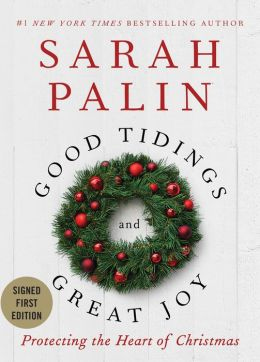
Call me old-fashioned, call me a traditionalist, call me a fuddy-duddy — but I miss the old days. When I was a kid, the War on Christmas didn’t begin until after Thanksgiving. Not any more. Yesterday the publisher HarperCollins released Good Tidings and Great Joy: Protecting the Heart of Christmas, by Sarah Palin.
That’s right. Sarah Palin is out there protecting the very heart of Christmas. According to HarperCollins,
At a time when Christian values are challenged—when the greeting “Merry Christmas” has been replaced by the supposedly less offensive “Happy Holidays”—Governor Sarah Palin makes the case for bringing back the freedom to express the religious spirit of the season.
You guys! You maybe didn’t notice it, but we totally lost our religious freedom when ACORN elected Baraq Hussein Obama (Mujahideen, Kenya, Africa) as President of These United States. We are no longer free to wish anybody “Merry Christmas.”
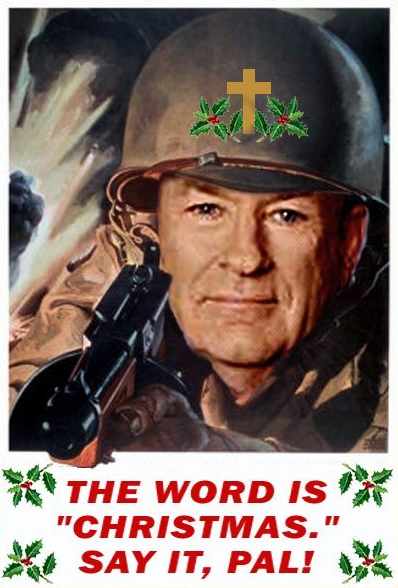
You’re either with Christmas — or you’re with the terrorists!
But happily Sarah Palin (Patriot, Macy’s, Grizzly Mama Department) has written her name on a book that tells oppressed Christians how to fight back against the tyranny of being forced to say those two most loathsome words in the English American language: Happy Holidays. Here are some of the former Governor’s peppy Words of Wisdom:
An angry atheist with a lawyer is one of the most powerful persons in America.
Totally true, you guys.You think Magneto was tough? You think The Joker was mean? You think Lex Luthor was cruel and relentless? Pffft…those guys were pikers compared to Angry Atheist (and his evil sidekick Lawyer). Angry Atheist is so tough, so mean, so cruel that Marvel Comics is afraid to write about him. According to Palin,
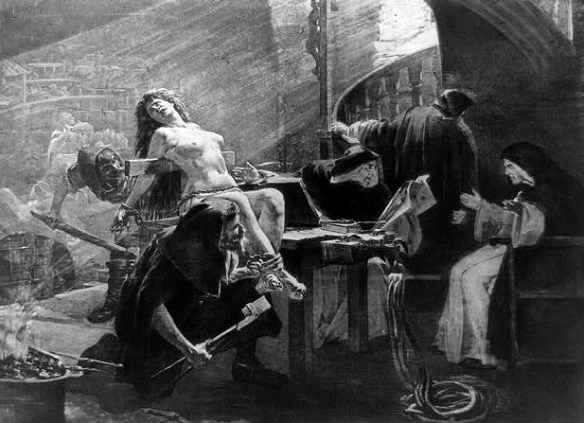
Atheism’s track record makes the Spanish Inquisition seem like Disneyland by comparison.
Also totally true. Think about it, you guys. The lawsuits brought by atheists to prevent Christian displays on public property are SO MUCH WORSE than the expulsion of 800,000 Jews from medieval Spain by the Tribunal del Santo Oficio de laInquisición. A couple centuries of torture of Jews and Muslims (and what the hell, a few hundred Lutherans) — that’s like a day playing with koala bears compared to the agony of having to hear people say “Happy holidays.” Seriously, ask yourself this question: would you rather live in a world where 5th grade students in public schools are denied the freedom to stage a play about the virgin birth of the Christian savior, or one in which a government agency legally uses torture to punish and/or convert citizens who disagree with religious orthodoxy? Think about the little children!
“Say it! Say ‘Merry Christmas’ and this will all be over.”
The Atheist Commie Muslim assault on ‘Merry Christmas’ is taking place on several fronts, some of which will totally shock you. As Palin points out,
Walgreens twenty-four page nationwide circular used the world ‘holidays’ thirty-six times without one mention of Christmas.
Seriously? I had no idea Walgreens was the drugstore of the Devil. I mean, c’mon, they seem SO American. They invented the malted milkshake, you guys! How did they manage to hide their fiendish nature from the American public for 112 years? Atheists are some sneaky anti-Christmas bastards.
I bet Charles Darwin never understood this: If the world could be described as truly ‘survival of the fittest,’ why would people collectively be stricken with the spirit of generosity in December?
Yeah, explain that, Charles Darwin. Let’s see you explain the evolutionary benefit of people around the entire globemost of the worldlarge parts of — uh, let’s see you explain the evolutionary benefit of people living in those bits of the world where Christianity is the dominant religion suddenly feeling particularly generous during the month of the winter solstice. You can’t, can you — and not just because you’ve been dead for more than 130 years, but because there IS no evolutionary benefit. Sarah Palin understands that everybody in the world people feel generous in the month of December because of Special Jeebus Magic.
Jolly Old Saint Nick bathes in the light of Special Jeebus Magic before taking to his flying-reindeer-driven sleigh to deliver gifts to Good (Christian) Boys and Girls.
Sarah Palin wants all Americans to live in a world where we no longer have to be terrified to say “Merry Christmas.” She’s SO brave, you guys. But still, would it kill anybody to wait to celebrate the War on Christmas until after Thanksgiving — the day we’ve set aside to thank God and Jeebus for letting us share a meal with those natives who survived the diseases we brought to the Americas (before we had to slaughter the savage bastards in order to expand the territory we seized from them and exploit the land’s natural resources).
I suppose I shouldn’t complain too much. Somebody has to protect the heart of Christmas from atheists and other Heart-of-Christmas-haters. Kudos to Sarah for standing up and writing putting her name on a book that’s sure to turn the tide in the War on Christmas (all proceeds, by the way, are being donated to a fund to support former half-term governors of states from which you can see Russia).
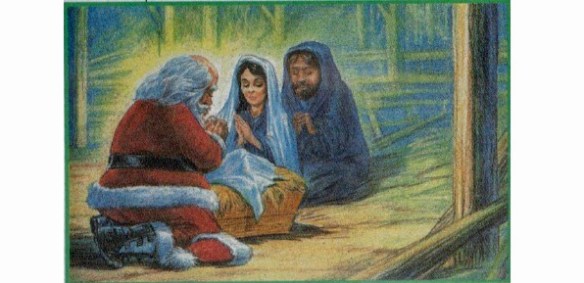
“Santa, all I want for Christmas is to sell a buttload of books.”
And so, as Tiny Tim observed, God bless us, every one.
Editorial note: Except John McCain. Curse you John McCain, for inflicting Sarah Palin on an unsuspecting public. May you be boiled with your own pudding, and buried with a stake of holly through your heart.













 gregfallis.com