curiosity and ragnar the cheesemaker

I have a morning routine, which rarely changes (because, you know, it’s in the morning and I’ve just awakened and and any activity that requires actual thought is probably beyond my capabilities). Greet the cat, check the perimeter (with the cat), feed the cat, ingest some form of caffeine, pet the damned cat, read the news, read more news, continue to pet and feed the fucking cat, consider reading email, decide against reading email, check Twitter, check Facebook.

By the time I reach the ‘read more news’ point, I’m moderately awake, properly caffeinated, and curiosity has kicked in. That generally results in me doing some level of research about what I’m reading. For example, this morning I saw something about ‘cult’ television shows. Not shows about cults; shows with cult audiences. No, wait…that sounds like the audience members are in a cult. Like everybody in the Order of the Solar Temple gathers around the television in the afternoon to watch Jeopardy. I’m talking about television shows that are obscure or generally unpopular with mainstream audiences, but still attract a devoted fan base. Somebody mentioned a British show called The Strange World of Gurney Slade. Which sounded weird and interesting, so I did some research and learned…well, that it was weird and interesting.

My point, if you can call it that, is that at some point in the morning, my need to read the news gets hijacked by my need to know and understand random stuff. This morning it was a few minutes of Gurney Slade. Then, on Twitter, I came across this simple question: Did Vikings make cheese? And my morning was gloriously ruined.

First, the question itself is wonderfully weird. You have to wonder what sparked the question. I assume it wasn’t just an idle thought; something caused this person to wonder if Vikings made cheese. Maybe they wanted to know what foods Vikings packed for a long voyage, maybe they were curious about Vikings and lactose intolerance–I don’t know. But it was an interesting question. But my immediate response was delight at the notion of a Viking cheesemaker. Some hirsute guy who, instead of setting off with the crew to raid the coast of Britain, decided, “Naw, I’m going to hang here and make a cheese.” Ragnar the Cheesemaker.

That led me to wonder how the process of making cheese was discovered, which eventually led me to read a sentence that not only took up much of my morning, but will likely haunt me for the rest of my life.

Cheese may have been discovered accidentally by the practice of storing milk in containers made from the stomachs of animals.

Okay, if you’re anything like me, you immediately started asking critically important questions. Who the fuck thought it was a good idea to store milk in the stomach of an animal? Who first said, “Dude, we got all this milk and we got no place to store it. Fetch me the stomach of an animal, please.” Who thought it was a good idea to store anything at all in the stomach of a dead animal? Who conceived of animal stomachs as prehistoric Tupperware containers? Somebody, while gutting an animal, must have had the idea, “Hey, let’s hang on to this stomach…we can clean it out and store stuff in it!”? Where would you keep the empty animal stomachs you plan to use later to store milk? And who, having left that first batch of milk in an animal stomach long enough for it to curdle and separate into curds and whey, thought, “Fuck it, I’m eating it anyway.”?

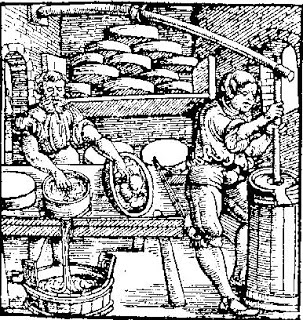
Medieval cheesemakers

My research also brought me to an article entitled Make Butter Viking Style, but I had to stop reading almost immediately, because of this:

Step One: Bring the crème fraîche up to room temperature and whisk it as if making whipped cream.

I am not convinced this is how Vikings made butter. I could go on (and believe me, I did), but you get my point. This has been my morning. Cat, Miami condo collapse, infrastructure agreement, some GOP bullshit about the military, cult television shows, Vikings, cheesemaking, animal stomachs, butter production. Every morning is like this for me. I’m completely fucking worthless from about 0700 to maybe 1000 hours, because of stuff like this.

And the worst thing about this? I have absolutely no use at all for what I’ve learned this morning. The odds of Gurney Slade or the history of cheesemaking (or, lawdy, the evolution of storage containers) ever coming up in conversation are astronomical. But this stuff will rattle around in my head for hours (or days or decades) and possibly spill out at some wildly inappropriate moment.

forget it joe, it’s afghanistan

There are things you can fix, and things you can’t. There are things you have a moral obligation to try to fix even if you can’t possibly fix them. There are things you believe need to be fixed, but aren’t actually broken. There are fixable things you believe you understand, but you’re wrong. There are fixable things that are none of your fucking business regardless of what you think about them. And when you’re in the middle of things, it’s hard–probably impossible–to know which things are which.

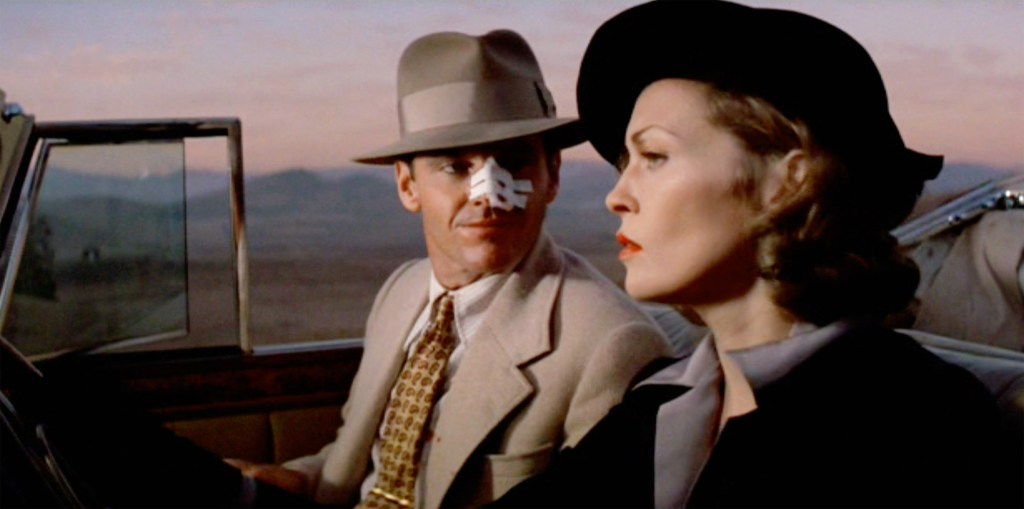
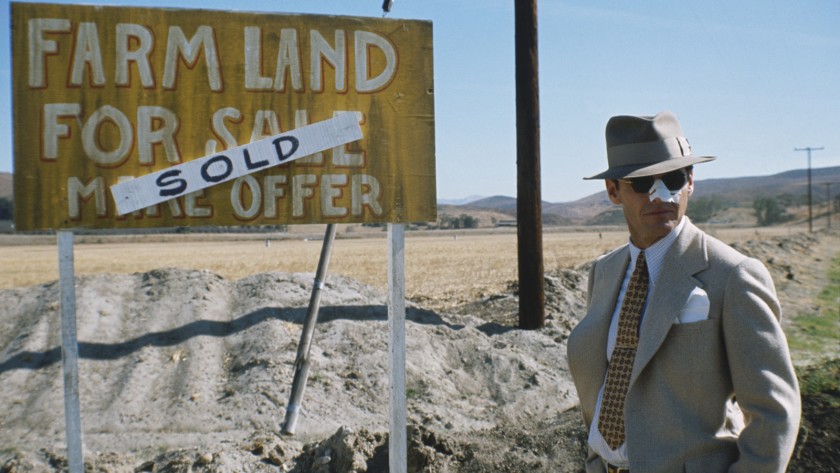
There’s a movie about that. Chinatown. Released in 1974. (I’m going to ignore the legitimate issues about the director, Roman Polanski, because for once I’m going to try to stay tangent-free.) Here’s the backstory of one of the main characters, and a short precis of the film’s plot (and yes, that means there are spoilers).

The backstory–Jake Gittes has a small private investigator business in Los Angeles. He’s a former police detective who worked in the notoriously corrupt Chinatown neighborhood. He became disillusioned (all movie PIs are disillusioned; it’s the law) partly because he was working in a culture whose norms and rules he didn’t understand, partly because of the endemic corruption, and partly because the actions and motivations of the Powers That Be (in both the Chinese and political communities) were concealed from him and inscrutable to him. When his client, Evelyn Mulwray learns he’d been a detective in Chinatown, she asks:

Evelyn Mulwray: What were you doing there?
Jake Gittes: Working for the District Attorney.
Evelyn: Doing what?
Jake: As little as possible.
Evelyn: The District Attorney gives his men advice like that?
Jake: They do in Chinatown.

As little as possible. Jake’s disillusionment was compounded when he attempted to help a Chinese woman. He says, “I thought I was keeping someone from being hurt and actually I ended up making sure she was hurt.” That same scenario plays out in the main plot, much of which is taken up with a long, brilliant McGuffin. It draws Jake into a situation in which he feels an obligation to rescue his client, Evelyn, and her daughter from an ugly situation involving Evelyn’s father–a multimillionaire developer. Once again, Jake finds himself in a situation in which the rules/laws aren’t clear to him, in which he doesn’t understand the motives or actions of the people involved, and where his attempts to help result in more harm. Had he done ‘as little as possible’ things may have worked out better, even if the situation itself remained awful.

In the final scene, his client is dead, the bad guys win, and Jake is not only helpless, he’s also partly responsible. He sees her body, mutters “…as little as possible” and is ordered away from the scene by his former Chinatown detective partner. As he’s being led away, one of Jake’s current employees tells him, “Forget it, Jake. It’s Chinatown.”

This scenario is being played out with President Uncle Joe and the decision to withdraw US troops from Afghanistan. It’s a culture–actually, a number of inter-related ancient tribal cultures–we don’t understand, cultures that operate on traditional rules and norms unknown to us, with values and ethics that are often alien to us, with goals that are foreign to us. The US and our Western allies have been attempting to resolve our involvement relying on OUR cultural norms and OUR values to achieve OUR goals. Forget it, Joe. It’s Afghanistan.

We had a valid reason (at least in my opinion) to intrude militarily in Afghanistan. Al Qaeda had used that nation as a training ground and recruitment center for the 9/11 attacks. We had a legit reason to go after al Qaeda. After that, things got…loose.

The fact is, no foreign adventure has ever succeeded in Afghanistan. Alexander the Great, whose Macedonian army basically walked over every army they’d fought, got caught up in a long guerrilla-style war in Afghanistan. He never fully succeeded in pacifying the various Afghan tribes. Before he died, Alexander said, “May God keep you away from the venom of the cobra, the teeth of the tiger, and the revenge of the Afghans.” Various Muslim invasions succeeded in converting most Afghan tribes to Islam, but never completely controlled the area. The Mongols, under Genghis Khan, occupied much of the area for quite a long time, but their empire also fell apart. Nobody held the area as long as Timur the Great–but it’s worth noting that Timur was known as Timur the Lame (or ‘Tamerlane’ as he was called by Europeans) because of wounds he received fighting Afghan tribes. After Timur’s empire failed, the Sikhs attempt to invade Afghan territories several times without much success. The British invaded three times in the 19th and early 20th centuries–and got their asses kicked each time. Russia invaded three times–in 1929, 1930, and finally in 1979–and got their asses kicked each time.

And, of course, the US (and NATO) invaded in 2001. We know how that worked out.

But here’s the thing the Afghan tribes have always known and the thing foreign invaders never seem to figure out: the Afghans don’t have to win any wars; they only have to keep fighting at some level, and eventually the invaders–no matter who they are, or where they’re from, and how powerful they are–will leave. The various Afghan tribes are unconcerned about foreign military deadlines or the domestic political necessities of foreign powers or the costs those powers incur; they’re operating on God’s time, and they measure cost on a different scale.

President Uncle Joe’s decision to pull out troops is just an acknowledgment that Afghanistan is Chinatown. Doesn’t matter if we had a legit reason for being there, doesn’t matter if our long low-level war of occupation was a genuine attempt to help the Afghan peoples (and I’m not convinced it was), doesn’t matter what our motives were. Like every other invasion force in Afghan history, we’ve almost certainly done more harm than good.

There’s a scene in Chinatown in which Jake Gittes speaks with Noah Cross, the millionaire developer behind all the misery that’s taking place. Cross inhabits a world where laws and rules of ordinary decency don’t seem to apply–a world that’s as ambiguous and perplexing to Jake as that of Chinatown, a world that’s just as baffling and complex as our involvement in Afghanistan.

Jake Gittes: How much are you worth?
Noah Cross: I have no idea. How much do you want?
Jake: I just wanna know what you’re worth. More than 10 million?
Noah: Oh my, yes!
Jake: Why are you doing it? How much better can you eat? What could you buy that you can’t already afford?
Noah: The future, Mr. Gittes! The future.

That’s why we’re in Afghanistan. The future. Their future, our future–we think we can make it better. We think we have the means and the power and the right to make it better. We think we know what ‘better’ means.

We don’t. We just don’t.

Forget it, Joe. It’s Afghanistan.

3 television shows i’d watch

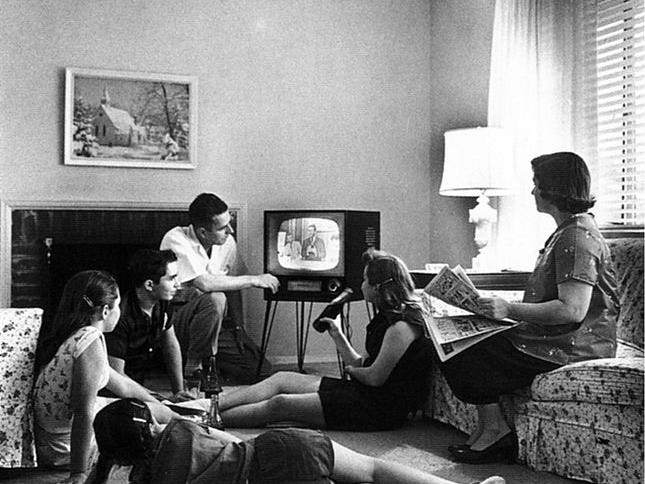
I like television. I don’t watch a lot of it, but I like it. I watch probably a couple of hours of television a day. Wait, not true. I usually watch the local news and the network news. That’s an hour right there. Then I’ll watch an episode of some show over a meal. Later I’ll usually watch an episode of a different show. So let’s say a couple of hours of entertainment television, and a hour of news.

With so many streaming services available, there’s always something to watch. That said, I don’t generally watch US network television shows. Not because of any anti-American bias, but because they all seem too slick and indistinguishable. Most of the actors–especially the women actors–tend to look like models rather than real people. The storylines often feel familiar and predictable. They don’t require anything from the viewer but passive engagement.

Since I complain about them, somebody asked me what I’d like to see US television production companies release. And because I’d rather think about that than what I’m supposed to be doing, I came up with three ideas for television shows I’d watch. I was just amusing myself, of course, and being a bit ridiculous–but I think I’d actually watch television shows like this.

Here we go:

Welcome to Ballachulish: Two assassins–one an official CIA wetwork specialist on a gov’t pension, one a Belgian freelancer who has made enough money to get out of the game–coincidentally choose to retire to the same small out-of-the-way village in Scotland. Although they each remain suspicious that the other is there to kill them, they semi-bond together as they interact with the quirky locals–an irascible veterinarian, a lesbian couple who operate a pub/B&B, an irascible postmaster, the local constable (a wanna-be spy novelist), an irascible shopkeeper, the local laird and his extended family, an irascible Korean owner of a Mexican restaurant, a standard attractive single woman school teacher, an irascible ironmonger/blacksmith/interior designer.

The Bookstore: A small, dusty used bookstore in Brooklyn that somehow attracts all sorts of customers–lawyers, immigrant taxi drivers, soccer moms, art students, police officers, actor/waiters, college professors, professional dancers, auto mechanics, bicycle messengers, etc. Occasionally some ask the bookseller for a recommendation. Bookseller encourages them to browse, take their time, find a book themselves. If they insist on a recommendation the bookseller will agree, saying “I’ll recommend a book for you just this once. One time, and that’s it. And all sales are final. Are you sure you want me to recommend a book?” If they still insist, the bookseller will charge them US$14.75 in advance, study their face for a while, then say “I know exactly what you’re looking for” and send them to a back room.

As they pass through the door, they enter a story. Might be a romance, might be a murder mystery, might be a heist story, might be a pirate story, might be science fiction or fantasy, might be a story set in a Russian gulag or a French Foreign Legion post in north Africa–but it’s rarely what the customer thinks they want. Most have happy–or at least satisfactory–endings. Some don’t. The story resolves, the customer finds themselves back in the bookstore.

Ol’ Man River: Guy (or woman, doesn’t matter–let’s say a woman, what the hell) wins the lottery. She leaves her old life behind (whatever that includes). Buys a houseboat. Travels up and down the Mississippi River mostly by herself. Stuff happens. She meets people, she has visits from family and friends, she deals with animals and boat problems and bad weather, she stops at various river towns, she learns some local history, she changes in ways she doesn’t expect. Lots of pretty scenery.

I considered suggesting a series in which two retired assassins buy a houseboat and travel up and down the Mississippi stopping at bookstores in river towns, but that seemed a bit over the top.

3 things that make me love the world

I’m not one of those “Let’s focus on happy news and forget how completely fucking awful the world is” guys. I lack the Pollyanna gene. When the world is completely fucking awful, I want to know about it. I want to understand it. Don’t try to distract me with bluebirds or other happy horseshit. Because despite how completely fucking awful the world is, I still manage to remain pretty chipper and stupidly happy. I still love this world.

I’m telling you that because the news this morning is jammed with the mass murder that took place in Georgia yesterday. Eight dead–six Asian women, two non-Asian men. Apparently murdered by some inadequate white incel asshole who, according to law enforcement officials, “had a really bad day…and this is what he did.” On any other morning, I’d be writing about both this hate crime against women (and the reality is that the most common hate crimes–and the least acknowledged hate crimes–are committed against women) and the casual way white law enforcement agents treat white mass murderers who commit hate crimes.

But not this morning. I’m NOT trying to distract you from the truly awful shit that’s taking place. But three things happened this morning that made me ridiculously happy. And I’m not going to let this Georgia asshole detract from that. Fuck him in the neck. These are three things that make me love this awful world.

First thing. The Pritzker Prize. If you’re not familiar with this, it’s the most prestigious award in architecture. It’s usually awarded to some arrogant asshole ‘starchitect’ who designs massive, expensive, flamboyant buildings. Not this year. This year it’s gone to Anne Lacaton and Jean-Philippe Vassal, a pair of architects who have largely focused on transforming low-income housing complexes. Instead of tearing down old structures and building new ones, these two have found ways to transform old housing projects into attractive living environments. A lot of poor people may hate where they live, but aren’t confident they’ll be better off if they moved.

Turning grim public housing into bright living spaces.

A few years ago, Lacaton and Vassal were asked to work on “a particularly large and hideous” public housing project in Bordeaux. The people who lived in the projects didn’t want to leave; they just wanted more space and more light. Lacaton and Vassal gave them what they wanted. The basically encased the building in glass, turning what had been exterior apartment walls into sliding glass doors leading to an enclosed terrace. It cost less money, it required less disruption for the tenants, and it turned grim, drab apartments into bright sunny spaces. The Pritzker jury wrote:

Through their belief that architecture is more than just buildings, through the issues they address and the proposals they realize, through forging a responsible and sometimes solitary path illustrating that the best architecture can be humble and is always thoughtful, respectful, and responsible, they have shown that architecture can have a great impact on our communities and contribute to the awareness that we are not alone.

I like living in a world where French architects are honored for their work in support of poor folks living in public housing.

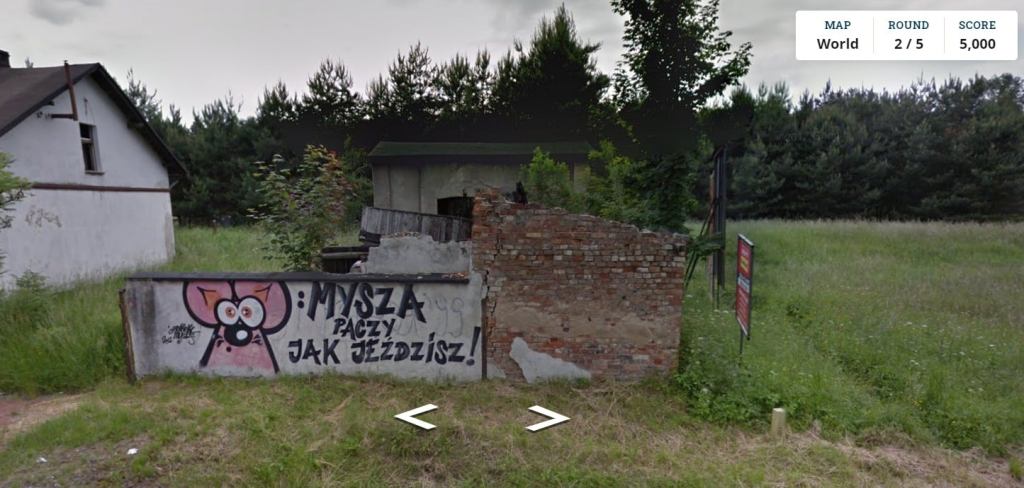
Second thing: I’ve written about the game Geoguessr before–both as a game and as source material for an appropriation art project. For a variety of reasons, I don’t play the game as often as I used to. But now and then, I’ll get the urge and I’ll immerse myself in virtually exploring a novel part of the world. Last night I played and found myself lost in the Polish countryside, where I saw an interesting bit of graffiti art.

I don’t speak Polish. But I help run a Facebook group called Geoguessr Oddities, with a global membership some of whom were likely to know Polish. So I posted the screengrab. And a short time later I learned Mysza Patrzy jak Jedzisz translates to “The Mouse watches you drive.” It wasn’t very helpful in finding out where I was in Poland, but the translation cracked me up, and the interaction itself made me happy. Then this morning another member of the group informed me that franekmysza is a Polish graffiti artist with an Instagram account. He’s painted that mouse all over Poland.

I like living in a world in which I can be introduced to a Polish graffiti artist by playing a game designed by a Swedish IT consultant to get you lost in new parts of the world.

Third thing. There was an article in the Washington Post about a kid, Darius Brown, who learned to sew bow ties for rescue animal–and I swear, this made me tear up and I came THIS close to crying like a little girl. Darius (and, again, he has an Instagram account you may want to follow) was taught to sew bow ties by his sister when he was eight years old. He got started in the rescue animal bow tie gig two years later, in 2017, when a couple dozen dogs left homeless in Florida and Puerto Rico by Hurricane Irma were transferred to a shelter in New York City. He thought the animals might get adopted quicker if they were wearing bow ties.

Let me just say that again. A ten-year-old kid in New Jersey sewed 25 bow ties for rescue dogs from Florida and Puerto Rico because he wanted them to get adopted. How perfectly wonderful is that? And hey, it worked.

Of course it worked. Look at that good boy wearing one of his bow ties in a Savannah shelter. Are you kidding me? Who wouldn’t want to adopt this tripod pooch? According to WaPo, Darius has now “donated more than 600 bow ties for dogs and cats in shelters.” He’s only 14-years-old. He says, “A well-dressed dog…that will make people smile.” And yeah, it does.

I suppose I should mention that Darius has both a speech disorder and a fine motor skills disorder–but since those things don’t define him, they’re less important than what he does. And what he does is make the lives of shelter animals better, which makes shelters better, which makes the lives of the people who adopt the shelter animals better, which makes the entire world a little bit better.

I like living in a world with Darius Brown in it.

Yes, the world is completely fucking awful. But it’s also completely fucking wonderful. We shouldn’t let the former diminish the latter. There are architects who transform awful buildings into livable spaces. There are graffiti artists painting snarky mice all over Poland. And there’s a kid in New Jersey putting bow ties on shelter animals. How can you not be in love with this world?

EDITORIAL NOTE: Another thing that makes me happy. A couple of folks have kindly and gently taken me to task for writing ‘crying like a little girl‘. It makes me happy because 1) it’s nice that folks call me when it looks like I’m being a dick, and 2) because originally I actually included a long, parenthetical tangent about that phrase, doing a riff sort of like Dickens in A Christman Carol when he natters on about the phrase ‘dead as a doornail’. But I write these posts in a rush, and I edit very little…so I deleted the tangent in the hope that people would interpret crying like a little girl to mean grown men and little girls cry in the same way and sometimes for the same reasons.

I’ve decided NOT to correct it. It’s better to let other folks learn from my misjudgments.

musings

Somebody (I don’t remember who) at some point in time (I also don’t remember when) asked me how I decided what to write about on this blog. I don’t remember what my answer was, but…okay, wait. I should point out there’s absolutely nothing wrong with my memory. It’s just that who asked the question and when it was asked and what my answer was–none of that’s important, except as a ridiculous way to introduce what I’m about to say. Well, write. You know what I mean.

Probably the reason I don’t remember what my answer was is that I’ve no idea how I decide what to write about. Something somewhere sparks a thought and I write about it. That’s it. Anyway, after yesterday’s post, my friend Anne said this:

“Beautiful photos, and really lovely musings.”

Musings. It sounds so intellectual, doesn’t it. But dude, IT IS NOT. I know this on account of the fact that ‘muse’ came up in a conversation I had years ago (and no, I don’t remember when, but I’m pretty sure I remember who…again, it doesn’t matter). I’d just assumed that ‘musing’ had something to do with the Muses. You know, the nine daughters of Zeus who were goddesses of the arts and sciences? Those Muses. I mean, that would seem to make sense, right?

Nope. Well, mostly nope. Etymologists suggest the modern word probably has been influenced in sense by capital ‘M’ Muse. There’s a lot of elasticity in ‘probably’. Doesn’t matter, because in fact, small ‘m’ muse comes…wait. Do I need to define ‘muse’? Probably not, but what the hell.

Muse: verb (mused, musing) 1 intrans (often muse on something) to reflect or ponder silently. 2 to say something in a reflective way. 3 intrans to gaze contemplatively. musing adj thoughtful; reflective. noun 1 (musings) literary thoughts. 2 the act of musing.

There you have it. As I was saying, small ‘m’ muse comes from the Old French muser, which meant “to ponder, dream, wonder’ and/or “to loiter, waste time.” This, in turn, came from the Gallo-Roman musa, meaning “snout”. It was apparently a term used in hunting. So basically, ‘musing’ referred to the act of standing around, sniffing the air like a dog who’s lost the scent. The term muzzle, by the way, is derived from the same root.

Dog, musing in a field; not that different from me musing in a junk shop.

So in essence, Anne was saying I stood around in that shop with my nose in the air, sniffing like a dog. Which would be rather rude and insulting except that it really isn’t that far from the truth. The place had a fairly distinct pong; sort of a melange of dust, must, wood chips, organic decay (remember, it was also a plant shop), and old pillows. And I did sort of root around like a curious puppy.

clutter

An untidy accumulation of objects, or the confused overcrowded state caused by it. From an Old English variant of clotern, meaning ‘to form clots, to heap on,’ which was derived from clott, meaning ‘a round mass or lump’. You know…clutter.

Most folks don’t like clutter. It makes them uncomfortable, uneasy, anxious, unsettled. Clutter, we’re told, “creates indecision and distractions, consuming attention and making unfettered happiness a real chore.” We are told, “Order is Heaven’s first law.” The problem, of course, is we fear disorder. We fear chaos. So we attempt (and to some extent, succeed) to impose a sense of order on…well, everything.

I confess, I can find “unfettered happiness” in cluttered spaces. Other people’s cluttered spaces, I should say. Not my own. I like to visit clutter; I don’t necessarily want to live or work in it. And it’s not just cluttered spaces in general that I enjoy. I’ve no interest at all in well-organized clutter. A room encumbered with stacks of old newspapers and magazines, a cellar jammed with tins of food, an office filled with dusty ledgers and technical manuals–no thank you.

No, what I like–what I find stimulating, what brings me some perverse joy–is random clutter. Clutter that contains surprises, clutter that holds unexpected stuff, clutter that’s arbitrary and unpredictable, that’s what I’m after. It’s a fairly rare phenomenon. I’ve encountered it occasionally in old sheds or farmhouse mudrooms, a bit more often in old school hardware stores. I found it at West End Architectural Salvage and Coffee Shop before it became a sort of high-end esoteric antique store. I found it at Fairground Hardware before it closed.

Everywhere you turn you find yourself saying, “Wait…what? Why are there taxidermied Canada Geese next to the Allen wrenches, which are beside the cans of spray paint? Who puts PVC pipe and vintage Melmac dishes together, along with toy trains and light bulbs? Putty knives and puppets and metal screws? What? Halloween decorations? And…wait, canned goods?

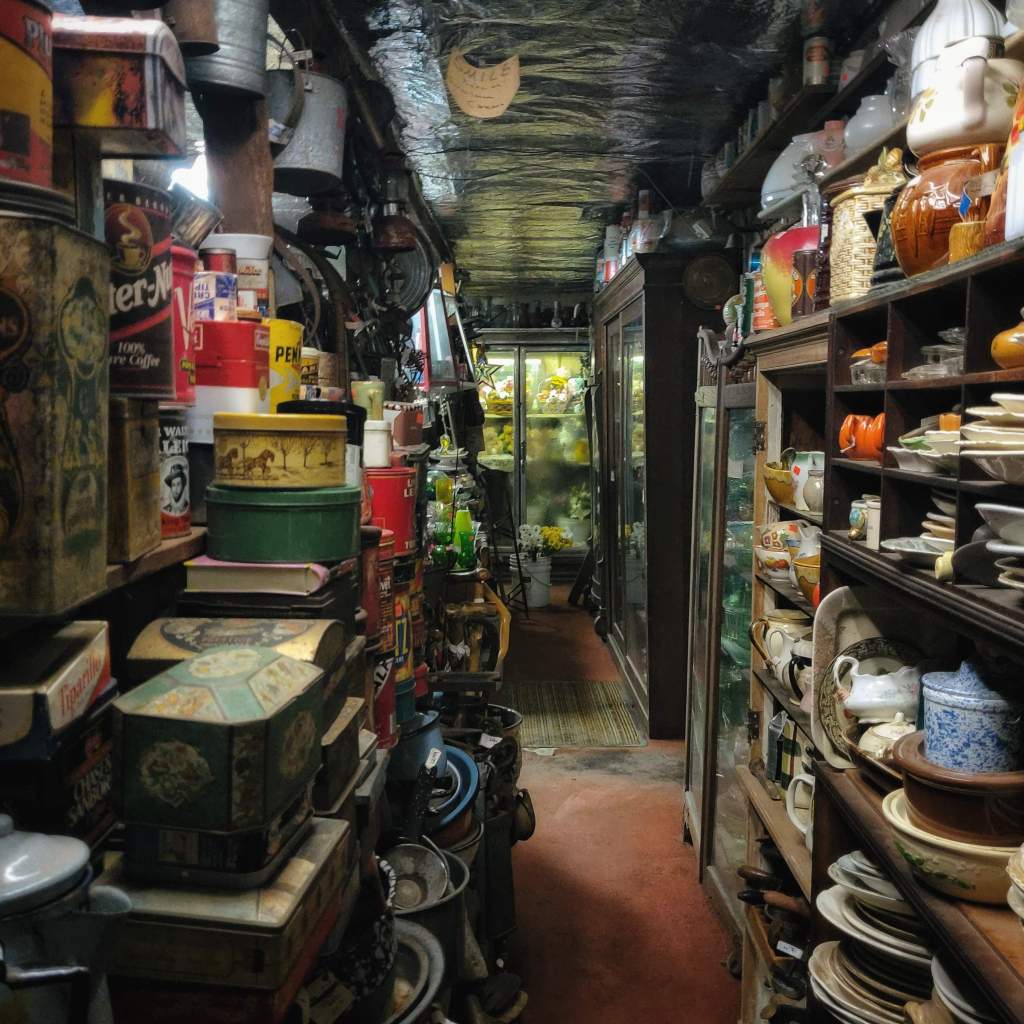
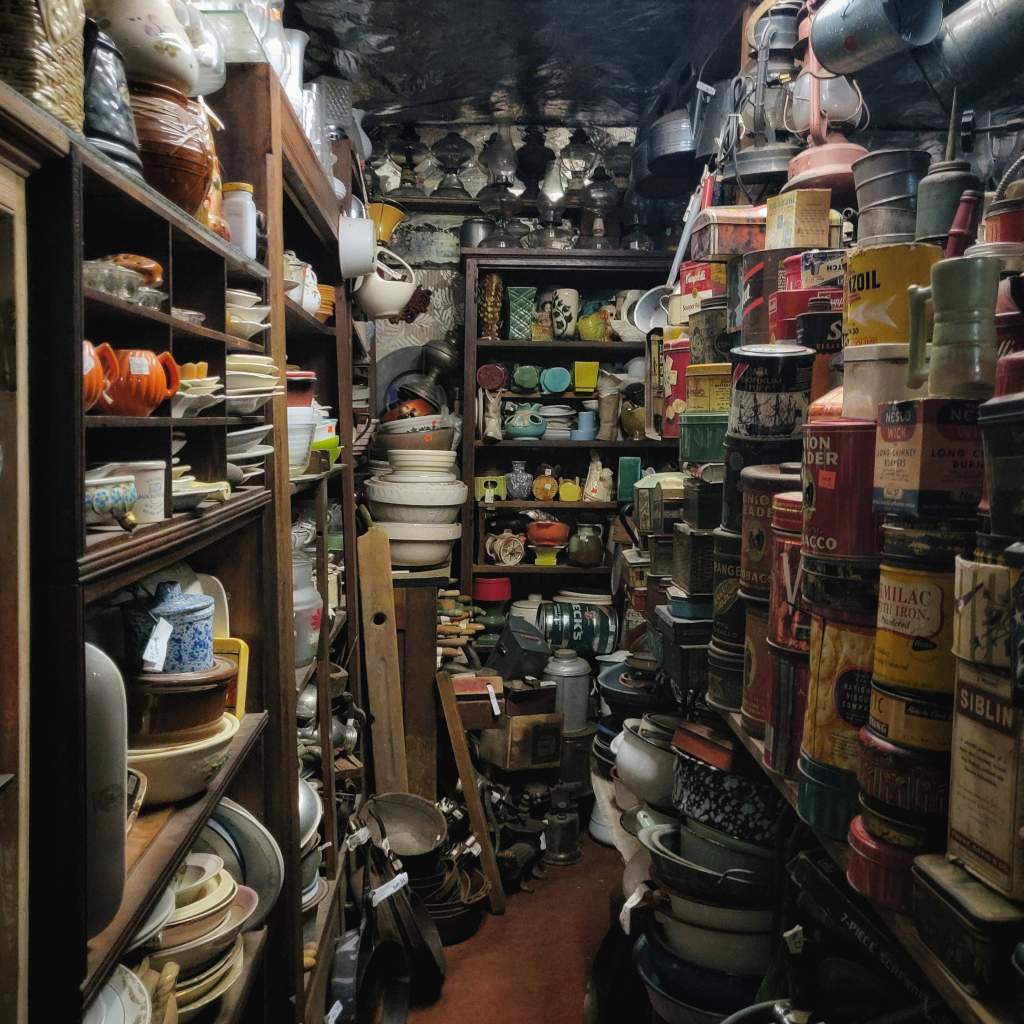
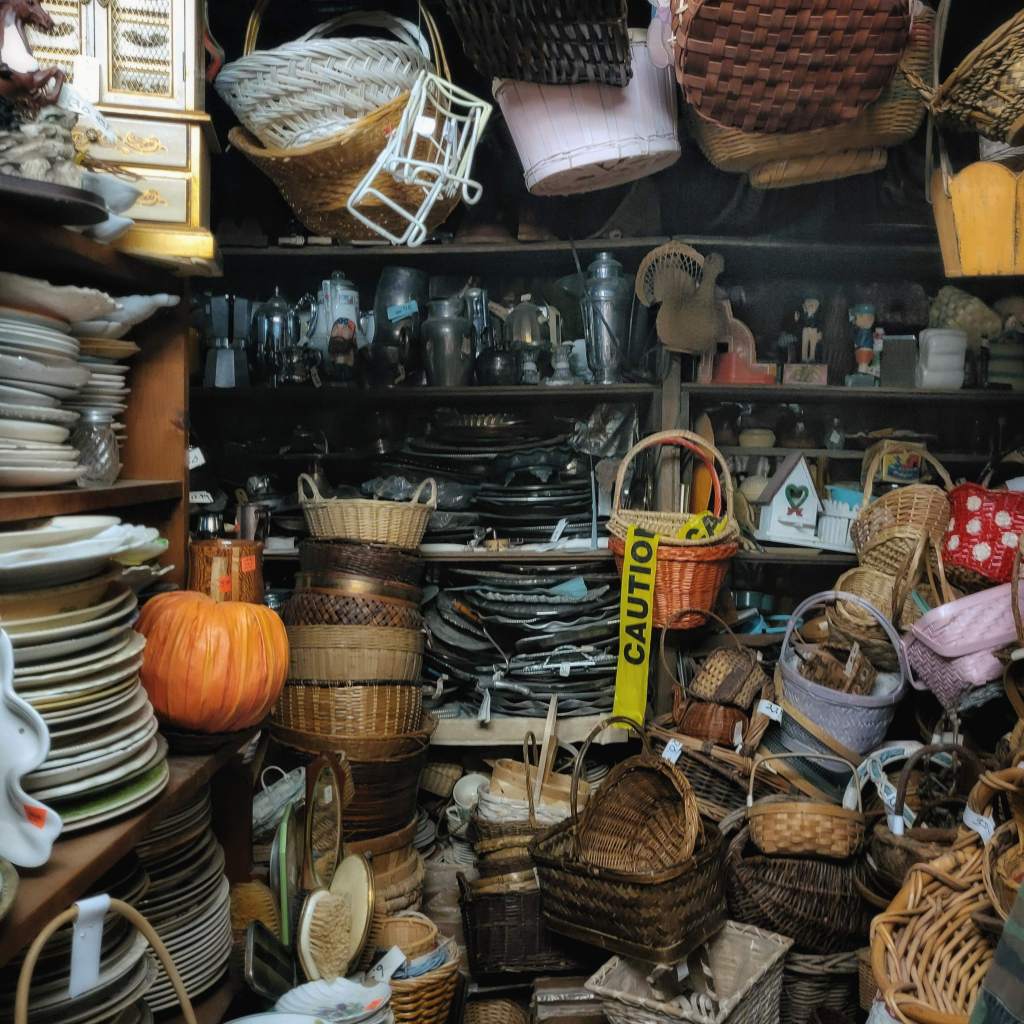
A couple of weeks ago I stumbled across an antique store/junk yard/plant shop/maze that was a celebration of clutter. Poorly lighted narrow aisles of overfilled shelves with often random semi-related stuff accumulating on the floor, sometimes forcing you to walk sideways. I say ‘random semi-related stuff’ because there was a sort of micro-taxonomy occurring–small clusters of items that belonged in the same (or a similar) category, but scattered among wildly unrelated clusters. Stacks of wooden boxes beside a stockpile of china dishes; a pile of wicker baskets under a shelf of brass candlesticks, under a shelf of religious figurines; a collection of antique toy trains next to a group of chamber pots and jugs sitting on a cabinet containing china bells.

The place was…well, disordered, to be polite. Everywhere you looked you saw something that somehow both belonged right there and yet was completely out of place. It was like walking through some other person’s dream-state–or perhaps wandering through a stranger’s memories; you recognized almost everything you saw, but even though nothing was quite where you thought it ought to be, you sensed it was where it was supposed to be. Which, I realize, doesn’t make any sense.

The poet Czesław Miłosz wrote about the “mystery of things, little sensations of time…all infinity can be contained in this stone corner, between the fireplace and the oak chest.” That’s how I feel in these cluttered spaces…as if thousands of people have dropped moments out of their lives onto all these dusty shelves, and I get to wander through them, sampling them, touching them, knowing that they’re real…or were real at one time…and now would be entirely forgotten if not for the curious people who look at them, wonder about them, then move on.

Miłosz was talking about ‘mystery’ in the older sense of the term–not as a curiosity to be explored and understood, but as a phenomenon that transcends the rational world. These baskets and bowls, these canisters and candlesticks aren’t physically imbued with some mystical connection to their previous owners. These objects aren’t haunted. But they do spark the imagination. Each of these things has a story. They remind us that those previous owners existed, that they lived lives and those lives intersected with these things, and somehow these things eventually made their way here, to these dim and dusty shelves.

I admit, it would be oppressive to spend a great deal of time in such cluttered spaces. It’s too dark, it’s too dusty, it’s too gravid with memory. But for a measured chunk of time, noodling through these dim aisles can be just as entrancing as it would be to wander like Kai Lung “unchecked through a garden of bright images.”

this was supposed to be a few scattered thoughts

I’m a tad brain-weary this morning. I worked as an election volunteer yesterday–15 hours of civic duty helping people vote on a school board issue–so rather than attempt to organize some coherent thought on a single subject or theme, I’m just going to natter on for a bit.

First Thought: The election was briefly disrupted yesterday by a pipe bomb. That’s right, some fuckwit placed a pipe bomb outside one of the election sites (not the one at which I volunteered). That’s right, a pipe bomb. A fucking pipe bomb. Over an election on how the local school district should spend its capital improvement funds. You know, do we want to improve classrooms and build new playground equipment–issues like that. We don’t know who planted the bomb (yet) or what his motives were (and yeah, I’m assuming it’s a guy…sue me), but to me it seems likely the would-be bomber will turn out to be some young Trump-crazed asshole who thinks the best way to ‘protect democracy’ is to attack elections.

Post-Trump democracy in action.

The good news is the local police acted quickly. A bomb squad from the Fire Marshall’s office showed up (as did the ATF and the FBI), and safely detonated the bomb. The bomb was found around 0920 and the election site was back up and helping voters by 1230. That makes me proud. The polling site was only closed for three hours. That’s the best way to say ‘Fuck you’ to the bomber.

Second Thought: Speaking of civic pride, there’s a village in Perthshire, Scotland called Aberfeldy. It’s just a small market village on the River Tay, population a wee bit under 2000. The name Aberfeldy comes from the Pictish term aber meaning ‘the mouth of a river’ and the Gaelic Peallaidh, which translates as ‘shaggy’. But–and this is SO cool–Pealladh is also the name of a local fay being which is said to abide in the river. ‘The shaggy one’ is considered a harmless sub-species of fuath, the generic class of Scots spirits/sprites that inhabit the sea, tidal rivers, fresh water rivers, and lochs.

Now that’s a fountain.

You’re probably asking, “Greg, old sock, what’s all that fae business got to do with civil pride?” It’s a good question (and stop calling me ‘old sock’). Here’s the answer: this village, inhabited by fewer than two thousand souls and one water sprite, has the most astonishing water fountain in the town square. Just look at that beauty. It was donated in 1885 by the Marquis of Breadalbane (no, really, Breadalbane, isn’t that a great name?). Now THAT is civic pride. Even Robert Burns (and there is nobody more Scottish than Burns) appreciated this little village. He wrote a poem called The Birks of Aberfeldy.

Now Simmer blinks on flowery braes,
And o’er the crystal streamlets plays;
Come let us spend the lightsome days,
In the birks of Aberfeldy!

Third Thought: Among the many stupid, hateful, vindictive, anti-democracy voting laws Republicans are pushing through state legislatures this year, this one stands out. The Georgia GOP wants to interpret an existing law that prohibits giving or receiving money/gifts for registering voters, or voting for a particular candidate to include folks handing out snacks or water to voters standing in long lines while waiting to vote.

It’s not enough to make it harder for certain groups to vote, it’s not enough to reduce their opportunities to vote, it’s not enough to reduce the hours in which they can vote, the Georgia GOP also wants to punish anybody who tries to ease the burden of voting. If there’s a Hell (and I’m afraid I don’t believe there is), there ought to be an especially severe section for deliberately cruel and corrupt politicians.

That would also include governors (and I’m particularly thinking of the singularly vile governor of Texas here, though the governors of Iowa, Missouri, North Dakota, and Mississippi are very nearly as horrible) who knowingly and willfully put the health and safety of their citizens at risk. Abbott of Texas not only completely lifted ALL Covid precautions statewide, his order also prohibited city and/or county governments from requiring masks or limiting business operation. He basically ordered them to stop doing anything to protect their citizens.

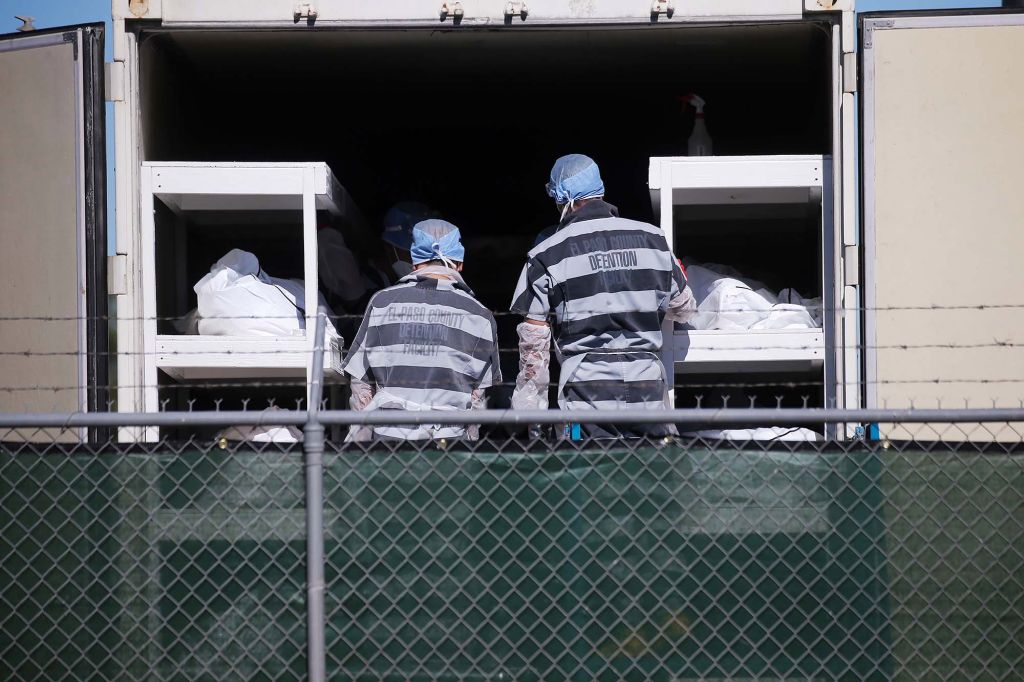
Just a few months ago Texas was paying prison inmates US$2 an hour to move Covid corpses into mobile refrigerated morgues.

Abbott did this while his state is still averaging over 200 Covid deaths each day. Texas has the the third-highest Covid body count in the country. It’s 45th among states in terms of the percentage of the population that’s been vaccinated. And by the way, every Republican member of Congress from Texas opposes Uncle Joe’s Covid relief bill. They know they can vote against it and still benefit from the cash when Democrats pass it. That’s how awful they are.

Remember when Comrade President Trump decided to stop federal funding for ‘anarchist jurisdictions’ that ‘refused to undertake reasonable measures to counteract criminal activities’? He was talking about states and cities that refused to call the National Guard to stop Black Lives Matters protests. But maybe that idea has some merit. Maybe Uncle Joe should consider limiting funding for anarchist jurisdictions that refuse to undertake reasonable measures to counteract the pandemic.

I wonder if Republicans would object to that.

Okay, remember when I started this post? I said I was too brain weary to ‘attempt to organize some coherent thought on a single subject or theme’? It turns out my brain was organizing stuff without my knowledge. Turns out there WAS a theme. Civic duty. Civic pride. Civic responsibility. Civic pride isn’t about being ‘the best’ or ‘first among’ or any of that ‘We’re Number One!’ sort of nonsense; it’s about putting in the effort to make the lives of your citizens a bit better. Civic pride is helping your people vote, it’s keeping your people safe, it’s a ridiculously ornate water fountain in a small village.

Civic pride. Governor Abbott doesn’t have any. The jackass who planted the pipe bomb doesn’t have any. The village of Aberfeldy does. “Come, let us spend the lightsome days / In the birks of Aberfeldy.” There are no lightsome days when you’re loading bodies into refrigerated trucks.

seven white balusters & a cat

I’ve been accused (more than once) of overthinking everything. That accusation is often valid. I tend to overthink some stuff because it’s amusing to me and because it reminds me that everything is connected.

For example, this photograph. It’s just a cat sleeping in a patch of sunlight. Nothing significant, nothing particularly interesting in itself. But if you overthink it, it links together a series of at least ten seemingly unrelated facts.

FACT 1: I belong to an online global collective of photographers called Utata. This group, which has over 30,000 members, creates a variety of photographic ‘challenges’ or projects for its members to participate in. One of the current challenges involves photographing a collection of seven related things.

FACT 2: Pomegranates originated in a historical region called Mesopotamia which occupied the ancient Near East and Western Asia.

FACT 3: The cat that lives here likes to sleep in patches of radiant heat. On winter days, to please the cat, I open the front door to allow the sun to shine in.

FACT 4: For more than three thousand years, Aramaic was one of the prominent languages of the ancient Near East, which included regions of Mesopotamia.

FACT 5: A balustrade is a railing, often ornamental, supported by individual short posts or columns, which are called balusters.

FACT 6: Near the front door, where the cat likes to sleep in the winter sunlight, is a stairway leading to the basement; the stairway is protected by a balustrade.

FACT 7: The earliest examples of balustrades are found in sculptured Assyrian bas-relief murals, some of which have been dated back to a period between the 13th and 7th centuries B.C.

FACT 8: Assyria was an ancient Mesopotamian empire.

FACT 9: The term ‘baluster’ comes from the Aramaic balatz, which refers to the flower of the wild pomegranate. Balusters in the bas-relief murals had double curves, which resembled a half-opened pomegranate flower.

FACT 10: I noticed the cat sleeping in the sunlight from the open front door. The light illuminated seven of the balusters supporting the balustrade, meeting the requirements for the Utata photo challenge.

Does knowing those facts make this a better photograph? Nope. It’s still just a photograph of a cat sleeping in a patch of winter sunlight.

But surely you’ll agree there’s a certain delight in knowing that the cat is sleeping in a patch of sunlight beside a railing supported by posts that were originally named in an ancient almost-forgotten language because of their resemblance to the flower of a fruit that first grew in an empire that no longer exists.