Whenever I have a story published, I get asked this question: “What’s it about?” And I’m always at a loss for an answer. You’d think, since I wrote the damned thing, that I’d be able to tell folks what the story is about. But that’s the thing about stories…or at least that’s the thing the stories I write (and I suspect that’s true of most writers). They’re never about just one thing.
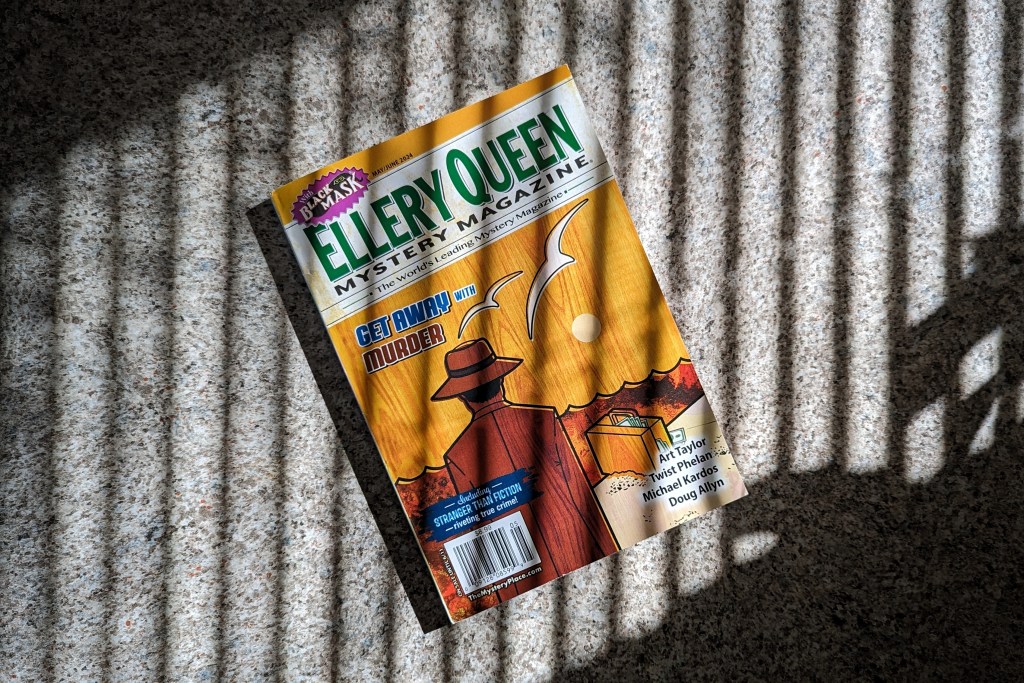
I have a story in the May/June edition of Ellery Queen’s Mystery Magazine (which, by the way, is an absolutely wonderful magazine if you like short mystery or detective fiction). It’s called Where’s Dookie?. I can confidently say it’s almost certainly the best short story you’ll ever read about Kool-Aid collecting. And yes, that’s a thing: there are actually people who collect Kool-Aid. I wouldn’t make that up. (Okay, in fact, I would make that up, but I’m not.) But it’s not really about Kool-Aid collecting.
I could say it’s probably one of very few pieces of short detective fiction that deals with the obscene cost of insulin. That would be accurate, but the story isn’t about the pharmaceutical industry. I could say the story revolves around the importance of family, which would most definitely be true. But it’s not actually about family. It also deals with the difference between commercial art and art for its own sake, but I’d be lying if I said the story is about art. The story involves issues of gentrification, and dive bar culture, and retirement communities–but it’s not about those things. Not really. The title suggests the story is about Dookie, which it kinda is, but mostly isn’t.
So what IS it about?
I guess it’s about caring. Which may seem like an odd thing for a detective story to be about, but there it is. Caring for the community, caring for the past, caring for the future, caring for your work, caring for people.
But that sounds awfully sappy, doesn’t it. And it sounds so very sincere. Even serious. But how serious can a story be if it involves Kool-Aid collecting and a character named Dookie?
Anyway, the story is out there. Now if anybody asks me what it’s about, I’ll can just point them to this blog post. It may not answer their question, but it’ll save me some time.
Okay, first? There be SPOILERS here. If you want to see the Alex Garland film Civil War with innocent eyes, then DON’T READ THIS.
Second, Civil War is NOT a movie about how the United States split up into various factions. In fact, you can basically ignore the underlying premise of the story. It’s just not very important. Well, it’s not important to the story. Sure, it’s weird as fuck that California and Texas have somehow joined together to overthrow the fascist government of the United States (and even weirder that–and I swear I’m NOT making this up–they are supported by the armed forces of Florida), but none of that really matters. It could have been Wakanda and Ruritania teaming up to fight against Fredonia and the story would be the same.
Because this is a movie about two journalists and two news photographers covering a story. That’s basically it. They don’t take any moral or political stance; they’re simply documenting and reporting what they see. And what they see is pretty fucking awful.
It’s also a sort of road movie. Instead of a traditional plot, this movie is a series of related vignettes. As the four make their way from New York City to Washington, DC, they encounter a series of deeply localized situations. Here’s a gas station controlled by a few guys who maybe belong to some sort of community militia, there’s a town where life goes on without any apparent awareness that a civil war is taking place (until you notice the snipers on a rooftop), and over there are some uniformed sociopaths quietly filling a mass grave.
Obviously, the four characters are affected by these scenarios. The two journalists–one a sort of adrenaline junkie, the other an older obese man at the end of his career–are an important part of the story, but they’re essentially supporting roles. The ‘stars’ of the movie are the photographers. The journalists just have to observe and report; the photographers have to get the photos, which requires them to expose themselves to the action.
This was the aspect of the film I was most interested in. Unlike a lot of movies in which an actor pretends to be a photographer, Kirsten Dunst and Cailee Spaeny clearly knew how to hold a camera. While I’m skeptical that a photographer–even a rookie–would rely on a 1980s-era Nikon FE2 film camera (without a motor drive, no less) in a modern combat situation, I wasn’t particularly troubled by it. After all, the FE2 was Don McCullin’s camera of choice in Vietnam, so I assume that choice was no accident. Kirsten Dunst’s more modern Sony A7 camera bodies made a lot more sense, although I’m not convinced an experienced conflict photographer would be running around during close quarters combat toting a camera with a massive and highly visible 70-200mm zoom lens.
But overall, both actors looked natural using their cameras. There was no sense that the cameras were just being treated as props. And I have to say, I got a kick out of the fact that Kirsten Dunst (like me) has a dominant left eye–which is sort of inconvenient for a photographer.
I was especially pleased when the film referenced Lee Miller, one of the pioneering women photojournalists during World War 2. And doubly pleased by a brief early scene that was (intentionally, I hope) a callback to Miller. The scene shows Kirsten Dunst in a bathtub, which I found was reminiscent of the famous photograph of Lee Miller sitting in Hitler’s bathtub on the day he committed suicide.
My only real complaint about the film is that the climactic scene was predictable–and frankly, that’s a pretty small complaint. Fairly early in the story, Jessie (the rookie) asks Lee (the veteran) if she’d photograph Jessie’s body if she was killed in action. Lee responds, “What do you think?” (or words to that effect). At that point, it was clear that one of them would be killed and the other would shoot the photograph. It could have played out either way, but it seemed more likely there’d be a sort of ‘passing the torch’ moment in which the rookie becomes the veteran. It’s a seriously stupid scene. Jessie exposes herself to gunfire and Lee, instead of tackling her and removing both of them as a target, stands in front of Jessie, facing her (her back to the gunfire). It makes for a nice photo of Lee’s face as she’s being killed, but is still stupid.
However, the final shot of the film–the shot on the screen as the credits roll–is perfect. In the final scene, Jessie photographs some troops summarily executing the president. It’s a very matter-of-fact scene, not particularly dramatic. As the credits roll, though, we see the shot taken after the execution. It’s depicted as if the image is very slowly being developed in a darkroom–the gradual revealing of the scene. It’s a classic military trophy photo, similar to every awful trophy photo shot in every war. Soldiers standing over a body, smiling proudly.
That final image is disgusting. It’s brilliant. It’s horrible. It’s perfect in that it says everything that needs to be said about war and violence. THAT is the shot that people need to think about and discuss. It reminds us that violence is the worst form of seduction.
I don’t have anything like a schedule, but I have a daily routine. Get up, make coffee, read various news sites, do the Wordle (yes, I still do that every morning, sue me), post my result in a Facebook group (there’s maybe 30 of us; each morning somebody offers up a line from a poem, or a song lyric, or a personal observation, or some fucking thing, after which we post our results and chat), then I look at FB Memories to see what entertained me or pissed me off on that date in the past.
Today I saw this:
There’s a young girl I see every afternoon, swinging on her backyard swing set. She’s not a child–maybe 13 or 14? Older than most kids you see on a swing. But she’s out there every day, in every sort of weather, swinging. She goes really high–as high as possible, given the limitations of Earth physics.
I’ve never seen her face; she’s too far away. I don’t know who she is. But as I’m tapping away on my laptop at the kitchen table, I can look through the window and see her swinging. In the summer she’s out there two or three times every afternoon and evening, swinging until it gets dark. All by herself, swinging.
She’s out there right now. It’s bitter cold–23 degrees, according to the thermometer, with a 20 mph wind; the air is full of blowing snow. And she’s swinging with a passion. I want so badly to take her photograph, but it seems such a private thing, her swinging.
She’s wearing red boots.
I wrote that on 30 January, 2013. Eleven years ago. I never made any effort to find out who she was; it never really mattered. At some point she disappeared. I assume she and her family moved away, but I don’t know. All I know is that I eventually realized it had been a while since I’d seen her swinging.
The swing set stayed there for a few years. Then one day I noticed it too was gone.
It’s probably been six or seven years since the girl in red boots disappeared. But I still remember her and the way she’d swing so hard. She’d lean way back on the upswing, pumping, and it was clear she liked the power behind it. On the backswing, she’d look back over her left shoulder, then stretch out and pump. The rhythm was hypnotic.
I never watched her for very long, and I never felt like I was invading her privacy. At least not in terms of the physical act of swinging; that was done right out in the open in her backyard. But there was also a sense that her swinging was, for her, a sort of portal into a very personal realm of motion and rhythm and wild speed. An emotional space she could, for a short time, occupy entirely by herself. I think the reason I never felt like I was invading her privacy was because when she was swinging, she was in a place that nobody else could ever actually see or share.
It’s like watching somebody on an ice skating rink, or shooting baskets on a public court, or dancing at a club, or digging a ditch. There’s something completely lovely about the physicality of some actions, about the way a person becomes so deeply immersed in the act that nothing and nobody outside the act matters.
One friend, after reading my post, wondered if perhaps the girl was in her backyard swinging because she felt unsafe inside her home. Which was possible, of course. But it never felt (to me) like it was escape swinging. It felt like joyful, celebratory, liberation swinging. Like she was enjoying the purity of it.
Another friend encouraged me to shoot the photo I’d said I was reluctant to shoot. And I actually considered doing that. Several times over the years, in fact. But I just couldn’t do it.
I could justify (to myself, at least) watching her swing for a short time because the act of swinging was so beautiful in itself. But to watch her for more than a minute or two—or to take her photograph—would, I think, have been too intrusive. She was in her own world; I could take a brief glance at it in passing, but in the end it belonged to her and I had no business being there.
I’m aware some people might read this and assume the worst about me; they could choose to interpret this as a pervy justification for voyeurism. The sad thing is, there are enough pervy people out there to validate that sort of suspicion. However, it’s also sad that such suspicion discourages people from appreciating simple, innocent beauty when they see it out in the world. There’s a part of me that believes the girl (and probably her parents) might have enjoyed seeing a photograph of her in her red boots, swinging while snow fell all around her. There’s also a part of me that knows for certain the girl and her parents would not appreciate that photograph being taken without their permission and knowledge.
This is the world we live in. There is no photograph memorializing that day. But the image of her on her swing in the falling snow, wearing her red boots has stayed with me and it’s more vivid than any eleven-year-old photograph could be. I wish you could see it too.
Whoever she is, wherever she’s gone, she has my gratitude.
Seven years…seems like a lifetime. Donald Trump, with the aid of Vlad Putin, had been installed in the White House. Women decided to protest.
It was really that simple—which is to say it wasn’t simple at all. It was a spontaneous desire to protest, but it took incredible coordination by a group of volunteers. The original plan to march in Washington DC expanded to other major cities, then to more modest cities, then to small towns. In fact, there were satellite protest marches across the globe. There are no truly accurate numbers, but it’s estimated that in the US more than five million people marched that cold January day. That was a little over 1% of the US population. It was, in the end, the largest single-day protest in US history.
The crowd began to gather. We hoped to get 6000. We got 26,000.
A couple of women in Los Angeles had an idea to create a hat that would not only help marchers stay warm, but would also be a visual statement of protest against a man who bragged women would allow him to “grab them by the pussy.” The pink pussy hat idea was flawed (it didn’t represent women of color or trans women) and was later abandoned as a form of protest, but on that day it provided a singularly powerful visual and emotional impact. It was, in a way, a sort of counter MAGA red baseball cap. The hats were also an example of the fundamental opposition to Trump; the vast majority of the pink pussy hats were made by hand by volunteers—often by personal friends of the marchers themselves.
Listening to music; waiting for the speeches to start.
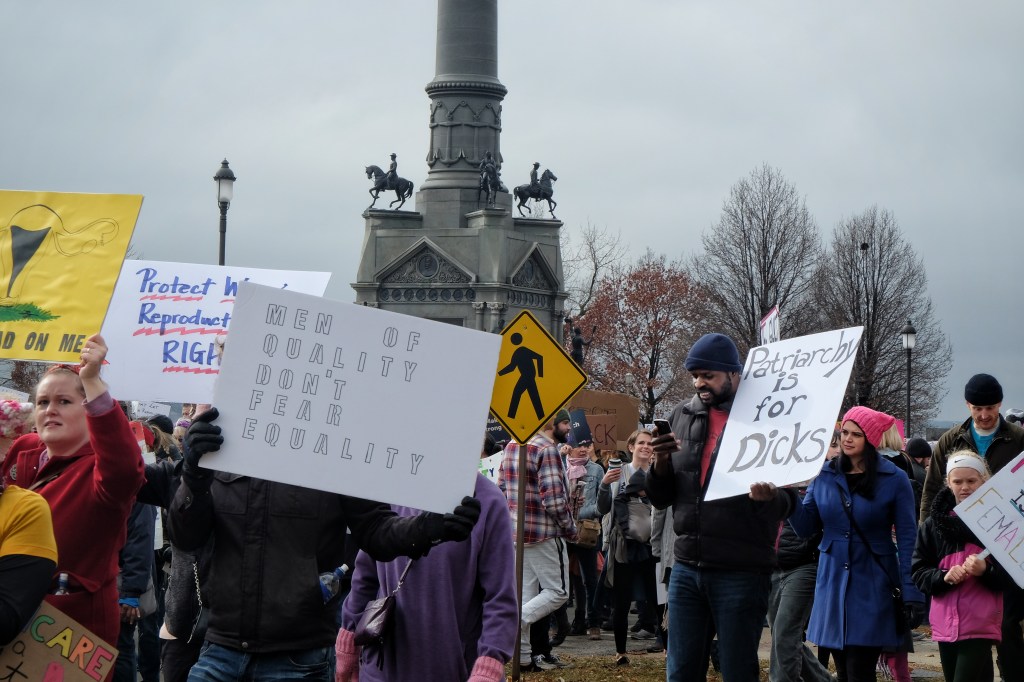
I marched in Des Moines, Iowa. Originally, the organizers thought we’d have a couple of thousand marchers. Later, they hoped to have maybe 6,000. Then they thought it was possible for 10,000 to show up. According to the local newspaper the final estimate was approximately 26,000. (I wrote about the march and the pussy hats a couple days later.)
Oh Jeez
It was mostly women and girls, but a lot of men showed up as well. All ages. It was as racially diverse as Iowa gets (which, let’s admit it, isn’t terribly diverse). Abled and disabled. We gathered at the Iowa state capitol building. There was music, there was food and hot coffee, there were speeches, there were spontaneous chants, there was singing, and then we…well, marched. I use the term ‘march’ rather loosely. We basically hiked around the capitol grounds. Because this is Iowa, the march itself was far more polite than the signage and the chants; we didn’t block the streets, we didn’t get into any punch-ups with the very few counter-demonstrators, and we didn’t leave a mess for other folks to clean up.
Patriarchy is for dicks.
I suppose the march officially ended when we’d returned to our original location, but few people left at that point. It may have been anger and concern that sparked the march and brought us all together, but once we’d gathered there was a pervasive sense of togetherness that everybody seemed reluctant to dismiss. There was a sense of hope, a feeling that if we all acted together—if we all worked for each other—we could mitigate the harm we fully expected to come from a Trump administration.
Not in the White House
We were so innocent. Trump was—and still is—worse than we could imagine. He’s done more damage than we thought possible. He had—and still has—more support for his authoritarian, anti-democratic, racist, misogynistic, vindictive agenda than we could conceive. I don’t think any of us had any idea of just how ugly, how hateful, how mean-spirited Trump’s supporters would be. We certainly didn’t anticipate how persistently and aggressively they’d attack long-held civil rights and liberties. We were so terribly innocent.
We’ve put away those hats, but we’ve kept the righteous anger.
It’s been seven years since the March. And we’re tired. Physically tired, emotionally tired, spiritually tired. We’ve put away our pussy hats (I still have mine—made for me by a friend, Kim Denise—stashed in a drawer), and rightly so because they weren’t inclusive. Our confidence in the benefits of protest has eroded; our confidence in our system of governance has been abraded by constant aggressive assaults by right-wing hate.
Bash the Fash
It’s fucking hard to be optimistic. The March itself, which was a buoyant expression of righteous anger and determination, has become a prolonged grind. It feels like the coming election will determine whether it’s possible for the US to recover from Trumpism.
Believe it.
So it doesn’t matter that we’re tired. We know what we need to do. We don’t need to gather together in person and march again, we don’t need pussy hats, we don’t need clever signs or chants. What we need is pretty simple. We need to gather together in spirit and tell Trump and all his enablers and supporters to go fuck themselves.
Just like the March itself, it’s that simple. Which is to say it’s not simple at all. But it’s necessary.
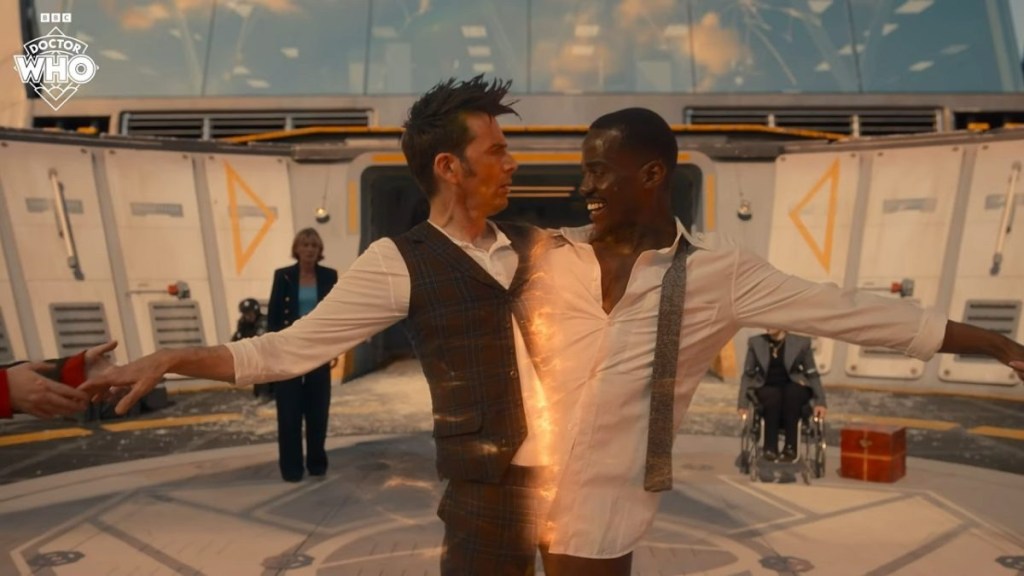
Okay, first thing, if you’re expecting this to be about a generation of bisexual people, you can just stop now. It’s not about bisexuality. Well, not specifically. I mean, it’s about Doctor Who, so it could be argued that bisexuality is sorta kinda implicit. I mean, The Doctor (and yes, Whovians (and also yes, Doctor Who fans are often called Whovians, get over it) always refer to Doctor Who as The Doctor, get over that too) is an alien who’s been both male and female and has been attracted to both men and women, so…yeah.
I understand, not everybody is a fan of Doctor Who. If you’re one of those folks, then you might as well take a nap, on account of this is totally about one of the esoteric aspects of The Doctor. I’m talking, of course, about bi-generation.
If you’re NOT a Doctor Who fan and, for some inexplicable reason you’re still reading this, allow me to explain the regeneration business. There’s obviously a practical aspect to it. The show is 60 years old; the original Doctor Who has been dead for almost half a century. In order to keep the show going, a new Doctor had to be introduced. Rather than just toss in another actor and pretend he’s the same person, the writers introduced the concept of regeneration. When The Doctor is fatally injured or their body is failing for some reason, they go through a transformation process—their cells renew into a different physical form, which results in a new body. Their memory remains mostly intact, but the new Doctor has a unique new personality. This is regeneration.
It’s happened 13 times in the course of the show. We expected it to happen a 14th time, when the new Doctor (played by Ncuti Gatwa) would be introduced. But instead of a classic regeneration, we were subjected to bi-generation. As The Doctor (played by David Tennant) prepares to die, he’s supported by two women, one on either side. The regeneration process begins, then…nope. It just…stops. Everybody is confused. The Doctor asks those supporting him to pull (on his arms), and hey, bingo, he splits in two. Sorta kinda.
I mean, where there was The Doctor, now there are two Doctors—one a pale skinny Scotsman (Tennant), the other a muscular Black man (Gatwa). I didn’t notice this at first, but The Doctor’s clothes are also divided; Gatwa gets the shirt, tie, shoes, and underpants. Gatwa also gets to ask the question that EVERYBODY is thinking: “Now, someone tell me what the hell is going on here!”
Putting the bi in bi-generation.
What the hell is going on is something completely and entirely unprecedented. As a fan, you have to ask, why did the writers do this? Why would they introduce a new form of regeneration? In my opinion, there are solid narrative reasons for the bi-generation business. Consider that The Doctor, in various incarnations, has been around a LONG time. They’ve saved civilizations and destroyed them, they’ve rescued billions of people and seen (or caused) billions to die, they’ve fought monsters and they’ve been monsters, they’ve loved companions and seen them die (or leave or get abandoned). Because of this, The Doctor has the universe’s worst case of PTSD and survivor’s guilt ever. Let’s face it, the Doctor is massively fucked up.
By tossing in this bi-generation, the writers have done two very important (for the fan base) things. First, they’ve given the new Doctor a clean slate. Gatwa has The Doctor’s memories, but isn’t burdened by the guilt. It also allowed Gatwa to skip the post-regeneration ‘Wait, who am I now?’ confusion that normally accompanies a new Doctor. He starts fresh, confident, eager, enthusiastic—and Gatwa’s delight in being Doctor Who is apparent and infectious.
Second (and probably more important for the fans), the old Doctor gets a chance to heal—to live a somewhat more normal life, to have something like a family, to be relieved of the obligation to fix every fucking thing that goes wrong, to just relax. There’s something healing about seeing Tennant sitting down to a meal with his expanded chosen family. It’s just really nice to know his end isn’t traumatic.
BUT (you knew there was a ‘but’ coming, didn’t you), I’m a wee bit disconcerted by one thing in particular. As I said at the beginning, Whovians always refer to The Doctor as The Doctor. Not just any Doctor, but THE Doctor. Because The Doctor is singular. There’s only one The Doctor.
Until now. How can Ncuti Gatwa be The Doctor when there’s another Doctor Who loafing about in Donna Noble’s garden in Chiswick? Personally, I’m more than willing to abandon the singular The and refer to the 14th Doctor as the Doctor, so long as I get to imagine the old Doctor sitting around at night with Wilfred Mott, drinking tea from a thermos and looking at stars through a telescope.
Every year around this time I feel the need to eat candy corn. And every year, after I eat a few pieces, I find myself wondering why. Because of that, I find it impossible to take sides in the ‘candy corn’ debate. I feel about candy corn the same way I feel about some of the more esoteric sexual practices: if you enjoy it, have at it. If you don’t, you still have lots of options.
But for fuck’s sake, people, don’t try to stop others from enjoying their candy corn, and don’t shame them for liking it. And candy corn aficionados, don’t try to force your candy corn on anybody who doesn’t want any. This is NOT complicated.
Candy corn has a long history in the US. It’s been around since the late 1880s. As far as I can tell, the company that’s been continuously making candy corn the longest is Jelly Belly, which was originally called the Goelitz Confectionery Company (and I have to say, I think the name change was an unfortunate decision; some poor bastard is now forced to introduce himself as the CEO of Jelly Belly, and you know all the other CEOs are laughing).
The Goelitz brothers began producing candy corn in 1898. Unlike the white, orange, and yellow candy we’re mostly familiar with, Goelitz candy corn (also apparently referred to as ‘chicken feed’) was white, brown and yellow. I’m sure there was some rational corporate explanation for the change in the color scheme, but I’m going to assume it was because orange is simply a more jolly color.
The commercial manufacture of candy corn was NOT the most unfortunate event of 1898. Henry Lindfield became the world’s first fatality from an automobile accident on a public road (his car rolled down a hill in Purley, England and struck a tree–which is less embarrassing than having to introduce yourself as the CEO of Jelly Belly). And the USS Maine exploded in Havana harbor, sparking the Spanish-American War (which, although it was fought primarily in the Caribbean, resulted in the US owning Guam and the Philippines; the US also annexed the Hawaiian islands that year, which was unrelated, but you have to wonder about the sudden desire of the US government to own islands located way the fuck away from the mainland). And Caleb Bradham invented Pepsi-Cola (so named because it was intended to relieve dyspepsia, whatever that is).
I seem to have lost track of my point, which is that despite the attempts to vilify it, there is absolutely nothing wrong with eating and appreciating candy corn. Even ordinary decent citizens (such as myself) have been known to enjoy it (or at least wanting to enjoy it, even if afterwards it turns out we do not). Nobody needs to justify their taste for candy corn.
Licorice, on the other hand, is an offense to the gods.
I had to check with Wikipedia to see how old he is. He’s 80. He’ll turn 81 in November. That’s pretty fucking old. Does it matter? Well, yeah, it kinda does. Does it matter enough to change how I’ll vote? Nofuckingway.
Is he in good health? According to his doctors (and at least Uncle Joe has real doctors, not some fluffer in a white lab coat like Comrade Trump), he’s “in good physical and mental shape relative to his years.” That’s…well, not entirely encouraging, but still somewhat comforting. I mean, the guy still rides a bike. That requires lower body strength, balance, hand-eye coordination, responsive reflexes, bilateral coordination, and postural strength. Sure, he’s not going to make the Olympic cycling squad, but he can get on a bike and crank out a few miles. That’s pretty damned good for an 80-year-old guy.
Okay, he’s also fallen on his bike. But let’s be honest about that. He fell when he was dismounting; caught his leg on the crossbar. Almost every person who’s ever ridden a bicycle with a crossbar has done that. I’m younger than Uncle Joe and I ride a step-through bike because I’ve done that too often. I’m not as flexible as I used to be.
But the ability to ride (and successfully dismount) a bike doesn’t directly translate to running the entire government of the United States. That take a certain amount of mental acuity and political savvy. Uncle Joe probably isn’t as sharp as he was when he was Vice President, but he’s still as politically savvy. He’s accomplished a hell of a lot since he was elected, and he’s done it without much drama (and without much public recognition). He’s still got great political instincts. He still travels the world and gets stuff done.
But yeah, he’s old. And he’ll be even older when/if he’s re-elected. But so what? It’s stupid to compare Uncle Joe against some ideal Democratic candidate. We have to compare him to his opponent. Which is almost certainly going to be Comrade Donald Trump. The guy who thinks he ‘aced’ a mental acuity examination because he was able to repeat man, woman, person, camera, TV. The guy who needed two hands to drink from a bottle of water. The guy who saluted a North Korean general, wanted to buy Greenland, and thought it might be a good idea to nuke a hurricane.
Since we acknowledge that Uncle Joe is old, let’s go ahead and say the ‘unthinkable’ thing we’re all thinking about. What if he gets elected but then goes toes up before the end of his term? That would be bad. But hey, Kamala Harris is perfectly competent to take over. I mean, that’s the whole reason to have a Vice-President, isn’t it. I’d be happy and feel secure with President Harris running the government.
So yeah, once again, Joe Biden is old, but he’s moderately fit and he’s very politically astute, plus he’s got Kamala insurance in case something unfortunate happens. Donald Trump, on the other hand, is a dumbfuck who…oh hell, dumbfuck ought to be enough. Seriously, the Democrats should run adverts saying Vote for the Old Guy; Don’t Vote for the Dumbfuck.
“Name a television show that changed you.” That sort of question gets asked all the time in social media, mainly by folks who want to generate some discussion. I generally ignore those questions. I thought I’d ignored that one too, when it came up a few days ago. But apparently I didn’t, because I’ve been thinking about it at odd moments when my brain isn’t occupied with other bullshit.
And hey, after a few days of episodic thought, I came up with two shows that…wait. You know, the whole notion of a television show actually changing somebody seems ridiculous. On the other hand the notion of a book changing somebody seems (to me, at any rate) perfectly reasonable. But I don’t know…I mean, they’re both narrative forms and only an idiot would deny the power of a narrative. So, okay, there’s no reason a television show/series can’t have a powerful effect on somebody. Whatever point I was going to make at the beginning of this paragraph is clearly bullshit. So never mind. Let me try that again.
After a few days of episodic thought, I came up with two shows that have had a profound effect on me. Buffy the Vampire Slayer and Veronica Mars. The former is about a high school girl who becomes the Chosen One whose purpose in the world is to kill vampires and demons and general ‘forces of darkness,’ which (as Buffy says) is a job of work for a high school kid. The latter is about a high school girl who becomes a private detective, solving crimes and helping innocent (and semi-innocent) people.
“I’m telling you, having a secret identity in this town is a job of work.”
Yeah, I know, the premise of each of those shows is absurd. Also yeah, I know, some of you may be saying to yourself, “A guy who watches girl hero television shows? What’s with that?” My response to that is a) hey, they’re really good shows and b) grow the fuck up.
Here’s the thing. Yeah, Buffy and Veronica are high school girls (at the beginning of each series) who are tough and snarky, who defend ordinary folks against bad folks, and who have to deal with gender and high school issues while also dealing with much larger problems. But what makes them singularly influential (to me, at least) is that they’ve both been through a world of shit and they’ve adapted to that by no longer caring very much what other folks think about them. They’re aware of peer pressure, and it still carries much of the gravitational pull that influences most of their peers. But they’ve each found the strength to shrug off that gravity and deal with the world they live in on their own terms.
“Why can’t the evil just get jobs like the rest of us?”
But that comes with a cost. They each suffer the isolation and alienation that comes with being different. They each learn to assemble a cohort that serves as a sort of family or support group. And then they’ve each learned that in some/many ways, they’re also isolated and alienated from that cohort. And as painful as that is, they continue to cope and occasionally to actually thrive.
Another thing about those shows: they each include a father figure who is realistically complex. Buffy has Giles, her Watcher; Veronica has…well, her dad. They try to help; they try to protect; they try to NOT interfere too much, and they routinely fuck up. Realistically fuck up. Because they’re conflicted; society suggests they should behave in a specific male parent way that generally interferes with the agency of their children BUT they also want to encourage their children to be their true selves. Anthony Head and Enrico Colantoni manage to bungle their parental responsibilities without completely destroying the trust of their kids. Their relationships are often painful, but always sort of beautiful.
So yeah, those two television shows were massively influential to me. The fact that Buffy and Veronica struggle against vampires or criminal sociopaths is sort of irrelevant. What matters is they mostly hold onto their personal integrity in a world that seems almost designed to destroy it. What matters is Buffy and Veronica build a mostly workable relationship with their own selves. If that makes sense.
Buffy Summers and Veronica Mars offered lessons in how to hold onto your true self when the world around you tried relentlessly to disrupt that. They gave good television.
THE USUAL EDITORIAL COMMENT: Yeah, the patriarchy. Got to incinerate it. Stake it to the ground, douse it with an accelerant, light it up. Burn it to ashes, bury the ashes, piss on the the burial site, then salt the earth above it so that nothing will ever grow there again. Then have a glass of wine. I recommend a Gewürztraminer.