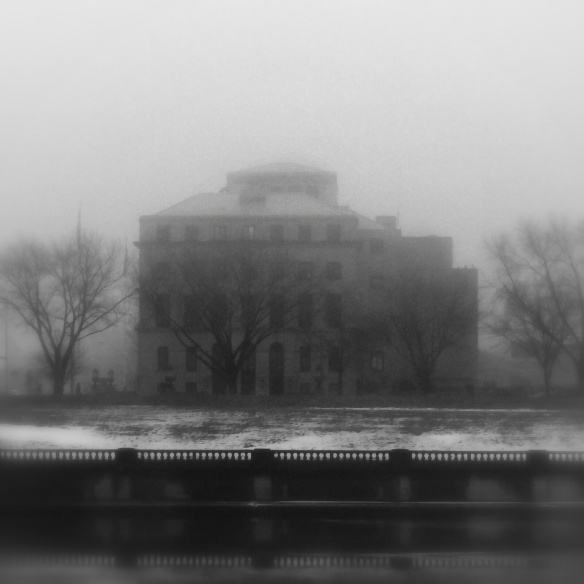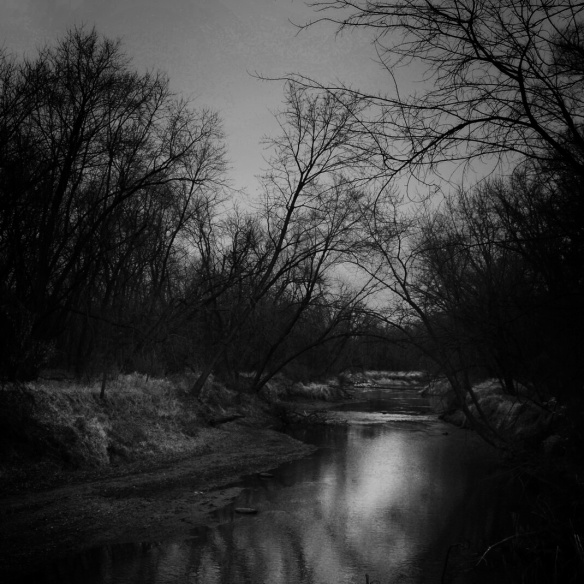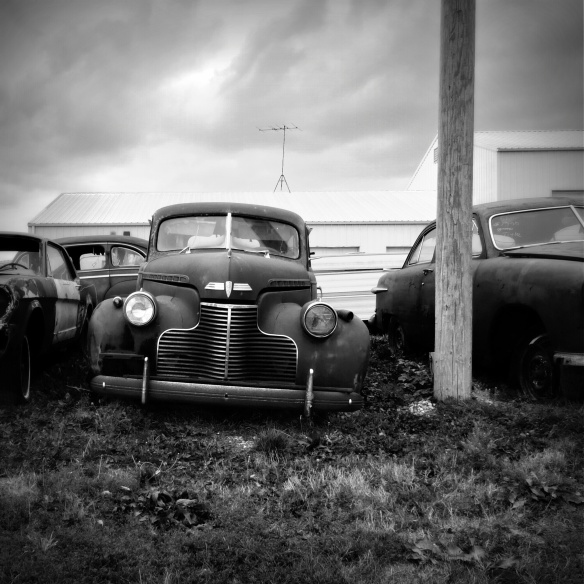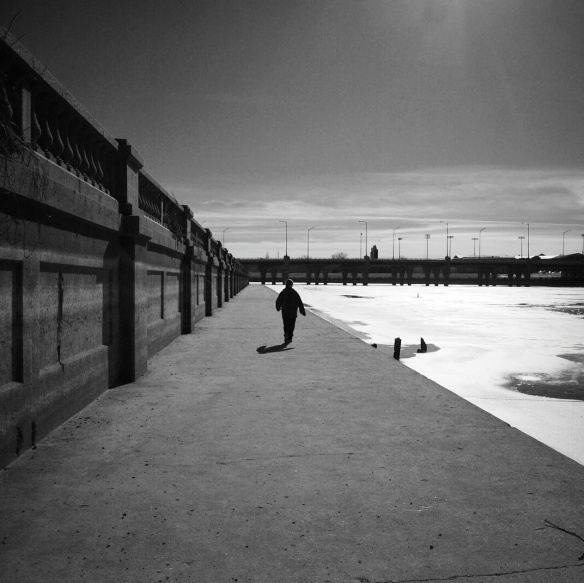
things on a table — knuckles dobrovic

Back in January I wrote about my reluctant conversion to Instagram. I was one of those people who mocked and jeered the app. I was one of those folks who used a camera to shoot photos — not a telephone with integrated camera-like technology. I considered Instagram to be a platform for cheesy photographers to display cheesy snapshots of their feet, or drunken snapshots of their drunken friends at parties, or sappy snapshots of sappy sunsets.

And hey, there really is a LOT of that stuff to be found in Instagram. But when I started to noodle around looking at photos on Instagram, I discovered there was also a surprising amount of really good work. It was because of that work (along with the purchase of a phone with a moderately decent camera) that I decided to dip my toe into the Instagram stream.
22 July, 2013

22 July, 2013

So in July of last year, I created an Instagram account. I was shy about it. I didn’t want something that could be publicly associated with me, so I used an alias for my account: Knuckles Dobrovic. I conceived a really simple (and let’s face it, really contrived) idea for some Instagram-ish photos: I would put something on a glass patio table, and I’d photograph it.

It was intended to be a lighthearted experiment. I was just going to noodle around and see what the cellphone camera could do, and get some idea of how Instagram worked. I wanted it to be something I could delete without hesitation or regret if/when it became too embarrassing or too dull.
August 3, 2013

August 3, 2013

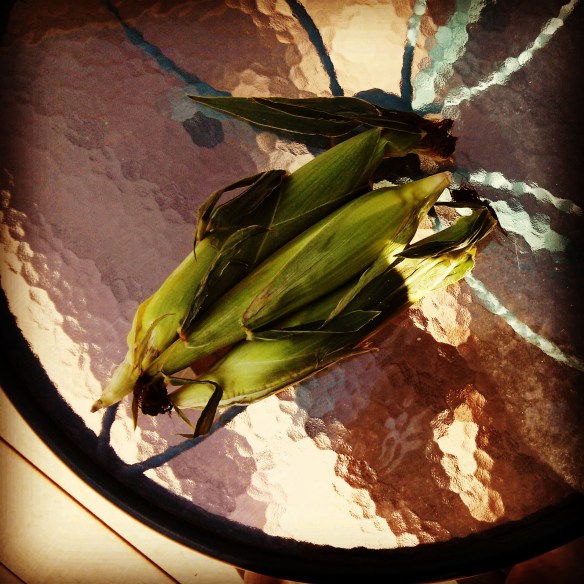
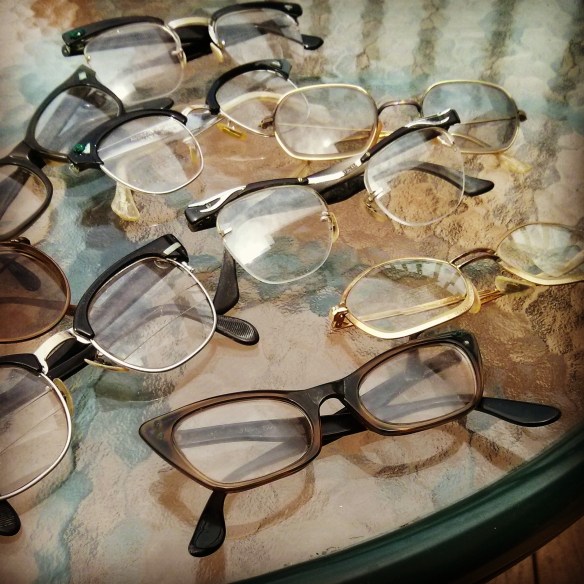
What I’d actually done, of course, was unconsciously sabotage the experiment. I didn’t want to like Instagram. And in the earliest photographs, that really showed. I just put any damned thing near to hand on the table — some ears of corn, a baseball, a beer bottle,  a random collection of old eyeglasses — and photographed it without much care or concern about the final image.

Sure, there was some minimal attempt at composition, but it remained basically a fairly lackadaisical exercise.
September 19, 2013

September 19, 2013

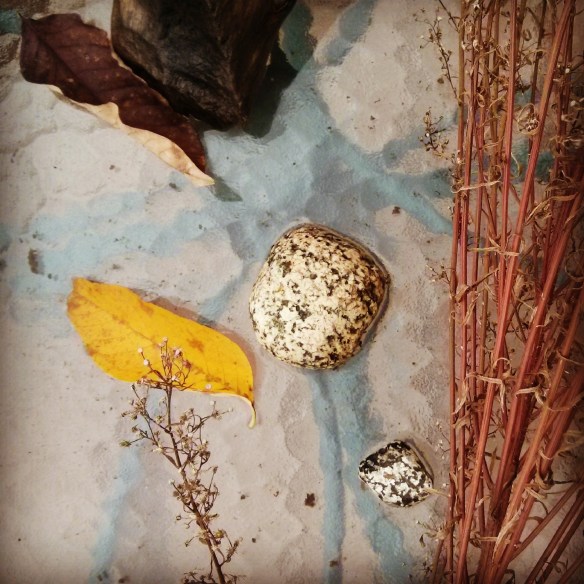
At some point, however, the experiment took hold of me. I found myself being more thoughtful and deliberate about the photos. I began to look around to find things that would be more photogenic on the table. I began to compose the shots more carefully. When I was out and about, I began collecting things specifically for the table. I talked about the project to friends and family. I actually began to care about the photographs.
November 4, 2013

November 4, 2013

Things on a Table became an actual project. Almost every day, I put something on the table and photographed it. I began to vary the time of day I shot the photo so I could use different light and catch different shadows. I photographed things on the table in all sorts of weather. I’d shift the table to different spots on the deck to get different patterns of line, light and shadow.

I even considered taking the table to different locations — out into the country, onto the sidewalk, into the city. That idea got tossed fairly quickly, mainly because it would have been a massive pain in the ass. But the important thing was that I’d begun to set specific parameters for limits on the project.
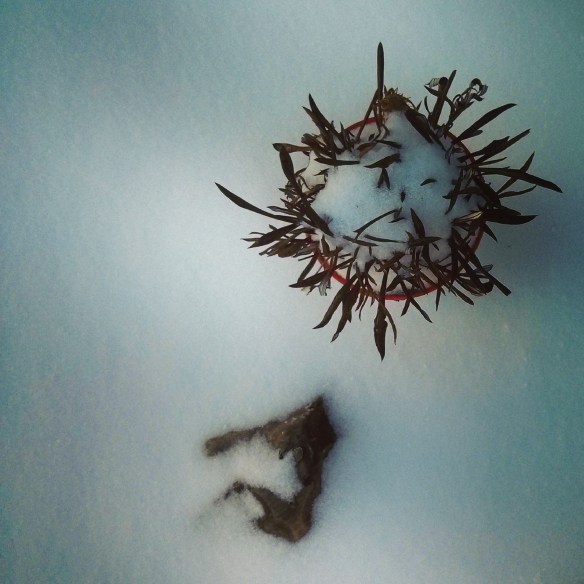
November 22, 2013

November 22, 2013

Winter came and snow covered the table, and I still put a thing on it and took a photo. I even began to create ice-things for the table. I’d find a thing, put it in a container, fill the container with water, set it outside and photograph the frozen result. I’d stuff things inside balloons, then fill the balloons with water and let them freeze. I’d shoot the photo, then leave the frozen things on the table and let the snow cover them. Over time the heat of the sun or the force of the wind would gradually reveal them, and I’d photograph them again.
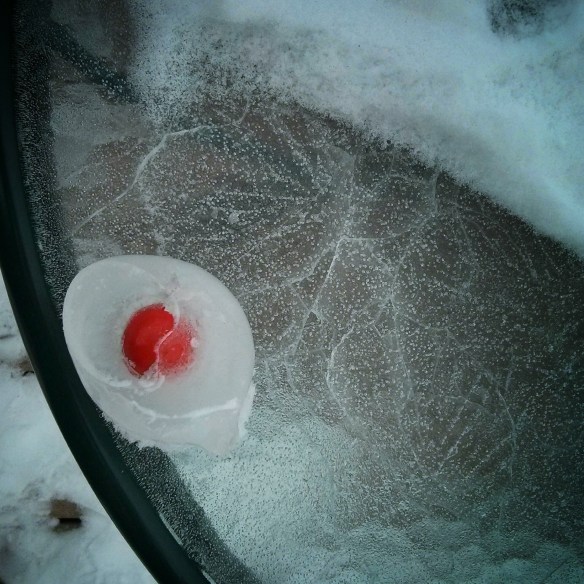
January 9, 2014

January 9, 2014

To my surprise, friends and family members began gathering assorted bits and bobs of stuff they thought might appeal to me or look good on the table. An odd rock, plastic bubble wrap from a toner cartridge, an interesting weed, a hubcap found along the road. Eventually, people I know only through social media began to mail me things to put on the table.

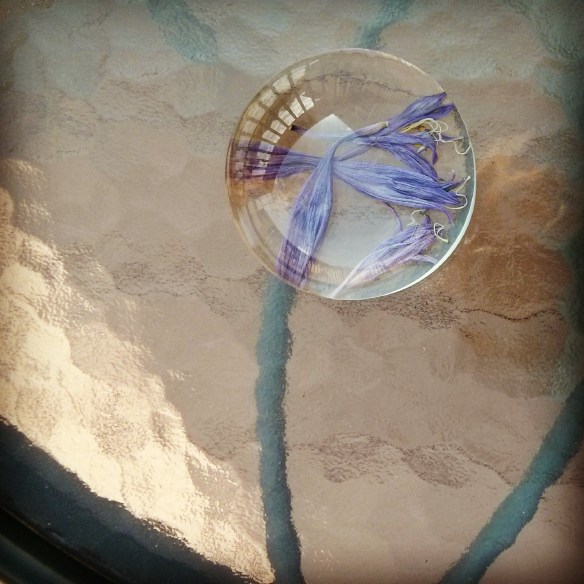
I began to re-use some of the things — a piece of driftwood, a half a brick, some dead flower blossoms, an ornamental magnifier — partly because I like their shape or texture, and partly because the idea of continuity of things appealed to me.
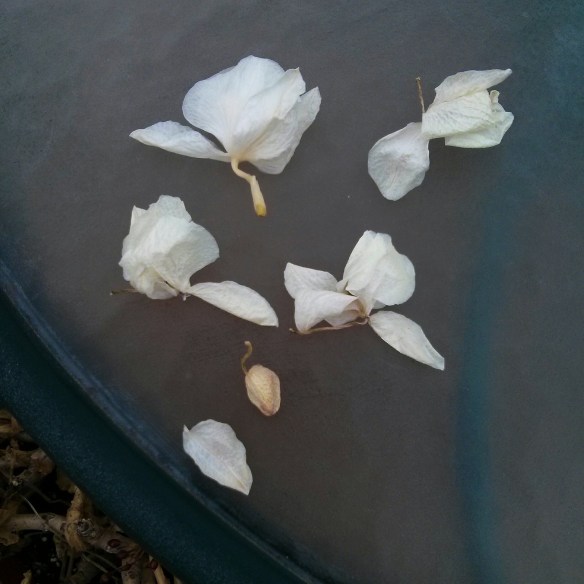
March 15, 2014

March 15, 2014

Like any project, this one occasionally feels like a chore. I’ve considered abandoning it two or three times. But each time I’d spot something that might be interesting on the table, and I’d find myself out on the deck trying to find an angle that worked.

At this point I figure I’ll finish out the year. I’ll continue to photograph things on the table into July. Then I’ll probably come up with some other sort of project, simply because I’ve grown fond of the name Knuckles Dobrovic.
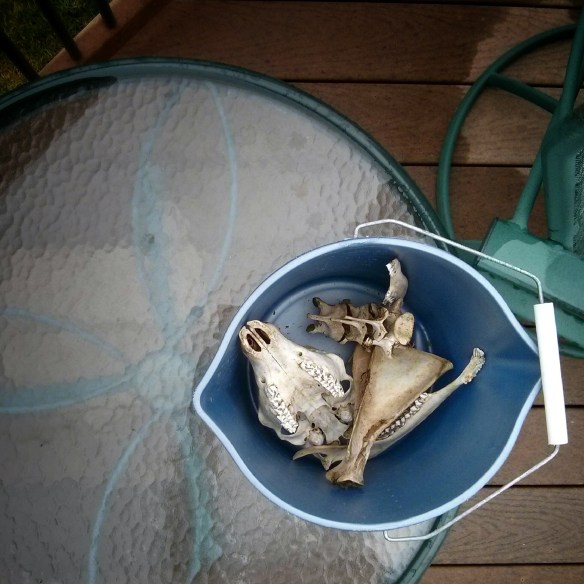
April 29, 2014

April 29, 2014

I realize that’s a stupid reason. I don’t care. I’ve no objection to doing things for stupid reasons. I mean, I’m the guy who came up with the name Knuckles Dobrovic just to photograph random things on a table. Stupid is where I live.
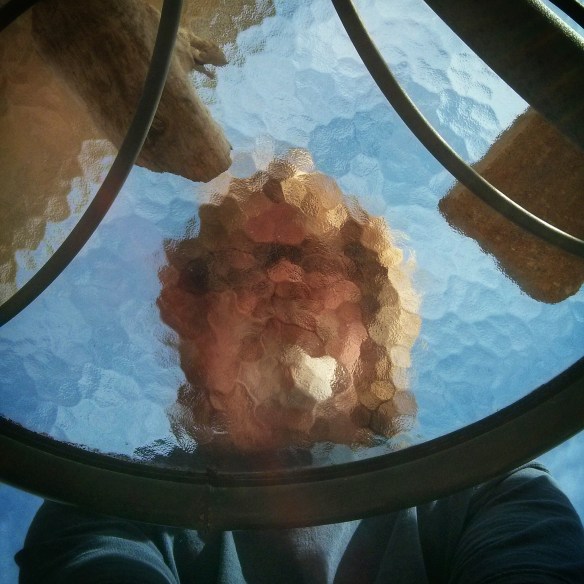
May 23, 2014
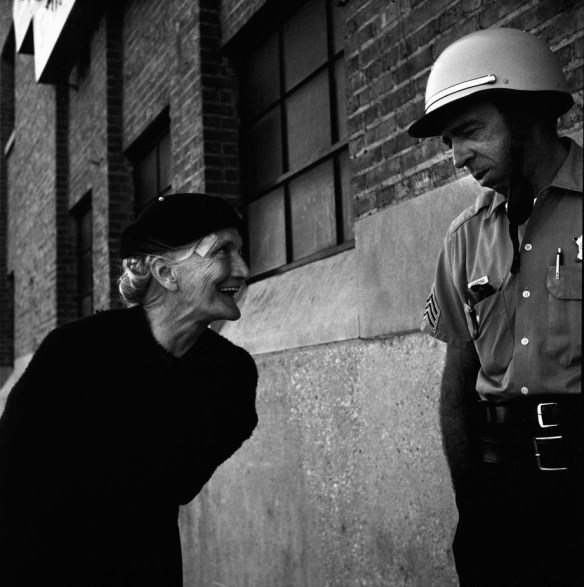
May 23, 2014
the vivian maier problem

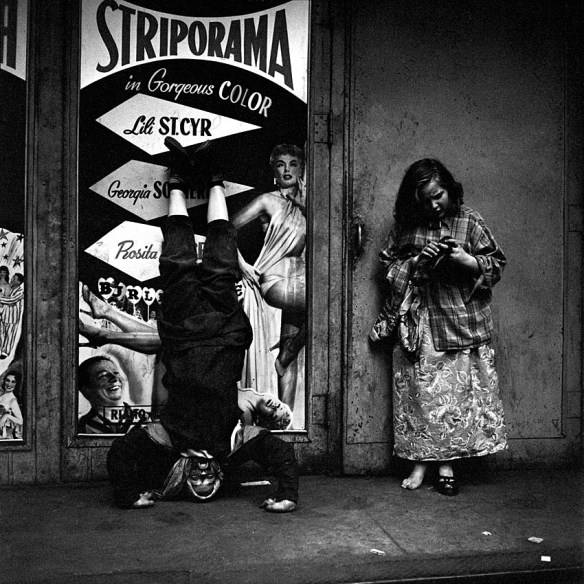
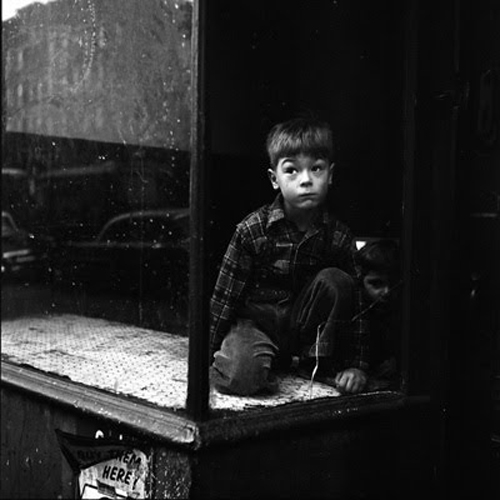
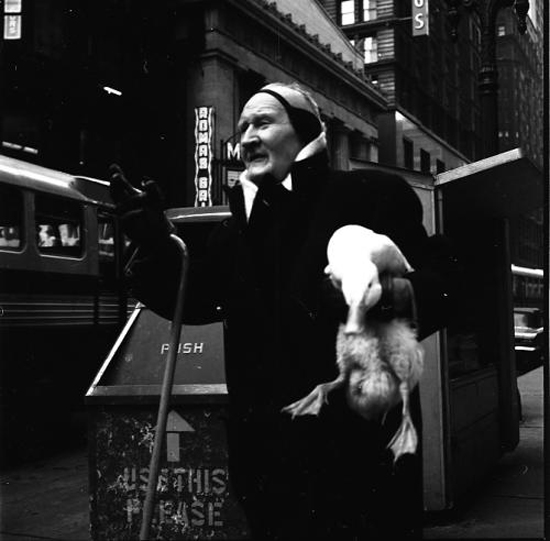
Everybody loves a mystery — and right there, that’s the beginning of the problem. Who is Vivian Maier? And everybody loves a success story — and there you have the middle of the problem. Vivian Maier is now famous, and the people who ‘discovered’ her have become important. And finally, everybody loves to see the high brought low — the tag end of the problem. Vivian Maier was just an amateur and the people who’ve made her famous are vultures picking off her bones.

maier2

I suspect everybody who pays attention to photography knows the basic outline of the Vivian Maier story. Photographer/local historian John Maloof attends an auction and buys a storage locker full of old photographic prints and negatives. The photos, which are quite striking, turn out to be the work of a reclusive nanny. Maloof publicizes the photos, the nanny is hailed as a naïve genius at street photography, a new star is created in the photographic firmament, the entire combustible photographic world is agog and everybody is completely charmed.

Predictably, the initial delight at the discovery is followed by the Vivian Maier backlash. This response seems to be driven in large measure by the extravagance of the early hype about Maier’s work, and is peppered with a large dose of cynicism.

“[I]t’s way too early to declare Vivian ‘great’ or to appraise her place or status in any way”

“Maier is a good enough photographer, I certainly don’t think she’s one of the greats”

“I can find no steady thread of consistency in her style”

“[S]omebody (or somebodies) smell an art gold mine with Maier’s work and are doing a fantastic job of building buzz that will pay off for them in the long run”

“[G]reatness and fame are two very different things”

“Maier can never be recognized (or collected) at the same level as, say, Winogrand, Arbus, or Frank mainly because she worked in utter isolation and influenced nothing in her time”

The backlash has been as bombastic as the hype. The result is two highly polarized camps; one of which believes Maier was a gifted but unschooled master of photography, and one which sees her at best a prolific but lucky amateur and at worst as a hack. Thanks to the Internet, those two camps formed with astonishing speed, and they’ve informed the Vivian Maier narrative so thoroughly that at this point it’s difficult for anybody to look at her work with an unjaundiced eye.

maier4

I was a quiet observer at the beginning of the Vivian Maier problem, before the hype. In October of 2009, John Maloof posted the following in a Flickr discussion forum:

I purchased a giant lot of negatives from a small auction house here in Chicago. It is the work of Vivian Maier, a French born photographer who recently past away in April of 2009 in Chicago, where she resided.

I have a ton of her work (about 30-40,000 negatives) which ranges in dates from the 1950’s-1970’s. I guess my question is, what do I do with this stuff? Check out the blog. Is this type of work worthy of exhibitions, a book? Or do bodies of work like this come up often?

Any direction would be great.

It’s clear Maloof believed the work was solid (though he was uncertain whether others would share his view). It’s equally clear the participants in the discussion largely agreed with him. It’s also obvious, though, that while Maloof was soon trying to promote the photography, he wasn’t making any exaggerated claims about Maier’s talent. He was genuinely intrigued by her work and her story.

maier1

It seems to me (and I’m sure other will disagree) that the hype didn’t originate with Maloof, though he was willing to feed it. So then, where did it come from?

I’m inclined to think it grew organically out of the situation. Vivian Maier really was a very odd woman. She really was an extremely talented photographer. She was almost certainly aware of what was going on in the world of photography, but it appears she really was essentially self-taught. Her photos and negatives really were a completely random, lucky find by John Maloof, who recognized he’d found something potentially extraordinary.

The situation sounds more like the plot of a novel or a screenplay than real life. Because of that, the narrative almost demands that Vivian Maier be an unrecognized genius or an over-promoted hack. It also requires that Maloof be either a savior who rescued her work or a villain who has taken advantage of another person’s talent. It has nothing to do with what actually happened; it has everything to do with what makes a better story.

maier3

In fact, it seems to me that the Vivian Maier Problem has relatively little to do with Vivian Maier or her photography. Rather, it’s grounded in the narrative imposed on her work by folks who spend their time thinking about photography (which isn’t a complaint, by the way; thinking about photography is a very fine thing to do — I do it myself).

I’ve spent some time over the last couple of weeks looking closely at the photographs in Maloof’s book Vivian Maier Street Photographer. Some of the photographs are unremarkable and a tad trite, even for the era in which they were shot. But others are absolutely stunning. Since the book was edited by Maloof (and, presumably, he also chose the photographs), there’s no way to tell if the photos are representative of Maier’s work or of Maloof’s editorial viewpoint.

maier6

In many ways, it doesn’t matter. There’s good work in the book. That’s what matters.

Does Vivian Maier deserve all the hype she’s received? No, of course not. She was not Mary Poppins with a Rolleiflex. She was not Cartier-Bresson in a dress and gloves. How could anybody possibly deserve all that hype?

But she deserves a great deal of it.

the devil is loose

Naming new things is tough work. Back in the 1850s they had to coin a term to describe the physical manifestation of communications sent over a distance by electrical signal. Somebody came up with telegram. That’s a portmanteau of tele, which is Greek for ‘over a distance’, and gram, also Greek, meaning ‘something written or drawn’. It’s really pretty catchy, but telegram totally pissed off language purists of the day. They absolutely hated it. Hated it.

May I suggest to such as are not contented with ‘Telegraphic Dispatch’ the rightly constructed word ‘telegrapheme’? I do not want it, but … I protest against such a barbarism as ‘telegram.’ [Richard Shilleto, Cambridge Greek scholar, London “Times,” Oct. 15, 1857]

I’m not any sort of purist, but I find Instagram objectionable as a word. It’s so bland and corporate. It could have been worse; they might have called it Instagrapheme which, let’s face it, would have been intolerable. Still, Instagram is an unattractive and unappealing name, and it made it easy for lots of folks (including me) to sneer at it. And we did.

DSCF4611_1

We sneered at Instagram for being a cheap, easy, lazy way to turn crappy photos into images that look artsy. Not ‘artful’ or ‘artistic’ but artsy. We sneered at it because the learning curve for using Instagram is — well, it’s hardly a curve at all. It’s almost a straight line. You shoot a photo with your cell phone, you flip through a couple dozen preset filters until you find one you like, tap to apply it, and hey bingo, you have yourself an artsy photo of your drunken friends at a tacky Chinese restaurant.

That ease of use is a big part of the appeal, of course. It allows any tunahead to bang out a halfway decent photograph. But it pisses off photography purists (purists of every persuasion spend a lot of time being pissed off, have you noticed?). The ease of use is another thing that makes Instagram so sneerable.

on the far side of the river_1

I grew up shooting film — and shooting it with a completely manual rangefinder camera without a resident light meter. That gave me certain inalienable sneering rights. But at the same time, I’m totally in favor of the democratization of photography. I love the fact that so many people are out there photographing so many things. 

That put me in a damned awkward position. How can I embrace the democratization of photography and at the same time still be able to sneer at Instagram? I told myself the app, at its best, was just a cheap imitation of real photography. At its worst, it was the devil itself. I told myself a lot of people — people who might otherwise actually learn the important mechanics and physics of photography — would substitute the creative process (which, let’s face it, can be really hard work) with the unthinking application of a filter. So I could argue that sneering at Instagram was actually good for photography. Right?

DSCF3901_1

All that sneering was made a lot easier by the fact that I’d never really looked at Instagram. Then I bought a smartphone with a tolerably decent camera. And suddenly everybody was all “Dude, join Instagram.”

So I reluctantly decided to look at it. And to my smug delight, I discovered I was right. It really was a cheap imitation of real photography. It really was an artistic wasteland of hipsters in vests photographing their lattes, and hiphop wannabes shooting pictures of their two hundred dollar sneakers, and women shooting duckface selfies in bathrooms, and …whoa…hold on hold on…what’s this? What the hell is this?

‘This’ turned out to be good work. I started to come across photography I actually wanted to see. Images that impressed the hell out of me and made me want to see more. On Instagram.

DSC_0017bw_1

I found solid, serious street photography. And good travel and landscape photography. And lawdy, good fine arts photography. I found good editorial news photography. Good color photography, good black-and-white photography. Good portraiture. Good photography. All of it right there in a 3-inch square on Instagram.

And that good shit, it was scalable. It looked good in a 3-inch square on my phone, but it continued to look good in larger versions. I was not expecting that.

Yes, yes — there’s a staggering amount of appalling crap on Instagram, but there’s a staggering amount of appalling crap everywhere in the world of photography. It’s one of the facts you accept if you believe in the democratization of photography. You accept the existence of the crap, and you try to help stem the tide by not making crap yourself.

DSC_0041bw_1

So hey, I joined Instagram. Quietly. Uncomfortably. Under an assumed name. Like an atheist going to Sunday School. I began shooting a simple little series — something I could delete easily if I decided I was contributing to the crapitization of photography. That project gradually transformed and grew into something more complex, but coherent and constrained — which is how real photo projects start. I may write about that project at another time, but what it meant for me was that I was taking Instagram seriously. How the hell did that happen?

It also meant (in my mind, at least) that I should limit that account to that project.

So I created a second Instagram account. Yes, I actually created a second Instagram account, and devoted it to shooting black-and-white images.

wink and a nod_1

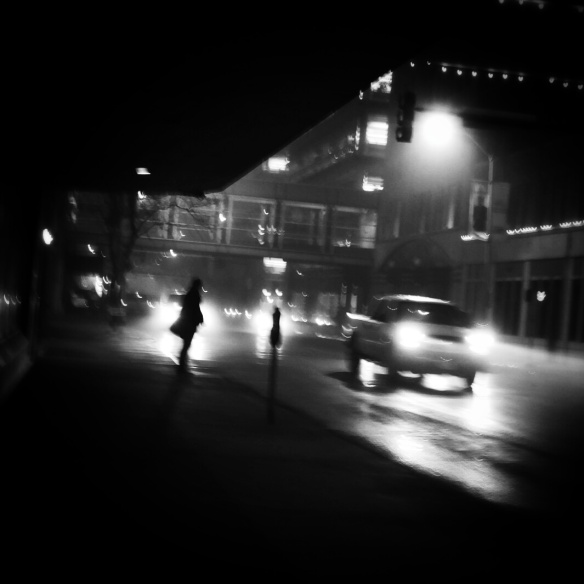
The photographs you see here, and along the side of the blog (and if you’re interested, you can see more of them here) have taught me that Instagram is an incredibly flexible and elastic app. You can shape it to fit whatever you want to photograph, in whatever style you want to photograph it. You don’t have to rely on their crappy little filters; there are some very fine processing apps for your mobile phone that give you a metric buttload of control over the image.

Instagram, it turns out, is not about filters. It’s not even about easily turning crappy photos into artsy ones. It’s about distribution. It’s about putting the photos out there.

DSC_0068bw_1

Instagram may, in fact. turn out to be the devil after all. It can be that seductive. But it’s the devil that’s likely to have the most influence on the shape of modern photography. 

Here’s where I drop in some more esoteric information. Eight hundred years ago King Richard I of England was captured on his way back from the Holy Land, where he’d been cheerfully slaughtering Muslims during the Crusades. While he was imprisoned, his brother John attempted to usurp the throne. When Richard won his release, King Philip of France sent a message to John, warning him. The message read: Look to yourself. The devil is loose.

The analogy isn’t perfect, but the warning is. The devil IS loose. And you know what? I kind of like him.


not a bad job

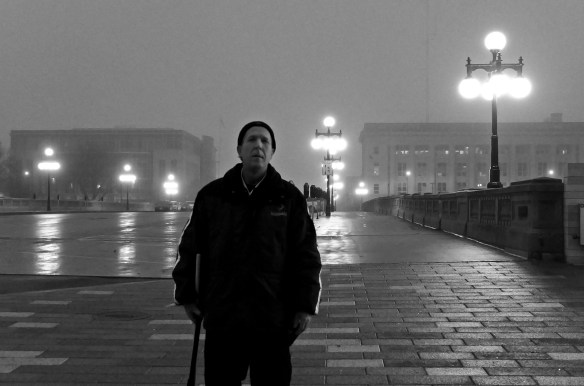
It’s eight-thirty in the morning. Dense fog and a deep, soaking mist. Cold, and getting colder. I’m walking around with my little Fujifilm X10, shooting manually because the fog and mist completely bitch-slapped the autofocus and light metering. Not many people on the street; not many people are stupid enough to be outside in that weather.

And I see this guy. He’s got a short broom — looks sort of like a modern version of an old-fashioned besom — and a long-handled dustpan. And he’s sweeping up trash off the street. At 0830 hours, in the cold, foggy mist. I shoot a couple of quick frames, thinking to myself “This poor bastard must be miserable.”

kent at work

I keep walking, he keeps looking for trash and sweeping it up. I nod to him and smile and say “You’ve got a cold morning for it.” He smiles and shrugs and says “I don’t mind so much, long as it’s doing this…” and he waves his hand up and down, like a karate chop “…and not doing this.” He waves his hand back and forth like he’s polishing a table. “Yeah, least there’s no wind,” I say.

His name is Kent. He’s been keeping the city streets clean for nearly three years. He says it’s not a bad job. “I like being outside. I get to meet people, walk around, don’t have to stay in one place.” He’s learned which business owners are nice, which ones ignore him like he’s not there, which ones are rude. He won’t identify any of the rude ones.

Kent says there’s about a dozen folks cleaning up the downtown area. He thinks most of his co-workers are pretty good or okay; a couple are lazy and some complain about the weather, but mostly they’re good people. He knows that most of the people he meets on the street don’t appreciate what he does, but he says clean streets sidewalks make the city a better place. He won’t say his job is important, but it’s clear he feels like he’s doing something worthwhile.

kent2

We talk for about ten minutes. We could have talked longer, but it’s obvious Kent feels he should get back to work. Sidewalks aren’t going to clean themselves, are they. I ask if I can take his photo. Kent sort of shuffles his feet, but nods. I take the shot, show it to him, and he grins. He tells me to stay safe; I tell him to stay warm. I go back to walking around, shooting photos; he goes back to picking up trash.

When people complain about their taxes — when they talk about cutting taxes and reducing the size of government — they’re talking about folks like Kent. Every single working day, regardless of the weather, this guy is out there making his city a more livable place. He’s making a meaningful contribution to the common good, which is a lot more than most of the folks complaining about their taxes do. Kent might not be comfortable saying his job is important, but it surely is.

And you know what’s really cool? You probably have somebody like Kent working in your city too. These folks don’t just exist in John Prine songs, you know. So take note of the people out there, and be sure to say hello to them.

a short note on the passing of saul leiter

Back in April of 2008 I did a Sunday Salon on Saul Leiter. Mr. Leiter died yesterday. He was 89 years old.

saul leiter2

These days we tend to think of Leiter as a pioneer in color street photography. It would probably surprise most of Leiter’s modern fans to discover he actually made his bones as a second-tier fashion photographer. He said,

“I was constantly aware that those who hired me would have preferred to work with a star such as Avedon. But it didn’t matter. I had work and I made a living. At the same time, I took my own photographs.”

Those photographs — the ones he described as ‘my own’ — are the photos he’s known for today. But Leiter stopped showing those photos to people in the late 1940s. He simply filed the transparencies away in cardboard boxes. Half a century later, in the 1990s, he began to print and show them.

saul leiter

Nobody paid much attention to them. Not at first. But gradually his work began to infiltrate into the world of fine arts photography. Today, of course, he’s the famous Saul Leiter.

“I spent a great deal of my life being ignored. I was always very happy that way. Being ignored is a great privilege.”

Saul Leiter. 1923 to 2013. We’ll not see his like again.

it ain’t just the zombies

I’ve avoided writing about The Walking Dead because, as improbable it sounds, there are people who don’t share my perfectly normal interest in zombies. But almost everybody I know is interested in art and photography. The cinematography of TWD is always compelling — but sadly most zombie fans don’t recognize the artistry involved in constructing those shots. That artistry was apparent in the most recent episode.

A word of warning: this WILL CONTAIN SPOILERS.

wd1

In order to really appreciate the photography, it’s necessary to give a bit of background information. Here’s what you need to know: 1) a zombie apocalypse has taken place; only a few survivors exist, 2) everybody is infected with the zombie virus, though it’s dormant in the living, 3) a zombie bite is always fatal, 4) everybody who dies — including those who die of natural causes — becomes a zombie,  5) the only way to ‘kill’ a zombie is to destroy its brain.

A group of survivors has taken residence in an old prison, where they can live in relative safety inside its walls. However, some sort of lethal flu-like syndrome has infected many of the survivors — and when they die…you get the picture. The most recent episode is called Isolation. On the most obvious level, it refers to the fact that the survivors are attempting to isolate their members who’ve contracted the ‘flu.’

wd2

On a deeper level, though, the episode is about human isolation. The geographic isolation of the small group of humans in a world of hungry zombies. Their physical isolation inside the walls of the prison (which, after all, is designed to isolate convicts from the citizenry, and from each other). The medical isolation of the sick from the healthy. The psychological isolation of the survivors from each other. And the terrible emotional isolation of the individual survivors from their own feelings.

And all of that is depicted on the screen — through the writing and the acting, of course, but also through the camera work.

wd4

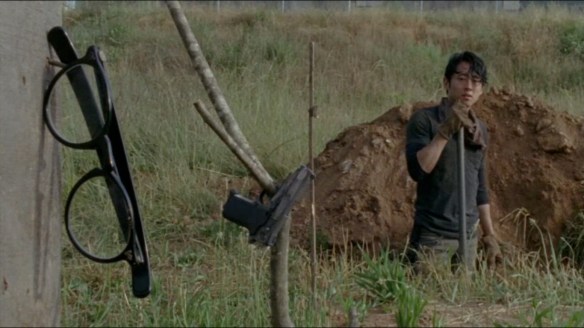
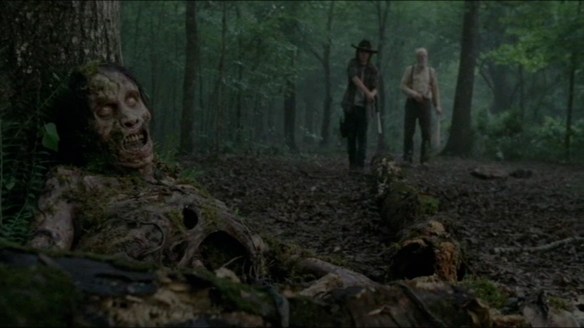
Notice how often the cinematographer uses the entire frame — not just from side to side, but from front to back. He deliberately stacks subjects on various planes within the frame. In the foreground of the first shot above we see a pair of eyeglasses attached to a simple grave-marker. Viewers will recognize the glasses as belonging to a young boy, the first victim of the mysterious flu. In the previous episode the boy died, became zombiefied, and had to be killed. In the middle-ground, a pistol — a killing tool, necessity in TWD world. In the background is Glenn, who is clearly exhausted — he’s exhausted both physically and emotionally, exhausted in almost every possible way (the boy with the eyeglasses was attacking Glenn at the time he was killed).

Everything in that shot — Glenn, the dead boy, the handgun — is linked thematically. Every element is isolated from the others. And yet every element is also inextricably linked to the others. The photography supports and enhances those themes.

wd7

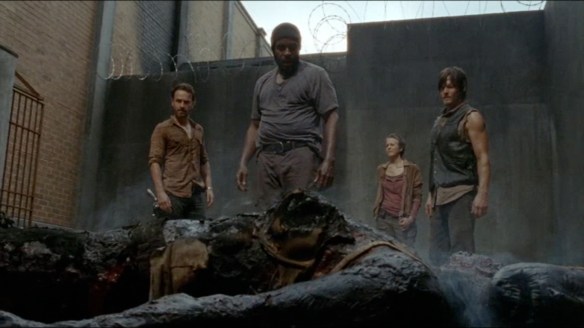
The same is true of the second shot. In the foreground, two bodies belonging to people who’d displayed symptoms of the illness. They’d been isolated; but somebody entered the isolation area, killed them, dragged their bodies outside, and set fire to them (much of the episode revolves around discovering who murdered these two). In the front middle-ground is the lover of one of the victims — a man obviously in shock. In the rear middle-ground are Rick and Daryl, leaders of the group of survivors. And in the background is Carol, the only one not looking directly at the bodies. At the end of the episode, Carol is revealed as the murderer.

Again, everyone and everything in the frame is thematically linked to everything else. And again, they’re all isolated from each other.

wd9

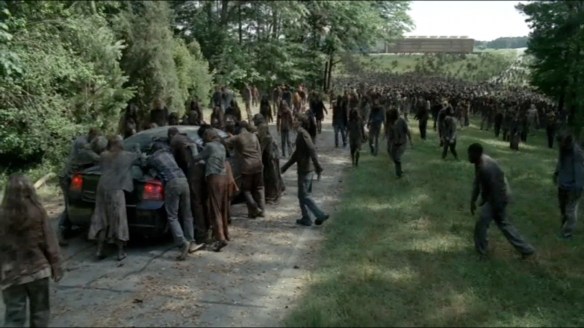
The director and cinematographer also use the frame to instill a sense of confinement. Everything seems to be crowding in on the characters. Even in the scenes that take place outdoors, the characters are somehow confined. In the woods they’re hemmed in by the trees, and by lurking zombies. On the open road — that most American venue — they find themselves quickly enclosed by a herd of zombies, trapped in the vehicle that’s supposed to grant them freedom of movement.

This happens in scene after scene in the episode. The frame is filled in every direction, thematically tight, and psychologically crowded. All those cascading claustrophobic moments create an aura of dread and despair in the viewer. It’s subtle, but very effective.

wd11

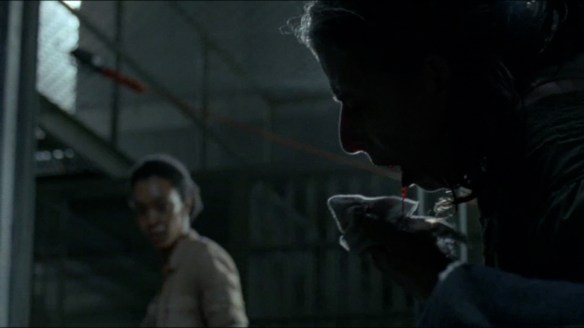
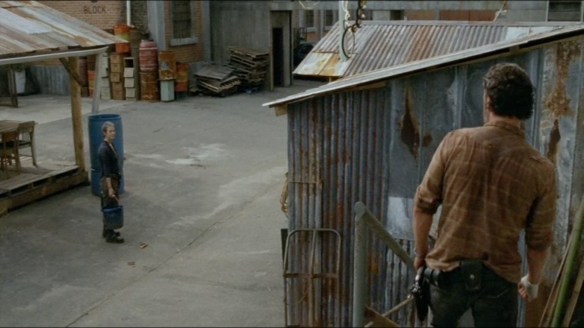
In the final sequence of the episode Rick is reluctantly preparing himself to ask Carol if she’s the person who killed and burned the two flu-sufferers. They’re filmed far apart; he’s high above her, in a rather judgmental position. She’s small and far below, waiting. He gradually comes down to her level — physically, emotionally, ethically — and asks the question he doesn’t want to ask.

The tension is palpable. She answers simply — yes. And walks away, the distance between them growing. And yet they’re both still linked, both still confined, both even more isolated.

I began watching The Walking Dead for the zombies. I still like it for that reason. Zombies are just flat out cool. But I appreciate TWD for the quality of the acting, the occasionally brilliant writing, and for the consistently amazing camera work.

aimless, but not pointless

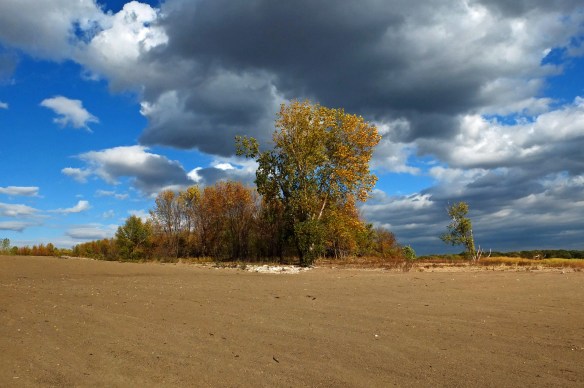
It’s probably got something to do with the transitional seasons — spring and autumn. Summer and winter are seasons of certainties and absolutes; you know what you can expect: heat and cold. Spring and autumn, though, are seasons of flux and movement; they’re about the passage from one absolute to another.

Maybe that’s why I feel a greater need to explore the countryside in spring and autumn. That’s where you witness the change.

DSCF4161b

Saturday began as a dark, cloudy, stormy day with no real promise of improvement. I had good reasons to stay inside — a book doctoring gig that was overdue, household chores I’d put off for too long, photographs I’d taken the week before but hadn’t yet uploaded. Valid reasons to stay home. But I felt restless…and here’s a true thing: I almost never feel restless. When I do, I usually give in to it.

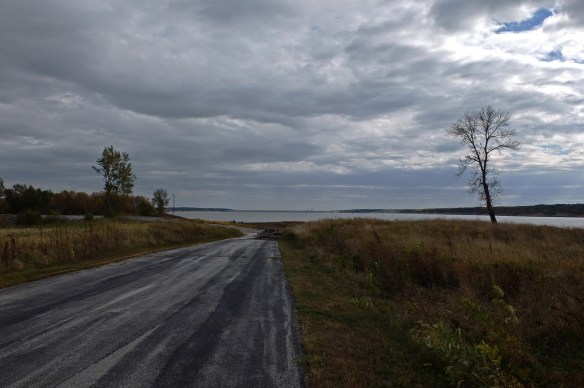
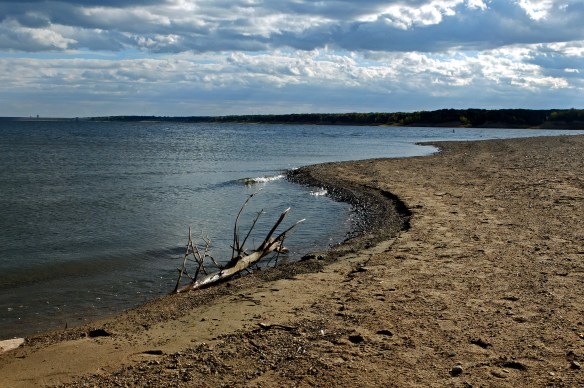
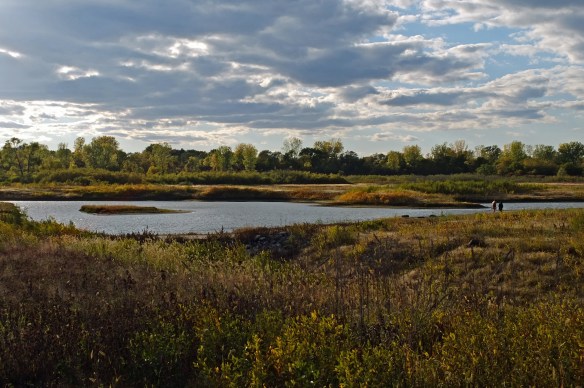
So I went to a nearby lake, with no purpose in mind other than to noodle around and see what there was to see. It was raw outside, miserably damp, and the light looked infirm. But there’s always something to see at the water’s edge. Lake, brook, ocean, river, doesn’t matter — there’s always something to see.

DSCF4196b

Then the clouds began to fail. The sun took a shufti, and started to wriggle and squirm through the cloud cover. And soon the day had become lovely. It didn’t get warm or anything, but it became comfortable. And the light…lawdy.

I’m sort of stingy when it comes to photography — maybe because I learned to shoot using film. I’ll lift the camera to my eye fairly often, but I don’t always press the shutter release. I’m not particularly conscious of my reasons for shooting or not shooting. All I know is sometimes it feels right and sometimes it doesn’t.

I was out at the lake for about an hour and a half — ninety minutes — and I took about ninety photographs. For me, that’s a LOT of photos.

DSCF4183c

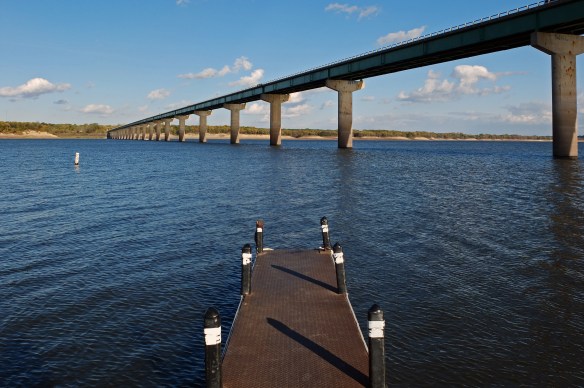
They call it a lake, but in fact it’s a reservoir built in the late 1960s and 70s as part of a flood control program. It’s hard to believe these days, but it wasn’t that long ago when the U.S. government spent big money on big projects that benefited regular people in a big way. Not only did the massive construction project itself provide a lot of jobs, but the finished lake supports a large community of small businesses.

The lake is a major local recreational area. It’s popular with recreational boaters, with hunters, with anglers, with hikers, with bicyclists (there are bike trails all through the area), with picnickers, with photographers (I saw one guy with a 4×5 view camera), with campers. All of those people spend money on their hobbies. They buy boats and jet-skis (and have them repaired and moored at marinas in the summer and stored in the winter), they buy fishing and hunting gear, they buy bikes and cameras, they eat at local diners and buy gas at local filling stations, they buy camping gear and rent camping sites at the many campgrounds, they buy sunscreen and mosquito repellent, they buy beer and soda, they spend a metric buttload of money every year. All because the government built a 26,000 acre flood protection reservoir. (All of which is to say ‘Fuck you, Tea Party Asshats!’)

DSCF4220bIn the summer, this lake is busy. It slows down quite a bit in the autumn, and on a day that began so cold and unwelcoming it wasn’t surprising that there were so few people to be seen. There were a few people bundled up but still zooming around in boats, there were a few folks fishing, there was a guy with a dog, and another guy wrestling with a large format camera. Lots of gulls, a few deer, some dead fish, a different hawk every few yards, no obvious raccoons or weasels (though a lot of tracks), finches so tiny you could fit two in a teacup.

It seems so quiet when you first arrive — but soon you realize how much sound there is. The waves, of course, and the wind through the grasses. Distant drone of boat motors. That ridiculous but somehow still moving plaintive cry of the gulls. Soft rattling of dead leaves. It seems absurd that the world could be so quiet and still so full of noise.

DSCF4207c

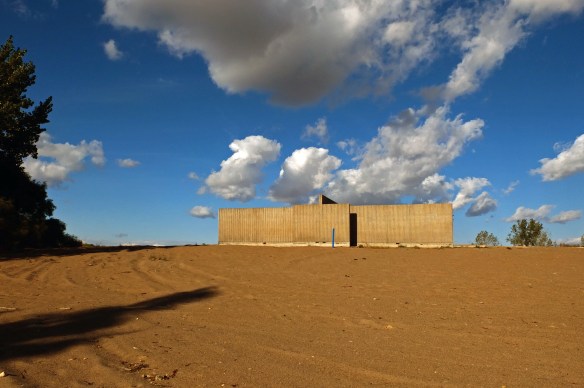
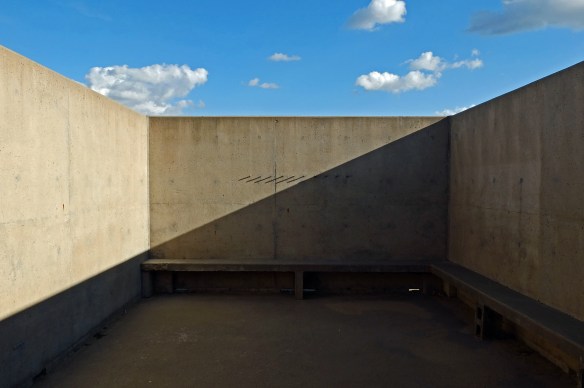
At one of the many official recreation spots there’s a bath house for swimmers — an open air place to shower and change in and out of swim suits. It’s a purely functional building made of formed concrete. It looks rather like a failed student project from the Soviet School of Architecture and Design. It ain’t pretty.

But, again, the light. Light has the capacity to turn even a butt-ugly bath-house into something interesting. For a moment, anyway.

DSCF4214b

Here’s an odd thing. When I first arrived at the lake, I spent most of my time looking out at everything. Looking out at the horizon, out at the trees and out over the water, out at the buildings and the shifting clouds. But the longer I was there, the more I began to look down.

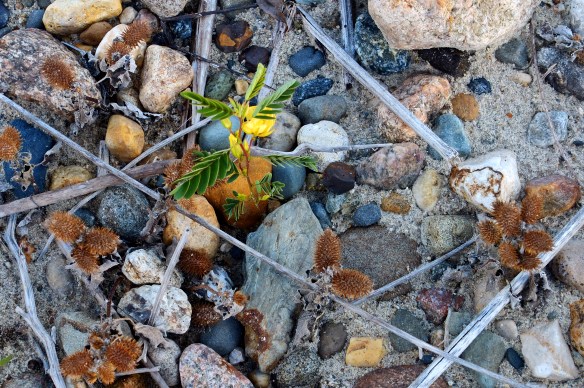
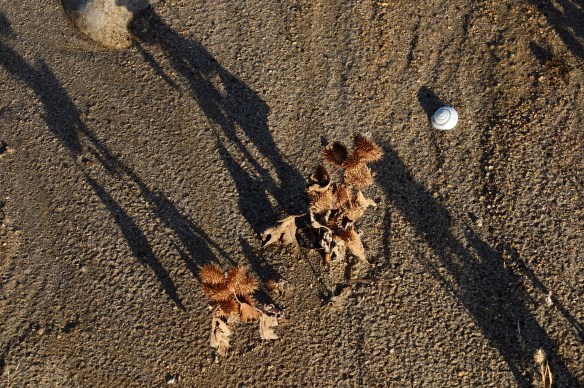
Looking out, you tend to see the larger world and the things you notice are large things. Looking down, you notice the smaller world. A world of small stones and tiny plants and odd-looking insects and sand and dry broken bits of wood and dead grasses and clusters of cockleburs. Along the lakeside, it’s a universe of cockleburs.

DSCF4230b

Cockleburs are really rather fascinating. The seeds, of course, are hard ovals covered in spines. The spines are actually wonderfully-formed hooks, though the tiny hooks are difficult to see without close study. But c’mon, who really looks at a cocklebur? Nobody. You just want to get the wee bastards off. Off your shirt, and off your pants, and off your socks, and your shoes, and Jeebus on toast I’ll bet the damned things could stick to tank treads.

That’s the point, of course. The spiny hooks are an incredibly efficient and effective mode of seed dispersal. But what’s really cool about these remarkably annoying plants is that they’re classic examples of photoperiodism. They’re what’s called short-day plants, plants that only bloom when the days begin to get shorter. Short-day plants have a protein that actually serves as a photo-receptor, which is incredibly cool. What’s even more cool (if you like this sort of thing) is that the photo-receptor isn’t triggered by the amount of light during the day, but by the amount of dark during the night. Short-day plants should actually be called long-night plants.

DSCF4235b

But wait — there’s still more cool but weird cocklebur stuff. That infuriating egg-shaped seed pod generally holds two seeds — one seed grows the next year, the other seed waits and grows during the second year. It’s a marvelously effective way to insure the perpetuation of the species. If you were to pick a few of those irritating burrs off your socks and boil them, you could make a tea that’s moderately effective at relieving nasal and sinus congestion. Or, you could use the plant itself to make a yellow dye. Seriously. The cocklebur belongs to the genus Xanthium, which means ‘yellow’ in Greek. It got that scientific name from a 17th century French botanist, Joseph Pitton de Tournefort, who was aware that the plant had been used for centuries by the Greeks to create a yellow hair dye.

So the next time you have to pick cockleburs off your shoestring, remember to give a moment of thought to what a truly remarkable plant it is. Then throw the irksome little bastard away (which, of course, is exactly what the irksome little bastard wants).

DSCF4241b

An hour and a half, that’s all the longer I was out there. An hour and a half, and the clouds began to move back in, the wind picked up, and the air took on a dampness that made it seem colder than it was. An hour and a half, and if I believed in the soul I’d say mine was replenished in that time. Ninety minutes of mostly aimless walking and looking and shooting photos.

And another ten minutes picking the damned cockleburs off my clothes.

neighbors

It might be art, but does that make it O.K.?

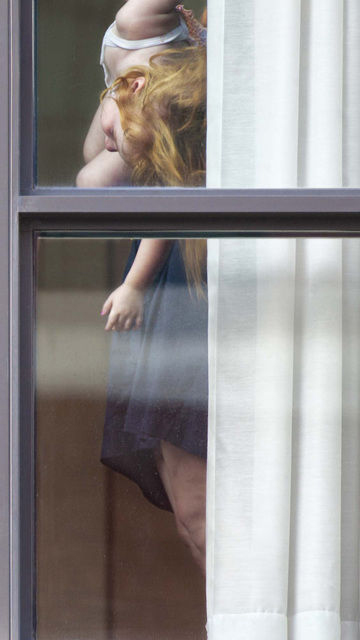
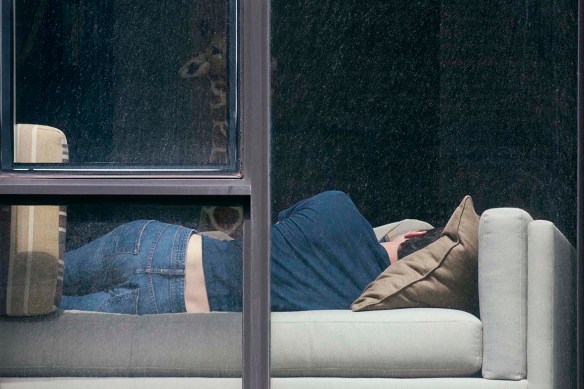
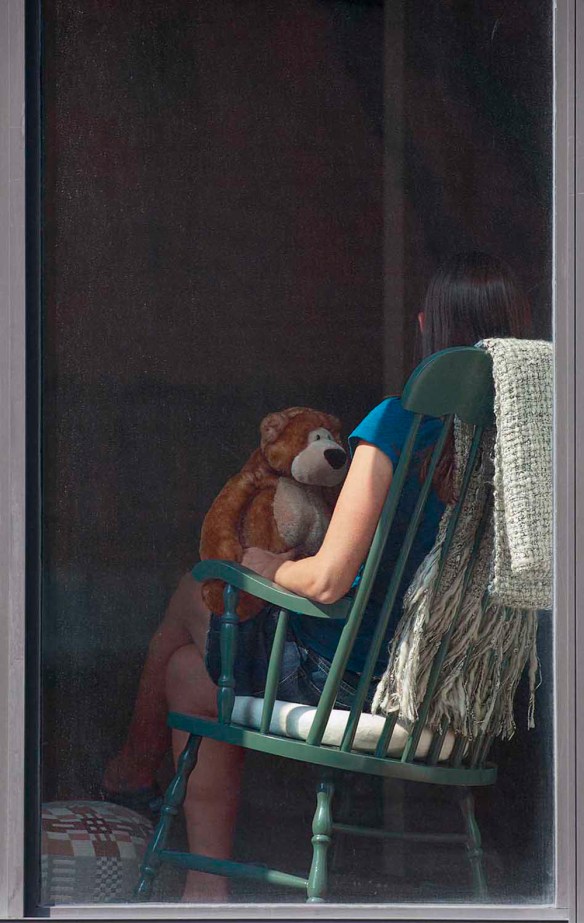
That’s the lead-in question raised in a New York Times article about photographer Arne Svenson’s new series Neighbors, which is on display in a Chelsea gallery. Svenson, who is probably best known for his still life photographs, came into possession of a 500mm lens. He didn’t buy it; according to reports, he ‘inherited’ the lens — whether from a friend who died or in some other way, it’s not clear. What is clear is that Svenson somehow ended up with a lens that’s great for wildlife and sports photography, but not particularly useful for still lifes.

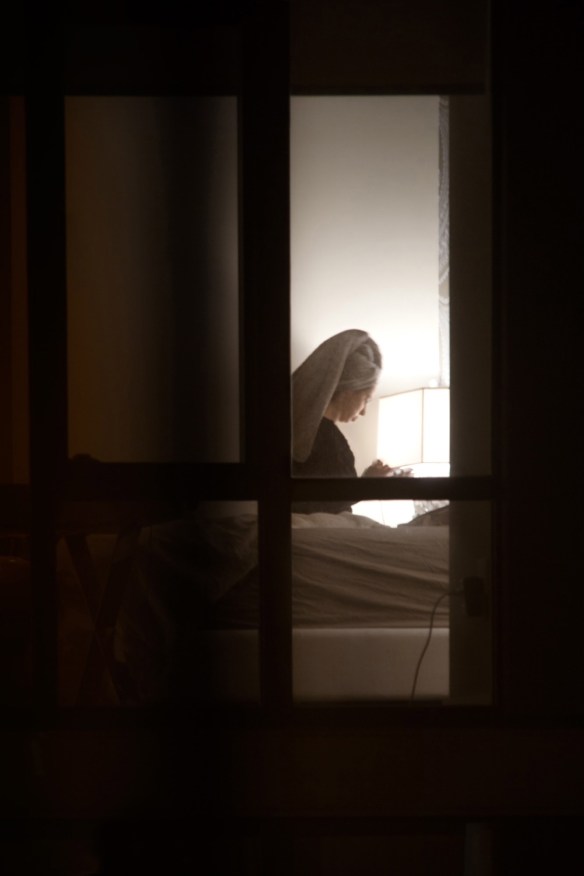
So he did what I suspect any photographer would do. He put the lens on his camera and looked out the window. Since Svenson lives in an apartment in TriBeCa, it’s not surprising that when he looked out his window, he saw the apartment building across the street.

neighours #1

Neighours #1

Back in 1964 the social philosopher Abraham Kaplan posited the Law of the Instrument. He wrote: Give a small boy a hammer, and he will find that everything he encounters needs pounding. This concept is sometimes referred to as Maslow’s Hammer, because a couple of years later Abraham Maslow wrote: I suppose it is tempting, if the only tool you have is a hammer, to treat everything as if it were a nail.

If you have a wildlife photographer’s lens, you treat everything you see through it as wildlife. And that’s sort of what Svenson did. He began to photograph his unsuspecting neighbors in the building across the street in much the same way a wildlife photographer would photograph, say, a Pileated Woodpecker. Quietly, surreptitiously, covertly. You don’t want to spook the bird; it’ll fly away. Svenson embraces this analogy.

“I am not unlike the birder, quietly waiting for hours, watching for the flutter of a hand or the movement of a curtain as an indication that there is life within.”

There’s a crucial difference between New Yorkers and woodpeckers, though. Birds don’t go to galleries in Chelsea. Birds never see their photographs hanging in a venue open to the public. Birds have a poor grasp on the concept of privacy. Birds don’t sue.

neighbors #14

Neighbors #14

Not surprisingly, some of the people Svenson photographed have brought suit against him. Martha and Matthew Foster are seeking ‘actual and exemplary damages for intentional infliction of emotional distress and an injunction to stop the dissemination of the photographs’ (emphasis added). Ms Foster and her children appear in two of Svenson’s photographs — Neighbors #6 and Neighbors #12, which are being sold for US$5000 and $7500. Ten copies of each print are apparently being offered. According to the suit,

Plaintiffs were also greatly frightened and angered by defendant’s utter disregard for their privacy and the privacy of their children. Plaintiffs now fear that they must keep their shades drawn at all hours of the day in order to avoid telephoto photography by a neighbor who happens to be a professional photographer.

It needs to be noted that this is a civil suit, not a criminal case; Svenson’s behavior may be ethically questionable, but it doesn’t appear to be illegal. But even though a civil suit has a lower standard of proof than a criminal case (generally ‘a preponderance of evidence’ or ‘clear and convincing evidence’ rather than ‘beyond a reasonable doubt’), I suspect the Fosters will have a difficult time proving Svenson intentionally inflicted emotional distress on them. Their anger and distress are almost certainly real, but that’s not enough for them to win a civil suit.

neighbors #12

Neighbors #12

So it seems Svenson did nothing criminal, and it appears unlikely he’ll be found civilly liable for his behavior. That brings us back to the ethical question raised in the Times: It might be art, but does that make Svenson’s behavior okay?

It’s really a rather silly question. I doubt many people would think using a telephoto lens to shoot surreptitious photographs of unsuspecting neighbors is okay. It’s most certainly not okay. It’s fucking rude, is what it is. Rude and more than a little creepy.

Neighbors #11

Neighbors #11

That said, I’m not convinced that ‘okay’ and ‘not okay’ are metrics that should be applied to art. I don’t think ‘rude’ or ‘creepy’ are useful yardsticks for measuring the acceptability of art. There’s good art and there’s bad art; there’s art that works and art that doesn’t. And those, of course, are entirely subjective measurements.

I’m not suggesting art trumps ethics, or that art is above ethics. Nor am I saying artists should ignore ethics. What I’m saying is that artists shouldn’t choose their subject matter based on whether it’s socially acceptable or not. They should, however, be willing to suffer whatever consequences arise from socially unacceptable art — including the occasional civil suit. In this case, as might be expected, the legal attention has brought Svenson’s work to a much wider audience and will almost certainly help his sales.

Neighbors #17

Neighbors #17

I think this is good art. I think these photographs work. I’m completely taken by the stillness, and the intimacy, and the painterly quality of the light. But at the same time, I think Svenson’s behavior in spying on his neighbors is morally reprehensible. If he’d done it to me, I’d very likely be massively pissed off. I’m glad he did it anyway.

I find myself wondering if the Fosters weren’t the subjects of the photographs and saw them — in a book, on a gallery wall, in a magazine — if they’d have appreciated them as photographs. As art. I wonder if they’d be able to look at Neighbors #6 and Neighbors #12 and, instead of seeing an appalling invasion of their own personal privacy, see them as lovely photographs depicting a happy, close-knit family. Because that’s what I see.