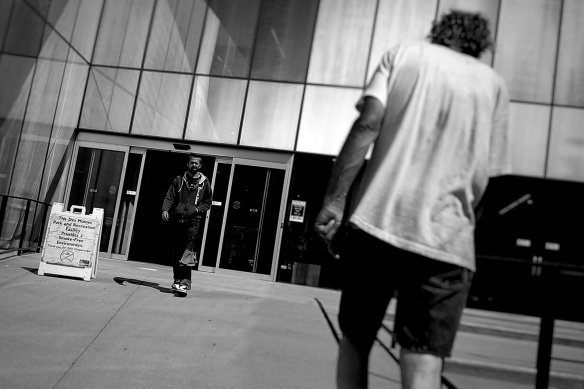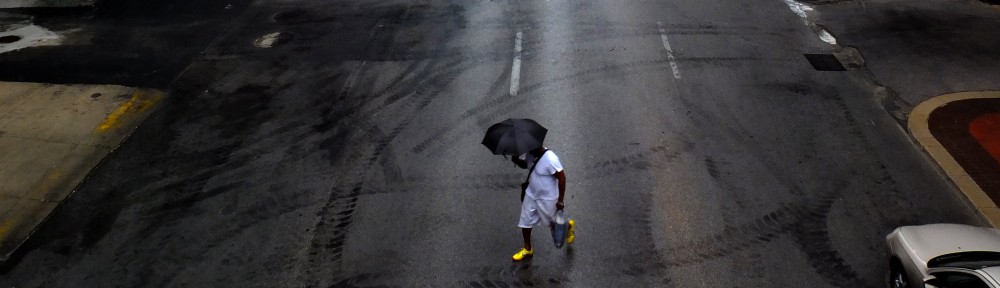
thoughts on sand

I was walking along the lake shore, not thinking about anything in particular. Just casually looking at the birds, watching the dragonflies that hunt the small ponds along the lake, listening to the gulls arguing, enjoying the way the sand shifted under my feet. Here’s an interesting thing about sand: it behaves more like a liquid when it’s dry, and more like a solid when it’s wet.

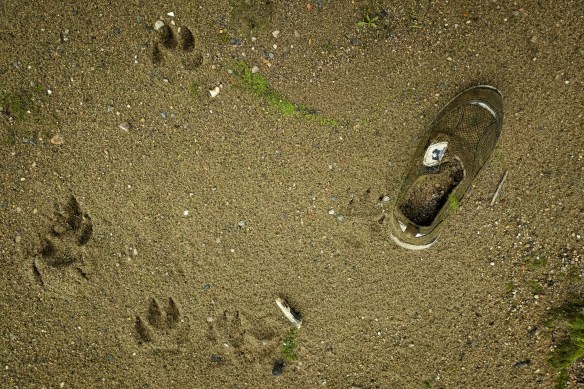
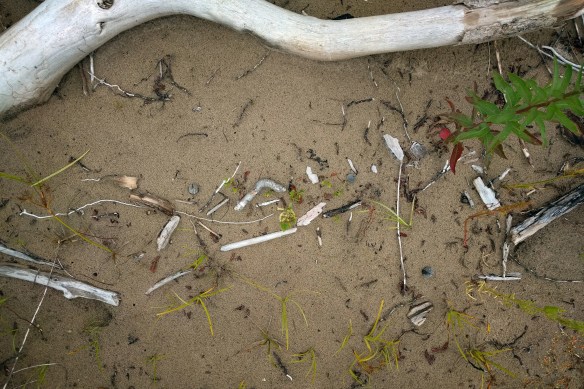
I was just walking in the sand by the lake, idly scanning the ground for interesting chunks of driftwood or colorful stones. And I saw this:

sand3

Somebody had lost a beach shoe. Nothing really out of the ordinary. And a dog had padded by. Also pretty common; lots of people take their dogs to the lake. At some point, a raccoon had wandered along the same bit of sand; the woods around the lake are a haven for raccoon. And now I was standing there. That layering of temporal events pleased me for some reason — four creatures had crossed that same little patch of sand, separated only by a period of time.

This sort of thing happens to me all the time. I see something, and neurons start firing in my brain. I saw that lost beach shoe and the dog’s paw print and the raccoon track, and thoughts start turning over in my mind. Because it wasn’t just us that had crossed that bit of sand. Dozens of creatures had walked, slithered, or hopped across that same spot. Thousands of dozens. Millions of thousands of dozens. I mean, some three hundred million years ago, this entire area was under water; it was the sandy bottom of a great inland sea — a sea that dried up, only to be replaced by another inland sea a couple hundred million years later. Then that sea dried up as well. Now there’s just sand.

sand1


Well, not just sand. There’s also a lake. Six thousand acres of water. Almost ten square miles. Not a natural lake, though. Technically, it’s a reservoir — a man-made lake; an intentional containment of the Des Moines River. The lake was created about 50 years ago to try to control the periodic flooding that plagued the city of Des Moines for over a century. The flooding also troubled the native people who’d settled at the confluence of the Des Moines and Raccoon Rivers seven thousand years earlier.

We know people lived here seven thousand years ago because we’ve found their bodies. A woman and a child, well-preserved skeletons sealed in a layer of sandy clay deposited by a sudden flood. It’s only relatively recently that humans developed the technology (and the audacity and arrogance) to dam up the river and create a lake. The dam and the lake hasn’t put an end to the flooding, but it’s certainly reduced the damage.

sand5

A lost beach shoe and a raccoon print in the sand, and my mind went caroming off of disappearing Paleozoic seas and banging into ancient human settlements and human high-handedness toward nature. But even while a chunk of my brain was knocking around notions of time and human presumption, I couldn’t help being drawn by how gracefully the water and wind have shaped the lake shore.

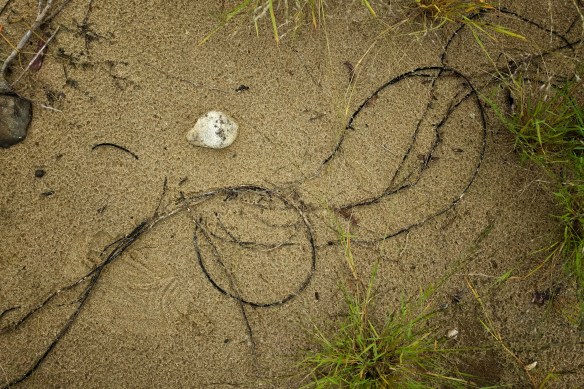
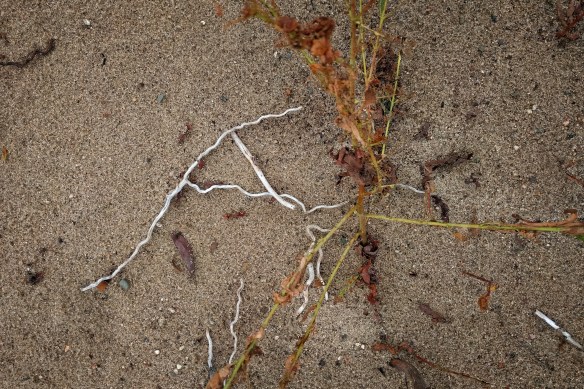
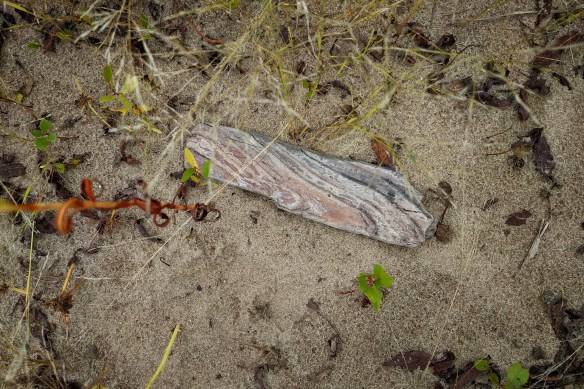
I found myself paying attention to how the moisture content of the sand shifted its color along with its consistency — how the farther I got from the water, the more pale the sand became. I started to notice how the granularity of the sand changed — how some was more coarse and some was incredibly fine. I paid more attention to how the wind revealed layers of different color in the sand, how driftwood bleached into various subtle shades.

sand4

There was something wonderful and beautiful about how dried leaves gathered gracefully in fluid self-organized, breeze-driven groups. There was something fascinating about how different waterlines arranged themselves; you could gauge the strength of various storms by the arrangements of the detritus and the driftwood and how far they’d been driven from the waterline by the wind and the waves.

None of this is stable. It’s changing all the time. The change is sometimes radical and quick and violent, but mostly it’s slow. I know I can return to this same spot in a couple of weeks and find that same driftwood log and those same weeds; I know I can return in six months and find that same log, though it will likely be surrounded by different detritus. There is continuity. Continuity, but not sameness.

sand6

There’s a good chance that the next time I return to the lake, that lost beach shoe will still be there. The dog’s paw print and the raccoon track probably won’t. The sand, though, it’ll still be there. Long after I’m dead and gone, long after that shoe disintegrates, long after the driftwood deteriorates into nothing, the sand will still be there.

There are people who collect sand as a hobby. They’re called arenophiles. The word comes from the Latin term for sand: harena. That’s also the root of the word arena. What does sand have to do with an arena? The Romans understood that the best and easiest way to soak up the blood spilled from their arena spectacles — the gladiator fights, the chariot races, the beast contests — was to lay down a layer of sand. Before there was a Coliseum, there was sand.

There’s always sand.


practicing in public

I very much like the work of photographer William Gedney, but I admit I wasn’t terribly interested when I learned his journals were available online. Still, when I wrote about Gedney several years ago I took the opportunity to look at a few of them.

Most of the journal entries were pretty dull. Photography historians may be fascinated to know that on Friday, April 22nd, 1966 Gedney finished a roll of Tri-X in his Leica M3 by shooting a few frames of the Long Island University gym and the Paramount building (1/60 at f 2.8) and of a sleeping boy (1/10 at f 2.8). Me, I don’t really care. It’s mildly interesting to know Gedney stopped by Diane Arbus’s apartment in January of 1969 to fetch a couple of prints, and that her hair was very short at the time. Me, I don’t really care.

against the tide

I’m only slightly more interested in reading the quotations or song lyrics Gedney copied into his journals. I tend not to be inspired by ‘inspirational’ quotations. But I found myself reading a three page entry in Gedney’s 1969 journal. Three pages — one long quotation by Alfred Stieglitz. I won’t quote the thing; you can read it yourself if you want. Essentially Stieglitz was talking about ‘practicing in public’ — showing work that doesn’t quite meet your standards for what the work could be. He said:

[I]f one does not practice in public in reality, then in nine cases out of ten the world will never see the finished product of one’s work. Some people go on the assumption that if a thing is not a hundred percent perfect it should not be given to the world, but I have seen too many things that were a hundred percent perfect that were spiritually dead, and then things that have been seemingly incomplete that have life and vitality, which I prefer by far to the other so-called perfect thing.

Stieglitz also talks some bullshit, like “Is the thing felt – does it come out of an inner need – an inner must? Is one ready to die for it?… that is the only test.” Is one ready to die for it, lawdy. Drama queen, right there. Gedney includes all that crap about ‘inner must’ in his three pages — but I think we can overlook the bullshit and still learn something worthwhile from Stieglitz.

sports fan

I love the notion of practicing in public. I’d be lying if I claimed I only shot photographs for my own pleasure. I enjoy making them available to other folks. I rather hope the folks who bother to look at them find something worthwhile in some of them, but if they don’t, I’m not that concerned. For the most part, I’m fairly confident of my ability to take a good photo — if I have a moment or two to allow the elements of a good photo to register in my brain. You know, stuff like composition, light and shadow, geometry, depth of field. All I need is that moment or two; I’ve been noodling with cameras long enough that I can adapt fairly quickly to most situations.

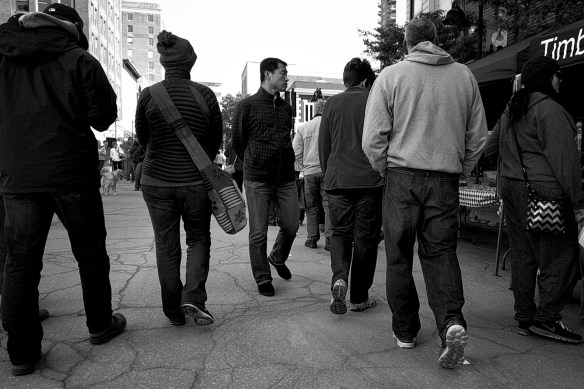
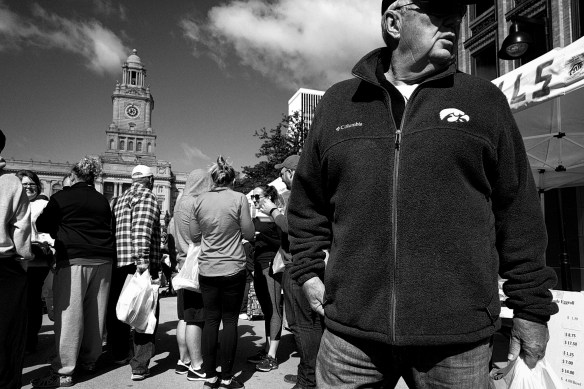
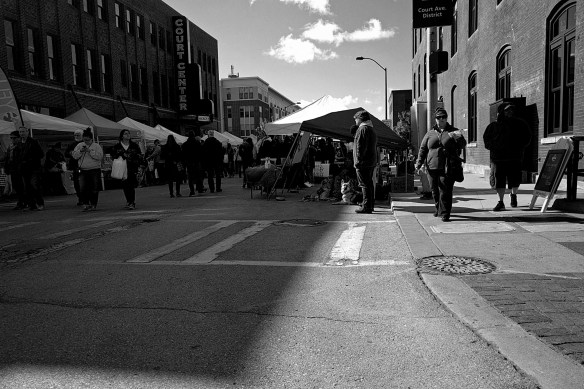
But then there’s street photography, and the street is pretty damned stingy when it comes to allowing you a moment or two for anything to register in the brain. Sure, you can look at a scene and quickly assess the possibilities — the light is good over there, the shadows are nice in that spot, all I need now is for something interesting to happen right there. But if nothing happens — like in the shot below — you’re just left standing around gawping like the village idiot. There’s a spot for potentially interesting photo, but the street just ain’t giving it away.

court avenue sidestreet

Street work is different. It’s about immediacy. It’s about anticipating what’s about to happen while incorporating the unpredictable. It’s about being open to the moment and responding to it creatively, and without conscious thought. Those are things I’ve been good at all my life. All my life — except when it comes to photography.

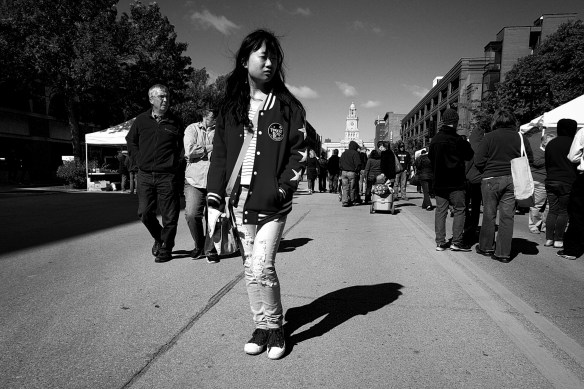
I have very little confidence in my ability to shoot street. I totally love doing it. I love the spontaneity of it. I love the semi-unpredictable way groups of people shift in and out of patterns. I love the way the point of balance of an image may exist only for a moment, then disappear and what could have been an engaging photo becomes just a disorganized, visually jarring clump of people. I love shooting from the hip (and I mean literally from the hip), trying to anticipate how various elements will arrange themselves in the next few moments — and predicting how that arrangement will appear through the lens of a camera held maybe eighteen inches below my eyes.

approaching the farmer's market

All the things I love about street photography are things that make it easy to get it wrong. It’s so very easy to miss the shot, to fuck up the composition, to release the shutter a moment too soon or too late, to be half a step too far to the left, to fail to notice what’s taking place (or not taking place) in the background.

The difference between good street work and ineffective street work can be measured in the time it takes a person to turn their head or glance at a cell phone. I love the practice of street photography — getting out there and trying to do it well. And I’m with Stieglitz about the importance of practicing in public. If you want to be good at this stuff, you need to be open about the struggle. Fuck perfection.

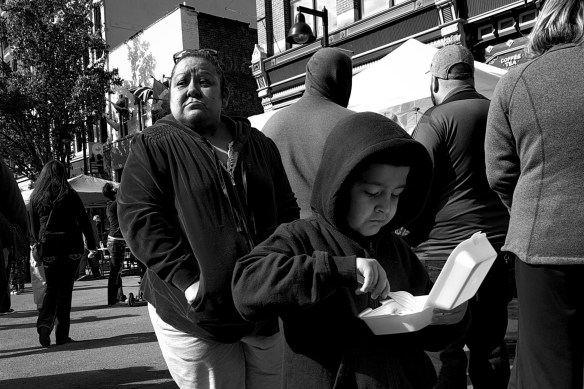
kid eating cinnamon roll

So back to Gedney and Stieglitz:

Either you feel that a thing must be perfect before you present it to the public, or you are willing to let it go out even knowing that it is not perfect, because you are striving for something even beyond what you have achieved… [I]n struggling for perfection you know that you may lose the very glimmer of life, the very spirit of the thing that you also know exists at a particular point in what you have done; and that to interfere with it would be to destroy that very living quality.

Practicing in public. I’ve been thinking about this concept off and on for a few years, but it was only recently I began to focus on that last phrase: “…to interfere with it would be to destroy that very living quality.”

It’s that living quality that makes street photography vital, isn’t it? So if there’s any style of photography that ought to be practiced in public — that should be liberated from the entire idea of ‘perfection’ — it should be street. Right?

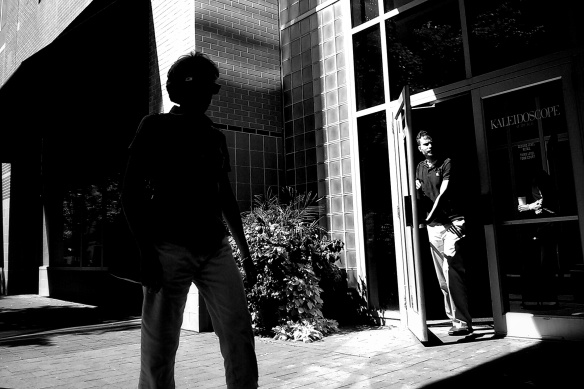
street

I love street photography. I love the energy of it. I love the unplanned immediacy of street photography. I love the connection between the photographer and what’s taking place within the frame, and I love the connection between the viewer and the image itself. When you look at a good street photo, the photographer disappears — it feels as if it’s just you and what’s happening in the photo, unfiltered by any photographer. I love street photography.

Wait, let me amend that — I love street photography when it’s done well. But here are a couple of true things: first, it’s really difficult to do it well. And second, it’s even more difficult to do it well with consistency. Good street photography is hard. Bad street photography, on the other hand, is incredibly easy.

I should also point out that although I love street photography, I’m not a street photographer. I sometimes shoot photographs on the street (though I’m more likely to shoot in alleys), but street photography isn’t entirely about location. It’s about the ways people inhabit and move through public spaces. Most of the photographs I shoot in public spaces are urban landscapes. If there are people in the photographs, they’re incidental.

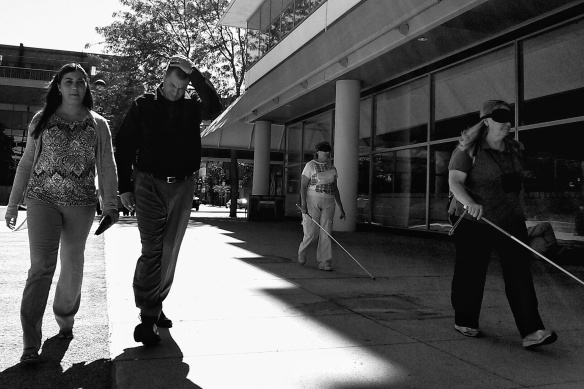
acting blind

That said, I often see good street photographic moments when I’m out noodling around. I’m a completely fucking brilliant mental street photographer. But brilliant mental street photography doesn’t translate to the camera. It’s one thing to see a street moment and think ‘There — that’s it.’ It’s entirely another thing to anticipate that moment, put yourself in the right spot, and have your camera ready to shoot it. That’s one of the reasons I’m not a street photographer. I’m just not willing to walk around with a camera always at hand, ready to snatch that exact moment when everything comes into alignment.

But last week, as I was wandering around downtown, it occurred to me that I do always have a camera at hand. My smartphone. It’s not a great camera, but so what? It’s quiet and unobtrusive, which is pretty important for street work. I have an app called Lenka that shoots basic black-and-white images. This clearly isn’t the optimal arrangement for street photography, but it’s what I had with me. You have to work within your limitations.

I set the app to allow me to take a photo by pressing the volume button on my phone (so I wouldn’t have to fuss about with using the phone as a viewfinder) and went off try some street. Almost immediately, I came across a small group of folks learning to be blind. The headquarters of the National Federation of the Blind is located downtown, and I assume that’s why we so often see a group of blindfolded people with canes being escorted around town. I took a couple of shots without looking.

the hub


They weren’t great photos, but they were enough to encourage me to keep trying. I wandered around, saw some interesting folks, took some shots. I tried not to focus too much on people who looked interesting, because those were mostly folks who were marginalized because of addiction or abuse or weight or some other social condition. I tried to look for visually interesting situations instead.

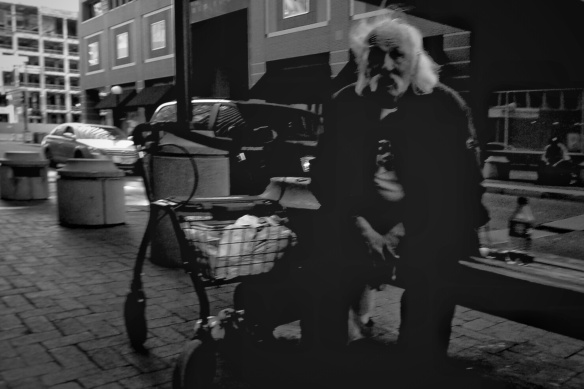
Then I ran into this old drunk guy.

old drunk sitting

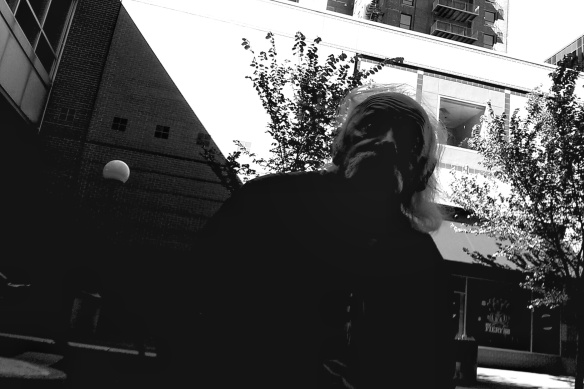
He immediately panhandled me, asking for spare change. I don’t carry much money; I use a debit card for everything. The only cash I had was a couple of twenties. So I told him I didn’t have any change — and I surreptitiously took his photo without looking. Shameful behavior on my part. Doubly shameful in that the photo was blurry.

The guy grinned and offered to take a twenty, which was a nice move on his part. It made me like him enough that I wanted to give him something. I told him I was heading for the drug store across the street and down the block, but if he was around when I came back that way, I’d hand over a little something — and I surreptitiously took his photo again. Still without looking; still shameful. This time the photo was badly exposed.

old drunk panhandling

So I went to the drug store, bought a cupcake for myself and a chicken salad sandwich for the old drunk guy. When I came out of the store, the ODG was hobbling across the street with his walker. I’d told him I was going to give him something and dammit, he was going to make sure I didn’t forget. I gave him the sandwich and a couple of bucks (and yes, I knew he’d spend the money on booze). Again, I surreptitiously took his photo. Again, it didn’t turn out well; badly expose and blurry.

That’s what you get for shooting without looking, I suppose.

IMG_1441830833485-01


Having done my part to support the local alcoholic community, I kept on wandering and shooting. Every so often I’d stop and find a place to sit and chimp the photos. Most of them were bad. Some were really bad. But mostly I was okay with them. If nothing else, I was learning to get the framing right. Mostly. Partly. That’s hard to do when you’re shooting from the hip.

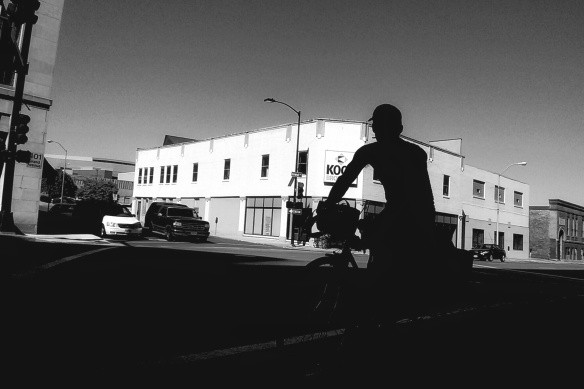
The light was getting increasingly harsh, the shadows were radical — great conditions for urban landscape photos, but not what you’d call street-friendly if you’re relying on shooting blind with a smartphone. Almost everything I shot was badly (or weirdly) exposed.

cyclist in shadow

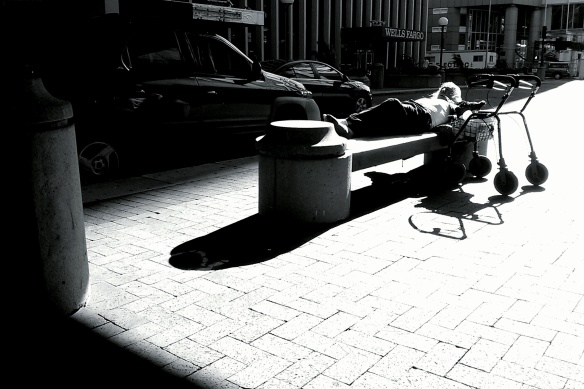
I decided to end the experiment. I knew a nice, quiet, dark space nearby (okay, let’s just call it a tavern), so I headed there for a cool drink and a chance to evaluate the photos. On the way there I came across the old drunk guy again. He’d taken off his shoes, put them in the basket of his walker (along with the uneaten chicken salad sandwich), and laid himself out on a public bench for a nap. Or to sleep it off.

And hey, I took his photograph one more time. Shameless again.

stll drunk

I learned four things from the experiment. First, I’m not a good street photographer. I’m okay with that. I’m not a rotten street photographer either. I can improve. If I decide to. Second, street work has a moral component. In the U.S. you pretty much have the right to photograph anything and anybody in the public arena. Doesn’t mean you should, though. Third, if you have a moral discussion with yourself before you shoot a photo, you’ll probably lose the shot.

Earlier I mentioned I tried not to focus too much on people who only looked interesting, because they tended to be folks who were marginalized in some way. Shooting photos of those folks would (or easily could) be exploitative — even if that wasn’t my intent, and even if I never showed the images to anybody. It would, in effect, be turning them into props; it would not be treating them as people.

There was a specific moment during the day I made a rule for myself. Shoot first, decide later if the photograph was ethical. Here’s how I came by that rule. I saw another drunk guy. The old man I’d met earlier was clearly an alcoholic, but he seemed pretty self-aware of his condition. He was friendly, with a sort of style and charm about him. He was clearly intoxicated, but not sloppy drunk. He was a sad case, but he was in control of himself and I liked him.

The other drunk guy was probably in his late 20s. He was staggering drunk. Oblivious to the world drunk. Slobbering and probably in dubious control of his bladder drunk. High school drunk. There was nothing likable or charming or self-aware about him. I could feel compassion for him and his situation, but I still recognized he was pretty disgusting. And he was heading up the sidewalk toward the public library.

young drunk


I hurried to catch up. I didn’t feel any need or desire to photograph the guy himself, but I thought it might be interesting to photograph the reactions of the people he met in the library. I took a single shot when a library patron came out of the library as the drunk guy approached. And then I thought it would be cruel to photograph those reactions; it would be demeaning to the drunk guy himself, and to the people he encountered. The photos wouldn’t be about anything but condemnation for a man who had some serious problems.

So I turned off my phone and put it in my pocket. I felt I’d made the right decision when, as these two guys approached each other, the library patron looked completely repelled. But as they got closer the library guy’s face shifted from loathing to concern. He stopped and spoke to the drunk guy; I couldn’t hear, but I assume he was asking if the drunk guy was okay. The drunk guy just lifted a hand — maybe in acknowledgement, maybe in denial, maybe a suggestion that the library guy should mind his own business, I don’t know — and he just kept zombie-shuffling toward the library.

I’d turned my camera off. I missed that shot. It had the potential to be a truly good street photo. It was a strangely non-judgmental moment. Almost sweet, on the part of the library patron. And that’s then I decided shoot first; decide its value later.

I said I learned four things from the experiment. Here’s the fourth: a sincere attempt at street photography (for me, at any rate) is oddly dissociative. It’s a combination of being very aware of yourself and the world around you, yet being somewhat removed from it. Until — and this is the freaky part — until you see the elements of a photo possibly coming together. At that point you become intensely aware. Of everything. The light, the geometry of the background, the spatial relationships of what’s in the frame, and you start plotting vectors of interception — where it’s all going to come together and where you need to be at that point to shoot the photograph. And it’s both exciting and terribly frustrating because oftentimes you’re also hyper-aware that you’re almost certainly NOT going to be in the right spot at the right moment and you’re going to miss the shot.

I love street photography — when it’s done well. I doubt I’ll ever be terribly good at it, but I’ll periodically continue the experiment. If nothing else, it’s great fun.

sunday salon, redux

I’ve been noodling around with cameras since I was in my teens. The mechanics of photography — all of that aperture, shutter speed, depth of field, ISO business — have been second nature to me for years; I rarely need to think about them.

But nine years ago I realized I was almost entirely ignorant about the medium itself. I’m talking about photography as history and culture. I was familiar with the names of a few of the photographic big hats — Ansel Adams, Cartier-Bresson, August Sander — and I could recognize some of their more well-known images, but basically I had no understanding at all of what had been done in photography, or who had done it, or what they were thinking when they did it.

I was the Jon Snow of photographic culture. I knew nothing.

New York City #1, 1976 (Joel Sternfeld)

(Joel Sternfeld)

Homer Page? Never heard of him. Ralph Meatyard? No idea. Mike Brodie, Ara Güler? Hadn’t a clue. Tina Barney, Tony Ray Jones, Lewis Baltz? All cyphers. Guy Bourdin, Helen Levitt, Anders Petersen, O. Winston Link, Milt Rogovin? Meant nothing at all to me.

So I set out to correct that. I decided to educate myself. I’d pick a photographer’s name and do some research. I also decided to share what I’d learned (or thought I’d learned) with the members of Utata, a Flickr group of smart, creative, funny, curious people who enjoyed photography and discussion in equal measure. I’d write a short essay on the photographer, include an example or two of the photographer’s work, and we’d chat about it. Or debate it. Or argue about it.

(John Vachon)

(John Vachon)

It was fun. Everything about it was fun — the research, the discussion. At first, I did them every week. I’d publish them on Sunday and we’d discuss them all week. I took a very catholic approach to selecting the subjects. Street photographers, portrait photographers, fine arts photographers, fashion photographers, sports photographers — there was something to learn from all of them. I looked at the usual dead white guy photographers, at little-known contemporary photographers, at cult and niche photographers, at niche photographers, at photographic curiosities. I ran through the alphabet, from Berenice Abbot to Guillaume Zuili.

(Guillaume Zuili)

(Guillaume Zuili)

The salons, I admit, weren’t always well-written. And there have been a few embarrassing mistakes in research. Some of the more controversial salons led to a harsh arguments. But it was fun. At first.

As the discussions became more informed and intelligent, I felt the need to spend more time doing research. The essays became longer, and included more examples of the photographer’s work. The extra research meant I could no longer keep up the once-a-week schedule. I began doing them every other week.

(Lu Guang)

(Lu Guang)

After a few years of this, it became a chore. A pleasant chore, for the most part, but still a chore. I stopped doing them every other week and began publishing the Sunday Salon at irregular intervals. A month might pass between salons. Maybe five or six weeks. I posted fifteen salons in 2010. Only four in 2011. Seven in 2012, and only three in 2013 — and two of them were on the same photographer.

And then I stopped.

I just didn’t want to do it anymore. I continued to read about photographers, but the idea of writing an essay about them was simply too much unpaid work. And I was okay with not writing them anymore.

(Lillian Bassman)

(Lillian Bassman)

Until I re-watched Paris, Texas a couple of weeks ago. Wim Wenders, that man knows how to frame a shot. Then coincidentally, Wenders re-released his photography book Written in the West, with a few new photographs. The photos were mostly shot when Wenders was scouting locations for Paris, Texas. So I started to read about Wenders.

And the Sunday Salons were reborn. It had been two years since I’d written one. I believe I’ll start writing them again, though not on any schedule.

(Wim Wenders)

(Wim Wenders)

So here’s the Sunday Salon on Wim Wenders. And here’s a list of the published Sunday Salons. I don’t know how many there are — somewhere between 150 and 200, I suspect. Some of them — especially the earlier ones — may look a wee bit wonky; Utata shifted publishing platforms a few years back, and not everything translated easily to the new platform. But they’re there if you’re interested.

story of my life

“What are you doing?”
       “Taking a photo.”
“Of what…that thing? With the wheels?”
       “Nope, the lines.”
“Lines?”
       “Lines.”
“Like…lines?”
       “Yes.”
“I don’t get it.”
       “I know. It’s okay.”
“Lines.”
       “Yes.”
“Okay then.”

lines

so sad so cool

The truck, that was the first thing I noticed — just off the road, on the other side of a deep, grassy ditch. At some point in time it had been a serious truck. Not a gentleman farmer’s pick-up that could also be used to run errands, but a full-sized working truck built to haul serious payloads. Now it was basically a ruin; sitting lop-sided in the dead grass. It had been sitting there so long it had actually settled into the soil.

truck2

Beyond the truck was a house. A small farmstead, really — the house, a collapsed barn, a few small outbuildings, some sheds, a scattering of grain bins, rusted farm equipment. There was surprisingly little vandalism, aside from a few shattered windows and maybe the front door, which had been torn from its hinges. Most of the damage appeared to be the result of weather and long neglect. The property was clearly abandoned, and had been for some time.

It’s a curious term, abandon. It connotes a complete giving up, an absolute and total acknowledgment that there will be no return, a total surrender. Perhaps whoever lived there had originally intended to return — but at some point there had to be a moment of recognition that it would never happen. There’s something profoundly sad about that.

abandoned farmhouse2

Here’s an odd thing: I couldn’t bring myself to enter the house. I mounted the stairs and stood in the doorway, but I was reluctant to go inside. Not because it wasn’t safe (the house itself seemed pretty stable), and not because it would be trespassing (legally, I was already trespassing). I was unwilling to go inside because it felt wrong. It felt like a violation, somehow. What makes it odd is that at one point in my life I had a job that involved routinely trespassing and violating the privacy of other folks. But back then I was getting paid; to trespass in the house for no reason other than my own amusement seemed like some sort of transgression.

However, I didn’t feel that way about the other buildings on the property. I noodled around in them without any compunction at all. This one, for example.

music room2

It was just a few yards away from the main house. The roof had caved in a long time ago, and the debris made it almost impossible to walk around. It didn’t help that there were obvious nails and shards of broken glass lying about (combined with the fact that I was wearing sneakers). Still, it was easy to tell the building had most recently been used as a sort of office or studio.

The bones of an old Hackley upright piano occupied the main room.

piano also2

In 1863, at the height of the American Civil War, Milo J. Chase began building pianos in Grand Rapids, Michigan. A few years later, his company was reorganized as Chase-Hackley Pianos. The company had a good reputation as builders of durable, medium quality instruments. The pianos could be bought directly from the manufacturers, which allowed buyers to avoid sales and additional shipping charges. This made Chase and Hackley pianos popular with rural and farm families — at least until they went out of business in 1930, victims of the Great Depression.

It’s easy to imagine farm kids sitting in front of this old Hackley, struggling away at some painful version of Clair de Lune.

tractor again2

Behind the house were a variety of small, slowly collapsing sheds and workshops, as well as well as some farm equipment — all of which suggest that at one time this was a rather successful farming operation. There was a woodworking shed, a machine and tool shed, and a couple of storage buildings — all of which were in some stage of dilapidation. Only a few had working doors; none had functioning windows.

As with the house, most of the damage was a result of time and weather — and in some cases, animals. One bench was littered with raccoon shit, there were what appeared to be small mammal nests under some of the workbenches, and paw prints in the dust.

shed again2

The barn was the most severely damaged structure on the farmstead. The roof and one wall had completely collapsed, two of the other walls were pretty unstable, and the fourth wall seemed to be supported primarily by stacked bales of old hay. I wouldn’t have gone inside at all, except that I could see some bones — and bones make me stupid.

So I crouched down and groucho-walked inside to look at them. It was dark, of course, and what I first thought was an old sack turned out to be the semi-mummified remains of a dog. It appeared to have died of exposure or natural causes rather than violence, and was eviscerated by other creatures after death. The roof was too low at that point to allow me to examine the dog closely. I couldn’t even photograph it properly; I had to hold the camera out at arm’s length and shoot blindly. This is the only shot that was in focus — which is probably just as well.

family dog2

I didn’t stay at the farmstead very long. Places to go, people to meet, and all that. But the entire time I was there, I was very aware of my own internal dissonance. I’m not a terribly self-reflective person under most circumstances. I don’t spend much (or any) time thinking about what I feel, or wondering why I do stuff. Yet I was conscious of being torn between feeling This is so sad and thinking This is so cool.

Because it was so sad and it was so cool, and it still is. I’ll almost certainly go back at some point when I have more time to explore. Maybe I’ll even overcome my conscience and actually go inside the house.

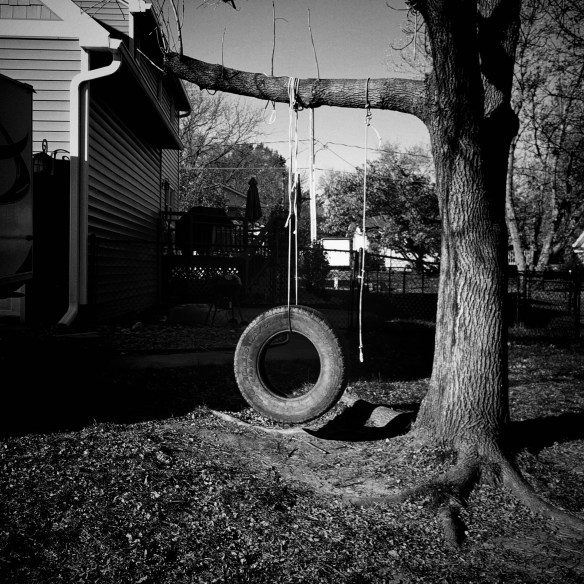
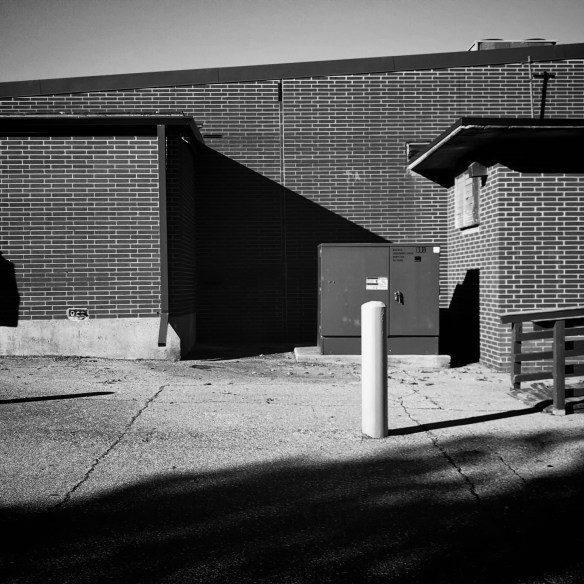
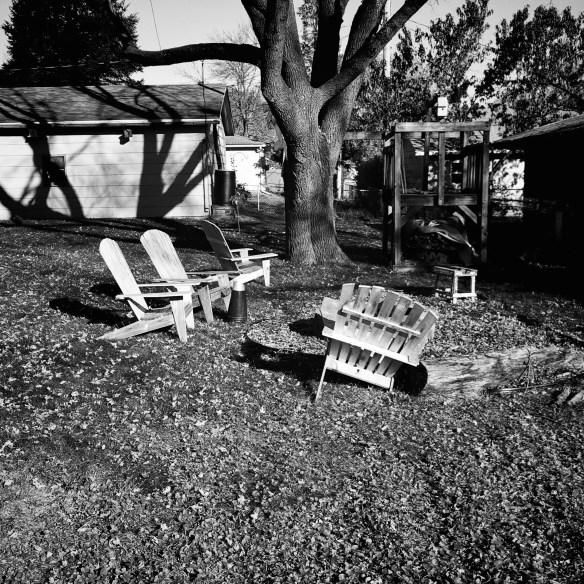
oblique nouveau-neo-new topographics

Twice in the last couple of weeks I’ve been asked about my ‘photographic style.’ The first time I basically said “Dunno, never thought about it.” I mean, who thinks about stuff like that? The second time I said “New Topo, laid on its side, and turned 45 degrees to the left.” I said it as a joke, but after I said it, I sorta kinda became the type of person who thinks about stuff like that. And hey, it turned out to be sorta kinda true.

Back in 1975 a guy named William Jenkins curated an exhibition of a new school of landscape photography: the New Topographics movement. Landscape photography to that point in time had generally followed the path of landscape painting, which for the most part consisted of romantic depictions of ‘undisturbed’ nature. We either had the Ansel Adams approach (epic vistas photographed on a grand scale in black and white) or the Eliot Porter approach (intimate color images of a few trees or a handful of leaves scattered on a pond). Nothing wrong with either approach, but that was basically it.

Traditional New Topo approach

Traditional New Topo approach

Then along came Jenkins and his New Topo crew. His exhibition consisted of 168 black-and-white prints of warehouses, industrial sites, suburban tract housing, filling stations. The idea behind the exhibition was to present the modern landscape as it actually existed rather than in an idealized way. Most art photographers used the camera as a device for self-expression. The New Topographics photographers reduced the camera to its most basic function.

The camera, after all, is a tool that records everything in front of the lens. Every goddamned thing, not just the pretty stuff or the majestic stuff. And it records it all with the same precision. It records with a detached, unemotional, deadpan eye. That’s all a camera does. With that idea in mind, New Topo photographers deliberately attempted to remove any notion of ‘artistry’ from the act of photography. Their intent was to depict the objects in front of the lens in a way that merely mapped their surface. In other words, to reduce the subject of the photograph to an essentially topographic state.

Neo-New Topo

Neo-New Topo

The exhibition garnered a lot of attention. Not all of it was positive. Hell, relatively little of it was positive. Most folks thought the photographs were bland, uninteresting, boring, even ugly. And hey, those folks were right. I tend to agree. In my opinion, a lot of those photos really were butt-ugly. But they were interesting.

People who thought about photography as an art — not just viewed it, but consciously and deliberately thought about what photography was and could be — those folks found the exhibition fascinating. Why? In part because they realized the emotionally detached camera opened up a visual world in which people could see the stuff that had previously been filtered out. The ugly stuff. The old tires, the broken sidewalks, the trash cans, the old telephone wires, the litter. All the crap photographers normally worked hard to exclude from their photographs.

Nouveau-Neo-New Topo

Nouveau-Neo-New Topo

But there was a problem. Humankind has spent something like twelve thousand years unconsciously building the foundation of aesthetics. It’s really difficult to just toss all that aside. It’s hard NOT to look for beauty, hard NOT to try to include that beauty in a photograph. That’s a lot of human nature to overcome.

So a sort of Neo-New Topographics style emerged fairly quickly (and yeah, I just made that name up). It’s a style in which photographers still photographed the same anonymous human-shaped landscapes, and continued to objectively map the surfaces of whatever is in front of the lens — but with the recognition that even industrial sites and warehouses can be beautiful. And after that, a Nouveau-Neo-New Topo approach, in which photographers actively sought out what beauty can be found through surface mapping.

Oblique Nouveau-Neo-New Topo

Oblique Nouveau-Neo-New Topo

That idea has become a big chunk of my photographic patch. Over the last few years I’ve been working in a sort of Oblique Nouveau-Neo-New Topo style. Surface mapping at a slant. New Topo, laid on its side, and turned 45 degrees. Because I prefer my surface to have depth. I like a surface that extends itself. A surface that sort of falls away.

ONNNT (which is also the sound a Canada Goose makes when landing in icy water)

ONNNT (which is also the sound a Canada Goose makes when landing in icy water)

I can’t really say that’s my ‘style’ since I shoot all sorts of crap. But when I’m deliberately looking and seeing photographically, that’s pretty much my default approach. Find an interesting surface — then either photograph it straight or find an angle that allows the eye to shift off into the distance. Oblique Nouveau-Neo-New Topo. Takes longer to say than to shoot.

But hey, at least now I have a response the next time somebody asks me about my photographic style. ONNNT.

The photo that sparked the question the second time.

The photo that sparked the question the second time.

oxbows and bottoms

One of the advantages (and let’s face it, there aren’t many) to being a freelance writer is that on any given day you can look out the window, see that it’s a lovely afternoon, and say “Fuck it, I’m going to go wander.” You can’t do that very often, of course, if you want to keep beans and tortillas on the table. But just knowing you can say it — and do it — is pretty liberating.

Yesterday I looked out that window, saw that it was a perfectly lovely autumn afternoon, said “Fuck it” (and yeah, I said it right out loud), turned off the computer, grabbed my aging little Fujifilm X10 camera, and walked out the door. I knew exactly where I wanted to go. Sort of.

chichaqua1

The Chichaqua Bottoms Greenbelt. I knew it existed. I’d seen it on Google maps. I knew generally where it was located (it’s only about 20 minutes by car from where I live). I had a basic understanding of what was meant by ‘bottoms’ and ‘greenbelt’. But I’d never taken the time to actually go there. Proof, if you needed proof, that I can be a massive fucking idjit.

This might seem silly, but one reason I wanted to visit the place is because of Chichaqua. I’ve mentioned this before, but it’s worth repeating. Some 350 years ago when this area was being explored and mapped by French coureurs de bois and voyageurs, they asked the local Sauk and Meskwaki Indians what the river was called. The river, they were told, was Chicaqua. The French had also heard that same term to describe a skunk,so they assumed that was the name of the river. The French began calling it Rivière Mouffette. Skunk River. And that’s what it’s still called. In fact, chichaqua was a term meaning ‘having a powerful smell.’ The natives had been talking about the wild onions and cabbage that grew along the river banks.

I don’t know why that amuses me so much. But it does.

chichaqua2

What’s weird, though, is the Chichaqua Bottoms Greenbelt is no longer a part of the Skunk River. A century ago (give or take a few decades) folks decided to ‘straighten’ the river. Which is a pretty arrogant thing to do. The idea was that a slow-moving, winding, meandering river was inefficient and prone to flooding. So they dug a massive gash in the ground and re-channeled the river. This sort of thing happened all over the world, by the way — not just in the American Midwest. Nobody realized at the time that a slow-moving, meandering river was a good thing for flooding. It localized the flood, which reduced the overall severity. Nobody realized that ‘straightening’ a river would reduce an area’s biodiversity. Hell, nobody knew what biodiversity was, or why it might be a good thing.

So…big gash, straight river. And about 25 miles of the old Skunk was isolated.

chichaquamap

See that straight blue line on the map? That’s the current channel of the South Skunk River. It’s basically a long ditch. A very pretty ditch, to be sure, and I love wandering along it. Nature has made interesting and lovely, but it’s still a ditch. That wiggly blue line? That’s the old channel. Nothing even remotely ditch-like about it.

Back in 1960, the county bought up about 9000 acres of the old Skunk River channel. The water had never drained from the old channel; the area had basically become a series of oxbow lakes and bottoms. What the hell are oxbows and bottoms? Glad you asked. That’s an oxbow in the photograph below.

chichaqua7

An oxbow is a U-shaped body of water; it occurs naturally in meandering rivers. An oxbow lake is one that’s formed when the U-shaped loop is cut off from the main channel, either because some engineering fuckwit decides to ‘straighten’ the river, or because a big flood (or sometimes an earthquake) will shift the river channel itself. Bottoms, on the other hand, are alluvial lowlands, which probably doesn’t tell you much. It’s what we call that land by a river that floods all the time. Marshy land, mosquito-breeding swamps, rich in sediment. If a river runs through a city, the Bottoms are where the poor folks usually live.

That bench in the photograph below? That’s sitting on bottomland. Oxbow lakes and bottoms. Great for wildlife and flood reduction. Sucks for housing.

chichaqua4

After the county bought up the old Skunk River channel, they sort of encouraged it to be more of what it already was — a wildlife habitat. They re-introduced otters, and bobolinks, and wild turkeys, and a few species of endangered turtles. Other species returned on their own, like Pileated Woodpeckers and various raptors. They preserved old trees and planted tree species that used to grow in the area before it became farmland.

And I have to say, they’ve done a fantastic job. The place is completely fucking beautiful. Within the first half hour I was there I saw two Great Blue Herons walking along the dead-end road that leads to the area. Herons on the road. They were apparently gigging for frogs in the marshy ponds just off the blacktop. I saw the first bobolink I’ve ever seen in the wild. I nearly stepped on a Northern Water Snake that was three and a half feet long.

chichaqua3

Did I get photos of those critters? No, I didn’t. Why? Because I was too busy looking at them to bring my camera to my eye. I’m rubbish when it comes to wildlife photography. What I did instead was photograph the stuff that didn’t move. You know — trees and all that. The water — which I guess does move, even in oxbow lakes. But the lakes and marshes themselves are pretty stationary. I’m not much better at landscape photography than I am at shooting wildlife. I think that’s partly because the landscape is SO BIG and the camera can only jam a small chunk of it through the lens. Still, these photos will, I hope, give you some small idea of the Chichaqua Bottoms.

chichaqua8

I’d only planned to be there a short time. I figured maybe an hour. You know, just a break from work to refresh my mind — then back to the computer. But do you remember that bit I mentioned at the beginning of this post? That bit about one of the few advantages of being a freelance writer is the ability to say “Fuck it, I’m going to go wander”? Well, that’s exactly what I did.

It’s days like this that make the lack of a steady income bearable. Pension plan? Pffft. You can’t put days like this in the bank. You have to spend them when you have them.