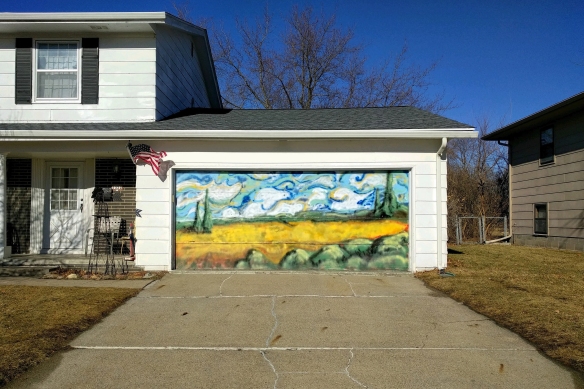
there’s a photo, right there

I’m out taking a walk, right? I had an errand to run in a part of town I’ve never been in before, and when I’m done with my errand, I say to myself ‘Dude, long as you’re here, why not take a walk, look around.’ So I do. But the business area turns into a generic suburban neighborhood, and I decide I’m going to take the next left and head back to the car.

Then I see this garage door. I’m thinking to myself ‘Dude, there’s a photo, right there‘, and what happens? Garage door goes up, car pulls into the drive and directly into garage, and a woman gets out and begins unloading groceries.

What am I supposed to do? I can’t just stand there watching this woman unload groceries. That would be totally creepy. I can’t really offer to help her with the groceries, on account of that would be mega-creepy. So I have to continue my walk. I tell myself ‘Dude, you know where the house is — you can come back when nobody’s home‘ which would sound super mega-creepy if folks could hear what I was telling myself, but they can’t so I turn on my heels and start walking again.

I’ve gone maybe twenty-five, thirty yards, and I hear that garage door sound. You know that sound; it’s sort of a mechanical murmur. Anyway I turn, and hey, the garage door is going down again. Only now my brain is caught in the don’t-be-creepy loop, and I start wondering if I go back and photograph the garage now, will anybody in this suburban neighborhood who happens to be looking out their window see me back outside the house and call the police? Which would be understandable in a suburban sort of way.

van-gogh-garage

Then I say to myself ‘Dude, won’t nobody be looking out the window — and even if there IS somebody looking out the window, they probably won’t call the police — and even if they DO call the police, won’t nothing happen on account of all I’ll have to do is say ‘Officer, cast your eyes upon that garage door’ and the officer would say ‘Dude, there’s a photo, right there’ and everything would be cool‘. So I turn around and head back to the house.

I shoot two quick frames, chimp the photos real quick, then I’m back on my way. No police were alerted. No neighbors were alarmed. No grocery-toting woman was creeped out. I call that a good walk.

LSotY

I belong to this odd collective of photographers called Utata. I’ve written about the group and some of its projects before, so I won’t bother you with a description again. I mention it because one of our elastic traditions (by elastic I mean sometimes we do it, sometimes we don’t, some of us do it, some of us don’t) is to post the last selfie we took in the year to our Flickr group.

Yesterday was the last day of 2016, so I went searching through my files (I say ‘files’ as if I actually have some sort of organized system of storing photographs, which polite folks would suggest was an exaggeration) for the last selfie I shot. Turns out that was June 20th.

img_20160620_144116

It’s a perfectly acceptable selfie (at least by my fairly low standards), but June 20th was six months ago. And let’s face it, the photo is more about the cat than me. Still, it’s technically a selfie so I figured it would do.

If I had a lick of sense, that would have been it. But no. I decided I should probably take a new photo — a current photo, a photograph that is more clearly a selfie, a photograph with less cat. Did I prepare this in any way? No, I did not. Did I change clothes or shave or even bother to comb my hair? No, I did not. Did I even look in a mirror first? No, I certainly did not. Why didn’t I do any of those things? Because I am, on any number of metrics, a fucking idiot.

Here’s more proof of my idiocy: I picked up my tablet (okay, you’ve almost certainly heard folks say you shouldn’t ever take a photo with a tablet because the cameras suck; turns out that’s true, and it’s even more true when it comes to taking a selfie because the front-facing camera (or is it the rear-facing camera? I don’t know) sucks even more), stepped into the middle of the room where there was the most light, and hey bingo at 5:09 Central time on December 31st, I took a selfie.

dsc_0678-01

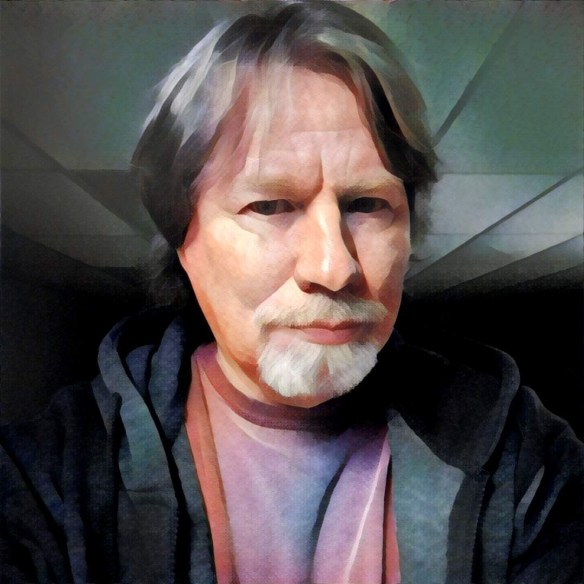
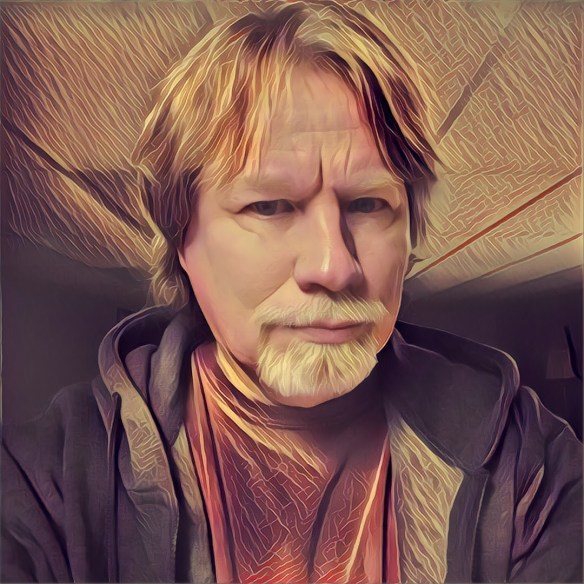
It was what you’d call a ‘tactical mistake’. I looked at the photo and thought ‘Lawdy, what the hell was I thinking?‘ It has been pointed out to me on occasion that I often look like a thug in photographs. I think we now have to amend that to ‘an aging thug’. Or maybe ‘a confused, aging thug’. Because, c’mon — just look at that. It looks like I’m concerned the camera is going to eat my soul.

I started to delete the photo, at which point I realized ‘Dude, THIS is the last selfie of the year.’ After a brief moment of horror, I realized I could comb my hair, put on different clothes, find some good light, take a selfie with an actual camera, and then THAT photo would be the LSotY.

But that would be sort of a dick move. Now, I’m perfectly capable of making dick moves. Mostly I make them without thinking. Deliberately making a dick move amplifies its essential dickishness (witness Donald J. Trump’s New Year’s tweet). I couldn’t really do that to Utata, could I. So I was stuck with this photo.

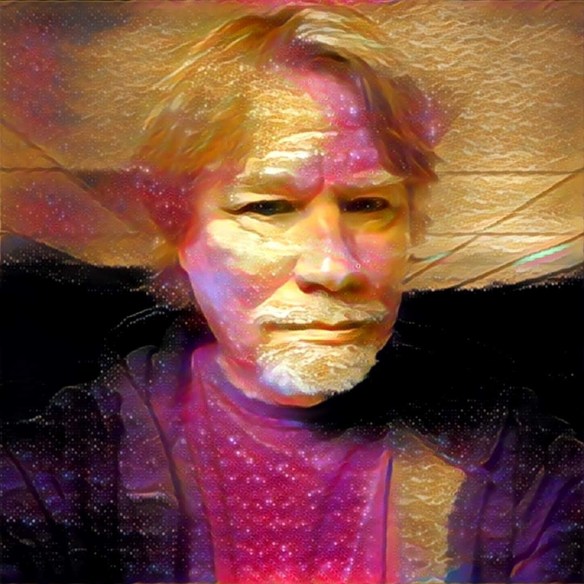
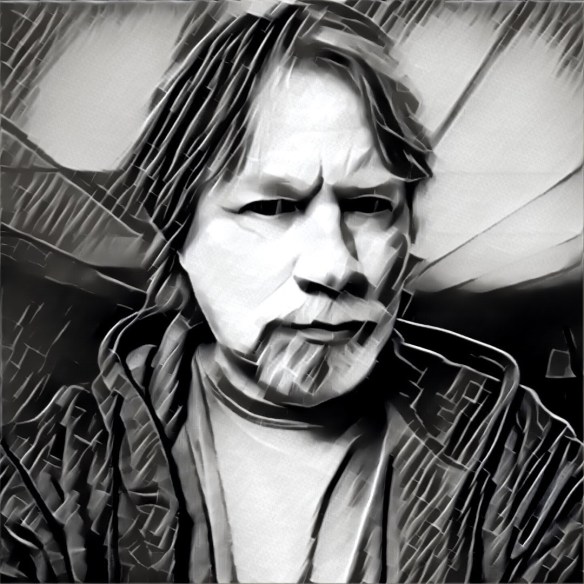
And then I thought of Prisma. If you’re not familiar with it, it’s an application created by some Russian developer that doesn’t just apply a filter on top of an existing photo; it actually scans the digital data and uses that information to apply a ‘style’ to a photo. I’ve had the app on my tablet for a few months, but never really bothered to play with it. This seemed like a good time to try it.

Prisma - Udnie

Udnie

Prisma must have around thirty different styles (yeah, I could count them, but really, how likely is that?). The style above is based (loosely, I’d say) on Francis Picabia’s painting Udnie (Young American Girl, The Dance). I don’t see it, myself. But hey, it’s an improvement on the original photo.

It’s much easier to see the connection between the Heisenberg style and the famous Heisenberg drawing of Walter White from Breaking Bad. I like this style, although I have to say it’s a wee bit alarming to see that a Breaking Bad-based style makes me look LESS like a thug than in the original photo.

Heisenberg

Heisenberg

Some of the Prisma styles don’t seem to have any relationship to — well, to anything at all. For example, the Colored Sky style has a lot of color, but I don’t see much sky in it. Unless you’re hallucinating. Or maybe on another planet. The shark eyes are sort of cool, though.

Colored Sky

Colored Sky

And the Aviator style? Seriously, what does this have to do with aviation? It should have been called the Braveheart style. It’s got Mel Gibson as William Wallace splashed all over it. Well, except there isn’t an implied claymore in the photo, and there’s no hint at all of consuming “…the English with fireballs from his eyes, and bolts of lightning from his arse.” So okay, maybe less Braveheart and more Pogo the Clown.

Aviator (seriously?)

Aviator (seriously?)

The Urban style doesn’t strike me as particularly ‘urban’ unless you’re defining ‘urban’ as ‘scowling like a motherfucker’. Really, I don’t understand where that scowl comes from. I’m a nice guy. Honest. A harmless guy. I’ve never once been convicted of a felony.

Urban

Urban

I suppose it’s appropriate to end this with the Mononoke style. I’m not sure if Prisma named the style after Princess Mononoke, the 1997 anime film by Miyazaki, or the 2007 Mononoke television series about an itinerant medicine seller, or the Japanese term for a supernatural spirit that can inhabit or possess…well, just about anything, it seems. It’s appropriate to end with this style because that’s sort of what Prisma does. It doesn’t lay a filter ON the photo; it digs down into the photo’s data and sort of inhabits the photograph. This is probably the closest approximation of the original selfie; it transforms the photo while still retaining its essential confused, aging thugness.

Mononoke

Mononoke

In general, I’m not a fan of apps like Prisma. I just can’t take them seriously. I certainly don’t believe Prisma’s claim that their app “transforms your photos and videos into works of art.” That’s fundamentally bullshit. You don’t create art by picking styles off a menu. That’s not making art; that’s shopping.

But you can have fun shopping with Prisma. Watching the transformation is a lot more entertaining than I thought it would be. And that’s the thing about Utata — it’s all about having fun. So I legitimately took my last selfie of the year at 5:09 Central time on December 31st. But I don’t think anybody can fault me for spending maybe twelve minutes on January 1st shopping with Prisma.

the humanness of things

“I don’t believe in coincidences.” You’ve heard that line spoken in every detective show that’s ever been on television. It’s ridiculous, of course, because coincidences exist. I mean, that’s why we have a word for it.

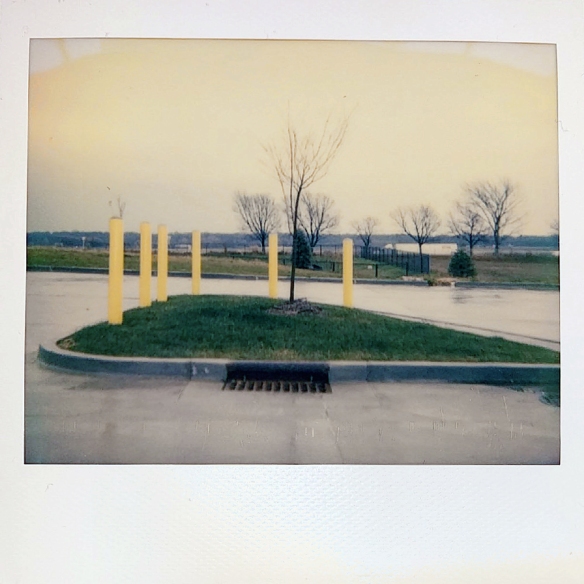
For example, about a week ago I was shooting a photograph of some yellow bollards at the very back of a massive and nearly empty parking area of a big box store. I was using an old Polaroid Spectra 2 camera, trying to get a feel for what the camera could do, using Impossible Project color film, trying to get a feel for what the film could do. In other words, I was experimenting.

family-of-bollards

Before I took the shot, however, a car pulled up and the driver rolled down his window. He was an old guy (and as I say that I realize he was probably around my age — maybe even a bit younger), and he grinned at me and my Polaroid camera and asked “How do you use your camera?”

I’d had a similar question from a police officer a couple of weeks earlier (there’s a coincidence for you — and coincidentally, one of the photos I shot before the arrival of the police officer was of a yellow bollard). With that encounter in mind I launched into an explanation of how I used the camera as a descriptive tool, a device designed to record a small but precise rectangle of the reality in front of the lens. I was prepared to elaborate on that idea — to spell out how the decisions of what to include in the frame and what to exclude from the frame were expressive decisions, and so even if the final image seemed mundane — like, say, a group of yellow bollards — there were still aesthetic aspects to be considered, as well as the notion that mundane objects and structures can be interpreted as a manifestation of humanness. In other words, my decision of what to include in the frame is, in part, a reflection of some other person’s past decision to…

“No,” the old guy interrupted. He said, “No, I mean, the camera. The camera. How do you use that camera? I thought they stopped making Polaroid film.” So I told him about the Impossible Project. Then I shot the photo.

That photo, coincidentally, sparked a brief discussion on Facebook because apparently relatively few people were aware those posts are called bollards. And coincidentally, this morning on Facebook I learned that William Christenberry had died.

Just over a decade ago I admitted that although I’d been shooting photographs for years and I knew how to operate a camera, I was pretty ignorant about the history of the craft. I had only the barest notion of what had been done in photography in the past, or who had done it, or what they were thinking when they did it. So I decided to educate myself, and I decided to share my education with a group of friends in a Flickr group called Utata. I’d pick a photographer, do some research, write a short article based on the research, and we’d discuss it in the group. We called it the Sunday Salon.

christenberry1

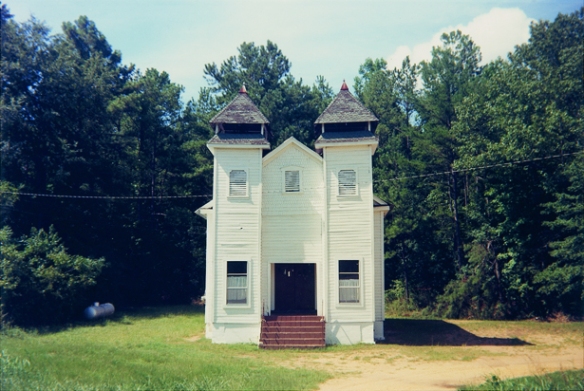
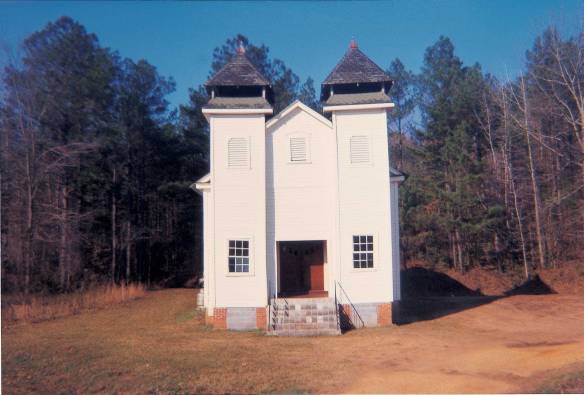
One of the first photographers I picked for the Sunday Salon was William Christenberry. Why? Because I came across his name somewhere and liked it. I didn’t know anything about his photography, and when I began to look at his photographs, they didn’t make a lick of sense to me. I saw an old black-and while photo of a dilapidated juke joint somewhere in Alabama. Then I saw a photo of the same building, only this time it was in color. Then another photo of the same place, and another and another — all of the same building.

I began to get it. This guy wasn’t just photographing the building; he was photographing the history of the building. Christenberry wasn’t trying to make art — at least not at first. He was just creating a document, a description of how particular structures evolved and devolved. He went back to the same places year after year to record how things change.

christenberry2

A building may be static, but the world around it is dynamic. What happens in the world is reflecting by the changes to a building. Wind and rain have an effect, the settling of the structure into the soil has an effect. Paint fades, shutters have to be replaced, buildings begin to tilt. Humans very obviously have an effect; they do the painting, they replace the shutters, they repair the damage.

Over time, Christenberry’s simple documentation process became deliberate, thoughtful art. His first photographs were shot using an old Brownie camera given to him when he was young, but as the project progressed, so did his use of technology. He eventually began to shoot with a Deardorff 8×10 view camera. Christenberry even began to take measurements of some of the buildings and recreated them as sculptures.

christenberry3

“What I really feel very strongly about,” Christenberry once said, “and I hope reflects in all aspects of my work, is the human touch, the humanness of things, the positive and sometimes the negative and sometimes the sad.”

There it is. The humanness of things. Those half-dozen yellow bollards? Somebody deliberately put them there. Somebody designed the shape of that small area, somebody chose to plant a tree in the middle of it, somebody decided what type of tree to plant. Somebody designed that parking lot. The humanness of things is always there.

I believe in coincidence. I love coincidence. I enjoy the weird, improbable chain that links an encounter with the police to an old guy in a parking lot asking about an old camera to a discussion on the etymology of the term bollard to the work of William Christenberry to a photograph of yellow bollards. I believe in coincidence and I believe in the humanness of things, and wouldn’t the world be terribly dull and uninteresting without them.

i took a walk a couple of weeks ago

I like to walk. I like to walk without any purpose, without any goal or objective, without any particular destination. But occasionally I walk with the idea of shooting photographs. Most often that happens on a Thursday (largely because I belong to Utata — an international group of photographers who walk on Thursdays; I’ve written about this before: here, here, and here).

So it wasn’t unusual for me to take a walk on Thursday, the 11th day of November, 2016. I needed a walk that day. I needed it because Donald J. (for Jackass) Trump had just been elected President of These United States. A quiet, contemplative walk on a gray, chilly day that seemed to hold the promise of a gray, chilly future.

And that was how I felt even before I got stopped by a police officer. But I’m getting ahead of myself.

tire-swing

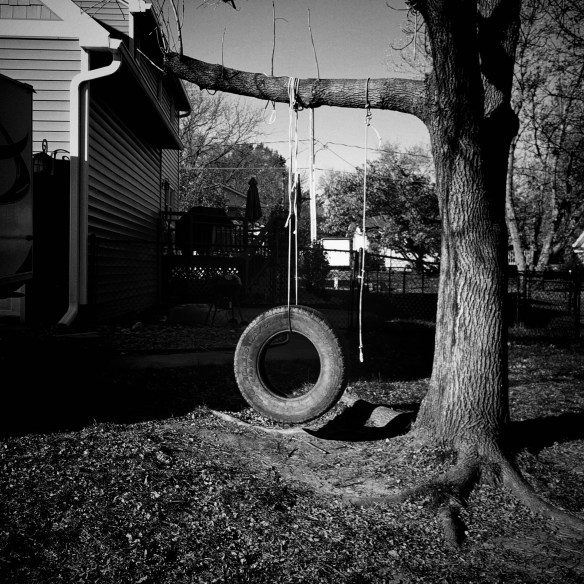
I wasn’t really in the mood to shoot photographs, so I didn’t bother to take a camera. Just my cell phone. It was this tire swing that first made me pull out my phone and open my favorite black-and-white camera app. It seemed a perfect metaphor for my mood. Sort of sad, sort of nostalgic, sort of pathetic. Lost innocence and all that.

I was near a semi-industrial commercial area, so wandered over there and strolled along behind the various shops. You know, that area where the shop owners keep their trash and deliveries get made and isn’t meant to attract customers. I’ve always liked the lack of pretense in alleyways and the backs of shops. And, again, it suited my mood.

fence-and-trash-can

This wasn’t an actual alley, though it served the same purpose. I’ve wandered along behind these buildings before; it’s always remarkably tidy. The morning light gave it a certain shabby elegance that contrasted well with the bright, functional geometry of the buildings.

At some point I’d stopped thinking about Trump and started to enjoy myself. That’s the thing about photography, isn’t it. It draws you outside of yourself. And that’s especially true, I think, of black-and-white photography, since you’re paying more attention to shape and line and structure.

bollard

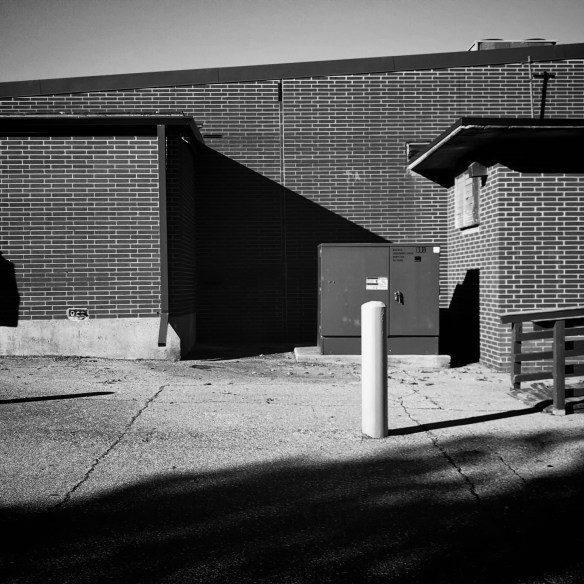
Everything gets reduced to what’s in the frame. Not just what’s in the center of the frame, but what’s on the periphery. A step or two to the right, and that bit of shadow from a vent disappears. A step or two to the left, and the bollard disrupts the lock on the electrical whatsit, and the ramp is no longer obviously a ramp.

I know this because I actually took those steps to the left and the right before deciding this was the composition I wanted. (I learned to shoot with film, and since film was expensive and processing it was pain the ass, I learned to pay very close attention to composition; get it right the first time, shoot one frame — maybe two — and move on. I’m a stingy photographer.)

broken-adirondack-chair

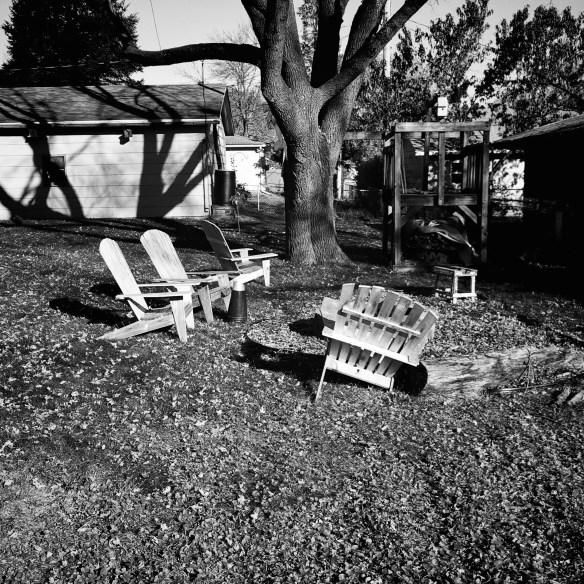
There’s usually a sort of fuzzy area between semi-industrial commercial shops and the more comfortably suburban, well-groomed neighborhoods — an area where the houses might need a bit of paint, where the lawns aren’t quite as tidy, where the kids’ toys haven’t been picked up, where the cars and trucks are a few years older and are showing a bit of rust. It’s the Almost American Dream zone. I grew up in that zone.

Remember that police officer I mentioned earlier? This is where he shows up. I was just about out of the Almost American Dream zone when he arrived.

packers-fan

He was very polite. Young white kid, buzz cut, nice smile. He rolled down his window, said “How’re you doing?” I considered telling him I’d voted for Hillary, so how the hell would I be doing. And that’s basically what I said, though I moderated the last bit. He nodded and said he couldn’t believe it either. Then he said something to this effect: “We got a call about somebody walking behind the shops and taking pictures with a phone. That you?”

I admitted it was. He said one of the shop owners was concerned that somebody might be casing the joint (he actually said “casing the joint”), and then asked if he could have my name.

A short digression here. I worked as a criminal defense investigator for about seven years. I’ve been stopped and questioned and actively harassed by police officers more times than I can count. I know my rights. As a pedestrian legally walking along a public way and minding my own business, I’m not required to identify myself to the police. However, if the officer is investigating a possible crime it becomes a tad tricky. And given that there might be some dispute whether the area behind these particular shops is a public way, it becomes a tad trickier. So I told the officer I was going to reach into my pocket and get my wallet (as a white guy, the odds that the police would shoot me for reaching for my wallet are really really really slim — but still).

I showed him my driver’s licence. He asked the obvious question. “Why were you taking pictures behind those shops?” So I told him. Thursday walks, Utata, light and shadow, alleyway geometry.

hoop

Then he asked the really difficult question. “Can I see your photos?”

The obvious answer is no. No, you can’t see my photos. No, because you have no legal right to see them, and I have no obligation to show them to you. The fact that he’d asked to see them rather than issuing a command didn’t matter. The fact that he’d asked politely didn’t matter. Courtesy counts, but it doesn’t trump civil rights.

On the other hand, I didn’t want a fuss. Hillary had just lost the election; I didn’t have the energy to make a passionate civil liberties argument. So I offered a compromise. I told the officer I was reluctant to show him the photos as a matter of principle, but I understood why he wanted to see them. I said “If you agree that you have no legal right to see the photos, I’ll show them to you.”

I got lucky, probably. This guy had a sense of humor. He laughed a bit, then agreed he had no legal right to see the photographs. So I showed him the photos. More than anything else, he was surprised to see that the photos were actually shot in black-and-white. He wasn’t aware there were black-and-white apps. He wasn’t aware you could shoot square format with a phone.

So I took my phone back, turned and shot the photo of the basketball hoop and shadow, and showed it to him. He asked for the name of the app. Then I asked if I could take his photo, and he said this (or something like this): “You have the right to take my picture so long as it doesn’t interfere with the performance of my duties…but I’d rather you didn’t.”

So I didn’t. I thought about it, but I didn’t. As he drove away, I wished I had. Sort of.

Postscript: I began to write about this on the day it happened. But the sad fact is, I was still too discouraged about the election to write more than a couple of paragraphs. I’ve noodled around with this post off and on, but I’m still pretty gutted by Hillary’s loss — and seeing these photos reminded me of how grim I’ve felt since the election. It reminds me of how much stuff I’ve put off, how many things I’ve been procrastinating about, how much normal stuff I’ve been avoiding.

I had a good encounter with a police officer — something positive happened to me — and I just couldn’t maintain that feeling. That sucks. It has to change. Maybe finishing this and publishing it is the spark I need. And now I suppose I have to append the ‘confessional crap’ tag to this. I hate confessional crap.

not really all that instant

Back in 2008, when Polaroid announced they were going to stop making film, I thought maybe I’d pick up an old camera and play around with it. I was never a fan of Polaroids; the notion of instant film always struck me as gimmicky. They were okay for making quick, amateurish snapshots at parties and events, but not for ‘real’ photography.

Still, Polaroid’s announcement sparked enough interest in me that I took a trip to the local Salvation Army store in search of a camera. They only had one — a Polaroid Spectra 2. The clerk had no idea if the camera worked, but since it was only a couple of bucks I figured I’d take the chance. The clerk also told me I should check out the nearby Goodwill shop. I did; they had a Polaroid Sun 660. Maybe a buck and a half. Maybe it would work, maybe not.
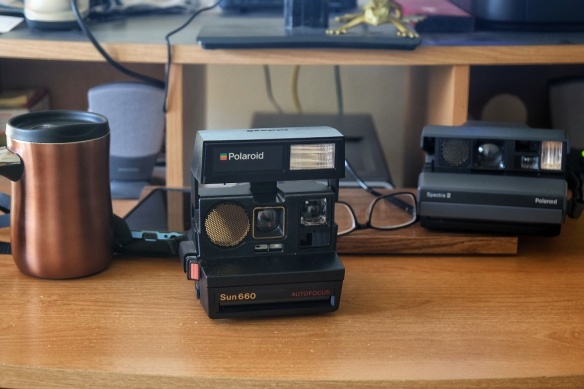
cameras

I took the two cameras home, put them on a shelf, and promptly forgot all about them. A few years later I heard about the Impossible Project — a group of lunatics who decided to try to recreate the process by which Polaroid film is made. They bought a bunch of old Polaroid production machinery, leased a building, and set to work. And hey, they succeeded. After a fashion. By every report, the film was finicky. Exceedingly finicky. Crazy finicky. So very finicky that I had no interest in playing with it.

I sort of half-heartedly followed the progress of the Impossible Project. Maybe more like quarter-heartedly; it was sort of like keeping abreast of Italian politics — you were aware that stuff was happening, but it all seemed very distant and confusing and it didn’t have any real effect on me.

But I discovered I had friends who were mad for Polaroids. Mad and passionate. Friends who weren’t the least bit discouraged by finicky film. Friends like Meredith Wilson, and Lisa Toboz, and Heather Polley, who shot astonishingly lovely Polaroid photographs using expired Polaroid film or film from the Impossible Project. Another friend, Debra Broughton, has been photographing a specific barn for at least a year and a half (she shoots with a Fujifilm Instax, which is a more modern instant film camera). These women and the work they’ve done made me more and more curious about instant film.
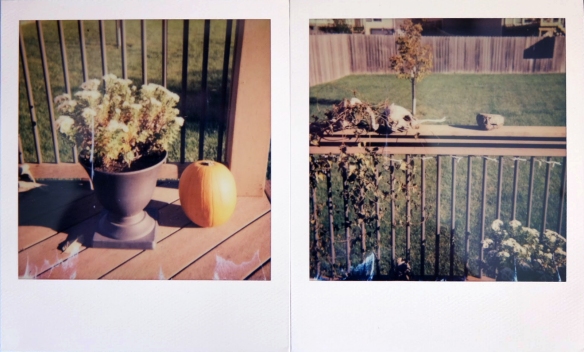
First two shots with the Polaroid 660.

First two test shots with the Polaroid 660.

Then, a few weeks ago, I learned about ‘Roid Week — a project on Flickr celebrating instant film photography. That was enough to get me interested in taking another look at those old thrift store cameras. And what the hell, I bought some B&W film from Impossible Project for the Spectra.

You’ve heard the phrase ‘a learning experience‘, right? Well, I had one of those. First, I learned that the camera sorta kinda functioned. It would take photos, but it wouldn’t eject them. They jammed. I did some reading, watched some videos, learned of a few possible causes for the problem, tried a few things — and none of them worked. So I sent an email to the folks at Impossible Project and asked, “Dudes, what else can I try?”

Get this: they replied within a couple of hours. And they told me what else I could try, but said the only way to test the camera would be to try another film pack. I should note at this point that Impossible Project film ain’t cheap. US$25 for eight photos. But — and seriously, get this — they offered me a free pack of film. So what the hell, I ordered another pack of B&W film for the Spectra AND a pack of color film for the Polaroid 660. The film arrived like two days later.

THAT is excellent customer service.
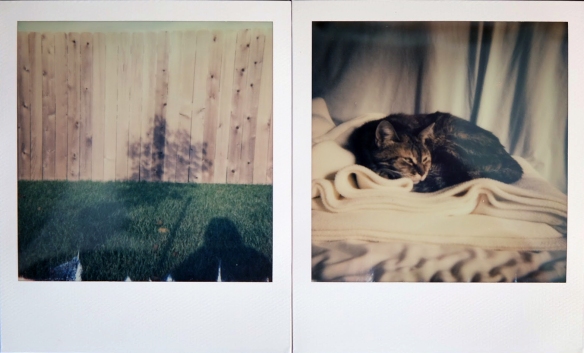
2016_1103_12130100

I loaded the color film in the 660, took a couple of test shots — and hey, bingo! The camera worked, the film worked. I made a few adjustments. Well, I made one adjustment. There aren’t really a lot of adjustments you can make on a Polaroid. Lighten or darken, that’s about it. I made my adjustment, shot another test shot, and then started to think about how to make photographs with a Polaroid.

There’s always been a cerebral aspect to photography for me. With the exception of street photography, most of the photographs I shoot are shot with some level of deliberation. I think about what I want in the frame and what I want to exclude it. I tend to think about shadow more than light. I think about depth of field, and the geometry of composition.

But with the Polaroid cameras I have, there’s little (or no) control over shadow — and the fixed focus lens severely limits what you can do with depth of field. So it all comes down to composition, right? Basically, I was using a camera I’d considered useful only for party snapshots to make what I hoped would be artful, thoughtful images.
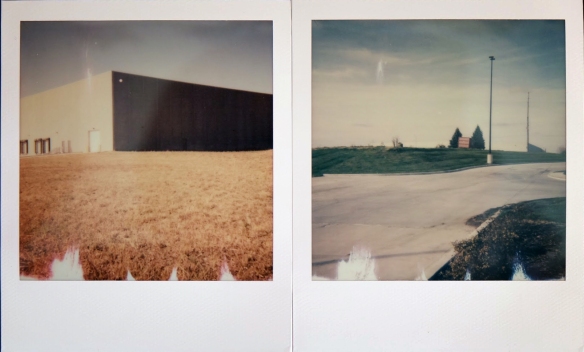
2016_1103_12133200

For me, that meant concentrating on the simplicity of composition. Line and form. Balance. Leading the viewer’s eye. Color blocking (with color film, obviously). The basics — which is sort of appropriate for such a basic camera.

Remember back a bit I spoke about how finicky Impossible Project film used to be? Well, it’s still finicky. Maybe not as finicky as before, but pretty damned finicky. Unlike the old Polaroid film, Impossible film has to develop in the dark. Almost everybody agrees the very first thing you do after the camera ejects the print is immediately put that little bugger away in a dark container. Don’t even bother trying to look at it for at least ten minutes. At least ten minutes. Some folks say give it an hour to cook.

This can sometimes be a monumental pain in the ass. In order to get the photograph of the industrial building above, I had to park my car near the field, open the glove box, open the passenger side door, walk about fifteen feet into the field — and THEN shoot the photo, immediately put it into the wee box the film arrived in, sprint to the car, slam the film box inside the glove box and close it. Then I drove home, put the car in the garage, and wait for an hour to go out, open the glove box, open the film box, and finally see if I’d got the shot.

I enjoyed ever minute of that.
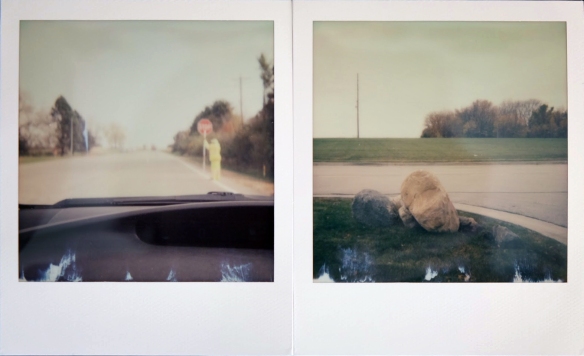
First two shots with the Polaroid 660

Here’s what I’ve learned about shooting with a Polaroid:

— It’s fun.
— It’s stupid expensive.
— It’s a lot of fuss.
— When you press the shutter release, there’s a charming little whirring sound that’s ridiculously happy-making.
— It’s SO easy to screw things up
— When it comes to Spectra film, you take what you can get. When I first ordered film, all they had was B&W packs. Now all they have is color packs.
— The autofocus is done by some weird sonar arrangement, which means shooting a photo through a window requires you to press a secret, hidden autofocus override button.
— It’s NOT instant film. It’s nowhere near instant. Unless you’re thinking in glacial or geological terms.
— It’s still fun.

I never got anything done in time for ‘Roid Week, sadly. I think for a serious photography project, personally I’d probably buy a Fujifilm Instax — they’re a lot more reliable and consistent. Not the Instax mini, but the silly-looking full-sized unit.

But for sheer unpredictable fun, it’s Polaroid. I don’t know that I’ll be doing a LOT of Polaroid work, but I suspect I’ll continue to do it sporadically. In fact, I’ve made some repairs to the old Spectra, and after feeding it a new pack of B&W film, it seems to be working. If I can get through a pack of eight without mishap, I’ll be ordering color film for the Spectra.

This is probably how all addictions begin.
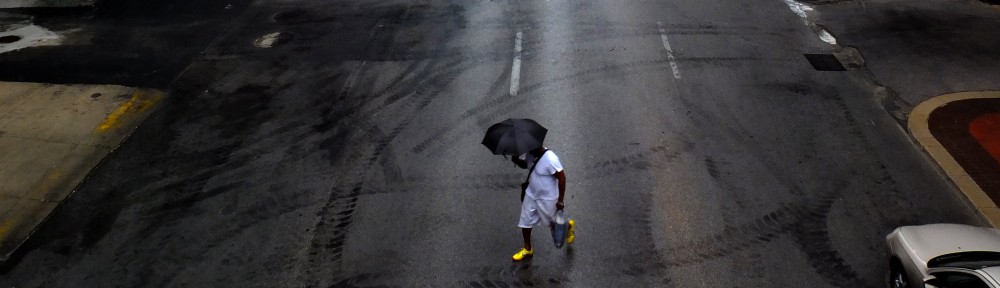
ambiguity in transit

All good photography is social. At a minimum, good photography requires two parties: the person who shoots the photo and the person who looks at it.

Don’t get me wrong; I’m not saying a photographer can’t do excellent work in isolation. You can shoot the most astonishing photographs, but like the work of Miroslav Tichý, if nobody ever sees them they’re just a form of wanking (not that there’s anything wrong with that). I’m not talking about photography as an act or the photograph as an object; I’m talking about photography as a mode of communication, as a tool for expression. After all, that’s how most of us use photography, even if all we’re communicating is ‘Dude, look at the cup of coffee I had this morning.’

This is where that ‘social’ business comes in; this is where photography, in my opinion, gets really interesting. Because the viewer isn’t bound by the photographer’s intent. The viewer is free to develop his own meaning from the photo. The photographer might be saying  ‘Dude, look at the cup of coffee I had this morning’ but the viewer might be hearing ‘Lawdy, what a ridiculous wanker.’

I’m not saying anything new here, obviously. I’m sure Susan Sontag had something densely clever to say about the photographer-viewer dialectic. I’m only saying it now because I recently had the unusual (for me, at any rate) and weird experience of being both photographer and viewer of the same image.

probably-notta-democrat

As a photographer, this was one of those photos you shoot on instinct. I noticed the guy’s t-shirt as he was walking in my general direction. I had the camera near my eye already, so I looked through the viewfinder, noticed the woman and child, reframed the shot, and snapped the shutter release. It was your basic f/8 and be there shot. A photo originally intended to be about the guy ended up being about the group.

I wasn’t necessarily trying to say anything with this photograph. I brought the camera to my eye because of the guy’s t-shirt, so my immediate motivation was political. But once I was looking through the viewfinder, it became more about the arrangement of elements within the frame (and yeah, at that moment these weren’t ‘people’ to me, they were just compositional elements in motion). The only tension I was interested in at that moment was aesthetic tension.

But a few days later, when I got around to actually looking at the photo, there seemed to be something emotionally disquieting and maybe distressing taking place. I wasn’t evaluating the photo as the maker of the photograph, I was looking at it as viewer — as if I was seeing a photo shot by somebody else. It was an oddly dissociative experience. But I didn’t give it much thought to it until I posted the photo on Instagram and Facebook, and other people reacted to it.

Some folks who saw the photo had interpretations similar to mine — that there was some emotional discord taking place. Others saw the photograph in political terms — either as being pro-Trump or anti-Trump. Here’s a sampling of the comments I received through Facebook, on Instagram, and through emails and texts:

That poor little girl, though. I hope that’s not her father.

Why are you posting pro-trump fotos? Thought you were for Hillary?

the lookon the kid’s face, my god…

That poor child doesn’t stand a chance.

Classic Lib move, presenting Trump supporters as mean angry old white men.

Are they fighting? Was the wife frightend? Did you think aoubt intervening?

Why di I feel sorry for that family?

Is this guy a Trump supporter? I don’t know. Probably. Or he might just be somebody who hates Hillary Clinton. Are these three people together? I’ve no idea. When I shot the photo I had the general impression they were a family unit, but it’s possible they’re unrelated and were just moving in the same general direction at about the same pace. Was this an emotionally strained situation? I don’t know. I didn’t sense it at the time, but again, I only saw these folks for a moment, and in that moment I was focused on shooting the photo.

I don’t know how much of what I experienced as a viewer of this photograph is actually IN the photo and how much I’ve brought TO the photo.

Wim Wenders said, “The most political decision you make is where you direct people’s eyes.” I’m not convinced that’s actually the most political decision you can make, but it IS a political decision. Politics on a very basic level certainly shaped my decision to shoot this photo. And politics has certainly shaped the response to it. But the politics of the act of photography (at least in this case) have nothing to do with the politics of viewing it.

I guess that’s how photography is supposed to work.

thoughts on sand

I was walking along the lake shore, not thinking about anything in particular. Just casually looking at the birds, watching the dragonflies that hunt the small ponds along the lake, listening to the gulls arguing, enjoying the way the sand shifted under my feet. Here’s an interesting thing about sand: it behaves more like a liquid when it’s dry, and more like a solid when it’s wet.

I was just walking in the sand by the lake, idly scanning the ground for interesting chunks of driftwood or colorful stones. And I saw this:

sand3

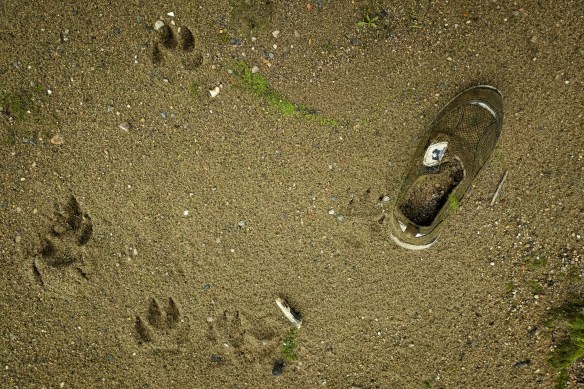
Somebody had lost a beach shoe. Nothing really out of the ordinary. And a dog had padded by. Also pretty common; lots of people take their dogs to the lake. At some point, a raccoon had wandered along the same bit of sand; the woods around the lake are a haven for raccoon. And now I was standing there. That layering of temporal events pleased me for some reason — four creatures had crossed that same little patch of sand, separated only by a period of time.

This sort of thing happens to me all the time. I see something, and neurons start firing in my brain. I saw that lost beach shoe and the dog’s paw print and the raccoon track, and thoughts start turning over in my mind. Because it wasn’t just us that had crossed that bit of sand. Dozens of creatures had walked, slithered, or hopped across that same spot. Thousands of dozens. Millions of thousands of dozens. I mean, some three hundred million years ago, this entire area was under water; it was the sandy bottom of a great inland sea — a sea that dried up, only to be replaced by another inland sea a couple hundred million years later. Then that sea dried up as well. Now there’s just sand.

sand1


Well, not just sand. There’s also a lake. Six thousand acres of water. Almost ten square miles. Not a natural lake, though. Technically, it’s a reservoir — a man-made lake; an intentional containment of the Des Moines River. The lake was created about 50 years ago to try to control the periodic flooding that plagued the city of Des Moines for over a century. The flooding also troubled the native people who’d settled at the confluence of the Des Moines and Raccoon Rivers seven thousand years earlier.

We know people lived here seven thousand years ago because we’ve found their bodies. A woman and a child, well-preserved skeletons sealed in a layer of sandy clay deposited by a sudden flood. It’s only relatively recently that humans developed the technology (and the audacity and arrogance) to dam up the river and create a lake. The dam and the lake hasn’t put an end to the flooding, but it’s certainly reduced the damage.

sand5

A lost beach shoe and a raccoon print in the sand, and my mind went caroming off of disappearing Paleozoic seas and banging into ancient human settlements and human high-handedness toward nature. But even while a chunk of my brain was knocking around notions of time and human presumption, I couldn’t help being drawn by how gracefully the water and wind have shaped the lake shore.

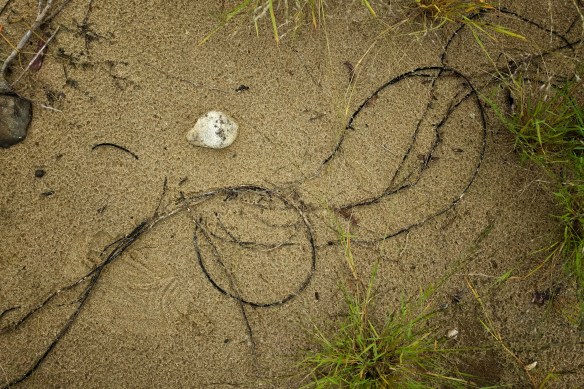
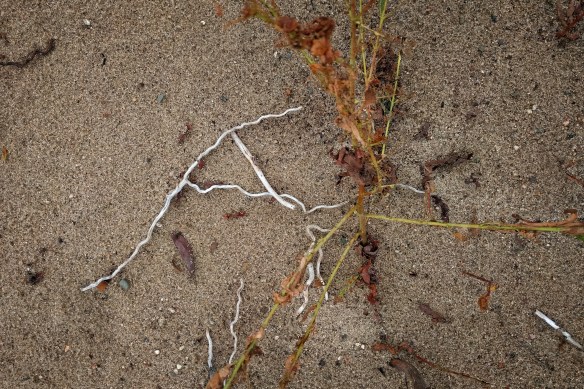
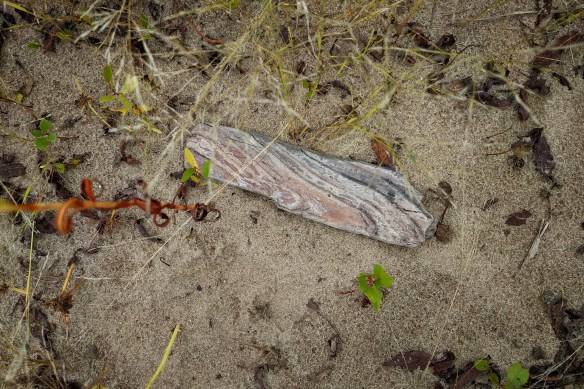
I found myself paying attention to how the moisture content of the sand shifted its color along with its consistency — how the farther I got from the water, the more pale the sand became. I started to notice how the granularity of the sand changed — how some was more coarse and some was incredibly fine. I paid more attention to how the wind revealed layers of different color in the sand, how driftwood bleached into various subtle shades.

sand4

There was something wonderful and beautiful about how dried leaves gathered gracefully in fluid self-organized, breeze-driven groups. There was something fascinating about how different waterlines arranged themselves; you could gauge the strength of various storms by the arrangements of the detritus and the driftwood and how far they’d been driven from the waterline by the wind and the waves.

None of this is stable. It’s changing all the time. The change is sometimes radical and quick and violent, but mostly it’s slow. I know I can return to this same spot in a couple of weeks and find that same driftwood log and those same weeds; I know I can return in six months and find that same log, though it will likely be surrounded by different detritus. There is continuity. Continuity, but not sameness.

sand6

There’s a good chance that the next time I return to the lake, that lost beach shoe will still be there. The dog’s paw print and the raccoon track probably won’t. The sand, though, it’ll still be there. Long after I’m dead and gone, long after that shoe disintegrates, long after the driftwood deteriorates into nothing, the sand will still be there.

There are people who collect sand as a hobby. They’re called arenophiles. The word comes from the Latin term for sand: harena. That’s also the root of the word arena. What does sand have to do with an arena? The Romans understood that the best and easiest way to soak up the blood spilled from their arena spectacles — the gladiator fights, the chariot races, the beast contests — was to lay down a layer of sand. Before there was a Coliseum, there was sand.

There’s always sand.


practicing in public

I very much like the work of photographer William Gedney, but I admit I wasn’t terribly interested when I learned his journals were available online. Still, when I wrote about Gedney several years ago I took the opportunity to look at a few of them.

Most of the journal entries were pretty dull. Photography historians may be fascinated to know that on Friday, April 22nd, 1966 Gedney finished a roll of Tri-X in his Leica M3 by shooting a few frames of the Long Island University gym and the Paramount building (1/60 at f 2.8) and of a sleeping boy (1/10 at f 2.8). Me, I don’t really care. It’s mildly interesting to know Gedney stopped by Diane Arbus’s apartment in January of 1969 to fetch a couple of prints, and that her hair was very short at the time. Me, I don’t really care.

against the tide

I’m only slightly more interested in reading the quotations or song lyrics Gedney copied into his journals. I tend not to be inspired by ‘inspirational’ quotations. But I found myself reading a three page entry in Gedney’s 1969 journal. Three pages — one long quotation by Alfred Stieglitz. I won’t quote the thing; you can read it yourself if you want. Essentially Stieglitz was talking about ‘practicing in public’ — showing work that doesn’t quite meet your standards for what the work could be. He said:

[I]f one does not practice in public in reality, then in nine cases out of ten the world will never see the finished product of one’s work. Some people go on the assumption that if a thing is not a hundred percent perfect it should not be given to the world, but I have seen too many things that were a hundred percent perfect that were spiritually dead, and then things that have been seemingly incomplete that have life and vitality, which I prefer by far to the other so-called perfect thing.

Stieglitz also talks some bullshit, like “Is the thing felt – does it come out of an inner need – an inner must? Is one ready to die for it?… that is the only test.” Is one ready to die for it, lawdy. Drama queen, right there. Gedney includes all that crap about ‘inner must’ in his three pages — but I think we can overlook the bullshit and still learn something worthwhile from Stieglitz.

sports fan

I love the notion of practicing in public. I’d be lying if I claimed I only shot photographs for my own pleasure. I enjoy making them available to other folks. I rather hope the folks who bother to look at them find something worthwhile in some of them, but if they don’t, I’m not that concerned. For the most part, I’m fairly confident of my ability to take a good photo — if I have a moment or two to allow the elements of a good photo to register in my brain. You know, stuff like composition, light and shadow, geometry, depth of field. All I need is that moment or two; I’ve been noodling with cameras long enough that I can adapt fairly quickly to most situations.

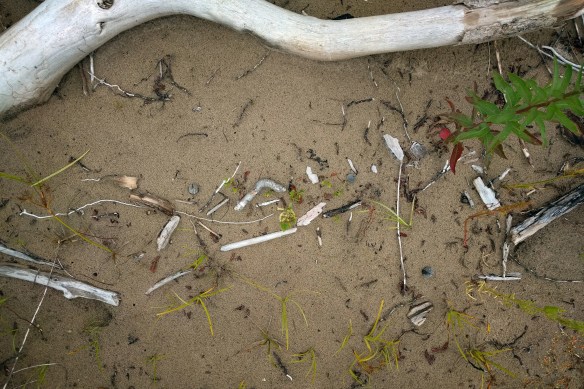
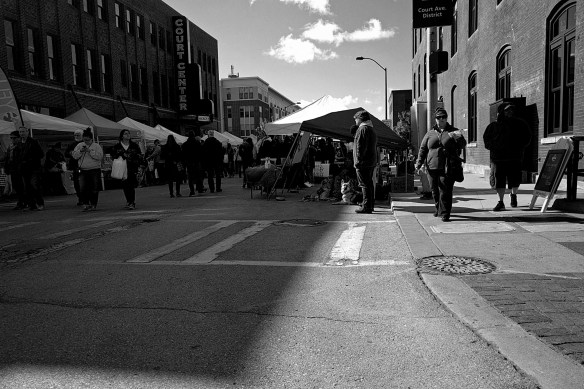
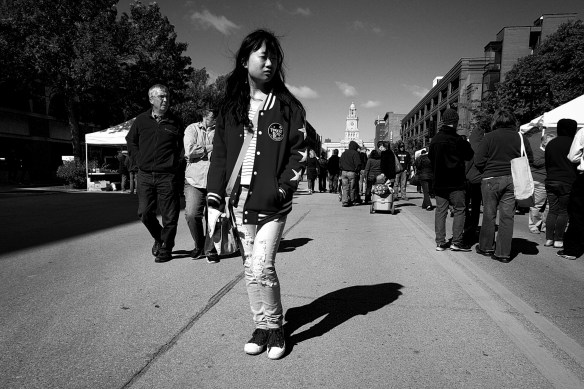
But then there’s street photography, and the street is pretty damned stingy when it comes to allowing you a moment or two for anything to register in the brain. Sure, you can look at a scene and quickly assess the possibilities — the light is good over there, the shadows are nice in that spot, all I need now is for something interesting to happen right there. But if nothing happens — like in the shot below — you’re just left standing around gawping like the village idiot. There’s a spot for potentially interesting photo, but the street just ain’t giving it away.

court avenue sidestreet

Street work is different. It’s about immediacy. It’s about anticipating what’s about to happen while incorporating the unpredictable. It’s about being open to the moment and responding to it creatively, and without conscious thought. Those are things I’ve been good at all my life. All my life — except when it comes to photography.

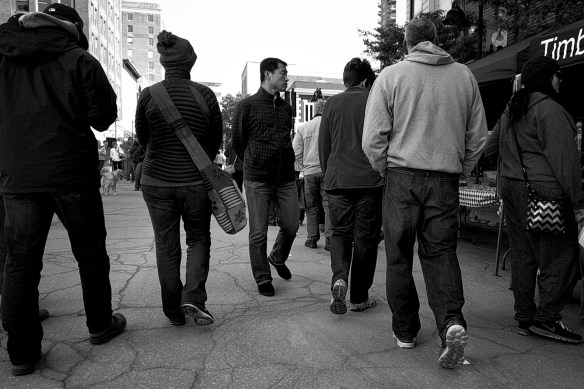
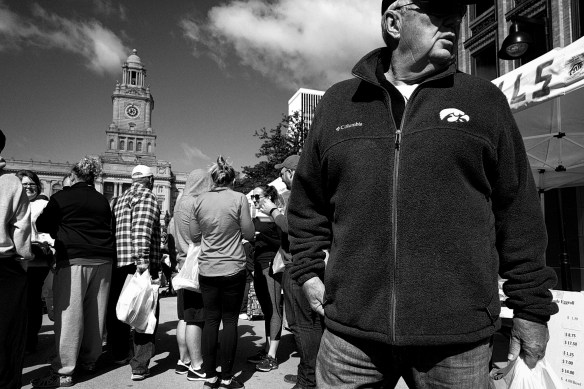
I have very little confidence in my ability to shoot street. I totally love doing it. I love the spontaneity of it. I love the semi-unpredictable way groups of people shift in and out of patterns. I love the way the point of balance of an image may exist only for a moment, then disappear and what could have been an engaging photo becomes just a disorganized, visually jarring clump of people. I love shooting from the hip (and I mean literally from the hip), trying to anticipate how various elements will arrange themselves in the next few moments — and predicting how that arrangement will appear through the lens of a camera held maybe eighteen inches below my eyes.

approaching the farmer's market

All the things I love about street photography are things that make it easy to get it wrong. It’s so very easy to miss the shot, to fuck up the composition, to release the shutter a moment too soon or too late, to be half a step too far to the left, to fail to notice what’s taking place (or not taking place) in the background.

The difference between good street work and ineffective street work can be measured in the time it takes a person to turn their head or glance at a cell phone. I love the practice of street photography — getting out there and trying to do it well. And I’m with Stieglitz about the importance of practicing in public. If you want to be good at this stuff, you need to be open about the struggle. Fuck perfection.

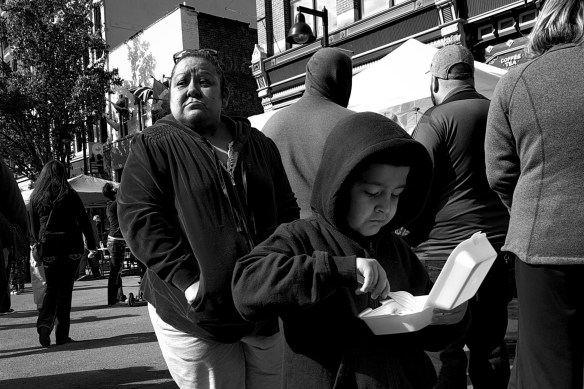
kid eating cinnamon roll

So back to Gedney and Stieglitz:

Either you feel that a thing must be perfect before you present it to the public, or you are willing to let it go out even knowing that it is not perfect, because you are striving for something even beyond what you have achieved… [I]n struggling for perfection you know that you may lose the very glimmer of life, the very spirit of the thing that you also know exists at a particular point in what you have done; and that to interfere with it would be to destroy that very living quality.

Practicing in public. I’ve been thinking about this concept off and on for a few years, but it was only recently I began to focus on that last phrase: “…to interfere with it would be to destroy that very living quality.”

It’s that living quality that makes street photography vital, isn’t it? So if there’s any style of photography that ought to be practiced in public — that should be liberated from the entire idea of ‘perfection’ — it should be street. Right?