civic virtue selfies

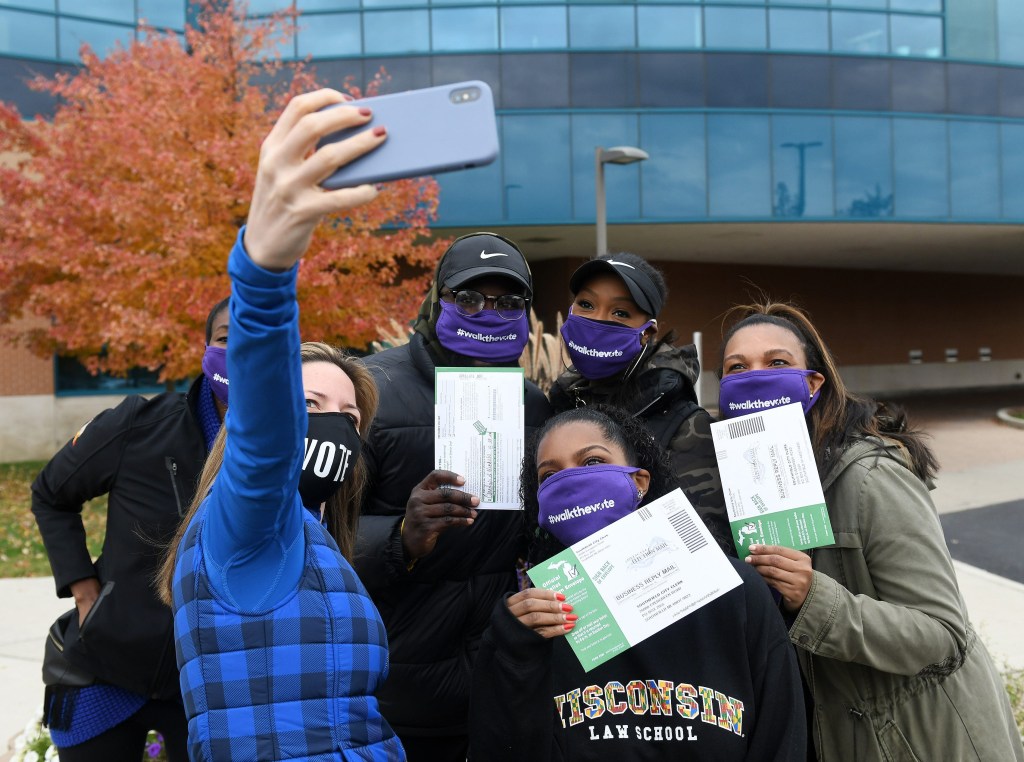
A friend recently said she was eager to vote in the coming local election next month, but was a wee bit sad that she wouldn’t be comfortable posting her usual “I Voted” selfie. I asked why she’d be uncomfortable. She said after posting her selfie after the last election, she was accused of virtue signaling.

My first thought was, “Okay, yeah, I get that.” Because saying, “Look how virtuous I am” is pretty cringe (and yeah, I know saying ‘cringe’ is…well, cringeworthy, but c’mon). My second thought, though, was, “Fuck that, go vote and post your selfie.”

This is not me.

Nonverbal signals are important in any culture. You already know that, so I’m not going to natter on about it. There are some virtues that ought to be signaled. Civic virtue is a good thing. Right now, when we’re facing growing authoritarianism, claiming our civic virtues is critically important.

You may be wondering, “Greg, old sock, what is this ‘civic virtue’ of which you speak?” Well, I’m about to tell you…and I’ll warn you up front it’s rather old-fashioned and maybe a tad sappy. Civic virtue is the general belief among the citizenry that the common good of the public should come before special interests of the few. That’s it, that’s all it is. It’s that whole Spock “The needs of the many outweigh the needs of the few” thing.

This is not me.

Voting is good. It’s virtuous. Signal the fuck out of it. I firmly believe in the concept of civic virtue. I’m a good citizen. Most of my life has been spent in some form of public service. I vote in every election. I stay relatively well informed on current events. I pay my taxes. I pay my bills. I follow most of the laws most of the time. If I’m in the market and see some product has fallen off the shelf, well I pick that shit up and put it back where it belongs. This is how civil society is supposed to work.
This is not me.

Civic virtue is the primary distinguishing difference between republican forms of government (note that’s small r republican, not ‘Republican’) and monarchical or tyrannical forms. In a republic, power belongs to the public through their elected representatives. Decisions on governance should reflect values and attitudes that promote the general welfare. It’s the polar opposite of a monarchical society, in which decisions on public matters are made by a monarch and based on the monarch’s interests. (Yeah, I’m talking about Comrade President Donald Trump here.)

The so-called ‘Republican’ Party in the US doesn’t support republican ideals. MAGA is essentially a weird, twisted, mishmash of monarchical and consumerist ideologies. Governmental decisions are based on the wants and needs of one person who believes civic virtue and selflessness are for suckers, and wealth is the only true measure of worth, and scams are the best and easiest way to accumulate wealth.
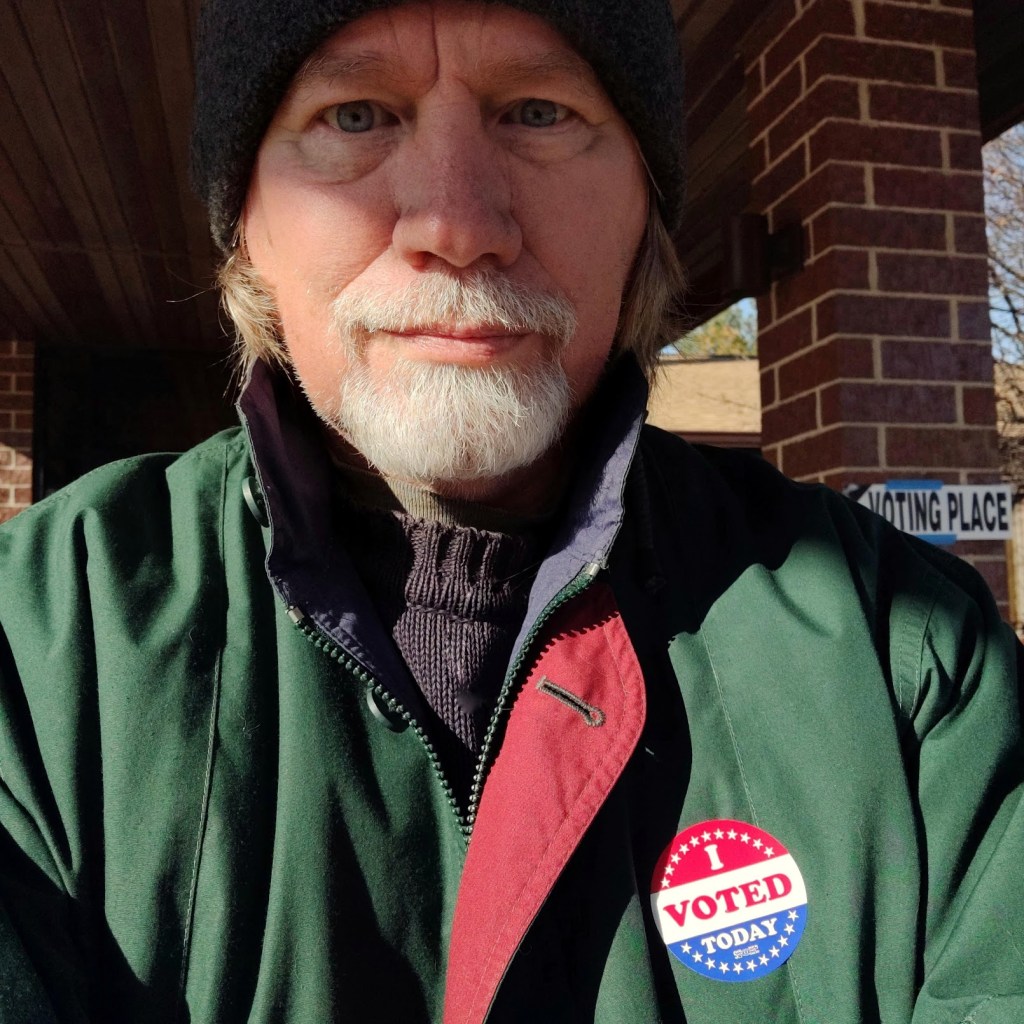
This is me.

MAGA wants us to be embarrassed by expressions of civic virtue. Go vote. Take a selfie with your “I Voted” sticker. Post it on social media. Tell MAGA to go fuck itself with a chainsaw.

the one thing everybody agreed on

Like a few million other folks, I showed up at the local No Kings protest. We were all there for the same fundamental reason: because Comrade Donald Trump and his cadre of Nazgûl have been merrily shitting on…well, everything that’s good and promising and hopeful and decent about the US.

Fuck Trump.

People are pissed off about SO MANY things Trump has done (and intends to do). The attacks on immigration, science, trans rights, healthcare, civil liberties, the environment, due process, Gaza (and Israel and Iran and and and), veteran’s benefits, free speech, the national debt, the January 6th pardons, everything about January 6th, the assault on education, the assault on libraries, the assault on the very concept of Truth.

No, really, fuck Trump.

But one thread tied all the anger and frustration and resentment together. A deep, abiding rage against Donald Trump as a person. Not only for the horrors he’s inflicted on the United States, but a profound loathing for him as an individual. As I wandered through the No Kings crowd, I kept seeing this same sentiment. Fuck Trump.

Also? Fuck Trump.

People really hate this motherfucker and they hate him personally. They hate him for what he’s done, they hate him for what he wants to do, and they hate for him who he is. Which, I suppose, is only fair, considering how many people he hates for who they are. Trump has a singular talent for both hating others and being hated.

Seriously, fuck that guy.

Why do people hate him so? Because he’s a liar, because he buried one of his many wives on a goddamn golf course, because he’s betrayed the United States, because he’s got truly godawful taste in everything, because he’s cheated on every wife he’s had, because he’s massively ignorant and unaware of it, because he’s a liar, because he’s fucked over every person and contractor he’s ever worked with, because he’s an unrepentant racist, because he hates women, because he loves autocrats, because he’s a liar, because he’s a coward, because he’s never owned a pet, because he’s a narcissist, because he pretends to support the military but believes they’re losers, because he’s a liar, because of his stupid fucking red hats, because he’s a phony, because he’s put incompetent people in positions of power, because he insults everybody who disagrees with him, because he’s a vindictive prick, because he’s a liar, because he’s rude, because of his stupid fucking hair, because he encourages his followers to be violent, because he hates immigrants but hires them to work for his resorts, because he’s shit all over the Arts, because he’s a liar, because he’s cruel and enjoys inflicting harm on others, because he pretends to be a Christian without having an inkling of Christian charity, because he’s a sex pest, because he’s committed many many crimes but has never been held accountable for any of them, because the people who like him are all massive assholes, because he’s a fucking liar.

And the horse he rode in on.

I’m sure I’ve skipped a few dozen other reasons why people hate him. But I think you get the point. People sincerely hate Trump.

But there was another guy at the No Kings event. Bearded guy, dressed all in black, sitting on a granite railing. He was wearing a T-shirt that said “Hate Will Never Win.” I hope he’s right. I genuinely hope hate won’t win. But I also hope the hatred against Donald Trump will get people to stand up for themselves and for others. I hope it will get people to push back against his authoritarianism. I hope it will get people to vote. I hope it will get people to hold Trump accountable for all (or at least some) of the horrible things he’s done to this country.

And then I hope we can let go of that hate.

hands off, the fringes

Like a million other concerned people, I attended the local Hands Off! protest yesterday. I wasn’t sure how many people would show up, considering it was a cold, blustery day (about 42F with steady 14mph winds and gusts about twice that). I thought we might still get a thousand people. Maybe.

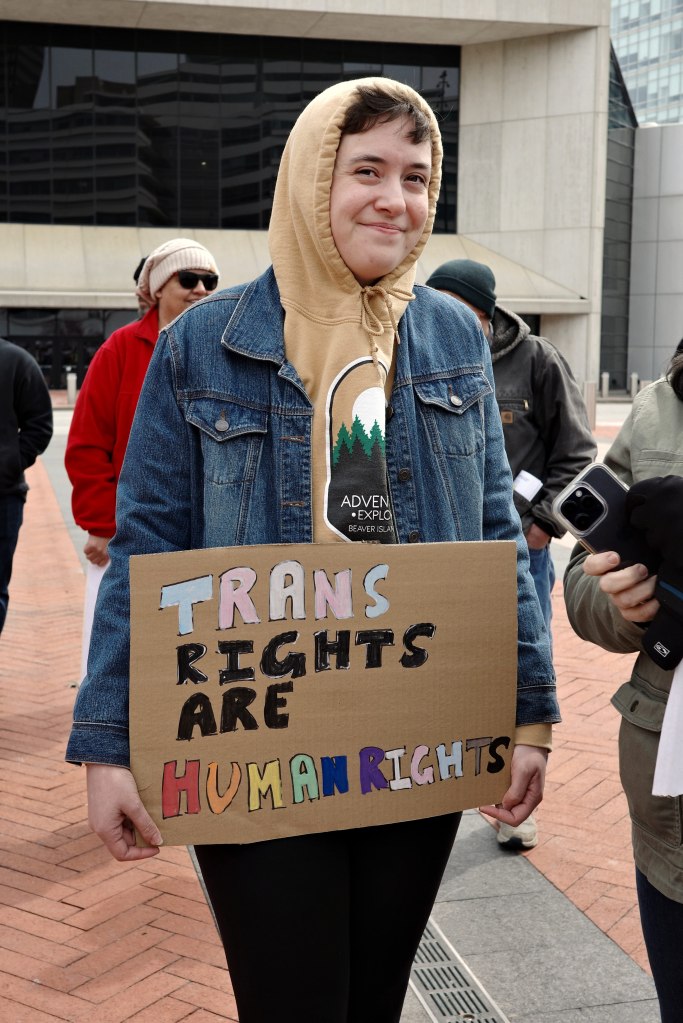
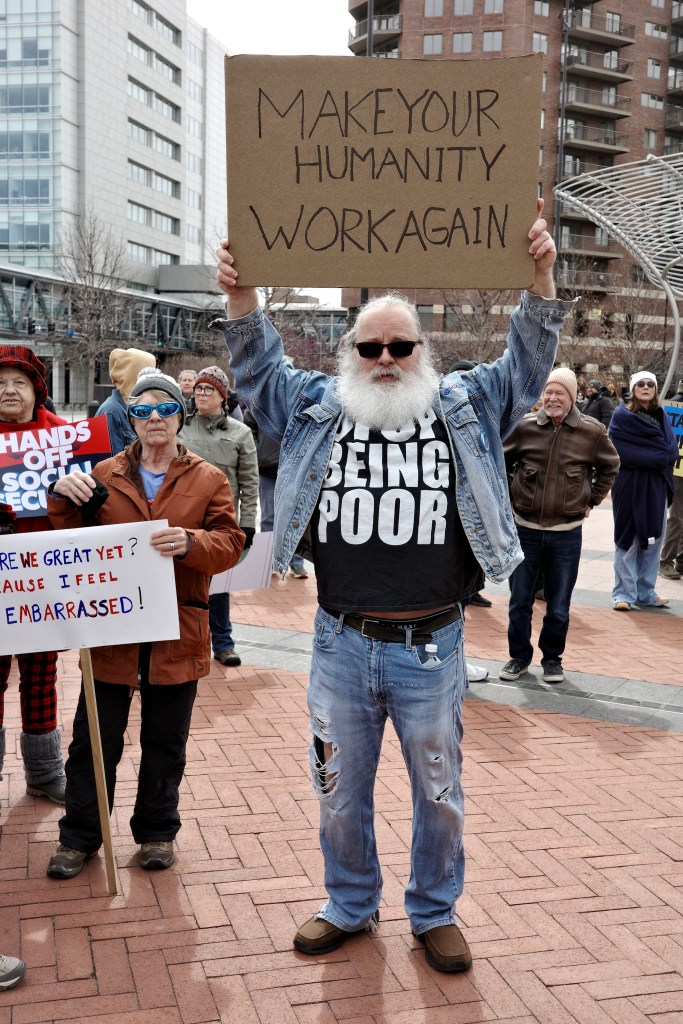
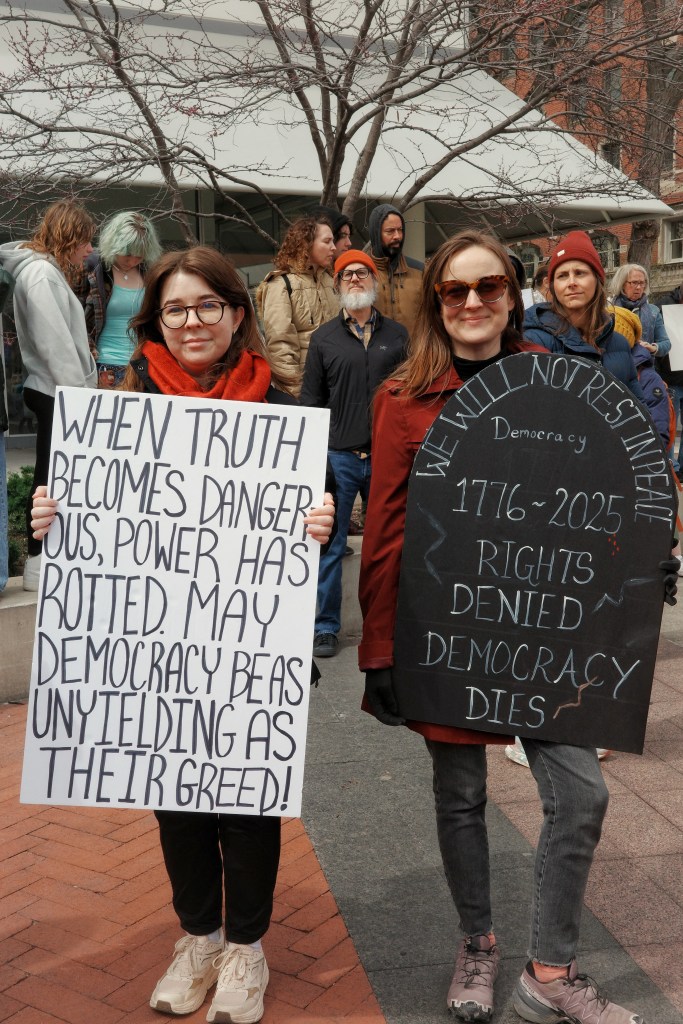
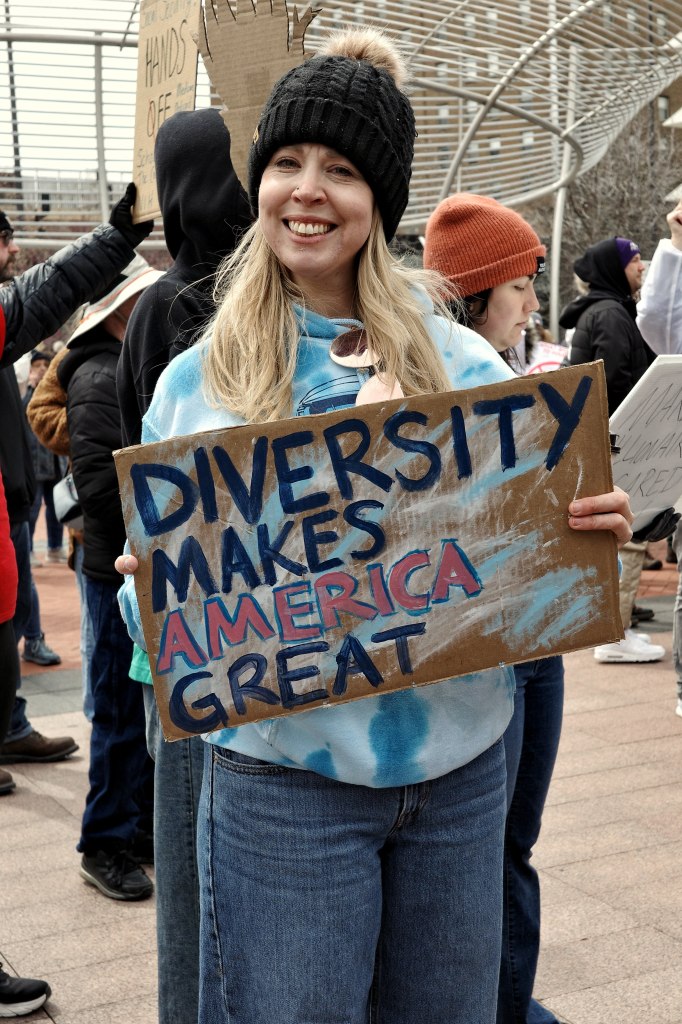
The local news estimated the attendance to be around 7,500, and they tend to be conservative in their estimates. It was an eclectic crowd with a variety of concerns. Climate change, veteran’s benefits, social security, health care, education, trans rights, social justice, the court system, immigrant’s rights, Ukraine, and more. But there was absolutely universal condemnation of Comrade Trump, Elon Musk, and DOGE.

The protest began, as all protests do, with speeches. I confess, I paid little attention to the actual speeches, though I was pleased to hear the crowd cheering and applauding. During the speeches, I left the main crowd and moved around the fringes. Why? Because there are folks who want to protest and make their voices heard BUT for any of a thousand reasons may be uncomfortable with crowds.

The folks on the fringe of the protest were pretty much the same people who made up the rest of the crowd. They were mostly white (this IS Iowa, after all) but beyond that they seemed to be a fairly representative sample of the protesters. There were young kids (some in strollers), and working class folks, and church-goers, and goths, and office workers, and trans folk, and wine moms, and college students, and old folks (some using walkers), and union members, and passers-by who just wanted to know what the hell was going on.

One of the things I found most interesting about the event was that everybody was 1) happy and 2) pissed off. They were pissed off enough to give up their Saturday to carry signs and listen to speeches and shout for Elon Musk to be deported and for Donald Trump to be impeached and to take over one of the main city streets and march a mile or so in cold, blustery weather to the state capitol building, where they listened to still more speeches. But they were also happy and laughing and clearly delighted to be with others who agreed with them. There was a tremendous sense of relief, and a sense of urgency, and a sense of something approaching hope and optimism. That all seems contradictory, but it didn’t feel like it.

Nobody there thought this march–or any of the hundreds of other marches–was going to change anything. Nobody there was that innocent. But it felt like there was a shared commitment to changing the way we govern ourselves. There was a very clear feeling of joy at the chance to express themselves, to carry signs and chant slogans and shout out their frustration and rage and hope.

It was also clear that this was the first time a lot of these people had attended a protest. At the beginning, there was a tentativeness to the crowd. A lot of looking around to see if anybody was watching, if anybody was upset or offended by what they were doing. This was especially clear when the organizers asked them to take to the street and march up to the capitol, where we’d join up with a second protest. We are a car-brained culture, and these people were unsure about the propriety of taking over a street without permission.

But they did it. And when cars approached the head of the march, they had to stop and make a U-turn. At the back of the march, a lone police officer in a squad car followed to insure no drivers disrupted the march from behind. Within a few hundred yards, this crowd of normal Iowans were chanting, “Whose street? OUR STREET!” There was a palpable sense of released anger and resentment and liberation. It really was OUR street.

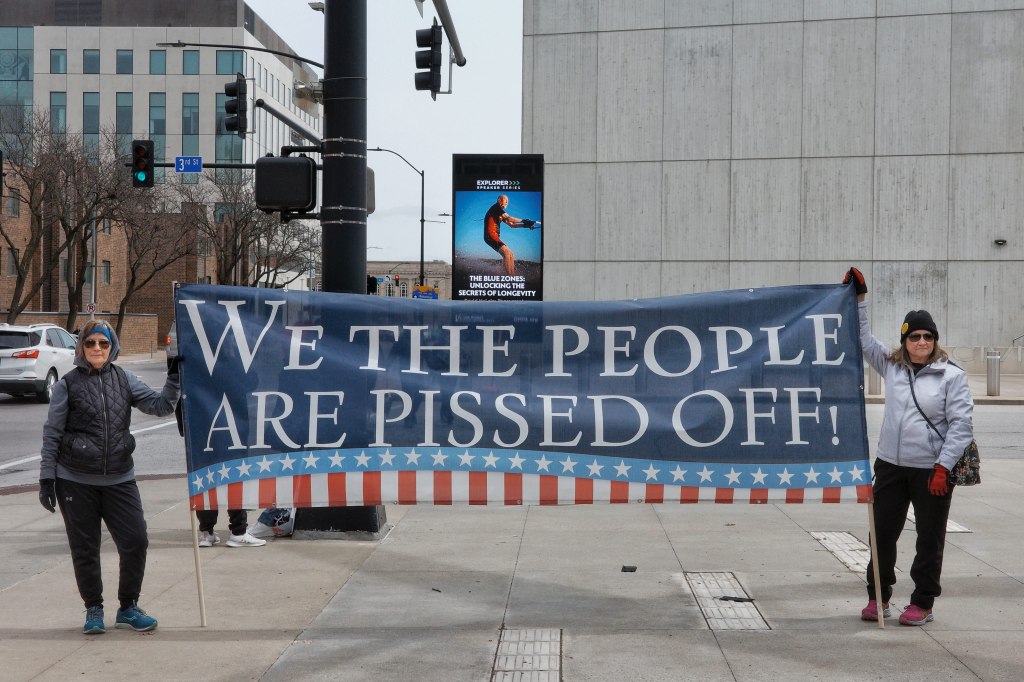
When the crowd took to the street, these two women with their “We the People” sign led the way. It seemed appropriate. Because it’s true. We, the people, are massively pissed off. And yesterday, we let those malignant fuckwits of the Trump administration know it.

I took a lot more photos of (and in) the crowd itself. But here I wanted to show the people who, at least at the beginning of the day, hovered around the fringe of the protest. The people who usually get overlooked. The people who don’t make the highlight reels or the news reports. As so many protest signs said, you know things are grim when even the introverts show up.

You’ll notice that most of these photographs are of women. You’ll notice they’re not drawing attention to themselves. They’re drawing attention to the signs they’re carrying. Signs they mostly made themselves. There’s a song from the 1950s resistance movement in South Africa that goes, “Wathint’ abafazi, wathint’ imbokodo.” This translates as:

When you strike the women, you strike stone.

We’ve been striking stone for decades. Centuries. Eventually, it’s going to spark a fire that will incinerate the patriarchy. It may still be a long time coming, but it’ll happen. And when it does, women like the ones in these photos–the ones quietly occupying space at the fringe–they’ll have helped light that spark.

red hat ladies

So here’s me in this small town (we’re talking fewer than 500 people) where there’s a little diner that serves the most excellent desserts (they make their bread pudding with cinnamon rolls). While I’m having lunch, there’s an impossible-to-ignore table with about a dozen older women. They’re all wearing red hats. Not MAGA hats, just hats that are red. All sorts of hats. And these women, they’re having a good time, laughing and talking.

It was fun to see them, and I thought about shooting a photo, but decided not to. I could have justified it ethically in photographic terms, but my momma taught me that old women deserve a few extra layers of respect. So I didn’t.

But after lunch, I ran into a couple of them at a gift shop across the street. And I chatted them up, because I was curious and because I like talking to strangers. We must have talked for more than ten minutes. And at one point, I asked if I could take their photo. And they said yes.

They belong to the Red Hat Ladies. It’s an informal group of a couple of dozen women who meet for lunch maybe once a month, maybe every couple of weeks, depends on their mood. They have rules, sort of. You have to be invited to be a member. You have to be over 60. You have to be sorta kinda approved by most of the other members (they indicated that wasn’t actually a rule, but you know, there’s some folks that just don’t click). And you have to wear a red hat to lunch. Most of them also wore red coats. I got the impression that many (maybe most) of them were widowed or divorced.

And they were a hoot. I teased them, they teased me back. They were so very clearly happy with themselves, and it made me happy to see them and spend time with them. There’s something wonderful about the way older women gather together, something liberating and caring, something that leaves them highly opinionated. It’s like they’ve learned to shrug off so much of the bullshit they’ve had to deal with for most of their lives. And if they haven’t actually shrugged it off, they’ve learned to shove the bullshit off to one side long enough to get together and have a good time. You have to respect that.

I suspect (and I hope this is true) that there are similar Red Hat Lady collectives all over the world. I’m pretty sure I’d object to many of the political and religious views of these women, but I’m inclined to think I’d trust them to run the country. Certainly, I’d prefer them to the hateful crew that’s now in charge. The thing about the Red Hat Ladies, they know when to be sensible and when to stick a purple bow on a red hat and if folks don’t like it, they can go eat lunch someplace else.

I’m pretty much content with being a guy, but I’m also sort of envious of these Red Hat Ladies. They’ve got something few men will ever have. One more reason to burn the patriarchy.

small love story

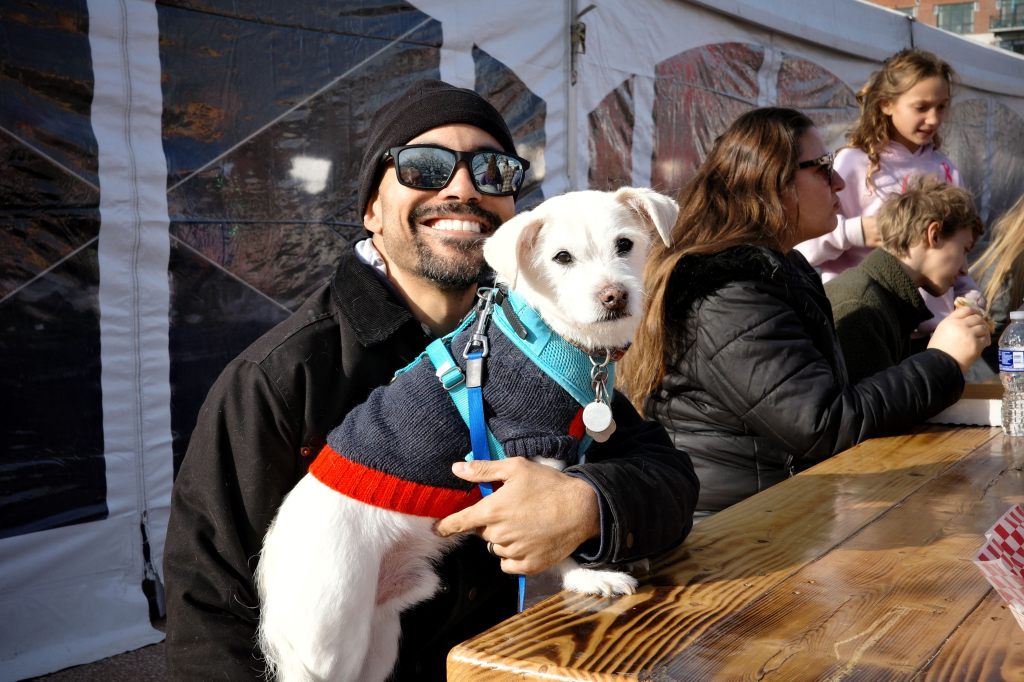
I’m at the Christkindlmarket and I see this guy and his dog sitting at a table. He’s holding the dog and the dog is leaning against him. I know it sounds ridiculous, but the moment I saw them I thought, “Madonna and child.” I blame all the Christmas stuff for that. I’m not a Christian, but I’m a fan of any holiday that’s (supposed to be) about love and sharing.

Anyway, I’ve got my little Ricoh GR3X in hand as I approach them, and the guy knows why I’m coming. I could see it on his face, the recognition that I wanted to photograph his dog. And it obviously pleased him. I barely got the words out…”Would you mind if I…?” before he said, “Sure.”

The dog, though, seemed a tad uncertain, so I slowed down. Instead of the close-up I’d intended, I stayed back a bit. Instead of shifting my position to isolate the guy and his dog from other people from the frame, I stayed still. Instead of shooting 3-4 frames, I took only one. I moved slowly to take the photo.

I said something like, “He’s a wee bit shy, isn’t he.” The guy said the dog was timid around other people, which is why he’d brought him to the Christkindlmarket and why he was holding him. He wanted the dog to feel safe and protected, but he also wanted him to get used to being around other people.

I didn’t even try to pet the dog, though I wanted to. I didn’t try to shoot more photos of them, though I very much wanted to. I figured the little guy was dealing with enough already.

In the end I said something like, “You’ve got yourself a little buddy.” He said, “I sure do.” And I walked away. But seeing them together lifted my spirits–which, given the world as it is today, was quite a feat. The obvious bond between them, the care the guy was taking with the dog, the trust the dog had in the guy — it was lovely, and I was weirdly proud of them both.

I could have taken a better photograph of them. They deserve a better photo. But it might have made the dog nervous, and no photo would be worth that.

colors, textures, and retirement-age train otaku

I’m not a train guy. Not a railroad guy. I mean, sure, I like trains and railroads. I appreciate their historical significance. I like to hear their whistles and see them rumbling along the tracks. I absolutely love the photographs of O. Winston Link. But if somebody asked me if I’d like to go spend a day looking at trains, I’d say…well, I’d say yes. Not because I’m a train guy, but because I’ll go look at just about anything.

And that’s exactly what I did recently. I agreed to go on a family/friend train excursion that included historic trains, a small train museum, and a dining experience in an old train that traversed some fields and woods and a ridiculously narrow bridge over a rather high river valley. It wasn’t something I’d have chosen on my own, but I’m really glad I agreed. (Pro-tip: always agree to do almost everything, because you never know.) It was fun and, of course, I took a few photos.

I’d expected to enjoy the train ride, and I did. There was a period of time when I lived on the East coast and I frequently traveled by train–Boston, New York City, Washington, DC, Norfolk. I always enjoyed it. But there’s a radical difference between (what in the US passes for) ‘modern’ train travel and an historical train. The engine that pulled our dining cars wasn’t a steam engine or anything, but it was old and slow and pleasantly lazy. Which was just as well, since the tracks were also old and the train swayed a LOT more than any train I’d ever been on. Hell, at times it swayed more than a lot of boats I’ve been on. You don’t want a lot of swaying when you’re on a high trestle bridge over a river valley. Still, it was fun and the food was surprisingly good.

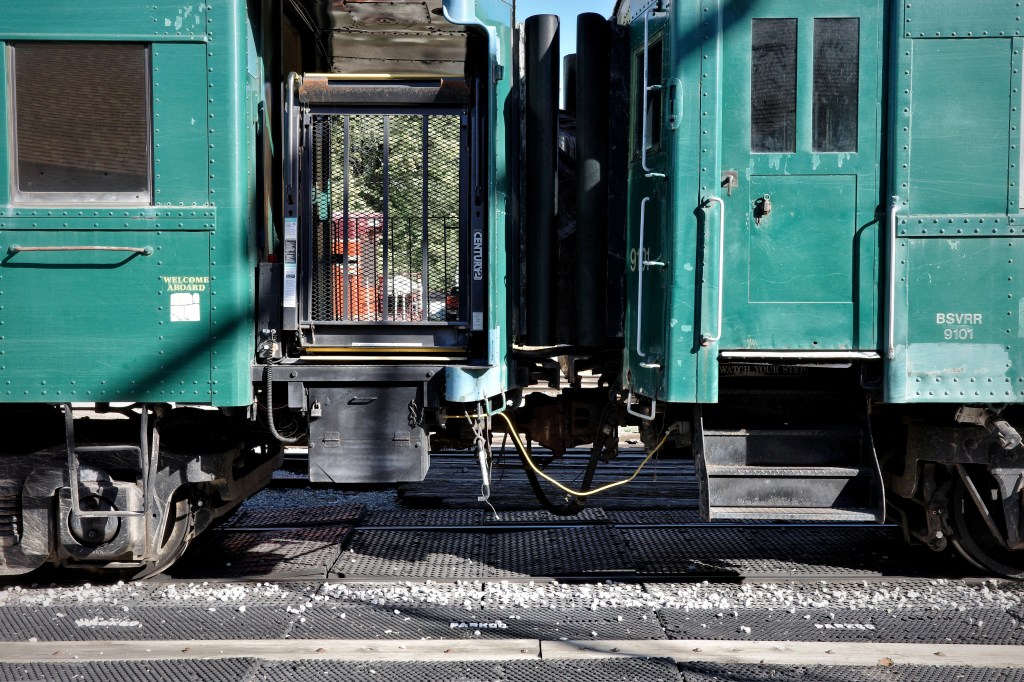
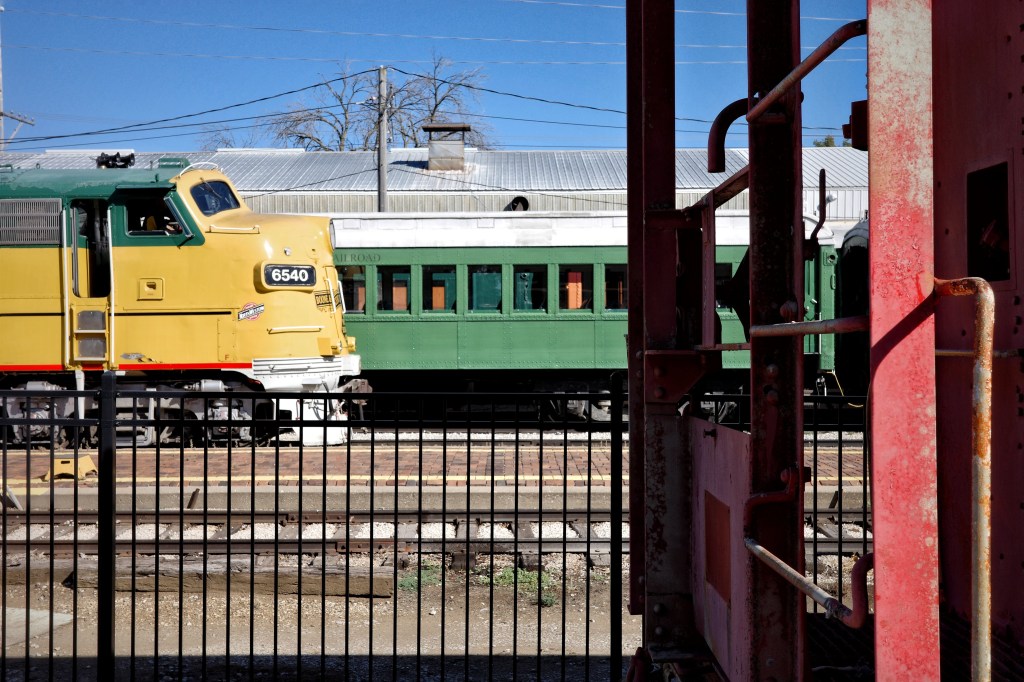
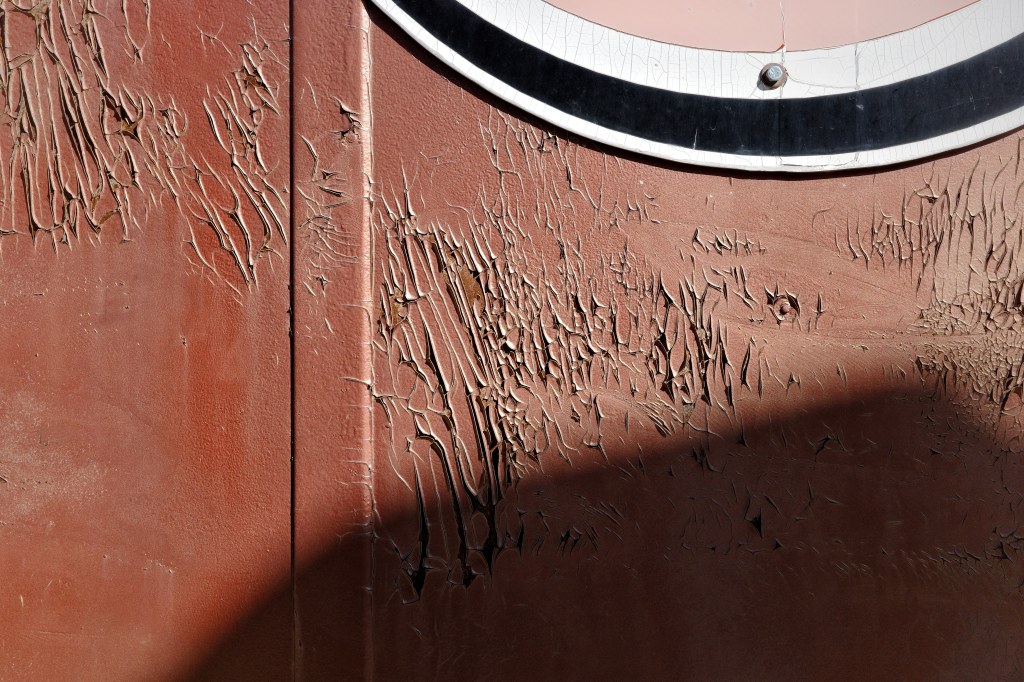
But the train ride and the meal were, for me, secondary. Hell, they were tertiary. I could have spent the entire day noodling around the train yard, looking at stuff I didn’t understand and appreciating it. BIG blocks of color. Gobs of dark, sexy shadow. Weirdly-shaped mechanical bits and bobs. And who knew trains had so many ladders? Everywhere you look, there’s a ladder. And different shapes of ladders, at that.

I hadn’t anticipated being fascinated by the shapes and forms, particularly of the works of the undercarriage (if that’s what it’s called). Everything was so massively sturdy. And I was completely captivated by the colors–the sun-faded greens, the bright yellows and oranges, the weathered reds and russet browns of the cars. I could have spent an hour just looking at the variety of textures and photographing the industrial weirdness of the undercarriage.

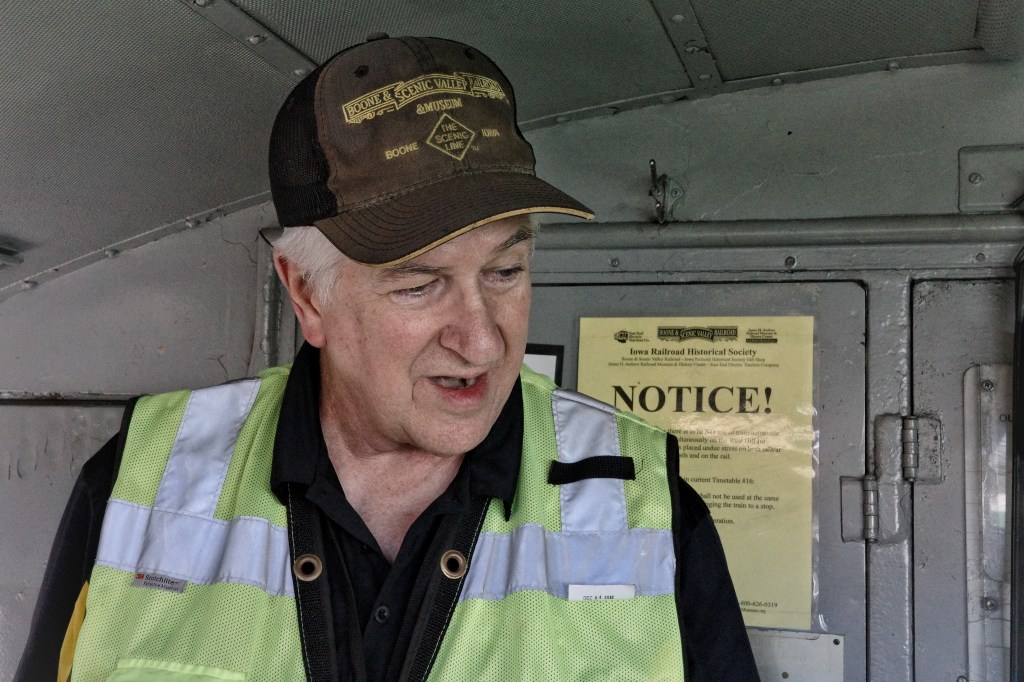
For once, I was more interested in the stuff than in the people, and I rather regret that because when I took a moment to actually talk with the people they were…well, I guess you could call them retirement-age train otaku. They were obsessive, but reserved until encouraged. One guy, with minimal encouragement, agreed to let my brother and I climb up an exterior ladder into the engineer’s cockpit (if that’s what it’s called). I don’t think it was actually prohibited, but it was certainly not part of the routine. Once we got up there, he explained how the engine, which had been built in 1958, had been retired from some Canadian railroad. He rattled off the specifications of the engine, and where it fit in the evolution of train engines. I suspect he’d have told us the entire life history of that particular engine, but folks were waiting for us and we had to leave.

I actually regretted leaving the train yard. But not everybody shares my interest in weathered paint and arcane mechanical whatsits, so I left without complaint. Now I find myself with a metric ton of train-related photographs, and while I’m hesitant to impose them on the unsuspecting Intertubes, I’m afraid you’re going to see more train stuff on my social media. Of course, I won’t be able to identify what’s IN the photos. You’ll have to find a retirement-age train otaku for that.

i still talk to strangers

I wrote a piece back in April of 2023 about my habit of talking to strangers. Here’s a somewhat concise summary of the point of that post.

I like talking to strangers. I like meeting new people and learning something about them. Granted, most of my conversations with strangers are casually superficial, so it’s not like I’m learning anything important or meaningful about them or their lives. But the simple fact of meeting and having an idle conversation with random strangers tells me something about humanity in general.

And this is what I’ve learned: most people are pretty much okay.

That’s still true. Most people really are pretty much okay. A few days ago I found myself in Perry, Iowa, a small town of about 8,000 people. As my companion and I walked down the street, we saw a guy get out of a pickup truck, carrying a couple of small jars. One of which looked like homemade pickles.

I kind of leaned forward and grinned at the jar of pickles…and he stopped. He was delivering the pickles and some homemade cherry jelly to a couple of friends in a nearby shop. I asked if he sold his homemade goods, and he said, “No, I just give them to friends.” He asked, in a very kindly but curious say, what we were doing in Perry. I told him we were just walking around, looking at the town and its architecture, shooting photos.

He started talking about the town—how it had changed over the years, how it had fallen on hard times, and he started to get a bit emotional. I said something vague about how it was clear that he loved his town, and that sort of love was a wonderful thing. Then he left to deliver his goods.

We walked on. I stopped to take a few photos. And then the guy came trotting up to us. The friend who was to get the cherry jelly wasn’t in the shop, so he thought we might like it. This stranger, just because we’d chatted with him for a bit, wanted to share his jelly with us.

Randy Kennedy and a jar of cherry jelly.

Randy Kennedy. He’d lived in Perry most of his life, and he walked with us down the street, giving us a history of almost every building and the people/families who lived/worked in them. The old shoe store owned by Greek immigrants, whose son was a hero in the Second World War. The French woman who ran a small diner/sandwich shop, and the various sandwiches she made, and how he and his friends would tap on a window and she’d sell them sandwiches through the window. The florist whose shop always smelled so nice. The building where the local newspaper had been printed and how he and his brother had been paperboys and they’d gather at “that door right there” and collect their papers, and how he was sometimes late in getting his deliveries made because he’d stop and get a slice of pie at another shop. He told us about two taverns with doors on opposite sides of an alley, one for hippies and one for farm folks, and how they’d drink together and argue politics in the 1970s.

As we walked and talked, other locals would drive by or ride by on bikes, and many of them would call out to Randy, and he’d wave back. He walked with us for maybe thirty minutes, telling us stories about how wonderful the town was, and how it was failing now, and how MAGA had created deep rifts in the community. He talked about the way the town felt increasingly divided, and had become less tolerant. He talked about the local pork producing plant that closed six months earlier, putting 800 people out of work. Eight hundred, out of a population of eight thousand.

He didn’t mention the school shooting that happened in January, leaving an 11-year-old boy and the school’s principal dead, and seven others wounded. Some things were apparently still too raw to talk about. But most of the shops—even the ones that were closed and empty—kept ‘Perry Strong’ posters in their windows, maybe claiming more resilience than the town actually has. Maybe hoping resilience would hold the town up long enough for some good news.

This guy loved his small town and was proud of what it had been and mourning what it had become. He was pessimistic about the future, but desperately hoped he was wrong. His love for the town was heartbreaking. He was sad, but said he was okay. That’s when I asked if I could take his photograph, holding the jelly he’d give us.

Like I said in my earlier post, most people are pretty much okay. In a lot of ways, being okay can be seen as a victory. Randy Kennedy may look a wee bit sad in this photo; he has good reason to be. And yet he’s basically okay. The proof of that is that he chased a couple of strangers down the street just to give us some cherry jelly that he’d made himself.

I talk to strangers. I will always talk to strangers. And this morning, I had cherry jelly on my toast.

the women’s march — seven years ago

Seven years…seems like a lifetime. Donald Trump, with the aid of Vlad Putin, had been installed in the White House. Women decided to protest.

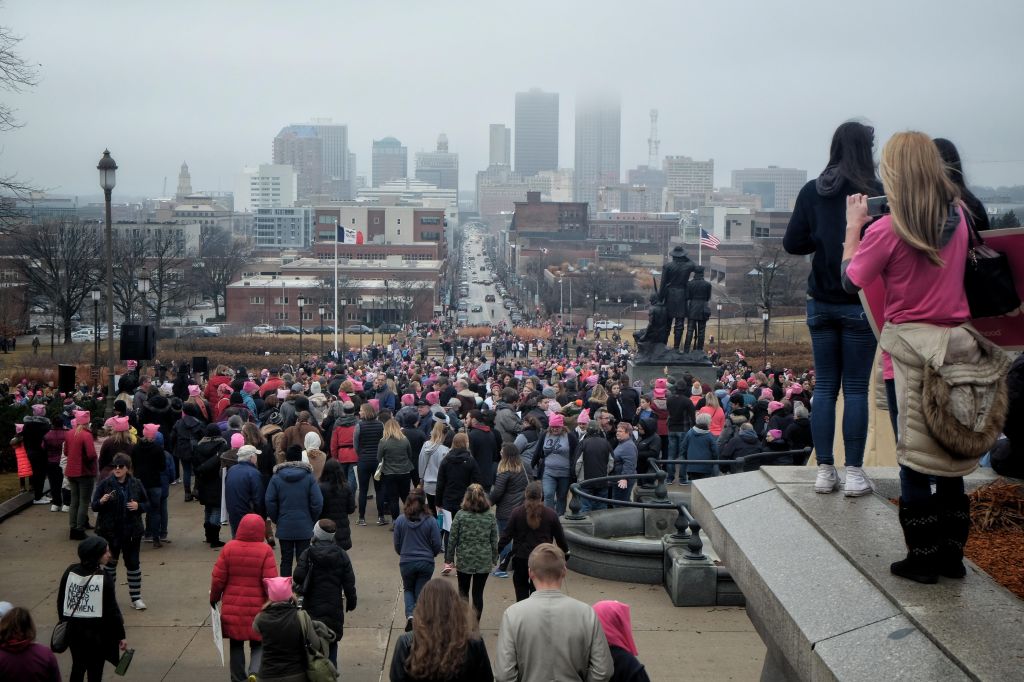
It was really that simple—which is to say it wasn’t simple at all. It was a spontaneous desire to protest, but it took incredible coordination by a group of volunteers. The original plan to march in Washington DC expanded to other major cities, then to more modest cities, then to small towns. In fact, there were satellite protest marches across the globe. There are no truly accurate numbers, but it’s estimated that in the US more than five million people marched that cold January day. That was a little over 1% of the US population. It was, in the end, the largest single-day protest in US history.

The crowd began to gather. We hoped to get 6000. We got 26,000.

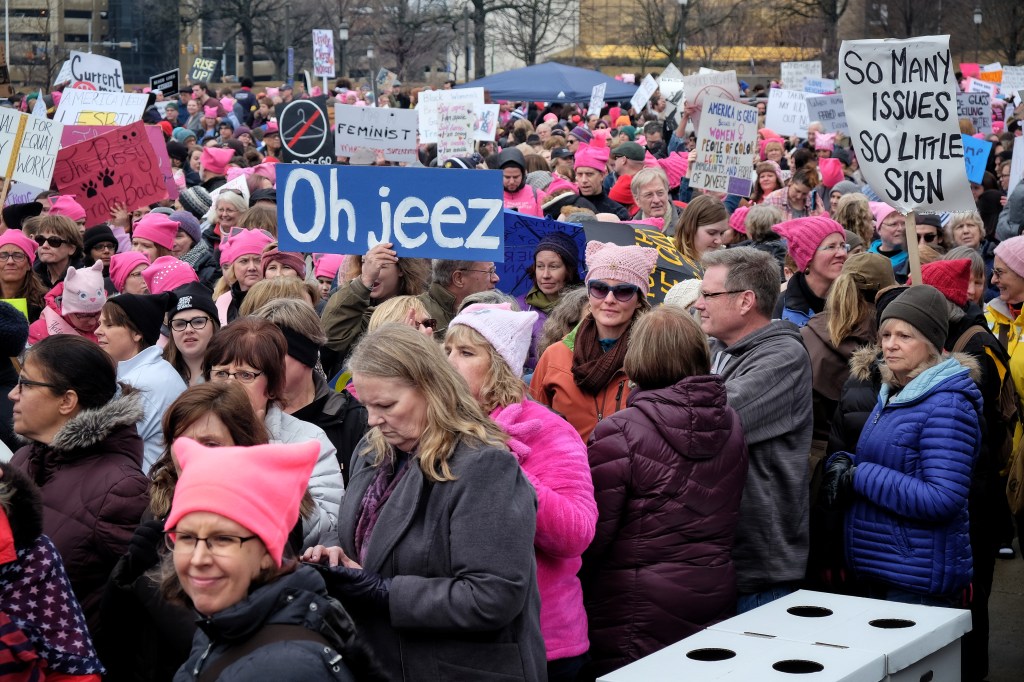
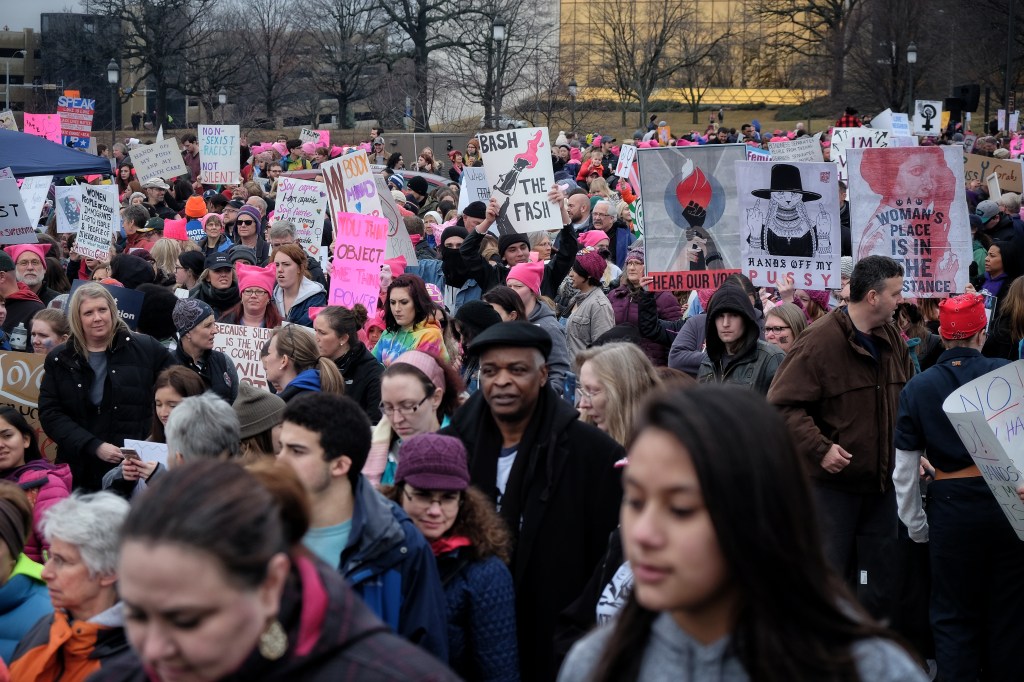
A couple of women in Los Angeles had an idea to create a hat that would not only help marchers stay warm, but would also be a visual statement of protest against a man who bragged women would allow him to “grab them by the pussy.” The pink pussy hat idea was flawed (it didn’t represent women of color or trans women) and was later abandoned as a form of protest, but on that day it provided a singularly powerful visual and emotional impact. It was, in a way, a sort of counter MAGA red baseball cap. The hats were also an example of the fundamental opposition to Trump; the vast majority of the pink pussy hats were made by hand by volunteers—often by personal friends of the marchers themselves.

Listening to music; waiting for the speeches to start.

I marched in Des Moines, Iowa. Originally, the organizers thought we’d have a couple of thousand marchers. Later, they hoped to have maybe 6,000. Then they thought it was possible for 10,000 to show up. According to the local newspaper the final estimate was approximately 26,000. (I wrote about the march and the pussy hats a couple days later.)

Oh Jeez

It was mostly women and girls, but a lot of men showed up as well. All ages. It was as racially diverse as Iowa gets (which, let’s admit it, isn’t terribly diverse). Abled and disabled. We gathered at the Iowa state capitol building. There was music, there was food and hot coffee, there were speeches, there were spontaneous chants, there was singing, and then we…well, marched. I use the term ‘march’ rather loosely. We basically hiked around the capitol grounds. Because this is Iowa, the march itself was far more polite than the signage and the chants; we didn’t block the streets, we didn’t get into any punch-ups with the very few counter-demonstrators, and we didn’t leave a mess for other folks to clean up.

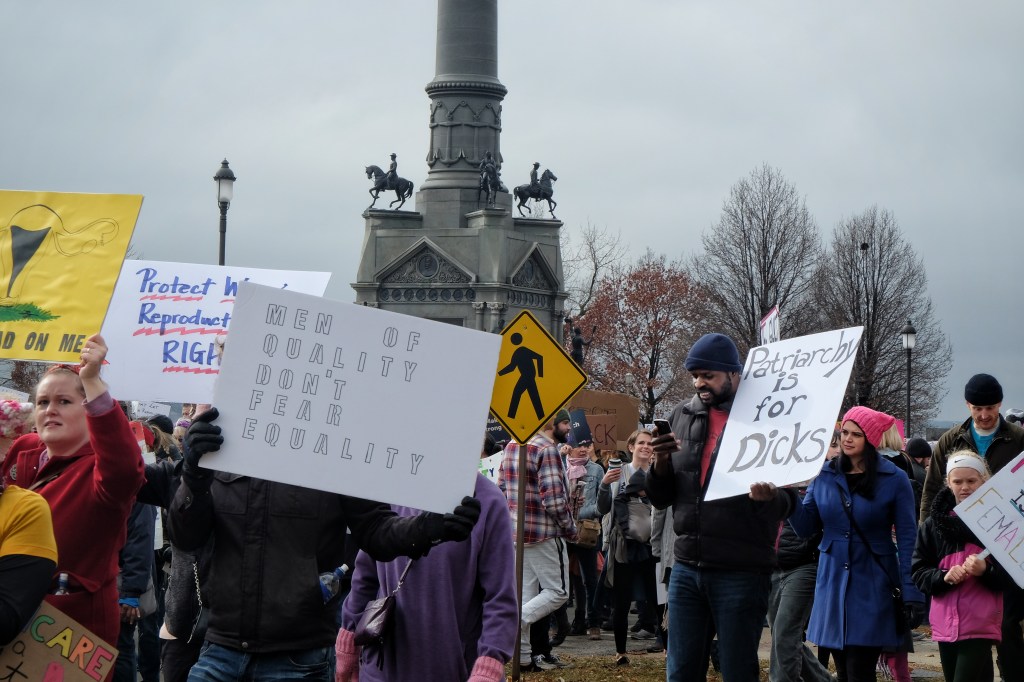
Patriarchy is for dicks.

I suppose the march officially ended when we’d returned to our original location, but few people left at that point. It may have been anger and concern that sparked the march and brought us all together, but once we’d gathered there was a pervasive sense of togetherness that everybody seemed reluctant to dismiss. There was a sense of hope, a feeling that if we all acted together—if we all worked for each other—we could mitigate the harm we fully expected to come from a Trump administration.

Not in the White House

We were so innocent. Trump was—and still is—worse than we could imagine. He’s done more damage than we thought possible. He had—and still has—more support for his authoritarian, anti-democratic, racist, misogynistic, vindictive agenda than we could conceive. I don’t think any of us had any idea of just how ugly, how hateful, how mean-spirited Trump’s supporters would be. We certainly didn’t anticipate how persistently and aggressively they’d attack long-held civil rights and liberties. We were so terribly innocent.

We’ve put away those hats, but we’ve kept the righteous anger.

It’s been seven years since the March. And we’re tired. Physically tired, emotionally tired, spiritually tired. We’ve put away our pussy hats (I still have mine—made for me by a friend, Kim Denise—stashed in a drawer), and rightly so because they weren’t inclusive. Our confidence in the benefits of protest has eroded; our confidence in our system of governance has been abraded by constant aggressive assaults by right-wing hate.

Bash the Fash

It’s fucking hard to be optimistic. The March itself, which was a buoyant expression of righteous anger and determination, has become a prolonged grind. It feels like the coming election will determine whether it’s possible for the US to recover from Trumpism.

Believe it.

So it doesn’t matter that we’re tired. We know what we need to do. We don’t need to gather together in person and march again, we don’t need pussy hats, we don’t need clever signs or chants. What we need is pretty simple. We need to gather together in spirit and tell Trump and all his enablers and supporters to go fuck themselves.

Just like the March itself, it’s that simple. Which is to say it’s not simple at all. But it’s necessary.