civic virtue selfies

A friend recently said she was eager to vote in the coming local election next month, but was a wee bit sad that she wouldn’t be comfortable posting her usual “I Voted” selfie. I asked why she’d be uncomfortable. She said after posting her selfie after the last election, she was accused of virtue signaling.

My first thought was, “Okay, yeah, I get that.” Because saying, “Look how virtuous I am” is pretty cringe (and yeah, I know saying ‘cringe’ is…well, cringeworthy, but c’mon). My second thought, though, was, “Fuck that, go vote and post your selfie.”
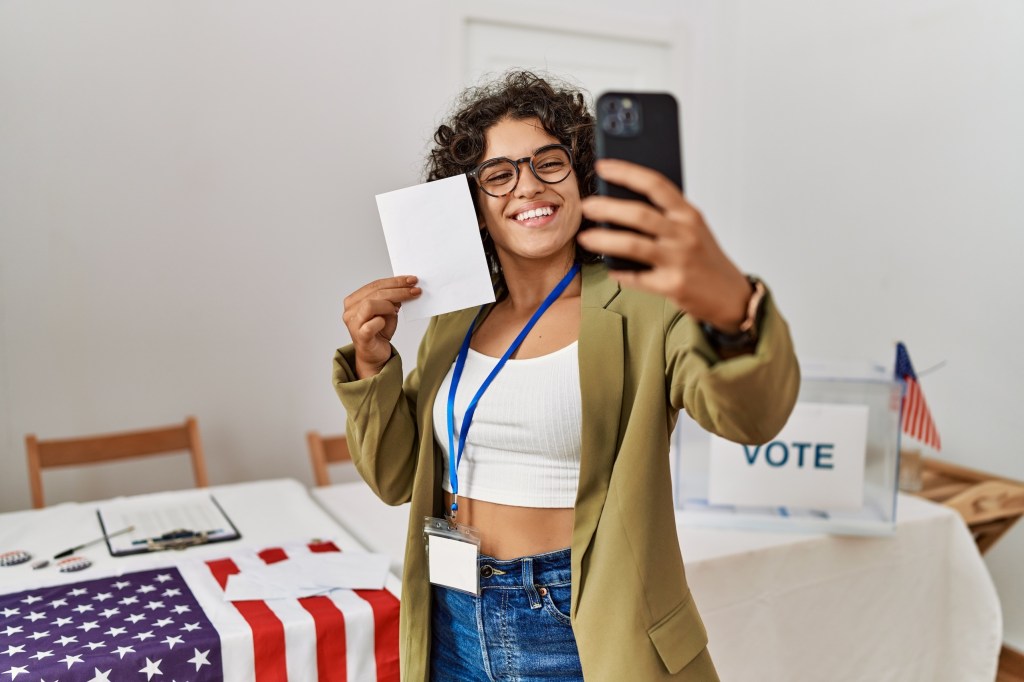
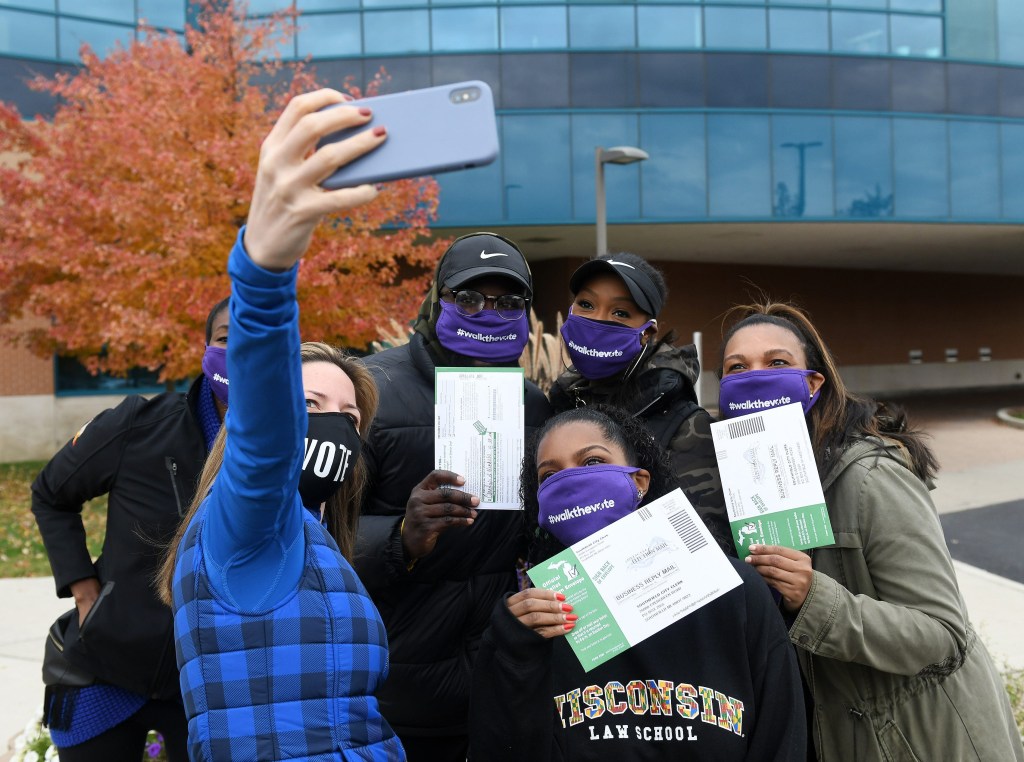
This is not me.

Nonverbal signals are important in any culture. You already know that, so I’m not going to natter on about it. There are some virtues that ought to be signaled. Civic virtue is a good thing. Right now, when we’re facing growing authoritarianism, claiming our civic virtues is critically important.

You may be wondering, “Greg, old sock, what is this ‘civic virtue’ of which you speak?” Well, I’m about to tell you…and I’ll warn you up front it’s rather old-fashioned and maybe a tad sappy. Civic virtue is the general belief among the citizenry that the common good of the public should come before special interests of the few. That’s it, that’s all it is. It’s that whole Spock “The needs of the many outweigh the needs of the few” thing.
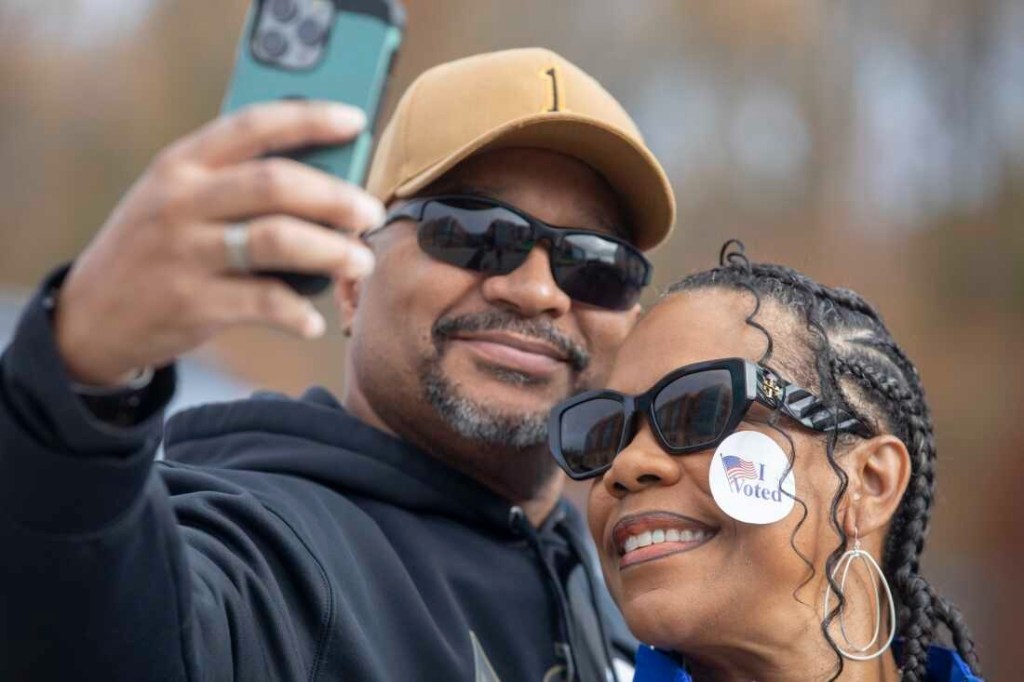
This is not me.

Voting is good. It’s virtuous. Signal the fuck out of it. I firmly believe in the concept of civic virtue. I’m a good citizen. Most of my life has been spent in some form of public service. I vote in every election. I stay relatively well informed on current events. I pay my taxes. I pay my bills. I follow most of the laws most of the time. If I’m in the market and see some product has fallen off the shelf, well I pick that shit up and put it back where it belongs. This is how civil society is supposed to work.
This is not me.

Civic virtue is the primary distinguishing difference between republican forms of government (note that’s small r republican, not ‘Republican’) and monarchical or tyrannical forms. In a republic, power belongs to the public through their elected representatives. Decisions on governance should reflect values and attitudes that promote the general welfare. It’s the polar opposite of a monarchical society, in which decisions on public matters are made by a monarch and based on the monarch’s interests. (Yeah, I’m talking about Comrade President Donald Trump here.)

The so-called ‘Republican’ Party in the US doesn’t support republican ideals. MAGA is essentially a weird, twisted, mishmash of monarchical and consumerist ideologies. Governmental decisions are based on the wants and needs of one person who believes civic virtue and selflessness are for suckers, and wealth is the only true measure of worth, and scams are the best and easiest way to accumulate wealth.
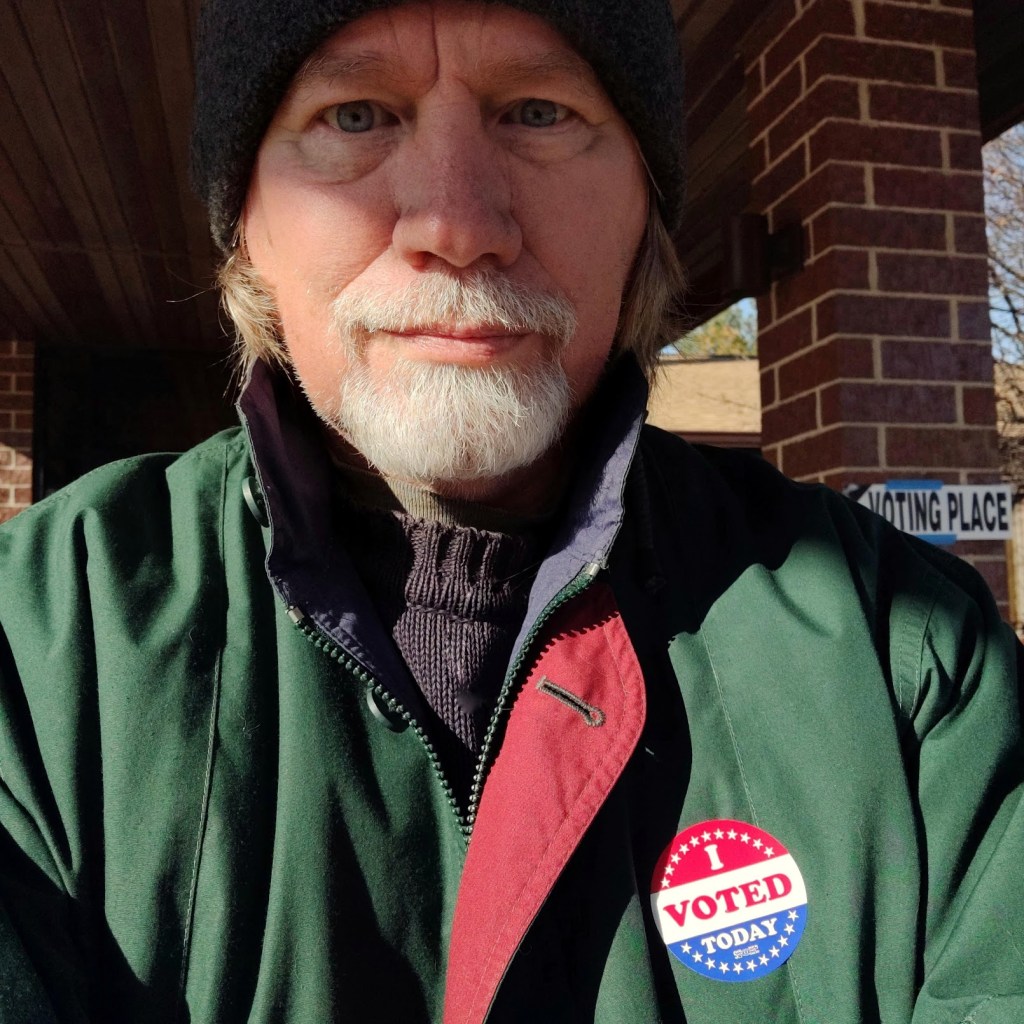
This is me.

MAGA wants us to be embarrassed by expressions of civic virtue. Go vote. Take a selfie with your “I Voted” sticker. Post it on social media. Tell MAGA to go fuck itself with a chainsaw.


a modest ebike proposal

Okay, first, this is NOT a Jonathan Swift-style modest proposal (see Endnote). This isn’t satire. Second, yes, okay, maybe I’m focusing on this relatively minor problem in an attempt to dodge thinking about the truly massive, cataclysmic problems we’re facing in the US. But hey, it’s my blog and I get to do what I want.

The fact is, there’s a very real problem in the Ebikeverse, and I have thoughts about it. I’ve been thinking about this problem off and on for a few months, in part because I had a minor disagreement with a fellow cyclist/photographer on Bluesky. He’d made a rather broad, disparaging comment about ebike riders. As an ebike rider, I asked for clarification. It turned out he was talking about a specific type of ebike, which he referred to as “not-a-moped” ebikes. These little bastards.

Ride1up Revv 1 FS

I responded to his comments:

It’s a mistake to equate all ebike cyclists with not-a-moped jerks, who I’ll agree are a massive problem.

I can’t quote his reply exactly because…well, he’s blocked me (see the Other Endnote). Basically, he said the people who ride that type of ebike were assholes. I responded that assholes are assholes, regardless of the type of bike they ride. At which point, he blocked me. Perhaps he thought I was calling him an asshole. Who knows?

But he was right about the problem. A sizable chunk of the people who ride this particular style of ebike DO tend to be aggressive jerks who are abusive and a danger to regular cyclists and pedestrians. But he was wrong to call them not-a-moped bikes, because (in my opinion) they actually ARE mopeds, not bicycles. They may have pedals, but they aren’t really designed to be pedaled; they’re designed to be driven using a throttle.

In the US, ebikes are basically categorized by how they’re powered. Class 1 ebikes rely exclusively on pedal assist (they’re technically called ‘pedelecs’).They have a top speed of 20mph and they lack a throttle. Class 2 ebikes are basically Class 1 ebikes, only with a throttle (which is used most often to get the bike moving again after a complete stop). Class 3 ebikes have pedal assist and a throttle, but have a top speed of up to 28 mph.

There are also Class 4 ebikes, which generally have more powerful motors and aren’t limited by a top speed. They’re considered to be motorized vehicles and (in many states) require a license to operate, as well as proof of insurance. They’re generally prohibited on bike paths.

The ebike/mopeds I’m talking about (like the one pictured above) are the bastard children of Class 3 and Class 4 units. They’re marketed as Class 3 ebikes and sold as Class 3 ebikes, but they’re not ridden like ebikes. Everybody knows this. In fact, in a review for the Ride1up Revv 1 FS shown above, it’s openly admitted.

[It] isn’t a bike, at least in conventional terms. The presence of pedals on little crank arms is more incidental and added to skirt existing laws about electric mopeds…nothing about the bike’s weight, geometry, or gearing is built for actual pedaling.

They’re designed to be throttle-driven. While they may be sold with a top speed of 28mph, they’re easily modified to go much faster, and there are lots of videos showing people how to do it (for example, here’s a video showing how to unlock the ‘bike’ in the photo above). And this is why they’re a problem.

So here’s my modest proposal: designate this specific type of ebike as a Class 4 ebike and establish an age limit for purchasing Class 4 ebikes.

That’s it. Don’t allow manufacturers to skirt existing laws by attaching mock pedals to a vehicle designed to be throttle-driven. It won’t stop assholes from riding like assholes, but it would reduce the asshole quotient on bike paths and sidewalks.

Endnote: Back in 1729, Swift wrote a satirical piece called A Modest Proposal for Preventing the Children of Poor People from Being a Burthen to Their Parents or Country, and for Making Them Beneficial to the Publick. The proposal was that poor folks should sell their children to the rich for food. So, nothing at all like my proposal.

Other Endnote: Even though I was blocked by this guy, I can’t/won’t complain about it. I’m a huge fan of the way blocking works on Bluesky. It’s incredibly effective and efficient. If somebody is annoying you, you block them and they disappear. You’ll never see anything they post again. They’ll never see anything you post again. If somebody you follow responds to a post by the person you blocked, you’ll see the response but not the post itself. It’s brilliant (even when it’s used against you).

the curious incident of the diner at midday

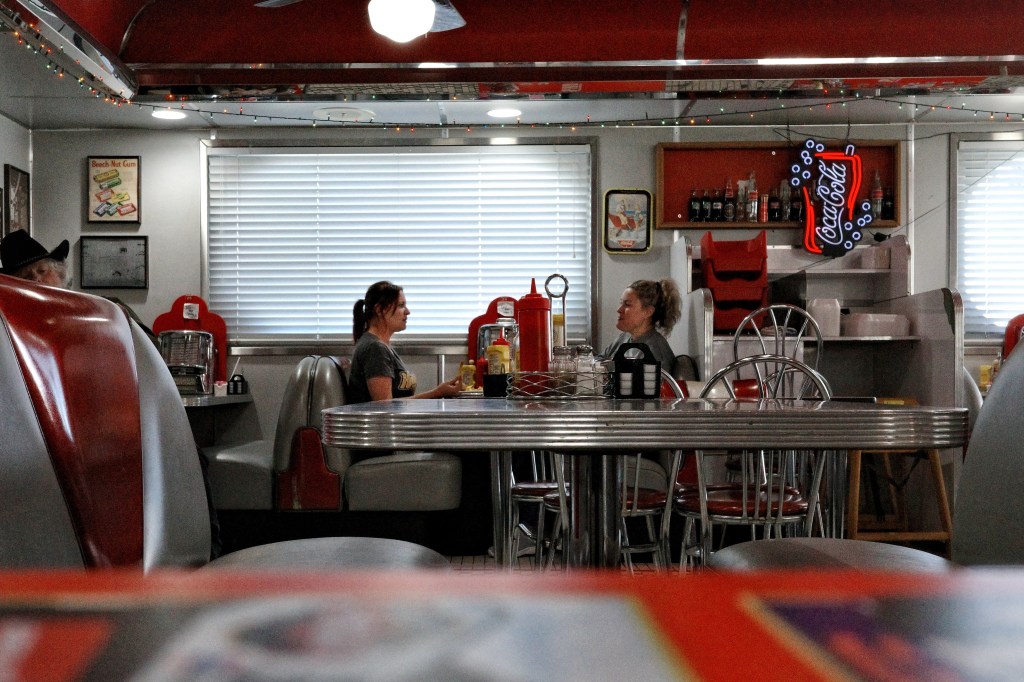
Here’s one of those photography ethics things. I was sitting in a booth in a quintessential American lunch-car diner with my camera on the table. While looking at the menu, I heard the sound of stressed voices coming from across the diner. I glanced over, saw two women who I thought had a family resemblance staring at each other. The light was nice and the scene had some drama. What to do?

  1. Mind your own business?
  2. Turn your camera on the table and shoot a quick photo without looking?
  3. Pick up your camera and photograph the situation?

Obviously, the most ethical thing to do is 1) Mind your own business. I had no idea what the situation was, it had nothing to do with me, and the two women involved would almost certainly prefer to be ignored.

But if you’ve ever practiced street photography–or if you’ve ever wanted to practice street photography–you know that people are often most interesting and most honest during emotionally charged moments. And those moments are almost always worth photographing. So some/many photographers would at least consider options 2 and 3.

You have to be a complete asshole to choose option 3; to pick up your camera and openly, deliberately invade their privacy. Option 3, however, has the dubious advantage of being honest and direct, whereas option 2 is, let’s face it, sort of underhanded. The thing about option 2–shooting without looking, without composing–is you’re allowing the fickle Gods of Photography determine if you get a decent shot or not. If the shot sucks, then it will get binned and nobody has to think about it.

If the result works as a photograph, then both options 2 and 3 set up a secondary ethics challenge: do you further violate the privacy of these two women by posting it? If you choose to post it, do you post it on a very public social media platform (like, say, BlueSky or Instagram) or on a significantly less popular platform (like, say, your blog)?

Obviously, I chose option 2. Well, sort of. I mean, it’s not like I sat there and considered all the ethical questions. I took the photograph without considering anything at all, completely unhindered by any thought process. I turned the camera on, turned it toward their table, touched the shutter release, turned the camera off, and didn’t think about it again until I got home and looked at my photos.

And hey, I got lucky. It’s a pretty good shot (in my opinion).

This is the shot in question.

Obviously, I decided to post the photos here, on my personal blog. I’ll also post links to the blog on Facebook and BlueSky. How do I justify this? I’m relying on the Men in Black defense. If you’re in a public place: don’t start nothing, won’t be nothing. If you raise voices in a public setting, the public will look at you. Sure, few of them will take your photo, but a photograph is essentially nothing more than an extended look. You don’t have a reasonable expectation of privacy in a public setting.

Another thing: I’ve no idea what these women were talking about. I don’t know if they were arguing, if they were upset with each other or with something else, if their distress was sincere or in jest, if one was distressed and the other wasn’t. I don’t know because I didn’t pay any attention to them (other than to note their voices were momentarily raised). They could have been outraged by the portions or the size of their bill, for all I know.

That said, it’s important (to me, at any rate) not to fully absolve myself. The women may not have had a reasonable expectation of privacy while talking to each other in a very public diner, but I didn’t have to pay attention to them. While I didn’t make any effort to take a good photograph, the fact remains that by taking any photograph I invaded what they probably thought of as a private moment.

Was it worth it? I don’t know. I think it’s an interesting photograph. The chance that either of them will ever see this…or that anybody they know will ever see this…are incredibly slim. I could probably legitimately make the ‘No harm, no foul’ argument. But maybe this type of photography is a social harm in and of itself. I don’t know.

Here’s the thing: I spent several years as a private investigator. Much of my work (which was primarily criminal defense investigation) involved making ethical decisions in the immediate moment–and there was rarely any obviously correct decision in those moments. So I’m used to questioning my ethics. It’s easier with photography. With photography, you can always take the shot and delete it later IF you decide it was inappropriate or unethical. In photography, you have that leeway.

Looking at the photo, I don’t think the level of tension between the two women is terribly obvious–unless you’re looking for it. I don’t think there’s any ethical reason NOT to publish it. Others may disagree, but I’m comfortable with my decision.

surrendered

Confederates: Okay, okay, you “won” the war. We give up.
Union: About time.
C: So basically you’re saying we can’t own black people anymore.
U: You can’t own ANY people.
C: What about Indians?
U: No, you can’t own native people.
C: Mexic…
U: No.
C: …
U: …


C: How about if we just keep them poor?
U: Why would you do that?
C: Somebody has to do all the shit jobs, right?
U: Well…
C: And we can provide them with alcohol and drugs.
U: Again, why would you…
C: For their own good. Look, they’re going to be doing shit jobs all day for little or no money. You don’t want to give them a little something to ease their pain?
U: Well, when you put it…
C: C’mon, it’ll give them something to sing about.
U: I dunno. I guess it would…
C: Good. We’re agreed.
U: If it’ll stop all the fighting, sure.
C: We’re not going to let those fuckers vote, though.
U: sigh

in a small town

I wouldn’t know Jason Aldean from Adam’s off ox, but he’s stirred up a fuss with his song Try That in a Small Town. I say ‘his song’ as if Aldean wrote it. He didn’t. The song was actually written by four guys: Kelley Lovelace, Kurt Allison, Neil Thrasher, and Tully Kennedy. Aldean just recorded the song.

Anyway, I listened to it. I sort of assumed it would be a traditional country-western song. You know…simple form, folksy lyrics, standard country music instruments (like fiddles or banjos or a steel guitar). But it’s not. Musically, it’s rock. Fairly hard rock at that. But the lyrics are sung in a sort of semi-traditional nasal country voice. Like a lot of country music, though, it’s short. Three minutes. Which is plenty long enough.

It’s the lyrics, of course, that make this song controversial. The lyrics were clearly intended to be controversial. The lyrics were meant to make everybody angry–to get folks to argue about it. It’s not so much a song as it is a musical grift. Get folks pissed off, keep the song in the public eye, put some coin in pockets.

It’s basically a cartoonish MAGA anthem made up of racist right-wing nightmares, faux tough guy attitude, hollow patriotism, all backed up with threats of violence. It’s a classic MAGA conglomeration of self-pity, masculine insecurity, misogyny, and free-floating resentment and rage. It’s a song written by assholes, recorded by an asshole, meant to be consumed by assholes.

Seriously, it would be comical if it weren’t so stupidly hateful and transparently phony. Try This in a Small Town is the musical version of a dentist buying a Harley and wearing leathers. It’s a mall security guard who joins a ‘militia’ and wears camo with his ‘warrior’ buddies on weekends. It’s the appliance store assistant manager who believes he was passed over for promotion because he’s white and male.

Try that in a small town
See how far ya make it down the road
Around here, we take care of our own

That’s the ugly heart of the song, right there. We take care of our own. If you’re not one of our own, you don’t belong and you’d best get the fuck out of town.

And hey, people have done just that. Folks who don’t fit in their small hometowns have always packed up and left. That’s one of the main reasons small towns are failing. The kids who are bored have left. The creative people have left. The curious people have left. The people who ask too many questions, they’ve left to find answers. And most of them don’t come back.

I recommend you don’t
Try that in a small town
Full of good ol’ boys, raised up right
If you’re looking for a fight
Try that in a small town

The ONLY people looking for a fight in a small town are the ones who are so absolutely certain they’re right; the ones who get to define ‘our own’. If you’re in the minority, you’re looking to avoid a fight. You know you’re not welcome, you know you’re outnumbered, and you know there are folks in your community who hate you and are actually eager to kick the everloving shit out of you. So you leave the first fucking chance you get.

And hey, that’s what happens. The people who don’t fit in, they leave. The young leave. The creative people leave. The curious people leave. The people who get bored leave. The people who want more from life, they leave. The people who want to try new things, they have to leave. The people who write songs, they leave.

There are actually a LOT of good songs about small towns. Songs that aren’t specifically designed for rage-grifting. Songs in almost every musical genre. Songs that look realistically and honestly at life in small towns. Some of them are celebratory, some are nostalgic, most of them are sad.

And over a double Bourbon
He said “I’ll tell you man to man,
This town died forty years ago.
Son, get out while you can.”

You want to know about life in small towns? Don’t look to assholes like Jason Aldean.

c’mon, we’re talking about elves here

In yet another episode in the continuing saga of Whiny-ass Complaints of Butt-hurt MAGA Fuckwits we learn there are people who are offended by the notion that elves aren’t necessarily White People. Seriously. This idiotic fuss is about the new Lord of the Rings prequel that has apparently just been released (see Editorial Note at the end).

“Casting a non-White actor to play an elf makes it more difficult for audiences to maintain their willing suspension of belief.”

No, it doesn’t. Casting a non-white actor to play an elf makes it more difficult for racist assholes to maintain their willing suspension of disbelief. The quote above was, according to CNN, from Louis Markos, who is apparently the author of From A to Z to Middle Earth with J.R.R. Tolkien.

This Markos guy gets at least three things wrong. First, of course, is he misquotes Samuel Taylor Coleridge’s phrase– the willing suspension of disbelief. Back in 1817, Coleridge suggested that if a writer introduced “‘human interest and a semblance of truth’ into a fantastic tale, the reader would suspend judgement concerning the implausibility of the narrative.” This is why television viewers were willing to watch 12 seasons of Murder, She Wrote–they were willing to suspend their disbelief that Jessica Fletcher encountered more than 250 murders in the small Maine village of Cabot Cove. All fiction depends to some degree on the reader/viewer’s willing suspension of disbelief.

Second, Markos says casting actors of color as elves threatens the story’s ‘believability’ because Tolkien described elves as “fair-faced.” The term fair comes from the Old English term fæger, which when applied to living things meant “pleasing to the eye, attractive” and when applied to weather meant “clear, bright, pleasant”. Tolkien, remember, was an academic who studied Old English and Anglo-Saxon literature, and had at one time worked for the Old English Dictionary as an expert in etymology. He knew what ‘fair’ meant and how it applied to faces. Markos clearly doesn’t. Or–and I suppose this is a real possibility–he simply doesn’t believe non-White folks can be pleasing to the eye. It’s fucked up either way.

Wait…what’s this? Could it be? Elves of color? What?

Third, Markos claims casting actors of color “…is not something organic that’s coming out of Middle-earth. This is really an agenda that is being imposed upon it.” He’s almost got a point here. Almost. Tolkien’s Middle-earth is based on the Norse Miðgarðr, which they broadly described as the world “inhabited by and known to humans.” In the literature, Miðgarðr actually referred to the defensive wall around the world constructed by the gods from the eyebrows of the giant Ymir (which, by the way, requires some serious fucking suspension of disbelief). But Tolkien used Middle-earth to describe an imaginary period of the Earth’s past when peoples other than Men (elves, dwarves, trolls, hobbits, orcs, ents, etc.) still inhabited the planet, although in dwindling numbers. His Middle-earth did sort of correspond to western Europe in terms of geography.

But to my knowledge, there’s nothing Tolkien wrote to suggest peoples other than Men (and Tolkien used ‘Men’ to refer to all humankind) were necessarily White. I mean, we’re talking about elves here. If you can’t deal with Black or Asian or Indonesian or pick-a-race elves, then the problem isn’t your capacity to suspend disbelief. The problem is you’re a racist asshole.

EDITORIAL NOTE: I haven’t seen the show I’m talking about, which ordinarily would be a problem. But in this instance, the show itself is less important than the books on which the story is based and the credentials of the person who wrote them. I haven’t been inclined to watch the show, mainly because I had the misfortune of watching the first of Peter Jackson’s wretched interpretation of The Hobbit. That was enough to eradicate any desire to see any new visualization of Tolkien’s work.

But I’m actually hearing good things about this show from people who were as skeptical about it as I was. So at some point I’ll probably watch it.

Also? I usually like to include an image in these blog posts, and I did a quick image search for Rings of Power and saw some images of POC in costume, but since I couldn’t see their ears I’ve no idea if they were meant to be elves or something else. I didn’t want to just drop in some random image of a Black actor who may or may not be an elf, so…no image.

EDITORIAL NOTE 2: Thanks to Mark Alexander, we now have an imbedded image to demonstrate…well, I’m not exactly sure what it demonstrates. That actors of color can play non-human roles in fantasy stories? We already knew that. I guess it demonstrates just how fucking idiotic it is for racists to get frantic about Black actors getting gigs as elves.

an inspiration?

At the end of Thursday’s hearing by the House Select Committee, Liz Cheney made a point of praising the women who testified before the committee. She named Capitol Police Officer Caroline Edwards and Georgia election workers Shaye Moss and Ruby Freeman, as well as Sarah Matthews who had testified moments before. But Cheney singled out Cassidy Hutchinson for particular praise.

“She sat here alone, took the oath and testified before millions of Americans. She knew all along she would be attacked by President Trump, and by the 50, 60 and 70-year-old men who hide themselves behind executive privilege. But like our witnesses today, she has courage, and she did it anyway. Cassidy, Sarah and our other witnesses, including Officer Caroline Edwards, Shaye Moss and her mother, Ruby Freeman, are an inspiration to American women and to American girls.”

Yes. And no. And yes again. Yes, all of these women deserve praise for doing the right thing. But let’s look at the totality of their circumstances. The two Georgia election workers were just doing their job like tens of thousands of election workers in every precinct in the United States. It’s an important job, but not an especially demanding one; it took no courage for them to do the right thing. Their courage was tested afterwards, when they were vilified for having done their job properly. Partisan politics didn’t play a role in their jobs.

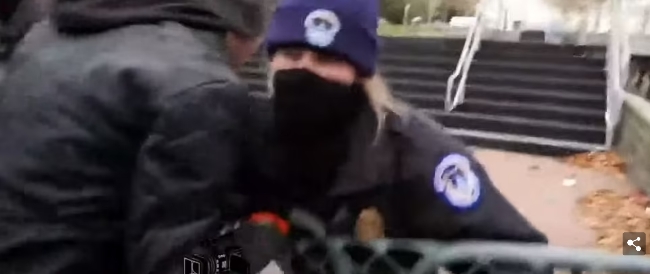
Officer Edwards at the fist barricade

Officer Edwards was doing her job as well, but on January 6th her job put her in direct physical danger. She was one of a handful of officers who were the first line of defense at the Capitol building. They were quickly overwhelmed; she was knocked down, knocked unconscious, suffered a traumatic brain injury–then after she regained consciousness, she went back to work and for several hours fought in close combat with rioters. That clearly took courage and dedication. Partisan politics didn’t play a role in her job.

Partisan politics is why Sarah Matthews and Cassidy Hutchinson had their jobs. They each made a deliberate choice to work in the Trump administration. They supported the Trump administration. They knew who Donald Trump was–how he behaved and how he treated others. They knew his history. And they chose to work for him They directly witnessed how he ran the White House, how he reached policy decisions, how frequently his staff quit or were fired, how he demanded loyalty without returning it. They knew Donald Trump and they willingly supported and represented him.

That makes them complicit in Trump’s behavior. They worked for him diligently for four years, during which they were willing to disregard or condone his bad behavior. It wasn’t until he actively urged an angry mob to engage in a violent insurrection in order to illegally retain power that they decided he’d gone too far.

It’s to their credit that they were willing to draw the line at sedition and insurrection. And it’s to their credit that they were willing to testify against Trump. That took courage, because Liz Cheney is right–they both knew how Trump and his supporters would treat them. Because they’d see him do it to others. Because they were okay with him doing it to others. It took courage for them to step up; but it doesn’t make them heroes.

Officer Edwards, unconscious.

So yes, the courage of these women should, as Cheney said, be “an inspiration to American women and to American girls.” But no, there’s nothing inspirational about being willing to work for corrupt, cruel people until their corruption and cruelty becomes intolerable. And yes, it’s better to draw the line too late than not draw it at all.

They were all just doing their jobs. Cassidy Hutchinson and Sarah Matthews aided a corrupt White House until the corruption became too much for them to accept. Shaye Moss and Ruby Freeman simply processed ballots according to the rules, and were unfairly vilified for it. Officer Caroline Edwards helped provide security for the Capitol Building and protect the people inside.

You want inspiration for redemption, look at Hutchinson and Matthews. You want inspiration for honesty and integrity, look at Moss and Freeman. But if you want a hero, look at Officer Edwards.

EDITORIAL NOTE: Just a reminder that patriarchy is a social structure kept in place by ordinary folks. Pay attention to how people in power treat people with lesser power. Call out assholes, even if they’re people you generally agree with. Support decency, even if it comes from people you disagree with. And every chance you get, add a match to the fire that will burn the patriarchy to the ground.

mtg omg

I watched the Marjorie Taylor Greene Amnesia-Fest yesterday. Technically, it was an evidentiary hearing to determine if MTG should be barred from seeking re-election to Congress based on a violation of Section 3 of the 14th Amendment to the United States Constitution. In practice, it was MTG playing dodge-ball with the Truth, ducking any personal responsibility by claiming she couldn’t remember much of anything about anything.

You may be wondering just what in the name of the Great Bearded God of Goats is in the 14th Amendment. There’s a whole bunch of stuff in it, but the only part that MTG was fretting about was Section 3, which says this:

No person shall be a Senator or Representative in Congress, or elector of President and Vice President, or hold any office, civil or military, under the United States, or under any State, who, having previously taken an oath, as a member of Congress, or as an officer of the United States, or as a member of any State legislature, or as an executive or judicial officer of any State, to support the Constitution of the United States, shall have engaged in insurrection or rebellion against the same, or given aid or comfort to the enemies thereof. 

The hearing was to determine whether there is any evidence that MTG ‘engaged in insurrection’ against the United States (SPOILER: yeah, lots of evidence) and whether the evidence was enough to begin a legal proceeding to remove her from the mid-term election ballot (SPOILER: probably not, but who knows?). The entire proceeding could be boiled down to this:

Lawyer: Ms. Greene, did you do some insurrection against the US?
MTG: I don’t recall.

I’ve seen a lot of trials and hearings, and I think I can say without any hesitation that MTG was a shitty witness. It wasn’t just that she was occasionally dramatic or uncooperative or snarky AF (though she often was), or that her memory was remarkably and conveniently inconsistent, it was the astonishing scope of her lack of memory that was staggering. She couldn’t remember nothing about nothing unless it meant nothing.

Marjorie Taylor Greene swearing to tell the truth, the whole truth, and nothing but the truth except when she can dodge it.

I wouldn’t expect her to remember every pro-insurrection tweet she made, because lawdy, she made a LOT of them. But I’m pretty sure that most folks would remember whether or not they discussed, with the President of These United States, imposing martial law on the US. That’s not the sort of thing that would slip your mind. But that was the level of her denial.

Sadly, I doubt the judge will find the evidence is sufficient to remove her from the ballot for the mid-term elections. It’s pretty clear she was lying some/many/most of the times she claimed she couldn’t recall stuff she’d done, but it’s damned difficult to prove she was lying.

At the heel of the hunt, this will probably be yet another example of a Republican lying, violating the law, and getting away with it. I suspect MTG will get to stay on the ballot and will likely be re-elected. I suspect other Republicans will learn the lesson that they can lie and get away with it.

I keep hoping that someday somebody somewhere will be held accountable for something.