bring me the head of edgar allan poe

I want his head. I want to put it…where should I put Edgar Allan Poe’s head? The mantle is traditional, I suppose. It would probably look silly in the kitchen, next to the coffee maker or on top of the refrigerator. I don’t have to decide now; there’s probably plenty of time to figure that out.

But I want his head. I’m not entirely sure I deserve it, but I won it, fair and square. Really. Last night I won the 2023 Edgar Allan Poe award for Best Short Story. There are probably a lot of benefits that come with winning the award, but the one that has me most excited is Edgar’s head. You get (or at least I’m reliably informed you get) a small bust of Poe’s noggin. How cool is that? Very cool, is how cool.

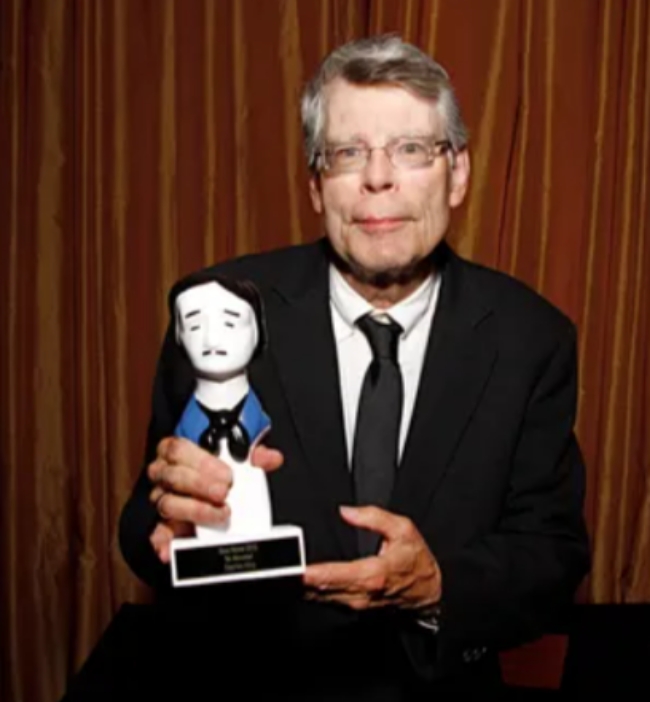
I was curious about the actual size of Edgar’s head (that statuette’s head, not his actual head), so I googled it. And right there, first page, was a photo of Stephen Goddamn King with an Edgar in his hands. So, not exactly life-size (again, I’m talking about Edgar’s head, not Stephen King’s, which I’m pretty confident is life-size), but still.

Look at that, Stephen Goddamn King

Winning an Edgar is really a rather big deal, at least in the world of mystery and detective fiction. There’s a large, enthusiastic, deeply engaged community of folks who love mystery and detective fiction. Writers, would-be writers, fans–they create and join book clubs, reading groups, fan clubs, professional organizations. Groups like the Mystery Writers of America (who sponsor the Edgar awards), Sisters in Crime, and the Private Eye Writers of America–groups that feed and nurture that community. These groups are invaluable.

The thing is, though, I’m not really an active part of that community. I have a lot of respect for it; I’m terribly glad it exists and I benefit from its existence. But aside from writing detective stories, I haven’t contributed to it. I’m just not a joiner. I’m not even a member of MWA, but nevertheless they’re still generously offering me Edgar Allan Poe’s head. That makes me seem a tad ungrateful and vaguely misanthropic, although I’m not. In fact, I’m very grateful and I’m pretty damned anthropic.

At the risk of sounding immodest, I’m a pretty good writer. But there are a LOT of pretty good writers out there (including all the other nominees for Best Short Story). The thing is (in case you were wondering what the thing is), pretty good writers are nothing without a venue for good writing. And I’ve been lucky enough to be associated with two of the best magazines for mystery and detective fiction.

Alfred Hitchcock’s and Ellery Queen’s Mystery Magazines are two separate, independent magazines owned by the same publishing corporation. They are incredibly welcoming to writers, especially new writers. Without them, I’d just be an odd guy sitting in a room making shit up and putting words in a row.

If you have any aspiration to write short mystery or detective fiction, I encourage you to submit your work to either of these magazines. They may not buy your work, but they’ll treat you right. And hey, you might just get a shot at collecting Edgar Allan Poe’s head.

i talk to strangers

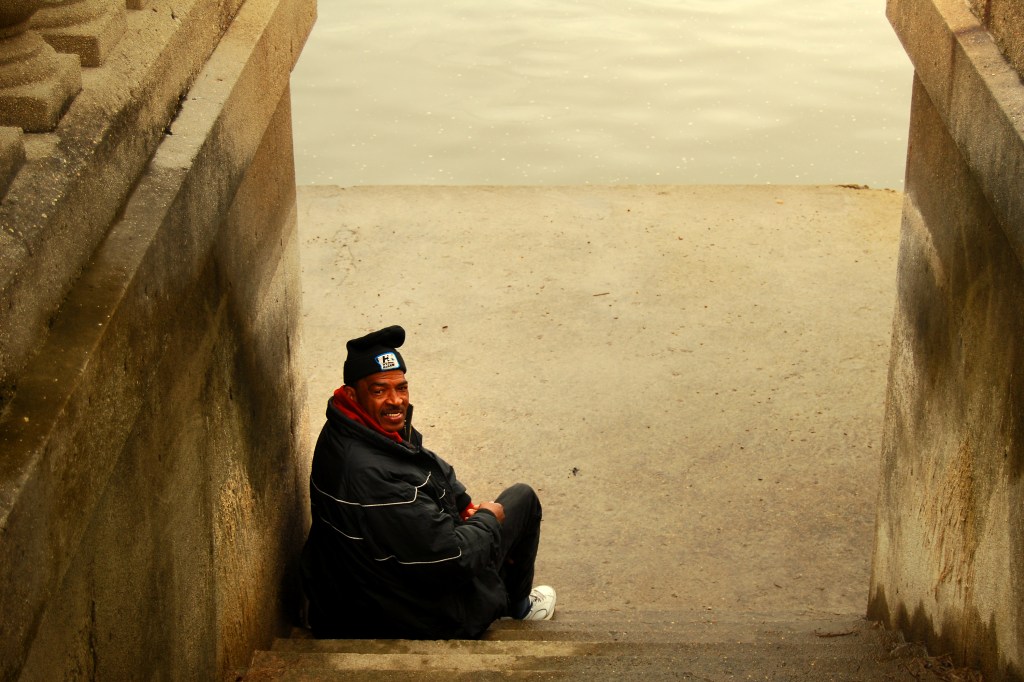
A few years ago, on a cloudy, rainy day, I was taking an idle stroll along the riverwalk in Des Moines and I came across a guy sitting on the steps. We chatted for a bit about nothing in particular. As I was leaving, I stopped and asked if I could take his photograph. He said “You gonna make me look sad or stupid?” I said, “Are you sad or stupid?” and he snorted and said “I sure am.” That’s when I took his photo. When I asked his name, he said “I’m just a guy sitting by the river.”

Just a guy sitting by the river.

I talk to strangers. I like talking to strangers. I like meeting new people and learning something about them. Granted, most of my conversations with strangers are casually superficial, so it’s not like I’m learning anything important or meaningful about them or their lives. But the simple fact of meeting and having an idle conversation with random strangers tells me something about humanity in general.

And this is what I’ve learned: most people are pretty much okay.

Just bought a bunch of children’s science booklets from the 1960s.

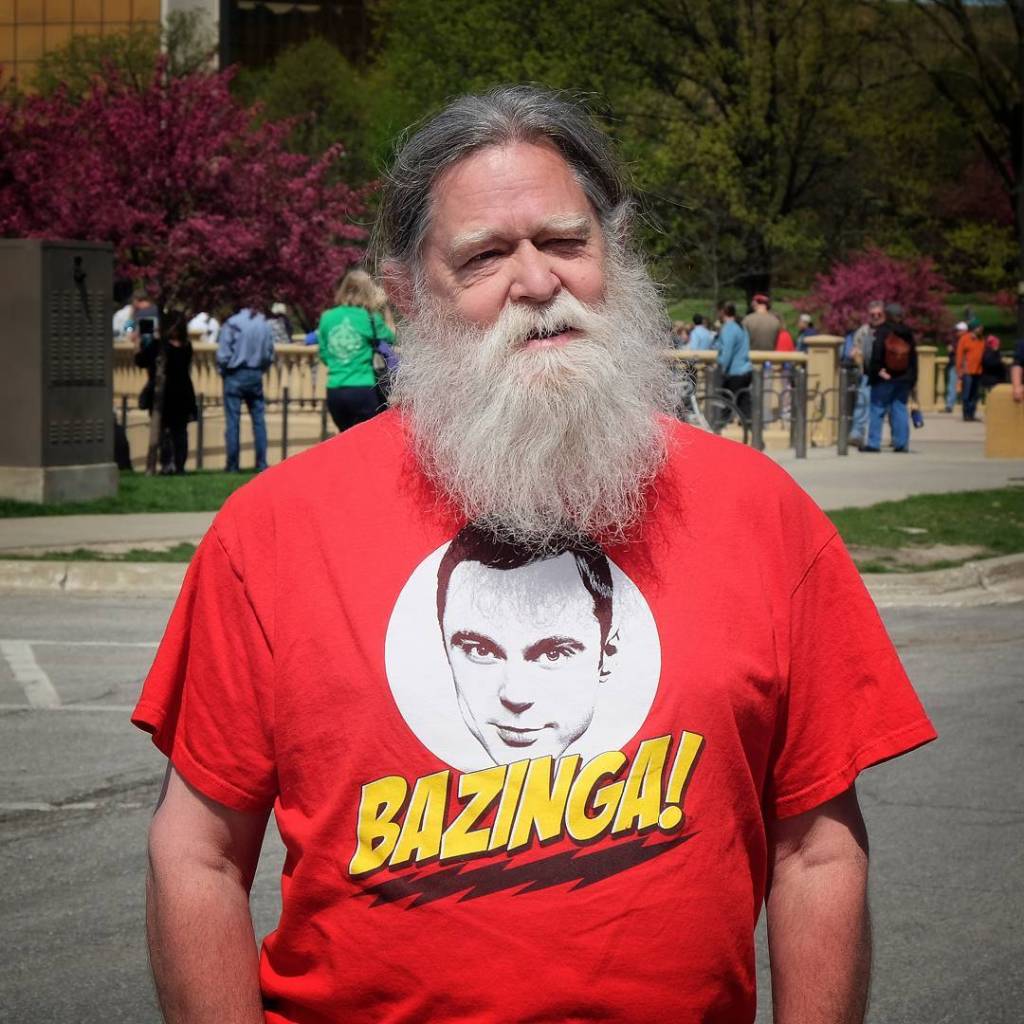
This guy (points up), for example. He’d just bought a bunch of outdated science booklets for kids, and he was happy and excited about them. To me, they looked like badly illustrated pamphlets depicting decades-old information about science. But his enthusiasm was infectious, and I found myself actually interested in the best 1960s approach to dealing with prairie dog overpopulation.

Is that information useful? Nope, not even remotely. But I love knowing that somewhere out in the world is a guy who can give a logical, sincere, and passionate defense of relying on natural predation instead of poison to deal with what ranchers consider vermin.

Mickey, whose story had…flaws

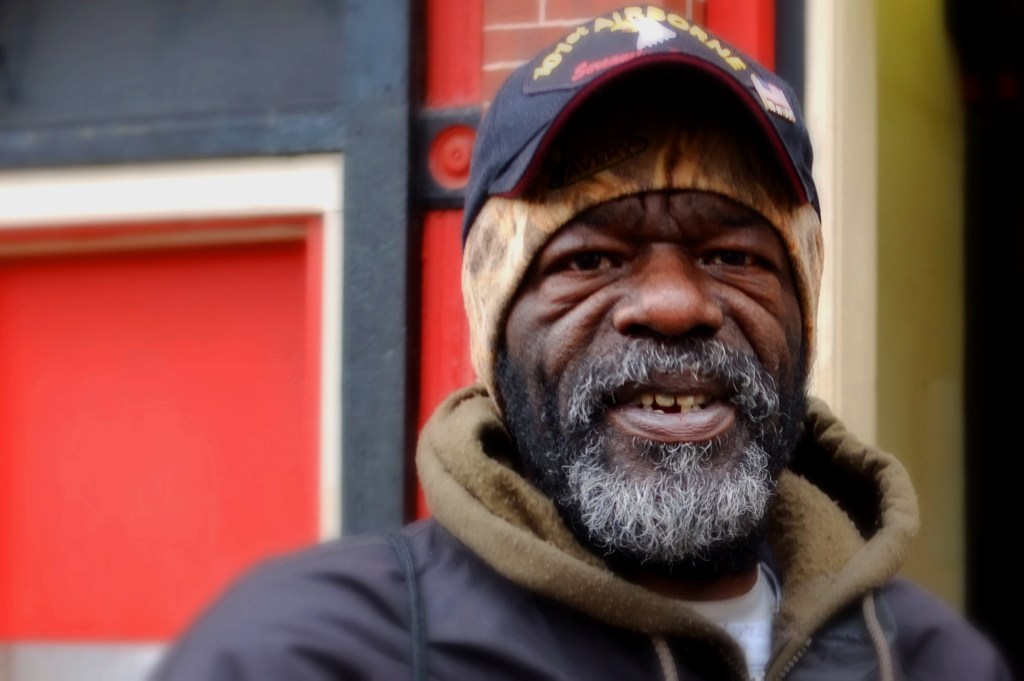
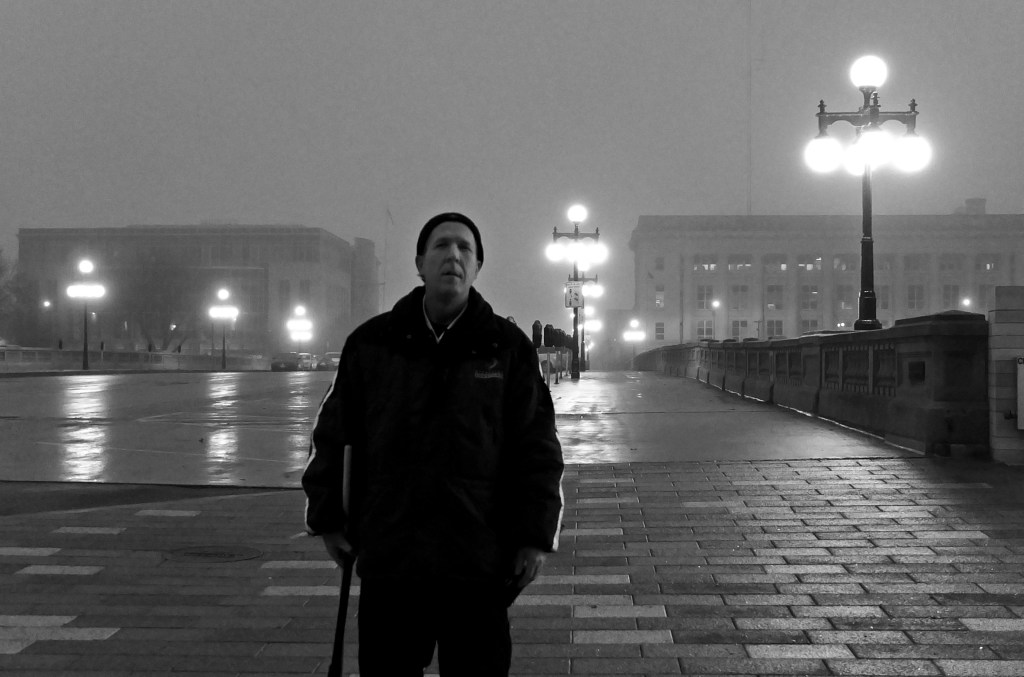
Every stranger I’ve met has a story. They’re not all true, of course. I don’t think that matters. Mickey (above) told me he was a disabled veteran. And who knows, maybe he was. He had a Marine Corps emblem on his jacket but his cap said 101st Airborne, which is a division of the Army. He was using a hand-carved walking stick, which I admired–and that’s how we struck up a short conversation. It was too chilly outside to chat for very long, and as we parted I gave him a quick salute–which he returned.

Here’s a True Thing: in basic military training, they literally teach you how to salute. How to hold your hand and wrist, the proper position of your upper arm, the correct incline of your elbow. They make you practice this over and over until it becomes automatic. Mickey didn’t know how to perform a proper salute. Does that mean he was lying about himself? Maybe. Maybe not. Again, I don’t think it matters. His story didn’t have to be true; it still told me something about what he believed and who he’d like to be and what he finds important.

James, sitting under a bridge

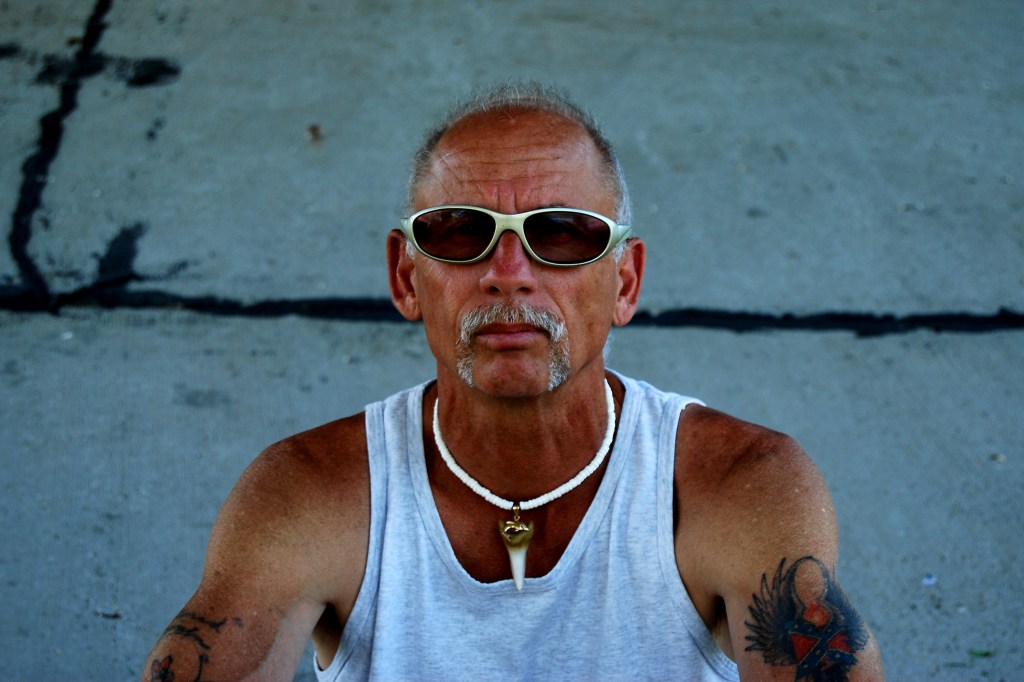
I met James on a hot summer day, sitting under a bridge. I was riding my bike, he was sitting in the cool shade drinking something in a brown paper bag. I stopped to get a drink from my water bottle. We discussed the heat, of course, but James also told me he worked at a nearby theme park; he liked to get away from the noise and the people, and the bridge was within walking distance. It was relatively quiet, cool, and it gave him a bit of what he called “down time.” You could tell James had been around a long, hard block–probably more than once–but he had a weird sort of muted raffish elegance about him. The careful way he trimmed his facial hair, his necklace, his sunglasses, his ornate tattoos–it’s as much about who he wants to be as who he is. And who knows–maybe he actually is who he wants to be.

Guy pushing his bike

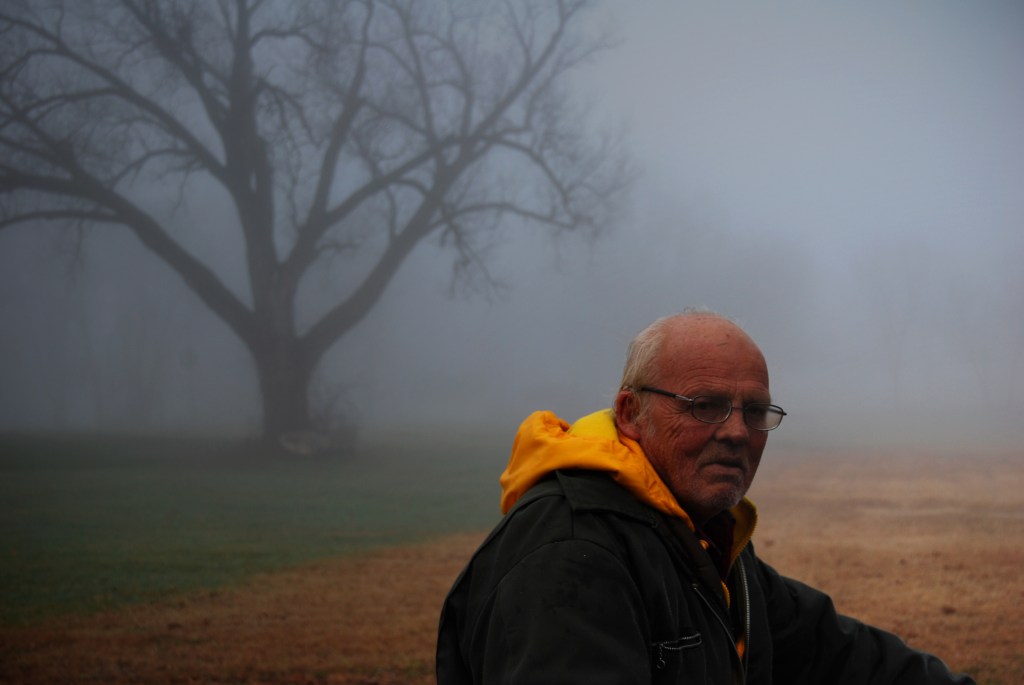
Meeting strangers is easy; they’re everywhere. But it’s getting a wee bit more difficult to get them to talk. People are increasingly suspicious of strangers. I guess I can’t blame the guy in the photo above for being suspicious. It was a cold, foggy morning. I was riding my bike; he was walking a bike. So I stopped to ask him if he was okay, if he needed help with his bike. He hesitated, then said, “I’m okay; I live nearby.” I told him I had a small tool kit in my bike bag and I’d be happy to help if I could. He shook his head. He was clearly uneasy, so I let it go. Instead, I asked if I could take his photo. He asked, “Why?” I said something about his yellow hoodie and the fog, which probably didn’t make any sense to him. But he said, “Okay.” I took his photo, wished him good luck, and went on my way.

I wondered later if maybe the guy didn’t want me reaching into my bike bag. Maybe he thought I carried a gun there. Some people do. On one cycling forum I follow, there are lots of discussions about self-protection on bikes. People are afraid they’ll be attacked as they ride or when they stop, afraid they’ll maybe get bike-jacked. A lot of those fearful people have opted to bike armed.

Scared people are the last people who should be carrying firearms. But we now live in a world in which wrong-place shootings take place on an alarmingly regular basis. It’s inevitable, I suppose, that somebody will get shot for being on a bike in the wrong place at the wrong time (assuming it hasn’t already happened somewhere). The fact that a term like ‘wrong-place shooting‘ even exists is an indictment against our society. I’d argue one of the reasons we have wrong-place shootings is because fewer people are willing to talk to strangers. All day every day there’s a ‘news’ station that injects fear porn directly into the veins of its viewers. They tell folks that ‘others’ are out to get them, to take their stuff, to molest their children, to break into their homes, to take away their rights, to destroy their religion, to confiscate their guns. Of course, they’re frightened.

Kent, keeping the streets clean.

This is Kent. I met him on a cold, foggy morning too. He was walking the streets, sweeping up the trash other people (and their dogs) left behind. He’d been keeping the city streets clean for nearly three years. I asked him about his work. He said, “It’s not a bad job. I like being outside. I get to meet people, walk around, don’t have to stay in one place.” He’d learned which business owners were nice, which ones ignored him like he wasn’t there, which ones were rude. He wouldn’t identify any of the rude ones. Kent said there were about a dozen people who worked cleaning up the downtown area. He thought most of his co-workers were okay; a couple were lazy and some complained about the weather, but basically they were good, decent people. He knew most of the people he met on the street didn’t appreciate his work, but he said clean streets sidewalks make the city a better place. He wouldn’t say his job was important, but it was clear he felt he was doing something worthwhile.

These are just a half dozen of the many strangers I’ve talked to in recent years. All of them have been interesting in some way. All of them are connected in some way, if only by a shared community or a shared humanity. And I like to feel I’m connected to them as well. A guy feeling sad and stupid sitting by the river, a guy excited about science for kids, a guy who maybe lied about his past, a guy sitting quietly under a bridge, a nervous guy afraid to ask for or accept help, and a guy who gets up every morning and tries to make city life a little bit better. These people–these strangers–have enriched my life.

We don’t have to live in fear and isolation. We don’t have to be afraid of strangers. At the risk of sounding hopelessly like a Pollyanna, I truly believe the world would be a lot better place–and we’d all be a lot more relaxed–if we’d just take a few moments and talk to a stranger.

do i gotta use words?

On some social media platforms I describe myself as a writer and a photographer. That recently led to an interesting question. I was asked:

“Do you shoot photographs the same way you write? Do you write like you shoot photos?”

My response was pretty simple: Never thought about it. And then, of course, I started thinking about it. I probably spent most of an afternoon thinking about it. Well, that’s not really accurate. I thought about it off and on for an afternoon. Because that’s a thing I do; I think about stuff.

Morning light, drinking coffee

My first thought was: Well, maybe I do. I mean, it was worth considering. Both writing and photography are vehicles for self-expression. They’re both grounded in craft rather than art, although they’re amenable to art. Do I need to go into the difference between art and craft? I suppose I do…but briefly. Basically, craft is about structured skills that can be learned whereas art is about unstructured imagination. I think that’s brief enough.

Anybody of average intelligence can learn the skills involved in writing and photography, stuff like the mechanics of grammar or the mechanics of exposure, or how to use punctuation in a sentence or determine an image’s depth of field. So in that sense, sure, I write and shoot photos in the same way. Learn the skills, apply them to the work.

But there’s a lot more to fiction than being able to write a complete sentence; there’s a lot more to creative photography than being able to correctly expose a photo. It all comes down to composition: 1) choosing what gets included, 2) what gets excluded, and 3) how it’s presented.

Because while writing and photography are both vehicles for self-expression, they’re completely different vehicles. Asking if me if I write the same way I shoot photos is like asking me if I drive a truck the same way I paddle a kayak. It’s like asking me if I sing the same way I play the banjo. (Okay, I don’t actually play the banjo, but you get the idea.)

I can articulate my reasons for crafting sentences and paragraphs. I’m aware as I’m writing why I arrange scenes the way I do. I know I’m trying to amuse the reader, or distract the reader from something in the story, or foreshadow an event that will take place later, or reveal something about a character.

I can’t always articulate why I shoot a photograph. Sometimes there’s just something about the arrangement of the world that pleases me. Looking through a camera’s viewfinder allows me to put a border–a frame–around a chunk of the world. At that point it becomes about arranging the world within that frame. A step to the right, two steps forward, dropping down on a knee–all of that changes the arrangement of the world inside the frame. But I’m not always aware of why a specific arrangement pleases me. Afterwards, looking at the photo, I can sometimes perform a sort of autopsy on the image to figure out what I was seeing at the moment I shot the photo.

Seven posts

(Sorry…here’s a tangent. Autopsy is from the Greek auto, meaning ‘self’, and opsis, meaning ‘see’ or view’. It basically means ‘to see for yourself’. Since the late 17th century autopsy has been used to describe a forensic dissection of the body to see for yourself what caused the body to die.)

Anyway, having thought about the question ‘Do you shoot photographs the same way you write?’ I decided to do a brief autopsy on a few photos I shot recently. The first was shot while I was sitting drinking coffee and reading the news–the morning light coming through a window. The other two were just things I saw during a semi-short road trip to find a small town diner for lunch.

The first photo autopsy was easy. I was just pleased by the momentary arrangement of light and shadow, of lines and shapes. And it was momentary; five minutes later the earth had rotated enough that the light through the window had shifted and was no longer interesting. But THINK about that for a moment. That photo depends entirely on the alignment of the solar system. How cool is that?

I suppose the second and third photographs also depended on the cooperation of the solar system since all photography depends on light, but not in such an immediately obvious way. They’re photos of ordinary crap you’d see in the Midwest countryside. Some posts marking the boundaries of a parking area in a public hunting zone. A blue corrugated metal shed. Why were they worth photographing?

Okay, I’m going to get even more pretentious here. There was a French poet-essayist-philosopher with the cumbersome name of Ambroise Paul Toussaint Jules Valéry (though he’s normally just called Paul Valéry). He wrote:

To see is to forget the name of the thing one sees.

That reads like a Zen koan, except that Valéry’s comment actually makes some sort of sense–or at least it does to me. The photo of the blue corrugated metal shed doesn’t depend on it being a blue corrugated metal shed. It’s ‘shedness’ is irrelevant. What matters is that it offers three different shades of blue, which pair well with the softer blue of the sky. What matters is the sharp angular lines of its shape, which contrasts nicely with the sinuous way the gravel road curves around it. It doesn’t matter that those three utility poles exist to distribute low voltage power to customers while keeping the cables insulated from the ground and out of the way of people and vehicles. It only matters that they provide a sense of balance to the overall image.

To see is to forget the name of the thing one sees. To forget the thing’s purpose, its use, its reason for existing. Those things can contribute to the complete effect of an image on the viewer, of course. I mean, the photo of the blue corrugated metal shed could be seen as a commentary on how humans have transformed the prairie by organizing its resources for commercial purposes. The photo of the posts in the parking area of a public hunting zone could serve as a reminder that early residents of the area hunted game in order to survive (and some still do).

But that’s all gravy. The photographs either work (or fail to work) on their own compositional merits. The words don’t always matter, and they shouldn’t. The visuals displace and supplant the words.

So there’s my answer. Nope, I don’t shoot photos the way I write. And more apologies, but here comes another pretentious moment. This is from TS Eliot’s Fragment of an Agon:

I gotta use words when I talk to you
But if you understand or if you dont
That’s nothing to me and nothing to you
We all gotta do what we gotta do

I’ve got to use words when I talk to you, but not when I show you something. But if you understand the words or images or if you don’t, that’s nothing to me. And really, it’s nothing to you either. We’ve all got to do what we’ve got to do.

me and edgar

Okay, good news. This morning I learned I’ve been nominated for an Edgar. The Mystery Writers of America have been handing out Edgar Allan Poe awards for short fiction since 1951. The nominations are announced on Poe’s birthday, which is today. Getting nominated is a pretty big deal in the mystery and detective fiction biz.

The nomination is for a short story called Red Flag, which deals with red flag laws (hence the clever title). It’s a story about a man whose career was ended by a mass shooting. He returns to his home state of Michigan, tries to live a quiet life, but gets reluctantly drawn into a situation. A mother is concerned about her son–an alienated young man she’s afraid is thinking about committing a mass murder. Because the young man has broken no law, local law enforcement can’t do anything. So the protagonist cobbles together a sort of plan in the hope of disrupting what he sees as the inevitable mass murder attempt.

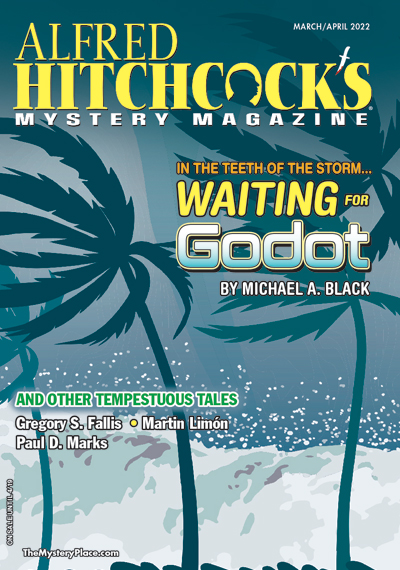
It’s an odd story. I was having lunch in a brew pub in a small Iowa town when I learned Alfred Hitchcock’s Mystery Magazine was going to publish it. I was delighted. The very next morning, there was a high publicity mass shooting in a Michigan high school; four students were killed and seven wounded. Lots of people were aware of the shooter’s emotional problems–his parents, school officials, other students. They all knew he’d made vague threats about a mass murder. They knew he had access to a firearm. A red flag law would have allowed the police to remove that firearm, which might have prevented the tragedy.

The coincidence of selling a story about a potential mass murder in Michigan and an actual mass murder in Michigan less than 24 hours later was weirdly discomfiting. Obviously, there was no connection. And yet, it bothered me. Still does, in fact.

So I have mixed emotions about the story, about its publication, and about this nomination. I’m obviously chuffed about it. But I can’t entirely enjoy it. I’ll always associate this story with tragic events. And since I live in the United States, there’ll always be another tragic event.

Today is January 19th. So far this year there have been at least 33 mass shooting incidents in the US, resulting 48 deaths and 128 wounded. There’ll almost certainly be another one today.

I’m incredibly pleased to have been nominated for the Edgar. But I sort of hope I don’t win. I hope more people will read the story. I hope we can change our culture. I have hope.

But not very much of it.

UPDATE: Yer boy won the Edgar.

return of the sunday salon

I’ve been shooting photographs for most of my life. I’m a competent photographer. But for most of my life, I was also pretty ignorant about the history and culture of photography. Oh, I knew the names of some of the Big Hats in photography and could probably recognize some of their photos. But I had no real understanding at all of what had been done in photography, or who had done it, how they’d done it, or what they were thinking when they did it. I was the Jon Snow of photographic culture. I knew nothing.

So I set out to correct that. I decided to educate myself. I did it in a fairly haphazard and casual way– picking a photographer who’d caught my attention for some reason and doing some research on them. I also decided to share what I’d learned. At the time, I was the managing editor for Utata, an online collective of smart, creative, funny, curious people who enjoyed photography and discussion in equal measure. So I wrote a short essay on the photographers I studied and used those as a foundation for discussion in the group’s online forum on Flickr.

It was fun at first. I did an essay every week. Then after a while, it was every other week. It was still basically fun, and I learned a lot. But after a few years, it became a chore. A pleasant chore, for the most part, but still a chore. And like one does with a chore, I began to find reasons to avoid doing it.

And then I stopped.

I just didn’t want to do it anymore. I continued to read about photographers and think about their work, but the idea of writing an essay about them…well, it was simply too much unpaid labor. The last Sunday Salon was published in July of 2017.

A year or so later I learned a change in Flickr’s API (I have no idea what an API is, but it changed) had essentially gutted the Sunday Salons; they were no longer available online. Nobody could see them. I was okay with that. I didn’t really care. The salons had been a personal project, after all, and I’d accomplished what I wanted to accomplish. If they were gone, they were gone.

A few years went by. A few folks would occasionally mention something they’d learned from the salons, but I gave them little or no thought. Until about a year ago, when I got the urge to write another one. But I didn’t do it. I mean, why write an essay for a site that couldn’t display them? But I got in touch with Utata’s tech ninja, David Winkinson, who is one of the most thoughtful, generous, and considerate tech ninja’s ever. Would it be possible to resurrect the old site? The answer was ‘Not entirely; not the photos.’ But he said he could restore the text and establish it on his personal server. And before I could say, ‘Don’t bother’ he went right ahead and bothered.

And there it was. 170 or so essays. Somewhat buggered up, to be sure, but all the bones were there. They just needed to be collected, put in order, and fleshed out with photo examples from each photographer.

So I’ve spent the last few months sporadically noodling around, rebuilding the damned thing. I have absolutely NO skill at graphic design. I’m not even sure ‘graphic design’ is the appropriate term for what I’m talking about. But I cobbled the Sunday Salon together after a fashion. I’d have spent more time trying to figure out how to make it more presentable and more useful, but last week Adolfo Kaminsky died.

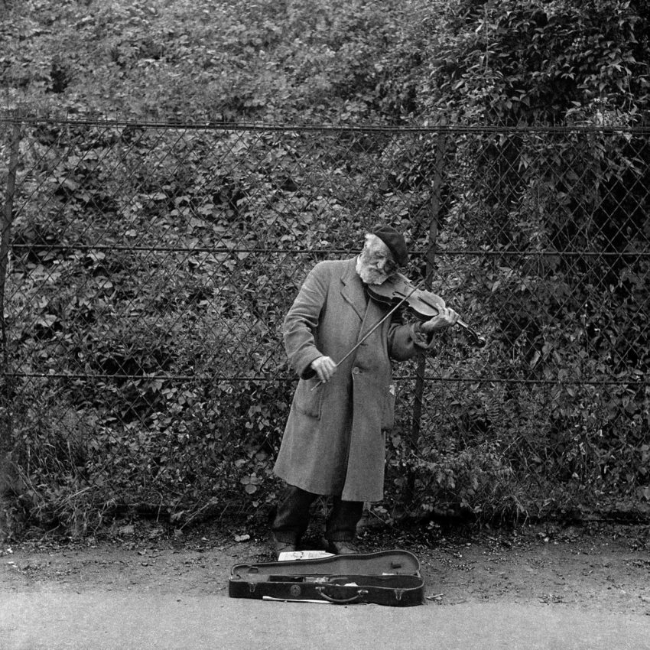
Violinist, 1945, by Adolfo Kaminsky

Odds are, you’ve no idea who Adolfo Kaminsky was. But you should. So I wrote a Sunday Salon about him (yes, I know today isn’t Sunday, but c’mon, let’s not get fussy at this point). Click on the link if you’re interested.

So here you go. The return of the Sunday Salon. You can find them all right here. Or just click on the Sunday Salon link at the top of the page.

another ordinary day

Wake up, get myself dressed, wander into the kitchen, remember the cat isn’t going to be there, make coffee, read the news, get distracted by…something. That last bit? Getting distracted by…something? Story of my life, right there.

I’m not driven by ambition or security or responsibility or success (whatever that means), but I am ridiculously weak to curiosity. I have a compelling need to know stuff. Unfortunately, it’s rarely useful stuff. If you’re looking for somebody who knows how to repair something mechanical or build a cabinet or replace an electrical outlet, I’m completely fucking useless. But if you ever want to know the name of the brother of the last Saxon king of England or the history and etymology of ‘spatula’ or why jamon iberica is the best ham in the world, I’m your huckleberry.

I only know these things because I allow myself to be distracted by something. And following that distraction led to something else, which led me to something else, which ended up with me accumulating still more useless information. And that’s exactly what happened to me this morning.

In an online forum devoted to readers of the historical fiction of Dorothy Dunnett I came across a passing reference to St. Mary’s Loch–the site of a band of mercenaries in Dunnett’s work. Being familiar with the novel, I had a general notion of where the loch was located in Scotland, but (and this where it always starts…with that but) I decided to look at a map to get a more exact location. And I was curious why the loch was named for St. Mary.

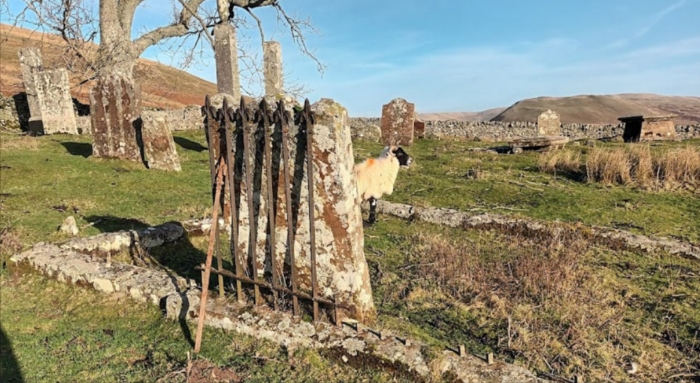
The answer to that last question was both obvious and easy to discover. It was named for a church dedicated to St. Mary. That church is gone now, but the graveyard is still there (and since this is about useless information, the difference between a graveyard and a cemetery is that a graveyard is associated with a churchyard, which requires a church; so this grave site is still a graveyard even though the church is gone).

St. Mary’s graveyard.

Information about the burial site led me to somebody’s blog post about St. Mary’s Loch, which included a reference to “the Hamlet of Cappercleuch with its couthy old, corrugated iron village hall.” Multiple sources of distraction here. What the fuck does couthy mean? (Spoiler: it’s a Scots term meaning ‘sociable, friendly, congenial, comfortable, snug.) And who wouldn’t want to see a couthy old, corrugated iron village hall?

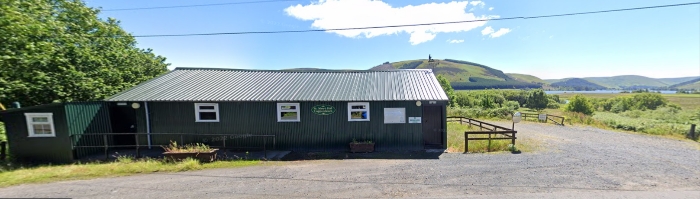
That led me to Google Maps and Google Street View of Cappercleuch. It turns out that a corrugated iron village hall is…well, just that. It’s basically a rather ordinary, disappointing metal shed. Not particularly old, and certainly not very couthy.

St. Mary’s Hall at Cappercleuch — neither old nor couthy.

Still, as long as I was noodling about with Google Street View, I figured I may as well spend a few minutes looking at St. Mary’s Loch and seeing what else Cappercleuch had to offer. And within ninety seconds I came across another distraction. This:

What the hell is this?

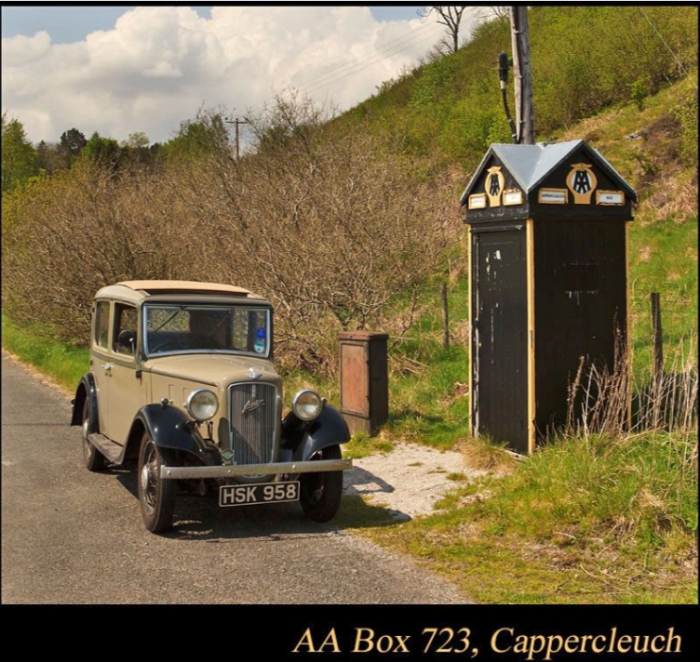
Reader, now THIS is a serious distraction. Just what the hell IS this? I mean, I can see what it is: a small, cross-gabled, distinctively decorated, phone-box sized structure. But what is its purpose? Why is it located just off the A708 motorway in Cappercleuch? (And if you’re curious enough to look for this on Google Maps, here’s a shortcut for you.)

The first thing I learned was that the A708 was one of the five most dangerous roads in proportion to traffic in all of Scotland. Or at least it was between 2007 and 2009. Not particularly helpful information, unless many of those accidents were because drivers were distracted by this weird boxy structure.

We can assume it’s not a Scots Tardis, but it has that ‘police box’ aura about it. It’s something official, certainly. The carefully crafted logo seems to confirm that. If we look closely, we can sort of see that it has the number 723 on the side. So, of course, the only thing for us to do is Google Box 723 Cappercleuch. And that gives us this:

I’m just going to assume you’ve made the same leap I did. AA stands for Automobile Association. It’s the UK version of AAA. AA boxes were an early form of roadside assistance in the UK. The first AA boxes were introduced in 1911. They were lit by oil lamps at night, and were sometimes referred to as “the lighthouses of the road.” The AA boxes contained maps to help folks who were lost, as well as a fire extinguisher, a lantern, and a telephone available to contact the AA for assistance. Members of the Automobile Association were issued with keys that fit all AA boxes in the UK.

By 1919 the AA had established a well-connected communication and assistance network of over a thousand roadside boxes, many of which were manned by yellow-uniformed ‘sentries’ who were there to offer free assistance.

Improvements in technology eventually made the AA boxes obsolete. By the late 1960s, the AA began to phase them out. In 2002 only 21 call boxes were still standing; AA shut down the entire network and made plans to dispose of the structures. The following year the boxes were listed as historic landmarks, and efforts were made to physically restore them. Apparently nineteen boxes still exist.

There’s a part of me, of course, that wants to use Google Maps to find them all. It shouldn’t be hard to do. There is absolutely NO REASON for me to do that, but at some point I probably will. Because that sort of pointless activity is my wheelhouse.

But it won’t be done today. I’ve learned some minimal self discipline over the years.

I’ve no idea how much of my day is spent giving in to my curiosity. I’m going to guess at least a couple of hours every day. There are folks who’ll consider this an inefficient use of my time.

Ain’t it great?

rabbit hole

I am weak to distraction. Doesn’t much matter what I’m doing, if I stumble across an interesting bit of information, an intriguing casual comment, a footnote in a book, almost anything that catches my eye and my imagination, I’m lost. I’ll stop what I’m doing and leap down that rabbit hole.

This morning on Twitter I came across a quote by novelist Henry Green, explaining the inspiration for his 1945 novel Loving. This is what he said:

I got the idea of Loving from a manservant in the Fire Service during the war. He was serving with me in the ranks, and he told me he had once asked the elderly butler who was over him what the old boy most liked in the world. The reply was: ‘Lying in bed on a summer morning, with the window open, listening to the church bells, eating buttered toast with cunty fingers.’ I saw the book in a flash.

It’s a great anecdote and an absolutely terrific line by the butler. So…there’s my rabbit hole. I tracked down the quotation. It was an interview conducted by novelist Terry Southern for The Paris Review (TPR) in 1958. Southern was also smitten with the butler’s line and used it to tweak the nose of the TPR’s editor. He wrote, “[Y]ou realize of course that the word ‘cunty’ makes the reply, gives it bite, insight, etc. I mean to say it simply would not do to rephrase it.”

Why was Southern pointing this out? Because five years earlier, TPR’s debut issue had included one of Southern’s short stories in which the term shit had been edited out. Instead of one character telling another “Don’t get your shit hot” TPR printed “Don’t get hot.” That’s a much weaker line.

Southern felt so strongly about the editing that he demanded TPR issue a correction in the following issue. And hey, they did. Sort of. Here’s their disappointing correction:

Terry Southern is most anxious that The Paris Review point out the absence of two words from his story The Accident (issue one): the sentence “don’t get hot” should have read “don’t get your crap hot,” an omission for which we apologize to all concerned.

The non-correction correction infuriated Southern, of course. So he was delighted (and absolutely correct) to force TPR to include cunty in the interview.

This made me happy for a couple of reasons. First, of course, is the butler’s line itself, which is simple but poetic. Second, because every writer likes to see an editor put in their place (even though editors are almost always right, damn it). Third, because I had a similar experience years ago.

I’d written a short story called Maybe the Horse Will Learn to Sing, which was published in Alfred Hitchcock’s Mystery Magazine. The story included this line:

So in trying to tweak Sweeney’s nose all I’d managed to do was to step on my own dick. There’s a lesson there, I suspect.

AHMM wanted to change that line to read, step on my own foot or something equally awful. Since I wanted to get paid, I agreed to change the line to some other weak analogy (I can’t recall what the final version was). The following year, however, that story was included in the 1999 anthology The Best American Mystery Stories, edited by Ed McBain and Otto Penzler. When I was asked permission to reprint the story, I agreed on the condition that they change the line back to the original. Penzler laughed and agreed it was a better line. That laugh was worth as much to me as the check.

So, that was today’s totally pointless but (for me) entertaining rabbit hole. That was probably 90 minutes out of my morning, including writing this pointless but (again, for me) entertaining blog post.

drive-by

I went for a drive on Thursday.

No, wait. It would be more accurate to say I went for a ride; I didn’t do any driving, I was just a passenger. It would be even more accurate to say four of us decided to visit a small town and have lunch in some local cafe (or diner or bakery or brewery or whatever passes for a lunch spot in that particular small town), and while we were out, I shot some photos. This is something we do periodically. After we eat we tend to tool around fairly randomly and see what there is to see. We may tour the town (if it’s big enough to actually tour), we may wander along the surrounding back roads.

I generally sit in the front passenger seat and shoot photos. Sometimes we stop and I shoot photos, sometimes I shoot photos out the window, sometimes I convince the driver (my very patient and obliging brother) to stop, turn around, drive back to something I thought might make an interesting photo.

My point, if you can call it that, is that on Thursday we…well, we did that. It was a chilly, occasionally breezy day with a steady fall of exceedingly fine snow. I don’t mean fine in terms of high quality or excellence (although as snow goes, it was pretty fine); I mean fine in terms of texture and delicacy. It was mostly a light, powdery sort of snow; it made the world look like it had been dusted with a sprinkling of powdered sugar.

Two things. One, I used to bring one of my cameras on these ventures, but for the last few years I’ve mostly used my phone for this sort of photography. Two, in winter I tend to shoot in black-and-white. I know it makes more sense to shoot in color and convert it to b&w; you have greater control over the final image. But there’s some weird trigger in my brain that says, “Hey, old sock, if you’re going to make black-and-white photos, commit to it.” It doesn’t make any sense, but there it is.

Over the years I’ve used half a dozen different dedicated b&w phone apps. So far, I keep gravitating back to an app called Vignette, which is a very flexible app that allows you to create a number of different camera profiles. I bang it around until I get a b&w setting that meets my general needs and aesthetic, then save it. Every time I buy a new phone, I sort of recreate that setting (although the recreated version is never quite the same as the previous, I’m okay with that).

All of the photos here are drive-by photos. They were shot through the passenger side window (which, of course, was closed because it’s fucking winter here). There’s always a part of me that wishes the window was perfectly transparent, and a conflicting part of me that likes the fact that the window conditions change and the photos change accordingly. The window might be a tad foggy with condensation, or it might be streaked with water or melting snow, or even spattered with mud or road grime. It all finds its way into the photo.

Drive-by photography is ridiculous. It’s all about predicting an image–seeing what’s up ahead and visualizing what it might look like when you get there. If that’s loopy enough, you then have to anticipate what’s coming and try to time the shutter release (okay, there’s no actual shutter in a cellphone, I know that, but you know what I mean) to correspond with what you hope will be a proper composition. That’s another issue with the Vignette app: the shutter lags. Just a moment, but it’s a fairly predictable moment. Which means if you’re using Vignette to shoot a drive-by photo, you have to factor that lag into the equation.

Half the fun of drive-by shooting, of course, is not quite knowing what you’re going to get. You make a number of guesses and predictions based on your experience and intuition and your understanding of the technical concerns, and hope for a good result. Most times, you guess wrong. But sometimes you guess just right and the photo is what you hope it will be. I guessed right (or close enough to right) on the photos you see here. None of them has been cropped, but most of them have been rotated slightly to straighten the horizon line.

The snow helped. Not just because it was pretty, but because we were driving more slowly. That gave me more time to evaluate the shot and a larger margin of error.

There are few finer ways to spend a weekday, when all the normal employed people are at work and out of the way. Good company, good food (usually), good drink (usually), and the serendipitous exploration of some place we have no real reason to visit other than whim. I count myself very fortunate that I get to do this.