in which I look at an old photo (part 5)

Right, quick recap: Back in the Spring of last year I was slowly emerging from a photographic funk. I hadn’t picked up an actual camera in…I don’t know, months, Several months. This had happened to me once before (see the endnote if you’re interested). Anyway, for whatever reason, I was coming out of that funk and starting to think about photography again.

That included reading about photography again. I came across an article on some photo website that suggested looking at and analyzing your old photos as if they were made by a different person. That seemed ridiculous to me. I’m not terribly interested in my old photos; I mean, I’ve already seen them, right? Why would I want to look at them again, especially when there are lots of photos by other people that I haven’t seen?

But I thought I’d give it a try now and then. This is my fifth time in nine months. I’m still not comfortable in doing this. But several years ago I wrote about Alfred Stieglitz and his notion of practicing in public. The idea, as I interpreted it at the time, is that if you’re serious about photography, you’ve got to be willing show your whole ass in public. So that’s sort of what I’m doing. So, here we go:

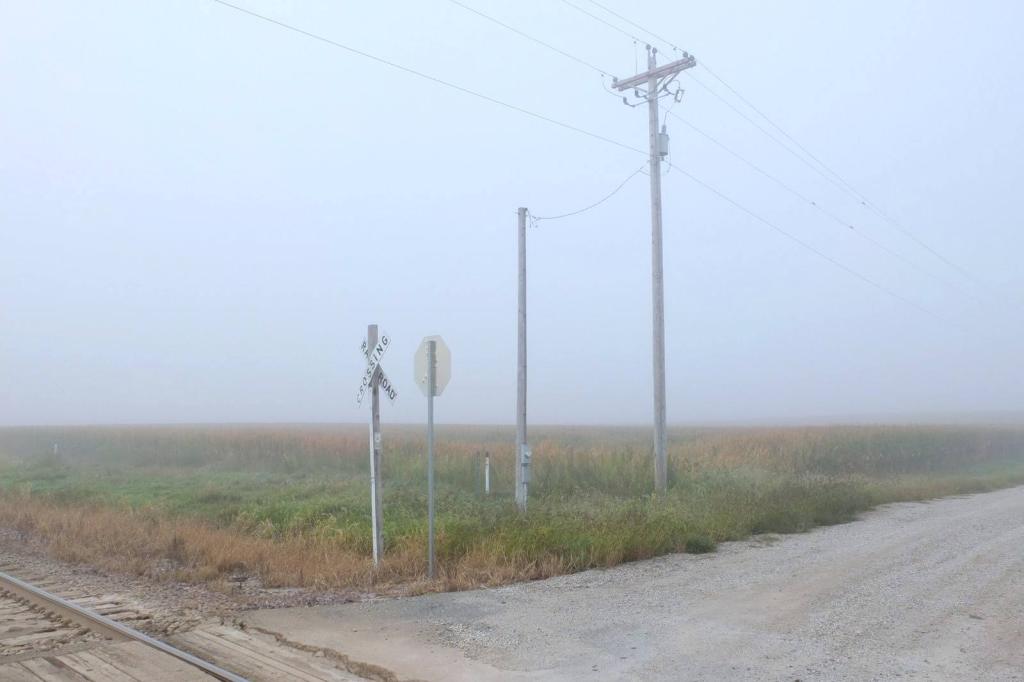
The metadata informs me I shot this photo on September 18, 2014 at 9:03 in the morning with my old Fujifilm X10 (ƒ/4.5, 1/450, ISO 200). It’s one of six photographs I shot that misty morning. I tend to be parsimonious when I shoot–a habit from the days when I couldn’t afford to piss away film.

I don’t remember anything about that day, but it’s clear to me why I stopped long enough to take this particular photo. It’s all about those angular lines. The railroad tracks, the dirt road, the rising line of poles, the telephone wires, and that terrifyingly flat horizon line (although I’m living in Iowa, I’m not a country boy, and I’m always a tad freaked out when I find myself in the flattest and most open parts of the Midwest countryside. There’s so much sky and so little to break up the horizon. It always reminds me that I’m on the surface of a planet, which makes me feel incredibly small and unimportant; that’s both humbling and sort of a nice reminder that everything is temporary when seen on a planetary scale).

I’m sort of surprised I didn’t shoot this photo in monochrome. If line and form are the predominant features inside the frame, I tend to opt for black-and-white (okay, yet another tangent, sorry. It’s silly, I know, but I deliberately choose to shoot in either color or in monochrome. I almost never turn a color photo into monochrome, though that process certainly gives the photographer a LOT more control over the final image). I have to assume that at the time I took the photo, I thought the mist-muted colors added something to composition. Maybe it does. I’m not curious enough to process the image in b&w to find out. I mean, this is the photo I chose to shoot, and there it is.

I like this photograph. I think I’d like it no matter who shot it. I like the simplicity of it. I like the balance. I like the emptiness.

So, is there any real value in this whole ‘looking at an old photo’ bullshit? I kind of hate to admit it, but I think there is. I may not be learning anything new, but the practice does reinforce the reality that I see and react to the world differently than regular people. That’s true of all photographers; it has to be. It validates the willingness to stop your car at some random spot, and get out in the chill mist, simply because you’re smitten by a series of visual lines that other folks wouldn’t notice.

So I’ll probably do this old photo business again in the not-too-distant future.

ENDNOTE: My first long-term photographic funk came at the end of my career as a criminal defense investigator. I used my cameras a LOT as a PI, but in a very technical forensic way. The photos I took for my work were all potential evidence to be used in court. The work was very object oriented. The photos were sometimes technically challenging (I once had to photograph the undercarriage of a wrecked car, which involved some tricky lighting and wide angle lenses while lying on a roller beneath the vehicle, which was claustrophobic as fuck). The problem was that there was no joy in that sort of forensic photography. Blood spatter patterns might be visually interesting, but it’s hard to appreciate when you’re shooting them. When I ended that career, I stuffed my cameras into my Sam Spade Conjurer’s Kit and stuck it in a closet, where it sat for about 3-4 years. I had no desire to hold a camera in my hand in all that time.

reflected

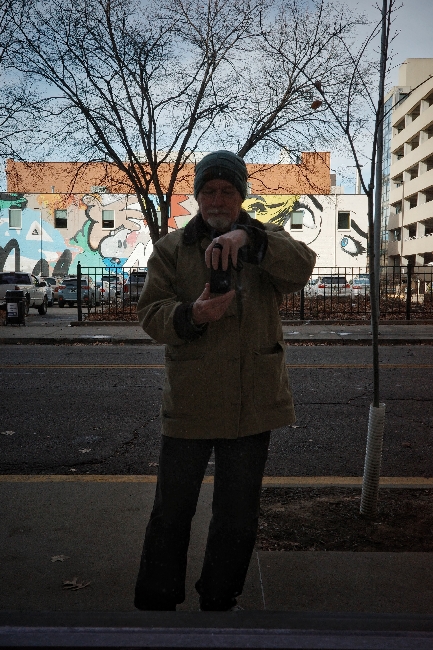
So here’s me, noodling around the city, shooting photos (okay, I know it’s way too soon for a tangent, but let me just say that I’m totally smitten with my Ricoh GR3X, oh lawdy, it’s SO much fun to shoot) and basically having as fine a time as is possible on a cold January day. The sun’s out, the sky is blue, the people I meet on the street are uniformly pleasant and smiling despite the chill in the air. It’s a nice way to spend an hour or so.

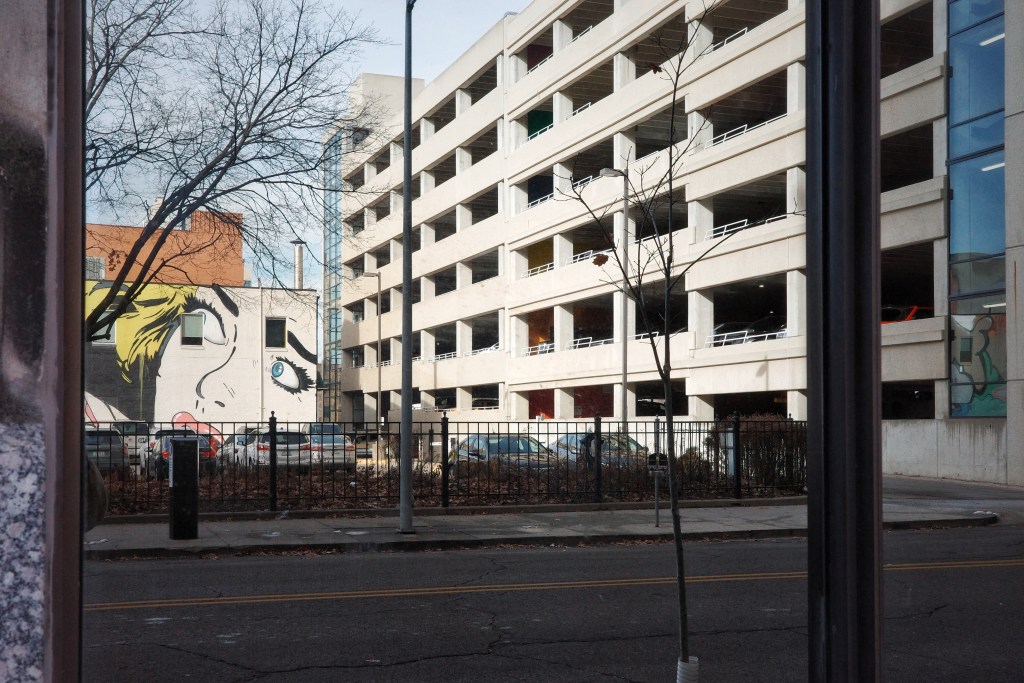
As I’m walking along I notice a mural reflected in a window. The mural includes a massive cartoon-styled woman’s face, showing alarm or horror. It’s cool, but it’s not particularly photo-worthy. But what the hell, I take a shot. Why not? I keep walking and keep looking at the mural hoping a better shot will appear, and then I reach a spot where I’m also in the reflection. There’s a giant cartoon hand reaching for me, and I’m thinking that must be the reason the giant woman is so alarmed. Still not photo-worthy (in fact, it’s even less photo-worthy), but it amuses me. So what the hell, I take a shot.

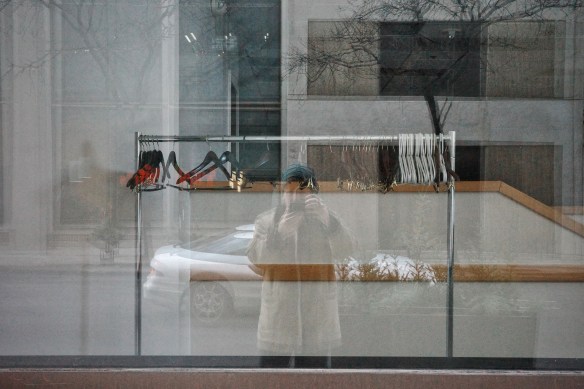
And I keep on walking (which is what you do on a photo-walk, after all). I stop now and then when the light or shadow catches my attention. I notice a particularly fine bollard. A stack of tires in an alley. There’s an ambulance and a fire truck flashing their lights in front of a hotel, but the light sucks and whatever is happening is happening inside the hotel and there’s nothing to see, so I keep walking. And I see an empty shop window, with a clothes rack devoid of clothes but with a fine collection of empty hangers. The lines are nice, the light is acceptable and there’s me again, reflected in the window along with a nice bare tree. So what the hell, I take a shot.

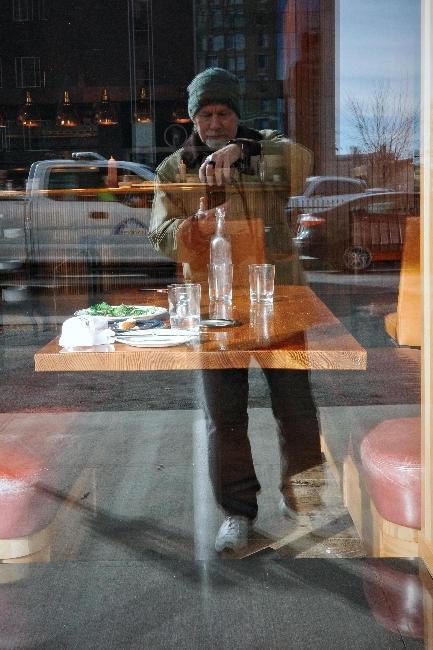
And I keep walking. Down along the river, which is running low. There’s about a million Canada Geese milling about as the ice is breaking up, making a colossal noise, and ignoring the mallards that are paddling around, minding their own business. Then I’m down a street with nice shops and fine restaurants, and the light is catching a table through a window, with the remains of somebody’s salad and an empty water carafe (which is a lovely word to say aloud; French, from the Arabic gharraf meaning “a drinking cup”; go ahead, say it out loud, nice and slow…isn’t it nice?). And, once again, there’s me in the reflection, ruining what might have been a nice photo. But what the hell, I take a shot.

This is a thing I seem to do…reflection selfies. They’re never good photographs, they’re never interesting photographs, and I almost never post those photos (for the reasons just stated). They’re more of a reflex action–like when your doctor taps your patellar tendon with a rubber mallet. I see myself reflected in a window, my shutter finger jerks. It’s a reflection reflex.

But as I was sorting through the day’s photos, deciding which ones were worth keeping, I found myself reflecting on my reflection reflex and c’mon, there’s no way I’m not going to use that phrase. So yeah, this blog post exists solely so I can write ‘reflecting on reflex reflections.’

my year in books

On social media I’ve been seeing a LOT of My Year in Books posts, in which people report on the books they’ve read in the preceding year. I confess, I’m a wee bit baffled by these posts. I mean, I’m interested in what other folks read. I’m interested in their thoughts about what they’ve read. That can be interesting. But the majority of these MYiB posts feature the number of books they’ve read, and I don’t understand the point of such a metric.

I don’t know how many books I’ve read in 2024. It never occurred to me to keep count. It was a bunch, to be sure. Probably less than fifty, but certainly more than thirty. So let’s say somewhere in the low-to-mid forties? But really, who cares how many books I read? Some of them were books I’ve read before, and I’m not sure if people count those towards their book total. Probably, right? I mean, they still read them.

More interesting to me are the books I bought that I thought I’d read, but didn’t. Again, I haven’t kept count, but I suspect I bought at least half a dozen books that I started to read, but ended up putting aside. A very few were books I just didn’t like (and no, I won’t name them). More were books I’d probably like, but simply wasn’t in the right mood to enjoy. Like The Priory of the Orange Tree. I’m totally smitten by the title and the cover art, but I got maybe 15-20 pages in and it just wasn’t working for me. I’ll try it again at some future point. Sometimes it just happens that way. It took me at least three tries before I finally got more than a couple of chapters into Dorothy Dunnett’s The Game of Kings, which is one of my all-time favorite novels. Same with Gideon the Ninth; the first time I tried to read it, I put the book down after less than fifty pages. Now I think it’s one of the most original and delightful novels I’ve ever read.

This year, like most years, I bought some books I didn’t think I’d like, but wanted to check out anyway. Like The Bright Sword, which is sort of a sideways retelling of the Arthurian saga. That’s the thing about Arthurian literature; you can’t trust it. The Arthurian story bones are so damned good that LOTS of people try to retell the story. Most attempts are at least tolerable. A very few are brilliant. But in my experience, the majority of new Arthurian stories are both regrettable and forgettable. However, sometimes your hopes pay off. To my surprise and delight, The Bright Sword turned out to be a lovely read.

This year, like the last several years, I tended to read mostly genre fiction and very little literary fiction. There’s probably a reason for that, but I can’t be bothered to examine it. I read a few mystery and detective novels, some science fiction, more fantasy than I care to admit (I want to like that genre more than I actually do), a couple of spy novels, and some novels that are clearly genre fiction without fitting neatly into a genre category.

Last year I did more re-reading than I normally do. Comfort reading in uncomfortable times. I re-read books that, for one reason or another, make me happy. Rivers of London, for example; an absolutely charming story, the first book in a series of magical police procedurals that are consistently solid. Mick Herron’s original Slow Horses spy novel, which is a delight in its own offensive way. Ellen Kushner’s The Privilege of the Sword, which, to be fair, isn’t quite as good as her novel Swordspoint, but remains my favorite because there’s an inherent sweetness to the protagonist. I can be a bit of a sap sometimes.

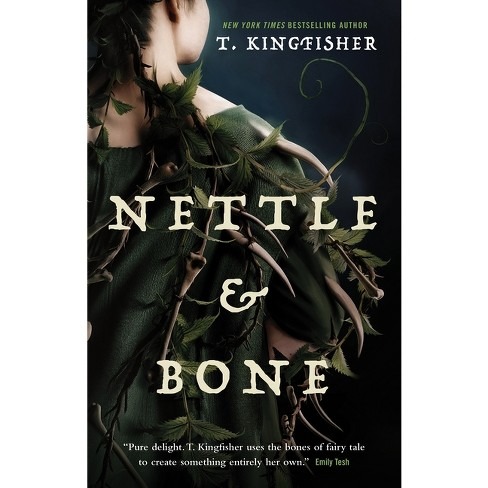
Did I have a favorite book in 2024? I guess. Sort of. I bought Nettle and Bone on a whim, based entirely on the title (which, I should point out, is a terribly stupid reason for buying a book). I have no idea what it is about the title that appealed to me so much. I was very skeptical about the novel at the beginning. I mean, it begins with a woman building a dog out of…well, bones. The scraps of former dogs. Unlike a LOT of novels in which magic is featured, Nettle and Bone doesn’t attempt to explain how magic works. The protagonist puts the dog bones together and when she’s done she’s got a bone dog…there it is, just matter-of-fact, magic exists. sometimes it works and sometimes not so much, you don’t need any more information than that, just accept the existence of the fucking bone dog and get on with the story. And that’s exactly what I did. Nettle and Bone is as dark as the darkest fairy tale (the best fairy tales are pretty damned dark), but it remained charming and amusing and incredibly emotional. Be aware that it deals very bluntly and unflinchingly with violence against women, but at the same time there’s a sweetness that cuts through the grim darkness.

Nettle and Bone was the most unexpected novel I’ve read in recent years. Is it a great novel? Naw, probably not. But I can’t recall any other novel that kept surprising me the way Nettle and Bone did. I look forward to re-reading it again this year.

i’m back

I’ve been away for a while. Not away away. Not ‘away’ as in a different location. I’ve been away from this blog. The last thing I posted was on 16 December, almost three weeks ago. I’ve been writing this blog since 2011, and this is the longest I’ve been away from it.

Why? Family crisis. I’m not going to go into any detail (partly because it’s not my story to tell, partly because it’s nobody’s business, and partly because I dislike folks who whinge online…or anywhere else, for that matter). I’m only tangentially involved in the FamCrisis (not my monkeys, not my circus); my normally calm, quiet, incredibly happy life is collateral domestic damage, so to speak. Life here has been wildly disrupted; everything is now crowded, noisy, busy, and chaotic. It’s this way, in large part, because it was calm, quiet, and happy. I mean, where else are you going to go to escape, right?

In any event, the situation hasn’t been conducive to writing. But so what? People have written under worse circumstances. And while everything is still ridiculously chaotic and rather grim (and likely to stay this way for some time), I’m starting to acclimate to it.

Even before the FamCrisis, I’d shifted away somewhat from my usual blog posting. Most of my posts over the last several years have been political. But the 2024 election left me in an absolute funk. Since the election, I’ve written more about photography than politics.

‘Annie’ was wrong; the sun ain’t coming out tomorrow. But someday…

But in a short time Comrade Donald Trump will once again infest the White House as an expression of the will of the people (the bastards). It seems pretty obvious that we’re entering into a grimdark era. Truth, decency, logic, kindness…that shit is out. Lies, grifting, loopiness, and willful cruelty will be featured in US ‘governance’ for the foreseeable future.

Ain’t no way I’m going to shut up about that. I’ll still write about photography and other stuff, of course, but I think it’s going to be necessary to call bullshit frequently and loudly in the coming months and years. So I’m back.

Editorial Note: Many/most of the problems we face are either due to or exacerbated by patriarchy. So we need to burn that shit. Burn it to the ground. Burn it, gather the ashes, douse them in oil, and burn them again. Piss on whatever is left, then salt the earth where the burning took place. Then burn the salt. Burn it and keep burning it, over and over. Burn it for generations. Then have tea and biscuits.

the curious incident of the diner at midday

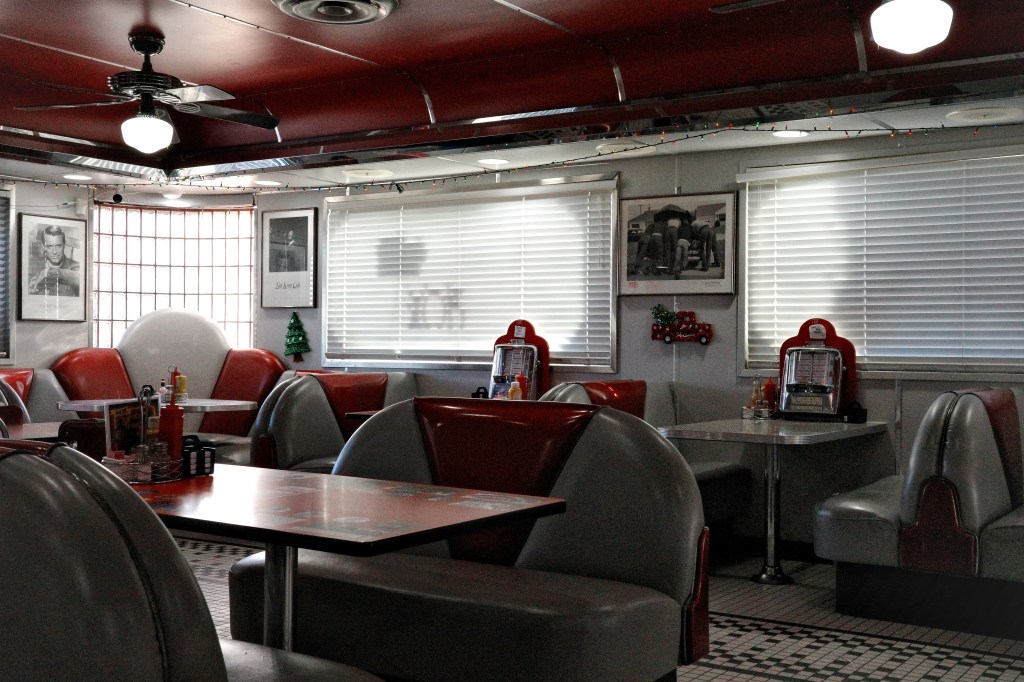
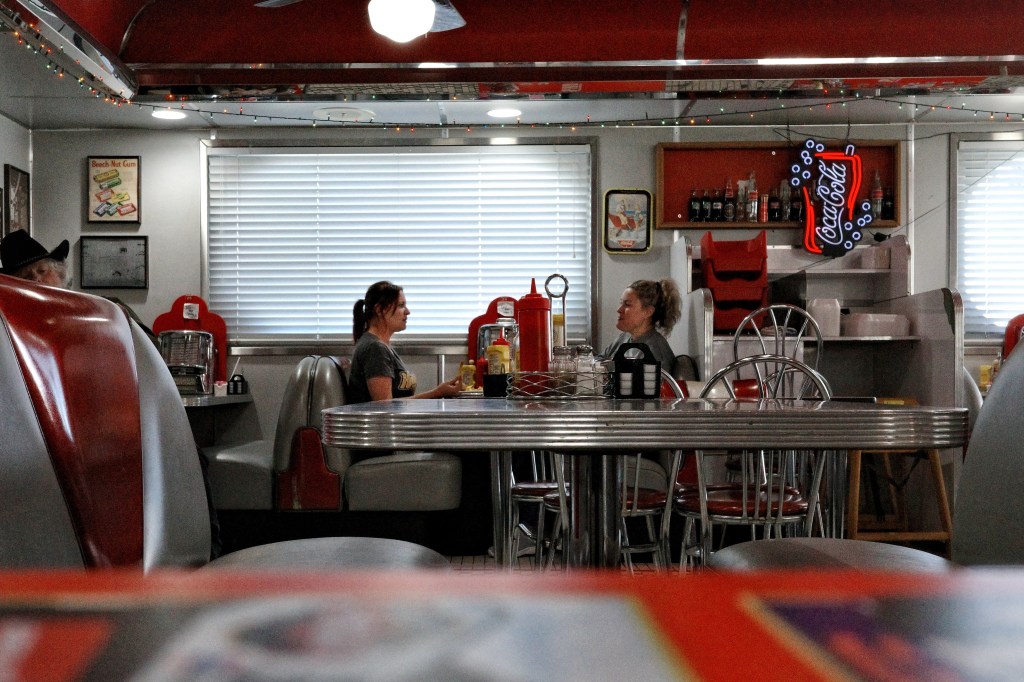
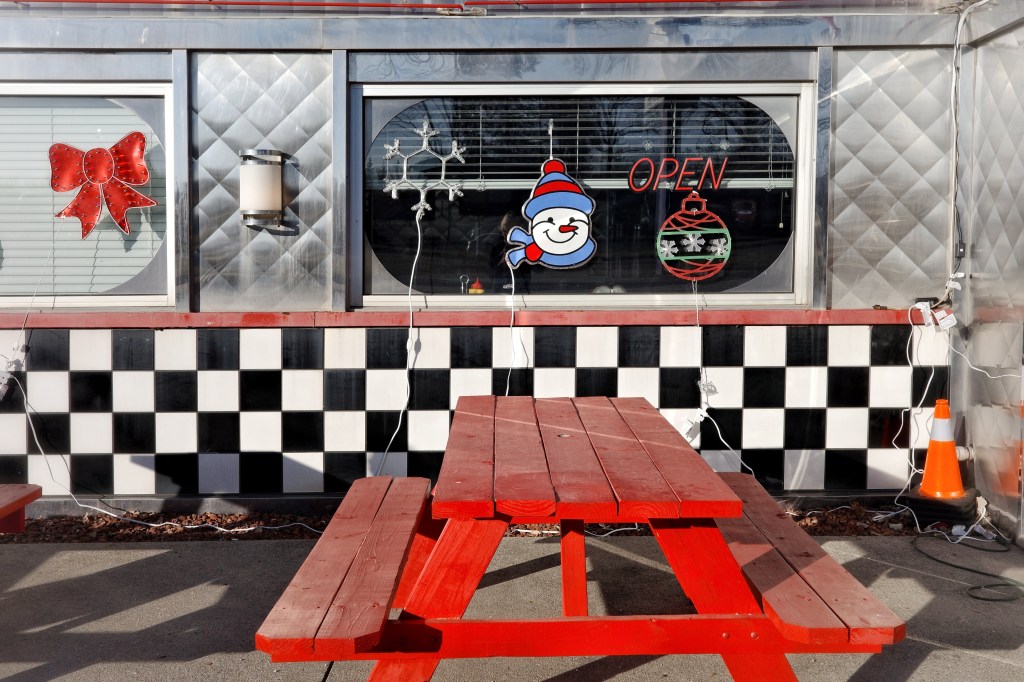
Here’s one of those photography ethics things. I was sitting in a booth in a quintessential American lunch-car diner with my camera on the table. While looking at the menu, I heard the sound of stressed voices coming from across the diner. I glanced over, saw two women who I thought had a family resemblance staring at each other. The light was nice and the scene had some drama. What to do?

  1. Mind your own business?
  2. Turn your camera on the table and shoot a quick photo without looking?
  3. Pick up your camera and photograph the situation?

Obviously, the most ethical thing to do is 1) Mind your own business. I had no idea what the situation was, it had nothing to do with me, and the two women involved would almost certainly prefer to be ignored.

But if you’ve ever practiced street photography–or if you’ve ever wanted to practice street photography–you know that people are often most interesting and most honest during emotionally charged moments. And those moments are almost always worth photographing. So some/many photographers would at least consider options 2 and 3.

You have to be a complete asshole to choose option 3; to pick up your camera and openly, deliberately invade their privacy. Option 3, however, has the dubious advantage of being honest and direct, whereas option 2 is, let’s face it, sort of underhanded. The thing about option 2–shooting without looking, without composing–is you’re allowing the fickle Gods of Photography determine if you get a decent shot or not. If the shot sucks, then it will get binned and nobody has to think about it.

If the result works as a photograph, then both options 2 and 3 set up a secondary ethics challenge: do you further violate the privacy of these two women by posting it? If you choose to post it, do you post it on a very public social media platform (like, say, BlueSky or Instagram) or on a significantly less popular platform (like, say, your blog)?

Obviously, I chose option 2. Well, sort of. I mean, it’s not like I sat there and considered all the ethical questions. I took the photograph without considering anything at all, completely unhindered by any thought process. I turned the camera on, turned it toward their table, touched the shutter release, turned the camera off, and didn’t think about it again until I got home and looked at my photos.

And hey, I got lucky. It’s a pretty good shot (in my opinion).

This is the shot in question.

Obviously, I decided to post the photos here, on my personal blog. I’ll also post links to the blog on Facebook and BlueSky. How do I justify this? I’m relying on the Men in Black defense. If you’re in a public place: don’t start nothing, won’t be nothing. If you raise voices in a public setting, the public will look at you. Sure, few of them will take your photo, but a photograph is essentially nothing more than an extended look. You don’t have a reasonable expectation of privacy in a public setting.

Another thing: I’ve no idea what these women were talking about. I don’t know if they were arguing, if they were upset with each other or with something else, if their distress was sincere or in jest, if one was distressed and the other wasn’t. I don’t know because I didn’t pay any attention to them (other than to note their voices were momentarily raised). They could have been outraged by the portions or the size of their bill, for all I know.

That said, it’s important (to me, at any rate) not to fully absolve myself. The women may not have had a reasonable expectation of privacy while talking to each other in a very public diner, but I didn’t have to pay attention to them. While I didn’t make any effort to take a good photograph, the fact remains that by taking any photograph I invaded what they probably thought of as a private moment.

Was it worth it? I don’t know. I think it’s an interesting photograph. The chance that either of them will ever see this…or that anybody they know will ever see this…are incredibly slim. I could probably legitimately make the ‘No harm, no foul’ argument. But maybe this type of photography is a social harm in and of itself. I don’t know.

Here’s the thing: I spent several years as a private investigator. Much of my work (which was primarily criminal defense investigation) involved making ethical decisions in the immediate moment–and there was rarely any obviously correct decision in those moments. So I’m used to questioning my ethics. It’s easier with photography. With photography, you can always take the shot and delete it later IF you decide it was inappropriate or unethical. In photography, you have that leeway.

Looking at the photo, I don’t think the level of tension between the two women is terribly obvious–unless you’re looking for it. I don’t think there’s any ethical reason NOT to publish it. Others may disagree, but I’m comfortable with my decision.

small love story

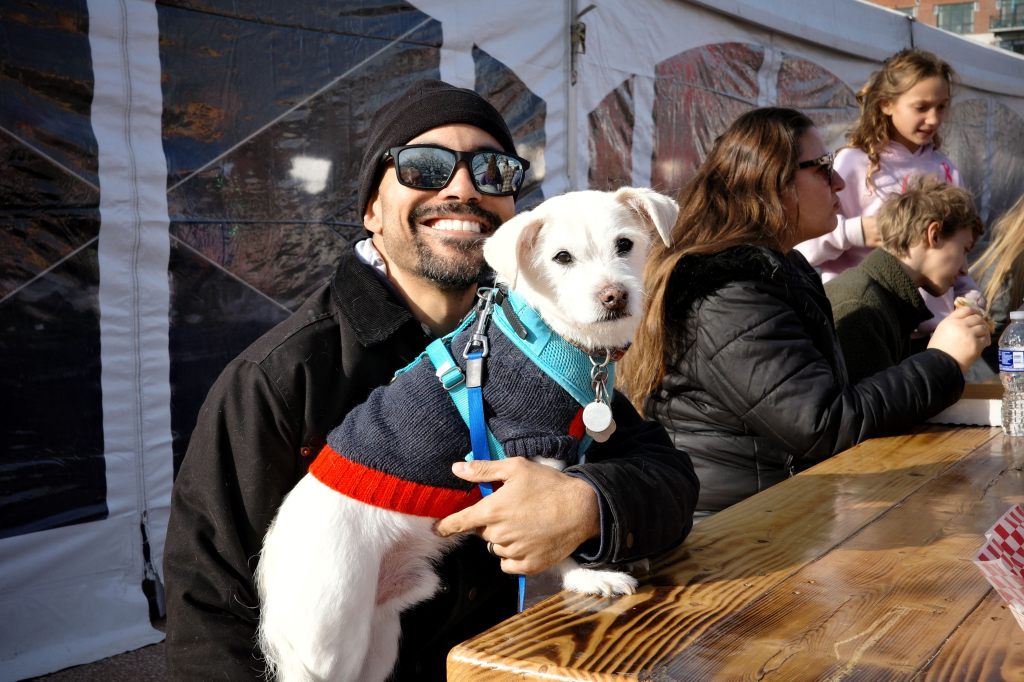
I’m at the Christkindlmarket and I see this guy and his dog sitting at a table. He’s holding the dog and the dog is leaning against him. I know it sounds ridiculous, but the moment I saw them I thought, “Madonna and child.” I blame all the Christmas stuff for that. I’m not a Christian, but I’m a fan of any holiday that’s (supposed to be) about love and sharing.

Anyway, I’ve got my little Ricoh GR3X in hand as I approach them, and the guy knows why I’m coming. I could see it on his face, the recognition that I wanted to photograph his dog. And it obviously pleased him. I barely got the words out…”Would you mind if I…?” before he said, “Sure.”

The dog, though, seemed a tad uncertain, so I slowed down. Instead of the close-up I’d intended, I stayed back a bit. Instead of shifting my position to isolate the guy and his dog from other people from the frame, I stayed still. Instead of shooting 3-4 frames, I took only one. I moved slowly to take the photo.

I said something like, “He’s a wee bit shy, isn’t he.” The guy said the dog was timid around other people, which is why he’d brought him to the Christkindlmarket and why he was holding him. He wanted the dog to feel safe and protected, but he also wanted him to get used to being around other people.

I didn’t even try to pet the dog, though I wanted to. I didn’t try to shoot more photos of them, though I very much wanted to. I figured the little guy was dealing with enough already.

In the end I said something like, “You’ve got yourself a little buddy.” He said, “I sure do.” And I walked away. But seeing them together lifted my spirits–which, given the world as it is today, was quite a feat. The obvious bond between them, the care the guy was taking with the dog, the trust the dog had in the guy — it was lovely, and I was weirdly proud of them both.

I could have taken a better photograph of them. They deserve a better photo. But it might have made the dog nervous, and no photo would be worth that.

lesson learned

I’ve had my Ricoh GR3x for a wee bit more than five months now. Long enough to be pretty familiar with it. Long enough, in fact, to get cocky with it. It’s SO fucking GOOD for shooting quickly and intuitively. So good that I’m starting to get sloppy with composition.

I’m usually pretty deliberate when I shoot photos. I know what I want in the frame, and I know what I don’t want. I’m usually conscious of where I should be standing in order to get the image I want. I’m usually patient. Usually. But I’m so comfortable with this new camera that I’m becoming less disciplined. Sometimes that’s good. Sometimes…not so much.

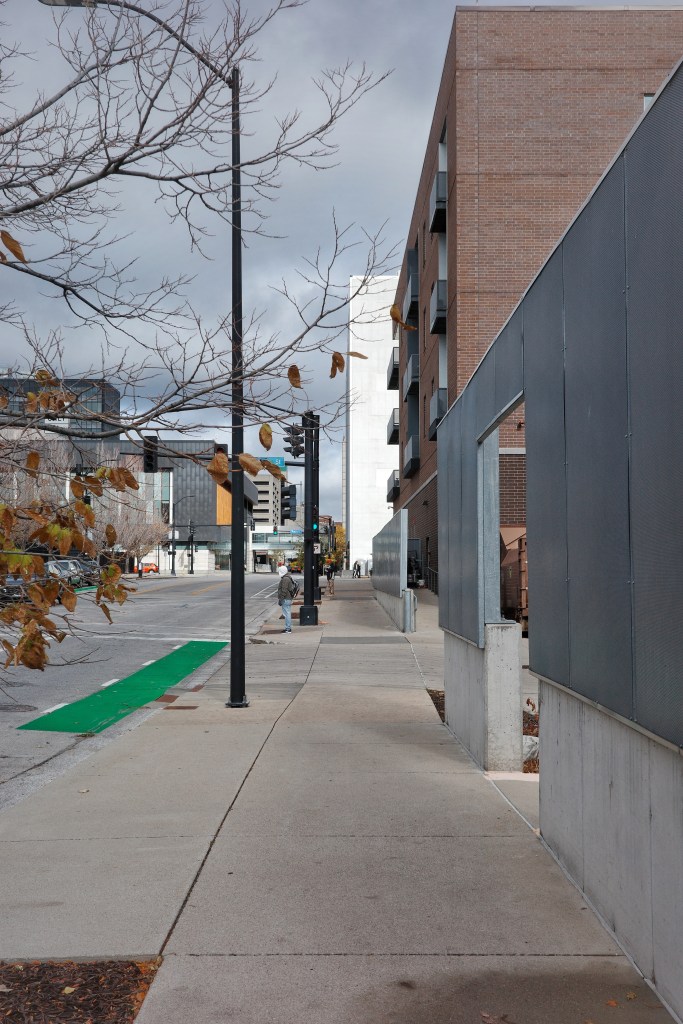
Here’s an example. I was walking down the street on a grey, sullen day when a burst of sunshine broke through the cloud cover, briefly illuminating a white building. I was immediately taken by the light and all of those lovely vertical lines. There was a sweet green patch of bike lane, some dead brown leaves still clinging to a tree, a guy in a hoodie waiting at the crosswalk. There was a wet patch on the sidewalk where a recycling bin had probably been sitting, and it mirrored the patch of turf in which the tree had been planted.

There were a LOT of elements and shapes all working together. So the Ricoh came out of my pocket, and I glanced at the screen, and took a snap as I walked. I mean, I didn’t even pause.

I chimped a quick look at the image without missing a step, and lawdy, I was so smug. Not so much with the image itself (it’s not a great photo) as with the way I shot it–on the move. It wasn’t until I got home and downloaded it that I realized I’d fucked up.

Cut off the top of the light pole.

It’s not a huge deal, partly because, as I said, it’s not a great photo to begin with. But it’s a reminder that speed and convenience aren’t always benefits. If I’d paused for a moment…if I’d taken a half step backward…if I’d followed one of the very basic rules of composition (check the edges of the goddamned frame), it…well, it still wouldn’t be a great photograph, but it would have been a properly composed one. I tell myself, “Self, if I’d paused I might have lost the light!” Which is true. But it’s also true that I wasn’t concerned with the light any more than I was concerned about the composition. I was only thinking about how cool it was to be able shoot that quickly and with such confidence. The confidence was misplaced.

Lesson learned.

(Maybe. Some lessons need to be learned repeatedly.)

clothes with history

Okay, first: here’s a photograph shot in October of 2020 of a blue flannel shirt draped over a stairway railing. You may be wondering why I’m posting a photo of a blue flannel shirt. Patience, grasshopper.

Now, here’s me loafing on a Sunday morning, drinking coffee, scrolling through Bluesky, and I see a post by my friend Kim Denise. It’s about knitting, a subject in which I have absolutely no interest at all; something to do with ‘fingering/4-ply/sock yarn,’ whatever that means. But she’s included a delightful photo of a young girl wearing a colorful knit jacket thingy, pushing a wheelbarrow. Kim explains, “This is a long cardigan/coat I made for a young friend of mine who was four at the time. She requested a number of specific elements. She wore it for years!

Photo by Kim Denise

I don’t know when Kim knitted that cardigan or who she knitted it for, but the child wore it for years, which means she had a history with that piece of clothing. I have a thing for clothes with history. Everybody has some item of clothing they cherish, whether they use that term or not. A shirt, a hat, a jacket, a sweater–something they’ve worn for years, something that’s comfortable or comforting, something that’s been through the wars and shows its age. Something they’ve become irrationally attached to.

For me, it’s that blue flannel shirt. In fact, I’m wearing it right now, this morning. I was wearing it when I saw Kim’s post, which is why I’m writing this blog post.

Here’s the weird thing: it’s not really my shirt at all. I didn’t buy this shirt. In 2001, when I moved from Manhattan to an old farm house in rural Pennsylvania, one of the movers accidentally left this shirt behind. Initially, I considered contacting the moving company to return the shirt. But then I discovered the movers had also walked off with my shepherd’s crook (yes, I owned a shepherd’s crook; it’s a long story) and a hand-carved mushroom-hunting stick made for me by my brother. The moving company informed me no such sticks were reported by the movers. So I kept the shirt. I’ve moved twice since then.

I don’t know how old the shirt is; it wasn’t new in 2001. Twenty-three years later, it’s getting pretty threadbare. These days I wear it exclusively around the house or to do yardwork; it’s too ratty to wear in public now. I’ve actually worn two holes in the front shirttails by fussing with them; the holes occasionally catch on doorknobs and drawer handles, jerking me to a halt. My partner sometimes teases me about the shirt; she says a hobo wouldn’t be seen wearing it.

In 2016 (photo by Sweet Jody Miller)

The shirt is soft with age now. Comfortable. I’m afraid to put it in the washing machine for fear it’ll disintegrate. A quarter of a century is long enough to turn flannel into something like gossamer. I have a history with this shirt. I have an irrational affection for it. I’ll wear it until it’s rag-worthy. But I’ll never turn it into rags. This shirt is my friend.