Last week while out noodling around I came across a tank. When I say ‘tank’ I mean a decommissioned military tank. An M60 battle tank, to be exact. It’s fairly common when the military starts scrapping old tanks, they offer them to small towns to use as memorials, or to ‘decorate’ public parks or town squares or wherever the hell a small town would like to park one. The US military stopped deploying M60s in 1997.
But this isn’t about the tank, really. It’s about how I photographed it. Which was like this:
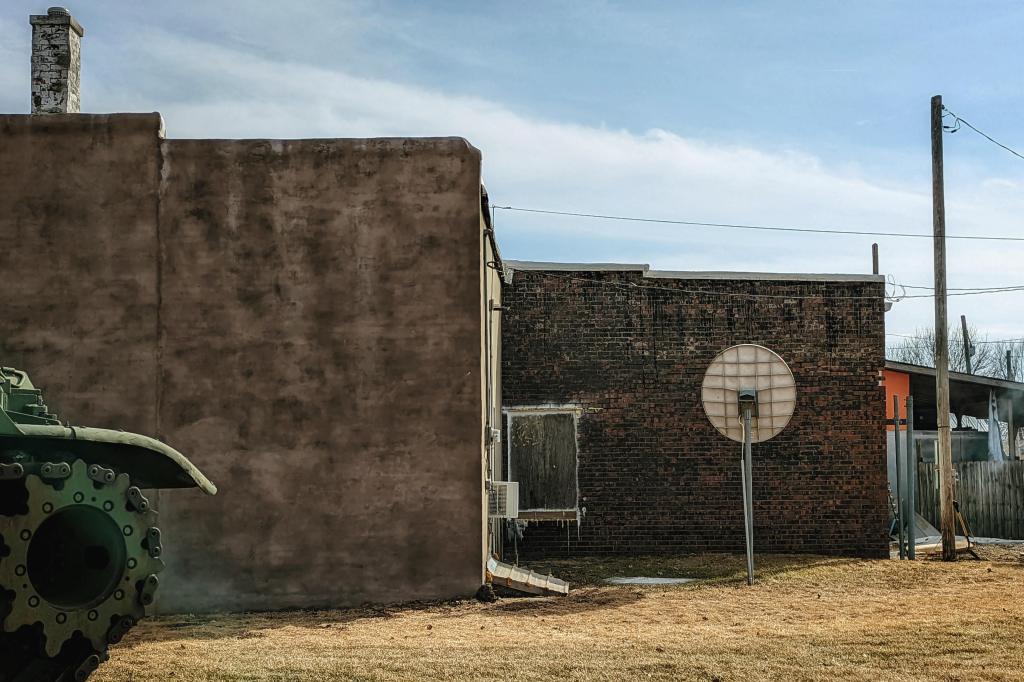
A friend asked me a couple of questions about the photo. First, what the hell is this a photograph of? Second, if it’s a photograph of a tank, why didn’t I include the whole tank? Those are valid questions. But they’re difficult to answer.
They’re difficult to answer for several reasons. The primary reason is that I’ve been shooting photos for so long that I rarely actually think about composition. I just kind of know what I want in the frame. Another reason it’s difficult to explain is because shooting a photo seems like it’s just a matter of releasing the shutter (or, with a cell phone, poking the whatsit that initiates the photo). But that moment is the result of a fairly complex process.
I wasn’t paying much attention to the process when I shot this, but I’ll try to recreate my thinking. Obviously, it began by getting out of the car to look at the tank because…well, there was a tank and I wanted to look at it. As I walked around it, I was attracted to that cascade of squarish shapes made by the building–so many different-sized squares of different textures. Then there was that white circle that sort of balanced the round rear tread wheel of the tank. And then there were those sweet vertical lines of the chimney and the light pole. And then I was drawn to that tiny splash of red, and that diagonal slant of the roof of the shed, and even the spade leaning against the light pole. All of those things appealed to me, both individually and as a collective.
I’d be lying if I said I noted all that stuff in that order, but when you’re lining up a shot it’s like your brain is ticking off boxes in a list. That works, that works, that doesn’t–so move a bit, that works. And then there’s some point when your synapses seem to agree that you’ve got all–or most–of the stuff you want in the frame, and you take the photo.
I’d probably have taken that photo even if the tank wasn’t there, because the light and the geometry appealed to me. But it was the tank that drew me to that spot and to me, that wee bit of tank is important to the composition. So, to me, it’s still a photo of the tank. The rest of the tank is implied.
Wait…I think I can explain this better. That same day, I took a photo of an old, rusted out Ford panel truck. Three photos, in fact, but only one photo mattered. Here’s the first photo.
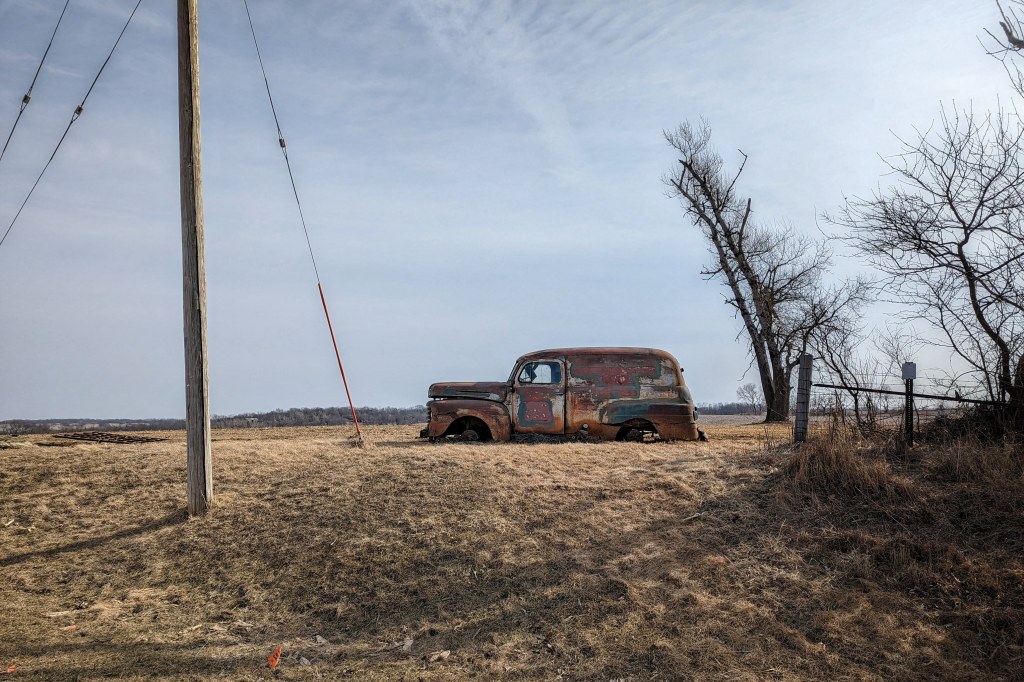
There’s nothing wrong with this as a photo. Again, I composed it intuitively, without a lot of thought. It’s got good lines. The curve of that tree is nice; it sorta kinda follows the shape of the truck. There’s a decent balance to the composition. It’s a perfectly adequate photo, a decent documentation of an old, rusted out Ford panel truck. Nothing wrong with it, but not terribly interesting.
So I got closer. Changed the perspective.
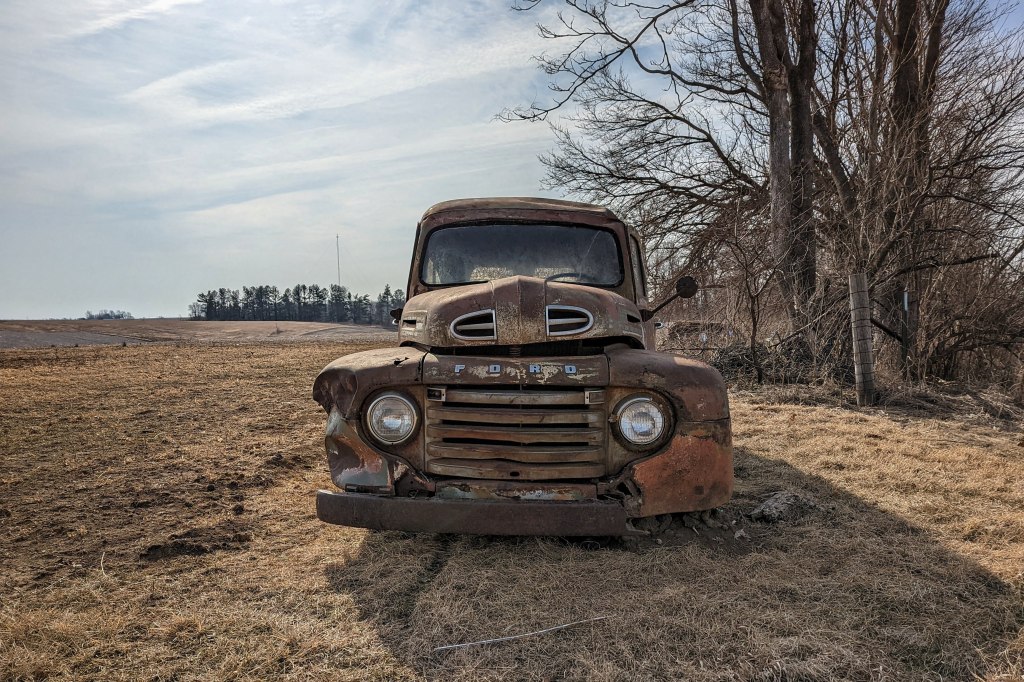
Again, there’s nothing wrong with this photo. Again, the composition was casual but deliberate. However, you’ve probably seen ten thousand photos almost exactly like this. A rusty wreck of a vehicle–an artifact of an outdated civilization cast aside in a living environment that will continue to grow while the artifact slowly degrades into nothingness. The best thing about this photo is that it places the panel truck in a larger landscape, which emphasizes how out of place it is. But basically, there’s nothing new to see in this photo.
So I got closer and changed the perspective again.
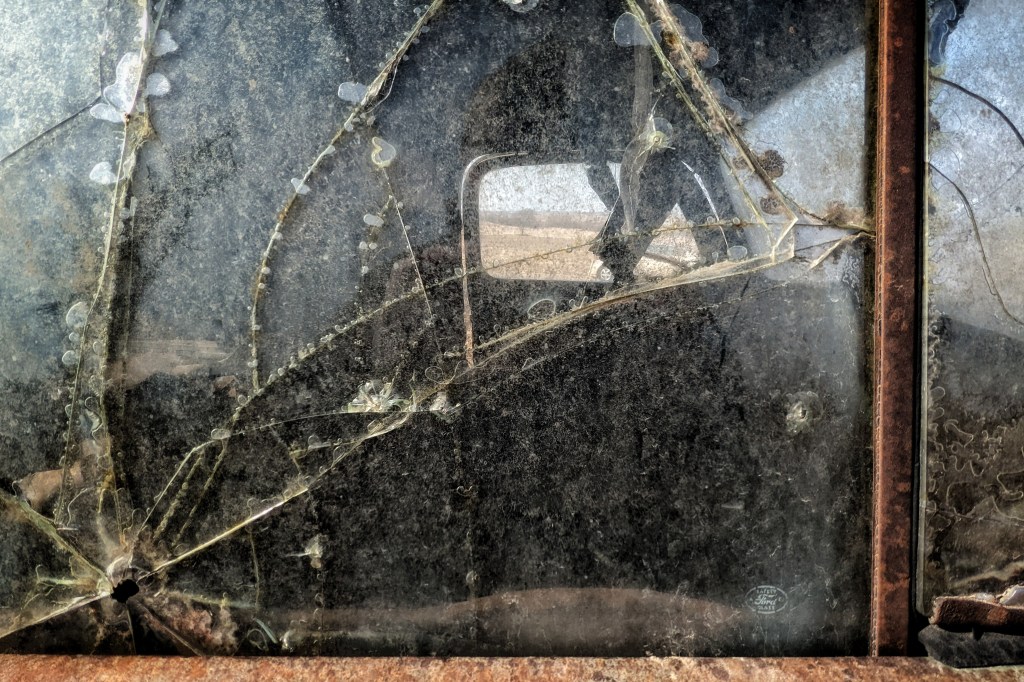
This is the photo that mattered. I took a bit more care with the composition. I knew I wanted the rust, I knew I wanted the suggestion of a large landscape through the windows, and I knew I wanted the lines of the shattered window and those bubbles formed by the thin layer of ice.
The actual old, rusted out Ford panel truck wasn’t really important; it’s the idea of the old, rusted out Ford panel truck that mattered. It’s a photo of an abandoned vehicle in the same way the first photo is a photo of a tank. The old, rusted out Ford panel truck is implied; you only need to see enough of it to hint at its existence.
The photo of the tank and the final photo of the panel truck are both photos of things that don’t belong there. Was I actually thinking of that when I took those photos? Nope. But after you’ve shot enough photos, a sort of algorithm develops in your brain. It’s like you know at the cellular level that everything in the frame matters, so you become very deliberate about what you keep in and what you keep out.
What you choose to include and exclude is grounded on why you’re shooting the photo. And that’s the thing. You may not be consciously aware that you’re shooting a photo of things that don’t belong where they are, but there’s some chunk of your brain that’s is actively registering that fact. If the tank or the panel truck were what mattered, you’d just photograph the tank and the panel truck. But you keep looking and moving and shifting around until your brain is at least semi-satisfied. Then you take the photo.
Okay, I’ve made the mistake of re-reading this (which I generally try to avoid in these blog posts). It sounds to me like I’m talking bullshit here (which is why I generally avoid re-reading these blog posts). But I’m still convinced that this is how I shoot photos. I can’t tell you how many times I’ve approached something that I wanted to photograph–that I felt was very photographable–and then walked away without taking a single shot because I couldn’t get what I wanted in the frame. There was something in the frame I didn’t want, or something I wanted but couldn’t include. My mind knew it, even if I wasn’t immediately aware of it.
The photographer Marc Riboud once said, “I photograph the way a musician hums.” That makes sense to me. Musicians, even when they’re just idly humming, know without thinking which notes work and which notes don’t. The wrong note ruins the composition.
And there it is.