Unknown's avatar

About greg

Just another bozo on the bus.

not the weirdest thing i’ve done

A couple of days ago I wrote about a photograph I’d taken of some cracks and oil stains in a random patch of blacktop. It may seem a wee bit weird to photograph a patch of blacktop, but…well, just wait. In that post, I briefly referred to the fact that there’s a difference between blacktop and asphalt. That sparked a reply to the post, and that reply reminded me of an earlier crushed stone and bitumen-related photograph I’d taken fifteen years ago.

Now that was weird.

Back in November of 2010 I was noodling around a location where a local supermarket had been demolished. All that remained of the store was its foundational slab and what had once been a parking lot. That’s where I came across something odd.

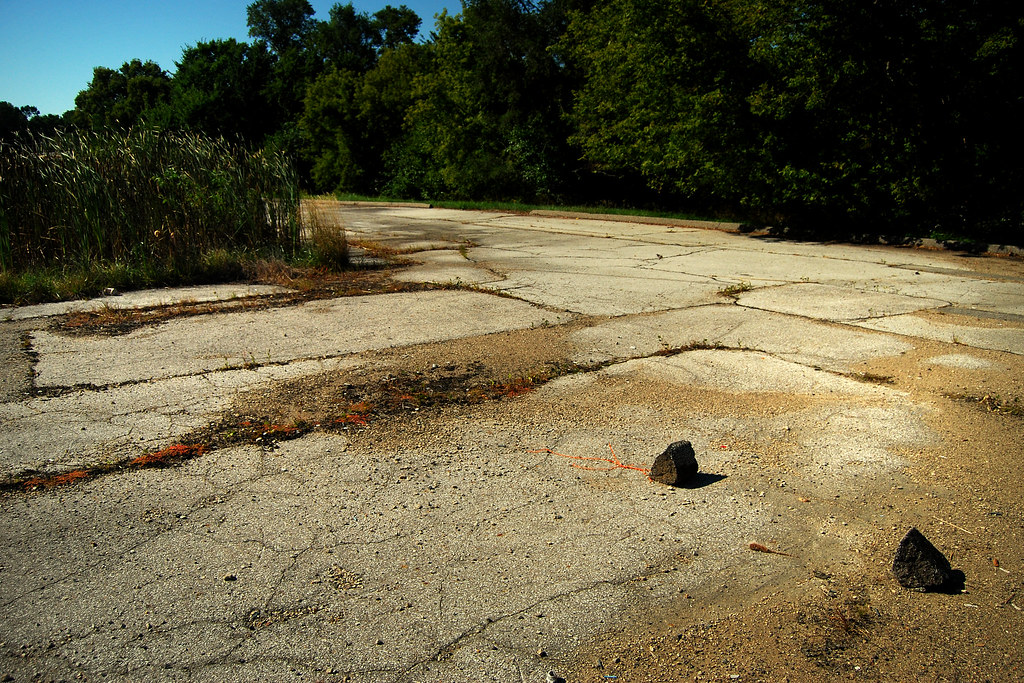
November 13, 2010

Yep, that’s a chunk of asphalt curbing around which somebody had tied a strand of red PVC-coated wire. Why would somebody do that? I don’t know, but I assumed it was to make it easier to carry. Why would somebody want to carry a chunk of asphalt curbing? No idea. I located the spot from which the curbing had been removed about 20 yards away. There were several similar chunks of broken asphalt curbing. But somebody had selected that particular chunk, tied red PVC wire around it, and moved it.

Why? No fucking clue. But it was odd, and I do love things that are odd.

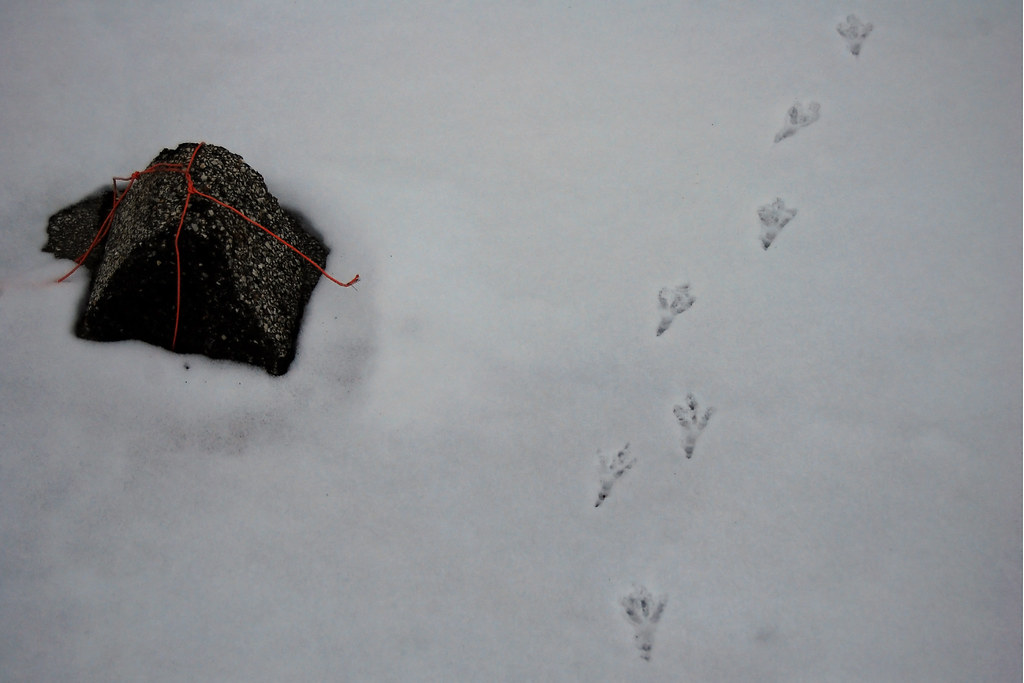
December 23, 2010

So I returned to that spot about six weeks later. The chunk of curbing was still there. It had snowed, but the snow had melted off the chunk. A heron had apparently been curious enough to check it out. Not sure if that meant the heron was as curious as I was, or if I was as stupid as a heron.

Anyway, I stood there in the snow for a while, trying to cobble together some semi-logical reason for somebody to tie some PVC wire around a chunk of curbing and carry it twenty yards before dropping it. I was sure there was a logical reason; not necessarily logical to me, but logical to the person who did it. But I’m damned if I could figure it out.

February 16, 2011

I found myself occasionally wondering about that chunk of curbing and the red PVC wire. Did the person just happen to have some red PVC wire in their pocket? Had they deliberately brought the wire with them, intending to move the chunk of curbing? And why why why would they want to move it in the first place? It made no sense, but I was intrigued by it.

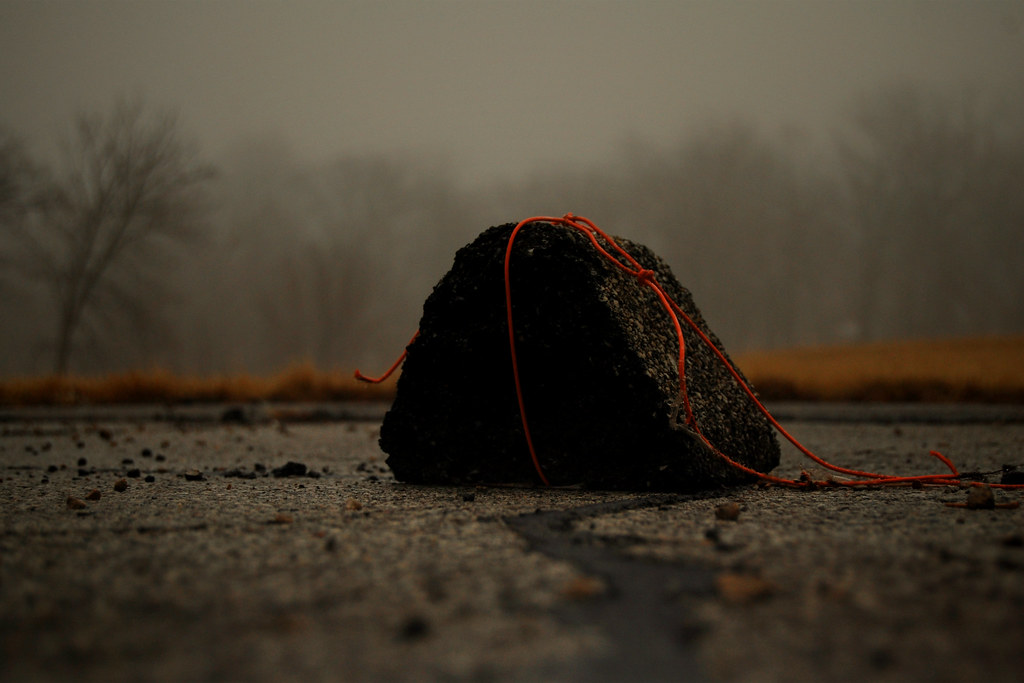
So I went back again on a cold, wet, foggy day in February. And yep, it was still there.

February 16, 2011

It wasn’t just strange; it was also visually interesting. I was taken with that red PVC wire. I considered taking hold of the wire and lifting the chunk, just to see how heavy it was. But I was reluctant to disturb it. It wasn’t just an object of curiosity anymore. That’s when I began to think of the chunk of curbing as a possible photo project. Which meant it didn’t seem right to intentionally change anything about the subject matter.

April 13, 2011

I returned to visit the chunk of curbing about a month later and was shocked to see it had been moved. Somebody had apparently picked it up, carried it about twenty-five feet, at which point the red PVC wire had snapped.

I can’t imagine many people would find a reason to noodle around the detritus of a former supermarket. But IF somebody did, and IF that somebody happened upon the chunk of curbing, then surely they’d be tempted to pick it up. I mean, I’d been tempted to pick it up myself. The way the PVC wire was wrapped around the chunk of curbing–it was clearly intended for it to be picked up. Who could resist it?

Somebody didn’t resist it. Somebody had seen it, had picked it up, and toted the chunk of curbing twenty-five feet. Hell, that was the most understandable thing about the whole situation.

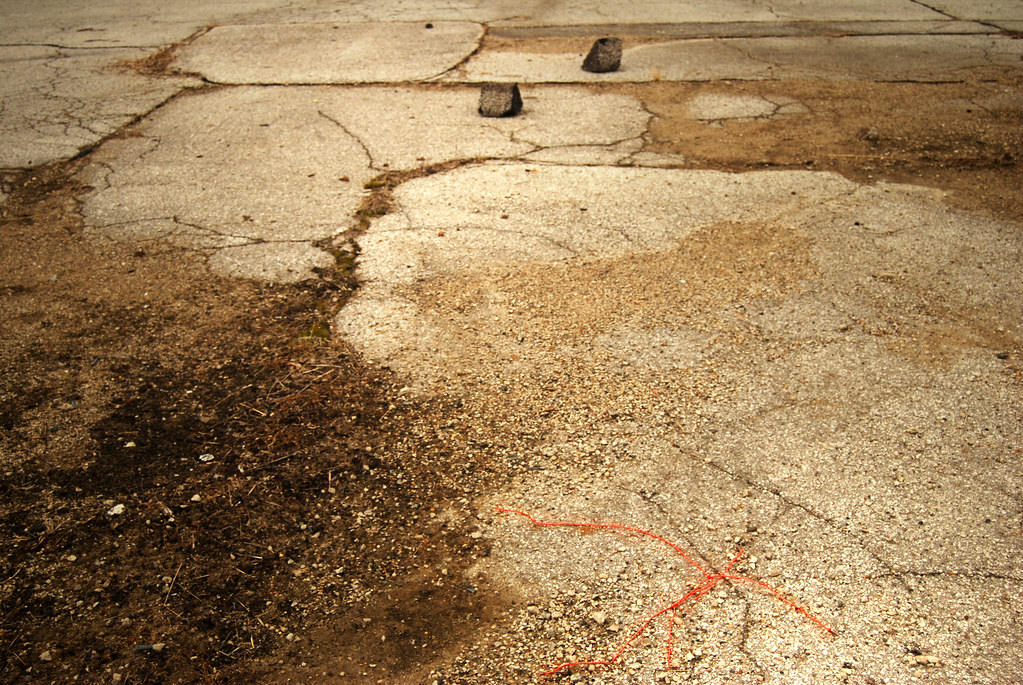
August 24, 2011

I didn’t get back to visit my pet chunk of asphalt curbing until late in the summer. As I approached, I saw two chunks. I thought maybe whomever had moved the curbing back in the spring must have returned and broken it.

But no. It was a second chunk of asphalt curbing. Somebody–maybe the same person who’d moved it earlier–had apparently gone to the spot where other chunks of curbing were scattered, picked up another chunk, carried it to the vicinity of my pet chunk, and dropped it.

This compounded the WTFedness of the situation. It reinforced the original weirdness. It made no sense at all. It was insane. It was…kind of wonderful. I was oddly pleased by the development.

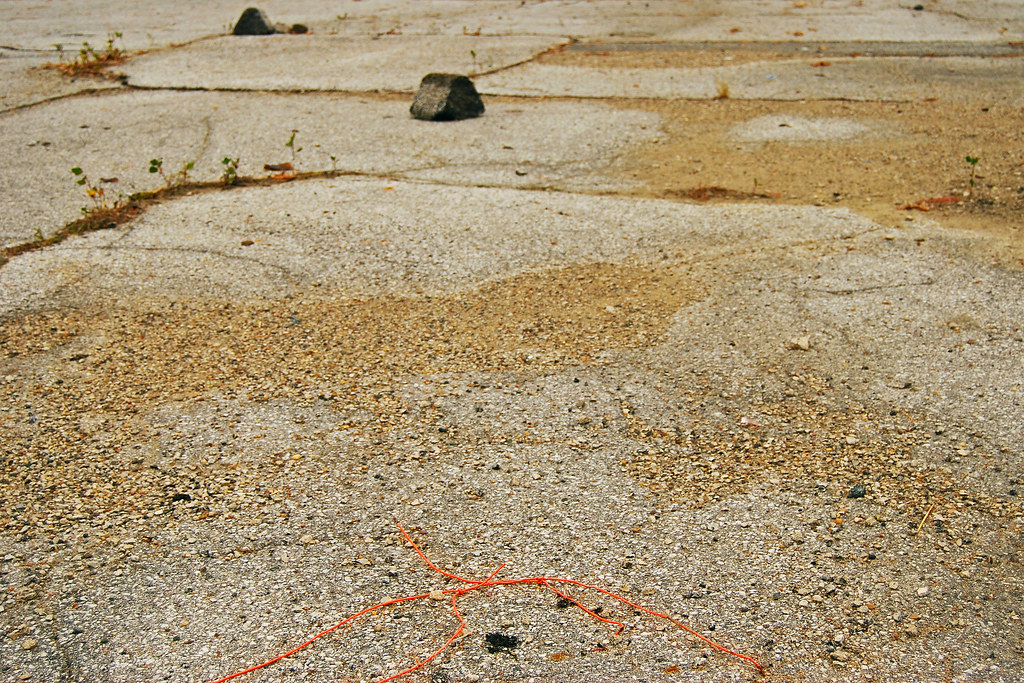
September 8, 2011

I returned a month later. Not much had changed. Some orangish lichen had grown in a nearby crack and I spent some time trying to find a way to photograph the red PVC wire and the orange lichen, but nothing seemed to work. In the end, I just documented my chunk of asphalt curbing along with its companion.

I figured I’d just about come to the end of the chunk’s story. I was still curious about the whole thing, but the original aura weirdness was beginning to fade.

October 18, 2011

Still, I’d developed something of a perverse relationship with that chunk of curbing. I felt a need to check on it. So of course I went back.

The red PVC wire had moved. It had broken six months earlier, but a length of it had been trapped beneath the chunk of curbing. How did it get loose? Maybe a bird or animal had tugged on the wire and freed it? In any event, I took it as a sign (No, not that sort of sign; just an ordinary sign) that the project was at an end. Surely, the wire would soon get blown away. Without the red PVC wire, the chunk of curbing was just a chunk of curbing. As soon as it was gone, the photo project would be over.

December 20, 2011

I gave it a couple of months. I went back in December. Nothing had changed. As near as I could tell, the red PVC wire hadn’t even moved. That was…weird. You’d think that over the course of two months something would have moved the wire. But that was just minor league weird compared to the overall weirdness.

Still, I’d made the decision that I’d keep coming back until the red wire was gone. So I returned in the spring. The entire area was fenced off and construction equipment was tearing up the old parking lot.

There’s an apartment complex there now.

I no longer live in that area, but maybe once or twice a year there’ll be a reason for me to pass nearby. And when I do, I think about that chunk of asphalt curbing, and the bright red PVC-insulated wire, and the person who’d tied the wire into a parcel-carrier. And I wonder what in the hell they’d been doing, and why. And it pleases me that I’ll never know the answer.

blacktop

So I’m in a parking lot. No, wait, not a parking lot…a parking area. It’s not like a parking lot outside a big box store, with lines designating parking spaces. This is just an extra wide bit of blacktop on a winding blacktop road through some woods near the spillway of a dam. It’s a place where people who fish the area above the spillway can park their cars.

On a weekday, it’s usually empty except for the occasional Asian or Latino immigrant looking to put some fish on the table. It’s a quiet spot. Shaded by trees. My partner and I sometimes make the half hour drive to this spot with a couple of camp chairs, something cool to drink, and our books. We sit, we read, we look at the birds, we listen to the wind in the trees, we chat with the folks who come to fish. On the way home we usually stop for ice cream. It’s nice.

She can sit still longer than I can. My knees are wonky and I have to get up periodically and stretch them. There’s always something to look at, and I’ve always got a camera with me, so occasionally I’ll take a photo. Yesterday I took a photo of the blacktop.

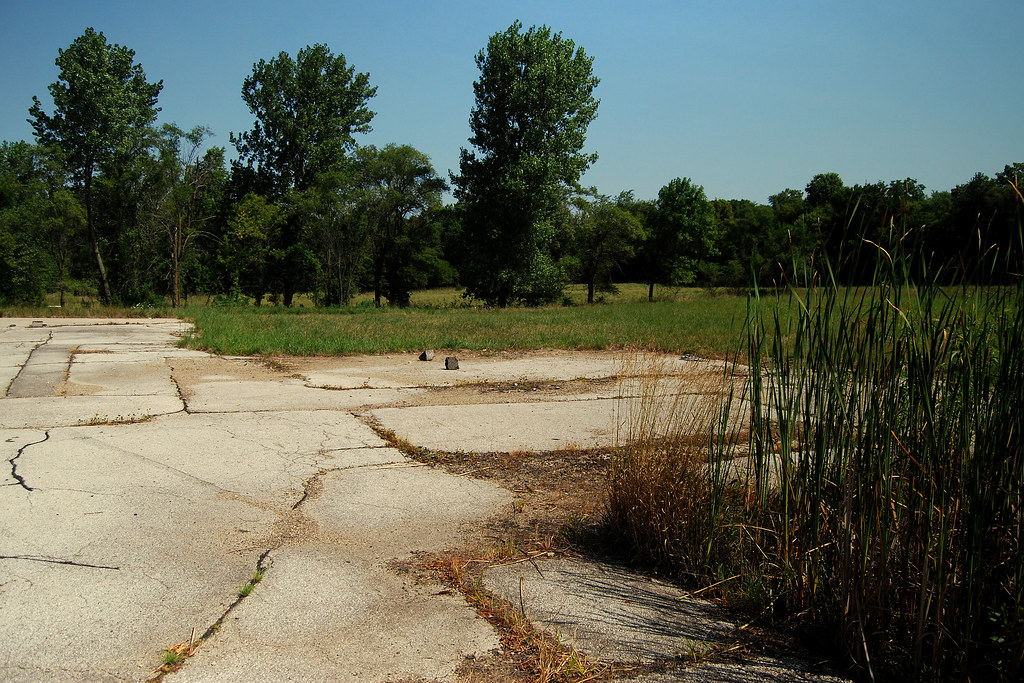
I don’t know why this particular patch of blacktop caught my attention, but it did. There are some cracks with little weedy bits growing in them, and some oil stains–some new, some faded. But it’s just blacktop (which isn’t asphalt, by the way; both blacktop and asphalt are made of crushed stone and bitumen, but the ratio of stone to bitumen is higher in blacktop, which can give it a more sparkly appearance–and lawdy, this is way more information than you need or want).

I pulled my Ricoh GR3X out of my pocket and looked at that patch of blacktop from several different angles and directions. I raised the camera higher, I lowered it closer to the surface, looking for a different framing of the patch. I probably spent three or four minutes trying to get the framing just right. Then I took this single photo.

I looked up to see my partner was watching me. She said,

“Bug?”
“What?”
“Where you taking a picture of a bug or something?”
“Oh. No. Just the blacktop.”

She looked at me for a moment, then nodded and went back to her book. The sky is blue, the clouds are white and fluffy, the water ripples a wee bit with the wind. There are swallows hawking for insects just above the surface of the lake. A kettle of vultures is making lazy circles in the distance. And there’s Greg taking a photo of a patch of blacktop.

The view.

Just another day at the upper spillway.

state fair in…monochrome?

The Iowa State Fair…well, every fair, really…is a colorful event. Bright, garish colors. Not normally a venue I’d consider photographing in black-and-white. And, in fact, of the maybe 150 photos I shot during my five hours of noodling around the fairgrounds yesterday, only a few were shot in monochrome.

Guy in an almost empty barn.

Why would I do that? Because there are some scenes that feel like they ought to be shot in monochrome. Color photography is my default approach, and sure, you can shoot scenes in color and convert them into black-and-white images (which is actually the best approach, since digital imagery is grounded in information rather than color). But if there’s something I want to shoot in black-and-white…well, I shoot it in black-and-white. I want to see it in black-and-white.

Bearded guy.

Obviously, we live in a world of color (well, most of us do) and yay for that. I love color. But sometimes it’s a distraction. The photograph above is all about the beard. But this guy’s clothing was a drab sort of khaki which made his beard almost disappear. Worse, the woman next to him was dressed in bright colors. In fact, most of the passers-by were dressed fairly colorfully. The only way this photo would work was if I removed the distractions of color.

That’s one of the many advantages of digital photography. Almost every modern digital camera allows you to quickly shift back and forth between color and monochrome. I have my Ricoh GR3X set up with two different color profiles and a high contrast monochrome profile. When I saw this guy demonstrating wood-turning on a small lathe, I knew his brown-green smock would interfere with the color of the wood. A turn of a dial, and problem solved.

But what do you do when there are scenes that work in monochrome AND color? For example, a blacksmith at work. You can’t ignore the bright color of flame, or the way fire casts a glow on the surroundings. Obviously, you have to shoot both. Each carries a different emotional weight.

Blacksmith at work.

The photograph above is, I think, a very human photo. It’s as much…or more…about the people in the photo as it is about blacksmithing. The light cast by the flame and the high windows softens everything. It gives the image an almost cozy feeling.

When you remove the distractions of color, the mood changes. It’s not just that the composition becomes more focused on tone and texture, on shadow and light, or line and form. Removing color also means abandoning the strictures of reality. Black-and-white photos are a wee bit divorced from reality, a step or two away from the real world, recognizable but still different. This can give an image an almost mythic quality.

Blacksmith at work.

This photo is less personal, more emotionally distant, more analytic. It’s not about the guy doing the work; it’s more about the mythos of blacksmithing–the narrative of the smithy, the cultural representation of blacksmithing. It has a more primitive vibe. Where the color photo is about warmth, this is about heat and fire.

Also? Black-and-white photography encourages a LOT more artsy-fartsy bullshit.

i don’t have time for your trans bullshit

Look, this is really simple. Trans women are women. Trans men are men. Trans people are people. Same goes for non-binary folks.

Trans military troops are troops. This is so fucking obvious, but there’s a lot of macho bullshit involved here. Again, it’s really pretty simple. Trans helo pilots are helo pilots, trans mechanics are mechanics, trans medics are medics, trans EOD specialists are EOD specialists. A helo or an unexploded bomb doesn’t care about gender. Piloting helos and defusing bombs are skills that can be learned. Sure, some folks will be better at it than other folks, but that’s just how the world works. It’s massively stupid to refuse to enlist anybody willing to put on the uniform, shoulder a weapon, and walk a post.

Trans athletes are athletes. There’s SO MUCH bullshit about this topic. It shouldn’t surprise anybody that not all athletes are equal, and not all of that is due to native talent. There are dozens of ways one athlete can have an advantage over another. There are technological advantages, in gear and in training. Having cutting edge equipment and sophisticated training tools make a difference. There are massive financial advantages; rich kids can afford trainers and gym fees and gear beyond the reach of poor kids.

And yes, there are genetic/physical advantages. Why was Michael Phelps such a good swimmer? He had unique physical attributes—a long torso, short legs, long arms, large hands and feet, and double-jointed ankles—that gave him a physical advantage over other swimmers. High testosterone levels can matter in sports, but variances in testosterone levels occur naturally (which is why you see those commercials for men with ‘low-t’). Even so, sports governing bodies like the NCAA created policies that require trans women (this apparently isn’t an issue for trans men) to complete a full calendar year of testosterone suppression treatment before being allowed to compete in women’s sports. If a trans person excels in sports, it’s for the same reasons anybody excels in sports. Hard work, good training, dedication, and maybe (like Phelps) some quirk of biology.

Trans teachers are teachers. Math is math, geography is geography, grammar is grammar, history is…well, debatable, but the eccentricities of history aren’t dependent on the biology of the teacher. Trans shopping clerks are shopping clerks. Whether you’re shopping for a sweater or a lawn mower or a canoe or patio furniture, all you want is somebody who knows the product they’re selling.

I could continue this. Trans surgeons are surgeons, trans plumbers are plumbers, trans lion tamers are lion tamers, and and and. Trans people are people. There’s no point in waffling about this. Yes, people will have different opinions on the matter, and yes, they’re allowed to voice those opinions, but no, you don’t have to respect those opinions.

And by the way, it works both ways: Trans assholes are assholes (uh…I’m talking personality here, not anatomy. Although that would also be true). My point is this: if you don’t accept trans people as people, then the problem isn’t with the trans folks; the problem is you’re an asshole.

EDITORIAL NOTE: This trans bullshit is another facet of patriarchy. We need to burn the patriarchy to the ground. Then dig up the roots and burn them. Then piss on the ashes before burying them in lye. Then nuke it from orbit (it’s the only way to be sure). Then have some of those little lemon cakes.

asking too much

Late last night I was noodling about on YouTube, looking for something about Japanese photographer Miyako Ishiuchi (who, by the way, is vastly underappreciated) and I came across a video by–I guess he’d be considered an ‘influencer’? I’m not going to mention names; he’s a good photographer, makes a LOT of videos about photography and photo gear, he’s got a large following. This particular video was focused on his feelings about being burnt out. He said:

“Lately I’ve been feeling like my photography hasn’t been saying what I want to say. I’ve been questioning if it’s even the right medium for me to communicate my thoughts and feelings.”

Okay, valid. And hey, he’s right. Still photography isn’t a very effective medium for expressing thoughts and feelings. Writing is a good medium for communicating thoughts and feelings. Cinematography–moving images–another good medium for communicating thoughts and feelings. A cohesive series of purposely related still images can be an effective medium for communicating thoughts and feelings.

But a single photograph? Nope.

A single photograph is useless for expressing thoughts and it’s unreliable as a tool for expressing something as complex as feelings. A single photo can certainly invoke a mood, and that mood might suggest something of what the photographer was feeling. But it might not. A happy photographer can shoot a grim, moody photo; a photographer in deep despair can still shoot a cheerful photograph. A single photo, regardless of how powerful it is, is just a moment isolated in time and limited by an artificial frame.

As to thoughts, you often hear people say stuff like, “This photo tells a story.” No. No, it doesn’t. A single photo doesn’t tell a story. It can’t tell a story. A story has a beginning, a middle, and an ending; you need at least three photographs to tell a story.

BUT a single photograph can hint at a story. It can imply a story. The viewer, looking at a single photo, can create a story based on that moment. But it’s the viewer’s story; it comes from the viewer. It’s only inspired by the photo. A single photo can be the beginning, the middle, or the ending of a story. But an entire story? Nope.

This is not a story. It could be part of a story, but it’s not, in itself, a story.

That said, still photography can be a powerful story-telling tool IF you string together a series of related photographs. Photo-stories can even be more powerful than video, because you can take your time looking at a still photo. You can examine every corner of the frame. You have time to blink and think and ponder what you’re seeing in each image, instead of simply responding to the images streaming in front of you.

The photographer in the video also said this:

“I feel like a good photograph is something that expresses what the creator wanted to say.”

I dunno, maybe? If you want to say something like “Ducks are cool” or “Tall buildings are impressive” or “Look at this guy cleaning up street trash on a cold, wet, foggy morning,” then yeah, a good photo can express what you want to say. But if you want to express anything more complex than a simple declarative sentence, then your hope that a photograph will express what you want to say is…well, misplaced.

The only thing I was trying to say was, ‘Seeing this guy at work makes me feel something.’

Another thing—at no point in his video did the guy ever articulate WHAT he wanted to say. Or why he wanted to say it. Or how his photography was falling short. In fact, he said,

“I sometimes feel like I don’t have anything to say…and that I’m just making photos.”

Dude, that’s fine. Ain’t nothing wrong with just making photos. But when you deliberately take a photograph, regardless of the subject, you ARE saying something. You’re saying, “This is what I see. This is how I see it. What’s happening in front of my camera is interesting to me. It makes me feel a certain way. Maybe it’ll have a similar effect on you.” The impulse to press the shutter release is, by itself, a valid reason to take a photo.

I found this guy’s video annoying. Annoying and ironic. The irony is that the guy who was complaining that still photography failed to communicate his thoughts and feelings was actually communicating his thoughts and feelings using a medium designed to communicate thoughts and feelings.

My point is this: any expressive medium–still photography, cinema, writing, dance, painting, acting, sculpture–is limited. Don’t ask more from any expressive medium than it can give you. And don’t whine about the limitations.

a photograph i won’t post

I posted this photograph on Bluesky a couple of days ago. I almost didn’t take it.

I was noodling around the edges of a demonstration and saw this guy, overcome with emotion (and maybe the heat), turn away and sit down. He was a big guy, bald, looked strong; not gym-strong, but work-strong. The anguish on his face was hard to look at but strangely beautiful. It was probably a moment he’d rather not have in public…but he did.

Overcome.

Okay, let me just get this out of the way: in the US you have no right to privacy when you’re in a public space. That’s the law. If you’re in public, other people have the right to take your photograph. The question is never whether it’s legal to take another person’s photo; the question is always whether it’s ethical or appropriate. Those are individual decisions and only the photographer gets to make them.

I wanted to take that guy’s photo. But I didn’t. It seemed too private, too personal. Then he put his hand up and covered his face. The depth of his emotion was still clear from his body language, but by covering his face the image became less about him as a person and more about the emotion itself. So I took one shot and moved on.

I don’t shoot a lot of photographs of people. When I do, it’s most often during a public event. A farmer’s market, a street fair, a protest march, a sporting event, that sort of thing. Sometimes I’ll shoot people in more generic public venues–at a fruit stand, in a pub, on a bicycle ride. I may or may not ask permission to take their photo; it depends on the situation and the moment. I’m very open about carrying my camera in circumstances like this; I’m not trying to conceal what I’m doing, but at the same time I don’t try to draw attention to myself.

“Oh? You want a photo?”

Occasionally I’ll see somebody who, for one reason or another, interests me and I’ll stop them and ask if I can take their photo. Occasionally, they’ll say no; sometimes because they’re in a hurry, sometimes because they’re shy, sometimes for reasons they don’t articulate. If they say no, I just thank them and go on my way.

But most people say yes. Like this guy, John, who was waiting for a bus. Most people are friendly. They may ask, “Why do you want to take my picture?” and if they do, I tell them. I told John I liked his mustache and his hat. I don’t always ask their name, but I always thank them and show them the photo. Nobody has ever asked me to delete their photo.

John, waiting for the bus.

I DO NOT take photos of marginalized people in states of distress. I confess, I’m occasionally tempted to shoot those sorts of photos. Suffering is part of the human condition, after all, and I think if it’s done with compassion, such photos can have merit. But they can also just be cheap exploitation. And frankly, the viewer can’t know the photographer’s purpose by looking at the photo. The photo is what it is.

Having just said that I don’t take photos of folks experiencing hardship, I’m now going to admit I actually DID take one a couple of weeks ago. I was walking down a city street and came across a man who was stumbling along, leaning against a containment wall of a landscaped office building. As I got closer it became clear he was extremely intoxicated. I asked him if he was okay. He kind of wobbled his head; I couldn’t tell if he was shaking his head ‘no’ or if he was nodding. He said, “I just need to lay down for a bit, I just need to rest, to sleep.” He said that two or three times.

And he did just that. He climbed up on the containment wall, laid his head on his arm, and closed his eyes. I don’t know if he went to sleep or if he just passed out. I stood there for a very long moment, uncomfortable about leaving him and equally uncomfortable about staying with him. The look of misery and exhaustion never left his face. But there was something almost delicate about his relaxed hands.

I very much wanted to photograph him. And I was ashamed of wanting that. In the end, after a minute or so, I took the photo and left. Was it an ethical violation of his privacy in moment of vulnerability? Yes, without a doubt. But I did it anyway.

It’s a good photograph. Not a great one, but good. t’s an honest one. I like it and I hate it. I haven’t shown it to anybody. I discussed the entire incident with my partner and told her about the photo; she was rightly troubled by my behavior. So am I.

But I can’t entirely regret it.

a writer of detective fiction has thoughts on rules and magic

I recently had a semi-long, somewhat convoluted discussion (debate? argument?) with a friend who writes fantasy fiction. This is it (edited for brevity):

Friend: “Magic doesn’t have to have rules.”
Me: “Well, yeah, it does.”
Friend: “No, it doesn’t.”
Me: “Yeah, it does.”
Friend: “You write detective fiction. What do you know about magic?”

Here’s the answer to that question: All fiction is a cosmological event.

That’s it. That’s my answer. When we write a story—any story in any genre—we create a world. Most fictional worlds resemble the one we live in. The operative term there is resemble. This is true across all genres. As writers, we take liberties with the world; we shape our fictional worlds in ways we find useful. A mystery writer might, for example, create a world in which dog trainers routinely discover dead bodies and solve crimes. A horror writer might create a world in which vampires live among us. A fantasy writer might create a world in which people can engage in rituals or behaviors that manipulate natural or supernatural forces.

But when we create these worlds, we also create a set of internal rules for them. Again, MOST of those rules are patterned after OUR real world and we take them for granted. Things like gravity; if an elf drops her sword or a detective drops his gun, it falls to the ground. Unless we’re talking about elves in space.

UNLESS. The Great Unless. That’s where everything gets all slickery. You can slide all manner of things into the UNLESS envelope. Things like magic. But here’s the thing about an envelope: it’s a container. You can stuff all sorts of things inside it, but it still has boundaries. If your magic doesn’t have some sort of boundaries, you don’t have a story. If a Dark Evil threatens the Land and you have limitless unbounded magic at your command, you can just wave a hand and…poof. No more Dark Evil. There’s not much entertainment value in that.

But that doesn’t mean magic has to exist within a spreadsheet. It just means there are things that Can Be Done and things that Cannot Be Done. What Can and Cannot Be Done might be person-specific, or limited by location, or constrained by training, or or or. Those limits don’t have to be articulated for the reader, but they have to exist.

Here’s an example. One of the most delightful novels I’ve read in recent years is Nettle and Bone by T. Kingfisher. It begins with a woman in a bone pit, constructing a dog out of wire and an assortment of dog bones. When she’s done…hell, even before she’s done…the dog comes to life. How and why the bone dog comes to life isn’t explained. It’s magic. The woman’s ultimate goal in the story is to kill an evil prince, but her access to magic is limited. Building a dog out of a random assortment of bones is a thing that Can Be Done; killing a prince is a thing that Cannot Be Done. At least not by her at this point in time.

That right there? That’s a rule. The reader doesn’t need to know WHY the rule exists. Even the writer doesn’t need to know why it exists. But it HAS to exist for the story to work as a story. She can use magic to bring a bone dog to life, but she can’t use it to kill the prince.

Look, there’s nothing wrong in not knowing why things are the way they are. I mean, we still don’t understand how gravitation works and folks have been studying it for at least 2300 years. We know it works at the Newtonian level, but then things get all weird down at the quantum level. If we’re unable to understand and explain one of the fundamental forces of the natural world, how in the hell are we supposed to understand how things work in the supernatural world?

So yeah, magic has rules. It has to. We just don’t always know what they are. That’s perfectly…well, natural.

a modest ebike proposal

Okay, first, this is NOT a Jonathan Swift-style modest proposal (see Endnote). This isn’t satire. Second, yes, okay, maybe I’m focusing on this relatively minor problem in an attempt to dodge thinking about the truly massive, cataclysmic problems we’re facing in the US. But hey, it’s my blog and I get to do what I want.

The fact is, there’s a very real problem in the Ebikeverse, and I have thoughts about it. I’ve been thinking about this problem off and on for a few months, in part because I had a minor disagreement with a fellow cyclist/photographer on Bluesky. He’d made a rather broad, disparaging comment about ebike riders. As an ebike rider, I asked for clarification. It turned out he was talking about a specific type of ebike, which he referred to as “not-a-moped” ebikes. These little bastards.

Ride1up Revv 1 FS

I responded to his comments:

It’s a mistake to equate all ebike cyclists with not-a-moped jerks, who I’ll agree are a massive problem.

I can’t quote his reply exactly because…well, he’s blocked me (see the Other Endnote). Basically, he said the people who ride that type of ebike were assholes. I responded that assholes are assholes, regardless of the type of bike they ride. At which point, he blocked me. Perhaps he thought I was calling him an asshole. Who knows?

But he was right about the problem. A sizable chunk of the people who ride this particular style of ebike DO tend to be aggressive jerks who are abusive and a danger to regular cyclists and pedestrians. But he was wrong to call them not-a-moped bikes, because (in my opinion) they actually ARE mopeds, not bicycles. They may have pedals, but they aren’t really designed to be pedaled; they’re designed to be driven using a throttle.

In the US, ebikes are basically categorized by how they’re powered. Class 1 ebikes rely exclusively on pedal assist (they’re technically called ‘pedelecs’).They have a top speed of 20mph and they lack a throttle. Class 2 ebikes are basically Class 1 ebikes, only with a throttle (which is used most often to get the bike moving again after a complete stop). Class 3 ebikes have pedal assist and a throttle, but have a top speed of up to 28 mph.

There are also Class 4 ebikes, which generally have more powerful motors and aren’t limited by a top speed. They’re considered to be motorized vehicles and (in many states) require a license to operate, as well as proof of insurance. They’re generally prohibited on bike paths.

The ebike/mopeds I’m talking about (like the one pictured above) are the bastard children of Class 3 and Class 4 units. They’re marketed as Class 3 ebikes and sold as Class 3 ebikes, but they’re not ridden like ebikes. Everybody knows this. In fact, in a review for the Ride1up Revv 1 FS shown above, it’s openly admitted.

[It] isn’t a bike, at least in conventional terms. The presence of pedals on little crank arms is more incidental and added to skirt existing laws about electric mopeds…nothing about the bike’s weight, geometry, or gearing is built for actual pedaling.

They’re designed to be throttle-driven. While they may be sold with a top speed of 28mph, they’re easily modified to go much faster, and there are lots of videos showing people how to do it (for example, here’s a video showing how to unlock the ‘bike’ in the photo above). And this is why they’re a problem.

So here’s my modest proposal: designate this specific type of ebike as a Class 4 ebike and establish an age limit for purchasing Class 4 ebikes.

That’s it. Don’t allow manufacturers to skirt existing laws by attaching mock pedals to a vehicle designed to be throttle-driven. It won’t stop assholes from riding like assholes, but it would reduce the asshole quotient on bike paths and sidewalks.

Endnote: Back in 1729, Swift wrote a satirical piece called A Modest Proposal for Preventing the Children of Poor People from Being a Burthen to Their Parents or Country, and for Making Them Beneficial to the Publick. The proposal was that poor folks should sell their children to the rich for food. So, nothing at all like my proposal.

Other Endnote: Even though I was blocked by this guy, I can’t/won’t complain about it. I’m a huge fan of the way blocking works on Bluesky. It’s incredibly effective and efficient. If somebody is annoying you, you block them and they disappear. You’ll never see anything they post again. They’ll never see anything you post again. If somebody you follow responds to a post by the person you blocked, you’ll see the response but not the post itself. It’s brilliant (even when it’s used against you).