the privilege of the sword

I don’t know if this is a thing or not, but during the holiday season (which, for those not in the US, is the period between our Thanksgiving and the New Year) I tend to re-read favorite novels. It’s probably got something to do with comfort and quiet and nesting. I don’t know, but there it is and I’m not going to think about it too much.

This year I’ve decided to re-read Ellen Kushner’s The Privilege of the Sword. It’s probably been a decade since I read it, but it’s a novel that resonated with me. I’d read her earlier novel, Swordspoint, a few months before. The Privilege of the Sword (okay, I’m just going to refer to as PotS from now on) isn’t exactly a sequel to the earlier novel, but it’s definitely sequelish. It includes many of the same characters and takes place in the same “fantasy” world.

You’ll note I’ve put “fantasy” in quotation marks. Both novels are often listed as fantasy novels, which is a genre I tend to associate with some sort of magic (and, too often, elves and dragons). I’m fundamentally skeptical about the use of magic (and elves and dragons) in a story, but I accept that they’re inextricably bound up in the fantasy genre. I accept them in the same way that I accept the frequency of murder victims in cozy mysteries. I tend to wince a little when it happens, then get on with the story.

As I started reading Swordspoint, the first novel, I kept waiting for somebody to do something magical. It was sort of like having a new car; you know it’s going to get dinged at some point, so you’re sort of tense every time you leave it in a parking lot. But once somebody opens their car door and dings your fender, you relax a bit. The damage is done. My point is I couldn’t quite relax and enjoy Swordspoint for the first few chapters, because I was waiting for somebody to wave a wand or cast a spell or something. Eventually I realized it wasn’t going to happen. It was a tremendous relief.

There’s no magic in either of these novels (at least not as an element of the story; the magic is in the quality of the writing). These novels are fantasies in the same way one of my childhood favorite books, The Prisoner of Zenda, was a fantasy. They’re set in an imaginary but internally consistent story world, one in which politics and political intrigue play as much a role as the swordplay. The ‘fantasy’ element is the way the story world–its culture, its social norms, its customs and traditions, its concept of status–is maintained and made real.

So why have I decided to read PotS instead of Swordspoint? Because I recall PotS as a more human story. I recall it being funnier, sadder, more simple but more surprising, more elegant, more intelligent, and more (for me, at any rate) emotional. My recollection may be faulty, but I’m relying on it anyway. There’s an excellent chance I’ll reread Swordspoint as well.

The basic plot of PotS (as I recall) is as follows: a young, rather flighty young woman is called to attend her uncle — the mad and deliciously depraved Duke of Tremontaine — who has decided, for obscure reasons and against all tradition, to train her as a swordsman. In both novels, disputes are sometimes/often decided by setting hired swordsmen against each other. The young woman (I think she’s in her teens?) is initially more interested in attending balls and attracting a potential husband, but tolerates her uncle’s peculiarities for her family’s sake. Eventually, she learns to appreciate swordplay both as a skill and for the freedom it provides her. Her new talent and attitude also allows her to help others who aren’t able to help themselves. There are, as I recall, at least a couple of subplots which are woven seamlessly into the narrative.

Some of that may be incorrect, but that’s how I remember it. What I remember most is that delicious feeling of being completely engaged with the story world and the characters who inhabit it.

I’ll start re-reading PotS this evening or tomorrow, depending on when I finish the novel I’m now reading (the most recent Murderbot novel) and how busy I am. I’ll take my time reading it — maybe read 2-3 chapters a day. I may report back here every few chapters.

I confess, I’m a tad hesitant to start re-reading it for fear it won’t quite hold up to my memory and my expectations. It’s always a risk to return to your favorites, isn’t it.

a tale of two railroad crossings

Okay, the title is a lie. There’s only one railroad crossing in this story. But the title was too good to pass up. Sue me.

Lately we’ve been seeing a lot of Nazi shit again. Some of it’s related to the appalling situation in Israel, of course, because Nazis will always find some way to contribute to whatever hate is taking place. Some of it comes from the Republican Party.

Seriously, the leadership of the Texas Republican Party voted 32-29 to reject a resolution saying members of the Texas GOP should “have no association whatsoever with any individual or organization that is known to espouse anti-Semitism [sic], pro-Nazi sympathies, or Holocaust denial.” They didn’t say it was fine to hang out with Nazis; they just decided hanging out with Nazis wasn’t important enough to make a fuss over.

You may be wondering, Greg, old sock, what’s that got to do with railroad crossings? I’m about to tell you.

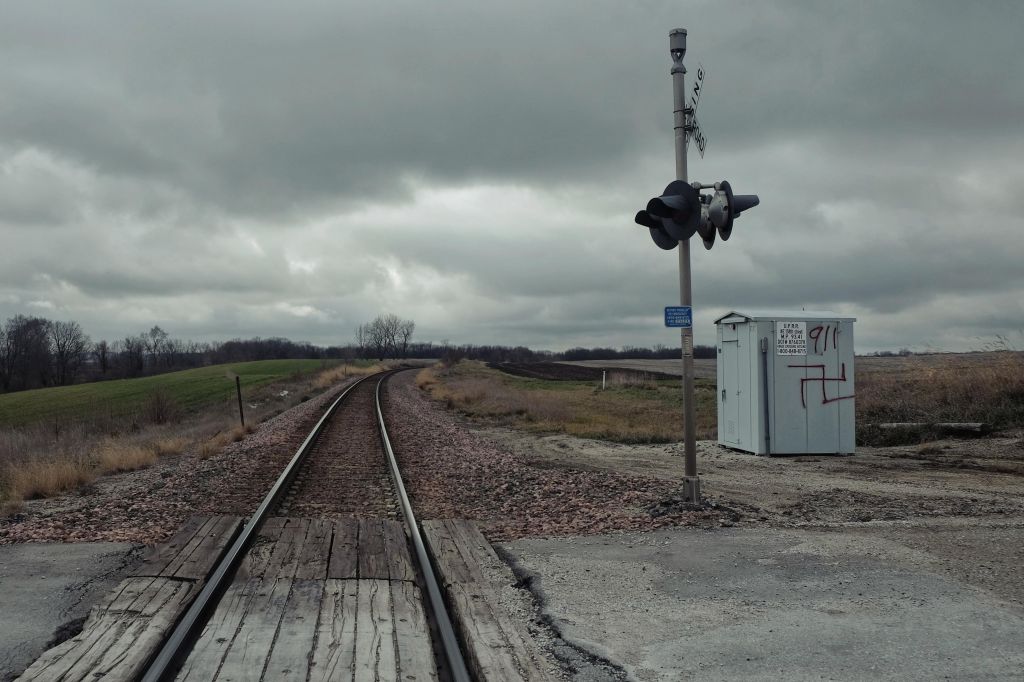
A few years ago I was out noodling around in the countryside and happened across a swastika painted on a shed beside a railroad crossing. So I did what anybody would do. I stopped and took a few photographs of it.

It was one of those cold, drizzly, dreary December days, which made for a nicely dramatic photograph. I only took three or four shots (because it was cold, drizzly, and dreary). Just as I was about to get back in the car, a sheriff’s deputy arrived. I waited and waved. He got out and politely asked me what I was doing. I told him I was shooting photographs. In the past, I’ve had a few encounters with the police who wanted to see my photos, so I prepared myself to refuse that request (you know…just on principle). Instead, he said something like, “I hope you got your shots, because I’m here to paint over that swastika.”

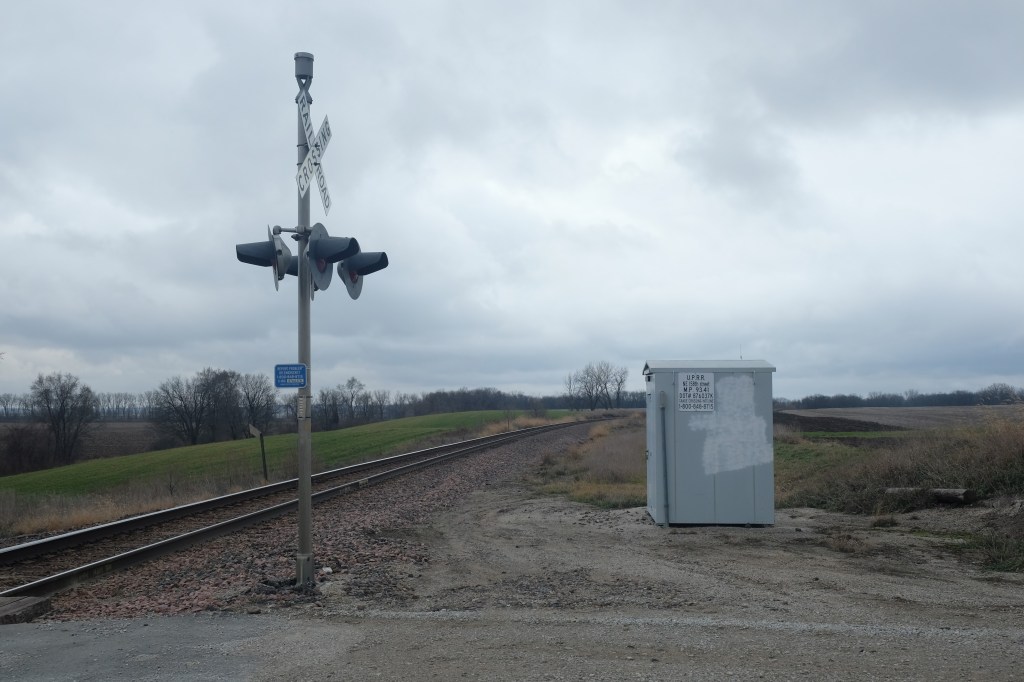
I asked if I could photograph him doing that. He said he’d rather I didn’t. And because he was polite, I didn’t. I got back in my car and left. But I returned about twenty minutes later.

The deputy was gone. So was the swastika. It’s certainly not as interesting as a photograph, but socially and culturally, it’s a huge improvement.

I don’t know if somebody reported the swastika or if one of the local deputies spotted it while on patrol. But I was pleased that the sheriff’s office acted.

EDITORIAL NOTE: I was a criminal defense investigator for several years, which meant I was in an openly adversarial relationship with policing agencies. I don’t fully ascribe to the ACAB (all cops are bastards) view, but I’m painfully aware that all police officers have the capacity to be cast-iron bastards and often are. Because of that, I’m quietly thankful when I see any law enforcement person actually contributing to public safety without being a bastard about it.

box of glasses

I don’t know about you (seriously, I can in all honesty say that I absolutely do not know about you), but whenever I come across a box full of old eyeglasses, I fall victim to a sort of mild compulsion. I feel the need to put them on. It’s not an irresistible compulsion; I could probably hold out against it, if I really wanted to. But why would I?

Perhaps you also feel that same impulse when you come across a box full of old eyeglasses. It’s possible. But like I said, I don’t know about you.

In any event, I did, in fact, recently come across a box full of old eyeglasses while clearing out some shelves in the garage. I don’t know how many pairs of glasses. Dozens, both men’s and women’s, both regular glasses and prescription sunglasses. And hey, I gave in to that compulsion. I gave in without any hesitation at all. I wanted to see what the world looked like through a series of lenses generated for other people.

[SPOILER: it looks blurry.]

And almost immediately I felt another mild compulsion: I wanted to see what they looked like on somebody’s face. But you can’t just ask somebody to sit and try on old eyeglasses that belonged to other people, all of whom are dead. You can’t ask somebody to do that just for your own amusement. I mean, you can ask them to do that, but it would be awfully presumptuous.

So instead, I turned to the Model of Primary Convenience. Me.

I don’t take many selfies. I know what I look like; I’ve had this same face all my life, so there’s nothing there for me to discover. And, in all honesty, I’m sort of uncomfortable taking photographs of myself (unless it’s a reflection in a window or something).

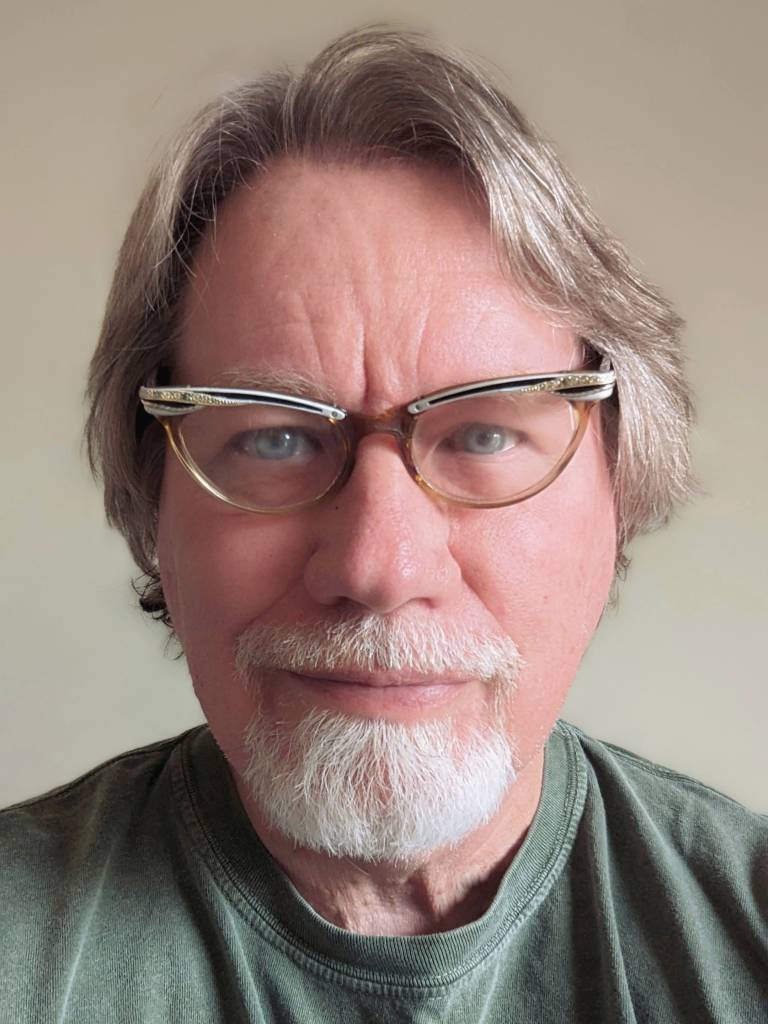
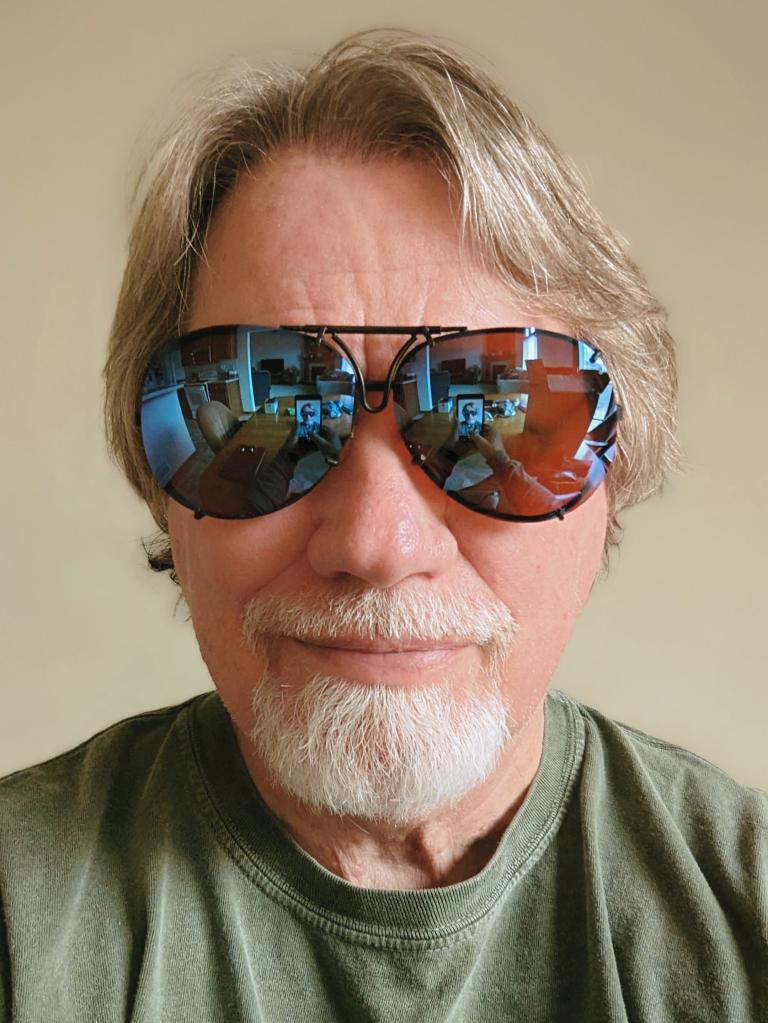
But there I was, under a mild compulsion, sitting at a table with a box full of eyeglasses and my Pixel phone in front of me. So, I put on the first pair of eyeglasses I pulled out of the box (women’s cat-eye glasses) and I took a selfie. And I looked at it. And it was sort of hilarious.

So I did it again, with a different pair of eyeglasses.

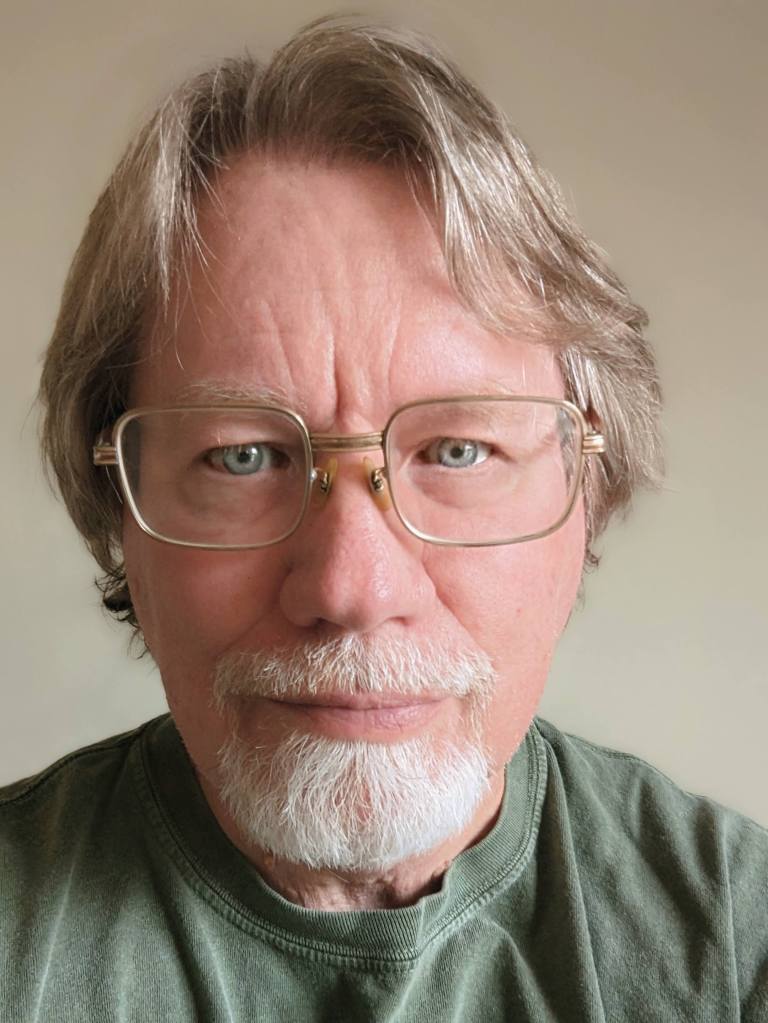
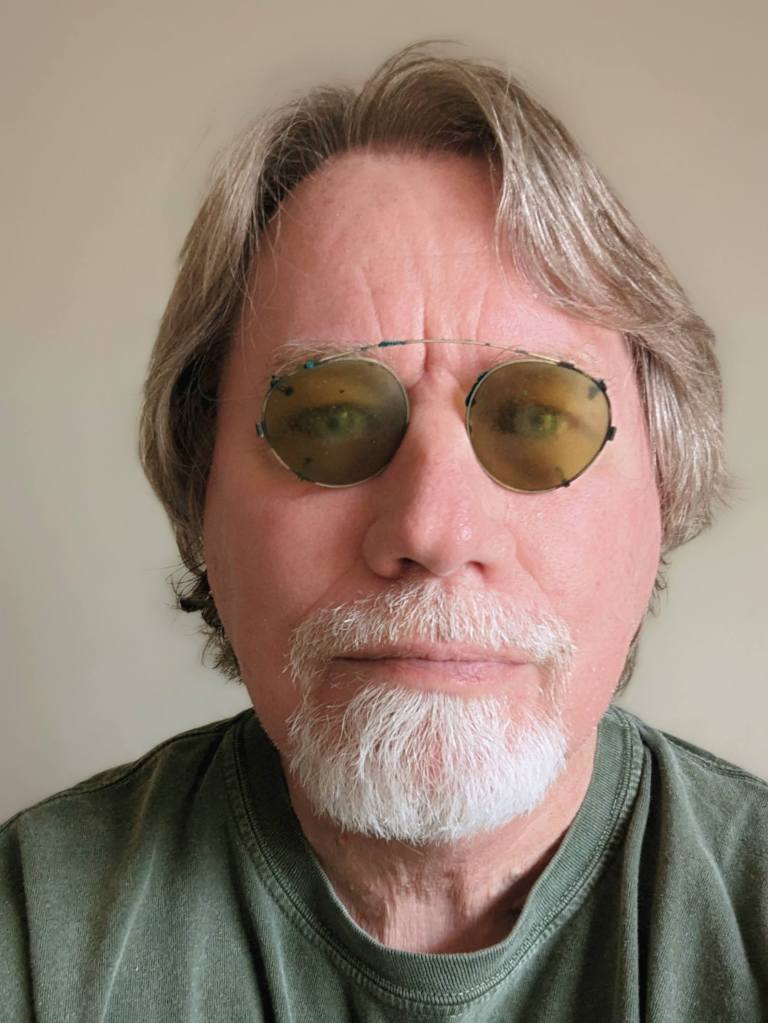
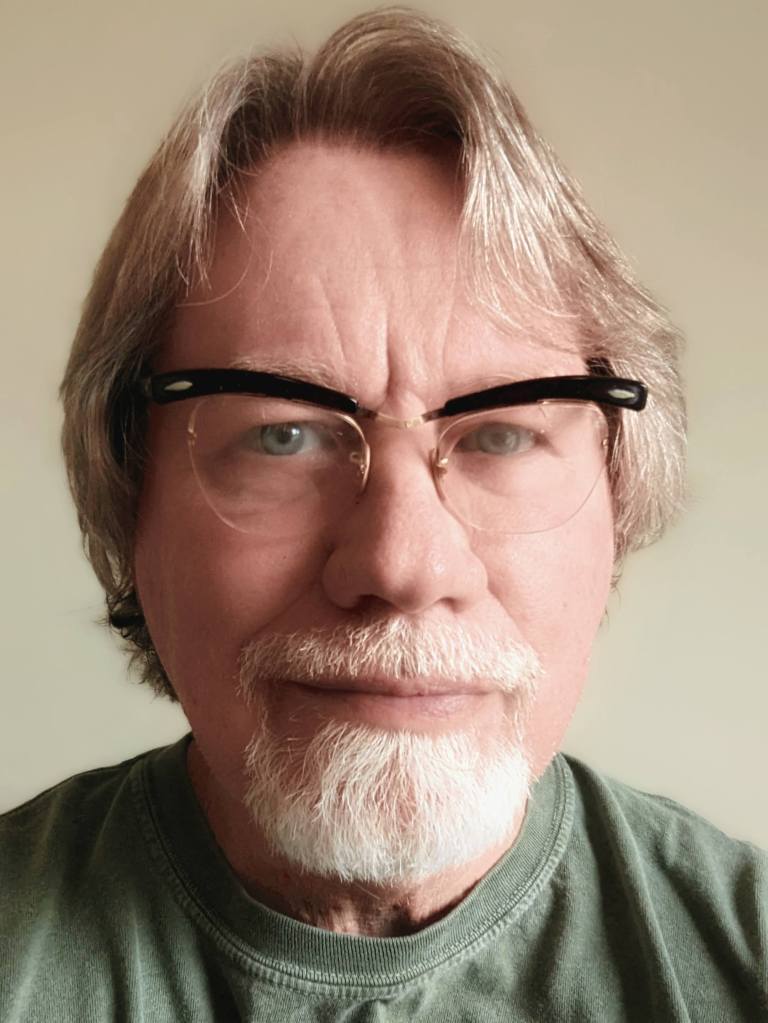
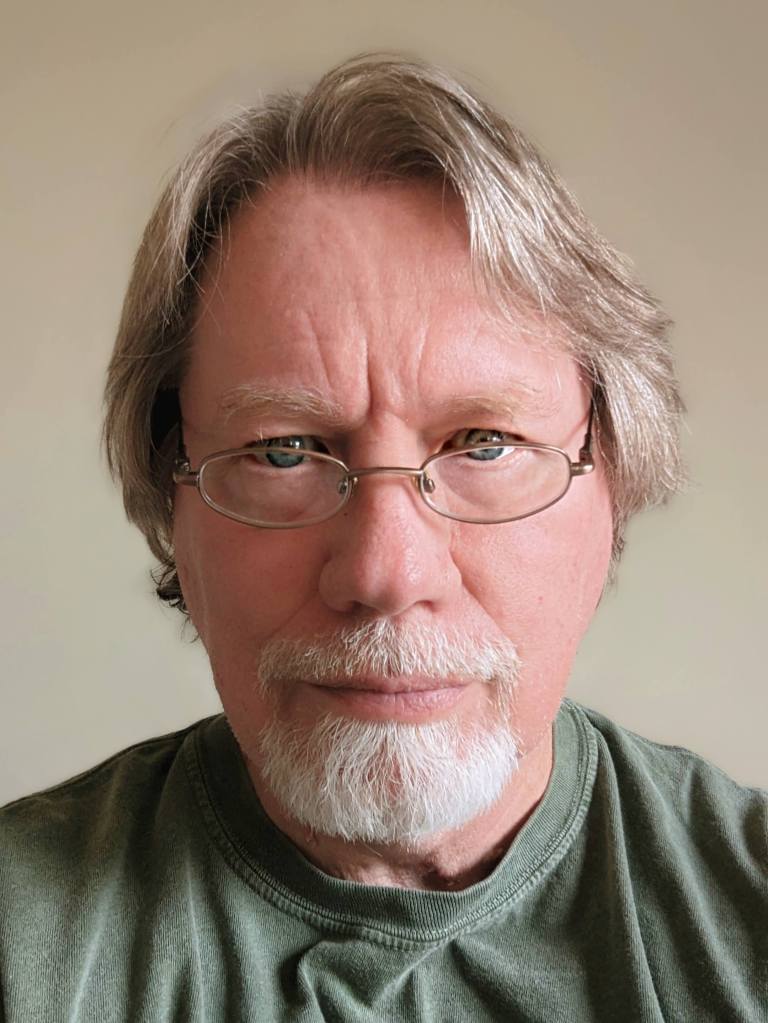
Here’s a True Thing about people who spend years shooting photographs: you sometimes stumble upon an idea that feels like it’s worth repeating. It becomes a project. Eventually, I tried on 25 different pairs of eyeglasses and took a selfie in each of them.

This wasn’t as simple as it sounds (and it sounds really simple). Lots of the glasses I put on were so strong they were disorienting. Others were so dark they were difficult to see through. I often had to guess when I was properly framed so I could press the shutter release (which, yes, I know, isn’t actually a shutter release; it was either call it a shutter release or the button, and the button makes it sound like I was launching a thermonuclear weapon).

I tried to maintain the same facial expression in all the photos because…well, I don’t really know. Some perverted notion of uniformity, maybe? Something to do with the notion of an internally consistent photo project. In any event, it was really difficult to maintain the same expression, partly because I kept wanting to laugh and partly because the glasses distorted my sense of reality to the degree that I often couldn’t see my expression clearly enough to maintain it.

Earlier, I wrote that I tried on twenty-five different pairs of eyeglasses and took a selfie in each of them. I probably tried on twice that many; I just didn’t take a selfie in all of them. A lot of the old eyeglasses were similar in design, so there was no point in photographing them. I mean, one pair of aviator-style glasses looks a lot like every other pair of aviator-style glasses.

A lot of those similar looking eyeglasses had radically different prescription strengths. It probably won’t surprise anybody to learn that trying on a few dozen different eyeglasses of various prescription levels will can you a whanging headache. So if I failed to keep my expression the same in all the photos–if, in some of the photos, I look confused or dazed or disoriented or dangerously unbalanced–now you know why.

I did all this entirely to entertain myself, of course. I’m sort of embarrassed to admit that’s my reason for doing a lot of the stuff I do. But having turned my personal amusement into something of a photo project–having shot a couple dozen selfies in various eyeglasses–I find myself thinking some of you might find it amusing as well.

Besides, I firmly believe in Stieglitz’s concept of practicing in public, of showing work that doesn’t quite meet your standards for what the work could be. He wrote:

[I]f one does not practice in public in reality, then in nine cases out of ten the world will never see the finished product of one’s work. Some people go on the assumption that if a thing is not a hundred percent perfect it should not be given to the world

Stieglitz talked a lot of bullshit, but he was spot on in this regard. I don’t feel any need for ‘the world’ to see the stuff I do, but I’m a firm believer in sharing anything I think somebody somewhere might find interesting. Even when it makes me look ridiculous.

farewell to flickr

I joined Flickr in December of 2004. For a long time, Flickr–more particularly, a Flickr community called Utata–was a significant part of my daily life. I’ve mentioned this group several times on the blog (just counted–29 posts mentioning Utata) because it was massively influential in my digital life. I made a lot of friends because of Utata. I participated in a lot of photographic projects (both personal projects and group projects). I wrote a large number of essays about photographers (the Sunday Salons) for Utata. I spent hours every week monitoring, promoting, and supporting Utata community discussions. It was a lot of work and I loved it.

The last photograph I posted on Flickr — 01/31/2023

But over time, it became a grind. Part of the problem was classic burnout; I was doing too much, taking on too many tasks, agreeing to too many requests. That was compounded by changes in the way Flickr ran itself — changes in ownership, changes in policies. Those changes had a massive detrimental effect on the way communities operated. Over the last 18 months, I gradually slipped completely out of the orbit around Flickr and Utata. Eventually, I stopped using Flickr altogether. I no longer even thought about it.

Until a few days ago, when I noticed I was still paying for a Pro Flickr membership. It wasn’t a lot of money — less than US$9 a month — but I asked myself why I was spending a hundred dollars a year on something I don’t use. I opened Flickr and saw that I haven’t posted a photograph there since January. I was never a prolific poster; I rarely posted more than one photograph a day. As I became less interested in Utata, I posted fewer and fewer photos.

The true purpose of a fence is to create the desire to climb over it — 08/08/2006 (51,534 views)

Out of curiosity, I checked my Flickr stats. I’d only posted a total of 2412 photographs in my 19 years on Flickr. That’s an average of about 125 photos per year. Only 51 photos were post in all of 2022 — one a week. My most viewed photo was taken in 2006 — a black-and-white image of a converted barn, with an unforgivably long title.

I even went back to check my first photograph on Flickr, which turned out to be a selfie. December 17, 2004. Shot with my very first digital camera: a 4 megapixel Olympus C-770 UltraZoom. I no longer have that jacket; I managed to walk off and leave it behind somewhere. Which is sort of what I’ve done with Flickr and Utata.

Jean Jacket — 12/17/2004

Nineteen years is a long time in a relationship. But this morning I canceled my Flickr Pro membership. Not my membership–just my paid membership. It’s more of a symbolic gesture than anything else. It’s me saving nine bucks a month. Maybe I’ll use that money to buy another jean jacket.

I sort of expected canceling my Pro membership would make me feel something. It seems like it ought to mean something, like leaving this behind should carry more weight. But it doesn’t. I guess that’s evidence that I’ve made the right decision.

I’ll continue to shoot photographs, of course. After all, I’ve just recently re-discovered the joy of shooting my 12-year-old Fujifilm X10 (which, by the way, would fit perfectly in the pocket of that jean jacket I no longer have). I can’t imagine NOT shooting photos. Or thinking about photography. Even when I don’t have a camera with me, I shoot photos in my mind. The fact is, absolutely nothing will change, except nine dollars will no longer be automatically deducted from my checking account. The ONLY actual thing that will come out canceling my Flickr subscription is this announcement.

That probably ought to be sad. But it’s not. It’s just something I did this morning after coffee.

six minutes

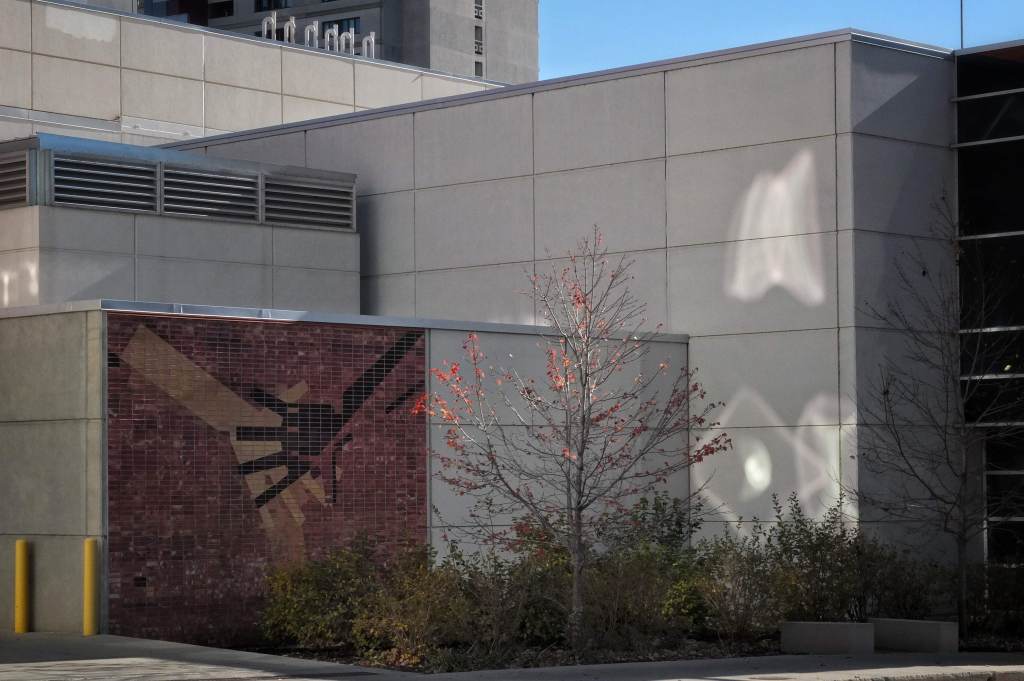
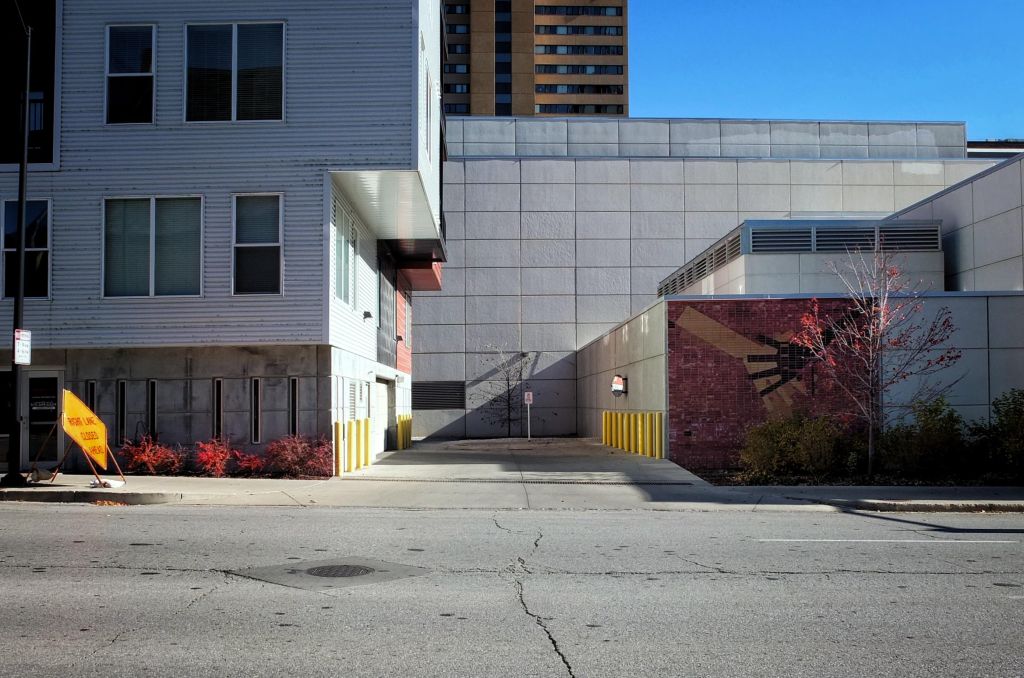
So I’m walking down the street last Saturday, right? And I see these weirdly-shaped areas of light on the side of a building–light reflected off another nearby building. The light is also illuminating just the top of a tree that’s almost completely devoid of its Autumn leaves. The nearly-bare tree is beside a tile mural of two hands–one black, one white–touching each other. The fingers on the hands sort of mirror the limbs of the tree. Everything there is odd and lovely and since I’ve got my little 12-year-old, 12 megapixel Fujifilm X10 in a pocket, I stop and shoot the photo.

And I’m happy with it. So I keep walking and I notice the mural is directly next to a cul-de-sac that’s the entrance to an underground parking garage for an apartment building (the building that’s creating the weird reflections in the first photo). There are a LOT of lovely yellow bollards (I have a thing for bollards) in the cul-de-sac that are sort of balanced by a yellow ‘Lane closed’ sign. Even better, there are some reddish shrubs that sort of balance the red of the illuminated tree. Better still, there’s a delicious acute right angle of shadow right in the middle–and in the middle of the shadow, another tree. And I’m immediately smitten by all the colors and the lines of the various buildings. So I stop and shoot the photo.

I want to get closer to those bollards, so I cross the street, where I discover that there are sections of the apartment complex that couldn’t be seen from a distance. Lovely red and black color blocks, with windows that cast still more reflections on the wall opposite. A circular convex mirror reflects those red and black colors. I notice that the wall at the back of the cul-de-sac, which appeared white from a distance, is actually a very pale shade of blue, that’s enhanced by the slight shift in the angle of the light. The angle of shadow is somewhat less acute. There’s a strange curving line of electrical tubing for a lamp, and some crazy shadows. Those yellow bollards, also catching some reflected light, seem almost decadent. And so many glorious straight lines at interesting angles to each other. Finally, right in the center, a tree which sneers at straight lines. So I took another photo.

Six minutes. According to the EXIF data, that’s how long I spent at that scene. It seemed a lot longer. Six minutes and three shots. Six minutes, drunk on light and shadow and line and shape. Six captivating minutes.

This isn’t unique. Every photographer has had a similar six minutes. They’ve probably had several similar six minute experiences. It’s those six minutes that keep us toting cameras and making a nuisance of ourselves. Six minutes of ineffable delight.

murder machine

Yeah, I don’t know how many blog posts I’ve written about guns and gun violence. Two or three dozen, probably. Maybe more. I’m not going to bother to count them. I’m mentioning that because yesterday WaPo published a piece called Terror on Repeat (this is a free gift link; you needn’t subscribe to WaPo to read it), which focuses on America’s mass murder sweetheart firearm: the AR-15.

The WaPo describes the piece as “the most comprehensive account to date of the repeating pattern of destruction wrought by the AR-15.” And hey, maybe it is. It’s certainly a powerful piece and I think y’all should deffo read it. It also says, “the full effects of the AR-15’s destructive force are rarely seen in public.” Which is true. But while the article does include photograph that reveal more of the weapon’s destructive power than most folks have ever seen, they don’t (and probably shouldn’t) show the REAL full effects of the AR-15. That would be the staggering damage it does to the body–especially the small bodies of children.

WaPo acknowledges that the AR-15 “was originally designed for military combat,” Most folks have heard that, of course. And most folks think the AR-15 is some sort of watered down version of the M16, a lesser weapon, an M16 Lite. Which is only sorta kinda accurate. Here are the main differences between the two.

  • The M16 has a heavier and longer barrel. A heavier barrel is more effective for prolonged and sustained firing by reducing heat-related accuracy issues. The 20-inch barrel also increases the rifle’s accuracy and effective range, making it effective for combat situations. The AR-15 usually comes with a lighter, shorter (16-inch) barrel, making it easier to handle and more effective in close quarters.
  • The M16’s bolt carrier is capable of both semi-automatic and automatic fire. Automatic fire means the rifle will continue to shoot as long as the trigger is held down. It’s capable of firing around 800 rounds per minute. The M16’s safety selector has three positions: safe, semi-automatic, and automatic/burst fire (in this setting, pulling and releasing the trigger will fire a burst of three rounds). The bolt carrier in the AR-15 is designed for semi-automatic fire only; its safety selector has only two positions: safe and fire. Semi-auto fire means the weapon will fire one round each time you pull the trigger. An unmodified AR-15 is capable of around 45 rounds per minute.

That’s it. Those are the only meaningful differences between an M16 and an AR-15. The M16 was designed for combat. The AR-15 may not have been intentionally designed for mass murder, but there’s a reason it’s the mass murder weapon of choice: it’s really, really, really effective at killing lots of people, usually at close range, in a relatively short time.

Does it have any other uses? Well, sure. I mean, you could use one to pound nails. It wouldn’t make a very good hammer, but it would work. As a firearm, though, it’s got limited utility. They’re fun to shoot (yeah, I’ve fired a few different AR-15 variants) and they’re easy to shoot. They’re easy because they use a gas impingement system. Basically that redirects some of the energy from a fired bullet into reloading the next bullet, which translates as less recoil. You can fire LOTS of rounds without bruising the shit out of your shoulder. And the AR-15 is like Barbie for gun nuts; it’s more a firearm platform than an actual gun–you can swap out parts and modify an AR-15 to achieve different looks. So they’re popular with gun nuts as well as mass murderers.

First Baptist Church in Sutherland Springs. 700 rounds in 11 minutes. 26 dead, 22 wounded.

But down at the bone, the AR-15 is basically a murder machine. It would be smart if the US would ban the sell and importation of AR-15 variants (we won’t do that). It would be even smarter to ban possession of AR-15 variants (no fucking way we’ll do that). But we’re not smart. So we’re stuck in a nation that has around 25,000,000 AR-15s in circulation. Twenty-five million murder machines. And more sold every year.

I think maybe the saddest thing…one of the very many sad things…about the WaPo article is this: there are folks out there (and by ‘folks’ I mean ‘guys’) who will read the article, who’ll look at the photographs and see all the blood, see all the destruction, who’ll read the statistics about the lethality of the AR-15, and they’ll be thinking, “I have GOT to get me one of those.”

Here’s a true thing: men commit around 98% of all mass murders; they (okay, we) are responsible for probably 90% of all murders. The vast majority of physical violence is committed by men. Around 80% of AR-15 owners in the US are men. I think it’s pretty safe to say there’s a serious problem with male culture in the US. We’re not going to solve our gun violence problems until we solve our problems with male culture.

EDITORIAL NOTE: We really must burn the patriarchy. It’s poison for everybody, regardless of gender or identity. We need to burn it to the ground and bury the ashes. We need to burn it and bury it and place a curse on the burial site. We need to destroy the patriarchy at the atomic level, so that no two patriarchal particles will ever touch again. We need to end the patriarchy, then buy ice cream and eat it really slow.

a year

It’s been a year now. A year without the cat. I don’t check the perimeter anymore.

Checking the perimeter. I should explain that. The cat was already living here when I moved in. Every morning, I’d get up, start the coffee, then I’d go stand by the sliding glass door that led out to the deck and the back yard to see what the weather was like. At some point, the cat decided to join me. And that became our morning routine.

August 31. 2014

Almost every morning for years. Once or twice a month the cat would decide to sleep in, but usually she’d hear me getting up and would meet me on my way to the kitchen. I’d start the coffee, then we’d stand at the door and look out. Nothing special, really. It was just a thing we did.

December 4, 2016

The cat would usually lean up against me when we did this. Sometimes she’d sit on my foot, which couldn’t have been comfortable for her. We’d look outside for a minute or so, then the cat would either suggest I feed her or she’d quietly slide off to some other part of the house.

January 2, 2018

Almost every day, we did this. Some mornings, if I had my phone with me, I’d take a photo of the cat beside me. I don’t know why; it was always the same basic photograph; my feet, the cat, the door. Some photos were in color, some black-and-white, some square, some with the standard 3:2 format. It would depend entirely on which app I opened on my phone (yeah, I’m the sort of guy that has a dedicated b&w app on my phone). Usually I deleted the photos shortly after I took them. Usually. Not always.

Periodically, I’d post a photo on Facebook or Instagram of the two of us at that door and caption it ‘The perimeter is secure.” My friends found it amusing. So did I. It became a thing, checking the perimeter. It turned into an accidental photo project.

The photo below is the last photo I shot of us checking the perimeter. I don’t think I posted it. A couple of weeks later, she was gone.

October 25, 2022

You do something together every morning for years and then one day it’s just you. It leaves you off-balance. For a week or two after the cat died I’d step over to the sliding door after starting the coffee and I’d check the…and I’d look outside. It wasn’t checking the perimeter anymore. It felt wrong. It felt wrong, and it just hurt too fucking much. So I stopped.

It’s been a year now. If I want to know the weather, I look out the window. Some mornings I still expect to see her waiting for me. Every so often I still get weepy, thinking about her. It still hurts. I hope it will always hurt.

It’s been a year. I miss her so much.

return of the fujifilm x10

This is what happened. At some point over the last few months I began to miss the feeling of using a camera. I missed holding a camera in my hands. I wasn’t dissatisfied with my phone; it takes excellent photos. But it’s not the same; it’s a multi-use device that also happens to take photographs. I missed using a tool designed solely for the purpose of making photographs.

So a couple of weeks ago I opened up a cupboard and looked at all my abandoned cameras. I don’t have a camera collection; I just have some cameras I’ve stopped using. Some are film cameras, some are digital. I picked up a few and handled them. It was one of those Goldilocks moments; this camera was too big, this one was too heavy, this one would require a substantial investment in film and processing.

I pulled out the last camera I’d bought–a Fujifilm mirrorless camera. I was surprised to find the battery still had a charge. So I shot a few frames around the house. It felt awkward in my hands. Worse, I’d forgotten all the familiar menu pathways. I couldn’t remember how to make the cameras do what I wanted it to do. When I put the camera back in the cupboard, I noticed the very first Fujifilm camera I bought. A small X10, the first model of the compact cameras with the letter X and two digits in the product name. I bought it back in 2012 and wrote a blog post about it.

Out of curiosity, I did a quick file search and found the last photo I shot with x10. It was from August 15, 2016 at the Iowa State Fair, at one of those rides designed to toss people around and give them the illusion of danger. I liked the photo; you can see anxiety and bravado, you can see the clinched-butt need to appear calm and unfazed.

Iowa State Fair 8/15/2016

That photo was the spark I needed. So I dug around in the cupboard until I found the battery charger and charged the batteries. It had been so long since I’d used the camera that I had to re-set everything from scratch, including the date and time. I even tracked down the manual for the X10 online. I’m sure I must have at least glanced at the manual when I bought the camera, but I was unaware of some of the things the camera could do. For example, I created a custom setting for black-and-white shots, which is something I’ve never done before (and I’ll come back to that in a bit).

A man in a bright red vest and hoodie standing outside a barber shop.

Yesterday I set out to see if I could remember how to use a camera. Well, that’s not entirely true; I set out to go geocaching with my brother, but I used the excursion as an opportunity to re-acquaint myself with the X10. The little camera was a tad too big to slip into the pocket of my jeans, but it slid easily into the pocket of my hoodie. It weighed next to nothing. While my brother did the grunt work of geocaching, I watched a guy in a red vest fidget outside a barbershop in a Latino neighborhood. And the camera felt right.

Dead end road across the river from the minor league baseball stadium.

The camera felt right but the final results were…mixed. The first thing I had to re-adapt to was the parallax effect since the X10 is a sort of retro-designed rangefinder camera. I suspect a lot of folks have never used a rangefinder camera and are wondering, “Greg, old sock, what the hell is this parallax effect?” Unlike your basic single-lens-reflex camera, which allows you to see the scene through your lens, a rangefinder viewfinder is only near the lens. So you’re not seeing exactly what the lens sees: that’s the parallax effect. You have to learn to adjust to the small shift between what you see and what the lens sees. The closer you are to the subject, the more drastic the effect.

Kid riding a bike, seen through a public art sculpture.

In the photo above, I wanted to catch the rider in that patch of sunlight between the shadow and the tree. I was a fraction of a second late with the shutter as I panned to follow the kid, but I want to claim the tiny amount of parallax exacerbated the problem (DISCLAIMER: it almost certainly did not exacerbate the problem, but it’s a convenient thing to blame). If I was a fraction of a second too late releasing the shutter in the photo above, I was a fraction too soon in the photo below.

A city employee cleaning up litter and leaves.

I’d hoped to catch the street cleaner at a point just beyond the sign identifying the location as the Civic Center. I was a tad too quick on the trigger. Much of the day was spent confronting the reality of the Ferris Bueller School of Photography. Life moves pretty fast. If you don’t stop and look around once in a while, you could miss it. I was lucky not to miss the look of disdain by this privileged white woman as she watched a black man securing some home furnishings in the back of a rusty pick-up.

A man secures some home furnishings in his pick-up while a woman walks by and watches.

I mentioned earlier that I created a custom setting for black-and-white shots. This is one of the advantages of digital photography. With a film camera, you either have to change from color film to black-and-white film or carry two cameras. With a digital camera, you just turn a dial or change a menu option. I decided to try to create a setting that would sorta kinda almost mimic Daido Moriyama’s Provoke period. High contrast, high ISO, high grain. (Of course, digital imagery doesn’t have grain; it has noise, which isn’t remotely the same…but what the hell, I set the noise allowance as high as possible).

And hey, guess what. It didn’t work.

Two people walking behind some townhomes.

It wasn’t really a surprise that it didn’t quite work. Partly because Moriyama wouldn’t photograph a couple walking behind some upscale trendy townhomes. Partly because I didn’t see many high contrast scenes. And partly-mostly because I’m no Daido Moriyama. I shot maybe a dozen frames (okay, digital imagery doesn’t actually have frames either) using the custom setting. Most of them, like the photo above, are painfully dull.

I was only pleased with one black-and-white shot. Frankly I’ve shot MUCH better black-and-white photos with my cell phone (which, if you’re interested, you can see in a post about practicing photography in public). These photos were less black-and-white and more black-and-shite. But I intend to experiment more. Maybe I’ll figure out how to get the camera to give me the b&w photos I want.

Cyclist checking his stats.

At the heel of the hunt, though, I’m happy with the old X10. I’m reminded that my approach to almost everything I do is grounded in the same attitude. I want to do things well, but so long as I’m enjoying myself, I’m not that concerned with the results. And folks, I had fun with that little X10. I plan to start toting it around with me more often. In fact, I just ordered two extra batteries.