nobody burned more bridges

“Nobody burned more bridges than Louise Brooks, or left prettier blazes on two continents.”

It was a pleasant afternoon and I was strolling along the riverwalk, which is a thing I like to do whenever possible. I was thinking about all the stuff I needed to get done, which is a thing I like to avoid thinking about whenever possible. As I approached one of the many bridges that cross the river I noticed a small sketch inked or painted on the side of the abutment.

It clearly wasn’t the usual graffiti. It was a woman’s face, sketched small — not much bigger than my hand. There was something very familiar about the face. It was the hair, mostly — that short angled bob — but even the pose reminded me of something I’d seen somewhere before. I knew that face.

I stood there for a time and studied the sketch. There seemed to be a slight Asian quality to her eyes, and I wondered for a bit if it might be a sketch of Anna Mae Wong — the first Chinese-American movie star of the 1920s and 30s. I’d seen a documentary about Wong at some point, and it mentioned her as having gone through a ‘flapper’ period. It might be her.

Anna Mae Wong

Anna Mae Wong

But no. When I returned home, I cracked open my computer and a quick Google search confirmed it. Whoever it was — if it was intended to be a sketch of an actual person — it wasn’t Anna Mae Wong.

But who was it? I was absolutely certain I’d seen that face somewhere. Maybe I’d come across a photo similar in style while researching a Sunday Salon. Some photographer from the 1920s or 30s, certainly. American? Possibly, but more probably European. A French photographer, perhaps. That hairstyle, though, definitely belonged to the flapper era. Was that a uniquely American Jazz Age phenomenon? Or was the flapper fashion cross-cultural? I’d no idea.

So I tried a Google image search using the keywords flapper bob. It seemed like a long shot…but there she was: first photograph on the first page.

Her name is Louise Brooks, and she wasn’t European. She certainly wasn’t French — at least not by birth. She was born in 1906 in a small town in Kansas, of all places — a town with the improbable name of Cherryvale. She wanted to be a dancer, which was quite an ambition for a girl from Cherryvale (which, at the time she was born, had a population of about 4000 souls — almost double the current population, which tells you something about Cherryvale, Kansas).

Louise decided to do what all ambitious Midwestern girls dream of doing: she packed a bag and went to New York City. That was in 1922; Louise was 15 years old.

She was accepted into the Denishawn Dance Company, run by famed choreographers Ruth Saint-Denis and Ted Shawn. By 1923 she was one of the company’s principal dancers. By 1924 she was fired from the company because of her temper. By 1925 she was dancing in London, where she gained some notoriety for being the first woman in England to dance the Charleston on stage. Later that year Louise returned to the U.S. and signed a five year contract with Paramount Studios. She was 19 years old and they told her they wanted to make her a movie star.

And lawdy, they did. They surely did.

She made a number of silent films in the U.S., and her signature hairstyle quickly became adopted by young women all over the country. For the most part Louise played flappers and vamps, roles for which she was perfectly suited since she actually was a flapper and a vamp. Her career at Paramount was tumultuous — she drank too much, she had affairs with men and women (including Marlene Dietrich), she argued with the studio executives, and she alienated directors and producers by ‘reading too many books’ and having too many opinions.

And once again her fiery temper caused her to be fired. As before, Louise responded to being rejected by going to Europe and becoming a success. In 1929, at the age of 23, she made the film for which she’s best known: Die Büchse der Pandora. Pandora’s Box. Here’s how the movie is described:

The rise and inevitable fall of an amoral but naive young woman whose insouciant eroticism inspires lust and violence in those around her.

Louise played the role of Lulu, the ‘amoral but naive young woman.’ The movie itself is confused and disjointed, but by all accounts Louise personified the role. It lifted her from the status of ‘movie star’ up into the category of ‘movie legend’ and eventually ‘cult figure.’

Her life continued at the same dizzying, passionate pace. She returned to Hollywood, she married millionaires and divorced them, she argued and seduced and drank and danced, she posed in the nude for photographers, she made two more films (one with John Wayne) and then abruptly left the movie business. She moved back to New York and spent herself into bankruptcy. By the time the Great Depression rolled around Louise Brooks was broke but well-dressed. She worked part-time as a salesgirl at Saks Fifth Avenue and part-time as a courtesan, keeping company with the city’s few remaining rich men.

By the 1950s, Louise Brooks was something of a recluse, living in a small New York apartment. Then French film historians rediscovered her and began to revive her films. The critic Henri Langlois declared “There is no Garbo, there is no Dietrich, there is only Louise Brooks.” The French revival sparked interest in the U.S., and caused the film curator of the George Eastman House to track down Louise in New York City. He persuaded her to move to Rochester, NY, where she began to write about her life and acting career. She became something of a film critic herself, and later published an autobiography titled Lulu in Hollywood. When Liza Minnelli was looking for inspiration on which to base her character Sally Bowles in the movie Cabaret, she found it in Louise Brooks. Her life story fueled novels and biographies, it drew the attention of documentary filmmakers, and even became the underlying concept of a popular and influential Italian erotic comic book series — Valentina.

That face went from Cherryvale, Kansas to New York City to London to Hollywood to Germany to Hollywood again and New York City again to Rochester, NY and now it’s on the side of a bridge crossing the Des Moines River, some four hundred miles from Cherryvale. That’s a hell of a journey. It’s a hell of a story. Louise Brooks was a hell of a woman.

darwin made it up

“The theory of evolution is a theory, and essentially the theory of evolution is not science—Darwin made it up.”

When I read this comment by Kentucky State Representative Ben Waide (do I need to say he’s a Republican?) I just shook my head. I wasn’t the least bit surprised; I wasn’t at all distressed. Scientific ignorance is rampant in some parts of the nation and it runs deep in one political party. So the guy is a dolt when it comes to science. So what?

Then I learned Waide is a member of Kentucky’s Joint Committee on Education. This guy is making decisions on education policy. And suddenly he’s not just a dolt when it comes to science — he’s a dolt with the power to create more dolts. And that matters.

Rep. Ben Waide

Waide went on to say one of the most profoundly stupid things I’ve ever heard. “My objection is they should ensure whatever scientific material is being put forth as a standard should at least stand up to scientific method. Under the most rudimentary, basic scientific examination, the theory of evolution has never stood up to scientific scrutiny.”

Never stood up to scientific scrutiny? I doubt that any scientific theory has been more thoroughly challenged and examined than theories of evolution. There is far more scientific support for evolutionary theory than there is for the current theories of gravitation, more solid scientific evidentiary support than there is for atomic theory, more  than there is for the theory of general relativity. If Waide believes evolution isn’t science, then the University of Louisville (where he graduated with a B.A. in Health Science) should rescind his degree. They should seize his diploma, burn it, bury the ashes in the ground and salt the earth above it.

Darwin made it up, he says. The shallowness of that claim is staggering. His total lack of understanding of science and how science works may not disqualify him from representing his district in Kentucky — his constituents have the absolute right to vote for somebody with that bovine level of intelligence — but you’d think it would be enough to prevent him from shaping education policy. Or misshaping it, as the case may be.

I don’t care if Waide personally doesn’t believe in evolution. I don’t care if he’s Kentucky’s version of Madeline Basset (who famously “holds the view that the stars are God’s daisy chain, that rabbits are gnomes in attendance on the Fairy Queen, and that every time a fairy blows its wee nose a baby is born”). But if you believe babies are a result of sinus issues in the wee folk, then you shouldn’t be shaping birth control policies.

boneheaded mistakes

I have a new camera. I’ve had new cameras before, but not like this one. Almost all of my previous new cameras were SLRs or DSLRs, and it was fairly easy to adjust to them. A slightly different feel in the hand, some variation in the menu system — that was it.

But not this time. This time is different. This time the new camera is a Fujifilm X10.

It’s a sweet little unit. Small but sturdy, beautifully constructed, extraordinarily quiet to use, pleasing to the eye but plain enough to be inconspicuous. It’s a rangefinder style camera, with an optical viewfinder that gives you absolutely NO information at all. No shutter speed, no aperture, no ISO, no hint at metering, nothing at all. If you want to get a good exposure, you’d damned well better know what you’re doing.

Oh, you can turn on the LCD monitor and use that to compose your photograph. That’ll provide you with nearly as much information as the Mars rover sends back to JPL. The LCD certainly makes shooting photos a lot easier. But I find I’m relying almost exclusively on the information-free viewfinder. It reminds me of my very first camera — an old Argus rangefinder from the 1950s. Completely manual, of course. I don’t think it even had a built-in light meter. It was just a metal box with a lens. Relying on the viewfinder with the X10 is like remembering how to drive a car with a manual transmission — you make some awkward and noisy mistakes, but you recall how much fun driving can be.

I wanted this camera to tote on my bicycle, but it’s turning out to be an ideal cityscape and street camera. I have no hesitation in pulling out the subtle little X10 in situations where I’d have been reluctant or unwilling to use a DSLR. There IS some hesitation before actually shooting the photo, however. Not because I’m uncomfortable with it, but because I have to pause a moment to consider issues of exposure. I have to hold back a bit while I judge the parallax error caused by the viewfinder.

It’s like learning to shoot photographs all over again. For the most part I walk around following the old Weegee rule for exposure: f8 and be there. But when immediacy isn’t an issue, I have to actually evaluate lighting conditions and decide on the proper exposure. Photography has become a challenge again. Every decision point that was second nature with a DSLR now requires active thought, which keeps me more engaged in the moment.

And isn’t that what photography is all about?

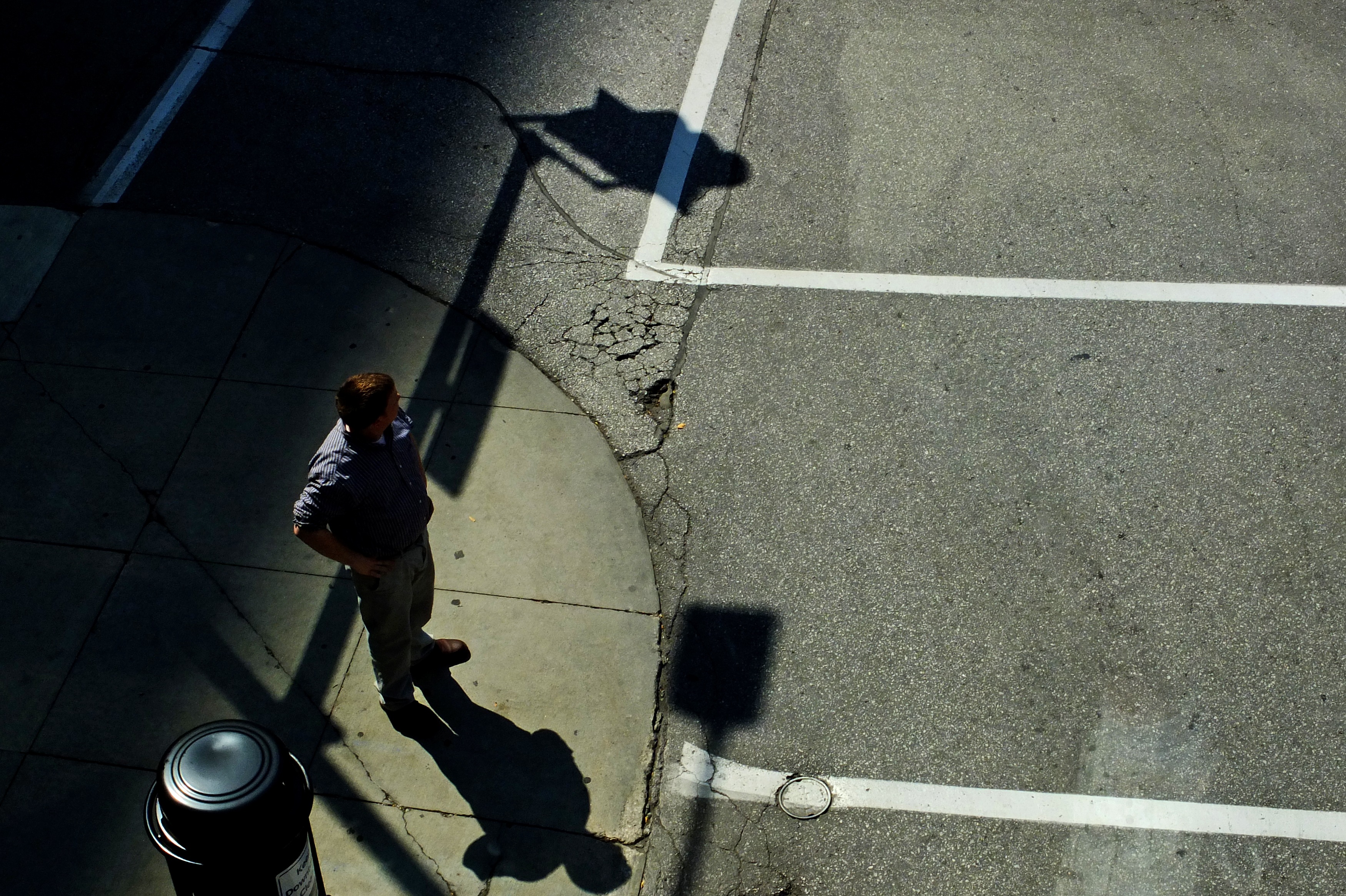
As you can see from some of these photographs, I’m still making mistakes. I sometimes get the exposure wrong, I screw up the composition by misreading the parallax difference, and I bungle the focus point. Rookie mistakes. Boneheaded mistakes.

I can’t tell you how much fun I’m having making those mistakes.

sad and stupid

“Right now, it’s just a mass shooting.”

Those are the words of ‘a federal official who spoke on the condition of anonymity,’ quoted in The Washington Post. Just a mass shooting. Jeebus on a fucking cracker. Just another mass shooting.

Some jamoke strolls into a Sikh temple and opens fire. Six people dead. Seven, counting the shooter himself. And we’ve become so inured to this routine madness that federal officials can say “it’s just a mass shooting.” In other words, it’s nothing out of the ordinary; it’s not an extraordinary massacre — just your usual, normal, everyday sort of massacre.

And how is the right wing responding to this latest ‘just a mass shooting’? Some of them are assuming it’s a ploy by President Obama to create conditions that will help him get re-elected and take away their guns. Here are a few choice comments from freerepublic.com:

   [T]he timing seems suspicious as well, given the upcoming elections and Democrats’ attempst to scale back conceal carry?

After Aurora is this the next asset being ‘activated’ by his handlers. The more BHO fears November the more of these events are going to occur and they will escalate in level of violence and number of casualties.

Sounds like Liberal black ops operation to influence the election

Adolph Hitler: socialist. Obama: socialist. And the parallels don’t stop there by any means. The parallels are eerily similar, except instead of Jews, it’s Christians that are now ok to persecute. I know in this case it wasn’t but that’s where the trend is going. I’m still wondering when 0bama’s Reichstag Fire moment will happen.

Wow the lefties are really shooting up the country right before the election. No doubt to prop up their Obama God as only he can save us from those evil right wingers.

So it’s either just another ordinary mass killing or it’s a liberal plot to disarm conservatives. Both viewpoints are sad and stupid. Stupid, stupid, and so terribly sad.

buying cheerios gets complicated

I put the camera away just before the police arrived.

I was just riding my bike to the market to buy some Cheerios, after all. My route took me by the former mobile home court. It’s ‘former’ because two years ago, this entire area was under two-to-three feet of water. The nearby creek had flooded for the second time in a couple years (each flood was consider a ‘once in a century’ event). I’ve written about the creek and the flood before. The people who lived in the mobile home court were evacuated, and eventually the entire area was condemned. The city bought the property, relocated the residents, set up some barricades and for a year and a half the mobile homes were inhabited primarily by sparrows. feral cats, and spiders.

After a year or so, the city sent in demolition crews and the mobile homes were reduced to trailer-sized piles of scrap metal and junk. The remains of the homes was hauled away, then other crews arrived and tided up the smaller scraps of metal and broken glass and scatterings of plastic.

And then…nothing. The weeds grew, the barricades were knocked over, there were fewer feral cats, but more deer and the occasional fox.

Yesterday, as I rode to the market, I noticed that the old barricades were gone and a fence with gates had been installed. There was a sign on the gate, and I assumed it was a No Trespassing sign. It was just a warning that dumping was illegal. The gate was cracked open. Just wide enough for a curious person on a bike to ride through.

I’m a curious person. I rode through.

It’s quiet; very little road noise after you’re in a hundred yards or so. It would be incorrect to suggest the area is beginning to look park-like. It looks more like a neglected yard behind a barn — only with a road running through it. It’s not particularly photogenic. But I’m playing with a new camera, so I shot a few frames. Then put the camera away and headed back for the gate.

And that’s when the police arrived. A squad car parked just outside the gates. I figured I was about to get a lecture about trespassing, but when the bald, bullet-headed officer stepped out of the squad car the first thing he said was “What’s up?” I told him I saw the gate was open and since there wasn’t any No Trespassing sign, I rode in and took a few photographs. He asked to see them. I asked why he wanted to see them. He gave me the standard ‘if you haven’t done anything wrong’ speech. I told him there was a principle involved.

I’ve been around the block a few times. One thing I’ve learned is that unnecessarily antagonizing a police officer is a mug’s game. I was willing to get into a pissing contest if it was necessary, but I’d rather avoid a situation where it becomes necessary. So I offered the officer a deal. “If you acknowledge you have no legal right to see the photos, and that I have no legal obligation to show them to you, then I’ll show them to you.” He seemed to find that amusing, but he agreed. He actually said it out loud; “I have no legal right to see your pictures and you have no legal duty to show them to me.” So I showed them to him. There were only seven of them.

After he’d looked at the photos, I asked if I could photograph him. He said “I can’t stop you, but I’d rather you didn’t.” So I didn’t. He got back in his car and drove off.

I got back on my bike and continued to the market. Bought some albacore tuna, a box of Honey Nut Cheerios, a couple of apples, and a pint of Red Velvet Cake ice cream.

wave the white flag

We’ve given up. Surrendered. Oh, we make a big fuss about the mass murder in Aurora. The news is full of ‘human interest’ stories about the victims — this one saved that one’s life, that one just got married, this other one worked with disabled kids, and that one had a promising career. So very sad, so very tragic — and yet we don’t really care enough about these poor people to even have a serious discussion about gun control. The simple fact is, we’ve capitulated. To this guy.

James Holmes

We say we need to have a discussion about gun control, but we openly concede we won’t. Why? Because at this point in the history of our culture we just acknowledge the fact that mass murder is acceptable. We’re basically okay with the fact that every so often somebody will buy a butt-load of firearms, then armor up and walk into a place of business, a shopping mall, a fast food restaurant, a school and shoot the living shit out of as many people as possible. We’re not only okay with it, we’ll pass laws that make it more possible. Hell, we’ll even pass laws that allow folks to buy extra capacity magazines so we can keep the body count up.

Here’s a true thing: according to data published by the FBI, single-victim gun killings have dropped more than 40 percent in the last 30 years. Here’s another true thing: mass murder — the killing of four or more victims in a single related incident — has increased in that same period. In the last three decades there have been around a thousand mass murders, with close to 5000 deaths. That’s another four or five people killed in another mass murder every what, nine days? Those are just the fatalities; who knows how many are wounded? Who know how many end up permanently disabled or emotionally fucked up.

Still, it’s no big deal. We have something over 300 million people in the U.S. We can lose a couple hundred a year to mass murder and not even blink.

Could we do something about it? Sure. If we wanted to. But we don’t. Instead, we’ll continue to make it possible for kids to dye their hair red and dress up in ballistic armor and do their part to provide the media with all those great human interest stories.

how did we get here?

Two things fuel the current idiotic state of gun laws in the United States: the romantic tradition of the Old West and contemporary paranoia and fear. It began with the glorification of the gunfight, in which a pair of steely-eyed men — one good and one wicked, of course — faced each other on dusty streets at high noon and settled their differences. There’s a limited but semi-factual basis for that tradition. Those sorts of gunfights actually did, on rare occasion, take place. In fact today is the anniversary of the first recognized ‘high noon’ style gunfight. It didn’t take place at noon, though, and neither of the participants could be said to be entirely ‘good’ people, and there was nothing particularly romantic about it. But this is where the tradition was born.

On this day in 1865, in the market square of Springfield, Missouri, a cowboy named Davis Tutt, who a few months earlier had been serving in the Confederate Army, faced off against James Butler Hickock, a professional gambler who’d served in the Union Army, first as a Jayhawker and later as a scout (if you’ve seen the movie The Outlaw Josey Wales, you’ve seen Jayhawkers — they were the ‘Red Legs’ who killed Clint Eastwood’s wife and child, and later massacred his companions as they were surrendering). Because of his prominent nose, Hickock’s fellow Jayhawkers called him Duckbill. By the end of the war, they’d begun calling him Wild Bill.

Wild Bill Hickock

The gunfight was primarily over a gambling debt; secondarily, it involved disputes over women (Tutt had been paying ‘undue attention’ to Hickock’s girlfriend; Hickock, on the other hand, was believed to have impregnated Tutt’s sister). They met in the town’s square, stood somewhere between 50 and 75 yards apart, took up a sideways duelist’s stance, and drew and fired at about the same time. Tutt, who was generally accounted the better shot, missed. Hickock didn’t. A year and a half later, an account of the gunfight was published in Harper’s Magazine. It propelled Hickock from his status as “a desperado, a drunken, swaggering fellow” to that of a dime-novel hero.

There is, let’s face it, something perversely attractive about the Old West mythos of the straight-talking and straight-shooting lawman. In reality, straight-talking was significantly less important than straight-shooting. It was the notion of straight-shooting that sparked the creation of the National Rifle Association.

At the end of every war there’s always a group of people who say “Well, that’s done — now, how do we fight the next one?” At the end of the American Civil War, one of those people was former Union Army General George Wingate. He was appalled by the inability of city-raised Union soldiers to hit a target; it was estimated that for every 1000 rounds fired by Union soldiers, only one Confederate soldier was hit. Confederate troops, having a more rural background, were far more accurate. In 1871 Wingate and a few others created the National Rifle Association to rectify that situation.

For a century or so, that’s what the NRA did — they taught firearm safety, they taught marksmanship, and they lobbied for sensible gun laws. That’s right, sensible gun laws in response to contemporary social circumstances. In the 1920s and 30s, for example, the NRA acted in response to the rise of gangsterism. This was the era of Bonnie and Clyde, of Machine Gun Kelly, of John Dillinger. The NRA helped craft legislation to restrict the buying and carrying of guns; laws requiring a person to obtain a permit from local law enforcement in order to carry a concealed weapon, laws limiting those permits to people who had a valid cause to be armed, laws requiring gun dealers to report every gun sale to law enforcement, and laws imposing a waiting period on the purchase of weapons. They supported laws restricting the sale and ownership of automatic weapons and sawed-off shotguns, which were considered ‘gangster’ guns. Even as late as 1963, after the assassination of President Kennedy, the NRA supported a ban on mail-order gun sales.

John Dillinger

By the middle of the 1960s, the NRA had essentially become an organization devoted to supporting the interests of hunters and sportsmen. Then in May of 1967, something unexpected happened. The wrong people started buying, owning and carrying guns. A year earlier, in response to incidents of police violence, Huey Newton and Bobby Seale formed the Black Panther Party to protect their neighborhoods. They began to openly carry firearms — mostly shotguns and handguns — while patrolling the streets. They also began to stockpile weapons.

In response, a conservative Republican state assemblyman, Don Mulford, proposed a law that would prohibit the carrying of a loaded weapon in any California city. The governor of California, Ronald Reagan, supported the restriction, saying there was “no reason why on the street today a citizen should be carrying loaded weapons” and telling reporters the legislation “would work no hardship on the honest citizen.” The new legislation was presented to the public as sensible gun control, but everybody knew it was directed at one segment of the population. As one Black Panther said at the time, the law wasn’t about controlling guns; it was about controlling black people.

The law passed. Of course it did. And on the day the legislation was debated, the Black Panthers marched, fully armed, to the state capitol.

The Black Panther Party on the steps of the California legislature – May, 1967

The following month began what has come to be called ‘the Long Hot Summer.” In June of 1967 there were race riots in Tampa,  Atlanta, Buffalo, Boston, and Cincinnati. In July the riots spread to Detroit, Newark, Birmingham, Chicago, New York City, Milwaukee, and Minneapolis. The rioting continued through August. In the three months of summer, there were 159 race riots in the United States. Police and National Guardsmen who attempted to maintain order during the riots often became the targets of sniper fire.

A couple of noteworthy things happened as a result of the riots. The Kerner Commission, established by President Johnson to determine why the riots took place and how future riots could be avoided, noted one reason for the level of violence was the easy access to firearms. That led to more very specific gun control legislation. People who’d been convicted of a felony or of drug possession weren’t allowed to buy a gun. In addition, small inexpensive handguns — known as ‘Saturday Night specials’ — were banned. Those laws received bipartisan support. Those laws, it should also be noted, primarily affected poor, urban, African-American communities.

While this was taking place, the NRA began to splinter. One branch continued to remain primarily a sportsman’s support group; the other branch began to believe it was important for good people to arm themselves against the possible collapse of civilization. That branch actively worked to rescind some of the legislation the NRA originally supported, in order to make it easier to acquire firearms.

The existence of the Black Panther party helped fuel the paranoid wing of the NRA, which eventually seized control of the group, turning it into the extremist political organization it is now. It didn’t matter that the Black Panthers self-destructed in a welter of drug abuse and criminality. Another terrifying enemy has always presented itself to the NRA. Communists, Muslims, the US government itself — there’s always somebody out to get them.

Any attempt to place even the smallest restriction on firearms is now condemned by the NRA as part of some shadowy plot to seize all the firearms in the U.S. As a result, restrictions on gun sales, gun ownership and the ability to carry a firearm have been relaxed or eliminated altogether.

Because we’ve perpetuated this romantic myth of gun play, and because a relatively small, paranoid, powerful gun lobby devotes a tremendous amount of money and effort to keep folks frightened, those of us who live in the US find ourselves in a nation in which a 24 year old kid can buy a full suit of tactical ballistic body armor, load up on weapons with high capacity magazines, and stroll into a movie theater and shoot 90 people.

It’s worth noting, though, that even Wild Bill Hickock believed in gun control. When he was the marshal of Abilene, Kansas he required cowboys to surrender their weapons when they came into town. A man named Phil Coe, drunk and belligerent, encouraged by his buddies, refused to surrender his gun. When Hickock insisted, Coe drew his gun and fired. Hickock drew his own weapon and shot Coe twice in the abdomen, killing him.

There’s a lesson to be learned there. Two lessons, in fact. Immediately after he shot Coe, Hickcock, out of the corner of his eye, saw somebody approaching him in a hurry. He turned and fired again, thinking it was one of Coe’s friends. It was, in fact, his own friend and deputy, coming to his aid. The man died on the spot.

We need to remember that. There’s nothing romantic about a gunfight, and the gun doesn’t care who gets killed.

the stupidest fucking people on the planet

Let me begin by saying this: I’m a liberal who likes guns. Guns are incredibly efficient technology, and I like efficiency. They make a terrific noise, and there are times when I enjoy a loud noise. I like the fact that you can point them at an object and a hole will appear in that object, and I like that it takes some skill to make that hole appear where you want it to appear. If you shoot a handgun at night, flame comes out of the barrel — and that’s pretty. Even prettier is tracer fire at night. So yes, I like guns.

I just don’t trust anybody to own one.

The fetishization of firearms reveals the very worst of American culture. It makes already paranoid people even more paranoid and already stupid people even more stupid. Witness Representative Louis Gohmert, a Republican from Texas (and I don’t want to cast aspersions on Texas, but lawdy folks, what the fuck is wrong with you people?). Gohmert has proven himself capable of superhuman feats of stupidity in the past (he once argued that the Trans-Alaska oil pipeline was good for the environment because it gave caribou a place to have sex), but in an interview this morning he took stupid to a new level. Gohmert claimed last night’s mass murder at the premier of the new Batman movie in Aurora, Colorado was a result of “ongoing attacks on Judeo-Christian beliefs.” That’s not just stupid, it’s delusional. He also wondered why nobody in the audience didn’t pull a firearm and return fire — I guess because one person shooting in a dark movie theater just isn’t enough. But hey, returning fire — that’s the Christian thing to do. (Gohmert, by the way, teaches Sunday School at the Green Acres Baptist Church in Tyler, Texas; it’s unknown how many of the children who attend his lectures are packing heat.)

Louis Gohmert

Some people on far right websites like FreeRepublic are even asserting the mass murder is part of a plan by the Obama administration — either to seize all the weapons in the US before the election in November or as part of a Muslim Brotherhood plot to seize control of the US. Or both. Others are claiming the shooting was part of an Occupy Wall Street plan to…well, nobody seems to know why OWS would shoot innocent strangers in a movie theater, but fucking hippie faggot communists dammit they’re capable of anything — I mean, what sort of people play drums in a circle? And then, of course, there were the people who assumed that since the shooting took place on the first night of Ramadan, it had to be a jihadist attack. Stupid, stupid fucking people.

There are three things we can be certain of. First, there will be calls from a few liberals for reasonable gun control legislation. Second, there will be claims from conservatives that existing gun control laws are already too strict. And finally, nothing will change.

Right now in the United States it’s almost as easy to buy a firearm as it is to buy a toaster. Sure, if you go to a licensed gun dealer, you’ll have to fill out a form and show some identification–but you’d have to be stupider than Louis Gohmert if you can’t figure out an easy way to get around that. Even if you are that stupid, you can still go to a gun show this weekend and buy any number of weapons without filling out any forms or showing any identification at all. Or you can go to an estate sale, or an auction, or a garage sale and buy weapons. Or if it’s too hot to go outside, you buy weapons through mail-order sportsman catalogs or on the internet and have them delivered right to your door.

This didn’t change after the Columbine School shootings, it didn’t change after the Virginia Tech school shootings, it didn’t change after the shooting at the Gabrielle Giffords event, it hasn’t changed despite all the mass murders that take place in the US every year — and sad to say, it’s not going to change now.

Here is a true thing: it’s too goddamn easy to buy firearms in the U.S. Don’t give me that shit about ‘guns don’t kill people, people kill people.’ If you actually think that’s true, then you’re just as fucking stupid as Louis Gohmert. Guns make it easier to kill people, and to kill people in larger numbers. You tell me that this guy in Colorado could have have killed as many people if he’d used a bomb? Fine, I’m all for making it more difficult to make bombs too. But it takes some skill and patience to build a bomb, whereas any nitwit can walk into a gun show and buy as many guns as his credit card will allow. You tell me that Second Amendment guarantees the right to keep and bear arms? I’m with you there, but brother that was written in the last half of the 18th century when a good marksman might have been able to fire four rounds per minute in a fucking musket. I’d be willing to allow you to own all the muskets you want. I guarantee you if the Aurora gunman had been armed with a musket, Colorado families wouldn’t be burying a dozen kids this week.

Here’s one of the problems we face. Right now liberals are saying “This isn’t a time for politics; we should be thinking about the families” and conservatives are saying “This is a tragedy, but you can’t punish honest law-abiding gun owners because of the actions of one crazy person.” And I’ll say “This IS a time for politics, because that’s the only way we can reduce the incidence of these sorts of mass murders.” And I’ll say “Placing reasonable limits on the types of firearms a person can own and the size of the magazines for those firearms isn’t punishing anybody but people who intend to shoot a whole lot of people in a short amount of time.”

What happened in Aurora is a community tragedy. The national tragedy is that the firearm debate in the US is controlled by the stupidest fucking people on the planet.

NOTE: I have to confess to an error. I suggested nothing had changed as a result of the shooting at the Gabrielle Giffords political event. I was wrong. Four months after the shootings, the State of Arizona passed legislation making the Colt single-action army revolver the State’s official sidearm.