slow cycling movement

Every week or so I’ll take a glance at some online cycling magazines and forums. It’s usually just a glance, because there’s rarely anything there to interest me. I don’t really care about most cycling tech, like derailleurs or suspension; I’m not interested in performance enhancing drinks or supplements; I have no interest at all in the various forms of cycling competition; and I’ve never paid any real attention to cycling efficiency or fitness. I’d rather pound a nail through my foot than read something about the coefficients of drag or wind resistance. I’ll occasionally read something about bicycle infrastructure or a recent development in ebikes. But in general, I’m not the target audience for cycling magazines.

That said, today I stumbled across an article that caught my attention. It was titled How to ride your bicycle slower and love it. It surprised me for a couple of reasons. First, because it never occurred to me that anybody would ever need to learn how to ride more slowly. I mean, you ride slower by…well, riding more slowly. Right? It’s pretty fucking obvious. But second, and more interesting (from my perspective, at any rate) I was surprised to discover there’s a growing (slowly growing, I presume) slow cycling movement.

Taking a break with my mountain bike, September, 2011

I was completely unaware of this. Apparently, there are communities of cyclists who’ve banded together to boldly declare, “Hey, I’m in no particular rush.” The article took pains to actually explain what slow cycling is, how it’s done, and why a person would do it. Slow cycling is:

[R]iding your bicycle in a relaxed manner, with time to look around and see the landscape…. It’s for leisurely enjoyment, not achievement, speed, or distance-bragging…. It’s all about meeting up with friends for a leisurely ride to the café for a streetside chat or going for a slow roll around town.

I shouldn’t mock (I’m going to, but I shouldn’t) because slow cycling is–and always has been–my default cycling mode. By nature, I’m a noodler. Whether I’m walking, driving, or riding a bike, I tend to just sort of noodle along. I’ve got nothing against riding for exercise. If that’s your interest, fine. Bikes are great for exercise. But so many of the people who ride for fitness seem to think those of us who ride for enjoyment are just in the way. We’re taking up valuable bike trail space that could be more effectively utilized for cardiovascular improvement.

A converted railway station on a bike trail, where I took a break.

The article about slow cycling (and yeah, I feel sort of silly even using that name) even went so far as to suggest how slow cyclists should dress. It’s not surprising that I actually dress in classic slow cyclist fashion. Cycling jerseys? Why? Wear a comfortable tee-shirt, or even something with buttons and a collar. What matters is that it should wick moisture away from the body to help keep you cool. Cycling shorts? Who needs them? (Well, I do, for one; I always have padded cycling underwear under my multi-pocketed sports shorts, and yeah, I like having lots of pockets for phones and keys and wallet and a camera.) When I’m riding with a group, the way I dress has always marked me as somebody not ‘serious’ about cycling.

When I’m riding with a group, I ride at the group’s pace, because that’s the polite thing to do. That’s usually anywhere from 15 to 20 miles per hour. But the vast majority of my cycling has been done solo. And yeah, then I ride slow. I’m talking a carefree 10-12 mph. That’s fast enough to cover distance, but slow enough to allow me to look at stuff while I ride. I’m constantly swiveling my head to look at birds and deer and groundhogs and whatever cool stuff I happen to see along the road or bike trail.

I took a break to chat with some guy and his dog I met on a bike path.

Not only do I ride slowly when I ride solo, but I stop fairly often. I stop and talk to strangers, I stop to pet dogs, I stop to look at stuff, I stop to take photos, I stop to have a drink and kick back for a bit and enjoy the quiet. I used to carry a small hammock; there have been many times I’ve stopped, tied the hammock between a couple of convenient trees, climbed in and taken a short nap. Or read a book.

None of that is efficient. It doesn’t burn many calories. It just makes me happy.

Which brings me back to that article. It claimed that slow cycling “releases serotonin and other happy hormones, not adrenalin.” That’s right. Happy hormones. Those are my favorite hormones. Fuck those grumpy hormones. Fuck them in the neck.

I was glad to learn a slow cycling movement exists, though I admit I haven’t seen any sign of it around here. Most cyclists I see are still on road bikes, still wearing colorful spandex cycling gear, still cycling with their heads down to be more aerodynamic, still failing to notice the chipmunks they’d just ridden past. Maybe that’ll change over time.

Or maybe I haven’t been paying enough attention. It’s possible I was looking at other stuff and the slow cyclists just sort of noodled on by me while I was distracted. I’d like that.

circular dance of ants

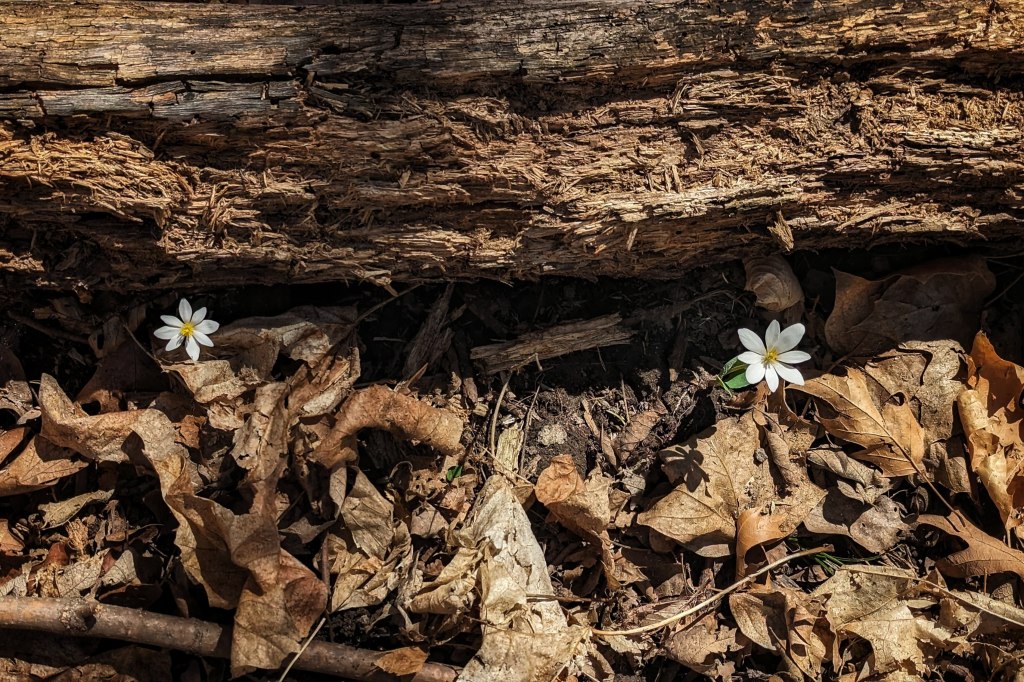
The photograph below shows a pair of bloodroot blossoms, one of the first flowering plants we see at the beginning of morel season. It doesn’t look at all bloody, does it. The sap, however, is generally orange to bright red. It’s sometimes used by native artists as a dye. The sap is also somewhat poisonous; eating bloodroot probably wouldn’t kill you, but it would certainly make you vomit like a high school drunk.

What’s cool about bloodroot, though, is the way it’s disseminated. The flowers produce pollen, but no nectar–which means all those bees and flies that land on the blossoms foraging for nectar are getting scammed. They’re helping pollinate the plant, but they aren’t getting jack in return.

But what’s really cool is that the seeds of bloodroot are spread by ants. That’s right, ants. The seeds have a fleshy organ–an elaiosome–that ants fucking love. They take the bloodroot seeds to their nest, eat the elaiosomes off them, then chuck out the seeds with the other ant trash and nest debris. Ant trash turns out to be a terrific medium for germinating seeds.

The process of ants foraging seeds for their tasty elaiosomes, then getting rid of the useless seeds in ant trash middens is called myrmechory. It’s from the Greek term for ants (mýrmēks) and a circular form of Greek dancing called khoreíā. The ants don’t actually dance in circles, of course, though they probably could if they wanted to. Who’s going to stop them? The important thing, though, is myrmechory works. It’s great for the ants, who get a scrumptious treat, and for the bloodroot, which gets dispersed across a wider range.

Of course, bees and flies and other pollen-seeking winged foragers get completely fucked over, which probably adds to the enjoyment of the elaiosome-eating ants. I’m okay with that. I mean, bees get to fly, after all; they get a temporary pardon from gravity. Hard to blame ants for being a wee bit envious and taking some small pleasure out of seeing the winged bastards get stiffed.

3 things that make me love the world

I’m not one of those “Let’s focus on happy news and forget how completely fucking awful the world is” guys. I lack the Pollyanna gene. When the world is completely fucking awful, I want to know about it. I want to understand it. Don’t try to distract me with bluebirds or other happy horseshit. Because despite how completely fucking awful the world is, I still manage to remain pretty chipper and stupidly happy. I still love this world.

I’m telling you that because the news this morning is jammed with the mass murder that took place in Georgia yesterday. Eight dead–six Asian women, two non-Asian men. Apparently murdered by some inadequate white incel asshole who, according to law enforcement officials, “had a really bad day…and this is what he did.” On any other morning, I’d be writing about both this hate crime against women (and the reality is that the most common hate crimes–and the least acknowledged hate crimes–are committed against women) and the casual way white law enforcement agents treat white mass murderers who commit hate crimes.

But not this morning. I’m NOT trying to distract you from the truly awful shit that’s taking place. But three things happened this morning that made me ridiculously happy. And I’m not going to let this Georgia asshole detract from that. Fuck him in the neck. These are three things that make me love this awful world.

First thing. The Pritzker Prize. If you’re not familiar with this, it’s the most prestigious award in architecture. It’s usually awarded to some arrogant asshole ‘starchitect’ who designs massive, expensive, flamboyant buildings. Not this year. This year it’s gone to Anne Lacaton and Jean-Philippe Vassal, a pair of architects who have largely focused on transforming low-income housing complexes. Instead of tearing down old structures and building new ones, these two have found ways to transform old housing projects into attractive living environments. A lot of poor people may hate where they live, but aren’t confident they’ll be better off if they moved.

Turning grim public housing into bright living spaces.

A few years ago, Lacaton and Vassal were asked to work on “a particularly large and hideous” public housing project in Bordeaux. The people who lived in the projects didn’t want to leave; they just wanted more space and more light. Lacaton and Vassal gave them what they wanted. The basically encased the building in glass, turning what had been exterior apartment walls into sliding glass doors leading to an enclosed terrace. It cost less money, it required less disruption for the tenants, and it turned grim, drab apartments into bright sunny spaces. The Pritzker jury wrote:

Through their belief that architecture is more than just buildings, through the issues they address and the proposals they realize, through forging a responsible and sometimes solitary path illustrating that the best architecture can be humble and is always thoughtful, respectful, and responsible, they have shown that architecture can have a great impact on our communities and contribute to the awareness that we are not alone.

I like living in a world where French architects are honored for their work in support of poor folks living in public housing.

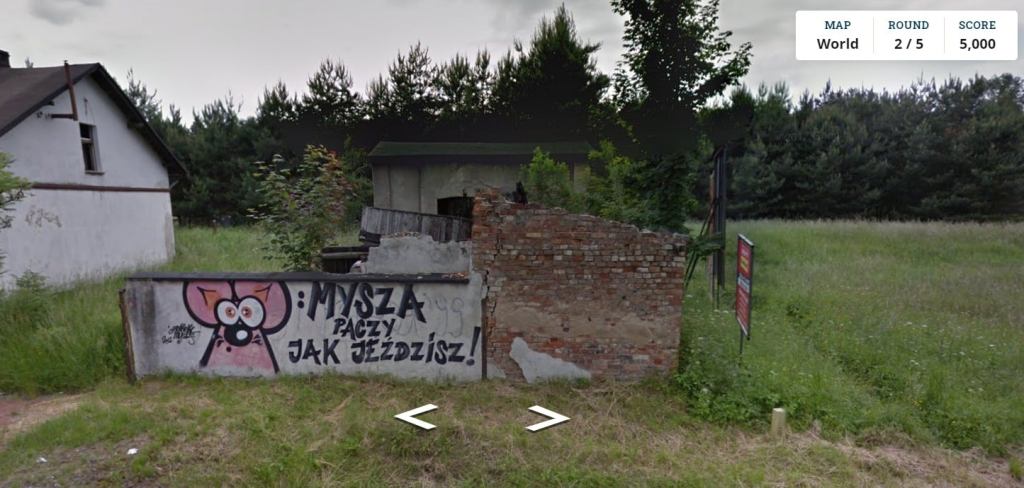
Second thing: I’ve written about the game Geoguessr before–both as a game and as source material for an appropriation art project. For a variety of reasons, I don’t play the game as often as I used to. But now and then, I’ll get the urge and I’ll immerse myself in virtually exploring a novel part of the world. Last night I played and found myself lost in the Polish countryside, where I saw an interesting bit of graffiti art.

I don’t speak Polish. But I help run a Facebook group called Geoguessr Oddities, with a global membership some of whom were likely to know Polish. So I posted the screengrab. And a short time later I learned Mysza Patrzy jak Jedzisz translates to “The Mouse watches you drive.” It wasn’t very helpful in finding out where I was in Poland, but the translation cracked me up, and the interaction itself made me happy. Then this morning another member of the group informed me that franekmysza is a Polish graffiti artist with an Instagram account. He’s painted that mouse all over Poland.

I like living in a world in which I can be introduced to a Polish graffiti artist by playing a game designed by a Swedish IT consultant to get you lost in new parts of the world.

Third thing. There was an article in the Washington Post about a kid, Darius Brown, who learned to sew bow ties for rescue animal–and I swear, this made me tear up and I came THIS close to crying like a little girl. Darius (and, again, he has an Instagram account you may want to follow) was taught to sew bow ties by his sister when he was eight years old. He got started in the rescue animal bow tie gig two years later, in 2017, when a couple dozen dogs left homeless in Florida and Puerto Rico by Hurricane Irma were transferred to a shelter in New York City. He thought the animals might get adopted quicker if they were wearing bow ties.

Let me just say that again. A ten-year-old kid in New Jersey sewed 25 bow ties for rescue dogs from Florida and Puerto Rico because he wanted them to get adopted. How perfectly wonderful is that? And hey, it worked.

Of course it worked. Look at that good boy wearing one of his bow ties in a Savannah shelter. Are you kidding me? Who wouldn’t want to adopt this tripod pooch? According to WaPo, Darius has now “donated more than 600 bow ties for dogs and cats in shelters.” He’s only 14-years-old. He says, “A well-dressed dog…that will make people smile.” And yeah, it does.

I suppose I should mention that Darius has both a speech disorder and a fine motor skills disorder–but since those things don’t define him, they’re less important than what he does. And what he does is make the lives of shelter animals better, which makes shelters better, which makes the lives of the people who adopt the shelter animals better, which makes the entire world a little bit better.

I like living in a world with Darius Brown in it.

Yes, the world is completely fucking awful. But it’s also completely fucking wonderful. We shouldn’t let the former diminish the latter. There are architects who transform awful buildings into livable spaces. There are graffiti artists painting snarky mice all over Poland. And there’s a kid in New Jersey putting bow ties on shelter animals. How can you not be in love with this world?

EDITORIAL NOTE: Another thing that makes me happy. A couple of folks have kindly and gently taken me to task for writing ‘crying like a little girl‘. It makes me happy because 1) it’s nice that folks call me when it looks like I’m being a dick, and 2) because originally I actually included a long, parenthetical tangent about that phrase, doing a riff sort of like Dickens in A Christman Carol when he natters on about the phrase ‘dead as a doornail’. But I write these posts in a rush, and I edit very little…so I deleted the tangent in the hope that people would interpret crying like a little girl to mean grown men and little girls cry in the same way and sometimes for the same reasons.

I’ve decided NOT to correct it. It’s better to let other folks learn from my misjudgments.

we’re talking the fomite, y’all

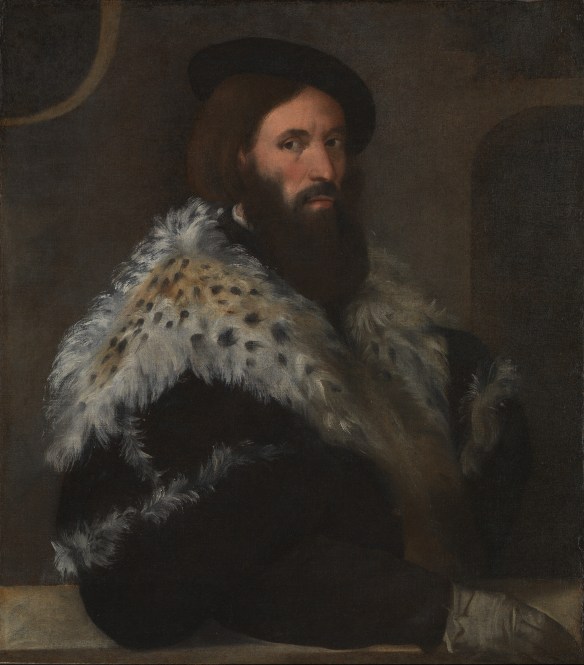
Okay, there are facts and there are suppositions based on facts. It’s a fact that the Renaissance painter Titian (who actual name was Tiziano Vecelli, which takes a lot longer to say) made a portrait (seen below) of Girolamo Fracastoro. It’s also a fact that Fracastoro was a poet, an astronomer, a physician, a geographer, and a mathematician (because back during the Renaissance everybody seemed to do everything). But it’s just supposition that Titian painted this portrait in exchange for Fracastoro (in physician mode) treating him for syphilis.

Girolamo Fracastoro (also known as Hieronymus Fracastorius because everybody in the Renaissance had like half a dozen different names).

You guys, Fracastoro invented syphilis. Not the disease (which apparently came from the Americas, brought back by a crewman on one of Columbus’ ships — I know, irony, right?), but the name of the disease. In 1530 he wrote an epic poem (we’re talking a trilogy — seriously, a three-book poem written (and I am NOT making this up) in dactylic hexameter; when these guys decided to do something, they didn’t fuck around) about a shepherd boy who insulted the god Apollo, who responded the way gods always seem to respond: he gave the boy a horrible disease. That unlucky boy in the poem was named…wait for it, wait for it…Syphilus.

The foul Infection o’er his Body spread
Prophanes his Bosome, and deforms his Head;
His wretched Limbs with filth and stench o’er flow,
While Flesh divides, and shews the Bones below.
Dire Ulcers (can the Gods permit them) prey
On his fair Eye-balls, and devour their Day.

Yikes, right? Three books of this. So many different forms of torture. Anyway, our boy Fracastoro made his bones (so to speak) by treating communicable diseases. He came up with the concept of fomes, which is the plural of fomite.

Syphilus being warned against yielding to temptation (temptation in the form of that chick with the lute — I mean, just look at those ankles).

So you’re probably thinking “Hey, Greg, old sock, what the fuck is a fomite?” Well, I’m going to tell you. And stop calling me ‘old sock’. Actually, I’m going to let Fracastoro his ownself tell you.

“I call fomites such things as clothes, linen, etc., which although not themselves corrupt, can nevertheless foster the essential seeds of the contagion and thus cause infection.”

In other words, he’s talking about the way disease can be spread. Fracastoro was a proponent of the notion that epidemics were caused by “spores” — transferable tiny particles — that could infect people (or animals) by direct or indirect contact, and that was how diseases moved over long distances. This was 300 years or so before folks came up with the idea of germs.

Oh, and fomes? That’s the Latin term for kindling or tinder — the material you gather together in order to start a fire.

Makes sense now, doesn’t it. Now you’re thinking of Covid-19, right? Now you’re thinking of all those anti-bacterial wipes you can’t find on the store shelves. Now you’re thinking about all those doorknobs you touch every day, and about the handrails on stairways and escalators, and about the handle of the coffee pot at work. Now you’re thinking about the table at the diner where you put your cell phone while you eat your salad, and how maybe the person who sat there before you touched an infected doorknob before sitting at that table and left ‘spores’ on the table that are now transferred to the back of your cell phone case, which means it’s now on your hands. And you’re thinking “Lawdy, my cell phone is a goddamned fomite! And that table, a goddamned fomite. And I’m surrounded by goddamned fomes!”

Which is exactly what you should be thinking. All those things you touch during the day? That’s kindling. You spread that kindling, you create a forest fire.

That’s fact, no supposition. Keep Girolamo Fracastoro in mind everywhere you go. I’d suggest you get a tattoo of Fracastoro on your forearm, except the tattoo gun is a goddamned fomite.

Wash your damn hands, people.

cheese will be provided

— Do you really think Comrade Trump will be impeached?
— I do.
— Really?
— Really. He’s going down.
— No, I mean do you really actually believe they’ll impeach him?
— He’s totally going down. No question.
— Okay. It’s just that…
— He’s going down like the Titanic.
— Yeah, you say that, but…
— Down like Betamax.
— Like what?
— Exactly.
— So you actually believe Trump will be…
— Down like Google+
— Holy crap.
— Down like a nine pound round of Double Gloucester cheese on Cooper’s Hill.
— …
— You know…the annual cheese rolling festival and massacre?
— No idea what you’re talking about.
— C’mon, it’s the most famous cheese rolling event in the world.
— Cheese rolling. Cheese rolling? What the fuck? Cheese rolling?
— Yeah. It’s an…
Cheese? Cheese rolling?
— Every spring for the last, oh, few hundred years the good and semi-sober people of Brockworth in Gloucestershire have held a sort of contest in which they roll a cheese down Cooper’s Hill.
— That’s it?
— Well, no. People chase the cheese down the hill. The first survivor at the bottom wins.
— Wins what?
— The cheese, you idiot.
— When you say ‘survivor’…
— It’s a steep hill. People fall. And tumble and roll and break bones.
— …
— Also spectators might get whacked by the cheese as it rolls and bounces down the hill.
— Hit by a cheese?
— A nine-pound round of Double Gloucester can top out at about seventy miles per hour. Cheese like that could kill a person. These are murderous cheeses.
— You’re making this up, aren’t you.
— How dare you!
— Why would anybody chase a cheese down a hill?
— Probably some sort of ancient primitive pagan fertility thing.
— That’s ridiculous.
— Dude, they’re British.
— Oh, right. Yeah, then it makes some sense. And people really do this? And they really get hurt?
— Watch this.

— Jesus suffering fuck.
— I know, right?
— That’s insane.
— Well, there’s cheese involved. And possibly alcohol.
— …
— …
— I totally want to do this.
— Impeach Trump?
— Fuck Trump. I want to chase the cheese. When does this happen?
— May 27th, five days from today. Around noon. Cooper’s Hill, Brockworth, Gloucestershire. Cheese and medical care are provided.
— This is why England will always be a great nation.

julius caesar, the foreskin of jesus, time to dance

Time is weird. No, wait…that’s not right. Time isn’t weird; the way people mark time, that’s what’s weird. For a big chunk of Western history, the new year began on March 1. Which makes actual sense, if you think about it. I mean, that’s pretty much the season in which life begins to re-assert itself after winter has stopped tossing its weight around.

The reason — one of the reasons — we celebrate January 1 as the first day of the new year is because Julius Caesar (yes, that Julius Caesar) decided people had fucked up the calendar, and he was just the boy to fix it. The problem was the early Roman calendar was a lunar calendar and only had ten months, ending in December (from the Latin word decem, meaning ten). Six of the months had thirty days, the other four had thirty-one. Why did some months have an extra day? Nobody really seems to know. There had to be a reason, but it was a long time ago — people forget. And really, who cares? It was fucked up, right? That’s why our boy Julius had to fix it.

Anyway, you can see the problem. The Roman year only had 304 official days. So they periodically added in a few extra days here and there (usually for political purposes), and they included a sort of block of unorganized winter days (and we all know what that’s like — it’s cold, it’s dark, one day is pretty much as miserable as another, and they all sort of blend together), and now and then they’d toss in an intercalary month of twenty-seven days. Sometimes twenty-eight days.

On with the dance! let joy be unconfined; No sleep till morn, when Youth and Pleasure meet to chase the glowing hours with flying feet.

Really, considering how organized the Roman empire was, it was a terribly sloppy way to deal with time. Seasons got weird, holidays would begin too early or too late, harvest festivals would be scheduled before the harvest was ready. Nothing made any sense. Folks complained. So one day Julius said, “Okay, this shit really has to stop.” He hired a guy from Alexandria, Sosigenes, who told him, “Dude, let’s just do what the Egyptians do. Chuck that whole lunar thing and base the calendar on the sun.”

So that’s what they did. They had to create a few new months, and add in a few extra days, but they banged together a new calendar and in the year 45 BC they said, “This is the first day of January, named for Janus the god of beginnings and endings, the god of gates and passages and doorways, the god of duality and transitions. And from now on, this is going to be the first day of the new year. Party on, people.”

The people partied on, but they still pretty much celebrated March 1 as beginning the new year. I mean, c’mon…tradition. And common sense. Who feels like celebrating in the middle of fucking winter? Even after the Roman Empire (and most of the Western world) went all over Christian, January 1 wasn’t treated as the beginning of the new year. Basically, it was celebrated as the Feast of the Circumcision of Christ. Which was a pretty big deal back then. You see, eight days after Jesus was born, his folks held a bris, a mohel nipped off his holy foreskin, they gave him his name, then everybody had a nice meal. Christians didn’t go in for all that; they skipped everything but the meal, but they still thought it was a fine thing to honor the day Jesus was separated from his foreskin. (Religion is also weird.)

Eventually the Julian calendar was supplanted (if ‘supplanted’ means what I think it means — I can’t be bothered to look it up) by the Gregorian calendar, and the Gregorian calendar got refined, and science weighed in, and time was more tightly ordered, and the world became more secular, and relatively few people wanted to celebrate the circumcision of Jesus, and now when you buy a calendar at the book store it begins in January. It’s not entirely universal, but January 1 has generally become accepted as the first day of the year.

When buds are breaking and birds singing merrily, dance with me.

But it’s basically all bullshit. Thomas Mann had it right when he wrote:

Time has no divisions to mark its passing. There is never a thunderstorm to announce the beginning of a new month or year.

Really, this is just another day. A lot of folks still have to go to work, the cat’s litter box still needs to be cleaned and the dog needs to be walked, food has to be prepared and dishes have to be cleared away and washed, the snow will still fall and have to be cleared off the sidewalk, people will still be people, and you’re still the same person you were yesterday.

It’s just another day. Nothing has really changed. But so what? Sometimes what we need is a symbolic transition. A point at which we can tell ourselves this is where things begin to change. This point, right here, this is the line. From this point forward, things will be different.

Doesn’t have to be the beginning of the year. Could be a birthday. Or an anniversary. It doesn’t even have to be a temporal point. It could be any symbolic point. Once I get my own apartment, once I get my first real job, once I can run a 5K, once I graduate, once I get married, once I can afford a ticket to Spain, once I get my driver’s license, once I get divorced, once the kids have grown up and left home, from that point on things will be different. That decisive point, whatever it is, it’s worth celebrating.

Now I think of it, I’m beginning to believe there’s actually something admirable about reaching that point on the first day of January. There’s something defiant choosing a day in the middle of the least hospitable, most bitter, darkest fucking season of the year. There’s something cheeky about shouting out, “It’s January First, bitches…and it’s time to dance.”

in which i travel the world and get cheerfully lost

A couple years ago a friend alerted me to Google’s Chrome Experiments, a curious and interesting group of browser-based games and art projects. At the time there were maybe five or six hundred projects, and while I thought some of them were pretty cool and worth exploring, I was busy. So I bookmarked the URL and, as so often happens with stuff I bookmark, I promptly forgot all about it.

Maybe six months ago I heard that Chrome Experiments had reached the 1000 projects mark. That revived my interest. I found my old sadly neglected bookmark and began to noodle around, exploring the various projects at random until I stumbled upon a game called GeoGuessr — and basically pissed away all my free time for about a week. Maybe two weeks. Possibly three. Now I’m more moderate in my GeoGuessr time; I play once or twice a week — but the game still fascinates me.

geo estonia village

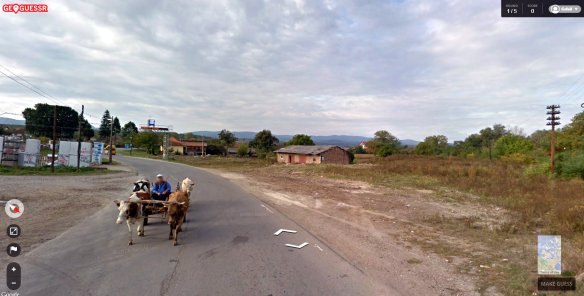
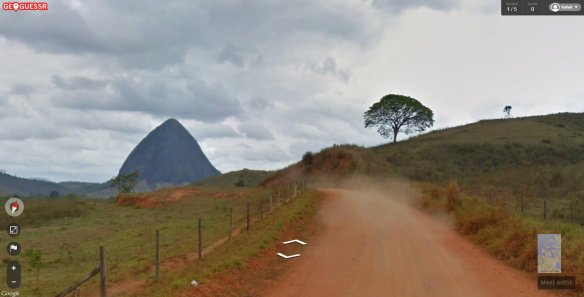
As the name suggests, it’s a game based on geography. The concept is simple. Using Google Maps’ Street View, the game drops you on a random street somewhere in the world. I use the term ‘street’ loosely, It might be an actual street. Or it might be a gravel road in a remote corner of the Ukraine, or an on-ramp of an Interstate Highway in the United States, or a dirt path along a newly planted field in Spain, or a back street in a mid-sized Brazilian city, or a boulevard in a major urban area in Russia, or in a suburban housing estate in Wales, or a secondary road in Croatia.

In fact, since the Google-cam can be worn as a backpack, Street View has expanded to include places not accessible to vehicles. I’ve found myself beginning a GeoGuessr game on a ski slope in Utah and on a hiking path to a Hindu temple in India.

Croatia

The ostensible goal of the game is to use the visual cues and clues of your surroundings to determine your location. You ‘travel’ down roads in search of those cues and clues, then you make a guess about your location and mark it on a map  You accrue points based on how accurate your guess is. Each game has five rounds — five different geographical locations — and at the end, you’re given a total score.

That’s it. As I said, the concept of the game is simple. Part of the attraction, of course, is the puzzle aspect — trying to figure out where the hell you are. That’s fun. Frustrating fun, sometimes. Challenging fun. But still fun.

geo dirt road somewhere4

But for me, figuring out my location (and earning a high score) is secondary. What draws me repeatedly back to the game is the power of the unexpected. The GoogleCam isn’t just mapping streets; it’s also moving through the daily events of the world, and the world is jammed full of weird, absurd, profoundly beautiful, desperately sad, fascinating stuff. Roadside shrines to gods and memorials to victims of traffic accidents. Prostitutes plying their trade along the street. Mountains that come straight out of an Indiana Jones movie. Astonishing poverty. Exotic coastlines that make you think of pirates or castaways.

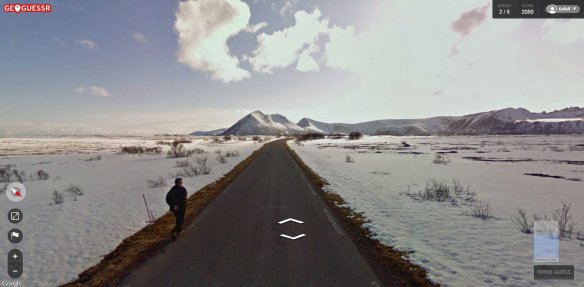
The randomness of GeoGuessr inserts you into unexpected locations where ordinary people are going about their ordinary daily lives. The reality of these lives — which are often radically different from my own — is fascinating. Kids playing stickball in the street. A young man meditating in a remote Hindu temple. A recent single-car accident in some remote road. A man walking by himself on some lonely stretch of road in northern Norway. A woman hitchhiking in South Africa. And the GoogleCam records it all with a completely dispassionate objectivity.

geo guy walking northern tip of Norway

I do enjoy the game aspects. There’s something fulfilling about being dropped at a random spot in the world and being able to locate that spot on a map within a few meters. Yet after I’ve figured out the location, I often continue to ramble around, intrigued by the ordinariness of life in other parts of the world.

I’ve begun to collect screen captures of bus stops. I’m thinking about collecting images of railroad crossings. And maybe bicycle riders. And people walking their dogs. These are things that are universal, and yet they’re all so very distinctive. The people waiting for a bus in South Africa probably have a lot in common for the people waiting for a bus in Russia. The cyclist in northern Spain probably has something in common with the cyclist in Australia, and the one on that mountain road in Utah.

stickball

Some of you who read this will be tempted to play GeoGuessr. Give into that temptation. You should be aware, though, that it’s an enormous time-suck. You’ll promise yourself you’ll only play for half an hour — but then you find yourself wondering what’s around the next corner, or over than next hill, or through that tunnel. You’ll wonder what that building is, and you’ll want to check out that overgrown cemetery, maybe follow that alleyway down toward the docks. So let me repeat this: it’s an enormous time-suck.

Play it anyway.

right in the neck

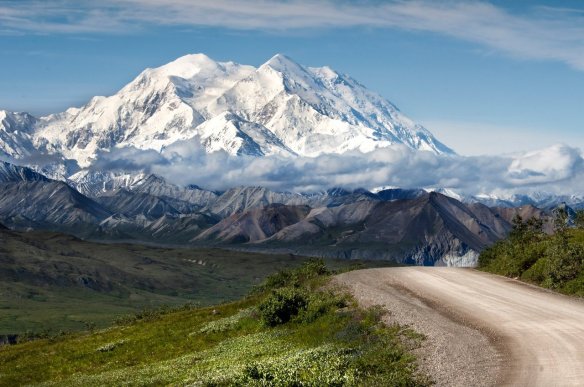
The Athabaskan people who lived near the mountain called it Denali, which meant ‘the high one.’ It’s a pretty name for a mountain. I like it. Another local tribe, the Dina’ena, called it Doleika, which meant ‘big mountain,’ which is less poetic but still pretty accurate. It really is a big mountain.

The Russians moved into the neighborhood in 1783; they called the mountain Bolshaya Gora, which also means ‘big mountain.’ They didn’t really change the name; they just said it in Russian, which is appropriate. But the Russians left in 1867, and I suspect folks in the area just continued to refer to it the ‘big mountain’ in whatever language they happened to have handy at the moment. Because it really IS a big mountain.

denali2

Then in the late 1880s, the white folks in the region decided to call it Densmore’s Peak, after Frank Densmore — a gold prospector who was, apparently, inordinately fond of the mountain. I don’t have any solid evidence to base this on, but I’m going to guess the natives continued to call it Denali or Doleika regardless of what the white folks did. Because what did the white folks know about it? Fuck them in the neck.

Then politics happened. A guy named William Dickey, who’d been prospecting for gold in the Susitna River, returned to the Lower Forty-eight and wrote an article about Alaska for the New York Sun newspaper. This was January of 1897, shortly after Republican William McKinley had been elected President of These United States. McKinley, you see, was a proponent of the gold standard (on which to base U.S. currency) — and Dickey was a Republican who’d been a gold prospector. McKinley’s Democratic opponent in the election, William Jennings Bryan, was in favor of a silver standard rather than a gold standard. Dickey had met a lot of silver prospectors while in Alaska, and they all favored the Democrat. This is all important information because in his article, Dickey made this rather suspect claim:

We named our great peak Mount McKinley, after William McKinley of Ohio, who had been nominated for the Presidency.

Whether that was true or not, it struck a chord for Republicans in Congress, and twenty years later they made the name official: Mount McKinley. They also named the area around the mountain McKinley National Park. Basically, it was Republicans saying ‘fuck you in the neck’ to Democrats (and to all the native folks in Alaska).denali3

It seems nobody in Alaska liked the name, and most folks just continued to call the mountain Denali. Who cared what the people south of Canada called it? In the 1970s, Alaska made the practical decision to officially change the name back to the original Denali. They petitioned the U.S. Board on Geographic Names (yes, there’s actually a government agency that oversees geographic names) to do the same. And hey, the board seemed open to the idea.

Then politics happened again. The Republican Congressman who represented the Ohio district when William McKinley spent most of his life (a complete jackass named Ralph Regula) intervened and basically stopped the process. Basically, he was saying ‘fuck you in the neck’ to the people of Alaska. The people of Alaska sort of shrugged off the whole fuss and in 1975 the Alaska Board of Geographic Names (yes, the state has its own government agency to oversee its geographic names) went ahead and changed the name anyway.

In 1980, President Jimmy Carter decided to change the name of the park from McKinley National Park to Denali National Park and Preserve. Basically, he was saying ‘fuck you in the neck back’ to Congressman Regula. But while the president was authorized to change the name of the park, Regula could still prevent him from changing the name of the actual mountain, which officially remained Mount McKinley. Basically, Regula was telling the president ‘re-fuck you in the neck.’Denali1

And that’s how things stayed until Regula retired. At that point Alaska again petitioned the Board on Geographic Names to change the damn name. Then politics happened yet again. Two members of Congress from Ohio — both Democrats — decided to carry on Regula’s profoundly stupid fight to retain the name of Mount McKinley. Basically, it looked like Ohio saying ‘fuck you in the neck’ to Alaska.

But the people of Ohio spoke out and told their members of Congress to grow the fuck up and stop interfering with Alaskan politics. And they did. So today, President Obama is officially authorizing the Board on Geographic Names to recognize what Alaskans have always recognized — that the mountain deserves to be called Denali because it really IS a big, high mountain.

And hey, guess what. Politics are happening. Republicans — and particularly those from Ohio — are rebuking the president’s decision. Speaker of the House John Boehner stated he was “deeply disappointed in this decision.” Senator Rob Portman decried the decision as “yet another example of the President going around Congress.”

And, of course, the proud patriots of FreeRepublic are voicing their considered opinions on the issue.

— Why not call it Glorious Jihad?

— If Hussein cared about what the people of Alaska thought, he would ask Valerie for permission to open up the northern slope for drilling. Alaskans want that, too.

— Obonzo didn’t do jack. He’s going up there to fundraise and kiss some minority @$$ for his ‘RAT comrades up there. Everyone in Alaska already refers to the mountain as Denali. The bastard Kenyan didn’t need to do anything. This is just another one of his “historical” In Yo Face Whitey Moments.

— Mount Barack….in honor of Bareback Mountain

— stupid bammy has to interject himself into normal people’s lives like the narcissist he is

— This is the work of a tyrant.

— I’m surprised it’s not going to be Kilimanjaro to make Zero feel more at home.

— Islam could easily be involved. Pakistan is close. Jihadis are everywhere.

To be fair, not everybody on FreeRepublic is a lunatic. Many of them have pointed out the fact that most Alaskans want the mountain to be called Denali. They don’t necessarily object to renaming the mountain; they just object to President Obama renaming the mountain. Basically, the people of FreeRepublic are saying ‘fuck you in the neck’ to the president.

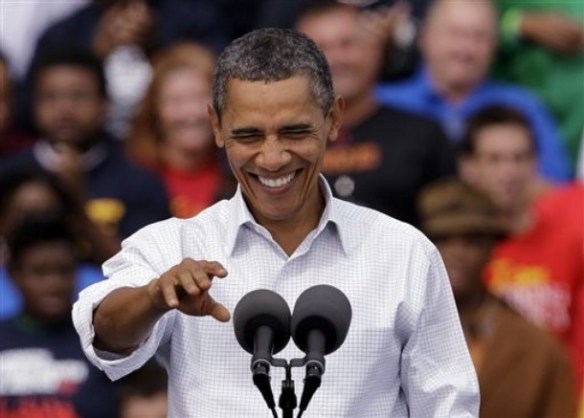
Barack Obama

But hey, it’s a done deal now. And it’ll be Obama’s smiling face we’ll see standing in front of Denali on the national news tonight. And guess what he’s basically symbolically saying to the folks of FreeRepublic.

Right in the neck.